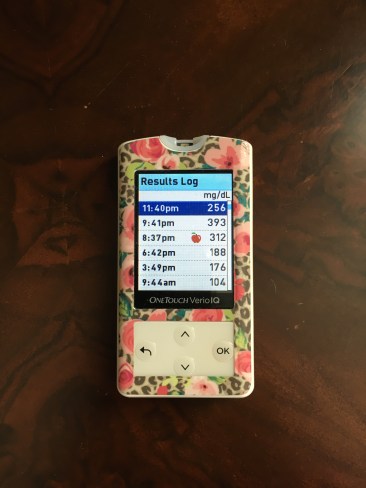
Nothing makes me feel as defeated as high blood sugar.
Maybe it’s because it takes so long for my blood sugar to come back down from a high.
Maybe it’s because I feel like I directly caused it – miscalculated my carb intake, or snuck in a snack that I shouldn’t have.
Most of these highs occurred due to a bent cannula in my pod a couple weeks ago.
Maybe it’s because it makes me feel like I’ve lost all control. That I can’t do anything but monitor the situation and take more insulin as necessary. I hate feeling so dependent, so trusting, of my insulin alone.
Maybe it’s because the technology has failed me, and there’s few things more frustrating than that. Imagine doing everything the “right” way, the way you’re supposed to, and getting the “wrong” results. You begin to question everything and your emotions get the better of you.
Whatever the reason is, I know I’ve got to work on accepting the fact that highs happen. I’ve dealt with many over the years, and I know I’ll encounter plenty more in the future. They’re upsetting, tiring, and irritating. They test my patience as I wait for long stretches of time for my insulin to finally kick in and stabilize my blood sugar. They are one of the more mentally and physically draining components of type 1 diabetes management.
One Friday per month, I’ll write about my favorite diabetes products. These items make the cut because they’re functional, fashionable, or fun – but usually, all three at once!
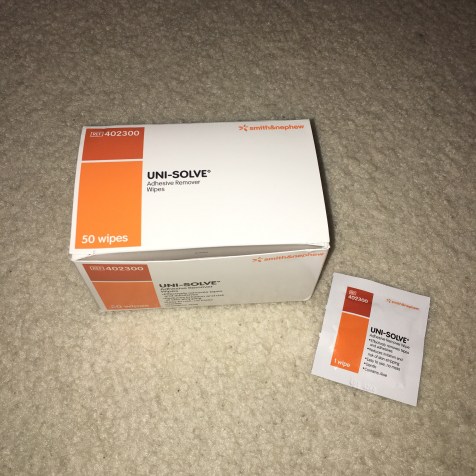
“Adhesive remover wipes” sounds about as exciting as dryer lint. But these really are a nifty invention, especially for someone like me who wears multiple T1D medical devices.
My pods stay on my body for three days at a time, and my CGM sensors can last as long as two weeks. So needless to say that they need to be equipped with super strong adhesive to ensure they stick for the necessary length of time.
These adhesive remover wipes look lame, but trust me, they’re pretty impressive.
I’m grateful for the high-quality adhesive, but man, it can be difficult to completely remove from my body. Before I discovered these magical wipes, I’d rub my skin raw in an attempt to get rid of all traces of leftover adhesive. As a result, I’d either walk around with gray circles of adhesive on my abdomen and arms, or with irritated, pink skin that I needed to let heal before reusing as a site. A surefire lose-lose scenario either way, right?
A quick search online caused me to discover these adhesive remover wipes. I purchased them immediately and I can say it was a brilliant buy. I no longer scratch at my skin until the adhesive disappears; rather, I merely wipe the area with one of these towelettes and within seconds, all adhesive is painlessly removed.
If you’ve struggled in a similar manner with removing your medical adhesive, definitely look into these wipes and save your skin from stress.
Or the pizza. Or the burrito. Or the decadent three-layer chocolate cake. Whatever the high-carb indulgence is, I’d rather just relish in it rather than focus on my diabetes.
Does that make me a “bad” diabetic? No. It’s not like I’m skipping an insulin dose or binge-eating food. I’m merely trying to enjoy a rare treat as well as the social experience that comes with it – like having sushi with coworkers.
A recent sushi dinner reminded me that it’s okay to stop thinking about my diabetes for a little while.
So instead of staring at my double-up arrows on my Dexcom, I’m staring at the artfully arranged sushi platter in front of me.
Instead of ordering the lowest-carb item on the menu, I order what I actually want to eat.
Instead of fretting over how quickly my insulin will kick in, I fret over which sushi roll I should try first.
Instead of letting my diabetes take over my dinner, I’m letting it go and living.
Sometimes, I need to remind myself that it’s okay to stop obsessing over my blood sugar in order to just live and enjoy my life.
“You have to remove your insulin pump before we can take your X-rays,” the technician said to me. I stared at him, and responded point-blank, “What? No, I can’t take it off.” I tried to hide the panic in my voice, but it quavered as tears stung my eyes.
“Well, let me check our insulin pump protocol…” his voice trailed off as he left me in the dark room with my right arm held up in the air in an attempt to mitigate the throbbing sensation going up and down my forearm.
That pod on my arm can’t simply be removed on command.
When I fell and broke my ulna a couple weeks ago, my insulin pump was one of the last things to cross my mind as I was shuffled from doctor to doctor and one medical facility after the other. All I could concentrate on was the injury – how severe was it? Would I be able to work? Could I keep up my exercise regimen? Was I going to need surgery? My diabetes, for once, was far from my thoughts.
But this instantly changed when I went to get an X-ray. When the technician told me that I’d have to remove my pump, I wanted to shout at him, “No! If I do that, my blood sugar will skyrocket! You can’t expect me to do that!” It was hard to keep calm, and my emotions were already running amok due to the chaos of the morning so far. So even as I tried to fight the tears, a couple escaped and ran down my cheeks. When he came back into the room, the X-ray technician’s expression changed. He looked at me empathetically.
“It’ll be okay. Come on, let’s call your endocrinologist. We’ll see what she has to say and get this all figured out.”
Twenty minutes later, after a series of phone calls and a few accidental hang-ups, we received confirmation that I could, indeed, wear my pump for the X-ray. The nurse practitioner who I spoke with at my endo’s office said that it was safe as long as I wore the protective vest. “It’s really only a problem if you’re going in for an MRI or a CAT scan, because those involve magnets,” he told me.
Once I got off the phone, I ran over to the X-ray technician and explained it to him. He smiled at me and said, “Got it. Let’s get these pictures over with – you’ve already had quite a day so far.”
I nodded and thanked him for his patience. He was right, I was overwhelmed from the events of the day – it wasn’t even noon yet – but in hindsight, I’m glad that the technician didn’t try to fight me when I said I couldn’t remove my pump. His willingness to hear me out was huge. It’s not easy to be your own advocate in a high-stress situation like that. But I’m proud of myself for speaking up and getting the answers we needed. Everything worked out in the end – well, except for that pesky broken-bone bit.
Ugh, I don’t know why I did this to myself, but about a year ago, I decided to schedule a bunch of my key doctors’ appointments back-to-back. That means every week for the next three weeks, I’ll be seeing one of my main doctors. Fun!!!
Truthfully, I don’t HATE going to see the doctor. It’s just the waiting and the feeling of being in a hospital-like environment that I detest. And I’ve gotta say, I’m not overly fond of my personal bubble being invaded for the sake of evaluating my wellness, but it is what it is.
First up on the calendar was a visit to the dentist. This is the only doctor I see who never asks about my diabetes, which is very refreshing. But that doesn’t mean diabetes is far from my mind when I go to get my teeth cleaned. My big fear is that my blood sugar will go low in the middle of the appointment, which would make things difficult seeing as I’d have to ask the dentist to stop what she’s doing and let me correct for the low. This would be super frustrating for both parties, as she’d probably have to start her work all over again and I’d have to wait for my blood sugar to go back up to normal.
Fortunately, this fear has yet to come to fruition and my blood sugar is usually fine, if not a little high, at the time of these appointments. And this trip to the dentist was likely one of the easier appointments I’ve got scheduled this month, because I was told my teeth look great. I was also told that my hair is awesome, which made me flash my pearly whites even bigger at the dentist. Yup, definitely the easiest (and CERTAINLY the most flattering?!) appointment I’ll have all month…possibly all year.
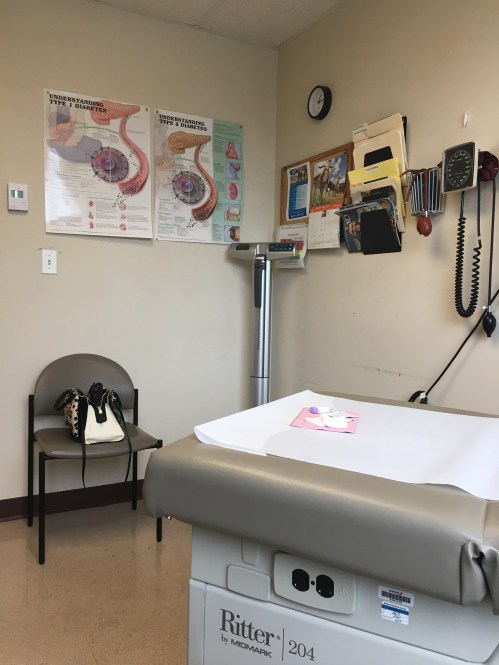
The patient’s perspective.
Next up is my primary care doctor. It’s time for my annual physical. This appointment was basically a complete wash because it occurred within the hour of me fracturing my ulna (see a couple posts down). In between my tears, my doctor asked me standard questions and requested to me to fulfill the usual battery of annual lab tests. My blood pressure was a little high during the appointment, but if I had to make an educated guess, it’s probably because I was stressed due to the excruciating pain I was experiencing in my right arm. Just a hunch.
Thank goodness that everything else came back normally, though. Fewer things to worry about when it comes to my health will always be a welcome concept.
I don’t want to count appointment number three on this list, but I guess it’s worth mentioning my trip to the orthopedic’s office – you know, because of the broken bone. I get to have at least two more with him in the next six weeks as follow-ups. Joy!!!
Finally, the last truly pre-scheduled appointment I’ve got is with my endocrinologist. I’m nervous because I don’t know what my A1c will be like. I have an excellent and empathetic endocrinologist, so I know whether it’s good or bad, this reading won’t affect the overall tone of the appointment. It’s just pressure that I put on myself.
We’ll find out what happens before long. All I know for sure is that I’ll be relieved when I’m finally through with all these appointments.
Almost two years ago, my friends from the College Diabetes Network asked me to discuss diabetes in the workplace at their annual student retreat. The prospect of bringing diabetes into a new career and encountering new sets of challenges can seem daunting, so I was happy to talk about my positive experiences thus far as a young adult who has already made the transition from college to “the real world”.
Diabetes in the workplace – how do I navigate it? Here’s a little snippet in which I explain how I’ve decided to disclose my diabetes with my coworkers:
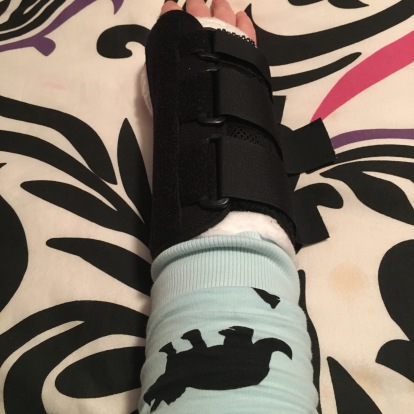
The morning of Tuesday, January 23rd, I took a bit of a tumble. I fell on some black ice in my driveway and managed to fracture a bone in the process: my ulna, which is the longer and thinner bone located in the forearm. I broke the one located in my dominant arm and have spent the past few days in a brace. I’ll get a real cast put on it early next week.
Please enjoy this gratuitous shot of my arm in a brace, featuring the sleeve of my dinosaur sweatshirt.
I waited a few days before writing a blog post about it for several reasons. For starters, I struggled with teaching myself how to type with limited range of motion in one hand. Actually, I struggled doing most things with just one hand. Brushing my hair, putting clothes on, feeding myself…every mundane task has become a challenge. It’s been especially difficult to accept that I need to allot myself twice the amount of time to do just about anything because I have no choice but to move slowly. I’m an incredibly impatient person, so this has been a hard truth to come to terms with. But I’m getting there.
Taking care of my diabetes is also included on the list of everyday tasks that are now tricky. I dislike having to rely on others for help, but I’ve got to say that changing my pod with one hand is far from easy. It feels like I’d be flirting with disaster if I were to hold a precious vial of insulin in an awkward grip as I made an attempt to fill a syringe, then a pod, with my shaky left hand. Fortunately, my parents are more than willing to help me when I need it – thanks guys – and I’m able to do other things, like check my blood sugar, on my own.
The healing process is expected to be about six weeks, so it won’t be too bad. I’m just going to have to adapt to life with one functioning arm/hand. There’s one thing that’s certain, though: I’m not going to let this stop me from doing anything I want to do! (Within reason, of course. Let’s just say I won’t be taking a boxing class any time soon, even though I’d really like to.) Just like diabetes, a broken bone can’t stop me. I’ve even managed to get 10,000 or more steps each day since the injury happened – including the day of the fracture! I could’ve chosen to pardon myself from exercise and stew over the pain, but I wanted to prove to myself that I’m both physically and mentally stronger than my excuses. After all, the rest of my body is in perfect working order. I’ve just got to keep it that way!
Recently, a random person on the Internet criticized my choice to incorporate carbohydrates in my daily diet. Thanks for the unnecessary judgment, stranger!!!
I’m not really upset about the comment, though, because it prompted me to reflect on why I consume carbs.
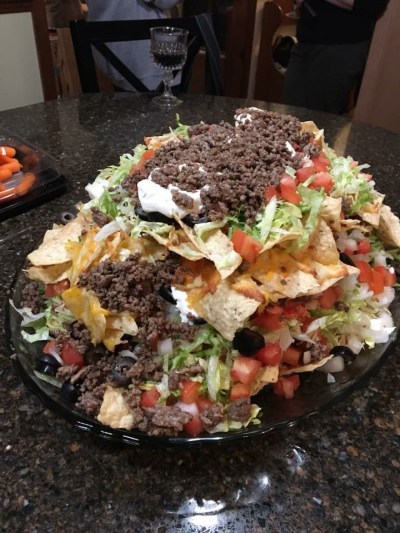
I LOVE CARBS. But of course, everything in moderation! So as much as I’d like to eat this mountain of nachos – a serving will do just fine & works better for me.
For me, it’s about more than just enjoying (relishing, adoring) the taste of carb-heavy substances both starchy and sweet. Carbs also help me achieve balance in my blood sugars. For instance, I find that consuming a serving of carbohydrates at dinnertime keeps me steady as I move through the evening hours. Say that I’m eating grilled chicken with a side salad for dinner. That’s a good meal by itself, but I like to complement it with a carb like half a cup of mashed potatoes or brown rice. I’ve noticed that the carbs kick in more slowly when they’re consumed with minimal or zero-carb foods, thanks to the power of the glycemic index.
The glycemic index is, in short, a measure of how quickly the carbohydrate content of foods will affect blood sugar levels. Since learning about it in college and subsequently researching the glycemic indices of various foods I eat, it’s been an immensely useful tool in determining the makeup of my meals throughout the day. Knowing the glycemic index of a wide array of foods also helps me figure out the timing of my insulin doses; in turn, preventing crazy spikes or crashes after eating.
I can’t shortchange carbs for the fact that they literally save my butt sometimes, too. When I’m experiencing a low blood sugar, nothing BUT carbs will bring me back up to a normal level. Whether it’s carbohydrates from healthy fruits or straight-up candy, it’s giving my blood sugar the surge it needs to keep me going. Like many things in life, it’s a matter of moderation – making sure I don’t consume TOO many carbs when I’m experiencing a low.
If you’re someone who thrives on low carb, high fat diets, that’s great! I know that many people find this to be a successful method in achieving target blood sugars. But for me, my tried-and-true technique of balancing carbs, fats, and proteins is always going to be my ideal strategy. Just because that’s what works for me doesn’t give anyone a right to criticize me for it. I’m here to live my best life, as we all should try to do. Shouldn’t we encourage one another to thrive, instead of judging?
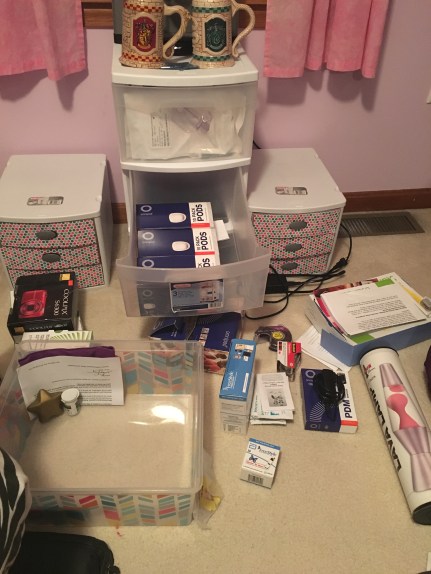
Warning: The following image may be disturbing to anyone adverse to messiness and general disorder.
Viewer discretion is advised!
Okay, ready? Here it is…
My extremely disorganized diabetes supplies stash evokes a one-word reaction: Yikes!!!
I told you it wasn’t pretty. Hence, I took it upon myself the other night to go through my entire stash of diabetes supplies to see what I should keep and what I should toss.
It was much easier than I thought it would be, albeit time consuming. It was a matter of putting the supplies into two separate piles (keep or toss), and then putting them away in a manner that made sense.
Items that wound up in the “discard” pile included expired test strips, duplicate instruction manuals, product boxes (which were empty; therefore, merely taking up space), old batteries, and used CGM transmitters. I decided to keep three or four spare test kits (you never know when they’ll come in handy), extra chargers, single copies of instruction manuals for all of my devices, all unused and unexpired pods/sensors, and that lava lamp – because it’s groovy, duh!
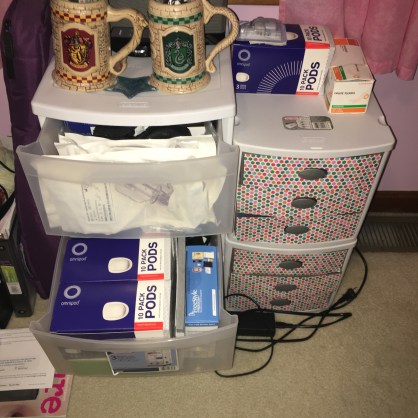
Once I had my two piles, I threw out the bunch I wasn’t keeping – freeing up my work space – and sorted through the items I was keeping. I wanted to make sure that items I need access to regularly (such as my pods and sensors) were within reach, so I left my box of pods on top of one set of drawers, and put my sensors in a stack in the front top part of the other set of drawers. Everything else, like the manuals and spare test kits, were placed neatly in the first and second parts of the bigger set of drawers.
Ahh…much better! (Don’t mind the Harry Potter mugs)
And…voila! Just like that, my supplies were organized and I’m feeling great about it. I like knowing the exact location of all my diabetes materials. This way, I won’t be rifling through a haphazard heap when I’m looking for something in particular – it’ll just be a matter of sorting through my tidy supplies stash.
One Monday per month, I’ll take a trip down memory lane and reflect on how much diabetes technology, education, and stigma has changed over the years. Remember when…
…BD glucose tablets were like, the only kind of tabs available?
I remember them vividly. The tablets were came in what looked like giant packages of gum. They were orange-flavored, but colored white. And they were square, chalky, and the epitome of boring. Even so, I’m slightly embarrassed to admit that I used to sneak them from my mom’s purse when I was little. (Sorry, mom.)
I don’t really know why I did it, considering they weren’t exactly the tastiest treats. But it felt rebelliously good to take one here and there, even if I wasn’t experiencing a low blood sugar. I knew I wasn’t allowed to graze on snacks as I wanted, and I knew that it would make my blood sugar go up. I also knew that I didn’t fully understand what diabetes was and why it was so important to be careful with how many glucose tablets I ate at the tender ages of six and seven years old.
Over time, I kicked the habit. As more flavors and varieties of glucose tablets popped up in the market, I grew increasingly resentful of having to use them to treat lows in the first place. I wasn’t enticed by the tropical or berry flavor mixes; after all, they didn’t have quite the same appeal as those weird white tablets.
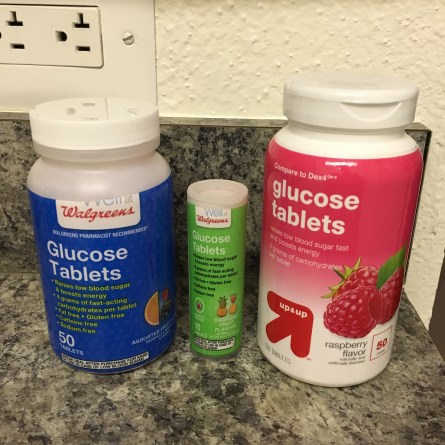
Today’s glucose tablets come in much more colorful and flavorful varieties.
Now, I’m just glad I’ve discovered ways to bring up a low quickly that don’t involve chewing chalky discs. Orange juice, mini boxes of raisins, gummies, smarties, and more all work efficiently. I still choose to carry around glucose tablets, though, because the tube they come in is discreet. Glucolift brand tablets are a personal favorite to stock the tube with, because they’re more pleasant to ingest, thanks to their quick-dissolve formula. Plus, I can’t totally hate something that’s saved my butt more times than I can count.


 Hugging the Cactus