How Time Traveling Affected my Blood Sugar

I traveled through time last week.

No, I didn’t use a magical device or step through a portal. It’s much more boring than that: I flew across the country, east coast to west coast, to spend a few days in Las Vegas.

Okay, there’s no way in hell that I could justifiably describe my Vegas trip as BORING.

But my point here is that flying through a couple different time zones is totally trippy. And, of course, it impacted my blood sugar. Because why wouldn’t diabetes just cooperatively come along for the ride?

I knew I should anticipate some sort of blood sugar swings going to and from my destination, I just wasn’t sure of when and how they’d hit. But I did know that when I landed in Vegas, the first thing I needed to do was adjust the time on my PDM (my insulin pump). Surely, my blood sugar would not react kindly to thinking that it was three hours later than it truly was in my new time zone. My question, though, was when should I do this? On the plane? After we landed? Should I adjust it slowly, in one-hour increments? Or should I dial it back entirely in one go?

Normally, I would’ve asked my endocrinologist what to do – but I forgot to bring it up during my last appointment with her a few weeks ago. So naturally, I asked the next best source: the Diabetes Online Community (DOC).

The answers I received were varied…

…nevertheless, I appreciated the immediate replies. I decided to quit stressing about it so much and focus on getting to the actual destination, vowing to keep an eye on my blood sugar for any suspicious trends while on the flight.

Five and a half long hours later, my travel companions and I arrived at our hotel. While in line for check in, I fixed the time on my pump and glanced at my CGM (which I didn’t bother adjusting, since none of the settings on it or my meter were dependent on time). I was steady at 97 mg/dL…not too shabby at all. And I’m pleased to say that I maintained that decent graph for the next day or so. I was nonplussed by the phenomenon, but I couldn’t complain about it.

The next few days are a different story, due to some “lifestyle choices” I made while in Vegas (c’mon, you know all I mean by that is eating junk food and imbibing alcohol). But that’s a tale for another post, coming soon.

This one’s about time travel, and while I had no issues flying TO Vegas, I did encounter trouble flying home FROM Vegas. My friends and I chose to a red-eye flight, which I don’t regret per se, but I’d never done one before and didn’t realize how much trouble I’d have falling asleep on the plane. It was disorienting enough leaving one place at 9 P.M. to arrive in another at 5 A.M., but add a freezing cold aircraft, turbulence, and an unsettled stomach to the mix, and you’ve got a recipe for disaster. As I tossed and turned in my seat, violently shivering a few times, my blood sugar was very slowly, incrementally, rising. I didn’t realize how much until we landed and drove home, where I had to bolus for an out-of-the-blue 308 mg/dL. I was so bloody tired, yet sleep evaded me further as I anxiously waited for my blood sugar to budge – which it did, but not for several, agonizingly long hours.

It definitely didn’t help matters that I wasn’t eating regularly; at the time of our arrival home, I hadn’t eaten real food in about 36 hours due to nausea that wouldn’t seem to leave me alone. I’d muscled down toast and a couple of granola bars, but not much else. I’d like to think that my entire body was just rebelling against me for spending the weekend eating too much pizza, staying up too late, and drinking a little too much whiskey, because that train of thought at least helps me make sense of my lack of appetite and recurring high blood sugars.

I’ve been back on the east coast for a couple days now, and I’m relieved to report that things have settled down. I’m eating regular meals (and I actually feel hungry for them), and besides a few flukes in my CGM graph, my blood sugars are mostly back to normal. I wish I could say that there was some big takeaway from this all: that I know exactly what to do next time I travel through time zones, or that I know just what to do to prevent it. But that’d be silly, because with diabetes, there are just too many variables. At least I CAN say that I know to take it in stride next time, to roll with the punches. Monitor my blood sugar like a hawk, correct as often as needed, eat normal meals as much as possible, and drink plenty of WATER. In any case, isn’t that what diabetes is all about…

…regardless of time travel and/or sorcery?
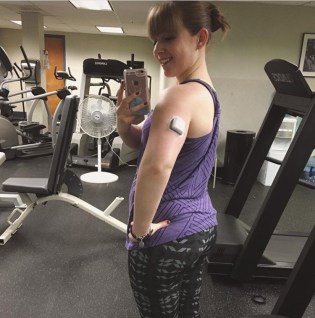
 

Diabetes Connections: Gym Edition

“Are you a diabetic?” Despite the fact that I was wearing earbuds, I heard the question that was undoubtedly being directed toward me.

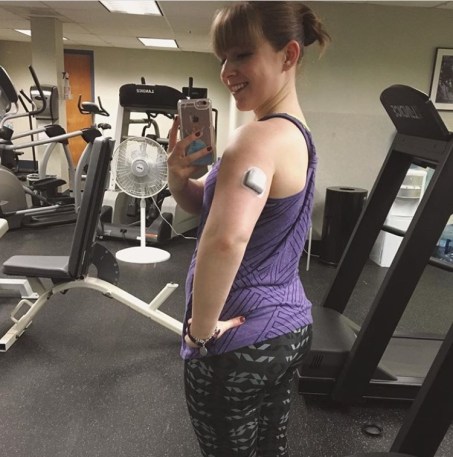
I glanced to my right and met the gaze of the teenage girl on the treadmill next to me. I smiled, tugging an earbud out, and said, “Yes, I am. My OmniPod gave it away, didn’t it?”

She nodded eagerly. “I have a Medtronic pump, but I know what an OmniPod looks like. When I saw it, I had to say something to you.”

This marked the beginning of what wound up being a thirty minute interaction with Shae, a high school senior with bucketloads of energy and questions for me about life with diabetes. We specifically chatted about college, and I couldn’t resist telling her all about the College Diabetes Network and what a useful tool it was for me during my three and a half years at UMass. The more we spoke, the more it felt like I was looking at a mirror image of myself from seven years ago. She had just finished taking her AP Psych exam and was relieved it was done. Her senior prom was in a few days, and she described how she’d wear her pump while donning her fancy gown. She was excited about college, but a little nervous about the dreaded “Freshman 15” and whether her diabetes would adjust well to college dining halls.

IMG_3979
It’s so funny to think how something as crappy as diabetes can introduce so many amazing people into your life.

I did my best to answer Shae’s rapid-fire questions frankly but reassuringly. As I told her about how much my CGM helped me in college (especially since I was still on multiple daily injection therapy at that time), she exclaimed that I was inspiring her to want to give her CGM another shot (pun unintended – I love spontaneous diabetes humor).

As we parted ways, we both grinned broadly and wished one another well. This is why moments like this – diabetes in the wild – are so great. Diabetes instantly bonds you to a stranger who you might not otherwise ever interact with, and the beauty in that immediate connection is priceless.

What It’s Like to Wear a Medical Device 24/7

A question I’m often asked is: “Can you feel your CGM or insulin pump on your body?”

The simple answer to that is: usually, no. It’s something that you just get used to. You grow accustomed to seeing a lump underneath your clothing. You adjust to putting clothes on (and taking them off) carefully to avoid accidentally ripping a site out. You acclimate to showering without being completely naked.

And, of course, you get used to the questions from strangers asking about that device stuck to you.

But the more honest answer to that question would be that there are times that I feel it more than others. For example, sometimes I forget where I’m wearing my pump until I hit it against something (I’m a major klutz who constantly runs into doorways and trip over things, almost always managing to catch my pod on whatever it is), resulting in pain at the site and a curse word or two to fly out of my mouth.

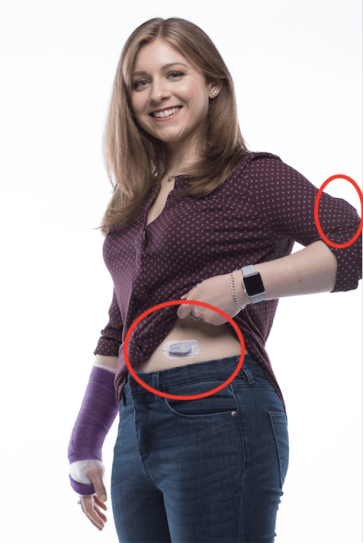
Circled Devices
My OmniPod (on my arm) and my Dexcom (on my stomach) are stuck on me 24/7.

I feel it the most, though, when people stare. Whether unconsciously or purposely, people do ogle at it in very not subtle manners. Which makes me feel extremely uncomfortable. It’s worse when they don’t even ask me what it is – I’d rather have a chance to use it as a teaching moment than to have someone walk away not knowing what the device does. This tends to make swimsuit season a little less welcome for me. Nothing will stop me from donning a bathing suit at the beach or by the pool, and I do so as much as possible in the summertime. But it’s just not as fun when I’ve got to cope with lingering looks, especially when I’m an admittedly insecure person in the first place.

So it’s a more complex question to answer than you might realize. Wearing a medical device 24/7 is humbling. It keeps me alive. I’m privileged to have access to it. I’m grateful for the ways it’s improved my life. I’m always wearing it, but it’s not at the forefront of my mind – unless it chooses to make its presence known by alarming, or I’ve got people blatantly checking it out. It’s kind of like diabetes itself. It can make you feel a gamut of emotions, but no matter what, it’s always there. It’s just a part of me, and I can deal with that.

How to Change an OmniPod

I decided to do something a little different and take video of how to change an OmniPod. Rest assured, though, that it does not take 22 seconds – it’s more like a seven-minute process.

Some things you’ll notice about my process:

  1. I fill my syringe with insulin and set it aside before deactivating my old pod. This simply means that I wear the old pod a little bit longer so there’s less of an interruption in time that I go without insulin.
  2. I use a pen to smack bubbles out of the syringe. Air bubbles will inevitably develop when drawing insulin out of a vial, so I find that gently hitting the sides of the syringe with a pen is the most effective way to get rid of the pesky air pockets.
  3. I prep my site with an alcohol swab, followed by a skin-tac wipe. The alcohol merely cleans the site, whereas the skin-tac makes the pod adhere to my skin better and longer.
  4. The new pod activates best when it is adjacent to my PDM. I always place my new pod to the right of my PDM. This helps the PDM register the new pod.
  5. It doesn’t actually hurt when I rip off an old pod. Not sure if you detected my dramatic facial expressing, but I was just yukking it up for the camera. It truly doesn’t hurt, especially if you just remove it in one swift motion.

So that’s it, the full process boiled down into 22 measly seconds. I admit that I kind of had fun making this video, even though the sight of myself sans make-up is semi-horrifying. But give me a break, I was on my way to a Pilates class! And let’s be real, diabetes isn’t always glamorous.

Favorite Things Friday: Adhesive Remover Wipes

One Friday per month, I’ll write about my favorite diabetes products. These items make the cut because they’re functional, fashionable, or fun – but usually, all three at once!

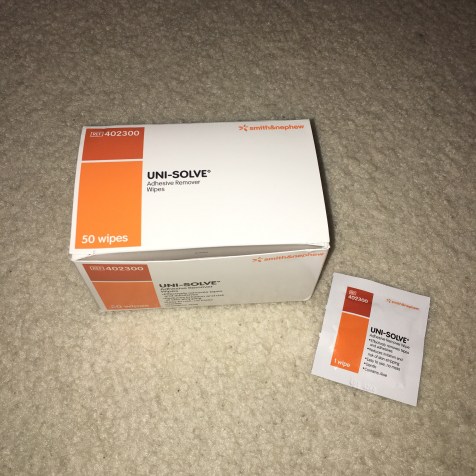
“Adhesive remover wipes” sounds about as exciting as dryer lint. But these really are a nifty invention, especially for someone like me who wears multiple T1D medical devices.

My pods stay on my body for three days at a time, and my CGM sensors can last as long as two weeks. So needless to say that they need to be equipped with super strong adhesive to ensure they stick for the necessary length of time.

IMG_5246
These adhesive remover wipes look lame, but trust me, they’re pretty impressive.

I’m grateful for the high-quality adhesive, but man, it can be difficult to completely remove from my body. Before I discovered these magical wipes, I’d rub my skin raw in an attempt to get rid of all traces of leftover adhesive. As a result, I’d either walk around with gray circles of adhesive on my abdomen and arms, or with irritated, pink skin that I needed to let heal before reusing as a site. A surefire lose-lose scenario either way, right?

A quick search online caused me to discover these adhesive remover wipes. I purchased them immediately and I can say it was a brilliant buy. I no longer scratch at my skin until the adhesive disappears; rather, I merely wipe the area with one of these towelettes and within seconds, all adhesive is painlessly removed.

If you’ve struggled in a similar manner with removing your medical adhesive, definitely look into these wipes and save your skin from stress.

Insulin Pumps and X-rays

“You have to remove your insulin pump before we can take your X-rays,” the technician said to me. I stared at him, and responded point-blank, “What? No, I can’t take it off.” I tried to hide the panic in my voice, but it quavered as tears stung my eyes.

“Well, let me check our insulin pump protocol…” his voice trailed off as he left me in the dark room with my right arm held up in the air in an attempt to mitigate the throbbing sensation going up and down my forearm.

IMG_3979
That pod on my arm can’t simply be removed on command.

When I fell and broke my ulna a couple weeks ago, my insulin pump was one of the last things to cross my mind as I was shuffled from doctor to doctor and one medical facility after the other. All I could concentrate on was the injury – how severe was it? Would I be able to work? Could I keep up my exercise regimen? Was I going to need surgery? My diabetes, for once, was far from my thoughts.

But this instantly changed when I went to get an X-ray. When the technician told me that I’d have to remove my pump, I wanted to shout at him, “No! If I do that, my blood sugar will skyrocket! You can’t expect me to do that!” It was hard to keep calm, and my emotions were already running amok due to the chaos of the morning so far. So even as I tried to fight the tears, a couple escaped and ran down my cheeks. When he came back into the room, the X-ray technician’s expression changed. He looked at me empathetically.

“It’ll be okay. Come on, let’s call your endocrinologist. We’ll see what she has to say and get this all figured out.”

Twenty minutes later, after a series of phone calls and a few accidental hang-ups, we received confirmation that I could, indeed, wear my pump for the X-ray. The nurse practitioner who I spoke with at my endo’s office said that it was safe as long as I wore the protective vest. “It’s really only a problem if you’re going in for an MRI or a CAT scan, because those involve magnets,” he told me.

Once I got off the phone, I ran over to the X-ray technician and explained it to him. He smiled at me and said, “Got it. Let’s get these pictures over with – you’ve already had quite a day so far.”

I nodded and thanked him for his patience. He was right, I was overwhelmed from the events of the day – it wasn’t even noon yet – but in hindsight, I’m glad that the technician didn’t try to fight me when I said I couldn’t remove my pump. His willingness to hear me out was huge. It’s not easy to be your own advocate in a high-stress situation like that. But I’m proud of myself for speaking up and getting the answers we needed. Everything worked out in the end – well, except for that pesky broken-bone bit.

Diabetes Data Overload

I’ve always been a words girl – never a big fan of numbers. So isn’t my T1D ironic, being that it’s an illness ruled by numbers?

Think about it. PWD have a ridiculous number of…numbers to be concerned about on a daily basis. Between blood sugar checks, insulin dosage calculations, carbohydrate counting, basal rate testing, and more, there’s a lot to take into account.

And as time has gone on and technology has evolved, it seems like these numbers are constantly accessible on an endless volume of devices. I can determine trends using my Dexcom CGM – using either my mobile app or my sparkly pink receiver. I can scroll through my record log of blood sugars on my meter. I can find out how much insulin I took in one day using my OmniPod. I can even download several weeks’ worth of blood sugar graphs from my Dexcom by simply hooking it up to a computer.

It’s information overload.

As much as I love having the ability to access all of this data, it’s also too much to swallow at times. I could drive myself nuts looking through days’ worth of graphs and logs to figure out why I was inexplicably high at 3 o’clock in the morning one day, but I can also just chalk it up to a fluke and better spend my energy worrying about my blood sugar in the present (as opposed to the past).

The point is, it’s exhausting to have my life dictated by all this data. I wish I could take a break from it sometimes, but then again, it’s helped me become more accountable for my own health. And I can still express my hatred for numbers by using my love of words, so it’s not all that bad.

Traveling with T1D: Upon Arrival

Bags packed? Check. Made it to the airport? Check. Boarded the plane? Check. Touchdown? Check. I’ve made it through the actual travel part of my trip. Yay! But after all that, I’ve still got a routine to follow, even though I’ve reached my destination.

C17960F7-CD51-4441-81DE-84B3FB5EF8AB
This little cooler comes in handy when en route to a destination, but I always feel much better when I can get my insulin vials into an actual refrigerator.

It’s pretty straightforward, really. I simply need to determine where to keep my diabetes supplies for the duration of my stay. If I’m in a hotel room, I locate the mini fridge and stash my insulin vials  in there. I tend to keep everything else (pods, swabs, etc.) out of plain sight in order to avoid attracting attention from housekeeping. I mean, if I was going in and out of hotel rooms all day long and noticed that one contained a bag filled with needles, I’d probably get a little suspicious. So this means my other supplies live in my suitcase for the week, in an easily accessible pocket.

It’s easier if I’m going to be visiting with friends or family. I still find a fridge to home my insulin, but I worry less about “hiding” my supplies. I’m able to keep them in a spot that’s convenient for me, which helps make site changes throughout my trip a smoother process.

Speaking of site changes, I find them particularly annoying when I’m on vacation. It feels like I have to plan a day – or several days in a row – around the fact that I’ve got an upcoming site change. But planning is a part of T1D management, so I’ve come to accept that I need to be diligent with scheduling activities and meals around it.

Sometimes site changes are no big deal on a trip, other times they’re a whole event (like when my mom and I went to Disney and had to change our pods in the parks – going into a family bathroom to do it was not overly fun). And other, more seldom times, site changes are reminders of why it’s so important to pack extra supplies on a trip.

Case in point: My family and I went on a Caribbean cruise a few years ago. It was an amazing vacation, but also one that presented a few challenges regarding diabetes. I was spending a lot of time in the sun and on beaches, and that took a toll on my pods a couple of times. I had to rip off pods prematurely twice on this trip and replace them with my backups. Thank goodness I had thought to bring a pod for every single day of the vacation (seven days, seven pods) – because I wound up using five of them. So I never feel badly about obsessively packing tons of extra supplies that I might not necessarily use, because I never know when they’ll come in handy.

Travelbetes. It can be kinda complicated; hence, it requires its own word. But it’s worth it in the end, because my choice to travel independently with diabetes shows that it won’t stop me from seeing new places.

Diabetes in the Wild

Diabetes in the wild refers to a random encounter with another T1D when out and about. My favorite recent occurrence of this happened when I was in Disney World with my mom (also a T1D). We had just entered Animal Kingdom. I was sporting my pod on the back of my upper arm.

IMG_4625
I don’t think Timon noticed my pod, but another T1D in the park sure did!

“Hey, Podder!” I heard someone yell. For a split second, I thought someone was saying, “hey, Potter,” you know, like the Harry Potter kind of Potter.

I looked around and saw a girl a few years younger than me waving her arms in my direction. When we made eye contact, she smiled and pointed at her pod. I gave her a thumbs up and the moment was over as quickly as it happened.

But it puts a smile on my face when I think about it, because it goes to show how awesome these chance meetings are – they serve as little reminders that even when I may feel like the odd duck in a crowd due to my pod, I’m not as alone as I think I am when it comes to diabetes.

Traveling with T1D: During the Trip

A few days ago, I wrote about what it’s like to prepare for travel with diabetes. It may have surprised you to learn how many steps are involved! But the work doesn’t end when en route to the destination…

It doesn’t matter if I’m going to be stuck in a car for several hours, flying on a plane, or – my worst nightmare – waiting in the airport for a delayed flight: There are additional steps I like to take when traveling to help ensure my blood sugar is steady and I’m adequately prepared with my supplies.

These steps include:

  • Checking my blood sugar often. I don’t like to rely completely on my CGM; after all, it can be inaccurate from time to time. So I tend to perform more blood sugar checks than usual while I’m waiting at the airport or sitting shotgun in a car. But if I’m the one driving, I (obviously) wait to check at rest stops as time allows.
  • Seeking healthy snacks. It’s definitely easier for me to find healthy options when I’m on a road trip – I can simply pack meals and snacks ahead of time. The airport is a little trickier for me, though. Sometimes, I’m tempted by candy or chips – comfort foods – because I’m not a huge fan of flying and like to do anything to take my mind off it. Luckily, though, even if I don’t make the healthiest choice, everything I’m consuming does have a carbohydrate count that’s easily accessible. This helps me take the correct insulin dosage and removes some extra thought from the process.
  • Getting as much movement in as possible. If this means taking laps in an airport terminal, so be it. I know that my diabetes responds well to exercise throughout the day, but it’s next to impossible to get movement in when cooped up in a car or plane. So what if I look kind of weird at a rest stop doing jumping jacks next to my car? At least I know I’m doing my body some good.

One thing I’d like to note is that the airport comes with some added fun: the TSA!!! (Insert sarcasm here.) That means I also have to be prepared for going through security. Some PWD have reported terrible experiences with the TSA, which is why I’ve devised a protocol for myself when traveling so I can (hopefully) avoid a bad interaction.

This plan consists of:

  1. Having my ziplock bag of diabetes supplies at the ready in my carry-on in case I’m asked to remove it,
  2. Telling the TSA agent conducting the body scan that I have T1D, and pointing out the locations I’m wearing my pod and CGM sensor,
  3. Knowing that I’ll probably be asked to touch my sites (over my clothing), and
  4. Allotting for the extra time it takes to get my hands swabbed.

So far, so good with this little strategy of mine. I’ve found that it works best to stay cool, calm, and collected throughout the whole TSA process. It’s a miserable one at best, but I might as well not exacerbate it by getting in a panic about my diabetes supplies.

After all that, what do I possibly have left to do once I actually arrive at my destination? Be on the lookout for my third and final post in this little series of travel procedures – but certainly not my last on traveling with diabetes, in general!