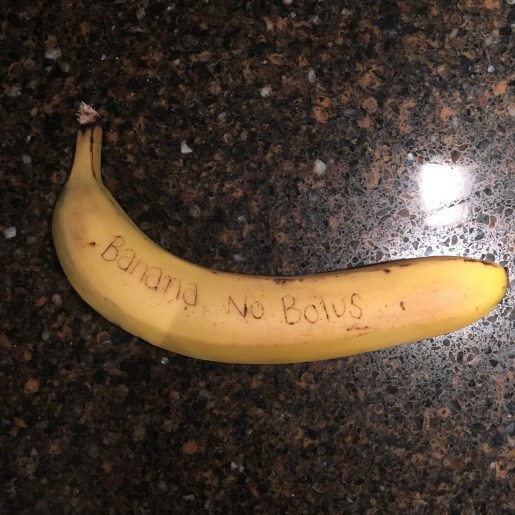
I ate a banana the other day without needing to correct for it. My blood sugar prior to eating it was 96 mg/dL. I sensed and oncoming low, and trusting this instinct, I decided to skip bolusing (taking insulin) for it. Two hours later, I was 108 mg/dL.
How did I do it?
Did my pancreas suddenly start working again?
Was it a low-carb banana?
Was sorcery involved?
I’ll explain how it happened; no, my pancreas didn’t suddenly decide to start secreting insulin; no, because low-carb bananas aren’t even a thing; and sadly, no, though I do wish I was well-versed in real-life wizardry and/or witchcraft.
It happened because I was running around like a maniac that entire morning. High activity levels can do a number – that is, lower the numbers – on a diabetic’s blood sugar. Between walking my dog, playing with him some more outside, and running errands, I scarcely had a chance to catch my breath from the time I woke up until noon. It was still mildly surprising, though, since bananas are a notoriously high-carb and fast-acting food. I’d expected to be at least 50 points higher from the initial blood sugar.
I was pleased with this outcome, but I still think that the voodoo magic – ahem, science – behind diabetes is just plain weird sometimes.
Happy Valentine’s Day, readers. Whether you celebrate the holiday or not, I’d like to make you think about a dozen roses today.
A dozen roses is a classic Valentine’s gift, right? But what if you received 11 roses in your bouquet, instead of 12? What if you knew that a rose was spared because the value of that flower helped support a child living with diabetes in a less-resourced country?
I bet you wouldn’t mind getting one less rose in that case.
This Valentine’s Day, please consider sparing a rose. Life for a Child is a nonprofit charity that created the Spare a Rose campaign. They’re able to support nearly 20,000 young people living with diabetes by using donations to buy them insulin, syringes, clinical care, diabetes education, and more. Anyone who’s familiar with diabetes realizes that access to care, education, and resources is critical to living a healthy and normal life. No one would want to deny another, especially a child, from having to forgo these resources because of the financial burden associated with them.
Or the pizza. Or the burrito. Or the decadent three-layer chocolate cake. Whatever the high-carb indulgence is, I’d rather just relish in it rather than focus on my diabetes.
Does that make me a “bad” diabetic? No. It’s not like I’m skipping an insulin dose or binge-eating food. I’m merely trying to enjoy a rare treat as well as the social experience that comes with it – like having sushi with coworkers.
A recent sushi dinner reminded me that it’s okay to stop thinking about my diabetes for a little while.
So instead of staring at my double-up arrows on my Dexcom, I’m staring at the artfully arranged sushi platter in front of me.
Instead of ordering the lowest-carb item on the menu, I order what I actually want to eat.
Instead of fretting over how quickly my insulin will kick in, I fret over which sushi roll I should try first.
Instead of letting my diabetes take over my dinner, I’m letting it go and living.
Sometimes, I need to remind myself that it’s okay to stop obsessing over my blood sugar in order to just live and enjoy my life.
One Friday per month, I’ll write about my favorite diabetes products. These items make the cut because they’re functional, fashionable, or fun – but usually, all three at once!
*Insert bad pun about how COOL this product is, like, literally AND figuratively!*
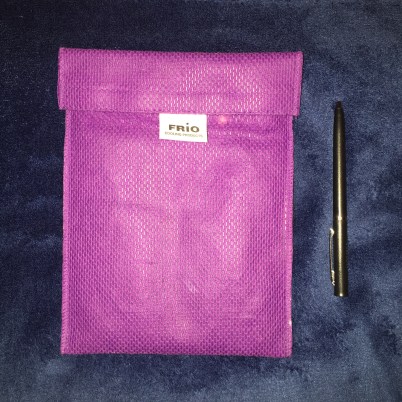
Alright, now that I’ve got that out of my system…let me tell you about my FRIO cooling case.
I heard about cooling cases from the DOC a few years back, and the timing couldn’t have been more perfect when I did. I was about to go on a weeklong vacation to Disney World. In Orlando, Florida. In August. A.K.A., one of the hottest and most humid times of year to be going there. And I was sweatin’ over what I was going to do about carrying my insulin around in the parks.
Before you even think it, no, my option wasn’t just to throw it in my backpack and call it a day. PWD know well that insulin needs to be kept a certain temperature – i.e., cool – in order for it to be viable. It CAN and WILL expire if it’s left out in extreme temperatures for too long. So clearly, I had to figure out how to keep my insulin cool in the Florida heat.
Fortunately, I’d read about the cooling cases on Twitter at some point and decided to order one a few weeks before the trip. When it arrived, I put it to the test right away to see how it fared.
My magical FRIO cooling case
I followed the instructions that came with the pouch: Immerse the black inner casing in cold water for 10-15 minutes, allowing the beads stuffed within it to turn to gel. After the time elapsed, I removed the case from the water and pat it dry. Then I put two of my Humalog pens (because I was still on injections at this time) into the black case, put that inside the purple pouch, and forgot about the contraption for a few hours so I could see if it would stay cool for that span of time.
And it did! The case worked beautifully. It was just as cool as it was when I had first removed it from the water, meaning my insulin was kept properly refrigerated. The only downside was that my pens felt slightly damp when I removed them from the bag, but they weren’t damaged whatsoever. I knew right then and there that it was just the thing I needed for my vacation.
Fast-forward to present day and the FRIO case continues to serve its purpose as I need it. I couldn’t recommend it more to PWD who travel – even if it’s to a mild-temperatured place. It helps keep insulins cool no matter what, and to me, that makes the case more than worth it. Check out friocoolingcase.com to learn more about their products!
Bags packed? Check. Made it to the airport? Check. Boarded the plane? Check. Touchdown? Check. I’ve made it through the actual travel part of my trip. Yay! But after all that, I’ve still got a routine to follow, even though I’ve reached my destination.
This little cooler comes in handy when en route to a destination, but I always feel much better when I can get my insulin vials into an actual refrigerator.
It’s pretty straightforward, really. I simply need to determine where to keep my diabetes supplies for the duration of my stay. If I’m in a hotel room, I locate the mini fridge and stash my insulin vials in there. I tend to keep everything else (pods, swabs, etc.) out of plain sight in order to avoid attracting attention from housekeeping. I mean, if I was going in and out of hotel rooms all day long and noticed that one contained a bag filled with needles, I’d probably get a little suspicious. So this means my other supplies live in my suitcase for the week, in an easily accessible pocket.
It’s easier if I’m going to be visiting with friends or family. I still find a fridge to home my insulin, but I worry less about “hiding” my supplies. I’m able to keep them in a spot that’s convenient for me, which helps make site changes throughout my trip a smoother process.
Speaking of site changes, I find them particularly annoying when I’m on vacation. It feels like I have to plan a day – or several days in a row – around the fact that I’ve got an upcoming site change. But planning is a part of T1D management, so I’ve come to accept that I need to be diligent with scheduling activities and meals around it.
Sometimes site changes are no big deal on a trip, other times they’re a whole event (like when my mom and I went to Disney and had to change our pods in the parks – going into a family bathroom to do it was not overly fun). And other, more seldom times, site changes are reminders of why it’s so important to pack extra supplies on a trip.
Case in point: My family and I went on a Caribbean cruise a few years ago. It was an amazing vacation, but also one that presented a few challenges regarding diabetes. I was spending a lot of time in the sun and on beaches, and that took a toll on my pods a couple of times. I had to rip off pods prematurely twice on this trip and replace them with my backups. Thank goodness I had thought to bring a pod for every single day of the vacation (seven days, seven pods) – because I wound up using five of them. So I never feel badly about obsessively packing tons of extra supplies that I might not necessarily use, because I never know when they’ll come in handy.
Travelbetes. It can be kinda complicated; hence, it requires its own word. But it’s worth it in the end, because my choice to travel independently with diabetes shows that it won’t stop me from seeing new places.


 Hugging the Cactus