The CGM Experiment: Comparing the Dexcom G5 to the G6

I have the extremely good fortune of being one of the first people in the world to receive the Dexcom G6, the latest in continuous glucose monitoring (CGM) technology. After spending almost two years eagerly anticipating its FDA approval, I could scarcely believe that I finally had it in my hands when it first arrived a few weeks ago.

I am partway through my second-ever G6 sensor, so I’ve had enough time to come up with some initial opinions on the system as a whole compared to the G5.

Let’s start with what I knew going into the first insertion of the G6. I knew that the transmitter would have a sleeker profile than the G5. I also was aware that the insertion process would be much more streamlined – all I would need to do is push a button and it would be on my body.  Plus, the G6 required 0 finger sticks or calibrations, could be worn for 10 consecutive days, and would no longer block acetaminophen (Tylenol) like its predecessors did. So far, me and the G6 were off to a solid start.

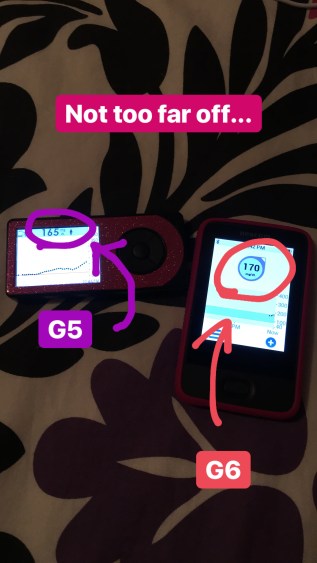
Then, it came time for me to actually put it on. Rather then end my current session with my G5, I decided to leave it on so I could see how accurate it was compared to the G6.
5af0f7d2789dd724634597

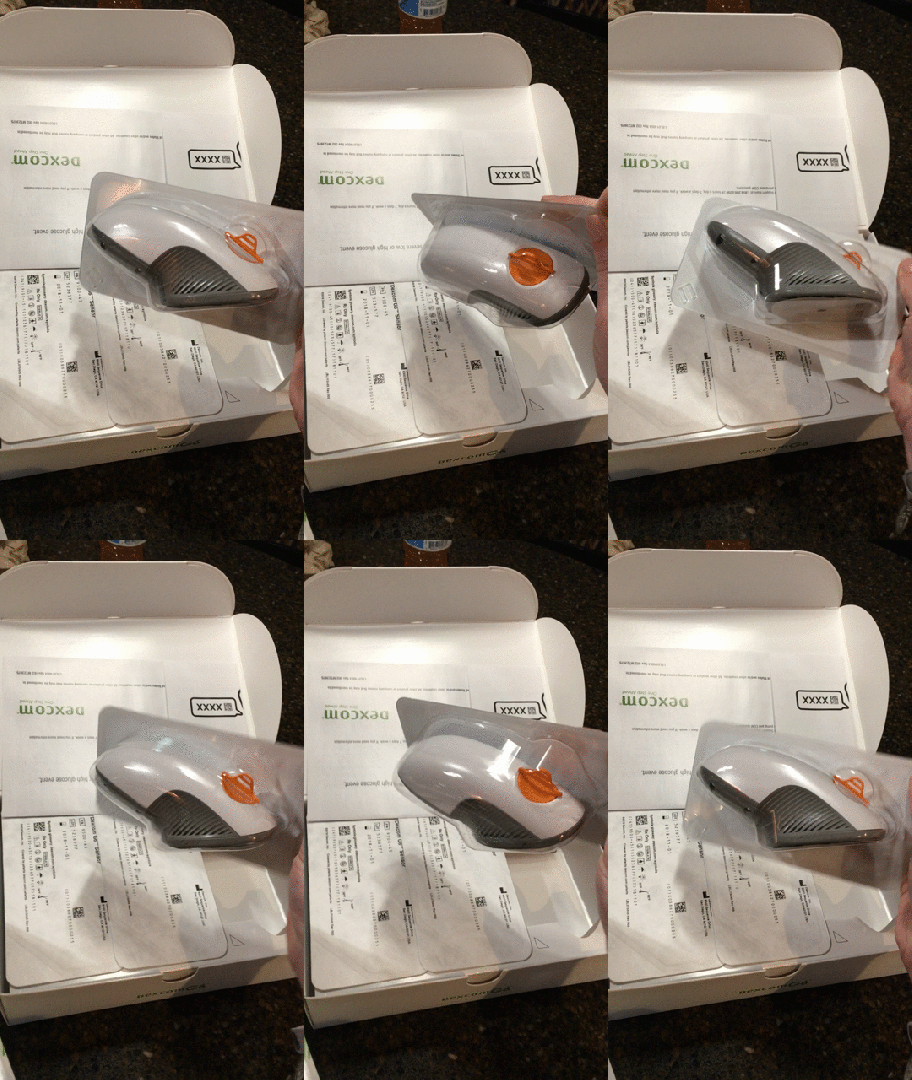
I was amazed by how easy it was to insert the G6. All I had to do was input a 4-digit code located on the sensor into my receiver. Once the code was accepted, I peeled the adhesive off the sensor, placed the system on my abdomen, folded the orange safety clip until it snapped off, and pushed the big orange button. I cringed when I did it for the first time; truthfully, I was prepared for it to hurt. It made a ka-shunk sound as the sensor inserted itself into my skin, and I…didn’t feel a thing. I marveled at how ridiculously comfortable it felt as I snapped the sleeker transmitter into place. I pressed one more button on my receiver to get the sensor warmed up, and that was it. Once two hours elapsed, my G6 system would be fully operational and could determine my blood sugar without requiring manual calibrations.
IMG_6655

While it felt great to know that I didn’t need to worry about calibrating my new device, I was more interested in seeing how well it matched up with my G5.

And I was a little let down…at least, I was in the beginning.

Initially, I was not impressed at all by the G6’s reports. They matched pretty damn closely with my G5. I was beginning to wonder whether the technology really was that excellent, and then my G6 proved to me that it was, indeed, kind of a big deal.

That moment came when it caught a low blood sugar sooner than my G5. I was feeling the early signs of a low, so it wasn’t much of a surprise when it alarmed. But what was particularly neat to me was that it was able to tell me that a serious low blood sugar (below 55 mg/dL) was oncoming in the next 20 minuets or less. In other words, it knew that I needed to treat my blood sugar right away to prevent a more urgent hypoglycemic event. That predictive feature was definitely a pleasant surprise.

As I wore my first G6 sensor for a few more days, it seemed to adjust better and better to my body. As evidenced in the above picture, it proved to be spot on when I compared it to the blood sugar readings I got from my meter. There’s absolutely still a bit of the classic CGM lag, as it takes about 15 minutes or so to catch up to what’s actually going on in the body, but that was to be expected.

I’m already on second sensor and I think it’s safe to say that I’m sold on the G6. But I don’t think that any product comparison/review is complete without a list of pros and cons, so here’s what I’ve come up with:

Pros of the G6 (compared to the G5)

  • Slimmer transmitter profile
  • 0 fingerstick calibrations (which I really loved when I didn’t have to wake up in the middle of the night to calibrate a sensor I inserted before bed)
  • Predictive low feature
  • Modern touchscreen receiver
  • Absolutely painless and foolproof application – honestly, it was THAT good that it might win me over from the G5 if that was the sole difference between the two

Cons of the G6 (compared to the G5)

  • Clunky applicator – as many other members of the DOC have noted, the system is comprised of a lot of plastic. Probably not very environmentally friendly. I wish it was possible to recycle it somehow
  • Automatic expiration after 10 days – with the G5, you could restart a sensor after a week had elapsed, and in theoryyou could use the same single sensor more than once for a few weeks in a row. The G6 automatically shuts down after 10 days, so you’re forced to put on a new sensor. This medical device is already pretty expensive, and you could at least get your money’s worth with the G5
  • No super noticeable improvement in blood sugar reporting capabilities

The bottom line is that the G6 is unquestionably an upgrade in diabetes technology. It requires fewer blood sugar checks and allows for greater discretion with its smaller size. The G6 is far from perfect, but it’s still a valued component of my diabetes toolkit. I’m excited to continue on this journey with it and discover just how much it helps me take the best possible care of myself.
What It’s Like to Wear a Medical Device 24/7

A question I’m often asked is: “Can you feel your CGM or insulin pump on your body?”

The simple answer to that is: usually, no. It’s something that you just get used to. You grow accustomed to seeing a lump underneath your clothing. You adjust to putting clothes on (and taking them off) carefully to avoid accidentally ripping a site out. You acclimate to showering without being completely naked.

And, of course, you get used to the questions from strangers asking about that device stuck to you.

But the more honest answer to that question would be that there are times that I feel it more than others. For example, sometimes I forget where I’m wearing my pump until I hit it against something (I’m a major klutz who constantly runs into doorways and trip over things, almost always managing to catch my pod on whatever it is), resulting in pain at the site and a curse word or two to fly out of my mouth.

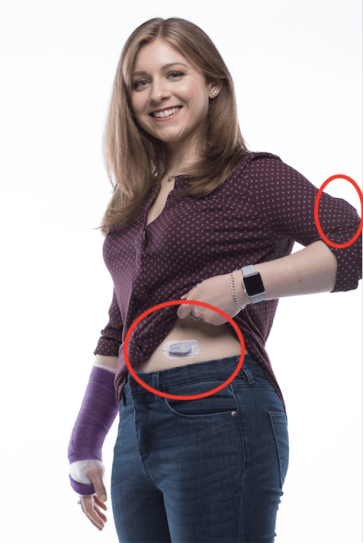
Circled Devices
My OmniPod (on my arm) and my Dexcom (on my stomach) are stuck on me 24/7.

I feel it the most, though, when people stare. Whether unconsciously or purposely, people do ogle at it in very not subtle manners. Which makes me feel extremely uncomfortable. It’s worse when they don’t even ask me what it is – I’d rather have a chance to use it as a teaching moment than to have someone walk away not knowing what the device does. This tends to make swimsuit season a little less welcome for me. Nothing will stop me from donning a bathing suit at the beach or by the pool, and I do so as much as possible in the summertime. But it’s just not as fun when I’ve got to cope with lingering looks, especially when I’m an admittedly insecure person in the first place.

So it’s a more complex question to answer than you might realize. Wearing a medical device 24/7 is humbling. It keeps me alive. I’m privileged to have access to it. I’m grateful for the ways it’s improved my life. I’m always wearing it, but it’s not at the forefront of my mind – unless it chooses to make its presence known by alarming, or I’ve got people blatantly checking it out. It’s kind of like diabetes itself. It can make you feel a gamut of emotions, but no matter what, it’s always there. It’s just a part of me, and I can deal with that.

So This Just Happened…

Capture

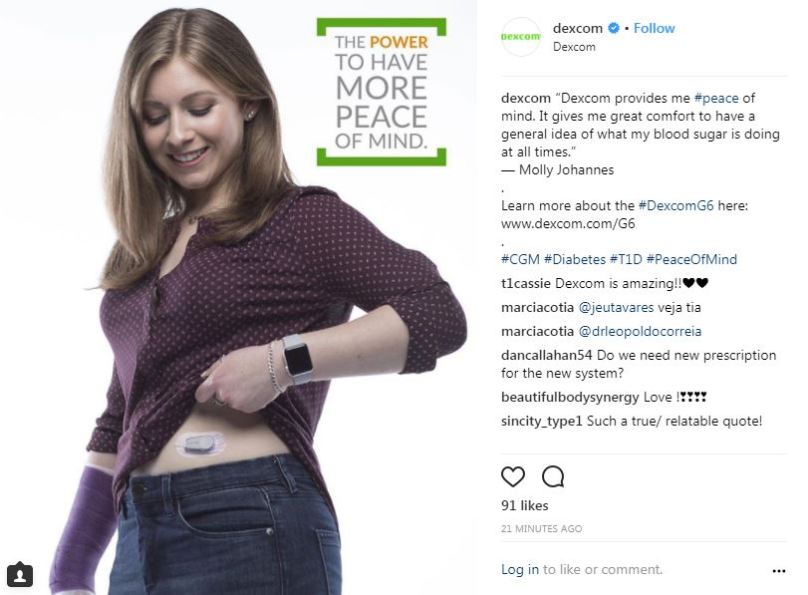
Whoa! It’s incredibly surreal to see myself on Dexcom’s Instagram feed, but there I am! Shout out to my T1D buddies who messaged me the day this appeared and made me feel like a rock star!

Glamour shots aside, this quote really does capture how I feel about Dexcom. It’s truly one of the most powerful tools in my diabetes care kit. In addition to helping me improve my blood sugars by giving me crucial data, my CGM also provides me peace of mind because it does a lot of extra work for me – saving me a lot of time and energy.

This just makes me even more excited to get my hands on the Dexcom G6, which is bound to make life with diabetes even easier! I have the feeling that I’ll get one sooner rather than later…

How to Change an OmniPod

I decided to do something a little different and take video of how to change an OmniPod. Rest assured, though, that it does not take 22 seconds – it’s more like a seven-minute process.

Some things you’ll notice about my process:

  1. I fill my syringe with insulin and set it aside before deactivating my old pod. This simply means that I wear the old pod a little bit longer so there’s less of an interruption in time that I go without insulin.
  2. I use a pen to smack bubbles out of the syringe. Air bubbles will inevitably develop when drawing insulin out of a vial, so I find that gently hitting the sides of the syringe with a pen is the most effective way to get rid of the pesky air pockets.
  3. I prep my site with an alcohol swab, followed by a skin-tac wipe. The alcohol merely cleans the site, whereas the skin-tac makes the pod adhere to my skin better and longer.
  4. The new pod activates best when it is adjacent to my PDM. I always place my new pod to the right of my PDM. This helps the PDM register the new pod.
  5. It doesn’t actually hurt when I rip off an old pod. Not sure if you detected my dramatic facial expressing, but I was just yukking it up for the camera. It truly doesn’t hurt, especially if you just remove it in one swift motion.

So that’s it, the full process boiled down into 22 measly seconds. I admit that I kind of had fun making this video, even though the sight of myself sans make-up is semi-horrifying. But give me a break, I was on my way to a Pilates class! And let’s be real, diabetes isn’t always glamorous.

Fantastic News! Dexcom G6 is Approved by the FDA

The official announcement has appeared across all sorts of social media in the last 48 hours, but I thought I’d say something about it here, too…

The FDA approved the Dexcom G6, the new and improved version of their Continuous Glucose Monitor (CGM) system!

This is particularly exciting, because the G6 comes with many new and exciting features:

  • 10-day wear (as opposed to seven days)
  • Slimmer and smaller sensor
  • Easy-to-use inserter
  • Zero calibrations necessary – the system does not require manual blood sugar inputs

Visit the Dexcom website to read about all of the details. And as more information comes out about its availability, stay tuned…

…because you may recognize a familiar name and face along the way!


Testing for Accuracy, in Addition to Blood Glucose

Blood glucose meters serve the sole purpose of checking current levels of glucose in the blood. Pretty self-explanatory, right? And it’s equally obvious that it’s crucial for all meters to generate accurate results so PWD can make the right treatment decisions based on those numbers.

Unfortunately, though, accuracy isn’t always what I get.

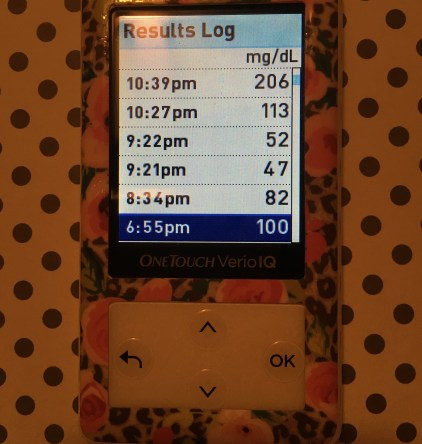
The other day, I was running low before bedtime. I corrected with an organic rice crispy treat (honestly, it was a million times better than the brand name kind). I waited nearly an hour for my blood sugar to come up. When my CGM wasn’t showing any progress, I tested: I was 47. It’s rare for me to be that low, so I tested again. 52. I believed it, especially since I was experiencing several hypoglycemic symptoms.

img_5802.jpg
My unicorn bg quickly turned into A Situation.

I chugged a glass of orange juice and plopped down on the couch to wait for signs of improvement. Before long, I was freezing cold – a sure sign I was coming up, because I had been sweating 20 minutes prior. But I didn’t feel comfortable going to bed yet. I wanted to see if my CGM would show an up arrow. When it finally did, I made my way upstairs to brush my teeth and wash my face. In the middle of my routine, though, I decided to glance at my CGM again – and saw the dreaded ??? screen.

I decided then that the Dexcom should be out of commission, a.k.a. not trusted at all, for the remainder of the evening.

I ripped it out and inserted a fresh one, not really caring that it would wake me up in two hours to be calibrated. I would need to set at least two alarms for the middle of the night, anyways, if I decided to go to bed disconnected from my Dex. So it just made sense.

Once that was done, I tested again. I was pretty tired at this point and really didn’t want to have to eat something else, so I did it as quickly as I could. In my haste, I jostled my meter just so – enough that I saw the test strip, already marked with my blood, move slightly as it brushed against my PDM and was placed next to it.

113 mg/dL flashed upon the screen. Normally, I’d be thrilled! But I furrowed my brow. Something just felt…off about that reading. So I tested again.

206.

What?!

I tested a third time – 203. Okay, something was definitely wrong. Either that 113 was wrong (likely) or my meter had just produced two wildly inaccurate blood sugars in a row (less likely).

This is one of the many times that it’s convenient to live with another PWD. I asked my mom if I could borrow her test kit and see what result it generated. Seconds later…a twin 203 popped up on the screen, reassuring me that the 113 was a fluke on my meter.

Relief with the reality and irritation with the technology washed over me simultaneously as I went to correct the high with a bolus. I was glad I wasn’t heading down again, but irked that my meter had failed me. True, it was a bit of human error there, but aren’t we at a point in technological advancements where this sort of thing just shouldn’t happen? I put my life into the “hands” of my meter, Dexcom, and OmniPod. They should produce results that are undoubtedly accurate.

I guess we aren’t quite there yet.

Waiting for the Shift in Numbers

Call me crazy, but sometimes, I find myself staring at my Dexcom app in anticipation of catching the numbers changing.

It might be because I’m hoping for a change (coming down from a high, coming up from a low). Or it could be because I find a strange satisfaction in receiving real-time data of my blood sugar levels. Whatever, so be it: I’m a diabetes nerd!

I remember this particular example bringing me happiness, because I’d been hovering pretty close to my high limit (170 mg/dL) for a couple hours. So watching that three-point shift happen reassured me that I was going to come down. And sure enough, 15 minutes after capturing these screenshots, I was going down closer to my target of 100.

When it comes to diabetes…it’s the little things, right? Am I the only one who likes monitoring my CGM this closely, every once in a while? Or am I just weird?

Maybe don’t answer that last question…

Keep or Toss? Decluttering my Diabetes Supplies Stash

Warning: The following image may be disturbing to anyone adverse to messiness and general disorder.

Viewer discretion is advised!

Okay, ready? Here it is…

36F46E18-66F3-4999-9548-9487FBB27A8E
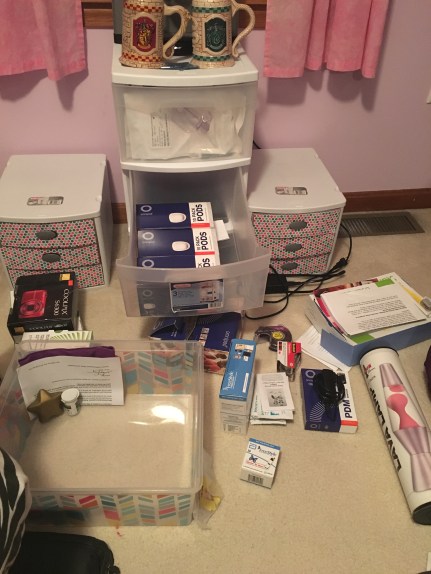
My extremely disorganized diabetes supplies stash evokes a one-word reaction: Yikes!!!

I told you it wasn’t pretty. Hence, I took it upon myself the other night to go through my entire stash of diabetes supplies to see what I should keep and what I should toss.

It was much easier than I thought it would be, albeit time consuming. It was a matter of putting the supplies into two separate piles (keep or toss), and then putting them away in a manner that made sense.

Items that wound up in the “discard” pile included expired test strips, duplicate instruction manuals, product boxes (which were empty; therefore, merely taking up space), old batteries, and used CGM transmitters. I decided to keep three or four spare test kits (you never know when they’ll come in handy), extra chargers, single copies of instruction manuals for all of my devices, all unused and unexpired pods/sensors, and that lava lamp – because it’s groovy, duh!

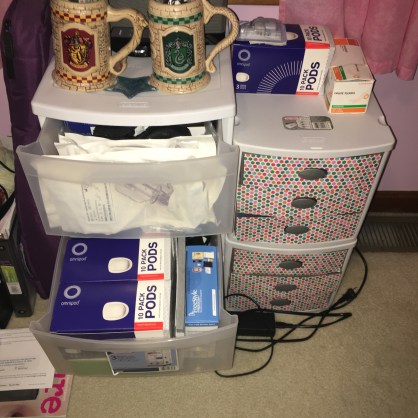
Once I had my two piles, I threw out the bunch I wasn’t keeping – freeing up my work space – and sorted through the items I was keeping. I wanted to make sure that items I need access to regularly (such as my pods and sensors) were within reach, so I left my box of pods on top of one set of drawers, and put my sensors in a stack in the front top part of the other set of drawers. Everything else, like the manuals and spare test kits, were placed neatly in the first and second parts of the bigger set of drawers.

43BBF4C4-F7B7-442A-9DD4-84E2EEF47AB8
Ahh…much better! (Don’t mind the Harry Potter mugs)

And…voila! Just like that, my supplies were organized and I’m feeling great about it. I like knowing the exact location of all my diabetes materials. This way, I won’t be rifling through a haphazard heap when I’m looking for something in particular – it’ll just be a matter of sorting through my tidy supplies stash.

Diabetes Data Overload

I’ve always been a words girl – never a big fan of numbers. So isn’t my T1D ironic, being that it’s an illness ruled by numbers?

Think about it. PWD have a ridiculous number of…numbers to be concerned about on a daily basis. Between blood sugar checks, insulin dosage calculations, carbohydrate counting, basal rate testing, and more, there’s a lot to take into account.

And as time has gone on and technology has evolved, it seems like these numbers are constantly accessible on an endless volume of devices. I can determine trends using my Dexcom CGM – using either my mobile app or my sparkly pink receiver. I can scroll through my record log of blood sugars on my meter. I can find out how much insulin I took in one day using my OmniPod. I can even download several weeks’ worth of blood sugar graphs from my Dexcom by simply hooking it up to a computer.

It’s information overload.

As much as I love having the ability to access all of this data, it’s also too much to swallow at times. I could drive myself nuts looking through days’ worth of graphs and logs to figure out why I was inexplicably high at 3 o’clock in the morning one day, but I can also just chalk it up to a fluke and better spend my energy worrying about my blood sugar in the present (as opposed to the past).

The point is, it’s exhausting to have my life dictated by all this data. I wish I could take a break from it sometimes, but then again, it’s helped me become more accountable for my own health. And I can still express my hatred for numbers by using my love of words, so it’s not all that bad.

Diabetes Products That Should Exist

Every now and then, I’ll think longingly about the diabetes products that should exist, but either don’t because nobody’s thought of them yet, or because I’m the only one who thinks they might be a good idea. Here’s my running list of diabetes products that I wish existed – what would your list look like?

  • A snack that keeps your blood sugar totally level while working out. No, not a low carb snack per se, but something that releases a small amount of carbohydrates into the system just as you need them. So it’s kind of a magic snack in that it predicts where your blood glucose is headed? In any case, I wish this was around because going low in the middle of a workout sucks, and I hate having to stop my activity to go drink a juice box or eat glucose tablets.
  • A portable sanitary station for changing insulin pump sites. This would look either like a small, collapsible table or a tray. But it would be a super clean and secure surface on which insulin pump sites could be changed, because I don’t know about you, but I’d much rather that than a dirty public bathroom sink.
  • Painless injections/cannulas/sensors. Yeah, I know that these things all need to puncture the surface of my skin in order to get insulin into my system or glucose readings, but I wouldn’t mind them so much if they didn’t sting. Don’t get me wrong, not all shots or needle pricks are painful – I’d estimate they only hurt 10% of the time. But that’s still too much.
  • A smaller, less invasive pod design. This one’s another practicality issue. I get that pods are kind of bulky because they’re supposed to be able to hold a three-day supply of insulin. And I wouldn’t trade the tubeless system for anything (except a cure, obviously). However, it would be awesome to wear a pump that’s tube-free and doesn’t create awkward bulges underneath my clothing.
  • A pump that needs to be changed once a month rather than once every three days. Hell, I’d take one that needs to be changed once a week, because rotating sites multiple times throughout the week can be inconvenient and exhausting. Again, there’s some logistical issues with this one – we rotate sites often to prevent scar tissue buildup and there’s a limited amount of insulin that one pump can accommodate. But this is wishful thinking, people! The sky’s the limit. And on that note, the last thing I wish existed?

A damn cure.

IMG_3097
Hey, it’s me as a kiddo! It’d be nice if that little girl grew up knowing a cure for diabetes existed.