Nothing screams “comfort food” quite like a hot, cheesy, and utterly delicious slice of lasagna. Unfortunately, though, said lasagna has a tendency to make my CGM scream, because consumption of the carb-laden food usually skyrockets my blood sugar.
On the bright side, a very low carb version of this dish exists, and it is just as wonderful as its starchy counterpart. The ground beef, pasta sauce, and mozzarella-parmesan blend are all there – the only bit that’s different is what’s used in lieu of pasta.
Instead of pasta, use cabbage leaves. No, I’m not kidding.
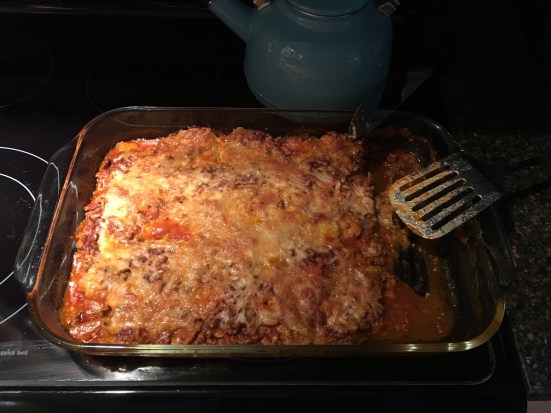
Cabbage lasagna looks and tastes just like its carb-ier alternative.
The cabbage soaks up the flavors of the sauce, meat, and cheese. As the concoction is baked, the cabbage also takes on the same consistency as pasta. It slices just as easily, and no, you really can’t taste the cabbage flavor (unless you pick out several chunks of it to eat on their own, but honestly, who does that?). It’s such a satisfying meal that I promise you won’t miss the carbs from the pasta.
Besides, if you’re like me and enjoy eating a healthy amount of carbs daily…you can always add a slice or two of garlic bread to your meal. I did just that, and in addition to having a well-rounded meal, I experienced great post-dinner blood sugars: a diabetes win!
Blood glucose meters serve the sole purpose of checking current levels of glucose in the blood. Pretty self-explanatory, right? And it’s equally obvious that it’s crucial for all meters to generate accurate results so PWD can make the right treatment decisions based on those numbers.
Unfortunately, though, accuracy isn’t always what I get.
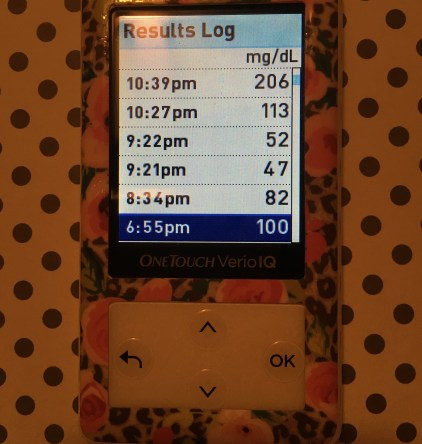
The other day, I was running low before bedtime. I corrected with an organic rice crispy treat (honestly, it was a million times better than the brand name kind). I waited nearly an hour for my blood sugar to come up. When my CGM wasn’t showing any progress, I tested: I was 47. It’s rare for me to be that low, so I tested again. 52. I believed it, especially since I was experiencing several hypoglycemic symptoms.
My unicorn bg quickly turned into A Situation.
I chugged a glass of orange juice and plopped down on the couch to wait for signs of improvement. Before long, I was freezing cold – a sure sign I was coming up, because I had been sweating 20 minutes prior. But I didn’t feel comfortable going to bed yet. I wanted to see if my CGM would show an up arrow. When it finally did, I made my way upstairs to brush my teeth and wash my face. In the middle of my routine, though, I decided to glance at my CGM again – and saw the dreaded ??? screen.
I decided then that the Dexcom should be out of commission, a.k.a. not trusted at all, for the remainder of the evening.
I ripped it out and inserted a fresh one, not really caring that it would wake me up in two hours to be calibrated. I would need to set at least two alarms for the middle of the night, anyways, if I decided to go to bed disconnected from my Dex. So it just made sense.
Once that was done, I tested again. I was pretty tired at this point and really didn’t want to have to eat something else, so I did it as quickly as I could. In my haste, I jostled my meter just so – enough that I saw the test strip, already marked with my blood, move slightly as it brushed against my PDM and was placed next to it.
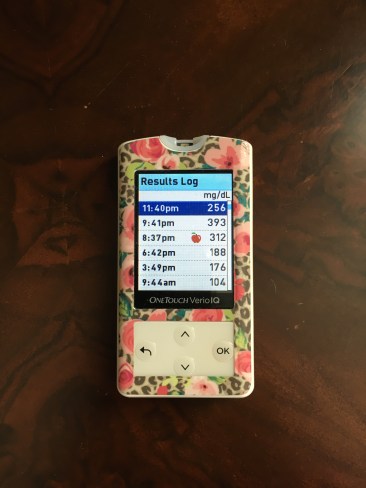
113 mg/dL flashed upon the screen. Normally, I’d be thrilled! But I furrowed my brow. Something just felt…off about that reading. So I tested again.
206.
What?!
I tested a third time – 203. Okay, something was definitely wrong. Either that 113 was wrong (likely) or my meter had just produced two wildly inaccurate blood sugars in a row (less likely).
This is one of the many times that it’s convenient to live with another PWD. I asked my mom if I could borrow her test kit and see what result it generated. Seconds later…a twin 203 popped up on the screen, reassuring me that the 113 was a fluke on my meter.
Relief with the reality and irritation with the technology washed over me simultaneously as I went to correct the high with a bolus. I was glad I wasn’t heading down again, but irked that my meter had failed me. True, it was a bit of human error there, but aren’t we at a point in technological advancements where this sort of thing just shouldn’t happen? I put my life into the “hands” of my meter, Dexcom, and OmniPod. They should produce results that are undoubtedly accurate.
A couple weeks ago, I was convinced that I was going to go insane.
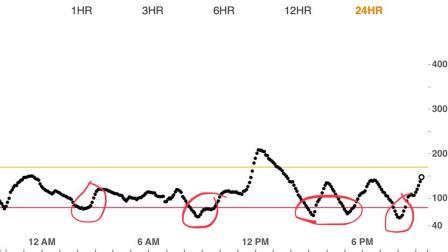
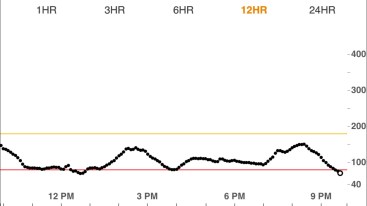
That’s because my graphs looked a lot like this for several days in a row:
All those red circles represent low blood sugars. The first day it happened, it was annoying. The second day, it evolved into concerning. Seven long days later, I was feeling incredibly burnt out as the low streak finally came to an end.
I have NO idea what triggered these lows. My activity levels were practically non-existent and I cut back on my insulin intake as it grew more apparent that this situation was sticking around for a bit. Besides standard stress levels, I wasn’t experiencing any crazy emotional swings that could cause wacky numbers. It was that certain, ahem, time of the month – but that happens every month, and I’ve never had a series of low blood sugars as a result of it. So what gives?
My honest assessment: Diabetes is unpredictable. You think you know it so well. You think you can have a handle on it when it decides to give you a big, old middle finger, as if to say, “Joke’s on you!!!”
And that’s beyond exhausting. The physical and mental toll that a week of low blood sugars had on me is indescribable, and it made me reluctant to even talk about the experience – because enduring it was enough, why the hell should I bother writing about it?
I write about it because I want it as evidence so I can remember that I can overcome any diabetes obstacle. I write about it because I want others to know that even though I seem okay on the surface at a given time, I actually might not be due to my diabetes. I write about it because I hope that another PWD can read it and say, “Yes, that’s exactly what it’s like!” or “I can relate.”
I write about it to feel less alone, and make other people affected by T1D feel less alone.
Okay, this isn’t a real blog post. But this is a very accurate representation of my diabetes lately. It’s like a moody teenager, filled with sudden ups and downs and likely to sour the mood of everyone around it.
Hey, diabetes? Get it together? Pretty please, with sugar-free sprinkles on top?
Call me crazy, but sometimes, I find myself staring at my Dexcom app in anticipation of catching the numbers changing.
It might be because I’m hoping for a change (coming down from a high, coming up from a low). Or it could be because I find a strange satisfaction in receiving real-time data of my blood sugar levels. Whatever, so be it: I’m a diabetes nerd!
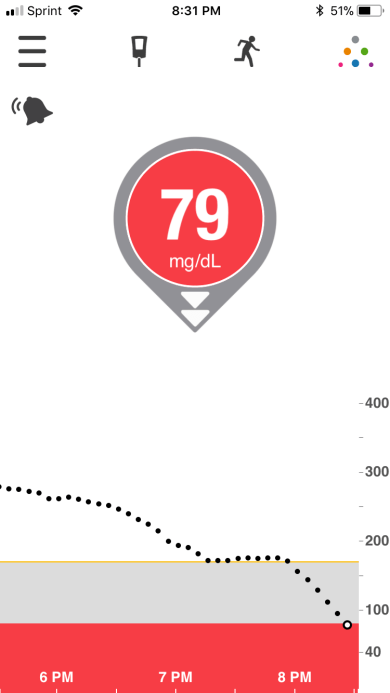
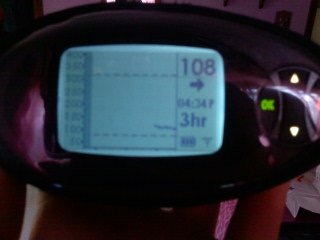
Watching the 3 point drop…
…brought me a bizarre sense of delight.
I remember this particular example bringing me happiness, because I’d been hovering pretty close to my high limit (170 mg/dL) for a couple hours. So watching that three-point shift happen reassured me that I was going to come down. And sure enough, 15 minutes after capturing these screenshots, I was going down closer to my target of 100.
When it comes to diabetes…it’s the little things, right? Am I the only one who likes monitoring my CGM this closely, every once in a while? Or am I just weird?
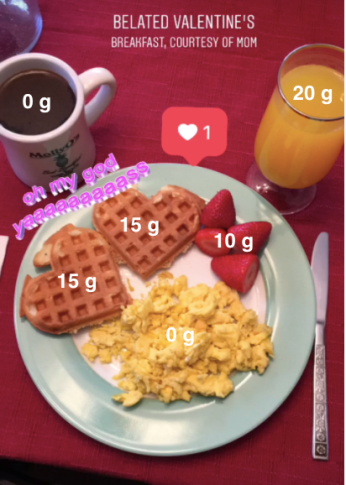
Look at the following image: What do you see? Breakfast, or a plateful of carbohydrates?
Breakfast, or a plateful of carbs? Trick question, it’s both.
Trick question, it’s both.
I seldom enjoy large breakfasts like this, but when I’m treated to them, it’s more than just a savory, delicious meal. It’s also a math problem. So besides looking at a plate full of yum, I’m also looking at this:
Looks like I’m having approximately 60 grams of tasty carbohydrates.
I can’t help it, I HAVE to look at my food this way because it helps me determine how much insulin I have to take. Once I add it up, I take the total amount (60) and divide it by 8, because that’s my morning insulin-to-carb ratio. From there, I take about 7.5 units of insulin to cover my breakfast. Of course, I’m not doing the division by myself – my pump is programmed to know all my mealtime ratios, so the only steps I’m responsible for is adding up my carbs and entering that information into my PDM.
You might think it’s a lot of work, but it’s what I’m used to, along with my fellow T1Ds. It all comes with practice, and before long, calculating carbs becomes part of the normal daily routine.
So this example is both breakfast and a plateful of carbohydrates, but that doesn’t make it any less enjoyable. After all, I’m used to crunching numbers along with my food.
One Monday per month, I’ll take a trip down memory lane and reflect on how much diabetes technology, education, and stigma has changed over the years. Remember when…
…Dexcom CGMs made their debut?
It was just over ten years ago that the Dexcom SEVEN CGM System launched. I didn’t actually know more about it, though, until a couple years after the fact. That was when my endocrinologist encouraged me to sign up for a week-long trial run with this new technology to see how I liked it.
Then: The Dexcom SEVEN CGM System
I didn’t like it, I LOVED it. I quickly became obsessed with the ability to monitor my blood sugar levels at all times. But it’s funny to think back to how bulky and just plain different that first-generation system was compared to today’s sleek and highly functional models.
A few key differences between now and then:
Size. The first CGM was large. It was roughly the size of my OmniPod PDM, which might not seem so significant, but it is when measured up against newer CGM models.
Display. The screen on my first CGM was very simple. No colors, no frills – just readings of my blood sugar. That was all fine, but I have to say that I’m a fan of color-coordinated blood sugar reports (red for low, yellow for high, gray for in-range numbers). In a weird way, it motivates me to keep my graph as gray as possible.
Distance restrictions. I hated that I had to keep my first CGM so close to me at all times, or else run the risk of losing data! It was hyper sensitive and my readings would be lost if I left the same room as the CGM for more than a couple of minutes. My CGM is now able to pick up readings from much farther away – sometimes, even when I’m downstairs and it’s upstairs.
Sounds. My memory is a little foggier on how the sounds compare between old and new Dexcom CGM generations, but I do recall the beeps and vibrations being far more aggressive and annoying on older models.
Smartphone access. This might be one of the biggest and best changes – the ability to download an app on your smartphone that can replace a Dexcom receiver. How awesome is that? Plus, if you choose to do so, you can invite family and friends to monitor your blood sugar along with you, which can be helpful in certain situations. Cell phones are so ingrained into society, so this move was brilliant on Dexcom’s part.
Now: Dexcom data, on my iPhone!
All these improvements have made me a member of Team Dexcom for life. It’ll be neat to see what they come up with next to help make the lives of people with diabetes easier and better.
Nothing makes me feel as defeated as high blood sugar.
Maybe it’s because it takes so long for my blood sugar to come back down from a high.
Maybe it’s because I feel like I directly caused it – miscalculated my carb intake, or snuck in a snack that I shouldn’t have.
Most of these highs occurred due to a bent cannula in my pod a couple weeks ago.
Maybe it’s because it makes me feel like I’ve lost all control. That I can’t do anything but monitor the situation and take more insulin as necessary. I hate feeling so dependent, so trusting, of my insulin alone.
Maybe it’s because the technology has failed me, and there’s few things more frustrating than that. Imagine doing everything the “right” way, the way you’re supposed to, and getting the “wrong” results. You begin to question everything and your emotions get the better of you.
Whatever the reason is, I know I’ve got to work on accepting the fact that highs happen. I’ve dealt with many over the years, and I know I’ll encounter plenty more in the future. They’re upsetting, tiring, and irritating. They test my patience as I wait for long stretches of time for my insulin to finally kick in and stabilize my blood sugar. They are one of the more mentally and physically draining components of type 1 diabetes management.
Or the pizza. Or the burrito. Or the decadent three-layer chocolate cake. Whatever the high-carb indulgence is, I’d rather just relish in it rather than focus on my diabetes.
Does that make me a “bad” diabetic? No. It’s not like I’m skipping an insulin dose or binge-eating food. I’m merely trying to enjoy a rare treat as well as the social experience that comes with it – like having sushi with coworkers.
A recent sushi dinner reminded me that it’s okay to stop thinking about my diabetes for a little while.
So instead of staring at my double-up arrows on my Dexcom, I’m staring at the artfully arranged sushi platter in front of me.
Instead of ordering the lowest-carb item on the menu, I order what I actually want to eat.
Instead of fretting over how quickly my insulin will kick in, I fret over which sushi roll I should try first.
Instead of letting my diabetes take over my dinner, I’m letting it go and living.
Sometimes, I need to remind myself that it’s okay to stop obsessing over my blood sugar in order to just live and enjoy my life.
One Monday per month, I’ll take a trip down memory lane and reflect on how much diabetes technology, education, and stigma has changed over the years. Remember when…
…BD glucose tablets were like, the only kind of tabs available?
I remember them vividly. The tablets were came in what looked like giant packages of gum. They were orange-flavored, but colored white. And they were square, chalky, and the epitome of boring. Even so, I’m slightly embarrassed to admit that I used to sneak them from my mom’s purse when I was little. (Sorry, mom.)
I don’t really know why I did it, considering they weren’t exactly the tastiest treats. But it felt rebelliously good to take one here and there, even if I wasn’t experiencing a low blood sugar. I knew I wasn’t allowed to graze on snacks as I wanted, and I knew that it would make my blood sugar go up. I also knew that I didn’t fully understand what diabetes was and why it was so important to be careful with how many glucose tablets I ate at the tender ages of six and seven years old.
Over time, I kicked the habit. As more flavors and varieties of glucose tablets popped up in the market, I grew increasingly resentful of having to use them to treat lows in the first place. I wasn’t enticed by the tropical or berry flavor mixes; after all, they didn’t have quite the same appeal as those weird white tablets.
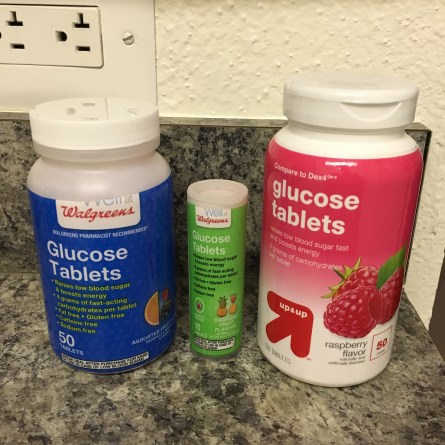
Today’s glucose tablets come in much more colorful and flavorful varieties.
Now, I’m just glad I’ve discovered ways to bring up a low quickly that don’t involve chewing chalky discs. Orange juice, mini boxes of raisins, gummies, smarties, and more all work efficiently. I still choose to carry around glucose tablets, though, because the tube they come in is discreet. Glucolift brand tablets are a personal favorite to stock the tube with, because they’re more pleasant to ingest, thanks to their quick-dissolve formula. Plus, I can’t totally hate something that’s saved my butt more times than I can count.





 Hugging the Cactus