The T1D Taste Test: My Unofficial Ranking of Drugstore Glucose Supplements

You may have heard of glucose tablets, but what about glucose gummies? Or liquid glucose, or glucose gel? Have you tried any of these forms of glucose?
B40CD359-8AE4-46A5-88E0-0E745CDE2A8C
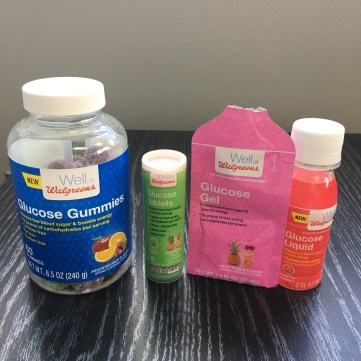
The four forms of glucose (that I’ve tried).

I’ve used them all, and I’ve formed some pretty strong opinions about each of them. I thought it’d be fun to rank them in order of most appetizing to least appetizing, because while they can effectively and efficiently correct low blood sugar, they certainly aren’t created equally:

  1. Best Tasting: Glucose Tablets. I can hardly believe that the most boring variety is the winner here, but it blows the competition out of the water for several reasons. For starters, glucose tablets come in an array of flavors. Orange, raspberry, fruit punch, grape, tropical, and sour apple are among the flavors I’ve tried over the years, and most of them are palatable. Plus, glucose tablets are most akin to actually candy: I’ve described them as giant Smarties to inquiring friends in the past. While actually Smarties are more fun to eat, glucose tablets are their closest counterpart in the diabetes world, making them a number-one choice in low blood sugar situations.
  2. Runner-Up: Glucose Gummies. I’m awarding second place to glucose gummies, mainly because of their novelty. It’s not particularly a standout in other categories like taste and texture. The gummies only come in three flavors: grape, orange, and apple, leaving something to be desired in terms of variety. And all three of those flavors taste a little…off, like there’s a little too much artificial additives going on. Maybe this was done deliberately to distract from the texture of the gummies, which tends to be hard/stale in my experience. It’s nice that the gummies have a layer of sugar on them to convey the likeness of real gummies, but that stuck-to-your-teeth feeling makes it harder to appreciate the gummies for what they are.
  3. Third Place: Glucose Gel. I’ve only ever found glucose gels in the fruit punch flavor at Walgreens – do they actually come in other flavors? Besides being one-note, the gel is a unique texture situation…not quite a liquid, not quite a solid. Gels aren’t a mainstay in my low blood sugar kit because I’m not fond of having to slurp them out of the pouch like a tube of Go-Gurt; in fact, I’d much rather have yogurt from a plastic tube than a gel because the yogurt is much tastier. The gel is just too artificial, with a medicinal aftertaste. And it doesn’t help that the consistency of it reminds me of hand sanitizer.
  4. The Loser: Glucose LiquidIt’s surprising that the glucose liquid wound up in last place, because on the surface, it had a lot going for it. I liked that it came in a small bottle and it seemed like it would be super easy to consume. All I’d need to do is pop the cap off and swig it down. But MAN, the taste was HORRIBLE! I thought I’d like the mixed berry flavor, but it tasted so supremely saccharine and fake that I could scarcely force myself to swallow it. I know, I know, it’s liquid glucose, it’s supposed to be very sweet. But this stuff was just over the top. I definitely will not be buying glucose liquid again any time soon. I’ll stick with my tried-and-true tablets.

Do you agree with my rankings? Did I miss any form of glucose that can be bought in most drugstores, and you think I should give it a try? Let me know in the comments!
Money Talks, Low Blood Sugar Slurs

Somewhere between Class A, B, and C share mutual funds, I got lost. That familiar fog clouded my brain and I had trouble focusing my gaze on anything, let alone absorbing any of the information being shared with me. I felt like I must’ve nodded my head so many times over the course of the conversations that I probably resembled a bobble-head. Words tumbled slowly, awkwardly, out of my mouth: I babbled “yup” and “right” over and over again to show that I was still engaged, even though I absolutely wasn’t.

What was wrong with me? I was having a low blood sugar in the middle of my (first-ever) meeting with a financial advisor. Stellar!!!

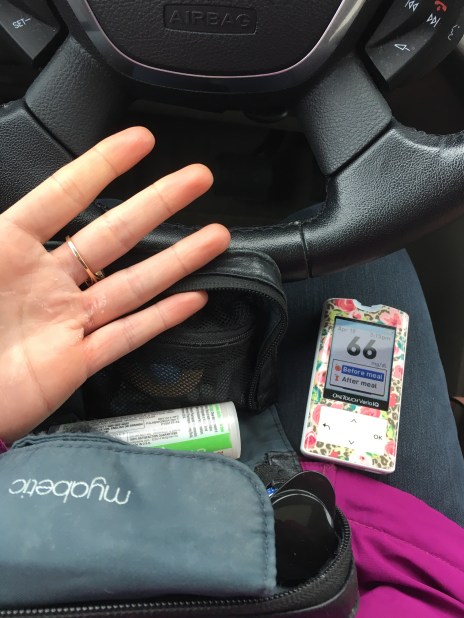
Obviously, I made it through the meeting fine. I got back to my car, tested my blood sugar, discovered that I was 66, and corrected it with three glucose tablets. I wiped my hands together, watching glucose dust puff up into the air like a cloud, and chided myself for not taking action sooner than that moment. I suppose I didn’t want to alarm the advisor by sticking a needle into my finger in the the middle of our meeting, but that hasn’t stopped me from doing what I must do, medically speaking, in other situations. Ordinarily, I would have calmly explained, “I have type one diabetes. I think I’m experiencing a low blood sugar right now. Do you mind if I check my blood sugar here, or could you please direct me to a place where I can do that?” I would also let the person know that I’d be fine either way, I just wanted to be sure so I could focus my energy back onto them and not my diabetes.
IMG_6428

I’m not really sure what was different about this particular low blood sugar event, but I didn’t do the “right” thing because I didn’t want to be rude and interrupt the advisor’s train of thought. But waiting nearly thirty minutes into experiencing these symptoms could have caused things to turn out much differently. My blood sugar could have gone even lower, and it could have become an embarrassing or scary situation for both of us.

I guess this’ll serve as a reminder to myself to speak up. It’s okay to interrupt, because my health and safety (and potentially the health and safety of another person) is at risk. It’s not rude, it’s good common sense.

Favorite Things Friday: Tabs2Go Cases

One Friday per month, I’ll write about my favorite diabetes products. These items make the cut because they’re functional, fashionable, or fun – but usually, all three at once!

Traditionally, I’ve toted glucose tablets around in a tube. My tube of tabs travels with me everywhere, because lows can be unpredictable and it’s always wise to be prepared. Though the contents of the tube have quite literally saved my life countless times, said tube is bulky. It takes up room in my diabetes kit. The tube is awkward to carry around when I go jogging, and more often than not winds up getting tucked away in my sports bra – not the most comfortable feeling.

But then a little, square, plastic container came into my world and changed how I carry around glucose tablets.

IMG_6145.JPGIMG_6144


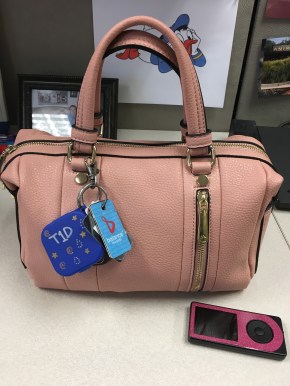
See that bright blue object attached to my purse? That’s a Tabs2Go case! It holds four glucose tablets at a time, the perfect amount to bring me back up from a low blood sugar. What I love most about it is that it’s dual purpose: It’s a case for tabs as well as a keychain. This means I can attach and detach it from my various key fobs, lanyards, and bags with ease, and as I please. I can tuck the case into my pocket without it creating an unsightly lump, and it stows away discreetly just about anywhere.

I have to give a shout out to Scott Bissinger, who created Tabs2Go and kindly supplied me with two of my own when I met him at the TypeOneNation Summit in Boston last month. Innovative products like this help to make the lives of people with diabetes a little easier, which makes me grateful.

Plus, I have to point out the fact that these cases are customizable. See the metallic embellishments I added to mine? Diabetes products that are functional and can be personalized are the real winners in my book!

“I’ll Have a Regular Soda, Please.”

A funny thing about life with diabetes is that new experiences occur all the time. For example, this was a first for me the other day: ordering a regular soda at a restaurant instead of a diet.

Why was this necessary? I chalk it up to a few different factors that affected my blood sugar: 1) I did strength training earlier in the day, which can make me go low several hours after the fact. 2) I ignored the diagonal down arrow that had appeared on my CGM, because I really didn’t think I’d end up below 100 mg/dL before dinner. 3) It took a long time for our dinner to come out, and I’d made the rookie mistake of bolusing soon after ordering the food. 4) I also think I miscalculated the carbs in my dinner – I’m used to ordering this particular dish, a cajun chicken salad, with a beer or two. But since I gave up alcohol for Lent (more on this in an upcoming blog post), I wasn’t getting the extra carbs from the beer, which I forgot to take into account.

So yeah, in hindsight, I could’ve seen the low blood sugar coming. But I just didn’t anticipate some of these occurrences, such as our food coming out late. This particular restaurant is usually timely, but since it was a Saturday evening and the bar was rapidly filling up, I should’ve connected the dots.

IMG_5443
Diet Coke has a special place in my part, but in a hypoglycemic emergency, it just won’t cut it.

Shoulda, woulda, coulda. There was nothing I could do about my rapidly dropping blood sugar, unless I bit the bullet and ordered a regular soda. Shoving my diet root beer to the side, I flagged down my semi-bemused bartender and asked for a regular Pepsi, trying to ignore the fact that he was joking about how “diet just wouldn’t do it for me any longer, eh”.

If only he knew that the circumstances required sugar, stat.

It only took him about 60 seconds to deliver the Pepsi, but it felt like a long time. My CGM alerted me to an urgent low and things around me were a little fuzzy. I was trying to engage in conversation with my companions, who knew that I was going low, but maybe weren’t aware of how quickly I was going down due to my determination to appear normal.

Once my Pepsi arrived, I gulped down several sips and sighed with relief as my dinner appeared soon after. I wolfed down every last bit of it within 15 minutes, taking breaks only to drink a little more soda. I knew I needed to control how much I drank, because I didn’t want to end up sky high later on in the night.

Fortunately, my blood sugar was coming back up to normal within no time, and I actually didn’t even go higher than 172 mg/dL for the remainder of the night. A huge win, all things considered. Even though it was a somewhat scary experience, I’m glad I did what I needed to in order to take proper care of myself…even if that meant drinking regular soda, which was actually pretty gross. How do people actually enjoy that saccharine sludge?!

The Week of Never-Ending Lows

A couple weeks ago, I was convinced that I was going to go insane.

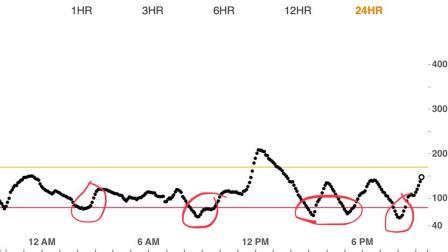
That’s because my graphs looked a lot like this for several days in a row:

28276753_2470934019799402_3452392286696220057_n

All those red circles represent low blood sugars. The first day it happened, it was annoying. The second day, it evolved into concerning. Seven long days later, I was feeling incredibly burnt out as the low streak finally came to an end.

I have NO idea what triggered these lows. My activity levels were practically non-existent and I cut back on my insulin intake as it grew more apparent that this situation was sticking around for a bit. Besides standard stress levels, I wasn’t experiencing any crazy emotional swings that could cause wacky numbers. It was that certain, ahem, time of the month – but that happens every month, and I’ve never had a series of low blood sugars as a result of it. So what gives?

My honest assessment: Diabetes is unpredictable. You think you know it so well. You think you can have a handle on it when it decides to give you a big, old middle finger, as if to say, “Joke’s on you!!!”

And that’s beyond exhausting. The physical and mental toll that a week of low blood sugars had on me is indescribable, and it made me reluctant to even talk about the experience – because enduring it was enough, why the hell should I bother writing about it?

I write about it because I want it as evidence so I can remember that I can overcome any diabetes obstacle. I write about it because I want others to know that even though I seem okay on the surface at a given time, I actually might not be due to my diabetes. I write about it because I hope that another PWD can read it and say, “Yes, that’s exactly what it’s like!” or “I can relate.”

I write about it to feel less alone, and make other people affected by T1D feel less alone.

Memory Monday: BD Glucose Tablets

One Monday per month, I’ll take a trip down memory lane and reflect on how much diabetes technology, education, and stigma has changed over the years. Remember when…

…BD glucose tablets were like, the only kind of tabs available?

I remember them vividly. The tablets were came in what looked like giant packages of gum. They were orange-flavored, but colored white. And they were square, chalky, and the epitome of boring. Even so, I’m slightly embarrassed to admit that I used to sneak them from my mom’s purse when I was little. (Sorry, mom.)

I don’t really know why I did it, considering they weren’t exactly the tastiest treats. But it felt rebelliously good to take one here and there, even if I wasn’t experiencing a low blood sugar. I knew I wasn’t allowed to graze on snacks as I wanted, and I knew that it would make my blood sugar go up. I also knew that I didn’t fully understand what diabetes was and why it was so important to be careful with how many glucose tablets I ate at the tender ages of six and seven years old.

Over time, I kicked the habit. As more flavors and varieties of glucose tablets popped up in the market, I grew increasingly resentful of having to use them to treat lows in the first place. I wasn’t enticed by the tropical or berry flavor mixes; after all, they didn’t have quite the same appeal as those weird white tablets.

772D403E-BB4C-4A32-8579-3AFFE9FF404B
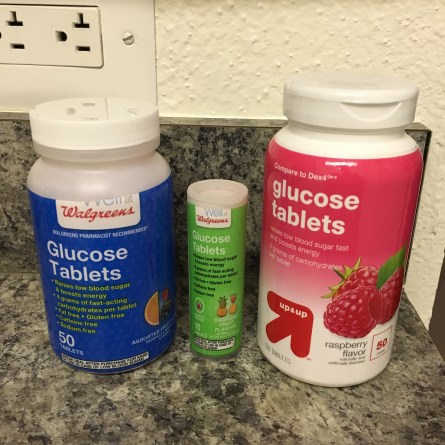
Today’s glucose tablets come in much more colorful and flavorful varieties.

Now, I’m just glad I’ve discovered ways to bring up a low quickly that don’t involve chewing chalky discs. Orange juice, mini boxes of raisins, gummies, smarties, and more all work efficiently. I still choose to carry around glucose tablets, though, because the tube they come in is discreet. Glucolift brand tablets are a personal favorite to stock the tube with, because they’re more pleasant to ingest, thanks to their quick-dissolve formula. Plus, I can’t totally hate something that’s saved my butt more times than I can count.

What it Feels Like to Have Low Blood Sugar

Diabetes evokes curiosity for those who are not familiar with it. I’ve been asked many questions over the years – can you eat sweets, does it hurt when you give yourself shots, do you have to protect your pump from water, just to name a few – all relatively easy-to-answer, yes-or-no questions. But every now and then, someone will ask harder questions. And one that I’ve struggled to answer in a succinct manner is: What does it feel like to have low blood sugar?

There isn’t really a simple answer. I guess my textbook response is to rattle off a list of common hypoglycemic symptoms: shakiness, dizziness, sweating, slurred speech, weakness. But I know that other PWD experience slightly different symptoms, such as feeling cold instead of sweaty, or drastic changes in personality. And there are even some PWD who don’t experience any symptoms due to hypoglycemia unawareness.

So how exactly do I response to a question like that, one that’s more loaded than it appears?

lowbg
A graphical representation of a sudden low – I guarantee I was not feeling great when this one hit.

I could tell the asker to imagine feeling simultaneously ravenous and disoriented. I could tell them to picture walking into the kitchen and feeling like inhaling the entire contents of the pantry – that’s how intensely your body craves sugar.

I could tell them to think about what it’s like to wake up in the middle of the night drenched in sweat. It might seem like a reaction to a nightmare, but it’s the body trying to convey a message that is, by some miracle, supposed to be grasped by someone who was just trying to get a solid night’s sleep.

I could tell them to envision feeling like energy is sapped out of every pore in the body abruptly, with little warning.

I could tell them that sometimes, it results in pure panic, particularly when no fast-acting carbohydrates are on hand or when no one is around to help you.

I could tell them that low blood sugar is one of the biggest sources of anxiety for many PWD, that it causes a deeply rooted fear. That it can sometimes lead to a PWD making unhealthy choices just to avoid a low from happening in the first place.

I could say all of this to anyone who asked me this question – and I still don’t think it would completely convey what it’s like to have low blood sugar.

How would you describe it to someone asking you about it? Would you use the terse medical explanation, or would you try to talk about how it really feels?

Leave your responses in the comments – I’d like to know how you handle this. And if you thought this was an interesting post, let me know. I’m thinking of doing a series about how I answer the more complicated diabetes-related questions I’m asked.