My New Favorite Low-Carb Recipe

The other night, I had two of my close girlfriends over for a couple hours of chatting and snacking. I’d thrown together a veggie tray for us to munch on and mentioned to my friends that I had tons of vegetables in the fridge that I wanted to try and use up in the next few days. They asked what I had, and I went through the list: tomatoes, snow peas, carrots, celery, peppers, and zucchini. At the mention of “zucchini”, one friend asked if I’d ever made zucchini pizza before.

My ears perked up. Zucchini pizza? I’d heard of making low-carb pizza using keto crust or even cauliflower crust, but not zucchini.

She told me how easy it was to make what she described as zucchini pizza bites: Cut up a zuke, top the slices with marinara sauce and cheese, and toss it in the oven. It was such a simple recipe that I decided to scour the Internet for ways to zest it up a bit.

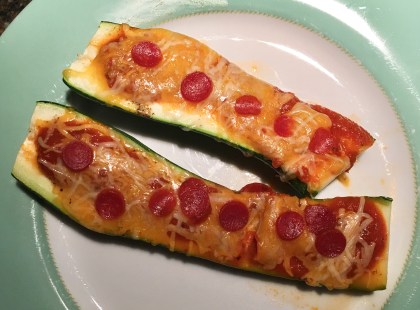
That’s how I came across zucchini pizza boats, my new favorite way to consume pizza-esque food without all the guilt.
C856214C-24B7-4091-9775-B009E15BCF70
One half is shorter than the other…because I couldn’t resist tasting my creation before snapping a pic. Oops!

Here’s how I made ’em:

  1. Preheat oven to 425 degrees. Cover a baking sheet with tinfoil – this makes clean up easier.
  2. Cut zucchini in half, lengthwise. Pat the insides dry. Place both halves onto the baking sheet.
  3. Brush olive oil on each half. Sprinkle garlic salt on top.
  4. Spoon marinara sauce (or any kind of red pasta sauce) on top.
  5. Sprinkle any kind of shredded cheese you like on top (I used a Mexican blend), followed by Parmesan cheese.
  6. Add mini pepperonis on top. Bake in the oven for 12-15 minutes or until the cheese has melted nicely on top.

And that’s it! Incredibly quick, easy, tasty, and filling. I ate these with a small serving of roasted Brussels sprouts and chicken meatballs and I was super satisfied. The best part is that I barely bolused for this meal and wound up with a fairly straight CGM graph.

I’ll definitely be prepping zucchini pizza again in the future, and maybe I’ll even add a few more carbs into the mix to see how my blood sugar fares.
Why I Decided to do a 3-Day Cleanse (and How it Impacted my Blood Sugars)

No carbs. No dairy. No meat. No processed foods. Strictly vegetables, fruits, and shakes for the next three days. 72 hours – I could do it, right?

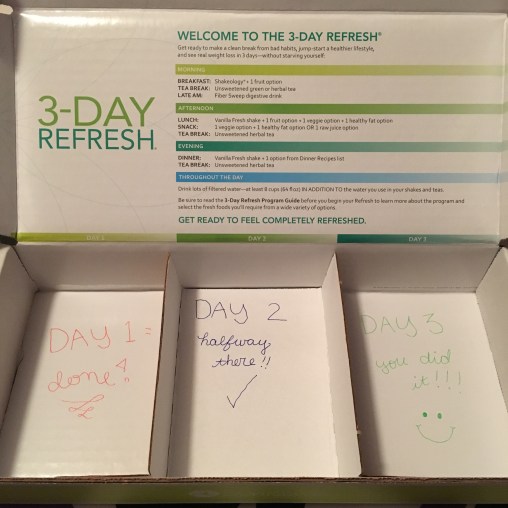
Last week, I completed a 3-Day Cleanse. My goal was that it would help me feel a little bit refreshed after a couple weeks of nonstop gluttony. I figured it’d help reset my system and make me feel less bloated and tired. I didn’t want to do a typical “cleanse” though, the kind that forces you to stop eating any and all food and stick with juices. That’s why I did this particular program – I would be eating real foods on a regular basis throughout all three days. The bonus was that it would be foods I’m familiar with and are generally low carb, which could only mean good things for my blood sugar.

My routine for all three days would follow this format: Wake up, drink a glass of water, blend a shake together with one serving size of fruit. I’d have a cup of herbal tea one hour after breakfast, and one hour after that, I’d have a fiber-filled drink. Lunch would consist of another shake, one serving of vegetables, one serving of fruit, and one spoonful of hummus. I’d have an afternoon snack of baby carrots and one spoonful of almond butter with another cup of herbal tea an hour after consuming the snack. Dinner would be one last shake, one cup of vegetable broth, and a spinach salad with olive oil and lemon juice drizzled on top. I could have a final cup of herbal tea any time in the evening.

5A4A1ADE-4D94-4BDE-BA41-FA1453340655

I didn’t expect to learn as much as I did throughout the program, but those three days taught me a lot about how the things I put into my body impact not just my blood sugar, but my state of mind. Here’s what happened during my cleanse:

  • Day 1 – This day was by far the easiest to complete. Despite dialing back the amounts and types of foods I was consuming, I didn’t feel hungry at all – everything sated me. I was really enjoying watching my Dexcom CGM graph because it barely budged. I stayed right around 90-110 mg/dL for most of the day, probably because I was eating minimal carbs. Fewer carbs means less room for error, and this concept was definitely cemented into my mind by the end of the cleanse. I went to bed with a slight headache at the end of day 1, but a smile on my face. This would be a breeze!
  • Day 2 – My CGM sensor went kaput by mid-morning, and I was PISSED about it. I wanted the ability to continue tracking my blood sugars on this cleanse, and suddenly it was no longer available to me (because oh-so-conveniently, it was my last sensor in stock). Fuming over my CGM situation, I started feeling slight pangs of hunger shortly after having my fiber drink. I ate lunch as soon as I could after that, and spent much of the rest of the afternoon fighting a headache and dreading going home to see – not eat – my mom’s delicious home cooking. On the brighter side of things, my digestion seemed to be improving already and I felt a bit less bloated.
  • Day 3 – I went from “Oh, this cleanse will be a breeze!” to “OMG THESE ARE THE LONGEST THREE DAYS OF MY LIFE GIMME REAL FOOD AGAIN BEFORE I HAVE A MELTDOWN” in less than 48 hours. That’s gotta be a new record. I distracted myself as much as I could from my misery by burying myself in my work, which helped to a degree. But I couldn’t fight the lightheaded sensation that seemed to grip my entire body. I was confused by that – I though only eating real, plant-based foods would eliminate crummy feelings. Maybe I was experiencing a sort of withdrawal as my body got used to this new diet? I can’t confirm that, but I suspect that after a few more days, I likely would’ve felt much better…or hungrier. I’ll leave it to speculation because there is no way I’m doing this again any time soon. But MAN, am I proud of myself for completing the cleanse without cheating, not even once.

So if I felt THAT miserable toward the end of the cleanse, then why am I glad that I did it? Mainly, I’m astonished at how much easier it was to maintain my diabetes and “desirable” blood sugar levels in that three-day time period. Even without my CGM, I was still getting great results. It reinforced something that I already knew: that the body will react accordingly to the quantity and quality of foods that are used to nourish it. It made me realize that perhaps I should toy with cutting down my daily carb intake and upping my veggie/fruit/protein consumption to find out whether that positively impacts my blood sugar in the way that I think it will. This doesn’t mean I’m starting a low-carb or keto diet; rather, I’m simply going to follow a more thoughtful one.

To sum it up, this three-day cleanse/torture act/lesson (whatever you want to call it) helped make my understanding and appreciation of food much stronger, which makes it worth it in my book.


Favorite Things Friday: Mini Boxes of Yogurt-Covered Raisins

One Friday per month, I’ll write about my favorite diabetes products. These items make the cut because they’re functional, fashionable, or fun – but usually, all three at once!

Mini boxes of yogurt-covered raisins is an oddly specific kind of food, but they’ve literally saved my life (and my mom’s) hundreds of times.

I’m almost certain that I introduced these raisins into our low supply kit because I was looking for something that 1) was portable 2) had 10-15 grams of carbs 3) could be quick and easy to consume and 4) wasn’t glucose tablets (I get sick of them). I must’ve been browsing through the aisles of the grocery store when I found a bag containing 10 mini boxes of raisins. Clocking in at exactly 10 grams of carbs per box, they seemed to fit the bill nicely. I brought them on a trip to Disney World soon after buying my first bag, and that sealed the deal for me. They proved to be super convenient throughout the trip and helped prevent me from over-correcting my lows, which was huge for me.

E132E84E-66A6-422A-BCE6-540FE52192D2
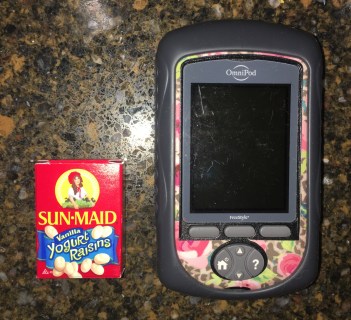
A box of raisins adjacent to my OmniPod PDM. I can easily fit several boxes of raisins into my purse, along with my other diabetes supplies.

Since that trip, the raisins have become a go-to low treatment for me and my mom, who agrees that they work just as well as glucose tablets. They’re much tastier than glucose tablets, and qualify as a healthier way to treat a low. As tempting as it might be to treat with Skittles or Starbursts, I struggle to control my intake of the candy when dealing with a particularly icky low. The raisins are already perfectly portioned, so that eliminates the can’t-stop-won’t-stop (eat ALL the foods!) feeling that can make dealing with low blood sugars difficult.

The raisins are excellent on the go, too. I can pop a box of them in the car, at my office desk, in the gym, or at church. I’ve even whipped them out at bars, and my friends get a bit of a chuckle when I down them like a shot of alcohol. But honestly, they’re so discreet and go down so easily that most of the time, people don’t even notice that I’m eating them. And if people aren’t noticing yet another part of my otherwise very prominent diabetes care kit, then that suits me just fine!

Banana, No Bolus

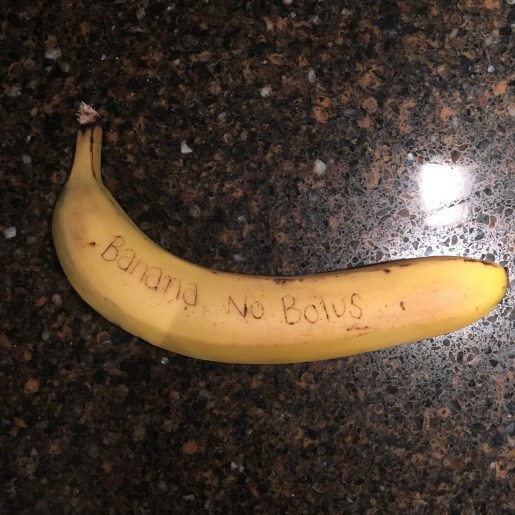
I ate a banana the other day without needing to correct for it. My blood sugar prior to eating it was 96 mg/dL. I sensed and oncoming low, and trusting this instinct, I decided to skip bolusing (taking insulin) for it. Two hours later, I was 108 mg/dL.

How did I do it?

Did my pancreas suddenly start working again?

Was it a low-carb banana?

Was sorcery involved?

I’ll explain how it happened; no, my pancreas didn’t suddenly decide to start secreting insulin; no, because low-carb bananas aren’t even a thing; and sadly, no, though I do wish I was well-versed in real-life wizardry and/or witchcraft.

IMG_6602

It happened because I was running around like a maniac that entire morning. High activity levels can do a number – that is, lower the numbers – on a diabetic’s blood sugar. Between walking my dog, playing with him some more outside, and running errands, I scarcely had a chance to catch my breath from the time I woke up until noon. It was still mildly surprising, though, since bananas are a notoriously high-carb and fast-acting food. I’d expected to be at least 50 points higher from the initial blood sugar.

I was pleased with this outcome, but I still think that the voodoo magic – ahem, science – behind diabetes is just plain weird sometimes.


Peanut Butter Paradise

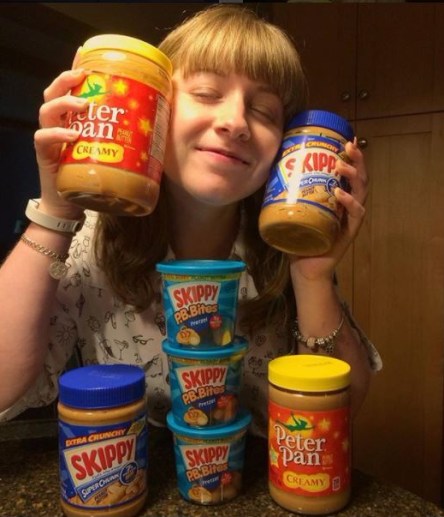
Family members, friends, coworkers, and really any one person who is the least bit acquainted with me all know one thing: that I, Molly Johannes, have an addiction to peanut butter.

Creamy, chunky, even the powdered stuff that you mix with water – it’s all positively delicious to me. I’d like to blame it on the fact that peanut butter is a lower-carb food item; when I was little, it was the first thing I’d reach for when simultaneously experiencing high blood sugar and hunger. Okay, okay, it still is my go-to snack even now.

Capture
Living my best life in peanut butter paradise.

What’s not to love about peanut butter? It’s rich and thick, somehow sweet and savory at the same time. It pairs excellently with a number of foods, from apples and bananas to toast and crackers. It also comes in a wide array of flavors; beyond traditional, I’ve seen peanut butter fusions containing white chocolate, dark chocolate, honey, strawberry, and pumpkin. I can honestly say I’ve yet to come across peanut butter in any iteration that I truly disliked.

It’s a problem. A peanut butter problem. But an oh-so-tasty (if highly caloric) one to have, and one I’m happy to live with because it coexists so blissfully with my diabetes.

How I Learned the Importance of Carb Counting

One recent evening, I was rummaging through the kitchen pantry and noticed a bag of “veggie stix” stashed away, waiting to get opened. The sight of the bag instantly brought back memories of a time I was blatantly irresponsible with my carb counting and insulin dosing…

IMG_6147

…It was my junior year of college. I had plans to meet with a friend for dinner at seven o’clock. While that’s a standard suppertime for many people, it was kind of late for me. So that explains why I decided to treat myself to a snack a couple hours before it was time to go, just to hold me until I had my meal. My snack of choice? A bag of veggie stix just like these were sitting in the kitchen of my on-campus apartment. I thought I’d help myself to a few, believing (naively) that I had enough self control to know when to stop shoveling them down my gullet. That’s right, instead of doing the right thing and counting out a bunch before stowing the bag away, I was blindly consuming handful after handful without dosing for a single stick.

I can’t even use the defense that these veggie stix are strangely addicting – they really are, they taste a little like those potato sticks that used to come in cans – because I knew what I was doing wasn’t good for me. I just didn’t care. I had munched my way through half of the bag when it dawned on me that it would probably be smart to stop myself from eating more. I rolled up the bag, returned to my room, and did some homework until it was time to meet with my gal pal.

Little did I know that my blood sugar was rising to potentially dangerous levels.

I didn’t find out how high I was – over 400 mg/dL – until I reached the sandwich shop and had a plate full of chicken pesto carb-y goodness waiting to be consumed. My face must’ve shown my shock, because my friend asked me if I was alright. I quickly explained to her my mistake, and took an extra large bolus to cover my food and correct my blood sugar. Once that was done, I somehow managed to stop panicking long enough to enjoy the dinner with my friend, even though I couldn’t eat a bite of mine until an hour or so after injecting my insulin.

Although it sucked to go through this, I’m kind of glad that it happened because I learned a major lesson from it: ALWAYS count my carbs. It doesn’t matter if I WANT to be lazy or pretend that my diabetes doesn’t exist, I HAVE to hold myself accountable. It may be mentally draining and a bit of a nuisance, but it’s my own health here. It’s up to me, and me alone, to manage it.

And by the way, I did just help myself to the above bag of veggie stix. I had exactly 24 pieces, which equals exactly 5.4 grams of carbohydrates – a much smaller amount than what I ate that one night five years ago.

Low Carb Lasagna Exists, and it is Amazing

Nothing screams “comfort food” quite like a hot, cheesy, and utterly delicious slice of lasagna. Unfortunately, though, said lasagna has a tendency to make my CGM scream, because consumption of the carb-laden food usually skyrockets my blood sugar.

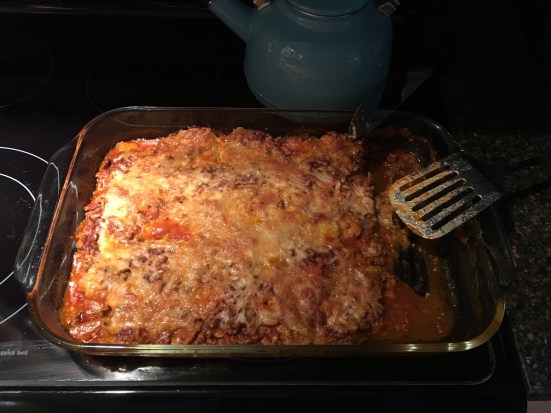
On the bright side, a very low carb version of this dish exists, and it is just as wonderful as its starchy counterpart. The ground beef, pasta sauce, and mozzarella-parmesan blend are all there – the only bit that’s different is what’s used in lieu of pasta.

Instead of pasta, use cabbage leaves. No, I’m not kidding.

IMG_5942
Cabbage lasagna looks and tastes just like its carb-ier alternative.

The cabbage soaks up the flavors of the sauce, meat, and cheese. As the concoction is baked, the cabbage also takes on the same consistency as pasta. It slices just as easily, and no, you really can’t taste the cabbage flavor (unless you pick out several chunks of it to eat on their own, but honestly, who does that?). It’s such a satisfying meal that I promise you won’t miss the carbs from the pasta.

Besides, if you’re like me and enjoy eating a healthy amount of carbs daily…you can always add a slice or two of garlic bread to your meal. I did just that, and in addition to having a well-rounded meal, I experienced great post-dinner blood sugars: a diabetes win!

Breakfast or a Plateful of Carbohydrates?

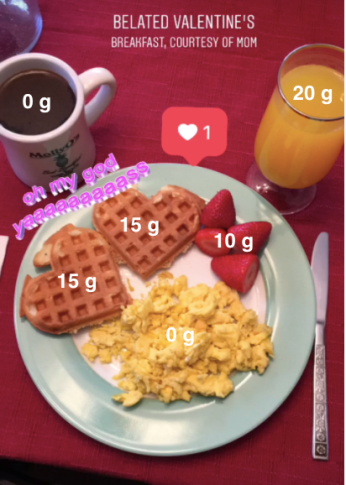
Look at the following image: What do you see? Breakfast, or a plateful of carbohydrates?

4B3EFDB5-F145-49D4-A3D1-7C87C4526847
Breakfast, or a plateful of carbs? Trick question, it’s both.

Trick question, it’s both.

I seldom enjoy large breakfasts like this, but when I’m treated to them, it’s more than just a savory, delicious meal. It’s also a math problem. So besides looking at a plate full of yum, I’m also looking at this:

Screen Shot 2018-02-18 at 10.11.21 AM
Looks like I’m having approximately 60 grams of tasty carbohydrates.

I can’t help it, I HAVE to look at my food this way because it helps me determine how much insulin I have to take. Once I add it up, I take the total amount (60) and divide it by 8, because that’s my morning insulin-to-carb ratio. From there, I take about 7.5 units of insulin to cover my breakfast. Of course, I’m not doing the division by myself – my pump is programmed to know all my mealtime ratios, so the only steps I’m responsible for is adding up my carbs and entering that information into my PDM.

You might think it’s a lot of work, but it’s what I’m used to, along with my fellow T1Ds. It all comes with practice, and before long, calculating carbs becomes part of the normal daily routine.

So this example is both breakfast and a plateful of carbohydrates, but that doesn’t make it any less enjoyable. After all, I’m used to crunching numbers along with my food.

Sometimes, You Just Need to Enjoy the Sushi.

Or the pizza. Or the burrito. Or the decadent three-layer chocolate cake. Whatever the high-carb indulgence is, I’d rather just relish in it rather than focus on my diabetes.

Does that make me a “bad” diabetic? No. It’s not like I’m skipping an insulin dose or binge-eating food. I’m merely trying to enjoy a rare treat as well as the social experience that comes with it – like having sushi with coworkers.

93B96F97-34C6-4FE0-94E5-0B00D31BA43B
A recent sushi dinner reminded me that it’s okay to stop thinking about my diabetes for a little while.

So instead of staring at my double-up arrows on my Dexcom, I’m staring at the artfully arranged sushi platter in front of me.

Instead of ordering the lowest-carb item on the menu, I order what I actually want to eat.

Instead of fretting over how quickly my insulin will kick in, I fret over which sushi roll I should try first.

Instead of letting my diabetes take over my dinner, I’m letting it go and living.

Sometimes, I need to remind myself that it’s okay to stop obsessing over my blood sugar in order to just live and enjoy my life.

Why I Refuse to Quit Carbs

Recently, a random person on the Internet criticized my choice to incorporate carbohydrates in my daily diet. Thanks for the unnecessary judgment, stranger!!!

I’m not really upset about the comment, though, because it prompted me to reflect on why I consume carbs.

F57D800E-5EE7-49C7-8D8D-682748908BD4
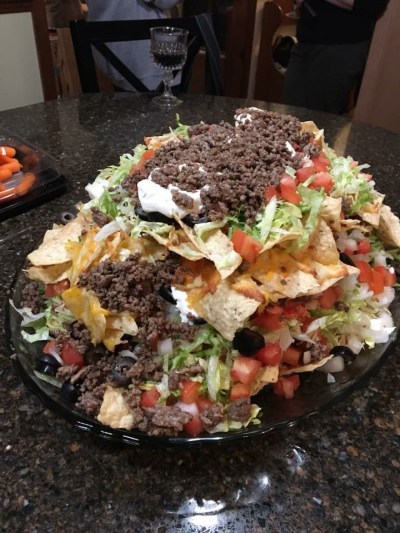
I LOVE CARBS. But of course, everything in moderation! So as much as I’d like to eat this mountain of nachos – a serving will do just fine & works better for me.

For me, it’s about more than just enjoying (relishing, adoring) the taste of carb-heavy substances both starchy and sweet. Carbs also help me achieve balance in my blood sugars. For instance, I find that consuming a serving of carbohydrates at dinnertime keeps me steady as I move through the evening hours. Say that I’m eating grilled chicken with a side salad for dinner. That’s a good meal by itself, but I like to complement it with a carb like half a cup of mashed potatoes or brown rice. I’ve noticed that the carbs kick in more slowly when they’re consumed with minimal or zero-carb foods, thanks to the power of the glycemic index.

The glycemic index is, in short, a measure of how quickly the carbohydrate content of foods will affect blood sugar levels. Since learning about it in college and subsequently researching the glycemic indices of various foods I eat, it’s been an immensely useful tool in determining the makeup of my meals throughout the day. Knowing the glycemic index of a wide array of foods also helps me figure out the timing of my insulin doses; in turn, preventing crazy spikes or crashes after eating.

I can’t shortchange carbs for the fact that they literally save my butt sometimes, too. When I’m experiencing a low blood sugar, nothing BUT carbs will bring me back up to a normal level. Whether it’s carbohydrates from healthy fruits or straight-up candy, it’s giving my blood sugar the surge it needs to keep me going. Like many things in life, it’s a matter of moderation – making sure I don’t consume TOO many carbs when I’m experiencing a low.

If you’re someone who thrives on low carb, high fat diets, that’s great! I know that many people find this to be a successful method in achieving target blood sugars. But for me, my tried-and-true technique of balancing carbs, fats, and proteins is always going to be my ideal strategy. Just because that’s what works for me doesn’t give anyone a right to criticize me for it. I’m here to live my best life, as we all should try to do. Shouldn’t we encourage one another to thrive, instead of judging?

The answer, if you didn’t realize, is YES.