Why I Refuse to Quit Carbs

This is an original post I wrote that was published on Hugging the Cactus on January 26, 2018. I am republishing it now because there’s been some buzz on the Diabetes Online Community recently about different diets people with diabetes “should” and “shouldn’t” follow…and this sums up my feelings on being told what choices I should make when it comes to my own health!

Recently, a random person on the Internet criticized my choice to incorporate carbohydrates in my daily diet. Thanks for the unnecessary judgment, stranger!!!

I’m not really upset about the comment, though, because it prompted me to reflect on why I consume carbs.
Have a slice!
*Oprah Winfrey voice* I. Love. Bread.

For me, it’s about more than just enjoying (relishing, adoring) the taste of carb-heavy substances both starchy and sweet. Carbs also help me achieve balance in my blood sugars. For instance, I find that consuming a serving of carbohydrates at dinnertime keeps me steady as I move through the evening hours. Say that I’m eating grilled chicken with a side salad for dinner. That’s a good meal by itself, but I like to complement it with a carb like half a cup of mashed potatoes or brown rice. I’ve noticed that the carbs kick in more slowly when they’re consumed with minimal or zero-carb foods, thanks to the power of the glycemic index.

The glycemic index is, in short, a measure of how quickly the carbohydrate content of foods will affect blood sugar levels. Since learning about it in college and subsequently researching the glycemic indices of various foods I eat, it’s been an immensely useful tool in determining the makeup of my meals throughout the day. Knowing the glycemic index of a wide array of foods also helps me figure out the timing of my insulin doses; in turn, preventing crazy spikes or crashes after eating.

I can’t shortchange carbs for the fact that they literally save my butt sometimes, too. When I’m experiencing a low blood sugar, nothing BUT carbs will bring me back up to a normal level. Whether it’s carbohydrates from healthy fruits or straight-up candy, it’s giving my blood sugar the surge it needs to keep me going. Like many things in life, it’s a matter of moderation – making sure I don’t consume TOO many carbs when I’m experiencing a low.

If you’re someone who thrives on low carb, high fat diets, that’s great! I know that many people find this to be a successful method in achieving target blood sugars. But for me, my tried-and-true technique of balancing carbs, fats, and proteins is always going to be my ideal strategy. Just because that’s what works for me doesn’t give anyone a right to criticize me for it. I’m here to live my best life, as we all should try to do. Shouldn’t we encourage one another to thrive, instead of judging?

The answer, if you didn’t realize, is YES.
Is it Possible to Eat Pizza Without Encountering Blood Sugar Problems?

My short answer to that question is YES. Yes, it’s absolutely possible to eat pizza – and just about any food, in my opinion – without experiencing turbulent blood sugars.

It all just comes down to serving size, timing, and method of insulin delivery. Piece of cake, right? (Or should I say, piece of pizza?)

Have a slice!

Well, it really isn’t THAT simple. Other factors include the exact type of pizza (Is it gluten-free? Are there toppings? Is the crust thick or thin?), whether or not other food/drink is being consumed with it, whether exercise or inaction will follow in the hours after eating it…truly, there’s all that (and more) that people with diabetes need to think about when eating any type of food.

But what’s different about pizza is that it has a particular combination of fat and carbohydrates that can make it a tricky food for people with diabetes to figure out how much insulin to take and when to take it. It’s a little easier for those of us who have insulin pumps, because we can utilize the extended bolus (or square wave) feature that allows us to give a certain percentage of a mealtime bolus at once, and select a time later on to receive the rest of the bolus.

If that last sentence didn’t make any sense, here’s an example of what I mean:

It’s dinnertime – 5:30 P.M. I have two slices of pizza that I plan on eating. One’s plain, the other has BBQ chicken on it. I figure that there’s 50 grams total of carbohydrates in the two slices of pizza. My blood sugar before eating the pizza is 130 mg/dL. I put that number into my pump, and also input 50 grams of carbs. My pump wants me to take 8 units of insulin to cover the pizza. Instead of administering the full 8 units at once, I hit the “extend” option and opt to take 75% of the dose now, and the remaining 25% an hour and a half from now. So I get 6 units of insulin at 5:30, and 2 units at 7:00. This extended bolus typically has the power to prevent my blood sugar from crashing and spiking hours after eating said pizza, and in turns, saves me from dealing with a massive headache and questioning why I ever ate pizza in the first place.

Granted, an extended bolus isn’t the end-all, be-all. It relies heavily on me and my ability to count carbs correctly and time my boluses perfectly. But I have had fantastic success using it, particularly in a recent situation in which I ate two large slices of whole wheat pizza, a side salad, and a bit of pita bread without spiking beyond 160. I can’t say whether it was the whole wheat crust that helped me out (maybe it has a lower carb count compared to regular crust?), or if it was just supremely accurate calculations on my end, but it really doesn’t matter to me in the end…because I know that I can eat and enjoy pizza – and again, virtually any food – without my diabetes ruining it for me.


Memory Monday: Carb Counting and the Calorie King

One Monday per month, I’ll take a trip down memory lane and reflect on how much my diabetes thoughts, feelings, and experiences have unfolded over the years. Today, I remember…

…discussing carb counting and the role of The Calorie King with a nutritionist.

I’ve met with a nutritionist as part of my diabetes care a few times in my life. During my last visit, maybe six or seven years ago, the nutritionist gifted me with a book entitled The Calorie King. “It’s really going to help you with your carb counting,” she told me.

I remember staring at the book dubiously. It was a compact little thing adorned with bright, bold colors. A bearded man wearing a crown was the cover image, and I couldn’t help but think that it looked totally dorky. I was skeptical: How was a book about calorie counting supposed to help me with my carb counting?

Fresh and Organic
Have you ever heard of The Calorie King or used it yourself for dietary or nutritional purposes?

As it turned out, it could help me a lot.

The Calorie King wasn’t just a list of the calorie content of different foods – it was a comprehensive guide that told me everything about the nutritional content of food. It was like having a manual of nutritional labels, except it was in an easier-to-digest format. And it gave me something that I’d never had access to before: Carbohydrate counts of food that you can get at fast food places, sit-down restaurants, and the like. It gave me a better sense of just how ridiculous some restaurants’ portions can be, as well as how serving size is one of the most critical factors in determining a food’s carb count. My mind marveled at that silly little book’s treasure trove of information, which would be key in helping me determine how much insulin I should take for food in just about any situation.

These days, I use apps on my phone whenever I’m unsure about a given meal or food item. They’re far more convenient than lugging around a copy of The Calorie King. But it turns out my nutritionist kinda knew what she was talking about when she told me that it would open my eyes up to the world of more precise carb counting. And for that, I’m grateful.


Breaking up with P.B.

This is a sad, difficult post for me to write…

I had to end things with P.B. I’m pretty distraught over it, but I know that it’ll do me some good in the long run. Absence is supposed to make the heart grow fonder, right?

If you’re wondering who or what I’m talking about…P.B. is, of course, peanut butter.

the sushi place
Looking at the above image of P.B. is almost enough to make me drool.

It’s that time of year again – the Lenten season, otherwise known as the six weeks prior to Easter during which Catholics traditionally practice penance, prayer, and almsgiving. In addition to avoiding the consumption of meat on Fridays during Lent, it’s also common for observers to give up something in order to focus more energy on acts of kindness and charity.

Last year, I gave up alcohol for Lent and wrote all about it in this blog post. This year, I’ve decided to really test myself by forgoing peanut butter during Lent.

And yes, this truly is a toughie for me…anyone who knows me knows that I love peanut butter. I love it too much. I eat unhealthy amounts of it. If I have a bad day at work, I have a couple spoonfuls of peanut butter. If I need a quick boost of protein, there’s peanut butter. If I’m giving my dog a taste of peanut butter, then you can bet your bottom dollar that I’ll be giving some to myself, too.

I know there are far worse foods out there to be pretty much addicted to – but peanut butter isn’t exactly the healthiest. The kind we keep around the house is not the natural/healthy stuff free from additives. It’s the Skippy/Peter Pan/Reese’s peanut butter jars that we have in stock…it’s the good stuff that tastes sinfully sugary and fatty.

To intensify matters, peanut butter is my go-to food when my blood sugar is high but I’m craving something delicious. Now that I can’t have it for this window of time, I’m going to have to find an alternative that works…and no, I can’t just consume a different type of nut butter. I’m not eating any of it during Lent because I’m choosing to give up ALL of it. If I indulged on almond butter, I feel like that would just make me want peanut butter more, so I’m avoiding any and all temptation. Honestly, my reliance on peanut butter as a food to eat in just about any situation is making me curious as to how my blood sugars will respond without it for this length of time. There’s a chance they could improve; after all, peanut butter is not without carbohydrates or sugar. So I’m cautiously optimistic that I’ll be glad I gave it up for Lent. Hopefully, by the end of this period of time, the distance will have done some good and lessen the strength of my addiction, as well as maybe even help me lose some weight. Time will tell. As for now, anyone have any suggestions on what could possibly, temporarily replace P.B. for me?!

When Diabetes Makes You Eat More in Between the Appetizers and the Main Course

Normally, I don’t eat snacks after I’ve had a starter course at a restaurant, and my order’s in for my entree…because that’s just weird. I’m going to a restaurant to eat food, anyways (presumably a meal), so why on earth would I need to eat a snack in between courses?

Diabetes. Duh. Diabetes is always the answer (or root of the problem).

How annoying it was to start feeling shaky and sweaty, only to discover that my blood sugar was almost in the 60s soon after devouring my app and placing my dinner order. How irritating to know that the two chicken wings I just ate contained virtually zero carbs; therefore, would not do anything to boost my blood sugar any time soon. And how obnoxious it was, looking around the crowded restaurant and realizing it’d likely take some time for my meal to come out – and that the food I’d ordered was also relatively low carb (a bun-less turkey burger with side salad), and would also do nothing to correct my low.

4A4C70F8-D388-4A66-8380-250DE52E655B
You can see that I held off on correcting the low for as long as possible…but then the shakiness started.

Can you tell that I was just a bit irked at the situation?

I did what I had to do – reach into my backpack to grab one of the leftover granola cups from the pack of two I’d started earlier that day. I ate it quickly, crushing the wrapper in my hand and shoving it hastily back into my bag, hoping that no one saw me eating food that wasn’t from the restaurant like a wackadoodle.

And I swear, within five minutes, our food was out. I was happy but also just mad that I had to snack in between my appetizer and my main course. But diabetes is like a petulant toddler – it doesn’t care what you want or need, it just demands. It’s more demanding than any person or thing in my life. It’s exhausting, but there’s no choice other than to just oblige its needs, even if it means eating when you don’t want to.

5 Tips for T1Ds Dining Out

Nothing beats home-cooked meals. But it is nice to go out to eat after a long workweek or to celebrate a special occasion. It’s a good way to unwind and socialize.

And like many other things, it’s also a little bit more complicated when you have type 1 diabetes. Not every T1D might feel the same way as I do, but there are times when I feel worried about going out to eat. Specifically, I start asking myself questions like, “Will there be a decent variety of lower-carb choices on the menu? Have I had this kind of cuisine before, and can I accurately predict how it will impact my blood sugar? Can I order what I actually want to eat without worrying about the carb content? Will the portion sizes be too small or too big? How long will it take for my meal to arrive, and does this mean I can safely pre-bolus for it?” Sadly, those are just a few of the questions that come to mind before some restaurant excursions.

5 tips for t1ds dining out

That’s why I like to remind myself of the following five tips. They’re pretty common sense, but then again, they’re also key for me to enjoy a meal out guilt-free and in a way that works best for my diabetes.

  1. Cut down on carbs, as needed. I’ve learned that one of the best ways to make sure my blood sugars cooperate during a dinner out is to try to reduce my carb intake as much as possible. After all, most restaurants don’t have nutritional information readily available for diners to consult. As a result, it’s impossible to know every single ingredient that could be in a given dish, let alone their carbohydrate content. So that’s why I cut corners where I can. If I’m craving a burger, I order it and ask for it without a bun. I substitute fries or other starchy sides for a salad or seasonal vegetables. If I notice that a pizzeria can make a cauliflower crust instead of a normal one, then I ask for it. I find that using this strategy helps me in just about any kind of restaurant. And if I find myself wanting to order something really high carb (which is rare), then I rely on tip #2.
  2. Ask for a doggy bag. Say I ordered pasta at a restaurant. At most places, there could be upwards of 80 or 90 carbs in that one dish, which is just too much for me to consume in one meal. So I make a plan to eat half of it and bring home the rest. It’s a tried-and-true technique that works for anyone who’s trying to watch what they eat, not just people with diabetes. It’s a win-win because I can still order that carb-y dish, but I don’t have to worry about potentially taking too much or too little insulin to cover it. Fewer carbs in one sitting means less room for error.
  3. Load up on veggies. I incorporate as many vegetables as I can into my meals at restaurants. In addition to subbing sides, I also will focus on eating those if they come with an appetizer. For me, it’s all about filling up on the healthy stuff so I don’t leave the restaurant with too much food guilt.
  4. Share with your table mates. Whether I’m with a large group or just part of a pair, I almost always offer to share appetizers or desserts as a subtle form of portion control for myself. Who doesn’t love splitting an order of nachos or a slice of cheesecake? It’s a great way to start off or end a meal out that involves minimal guilt or blood sugar concerns.
  5. Order drinks with care. I’m very careful when it comes to choosing drinks that have zero carbs, or at least very few carbs. More often than not, I stick with water or unsweetened iced tea with lemon to accompany my meals. But when I choose to drink alcohol at a restaurant, I try to order a glass of wine or lower carb cocktails. I tend to have better luck with those, because I can more accurately predict how they’ll affect my blood sugar, if at all. I do like beer and order it from time to time, but I limit myself to no more than two – any more than that and I push my luck by running the risk of experiencing high blood sugars.

But arguably my most important, unofficial sixth rule is to remember to enjoy myself. There’s no sense in stressing too much about what my blood sugar might or might not do (unless there’s extenuating circumstances, then I totally pay it proper attention). I like to bear in mind that no matter how my blood sugars may react to certain foods, I still have to eat. Why not appreciate every aspect of the experience?

Favorite Things Friday: My Fave Carb Counting App

One Friday per month, I’ll write about my favorite things that make life with diabetes a little easier for me.

I’ve written about my favorite diabetes-specific apps in the past, but I’ve also got a couple others that aren’t directly related to T1D that are mainstays on my iPhone. But there’s one in particular that 1) on the surface, has nothing to do with diabetes and 2) has been exceedingly helpful at giving me guidance when it comes to carb counting in certain situations. So without further ado, let me share the name and what I like so much about the app itself.

MyFitnessPal is my carb-counting app of choice. As the name implies, it’s an app that revolves around, well, fitness. It’s designed to provide users with a comprehensive log that tracks activity levels, food/water intake, nutrition information, and so much more. Initially, I downloaded it to keep a record of my daily calorie consumption and quickly discovered that it wouldn’t only help me figure out what dietary changes I needed to make, but it would also improve my carb counting.

67bb54cc-4790-41aa-b88b-7266f7d46d91
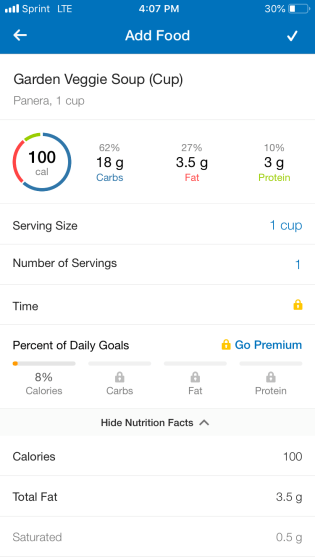
An example of MyFitnessPal in action – if I wanted to know the carb count in a cup of veggie soup from Panera, I can find it by simply searching for it within the app. 

How? The app contains a comprehensive food library – sort of like the one that’s built into the OmniPod PDM, except this one is much, MUCH more substantial. It includes foods from fast food restaurants, regular dining establishments, grocery stores, and just about any other place you could order food from. It’s been an absolute godsend in situations in which I’m really struggling to figure out how many carbs are in a dish that I’d like to order/buy. It’s not an end-all, be-all source of information – just like anything else in life, the food library isn’t flawless – but it’s a solid starting point when it comes to foods I’m less familiar with.

In addition to showing me how many carbs I consume in a day, the app has also taught me how logging simple information related to diabetes can go a long way in establishing trends, such as how different foods affect my blood sugar. The act of logging or writing something down can sound like a pain, but really, the few minutes it takes each day is worth the knowledge it ultimately imparts.

Readers, what about you? Do you use carb-counting apps? If so, which ones and why? I’m especially curious in hearing feedback from anyone who uses Figwee – I’ve heard nothing but praise for that one. Drop a comment here, tweet at me, or leave a note on my Instagram page about your favorite carb-counting app!

Diabetes, Diets, and Holidays are Naughty, Not Nice

Ahh, the holiday season…it’s been in full swing for just about a month now, and with that arrived a bevy of parties, potlucks, and poor dietary decisions. In a week, the new year will be here and it’ll bring a fresh start with it, but for now…I’m trying to find a way to make peace with all the indulgences I’ve enjoyed in the last several weeks.

Takeout Chinese food, pizza, homemade roasts, and baked goods galore are among the gamut of glutinous grub responsible for transforming me into a guilty gourmand over the course of the holidays. (Can I get a round of applause for that alliterative sentence?) I wish I could say that I had the willpower to resist the temptation of these foods that have been provided at the various holiday parties I’ve attended; alas, I couldn’t stop myself from noshing on them just as much as the other guests at these gatherings. A fair share of my fellow party attendees commiserated with me about diets flying out the window this time of year, but very few of them could understand that the fattening fare impacts more than just my waistline.

My blood sugars, of course, have been a victim of holiday feasting just as much as my size six jeans.

Feel the joy!
Instead of sugarplums, I’ve got visions of wacky blood sugars and too-tight pants dancing in my head. Fun!!!

Truthfully, they’re not as terrible as they’ve been during past holiday seasons. But that doesn’t mean I’m satisfied with them, or okay with the fact that they tend to rise and crash at equally rapid paces when I eat too much of the carb-y stuff and correct accordingly with insulin. The roller coaster ride combined with the feeling that I’m turning into the Pillsbury dough girl is what I’m fed up with, and I’m trying to figure out a way to stop punishing myself for it. After all, a new year IS right around the corner, and like many others in the world, I can and should use it as a reason to start eating more mindfully and healthfully, leaving the dietary mistakes of 2018 in the past.

It’s definitely cliche, but I’ve got to get back into the routine and replace all the cookies and fancy chocolates I’ve been consuming with leafy veggies and lean proteins. It won’t be easy, but I know that it’ll be worth the improved blood sugars and looser pants that are bound to follow.


Grazing: My Bad Habit

A handful of peanuts here, a couple of slices of cheese there.

A pile of popcorn followed by a spoonful of peanut butter.

A few pretzels and a small smattering of chocolate chips – because chocolate.

These snack combos, as strange as they may be, all describe some snacking behavior that I also refer to as “grazing”. Grazing is all about taking little bits of food when I’m not necessarily hungry. I equate it to eating out of boredom, except I’m not indulging on full meals or anything, I’m simply munching because the food is there and my blood sugar is acceptable enough to the point that I can freely snack without having to bolus, or worry about significant blood sugar jumps later on.

In other words, grazing is a habit I’m trying to break.

grazing

I’m not stupid. I know that the aforementioned foods I choose to graze on contain carbohydrates. Whether trace or moderate, they’re still there. And I choose to ignore them.

I don’t know why. If I want to have a snack, then that’s okay, as long as I take insulin for it. But I guess my rationale for grazing is that I’m taking “itty bitty” amounts of food that will minimally impact my blood sugar, if at all.

Then again…it’s not exactly logical when those small snacks DO wind up impacting my blood sugar. Usually, the spike happens several hours after, and each time I get angry at myself for a) not having enough self-control to resist grazing and b) not taking insulin for it when I do give in to the bad habit.

Nearly 21 years of diabetes and I’m still occasionally blown away by the minutiae of it: how just the slightest smackerels can take a toll on the straight-lined graphs I strive to achieve daily.

Diabetes in the Renaissance

Can you imagine having diabetes in the 14th – 17th centuries??? The answer to that is no, you probably cannot…because without modern medicine, it wouldn’t have been possible for a T1D to survive in the Renaissance. And ‘cuz, well y’know, the Black Plague was a thing back then and lots of people didn’t survive.

But fortunately, we’re living in the 21st century, which means we have access to all sorts of things that help us manage diabetes. Still waiting on that cure, though.

Where am I going with all this?

I wanted to recount my recent trip to a Renaissance festival, in which I spent a day taking care of my diabetes while jousting tournaments, Shakespearean performances, and drunken debaucheries took place all around. And you know what? It was easier than I thought it’d be.

Sure, I didn’t check my blood sugar with my meter as much as I should have. My inner germaphobe was reluctant to rely on my meter for accurate results, seeing as there weren’t really any hand-washing stations on the fairgrounds. (Remember, this is the Renaissance…things were a little grimier in those days.) I used hand sanitizer whenever it was available to me to keep my hands clean, but it was a bit of a challenge, especially when my mitts got caked in mud post-ax throwing.

587E26CB-B564-463E-815B-B5CF73256412
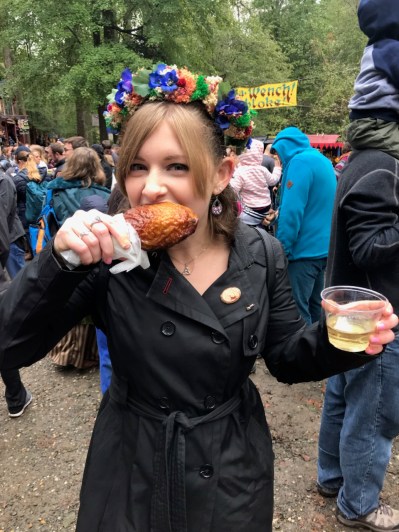
Enjoying a turkey leg alongside a serving of Chardonnay at the Renaissance Faire – y’know, to keep things classy.

Thankfully, I had my Dexcom G6 to help keep me on track as I ate my way through the fictional 16th century village. I was jazzed that several low-carb options were available to me; throughout the day, I snacked on a giant turkey leg, a Scotch egg, and spiced nuts. Maybe a “diabetes-friendly” diet would’ve been easy to follow in the Renaissance? Though I will admit that I gave in to temptation and ate (devoured) a slice of cheesecake. On a stick. And dipped in chocolate. Not low carb, but super YUM.

So even though my diet was far from nutritious at the ye olde faire, I think that all the walking around and sharp-objects-throwing kept my blood sugar in check, much to my relief. My experience at the fest is just another example of how diabetes won’t prevent me from living life to the fullest, whether it’s in the reality of 2018 or the fantasy of the 16th century.