My Low-Carb Baking Fail

Ever since I was old enough to be trusted in the kitchen, I’ve loved baking everything from cupcakes and cookies to cheesecakes and breads. There’s so much I enjoy about baking: measuring out ingredients so satisfyingly precisely, smelling sweet aromas waft from the oven, and naturally, sampling the tasty final products.

But this hobby of mine has been a bit hazardous at times, seeing as just about every recipe I’ve ever followed has been far from low carb. Mainly, this was due to the fact that I never really had low-carb recipes on hand; rather, I was following tried-and-true, blue-ribbon-winning recipes from my mother’s collection of cookbooks. Plus, I figured that family and friends would be more willing to try baked goods that were made from “real” ingredients, not artificial sweeteners or alternative flour mixes. There was never a reason why I wouldn’t be able to try my creations, either – that’s why I had insulin, of course.

Now that I have a kitchen of my own to experiment in, though, I find my interests turning to lower-carb cooking and baking. I don’t follow a low-carb diet, but I will occasionally cut carbs here and there to see whether my blood sugars benefit from it and to find out if my taste buds like it.

Besides my lack of experience, I was hesitant to try low-carb baking because it seems like the core ingredients needed for most recipes are so hard to find…and expensive! Coconut flour, xanthan gum, and erythritol aren’t exactly the most common items on the typical grocery store’s shelves. But thankfully, I am fairly close to an Aldi supermarket, where I’ve had incredible luck finding things that are priced significantly cheaper compared to other grocery stores. So, after a couple of slowly rotting bananas on my counter top inspired me to search for a low-carb banana bread recipe, I gathered up my low-carb baking supplies on a trip to Aldi and set about baking my first keto-friendly banana bread.
My Low-Carb Baking Fail
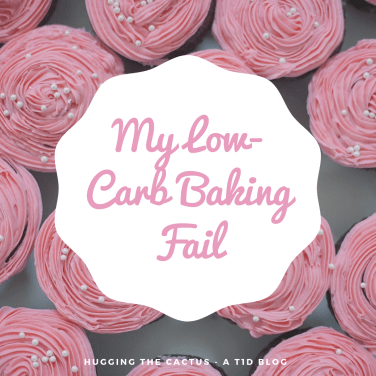
Maybe one day, I can make low-carb cupcakes that taste good AND are as pretty as the ones above.

It did not go as expected. I intended on baking two breads, seeing as the recipe called for one banana per loaf and I had two to be used. The actual process of making the first loaf of bread was actually very straightforward – mixing dry ingredients, then wet, then combining all of them together. The bread had to go into the oven at 350 for an hour, and when it finally was done, it looked totally normal and even tasted pretty good. The walnuts I’d mixed in added the perfect crunch and helped the banana bread taste like the “normal” kind.

So I felt fairly confident as I started to make the batter for the second loaf. The only difference this time was that I added dark chocolate chips, which I think are the perfect complement to banana bread. I even dotted the top of the bread with the chips in a pattern to add a little extra flair.

I knew something was wrong immediately upon taking the bread out of the oven one hour later. The chocolate chips I’d artfully arranged on the top had disappeared. WTF? It only got worse when I removed the loaf from the pan…because half of it stuck to it. That’s right, half of my banana bread was not salvageable, and the other half that came out was looking pretty damn ugly.

The taste? It was fine…not great, though. The chips had melted into the dough in an unappealing way. The bread itself seemed less like a banana bread and more like a weird banana-chocolate chip mush. It was definitely not the outcome I wanted. And no, I did not take a picture of the fail…I didn’t want the reminder that it was a bit of a hot mess.

Does this mean I’m done experimenting with low-carb baking? Absolutely not. I’ll take a little break from it for now and search for new, promising recipes at another time. But one thing I’ll do for sure the next go-around? I won’t get cocky and add any mix-ins…unless they’re specifically called for in the recipe instructions.

 

Navigating Health Insurance Hell

I am one month into my new health insurance plan, and I’m more confused than ever.

I’ve sent several emails. I’ve engaged in a number of live chats. I’ve made countless calls to my insurance company, my insulin pump provider, a mail-in pharmacy service, and my CGM provider just to try and get some answers. And almost every time I hang up the phone or walk away from the chat service, I feel lost because nothing is clear to me.

Am I stupid?

Keep track of your fitness at www.reallygreatsite.com.png

I can’t be the only one who just doesn’t get how it all works…right?

Why can’t I just get definitive answers as to how much I’ll need to pay for insulin each month?

Why does my health insurance company advertise a partnership with a mail-order pharmacy that puts a cap on insulin costs…when in reality, it doesn’t (or at least, nobody has informed me that it does)?

Why am I learning, at this stage in the game, that my prescription plan isn’t integrated with my medical plan, which means that any prescriptions I fill using the mail-order service don’t qualify towards my deductible?

Why is it all so convoluted?

As mystified as I am by all of this, I’m coping with a strategy that my parents have helped me develop, which I’ll share with you: Anyone who is going through all of this right now, or anyone who is about to go through all of this, needs to remember to be their own advocate. (I’m reminding myself to do this on the daily.) Frequently, I tell myself that I have every right to make as many phone calls or contact efforts as needed until I understand the costs associated with reordering my supplies. Although it’s easy to get frustrated when a representative on the phone speeds through an explanation or provides contradictory information, it’s important to stay focused on the task at hand.

As I continue to figure all of this out, I’m going to take note of questions that crop up and have a notepad and pen in hand any time I make a call. I’m keeping track of all messages exchanged online and I’m using the next couple of weeks as my fact-gathering stage. It’s almost like I’m assembling pieces to a puzzle…a ginormous, complicated puzzle, but one that will result in a more complete picture of the cost of my prescriptions going forward.

Supporting T1D Students with my #SensorSelfie

I’m taking a departure from a “traditional” blog post today to tell you, my dear readers, that you should consider celebrating a special holiday with me today: National Selfie Day! Before you roll your eyes at the mere idea of that, please keep reading to learn how participating will help support students with diabetes.

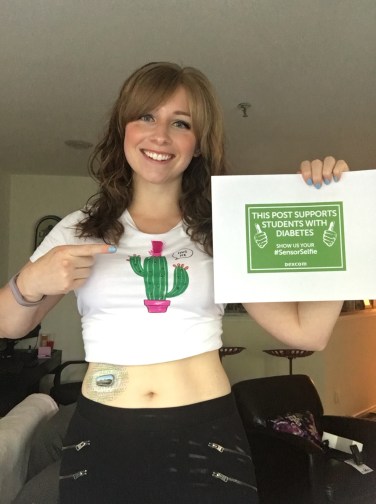
Dexcom has partnered with a nonprofit that is very important to me – The College Diabetes Network (CDN) – to help put some focus on the diabetes community and raise money. They’ve created the #SensorSelfie social media campaign to encourage people with diabetes to take photos of themselves proudly donning their Dexcom sensors.

947D37E4-B661-4EC5-8E02-C58D07A66110
Here’s my #SensorSelfie, which wouldn’t be complete without my cactus shirt.

But what exactly do you need to do in order to take part in the campaign? There’s four simple steps to follow today, June 21st:

  1. Take a picture showing off your Dexcom sensor
  2. Post the photo to your Facebook and Instagram pages
  3. Use the hashtag #SensorSelfie and tag @Dexcom
  4. Tell ALLLLLL your diabuddies to do the same

For every post that uses #SensorSelfie today, Dexcom will donate $1 to CDN. Can you imagine how much money could be raised if you got all the T1Ds you know to participate?

If you’re looking for some more information on this social media campaign, click this link. Otherwise, what are you waiting for? Get to snapping, posting, and tagging!

Dad Appreciation Post

This post originally appeared on Hugging the Cactus on June 18, 2018. I wanted to republish it today because my dad (and all fathers of T1D children) should be recognized for everything they do for us. I also wanted to give my dad a little extra shout-out, as this is the first Father’s Day that I’m not there to celebrate him in-person.

Father’s Day was yesterday, but as I did the day after Mother’s Day, I want to use today’s blog as an opportunity to express my appreciation for dads: Namely, my own father.

Besides being the family patriarch, my dad is a firefighter/EMT. He makes his family feel safe with his emergency preparedness knowledge and skills. He also deals with his diabetic wife and daughter on an almost-daily basis, which warrants, at the very least, a ginormous golden trophy with his name engraved on it in fancy script.

Hey, Handsome
I’m so grateful for my amazing dad!

That’s because he sees the ugly side of diabetes from time to time. The side that causes blood to spurt out of mom’s abdomen when she removes a pod that struck a vein. The side that causes me to lash out, because my blood sugar won’t seem to come down from a sticky high, no matter what I do. The side that causes mom and I to lose sleep, because we’re treating another middle-of-the-night low blood sugar. The side that forces mom and I to be prepared for any and every possible diabetes scenario that could occur while traveling. The side that causes us to cry, because we just can’t deal with diabetes today.

And he’s there through it all.

He’s there to apply pressure and gauze to the bloody site. He’s there, feeling just as upset as I am, because he just wants my blood sugar levels to come back down, too. He’s there to make sure mom and I have enough glucose tablets or juice to bring our levels back up. He’s there, keeping us calm as we pack for our next trip and taking care of all the travel arrangements. He’s there to comfort us when we need him to, and he hates that we live with diabetes – probably even more than we do.

He’s the kind of guy who says he’d trade his pancreas with us in a heartbeat if it meant we wouldn’t have to live with diabetes anymore.

He’s the kind of guy I’m proud to call my dad.

Thanks, Dad, for helping me handle my diabetes over the years, and supporting every venture (diabetes and otherwise) that I pursue.

Metformin Update #2: Reintroducing Myself to the Big White Pill

It’s been a minute since I wrote about my Metformin journey on the blog. The last time I posted about it, I had made the decision to stop taking it after experiencing a scary low blood sugar. That, coupled with the fact that I just didn’t feel ready to be experimenting so much with my diabetes medication, convinced me that the timing wasn’t right for me and Metformin.

Fast-forward to May 30, 2019. I had an appointment with my endocrinologist. It was a productive one, because we addressed a number of my concerns that have cropped up in the last three months. One question I had for her was whether she thought I should give Metformin another shot.

METFORMIN UPDATE #2
Really though, why do these darn pills have to be so large?

She thought that I should. We went over the benefits: it’d make my insulin more effective, thereby fighting back against my current insulin resistance and reducing my total daily intake. With less artificially-made insulin in my system, I may be reducing my risk for cancer (according to studies she’s read), and I may also shed a few of the pounds that I’ve been struggling to lose.

By the time of this appointment, I was feeling frustrated with the amounts of insulin I was using each day. Ever since I got off my parents’ health insurance plan, I’ve been super conscious about my supply of insulin as I try to figure out how I’ll afford it under my new plan. And it hasn’t been easy. So in an effort to reduce my overall insulin use, I decided it was time to give Metformin another go.

I’m more cautious this time around. My doctor and I talked about my fears and she helped me come up with a plan to reintroduce it to my diabetes care and management routine. I’m starting to take less insulin at dinnertime and I’m running a temp basal overnight to see how my blood sugars fare. We’re playing it safe by somewhat dramatically reducing my dinnertime insulin-to-carb ratio, but I’d much rather do that than be overly aggressive.

It’s only been about a week since I’ve started the new regimen. That’s not enough time for me to attest to whether or not I’ve adjusted to it, because I deliberately skipped taking Metformin on a couple nights in which I knew I’d be imbibing alcohol…again, it’s all about being smart and not introducing too many variables at once. We’ll see how it goes. Until Metformin update #3, that’s all I’ve got for now.

That “Thing” on my Arm

“Yo, I don’t mean to be rude, but what’s that thing on your arm? Looks pretty cool.”

I turned around to face the stranger who was looking at me and asking me this question. It was well after midnight and we were on the rooftop of a fairly crowded bar. It was a balmy, summery night and I was enjoying the atmosphere with my boyfriend and my best friend. I’d had a few drinks over the course of the night, but judging by the state of everyone else on the rooftop, I was probably more sober than most of them.

IMG_2634
THIS is the sticker I should’ve been wearing that night…keeps things much more simple.

I could’ve answered his question in a scolding manner; it wasn’t a “thing”, it was a device that keeps me alive.

I could’ve totally dismissed him and told him to mind his own beeswax, because really, it is sort of rude to point out something on another person’s body.

I could’ve lied and told him it was something that it’s not to get him to stop bothering me.

I could’ve launched into an educational breakdown of what an insulin pump is and why my OmniPod looks the way it does.

I could’ve done any number of things, but instead I decided to say, “Oh, this is my insulin pump. I’ve got it decorated right now with a picture of a lighthouse because I like adding some style to it.” I smiled at him as a way of reassuring him that I really didn’t care that he was asking me, because I didn’t.

My straightforward answer seemed to please this random man. He told me again that he thought it was cool, and then we chatted a bit about where the lighthouse is and discovered we both have a connection to Massachusetts. Within a few brief moments, the conversation was over as we went our separate ways.

It was a perfectly harmless interaction that could’ve went a number of different ways, but to me, it’s all about context. This guy was just asking out of curiosity, and I truly don’t think he was trying to be rude about it. So I answered his question succinctly but good-naturedly, because I felt that was the only way to go about it in this busy party environment. Plus, let’s be real here…had I delved into a discussion about diabetes and devices, this drunk man probably wouldn’t have digested a single detail of my description. (Ahh, I love alliteration.) And another important point? He was damn right, my pump did look cool because of the lighthouse sticker!

But man, how much simpler it’d’ve been if I’d just been wearing my “THIS IS MY INSULIN PUMP” sticker on my pod that night.

What Would it be Like to Have Diabetes in the Wizarding World?

I’m a Harry Potter fan. A major one. I attended the midnight release book parties. I saw every movie in theaters. I’ve dressed as Hermione Granger for Halloween on more than one occasion. I’ve been to the theme park in Florida, I’ve read the books a countless number of times, and I’ve even written fan fiction before. So maybe I’m a little bit more than a fan…I’m an ardent enthusiast.

Even though the last Potter book came out years ago, I still indulge in the wizarding world somewhat often. One day, I was thinking about it and how nobody in the books ever suffered any serious maladies (okay, having all of your bones removed by your Defense Against the Dark Arts professor or getting petrified by a basilisk snake or Splinched when Apparating are all pretty significant conditions…but bear with me here). None of the characters had anything chronic, like arthritis, or Crohn’s disease, or type 1 diabetes. And one might make the argument that it’s the effing wizarding world…why couldn’t magic be used to cure any of these illnesses?

HUGGING THE CACTUS - A T1D BLOG.png

My response to that question would be: How come Mad-Eye Moody had a fake eye? Couldn’t a new, working one have been magicked into his eye socket? (Same thing goes for his wooden leg.) George Weasley lost his ear, thanks to a Death Eater – how come it couldn’t be restored onto his head? Dragonpox, Spattergroit, and lycanthropy are all serious conditions in the books that, if curable, weren’t easily healed. Particularly lycanthropy, otherwise known as a condition in which a person transforms to a werewolf. The books specifically said there was no cure for this; only Wolfsbane potion could be drunk by the affected person to ease the transition from human to werewolf.

So obviously, I think that lycanthropy = T1D, and Wolfsbane potion = insulin in this hypothetical comparison/scenario. That being said, life with diabetes in the wizarding world as I’ve imagined it would be a little something like this…

  • Diagnosis would take place at St. Mungo’s Hospital for Magical Maladies and Injuries. Madam Pomfrey would be on-hand to learn how to help the affected student.
  • Pumpkin juice and butterbeer are definitely the best/most preferable ways to bring up a low blood sugar.
  • Honeydukes, the confections shop in Hogsmeade, would offer sugar-free confections that tasted so wonderful that I’d forget they were sugar-free.
  • Insulin would be administered in a much less painful and invasive way. Perhaps Professor Snape would let me brew some potions for doing so in class?
  • Quidditch would be the ideal form of exercise/would help keep my blood sugars in check.
  • Instead of Express Scripts, I’d get my medications via Owlery Express – my very own Hedwig-esque owl would deliver them to me. And they’d cost no more than a Knut (the lowest value coin in the wizarding world).
  • In Charms, I’d learn how to calculate the carbohydrates in my food with just the wave of my wand.
  • My Care of Magical Creatures class would introduce me to a hot-pink colored pygmy puff who would be the magical equivalent to a diabetes alert dog – just with a touch more inherent as opposed to learned knowledge about diabetes.
  • I’d learn all about Banting and Best in Muggle Studies.

Well, what are your thoughts? If you’re well-versed in the PotterSphere, what would you add to my bullet-point list? Drop a comment below…trust me, it’s actually incredibly fun to imagine a world where diabetes is a bit more tolerable, especially one so fantastically magical.


Trying to Stay in the Loop with DIY Diabetes

I can’t remember exactly when I heard of “DIY diabetes”, also known as “looping”. It may have been at a conference a few years ago, or maybe I saw something about it on social media. Either way, it seems to have totally blown up as more and more people with T1D are looping.

TRYING TO STAY IN THE LOOP WITH DIY DIABETES
Are you a Looper?

Before I talk about it more…a brief definition of looping. Loop refers to a kind of automated insulin delivery system. According to what I read about it on diaTribe, Loop systems are open-source and DIY, meaning that T1D Loopers download an app for the iPhone that communicates with a device that also communicates with compatible pumps and CGMs.

If you’re confused, don’t worry – so am I. There’s a number of moving pieces involved with Looping that make it daunting and difficult for me to keep up with as the technology changes. But the ultimate goal of Looping is what has me interested in it. Looping is supposed to help improve time-in-range, particularly overnight, because it does a lot of the thinking for you and ultimately makes life with diabetes easier. And I’m all for that.

Looping’s been popping up on my social media a lot lately because at the end of April, the geniuses behind Loop announced that compatibly with the OmniPod for the first time. (Previously, Looping was only available to Medtronic folks.) On what feels like a daily basis, I notice more people on my social media platforms – particularly Instagram – who are Podders that have made the decision to start Looping. The common denominator with many of these individuals, besides being Looping Podders (sounds like a wacky band name) is that they’ve found great success in doing so. It seems like each person spends 90% or more of his/her time in range, encounters fewer low/high blood sugars, and wastes less time worrying about diabetes in general.

All of that sounds too good to be true. Of course my interest is piqued by such incredible results, and of course I’d love to dive right into Looping and see whether it’s a good fit for me. But the reason why I don’t is simple…I just hesitate to trust new technology.

Technology can fail. Plain and simple. All operations for Looping with the OmniPod take place on the iPhone. That means that the PDM is rendered useless. What happens if I lose my cell phone? What if the battery dies when I need to bolus? What do I do when I upgrade to a new phone? There are so many questions I can think of related to the phone issues alone, never mind any other potential problems. Put simply, the unknowns – the “what ifs” – terrify me so much that I can’t help but be skeptical of Looping.

But this doesn’t mean my interest goes away. My curiosity about Looping is stronger than ever. The DIY element is frightening, but the rewards could be greater than the risks.

The only thing I know for sure is that I won’t even attempt to Loop until I have a conversation with my endocrinologist about it. Together, we make decisions about my diabetes care and treatment that we both feel are safe and right for me. I’d love her opinion on Looping to see how much she knows about it and whether she has any patients who use it. Until I talk to her and gain more information from other Loopers, it’ll just be something that I cautiously admire from afar on social media.

Starting Off on the Wrong Foot

“How are you today, ma’am?” The man behind the Dunkin’ Donuts counter smiled and looked at me expectantly, as I started back at him blankly.

I wasn’t sure how to answer. My mental state wasn’t great, that was for sure. I’d just come from a visit to a walk-in clinic, where I’d had X-rays of my foot taken to see whether or not it was fractured.

The previous 24 hours had been a bit of a whirlwind. I’d worked and gone to my first-ever kickboxing class, which was an awesome experience. I’d had dinner with my partner and started playing video games soon after as a way to unwind after the long day. That’s when pain in my foot flared up, suddenly and significantly.

Could I have injured it in the kickboxing class, without even knowing it? Was I overdoing it on exercising, in general? How and why did the pain just start up like that? Almost immediately, I plopped myself down onto the couch with an ice pack and extra cushions, hoping that I could stop the pain as quickly as it started.

No such luck. I went to bed early that night, but the pain was so severe that sleep was virtually impossible. I tossed and turned for hours, wondering what the hell was going on and coming up with a plan to get it checked out A.S.A.P.

That’s how I found myself at a walk-in clinic, a little over 12 hours after I first felt the pain. I was evaluated by a nurse practitioner who told me that “the likelihood of a fracture was low” (thank goodness) and that it was “probably tendinitis.” I was given instructions to rest, ice, and elevate my foot for the weekend, and take non-steroidal anti-inflammatory drugs (otherwise known as NSAIDs, like Ibuprofen or Aspirin) as needed.

Hugging the cactus - a t1d blog
I’m trying to put my best foot forward as I deal with this injury.

That meant hours and hours of being sedentary.

That meant no exercise of any kind – I even had to keep walking at a minimum.

That meant my spirits were crushed.

I was glad that it wasn’t worse, and proud of myself for not waiting to seek medical treatment. But that didn’t mean I was thrilled with the outcome. Basically, I had to take the wait-and-see approach. Time will tell how long the pain lasts, and I can’t stand not knowing. I also can’t stand not being able to be active. Daily exercise is a key element to maintaining good blood sugars. Sitting around idle doesn’t do my diabetes any favors, but it’s not like I had any other choice.

I left the clinic, trying to process this information. This certainly wasn’t the way I wanted to kick off the long Memorial Day weekend. It definitely could have gotten off on a better foot. (Okay, okay, I’ll stop with the puns.) I found myself at a nearby Dunkin’ Donuts minutes later. I hobbled in, hoping that an iced coffee might lift my spirits somewhat.

I blinked, bringing myself back into the moment, and smiled wryly at the Dunkin’ cashier. “I’m okay,” I said to him. It wasn’t just a response to his question, it was also a reassurance to myself. I’m okay and I will be okay. I won’t let this get me down.