“Doesn’t Your Pump Do All the Work for You?”

The answer to the above question is a big, fat, resounding…

NO.

I’ve written blog posts in the past about questions I’m frequently asked about life with diabetes, but shockingly, I neglected to include this one…which is so surprising because it’s probably among the more frustrating questions.

Don’t get me wrong: Diabetes technology has come a loooooong way, particularly in the last couple of decades. There are options when it comes to insulin pumps and pens alike (that is, if the choices are covered by insurance…that’s another story for a different post). There are tubed, tubeless, touchscreen, CGM-integrated, and waterproof pumps out there. There’s even a couple with intelligent software that can kick in and predict low or high blood sugars. And there are smarter insulin pens available that far surpass the ones I used just 7ish years ago…some can track insulin intake and are bluetooth-enabled.

It sounds like our pumps should be equipped to do all the work for us…but the simple truth is that they can’t.

Our diabetes devices are far from perfect.

_Doesn't Your Pump Do All the Work for You__
No…these two pieces of plastic simply CANNOT do all the work for me. They actually rely on me quite heavily.

Failures happen.

Batteries drain.

Error messages pop up.

When it comes to dealing with diabetes, technology certainly helps us, but sometimes things can go so awry with it that it almost makes life even more frustrating.

Certainly, the reward outweighs the risk; after all, I don’t believe that many people would continue to use pumps, CGMs, etc. if they didn’t work for them the vast majority of the time. I know that I wouldn’t.

But there’s too many variables happening independently of these devices doing their jobs that it essentially guarantees imperfection.

Stress, miscalculated carbs, medication dose/timing/interactions, too much/too little sleep, expired insulin, temperature, exercise, menstruation, alcohol consumption, family and social pressures…these are JUST A FEW of the things that are known to impact blood sugar levels. Just a few!!! I can barely keep track of those factors, let alone how they each affect me…and to expect a machine to know how to do that is placing a little too much faith into something comprised of wires and chips.

My point is that I really wish that people living without diabetes didn’t make assumptions that our lives are easy because of these devices. They are easier, most of the time. But there’s that other portion of time in which a lot of spare mental energy is used on maintaining that technology and making sure it functions the way it should, which is far from easy.

The short answer to the question-as-a-title of this blog post is no, I (we) do all the work for my (our) insulin pump(s)…they’re smart and capable, but only with the input of the people handling them.
World Diabetes Day 2020: Celebrating Nurses Making a Difference in the Lives of People with Diabetes

One thing that hasn’t changed in 2020 is the significance of tomorrow’s date: November 14th is internationally recognized as World Diabetes Day, a day specially reserved for diabetes awareness and advocacy.

Several weeks ago, when I realized this date was rapidly approaching, I was unenthused about it, to put it mildly. My life has been super-duper busy lately…I’ve dealt with high stress and anxiety levels, an overloaded schedule, and not enough time for self-care. So when it hit me that diabetes awareness month was just around the corner, and with that it would bring World Diabetes Day, I just felt “meh” about it. This year has been so sucky that celebrating didn’t feel right or something that I could muster up the energy to do.

However, that was before I realized that there’s a theme for this particular World Diabetes Day…promoting the role of nurses in the prevention and management of diabetes.

World Diabetes Day is tomorrow…what will you do to celebrate?

Nurses are heroes under normal circumstances. But in the context of 2020? They’re more important than ever. I read more about the reasoning behind the World Diabetes Day theme on the International Diabetes Federation website and immediately understood why nurses deserve recognition on 11/14:

Nurses currently account for over half of the global health workforce. They do outstanding work to support people living with a wide range of health concerns. People who either live with diabetes or are at risk of developing the condition need their support too.

People living with diabetes face a number of challenges, and education is vital to equip nurses with the skills to support them.

As the number of people with diabetes continues to rise across the world, the role of nurses and other health professional support staff becomes increasingly important in managing the impact of the condition.

Healthcare providers and governments must recognise the importance of investing in education and training. With the right expertise, nurses can make the difference for people affected by diabetes.

The International Diabetes Federation, 2020

So tomorrow, on World Diabetes Day 2020, I’m going to express my gratitude for all nurses, especially the ones who work specifically with people with diabetes. They deserve all the recognition and support in the world, and in a year in which the world is faced with a pandemic, the work that they do (along with other healthcare workers and essential employees) for people with and without diabetes is invaluable.

Thank you to all nurses and healthcare workers…and Happy World Diabetes Day to my fellow people living with diabetes. Wishing a wonderful day for you all filled with good blood sugars, education, and positive advocacy experiences!

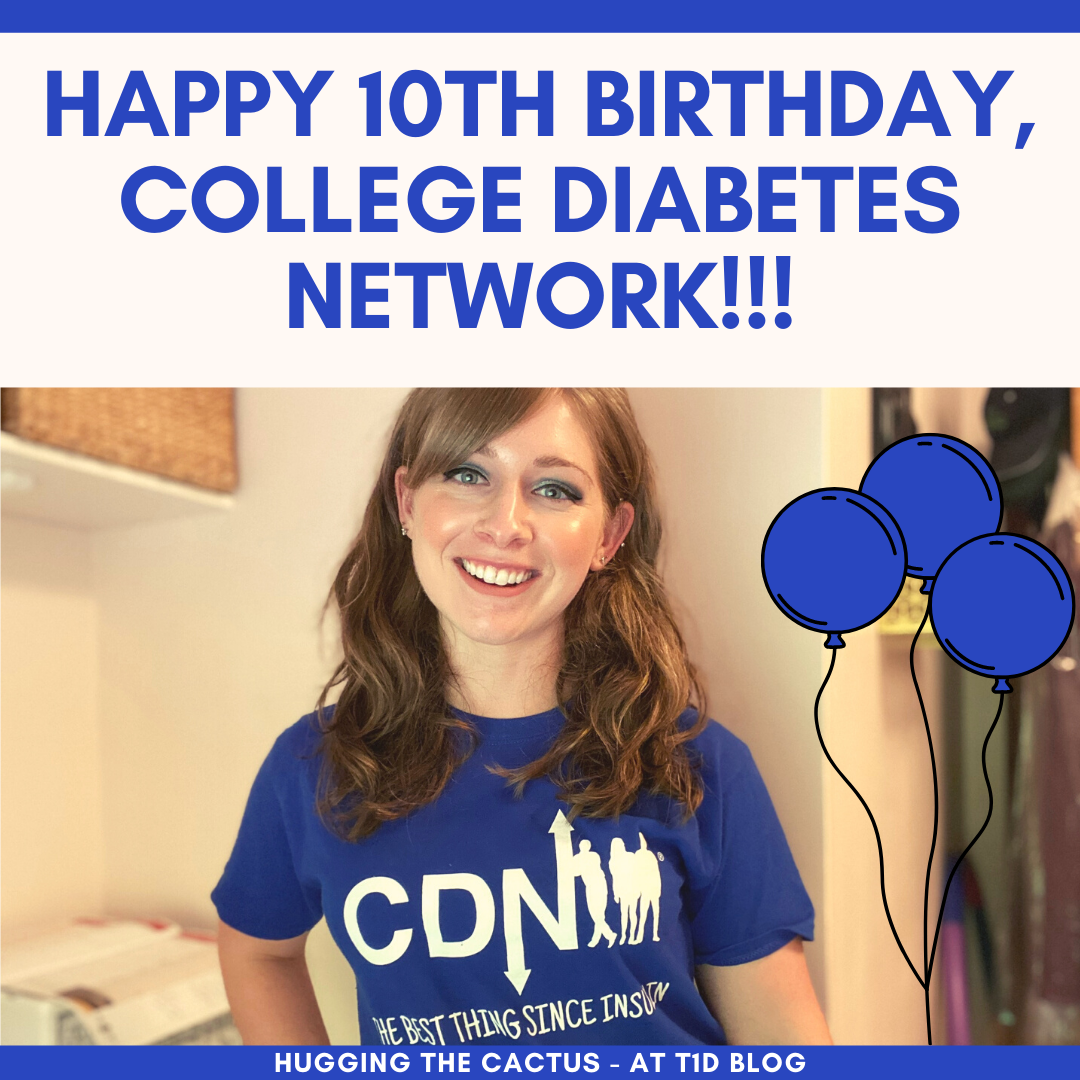
Happy 10th Birthday, College Diabetes Network!!!

Tomorrow, one of my favorite diabetes non-profits – the College Diabetes Network (CDN) – celebrates its 10th birthday!

All I can say is…wow. A whole decade of CDN doing beyond amazing, impactful things for the diabetes community.

Happy 10th Birthday, College Diabetes Network!!!
Congratulations on 10 absolutely fantastic years to my friends at CDN.

I’m not an active member of an existing CDN chapter today, but I used to be. In fact, I was the President of the UMass Amherst chapter of the CDN for close to three years when I was an undergrad there. And it just so happens that my time as President coincides with the time that CDN was really just beginning, meaning that it’s been my honor and privilege to witness it thrive from its origin.

I will never, ever forget being coerced – I mean, attending – a talk at a local college with my mom in which college students and parents sat together on a panel and spoke to high school students (like me, at the time) about the college experience…mainly, how to handle the transition from having my parents help me manage my diabetes to gaining more independence and accountability for it as a young adult away from home.

At this talk, I met Tina Roth, the founder and CEO of CDN. Actually, I didn’t just meet her – we chatted for a bit about how I was going to her alma mater, UMass Amherst, and that there was this little group on campus there called the College Diabetes Network. She told me I should check it out in the fall and think about joining in case I had the desire for peer support when it came to juggling diabetes and college life.

I didn’t know it then, but that conversation and my subsequent action to attend a CDN meeting changed my life.

Through my involvement with CDN, I was introduced and understood for the first time in my life the value of peer support when living with type 1 diabetes. As someone who rejected it her entire childhood, it was brand-new to me as an adult and an incredibly powerful tool that I believe helped me navigate college as a PWD in an informed, healthy, positive, and self-assured way. 

My involvement with CDN gave me confidence: as both a student leader and as a person living with diabetes.

My involvement with CDN gave me exposure: to other students just like me across the country, to new technologies, to resources that improved my quality of life.

My involvement with CDN gave me a career path, for goodness’s sake: It reinforced that I’m a writer. I became a T1D blogger through an opportunity that became available to me because of CDN. I was able to put both my CDN leadership experience as well as my blogging skills on my resume that lead me to the full-time job that I have today. 

My involvement with CDN gave me so much more, too…lifelong friendships being among the most important. I met the most inspiring, motivated, intelligent, and kind people through CDN. I love keeping up with them via social media and pre-2020, I was even able to catch up with some of them in person. And I can’t wait for the day that we can do that again.

There is no doubt in my mind that CDN changed my life. And I’m just one person. To think that they’ve continued to grow and expand, with more and more chapters being created at colleges across the country, and more and more people learning about their mission to provide young adults with T1D the peer connections they value, and expert resources they need, to successfully manage the challenging transition to independence at college and beyond.

Happy birthday, CDN. Thank you for everything you’ve done for me, and thank you for all that you continue to do for countless young adults. I can’t wait to see what the next 10 years look like for you!

As a 10th birthday gift, please consider donating to the CDN using this link – I can promise you that the cause is more than worthy and that the CDN will continue to do wonderful work for our community with your support.


A Song to Describe Diabetes Today…

On Instagram, I’m participating in the #TrueDiabeticChallenge all throughout November. Today’s post was inspired by the prompt for Day 9 of the challenge – name a song that describes diabetes today. Here’s a song that I think describes my relationship with diabetes today, even though it’s a throwback tune…

I’m a child of the 90s, so you can bet that I listened to a whooooole lot of boy bands and girl groups growing up – N*SYNC, Backstreet Boys, Spice Girls, and Destiny’s Child were just a few of them.

But of course, I loved my solo artists…especially Britney Spears.

Speaking of 90s throwbacks, doesn’t this color scheme remind you of Lisa Frank’s colorfully designed notebooks, folders, and pencils?!

Her first album, “…Baby One More Time”, was everythiiiiiiiing…oh, the NUMBER of times it was played in my house! Like most kids my age at that time, I couldn’t get enough of her bubblegum-sweet voice and catchy-as-heck lyrics/tunes. No matter what your opinion of her has been throughout her contentious career and life in the spotlight, you can’t deny her talent as a singer, dancer, and entertainer.

Brit’s been on my mind lately (I know I’m not the whole one – #FreeBritney!), so a few times throughout the workweek, I tend to listen to her music from all sorts of albums she’s put out over the years. I’m happy to report they’re still absolute BOPS today, but what’s more is that I found one that perfectly fit this prompt for me:

(You Drive Me) Crazy!

Okay, besides being an all-around excellent song with an entertaining music video (yes, that’s Melissa Joan Hart AND Adrian Grenier making cameos in it), it also tooooooooootally describes how my diabetes makes me feel these days. It drives me CRAZY!!! Let’s look at some of the lyrics…

Baby, you spin me around, oh

The earth is moving, but I can’t feel the ground

-Me when my blood sugar is low

You drive me crazy, I just can’t sleep

-Me every dang time my blood sugar interrupts my sleep

Oh, oh, oh crazy, but it feels alright

Baby, thinking of you keeps me up all night

-Definitely NOT alright because I hate when diabetes keeps me up at night and it sure as hell isn’t my “baby”

So maaaaaaybe it’s a bit of a stretch to say this song is perfect for me and my diabetes, because the way Brit sings it and how the lyrics are written, she’s enjoying being driven crazy. But not me! This is one of those songs where I could easily rewrite it and make it an eff-you diabetes anthem.

Really, though, the hook of the song captures it all: YOU DRIVE ME CRAZY.

The “you” here is YOU, DIABETES!

I Said Something Very Messed Up About My Diabetes…

You’re looking at the title of this blog post and thinking…”ugh, clickbait!”

I assure you that I’m not trying to present this as clickbait; in reality, I did recently say something extremely messed up about my diabetes.

I didn’t 100% mean what I said…

In a dramatic outburst spurred by three days of frustratingly high blood sugars, I said to my parents, “I’m going to die of diabetes.

Look…we all say things that we don’t mean sometimes. But when I said this, there was a teensy-weensy piece of me that really believed there was an ounce of truth in that statement. That’s how fed-up I was with my diabetes.

It’s because I was going through insulin like crazy in the first half of that week. I couldn’t figure out why my numbers were running so high and tried what seemed like everything to cope with it: eating low carb, running temp basal increases, doubling my mealtime insulin, staying as hydrated as possible, checking ketones…and I was still contending with high numbers. The longer I stayed above my high threshold on my CGM, the more I convinced myself I was doing damage to my body, and that was an incredibly awful feeling. So I made that horrid exclamation out of sheer exasperation and fear.

I was letting my diabetes win that day.

I was letting my diabetes control the narrative.

I was letting my diabetes make me think that I was doing everything wrong, when in reality I was trying like hell to do everything right.

And…I was letting myself down. That defeatist attitude is not how I approach life with diabetes.

But I said what I said, and I can’t take it back…but I absolutely can change my thinking so that when something like this happens again, and I’m just feeling incredibly burnt out from it all, I have a new thing to say that is far from messed up:

I’m going to LIVE WITH diabetes.

Not just live…I’m going to live well with diabetes.

“You’re Being Too Paranoid”

They didn’t say that to me, but they didn’t have to…it was written in bold all over their faces.

Recently, I dined outside with people who are close to me (I’m not going into specifics as to who exactly they were to maintain some level of discretion). I was explaining to them that come the winter season, I probably won’t be dining out much out of COVID concerns.

I wish people would spend less time judging others and more time taking the proper precautions to help protect themselves and their loved ones.

I’m just not ready to dine indoors yet. In fact, since March, I’ve only set foot into a physical store, dwelling, or other establishment a dozen times. For me, the risk associated with spending time inside when it’s completely avoidable just isn’t worth it.

But what sucks about this is the judgment I receive from others. Just like I did in this scenario, the looks on their faces make me feel like I have to defend myself. I wanted to scream at them, “you try having a chronic illness and dealing with it during a global pandemic!”…but of course, I’d never do such a thing, and I’m very glad that they don’t have to worry about that.

I do wish, though, that they – as well as other people who are quick to judge individuals like me who are scared and overly cautious these days – would use a little more grace and humility when conversing with those of us who are high risk.

Please try to put yourself in my shoes.

Please understand that not only am I considered high risk, but I’m in direct contact with loved ones who are also considered high risk.

Please know that, yes, I do have a desire – a very strong one – to get back out there and do “normal” things.

But think about the things holding me back…a chronic condition that requires a lot of my time and energy, for starters.

And think about how there are millions of other people like me who share this great responsibility for an underlying health condition that they didn’t ask for on top of a great fear.

I hope it changes your perspective.

There Is No Insulin in Iran

This post was originally published on the T1International blog on October 27, 2020. I am reposting it here because this situation is completely, utterly horrifying and heartbreaking. As a community that collectively lives with the same chronic condition, we must come together and help Iranian people with diabetes be heard. It’s a grim reminder that the notion of “insulin for all” does not only mean that we must fight for affordable access to insulin, but we must also fight for access, period. And that simply isn’t how it should be.

To be honest, “there is no insulin” is the actual situation. Shortages of insulin are not something new in Iran, but recently there is no insulin at all. We were shocked by responses from our politicians who said, “The shortage is just for pens and we have plenty of internal production of insulin. People can replace it.” However, the types of insulin that are produced in Iran are NPH and R. Few consumers in Iran use NPH. About 70 percent of Iranian people with diabetes use insulin pens.

I myself could only find Novo Rapid insulin that was 10 times more expensive than what I normally pay – and what I paid about three weeks ago. The cost was not logical at all. We have heard many heartbreaking stories. For instance, there was a mother who did not feed her children with diabetes because they couldn’t find insulin.

We’ve made groups on social media and we are using hashtags to support each other with our own insulin, even if we are worried that we won’t have enough. In these days of quarantine, there are already a lot of people dying in Iran because of coronavirus. Now we worry that we will lose more because of the insulin shortage.

“I worry that the promise of insulin was meant to make us silent, but we have to keep speaking out.”

People have to search lots of pharmacies in their city. If they are lucky, they can find two or three pens (usually only short-acting ones). Recently, the only available type of long acting insulin pens are with insulin called “Basalin”. There is no international evidence and confirmation of safety (such as FDA approval) for this medicine.

In Iran, we just have access to glucose meters. There are no other advanced devices available, such as continuous glucose monitors or other sensors. But now, in addition to our insulin problems, we have to cope with the shortage of glucose test strips, too. How can we control our blood sugar levels without them?

As far as we can tell, it seems like our own government does not consider the current situation to be a serious issue. These days are suffocating for us. We are so unsure about everything and we don’t know exactly why this happened. When we seek an answer, we don’t get a proper one. Some say it is because of the economic sanctions imposed on Iran by the USA. Political issues should not affect something like that. People’s lives matter.

The government of Iran reacted to recent protests by saying they will distribute 600,000 pens of insulin, but they did not mention the type. Although some of us have found insulin, others are still searching pharmacies and can’t find any. I worry that the promise of insulin was meant to make us silent, but we have to keep speaking out. Thank you for helping us to be heard.

National Diabetes Awareness Month is Right Around the Corner

November is National Diabetes Awareness Month!

…And I am NOT! READY! FOR! IT! AT ALLLLLLLLLL!

I can’t be the only one in the diabetes online community who is feeling apathetic (at best) for a month that I’m normally thrilled to celebrate. After all, I love being a diabetes advocate!

But this year…the mere prospect of it just feels like it’s a little much.

National Diabetes Awareness Month 2020 is happening soon…how can this be? Aren’t we still in March 2020?!?!

It’s a little much in a year in which the world is facing a pandemic.

It’s a little much when potentially the most important U.S. presidential election in history is also happening this month.

It’s a little much when I’m dealing with a HELLUVA lot of other things in my personal life – mostly good things, but ones that happen to be highly stressful.

It’s just…when I think of it…how can I approach this National Diabetes Awareness Month with all the enthusiasm that I’ve showed it in past Novembers?

I don’t know how to answer that question right now, but I do suspect that I’ll muster up some of my advocacy spirit once I start seeing posts and prompts from the diabetes online community.

Which makes sense…after all, we turn to one another when we deal with the literal and figurative lows of life with diabetes. So it’s perfectly logical to have faith in knowing that this will be a great November with the trusty DOC supporting me.

The Impact of Diabetes on My Relationship with Food

There’s no cutesy lead-in to this post…I’m going with a very straightforward statement here:

Diabetes has caused me to have a very weird and strained relationship with food.

How? Oh, let me count the ways…

Diabetes has positively impacted my relationship with food because it has helped me understand the importance of nutrition. I’ve had to learn how carbohydrates, proteins, and fats affect my levels, as well as the role that the glycemic index of foods play into the picture. I’m also grateful that diabetes has caused me to realize there are limits – I can’t mindlessly eat huge quantities of food (though on occasion I do, more on that in a minute). I must measure everything out, and I believe that this forced sense of portion control has helped me maintain a (mostly) healthy weight.

But diabetes has also, absolutely, negatively impacted my relationship with food.

Here’s pretend cartoon me, being absolutely adorable as she calmly whips up a feast in the kitchen (LOL there’s so much wrong about that sentence)!!!

For starters, I can get so fed-up with having to account for every single morsel I consume in a given day – I resent having to take insulin for foods I’d otherwise find enjoyable. Plus, there’s a lot of guilt associated with my regular food consumption. “Should you eat that?” is question I hear not just from others, but from myself as I have to think about whether certain foods are worth not just the calories, but also the amount of insulin that I have to dose for it. And don’t even get me started on how literally unsavory it is to have to eat food when I’m already full but dealing with a low blood sugar…

In a word, my relationship with food is complicated…and I don’t hesitate to blame my diabetes for that. Don’t get me wrong: At the end of the day, I loooooooove food. Really, there’s very few things that I don’t (or won’t) eat or at least try. I enjoy consuming a large variety of foods and I like to eat veggies almost as much as I like eating chocolate (that may be a bit of a stretch, but I think you get my point).

It’s just unfortunate that my diabetes forces me to overthink every food choice that I make. So I’m that much more hopeful for the day which I can eat food without having to think twice about it, without having to feel guilt, shame, doubt, anger, sadness…nothing but pure enjoyment.

The Best Time to Do a Pod Change

Whether you’re new to using an insulin pump or a seasoned pro, you might be wondering if there’s a time of day that’s most ideal to do a pod/site change.

And I’m here to tell you…there isn’t a one-size-fits-all answer. (Sorry!)

Like many aspects of life with diabetes, the best time to do a pod change will be different for everyone.

However, I do feel pretty strongly about what works best for me, and I can explain why it does. Maybe that will help you or a T1D in your life decide what makes the most sense for your individual situation!

The best time to do a pod or an insulin pump site change will probably vary for most people with diabetes, just like so many other things.

In my opinion, the best time to change my pod is within the 3-hour window after I’ve eaten dinner. Since I typically eat at about 5:30/6 o’clock, this means that I like to change my pod no later than 9 o’clock at night (but preferably sometime around 8).

Here are the reasons why:

  • I can take my dinnertime bolus using a pod that I know for certain is acting the way it should.
  • That timeframe is early enough for me to verify that my new pod is acting the way it should before I go to bed.
  • Usually, I don’t eat much in the evenings after dinner, so even if my new pod isn’t working right, it’s not too big of a deal because it’s not like I’ll be bolusing for mealtime carbohydrates.
  • When I change my pod at other times of the day, it interrupts other aspects of my daily flow (e.g., my wake-up time or my work schedule).
  • There’s something to be said for ending my day with a fresh pod and incorporating the pod change into my bedtime wind-down routine.

Of course, I’ve had to change my pod at less-than-ideal times (I recently did a 6 A.M. pod change because I was deliberately wearing my pod for the maximum 80 hours and it was not my favorite way to start my day). Pods fail or get knocked off and I’ve learned to roll with the punches by having back-ups at all times.

But since I know my best time for a pod change, it’s really nice when I can stick with it…because any reliable aspect of life with diabetes is one that makes it ever-so-slightly more tolerable.