Dazed, I roll out of bed and suddenly become aware of how hot I am. Beads of sweat are rolling down my back, making my pajamas stick to my skin. I look at the number on my Dexcom – there isn’t one.
It just says LOW.
I grow more alert and turn to my test kit to do a fingerstick check and verify my Dexcom reading. My meter says that I’m 44.
And suddenly, I’m feeling that low. I need sugar, stat. I could open the bottle of glucose tabs conveniently perched on my nightstand, chew 5 or 6, and then get settled into bed and fall back asleep relatively quickly. But the desire to get downstairs and eat the contents of my kitchen strikes, even though it’s 1 A.M. and eating too much at this time of night wouldn’t be good for either my blood sugar or my sleep hygiene.
Ignoring my more rational side (as well as my glucose tabs), I grab my phone, my meter, my PDM, and my bathrobe and stumble down the stairs in the dark. I turn on the ceiling fan in my living room in a desperate attempt to cool down faster before I walk into the kitchen.
My eyes fall on a cupcake sitting innocently on the counter.
This isn’t a picture from this particular incident – nobody wants to see me when I’m this low – but this is one of the cupcakes that I’d made. Violet always wants me to share.
I don’t think twice – I tear the wrapper off and three bites later, it’s gone.
I collapse on the couch, directly under my ceiling fan. I am a sweaty mess. This low is hitting me hard. I put the TV on in a futile attempt to distract myself while I wait for the cupcake to kick in, but instead of paying attention to what’s on the screen, all I can feel is gross for choosing to eat a damn cupcake at 1 in the morning instead of doing the “right” thing and treating my low from the comfort of my bed with glucose tabs.
20 minutes later, I start to feel chilly. I’m no longer perspiring and I feel all of my low symptoms subside. I’m better, so it’s time to head back upstairs and try to fall back asleep.
I toss and turn for a bit, cursing diabetes and its middle-of-the-night low blood sugar curveballs, and the stupid 1 A.M. cupcake that my diabetes somehow convinced me to eat to treat a low instead of waiting to have it at a time that I could actually enjoy it.
Diabetes strikes again, I think as I drift back to sleep.
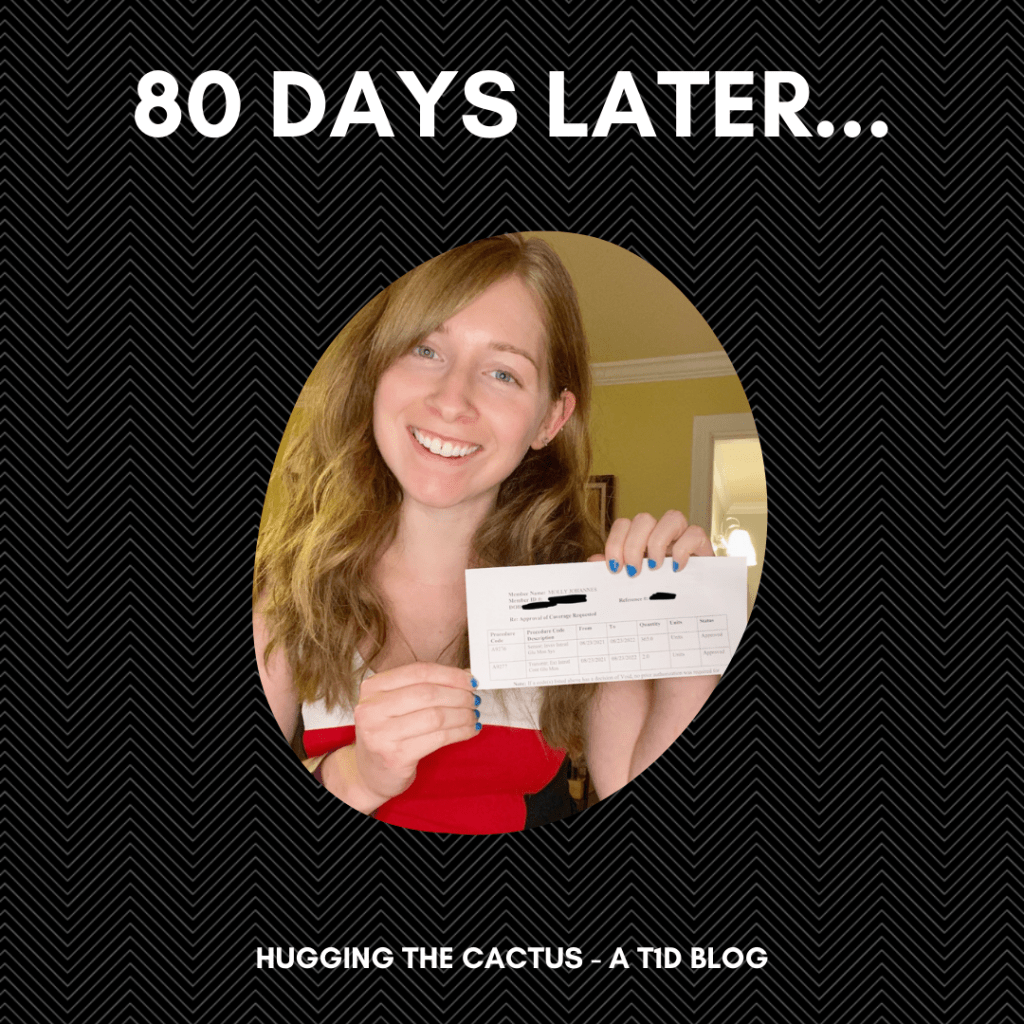
That’s how long it took for me to receive the letter from my health insurance company notifying me (at long last) that the pre-authorization for my Dexcom supplies came through – and more importantly, was approved.
Those 80 days were fraught with anxious thoughts. On a daily basis, I wondered…
When would I get my next Dexcom order? Answer: Almost three full months after I started my new job and switched health insurance.
Would I even still be able to use Dexcom under my new health plan? Answer: Yes, although I wasn’t sure for a long time seeing as I didn’t find out until recently that I needed a prior authorization in order to get Dexcom coverage.
Why was it taking so long? Answer: It took so long partly because this stuff can be time-consuming. I work full-time, maintain a home, care for my dog, and juggle a jam-packed social calendar…and don’t often have the bandwidth to be waiting on hold with my doctor’s office, my health insurance provider, and my Dexcom supplier. I was counting on all three of the aforementioned parties to do a little more of the heavy lifting for me when I should’ve depended on myself alone to make sure I got my supplies as quickly as possible.
What was I doing wrong? Answer: Honestly, even though I sound like I’m shouldering most of the responsibility in the latter paragraph, I don’t think it’s fair to pin this all on me. Sure, I could’ve and should’ve hustled harder to get my Dexcom supplies, but I put trust in a system that I already knew is fundamentally broken. Health insurance can be ridiculous complicated to understand and contend with. I’d never needed a prior authorization for anything before, so that concept was new to me. Throw a new health plan that I had zero familiarity with into the mix and I was bound to encounter some bumps in the road to get my supplies.
I was so excited to get this letter in the mail that I took a damn picture with it.
That’s why I almost cried tears of relief and joy when I finally got the letter from my insurance company that informed me my Dexcom supplies were approved. The waiting period was over. 80 days of fretting over whether or not I’d have access to a tool that has revolutionized my diabetes care and management was absolute agony. That period of time also represented the first time I was truly worried over whether or not I could continue with the diabetes regimen that works for me. I was trying to remember the days before my Dexcom, the days that I had finger pricks and finger pricks alone to base my diabetes decisions on.
I could scarcely remember those days. And the fact that they could’ve become my new reality if I didn’t figure out the Dexcom situation frightened me.
I feel very fortunate that I was eventually able to successfully place an order for my Dexcom supplies under my new health plan, but I also feel rage that the system made it so difficult, as well as utter heartbreak for those who don’t have choice when it comes to diabetes supplies or even access to life-altering (and life-saving) medications.
I’ve said it before and I’ll say it again…our healthcare system is broken. Choice and access matter.
Sometimes, I feel like I am a human garbage disposal.
It’s not everyday, but there are occasions in which I want to eat anything and everything within arm’s reach like it’s the last meal or snack that I’ll consume for days. When I’m experiencing a low blood sugar, I’m especially likely to inhale food as if I’m a living Hoover vacuum…or as I’ve come to think of it, a human garbage disposal.
There’s no doubt about it: Diabetes has totally screwed up my relationship with food. I’ve written about this previously. I’m also just as sure of the fact that my relationship with food has gotten worse as I’ve grown older, a phenomenon that I blame on numerous factors such as the natural process of aging, social media, and society’s constant scrutiny of how women’s bodies “should” look. Add my diabetes into this mix and I feel like trash about my body and harvest negative feelings towards food (despite also loving food).
I definitely blame my diabetes for ruining my relationship with food.
So yeah, a human garbage disposal – with diabetes, no less – feels like an accurate way to describe me and my relationship with food.
Don’t get me wrong – this isn’t a “pity me” post. Not at all. This post is more so me…trying to understand what can be done to repair my relationship with food. Because I think if I can repair it, then I can start seeing positive outcomes on my blood sugar and start to strengthen my own sense of self-love. These are important things, you know, and I’ve hit a point where I’m just tired of feeling so damn negative about my diabetes, food, and my body all the time.
I might feel like a human garbage disposal lately, but “human” is at the forefront of that phrase. I’m human, I make mistakes, and my relationships with my diabetes, my food, and my body are bound to ebb and flow over the years.
At the end of the day, I think it’s just a matter of making peace with that.
When I experience it for prolonged periods of time (say, 2+ hours), I’m far from a happy camper. I anxiously check my Dexcom every 5 minutes until I see my blood sugar start to come back down to range. I gulp down glass after glass of water. I stack insulin (only sometimes). And I will even march or dance around in place as a means of getting my number to come down faster.
Needless to say, my mood tends to be pretty foul when I have a high blood sugar…
…except on the occasions when I refuse to let it steal my happiness.
One such event recently occurred. I was away for the weekend to attend a wedding that I was so dang excited to go to. I couldn’t wait to get all dolled up and spend some quality time with my partner and his friends. It was the first large event that I was going to since the pandemic began, and I admit there were some nerves despite being fully vaccinated. However, I felt better knowing that 1) everything was taking place outdoors, 2) I was surrounded by other like-minded individuals, and 3) I would still be taking extra precautions (e.g., using copious amounts of hand sanitizer all weekend long) to make sure that I was protecting myself and others, too.
I just wanted to have fun without worrying about the what-ifs…delta or diabetes be damned.
High blood sugar was no match for me and my happiness bubble.
And I just wanted to live in what I’ve since dubbed my “happiness bubble”, otherwise known as my own personal la-la land, in which everything is lovely and safe and none of the world’s many issues can penetrate.
An ignorant and naive place? Yes, for sure, but one that allowed me to embrace everything about the weekend:
It allowed me to enjoy every bit of food and drink all weekend long, even though it caused crazy high blood sugars.
It allowed me to forget about my diabetes for awhile and just soak up the company of others and the (truly beautiful) environment that I was experiencing.
It allowed me to feel bliss that I hadn’t really felt since before the pandemic.
Sure, it’s not sustainable to live this way all the time, and it definitely is not an effective diabetes management tactic. However, it was beyond worth it, just for a weekend, to live in my happiness bubble that high blood sugars or diabetes couldn’t ruin, no matter how hard they tried.
This post was originally published on Hugging the Cactus on February 28, 2020. I’m sharing it again today because while my affection for the pump is still very much intact, I still wish at times that I had explored other options. But that doesn’t deter my excitement about switching to the DASH soon! Read on to learn about the one major factor that made me decide to go with an OmniPod over all the other insulin pumps out there.
Choosing an insulin pump therapy can be stressful and overwhelming, especially if you’ve never pumped before.
Factors like tubed vs. tubeless, whether or not your insurance will cover a given pump, ease of use, reservoir capacity, and many others all play into the big pump decision…
Weird to think that soon, I will no longer be using this exact same OmniPod system!
…if you’re like most (logical) people.
But if you’re me, then you count on pretty much one thing when making the choice: familiarity. I solely relied on the fact that someone I knew and trusted used the OmniPod and had a positive experience with it, and that person is my mother. On top of that, I waited a solid 2-3 years after she started to use it before it was my turn, because I wasn’t willing to even think about trying it until I could feel fairly confident that I would even like it myself.
Luckily, I’ve been on it for just over five years now without any major issues. While I do love it more than I ever liked multiple daily injections, I do wish I had thought it over some more before just going with it…especially now that there are other insulin pumps out there with some amazing features. I know that the manufacturer of the OmniPod, Insulet, has some great upgrades in the works, but it can be hard to wait for them.
If I could go back in time, I’d definitely do more research before semi-idly deciding that the OmniPod is right for me. Of course, I could make the switch to a new insulin pump in the future…but if and when I do decide to try something else down the road, I know I’ll make much more of an effort to really learn everything I can about my options before committing to a new piece of diabetes technology.
I sat down to write a blog post and didn’t make it past the first sentence when I heard a loud beep emitting from the pod I was wearing on my leg.
The beep was signaling to me that it was time to change my pod. And because I wore it for a full 80 hours, it couldn’t wait even 15 minutes – it had to be done immediately.
That little interruption got me thinking about how diabetes it the greatest interruptor that I know.
Diabetes makes my 10-month-old Sheltie seem like she’s got the patience of a saint.
Let me name just a few of the ways diabetes interrupts me on practically a daily basis:
When I’m exercising and I have to stop because I have a low blood sugar
When I’m in a work meeting and a high blood sugar gives me brain fog that prevents me from making any meaningful contributions
When I’m sleeping and a high or low alarm goes off
When I’m trying to cook dinner and diabetes refuses to wait any longer for food and makes my blood sugar go low, causing me to have to eat a snack before eating a full meal which is totally counterintuitive
When I’m in the middle of work, a conversation, or any ordinary task and my devices beep incessantly, not caring that they’re being obnoxious
These are just some of the scenarios I can think of in which diabetes is unrelenting in its immediate demands. It’s like taking care of an extremely fussy baby that doesn’t ever get any older. It’s exhausting.
Diabetes is truly the great interruptor, one that people like me living with it have learned to cope with…which definitely makes us some form of superhero, IMHO.
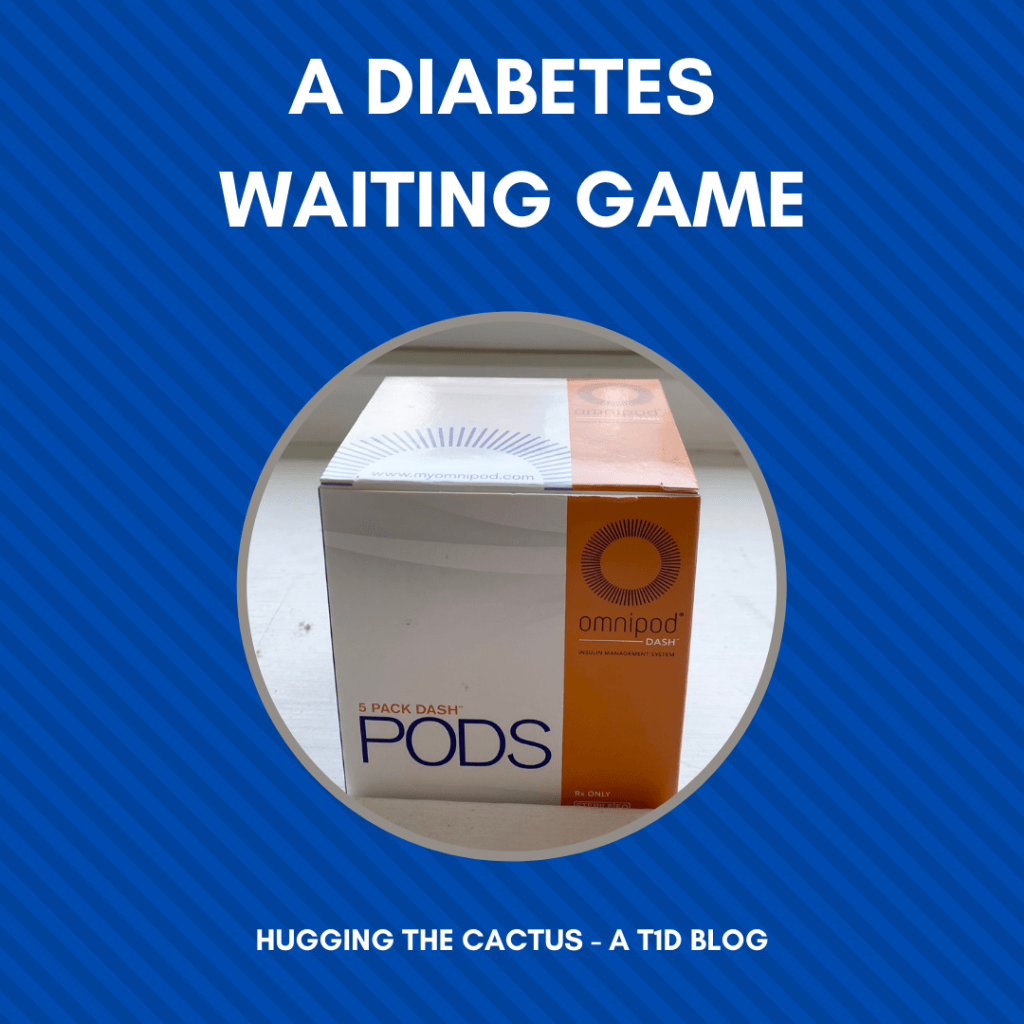
I am smack-dab-in-the-middle of a very long, very annoying diabetes waiting game.
I’ve waited for my Dexcom sensors and transmitter refill for two months now.
I’ve waited to transition to the OmniPod DASH system for a few weeks now.
I’m very glad, and fortunate, that this waiting game does not apply to the most crucial of my diabetes supplies, which is of course my insulin.
But I’m still tired of waiting.
I don’t mind it as much for the OmniPod DASH; after all, I’d rather use up my remaining pods before diving right into full-time use of the new system.
But the Dexcom sensors and transmitter? That wait has been borderline ridiculous.
I may have to wait to use my new DASH pods, but at least I have ’em here when I’m ready to put them in action.
To sum it up, the wait is due to a series of miscommunications between me, my doctor’s office, my health insurance provider, and my DME (durable medical equipment) provider. And it sucks, because just like anyone else who has diabetes, works full-time, manages a household, and has a social life, I’m doing everything I can to address the matter when I have the time and mental bandwidth to do so, but still blame myself for not getting my prescriptions sooner.
It sucks that I feel failed by the healthcare system.
And again, I find myself feeling grateful that this is my first time experiencing anything like this in 23ish years of life with diabetes. But what’s opened my eyes is that this is a reality for some people with diabetes all thetime. That doesn’t just suck – it’s unacceptable.
When will we stop having obstacles block the paths to getting essential, life-saving medications and equipment?
This post was written by Elizabeth Roosevelt and it originally appeared on the T1International blog on July 16, 2021. I wanted to share it here today because Elizabeth did a beautiful job of summing up similar sentiments that I’ve personally experienced regarding insulin affordability and access. Thank you for sharing, Elizabeth, and know that many others feel the same way as you!
“We can discuss our technology, diabetes and Covid-19, our experiences with insulin affordability; anything you would like,” Beth, who oversees and organizes the T1International Digital Advocates, echoes through the Zoom during our Digital Advocate meet and greet.
A little embarrassed, I think to myself, “please, not our experiences with insulin affordability.”
As someone living with type one diabetes for fourteen years and a Digital Advocate for T1International since August 2020, it sounds like a conflict of interest that I wouldn’t want to share my experiences accessing insulin – a drug that saves my life each day. After all, this is a major goal of T1International: to advocate for global access to insulin.
It sounds like I shouldn’t be an advocate.
“This prompted me to seek organizations like T1International where I could not only learn more about healthcare inequalities that impact my own community but also fight for change.”
In reality, I’m just a little nervous. I am nineteen years old, was diagnosed with type one diabetes at age five, and have always lived in the United States. Growing up, I had no idea where my insulin came from, but I knew it would be there, delivered to my front door in an unassuming cardboard box with a few neon biohazard labels slapped on the top.
Every time I opened the refrigerator to grab insulin for a pump site change, a few vials of Novolog would be perfectly lined up on the top shelf. Each time I swung the cabinet open to reach for a new infusion set, the supplies were there, waiting for me. When packing for vacation, I never thought twice about having enough supplies back-stocked in my house to take with me.
When I wanted to switch from the Medtronic pump to the OmniPod, the thought that the OmniPod might be more expensive never crossed my mind. Money didn’t grow on trees, but my parents always made it happen. And for that I am eternally grateful and blessed.
So, if the other advocates started sharing their experiences with insulin affordability on that Zoom, I’m not sure what I would’ve said. That I’ve never had an issue with it? That I didn’t know insulin affordability was a pressing problem in the United States until a few years ago, when Instagram posts by Senator Bernie Sanders and diabetes influencers began to pop up on my feed, explaining that Big Pharma was killing Americans, especially those with diabetes? It was only when our country’s flawed healthcare system made headlines that I noticed I seemed to be in a position many American diabetics were not.
This ignited a spark in me. It didn’t seem fair that just because I was born into a family that could afford private insurance to cover my diabetes costs I could do just about anything a person without diabetes could do. I could study and work to the best of my ability because a high blood sugar wasn’t slowing down my mind. This prompted me to seek organizations like T1International where I could not only learn more about healthcare inequalities that impact my own community but also fight for change.
Because I’ve had access to technology that allows me to sleep through the night and insulin delivered to my doorstep, I sometimes feel like less of a person with diabetes (PWD) and guilty of my privilege. While all people with type one struggle with the condition in some shape or form, I find myself invalidating my challenges because I tell myself I have it much easier. And in many ways, I do. I’ve grown up as a privileged white person in an affluent neighborhood, sheltered from the reality that very few people have access to insulin as I do, especially under the heavy, capitalist-driven policies of the United States.
However, I’ve learned that having it easier than others is not something to be embarrassed about nor does it make me less of a PWD. Instead, it is a responsibility.
It’s crucial that those of us who have access to insulin use our platform and privilege to fight for our community and for the people with diabetes who are solely focused on surviving. We must serve as the voice for the people with diabetes who can’t use their own because they’re bogged down working three jobs and choosing between putting food on the table for their family or insulin.
Maybe this fighting takes the form of educating our friends, family members, and colleagues about the disparities in insulin access through discussion or educational posts on social media. Or maybe, it’s collecting near-empty insulin vials and diabetes supplies in your community to help provide short term relief to struggling diabetics. Or perhaps, it’s calling the offices of or requesting meetings with your districts congressional representatives to urge their support of regulating legislation.
Whichever way our fighting takes shape, we must redirect the guilt we feel over our privilege into a heightened sense of advocacy, into change, into a fire that spurs our movement forward and pushes the established healthcare system towards equality.
#insulin4all truly means for all, and until all those who need insulin have access to it, our work isn’t done.
Hi, my name is Molly and I have type 1 diabetes, and although I am extremely grateful for health insurance, I also hate every aspect of it.
When I aged out of my parents’ health insurance plan two years ago, I was completely lost and overwhelmed by choosing my new plan. How much would I have to pay for my supplies? Would everything be covered? Could I keep my doctors? How much money should I put into my FSA? The answers to these questions took me a good chunk of time to figure out, and I only started feeling good about my knowledge of my old job’s health insurance plan in the last year or so.
As a result, the only thing that made me less excited to start my new job was the burden of having to figure out a new health insurance plan. And for good reason, it turns out, because it has been a challenge to say the least. But there are a handful of things I’ve learned along the way that I don’t think I’ll ever forget so that I can have an better experience the next time I need to change health plans. Here are my tips for making the transition from one health insurance plan to another as easy as possible:
1.Take stock of ALL my supplies before starting the new job (and before losing my old job’s health coverage). This was, without a doubt, the best thing I could’ve done for myself before I started my new job. In my last few weeks with my former company, I looked through all of my diabetes supplies and inventoried them. I kept a running list of the most important items (things like insulin, Dexcom sensors/transmitters, and pods) and decided that even if I had plenty of those things, I would still place an order for them before losing my health insurance. This ended up being a fantastic idea because it took me a solid couple of weeks at my new job to figure out which health plan would work best for me, and in that span of time, my supply stash was dwindling. On top of that, it took several more weeks for me to get all my prescriptions straightened away (more on that in tip 3), so I was especially grateful that I had seriously stocked up before leaving my old job.
2.Compare plans extensively. Like I mentioned above, I spent a couple weeks reading through my plan options before I finally settled on one. It took me so long because I wanted to feel 100% comfortable with my new plan, and I knew that I had a 4-week period to complete my research before committing to a new plan. Plus, my new job uses a website that offers a health insurance plan comparison tool (a super cute one, to boot, that explains all things insurance in layman’s terms) that I was happy to take advantage of during the decision-making process.
What tips would you have for someone who is switching health insurance plans?
3. Send as many messages and make as many phone calls as it takes until everything about the new plan is crystal clear. For me, this including calling my local pharmacy and sending toooons of online messages to my doctor’s office, as well as my new health insurance provider. I honestly felt like I was playing a game of telephone – you know, that game that kids play where they have to whisper a message into each other’s ears as a test of listening and communicating effectively – because it seemed that nobody would take accountability for sending my prescriptions to the right place or understanding exactly how I needed help. So in the last few weeks of July (leading into the first few weeks of August, really, ‘cuz I’m still working on this), I made a vow to myself that I’d get to the bottom of everything and get my prescriptions fully straightened away. I’m happy to report I’ve made substantial progress, but I’d be lying if I said it didn’t require a lot of my spare time and energy.
4. Talk to coworkers and ask for their feedback on plans. This might be unique to me because I work for a diabetes organization and my colleagues have an intimate knowledge of health insurance hurdles combined with a chronic illness, but even so, I remember asking coworkers at my previous job about their thoughts on the health insurance offerings and I got some solid feedback from that. So that’s why I decided to ask around at the new job, and of course I was met with helpful replies that made my transition a little smoother.
The biggest lesson I learned throughout this process? I realized I need to give myself a little grace. This stuff isn’t intuitive to anyone (unless you’re some sort of health insurance guru). I shouldn’t beat myself up because the system is more complicated than it needs to be. And bottom line is that I need to focus on the fact that I have choice when it comes to health insurance, period, because I know that there are too many people out there who can’t say the same.
So I guess in a way I am glad for the challenges presented to me by my health coverage.
I have some exciting news…I’m switching to the OmniPod DASH!
While I won’t start using my DASH until after my old OmniPods are used up (first generation OmniPods aren’t compatible with the DASH PDM), I’m still really excited about switching things up. Nearly a year ago, I expressed my desire to switch to the DASH in addition to my frustration that it would be more expensive for me to make the change.
But with a new job comes new health insurance and a whole new set of “rules” that I’ve been figuring out in the last couple of months.
And let me tell ya…it hasn’t been easy. But more on my struggles to get my basic diabetes prescriptions filled under my new health insurance to come in a blog post very soon…
Violet is excited about my new DASH PDM, too!
Anyways, back to the DASH. When I called Insulet to report a failed pod not too long ago, the representative I was speaking with was asking me if I’d heard about or was interested in the DASH system. Normally, I would’ve brushed her off and explained that I was only interested in getting a replacement for my failed pod that day, but I happened to have some spare time on my hands and decided to ask her if she could see if/how my new insurance would cover the DASH.
She kindly did some research and reported back to me that yes, it was indeed, and that all I’d have to do is get my doctor’s office to prescribe some DASH pods to me and in the meantime, Insulet could send my DASH PDM to me so that I had it on hand when I was ready to start using it. What really sold me, though, was the price – I’d be paying less for a 90-day supply of DASH pods than what I was paying for regular OmniPods under my old health insurance plan.
It was a no-brainer, really.
Even though I’m not DASHing away to start up my DASH (again, gotta make use of those old pods first), I’m still looking forward to getting acquainted with a new piece of diabetes technology that will feel familiar to me because of my years on the OmniPod system. I can’t wait to share more when I finally get DASHin’!







 Hugging the Cactus