Oh, the Dexcom G6. You have no idea how much I simultaneously love and hate you. I love you for your painless insertion, increased accuracy, acetaminophen-blocking capabilities, and your sleeker profile. But I effing loathe you for having communication issues with the sensor on days 9 and 10 of wear…that is, if you even last that long on my body. You have serious sticking issues, old pal. Your adhesive tends to be a bit of a ripoff – both literal and figurative.
You see, I was just trying to roll over into a more comfortable position in the middle of the night when you decided right then would be the ideal time to just fall off my arm, prompting me to go from blissfully snoozing to wide awake and angry in less than 10 seconds. Way to go! It pissed me off because it happened with very little effort. I would’ve understood if I had scratched or touched it in any way, but all I had done was flip from sleeping on my left side to my right. Not fair and definitely not the ideal way to wake up.
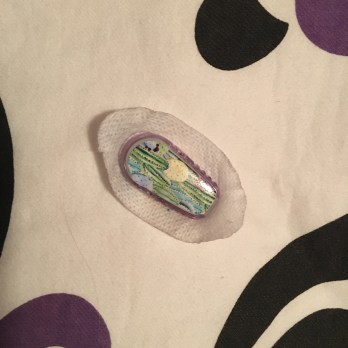
The ripoff sensor in question.
I wish I could say it was a one-time occurrence, but no, it happened a couple months ago. Again, it was the middle of the night and again, it was ripped off prematurely. I think that in both cases, I still had at least another three or four days of use before it was due to be changed. And even before these two middle-of-the-night ordeals, I had trouble with a freshly inserted sensor that was peeling all around the edges. What the heck is going on with Dexcom G6 adhesiveness?
Maybe this is a sign that I need to start using something in addition to an alcohol swab each time I change a sensor. Perhaps Skin-Tac or more regular usage of Pump Peelz/Grif Grips will prevent future sensor ripoffs. But I still can’t help feeling ripped off, because this never really happened when I was using my G5 sensors.
The small mercy in this situation is Dexcom customer service. Kudos to their team for being understanding and willing to replace my not-so-sticky sensors…but I wish I could say that I had more faith in a G6 sensor’s ability to stay on my body for the full 10 days that it was intended to.
“It’s better to have it and not need it, than to need it and not have it.”
Growing up, this mantra was frequently repeated by my mother regarding my diabetes supplies. More often than not, I’d roll my eyes at the saying – not because I was annoyed with her, but because the prospect of carrying extra supplies “just in case” felt very inconvenient. My purse/backpack/overnight bag would already be crammed to maximum capacity, so squeezing in backup needles or insulin was practically impossible. But typically, I’d cave and make it all work somehow, because the fear of not having something essential when I was away from home was strong enough.
I’ve kept up this practice in my adulthood, as overnight travel and increased distance from home have become more common. And I was reminded why it’s a good idea very recently.
I was staying at a friends’ place for the night. They live about 45 minutes away from my house, which isn’t far, but it was far enough for me to want to make sure I had extra supplies. I definitely did not want to have to make that drive twice in one night, and I knew it wouldn’t even be a realistic option, because chances were good that I’d be drinking alcohol – it was game night, after all.
If you have T1D, always be prepared.
Pizza, beers, and laughs were had, and before we knew it, it was one in the morning. We all headed off to bed, and just as I do every night, I checked my blood sugar before I got totally settled.
I was wicked high – the mid-300s, actually.
I was worried, because I thought I’d been on top of my blood sugar for most of the night. I gave myself an extended bolus for the three slices of pizza I ate, limited my beer intake (too many carbs), and kept a watchful eye on my CGM. While I did know that my blood sugar was climbing, I thought that I was staying on top of it with correction doses. Apparently not.
No matter, I figured. The best I could do was take more insulin, drink some water, and try to relax a bit before bed. I didn’t want to sleep until I knew my numbers were coming down, but I also knew that my willpower to stay awake was fading. So I set an alarm on my phone to wake up in an hour and check my blood sugar again.
When I did, I was 377! I couldn’t believe it. I followed the same process again – bolused, drank water, set an alarm to wake up in another hour – and hoped for the best. But when my alarm blared again at 3 A.M. and I discovered that I was STILL stuck at 377, something told me that there was more to the story here. I lifted up my shirt to check my pod, which should’ve been securely stuck to my belly…except it wasn’t. The end with the cannula was sticking up, revealing that the cannula was not underneath the surface of my skin.
I felt simultaneously pissed off and relieved. I was mad because I’d just changed my pod earlier that day, so it should not have come off so easily. But I was relieved because finally, I had an explanation behind the super-high, super-stagnant blood sugars.
And I was seriously relieved that I’d thought to pack my insulin, a spare pod, and an alcohol swab in my overnight bag.
So there I was, changing my pod at 3 A.M. Far from fun, but it was necessary. I even wound up giving myself an injection with a syringe – yet another diabetes supply that I don’t really need to carry but had stowed away in my kit (just in case) – to ensure that my system had insulin in it to bring my blood sugar back down.
From there, it was a long night (morning!) as I set numerous alarms for the next few hours to wake up, check my blood sugar, and bolus more as needed. I couldn’t rely on my CGM for readings, because guess what? It got torn right off my arm as I tossed and turned in bed. Go figure, right? (I didn’t have a backup sensor because the CGM is one thing that isn’t exactly necessary. It makes life a helluva lot easier, but for a single overnight trip, an extra sensor wasn’t needed.)
What a long night…
I probably only got three hours of sleep that night, and I was pretty damn defeated looking at a shitty CGM graph the next day. But you know what? The whole incident serves as a stark reminder that it’s important to ALWAYS have backup supplies: You never know when you might depend on them.
I’ve been lucky enough to have the Dexcom G6 CGM in my life for just over six months now. In that time, many people in my life – both T1Ds and non-T1Ds – have asked me countless questions about my experience with the device. I thought it’d make sense to address some of the most commonly asked questions here, in the hopes that I can provide some insight to those who are curious about the Dexcom G6.
Question: Can the Dexcom G6 be restarted?
Answer: In my experience, no. I cannot get the G6 to restart like I could get my G5 to restart. But take my “no” with a grain of salt, here, because I know of other people who HAVE had success restarting their G6 sensor, making its life extend much longer than the 10 days guaranteed by Dexcom. I have only tried to restart the G6 once, with absolutely zero success, following the process outlined here. My advice to those who want to try to restart their G6 is to do so cautiously, and make sure you’re not trying to do so with the last sensor in your stockpile.
Question: Is it actually safe to take acetaminophen (Tylenol) on the Dexcom G6?
Answer: Yes! I’ve noticed that acetaminophen can be taken safely on the G6. I did not anticipate for it to be unsafe, seeing as it was advertised as one of the big improvements Dexcom made from the G5 to the G6. I’ve taken Tylenol a handful of times without noticing any issues with my CGM readings, but as always, be sure to monitor your blood sugar carefully and perform a manual finger stick check if your symptoms don’t match up with your CGM.
Question: I can’t get my Dexcom G6 sensor to stay put for the full ten days. How do you make it last?
Answer: There’s tons of ways you can help ensure your G6 sensor stays stuck on for the entire ten-day duration. I always make sure that my skin is completely dry before the sensor makes any contact with the site. Avoiding any excess moisture is key in helping it stay put. If I notice the sensor starting to peel around the edges after a few days of wear, then I use a Pump Peelz CGM adhesive to keep it in place. Those tend to work really well for me. In times of serious adhesive doubt, I also use Skin Tac wipes, which basically glue that sucker down. One last tip I recommend is to avoid sites that come into contact with a wide variety of surfaces. In other words, a sensor that’s placed on the abdomen may fare better than a sensor on the leg, because the odds of the sensor getting accidentally knocked off due to contact with clothing or other objects are lesser. You know your own body better than anyone, though, so trust your own judgment when it comes to CGM placement.
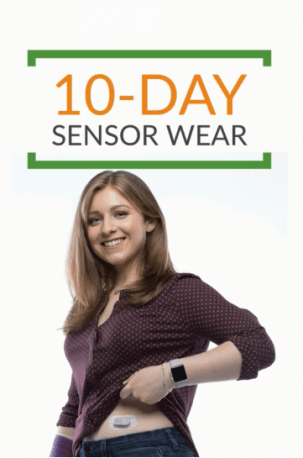
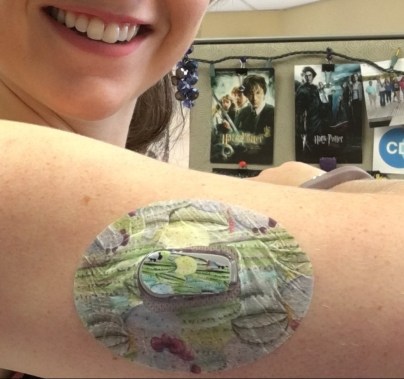
Modeling my G6.
Question: Is sensor insertion truly painless?
Answer: For me, G6 insertion has been pain-free approximately 85% of the time. It’s stung slightly a handful of times, but I’ve found that it only hurts when I choose a site that’s not particularly fatty. That’s why I generally stick with my abdomen – either side of my navel – or the back of my arms for G6 insertion.
Question: Is the G6 really that much more accurate compared to the G5, or any other CGM on the market?
Answer: Yes and no. That may not be a very satisfactory answer, but I’ll explain why that’s my belief. Overall, the G6 seems to be more accurate for me than the previous Dexcom CGM models I’ve worn. Are the number always on point compared to what appears on my meter? No. Do I wear the Dexcom CGM to have an accurate picture of what my exact number is at a given moment in time? Kind of, but I also know that this isn’t totally realistic. After all, users of the Dexcom CGMs know that it measures blood sugar levels in five-minute intervals. It can’t give me a clearer picture of what my blood sugar changes are minute-to-minute. So with that in mind, I find that the G6 is really excellent for monitoring trends – seeing how rapidly my blood sugar is falling or rising, or seeing how it changes gradually over time. The patterns are more important to me than the precise numbers; at least, that’s how I feel in my current stage of diabetes management.
I can’t really speak to other CGMs on the market, such as the Freestyle Libre or Medtronic’s CGM. But what I can say is that I’ve heard less-than-stellar reviews about both. It’s important to remember, though, that they’re not meant to be the exact same as the Dexcom CGM. The Libre itself isn’t really continuous and can’t provide users with information until they chose to wave the receiver over the sensor. And as far as I’m aware, the Medtronic CGM communicates directly with Medtronic pumps, and I’m not sure how seamlessly the systems work together.
Bear in mind that when it all comes down to it, I’m answering these questions with my experience, and my experience alone, in mind. Dexcom is and will always be the number one resource to go to with any questions regarding their CGM devices. But hopefully, the information I’ve shared here will at least help someone who is curious about the G6 feel more motivated to seek additional information. I stand by the fact that it has revolutionized my own diabetes care and management, and though it’s far from being flawless, it’s still an invaluable tool to have incorporated into my daily routine.
Diabetes Awareness Month may have only started a few days ago, but boy, has it been jam-packed with advocacy and awareness efforts so far! In fact, I think this is the most active year yet for most social media platforms. I’ve seen tons of different campaigns, hashtags, and posts that were all created especially for this month, and it’s absolutely wonderful to see such inspired content as well as high participation rates.
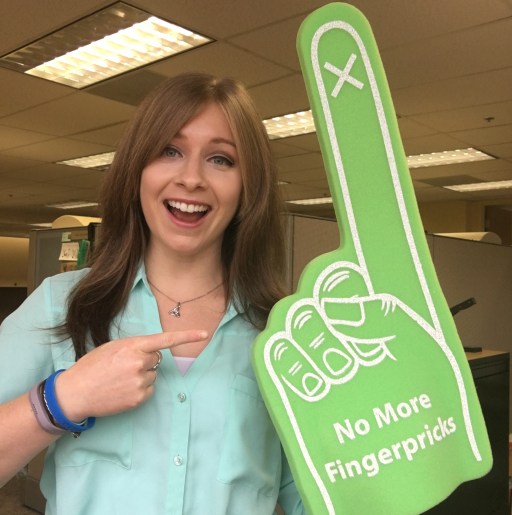
And I hope to keep the ball rolling on this! That’s why I’m sharing my #NoMoreFingerpricks post today. This campaign was launched by Dexcom and Beyond Type 1. Participants are encouraged to take a picture or video wearing the foam finger from Dexcom, or to draw an “X” on an actual finger (if they don’t have a foam finger). For every photo or video posted on Facebook/Instagram with an @Dexcom and #NoMoreFingerpricks, Dexcom will donate $1 to Beyond Type 1.
Here’s my #NoMoreFingerpricks campaign photo! And yes, I deliberately wore blue – the color of diabetes awareness.
Yup, it’s that easy to do! And it’s exactly the kind of social media campaign that can catch on quickly. Recruit your family and friends to take photos and get posting! And be sure to teach them a couple of diabetes facts and what the whole #NoMoreFingerpricks hashtag is all about. For instance, you could mention that:
34% of people with T1D know nothing or little about CGM
80% of people with T1D still prick their fingers more than 3 times a day
96% of CGM users would recommend CGM
You could even direct inquiring minds to visit nomorefingerpricks.com to learn more about continuous glucose monitoring technology and this campaign.
So…what are you waiting for?! Draw an “X” or grab that foam finger and post your photo to educate, advocate, and celebrate living beyond!
High blood sugar and low blood sugar are both incredibly draining. One turns me into a grump who can’t drink enough water and the other turns me into a shaky, sweaty, slurring hot mess who can’t string a simple sentence together. Needless to say, neither situation is fun.
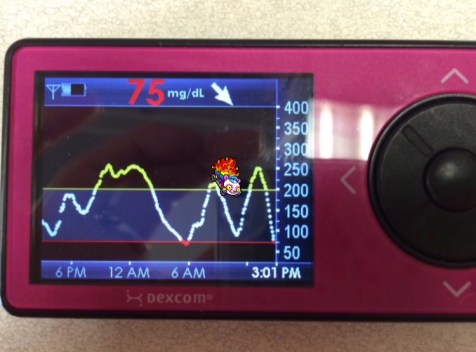
But there’s one even worse than that: the roller coaster situation. It’s best illustrated using a CGM graph like this:
I added the little graphic of psychedelic teddy bears riding a roller coaster – it seemed to illustrate my point well.
It’s what I use to describe blood sugar that won’t level out to my target range. It just goes up, up, up, and falls dramatically – just like an actual roller coaster – once the high is corrected. And boy, does that drop down take my breath away.
But then wait, there’s more! After the crash and the inevitable need for lots of sugar (and fast) is satisfied, the blood sugar soars back up again, leaving me frustrated as I take another bolus to fix it…
…only for it to happen again. And again.
Get me off this ride!
When I’m stuck on these blood sugar roller coasters, it’s mentally and physically exhausting. I question my every action over and over again as I try to do the “right thing” and make my numbers level out, only to end up berating myself for getting into this situation in the first place.
I’ve never been a fan of roller coasters in real life – they make me a combination of anxious and nauseous that I’ve dubbed “nauxious” – but I’d rather ride one that goes upside down than experience the T1D roller coaster situation again any time soon.
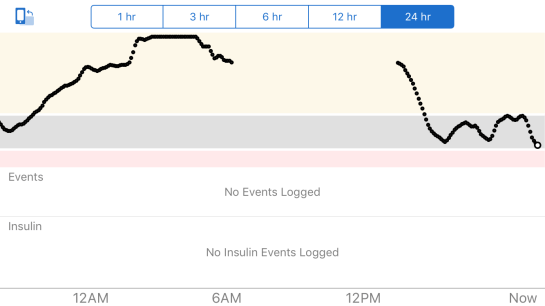
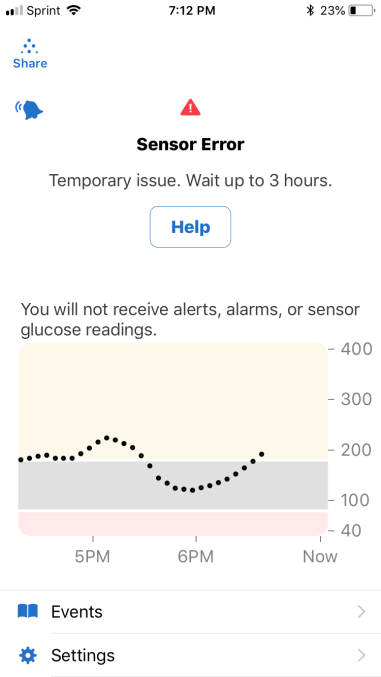
I don’t understand why the sensor error occurs. But it almost ALWAYS happens on the ninth day: My sensor will work wonderfully and provide me with extremely accurate data, but then BOOM it’ll sporadically stop working and produce graphs like the one above that are virtually useless. Even worse, there’s no telling when exactly it’ll start communicating again with my receiver. The error message SAYS I’ll get data back within 3 hours, and I normally do, but there’s a big difference between going 10 minutes and going 2 hours without any readings.
This device has so many good things working in its favor: longer wear, painless insertion, increased accuracy, compatibility with acetaminophen, slimmer profile. But I’m of the opinion that if something says it will totally function for a certain length of time, then it WILL. The fact that it doesn’t, and that this has occurred more than once to me, is alarming and frustrating.
The only possible explanation I’ve come up with is that maybe the upper arm isn’t a great place to wear the G6. As we all know, Dexcom devices are FDA approved to be worn on one location, the abdomen. However, that hasn’t stopped the cheeky diabetes community from wearing it elsewhere. Besides the upper arm, I’ve seen people with it on their forearms, thighs, and calves. I even know one clever person who chooses to wear it on the upper bum during the summer months to prevent tan lines (hilarious and brilliant, IMO). I choose to wear my CGM on my upper arm most of the time because it’s comfortable there, and I like to give the sites on my belly a break. But maybe it’s time I start wearing it more frequently on my stomach, the “officially okay” site, to see if that prevents these ridiculous sensor error scenarios.
What I’d like to know in the meantime, though, is has this happened to you or anyone you know using the G6? Has anyone pinpointed a cause, and is it worth notifying Dexcom of this issue? I’d love to hear your stories and thoughts – drop a note in the comments or get in touch with me directly!
There’s nothing worse than medical adhesive that just won’t stick.
If an infusion site or CGM sensor fails to stick to the body, that almost always means that there’s no choice but to dispose of it prematurely. And that is the definition of a total waste, which is a horrible feeling when it comes to exorbitantly expensive diabetes supplies.
So you can probably imagine my vague sense of panic when less than 12 hours after inserting a recent CGM sensor, it started to peel around the edges. Actually, that’s phrasing it a bit lightly – one half of it was practically flopping off my arm. No matter how much I pressed it back against my skin, it wouldn’t stick. I knew that I needed to save it somehow, and fast.
My first resort was a Patch Peel – it’s cut to accommodate the CGM transmitter; as such, it was the most secure option I had available to me. But seconds after applying the patch, it started peeling all around the edges. WTF?! It was definitely the same strong adhesive that Pump Peelz uses on all of their products, so I didn’t understand why it wasn’t sticking. I cursed under my breath as I racked my brain, thinking of anything else I could use to salvage the sensor. I couldn’t bear the thought of throwing it away after less than a full day’s worth of use.
Smiling big with my salvaged sensor.
Then I remembered I had SkinTac, which is so strong and glue-like that I normally avoid using it. But desperate times call for desperate measures, right? I lifted up the edges of my patch and wiped the SkinTac all around my skin, patting the patch gingerly back into place as the SkinTac dried. And…it worked! My patch got wrinkly as hell as the adhesives bound together, but I didn’t care because I’d managed to save the sensor. Will it hurt in a few days when I peel off all those layers of adhesive? Oh yes. But I won’t mind at all because I didn’t have to waste a sensor with a retail value of about (cue the gasps) $165.
It’s defined by finger pricks, drops of blood, infusion site bruises. Diabetes rarely leaves beautiful markings behind on the body; rather, it can make me feel unsightly.
Needless to say, diabetes occasionally makes me feel worse about my body. I try to project body confidence when around others, but on the inside, I’m terribly self-conscious about the way I look.
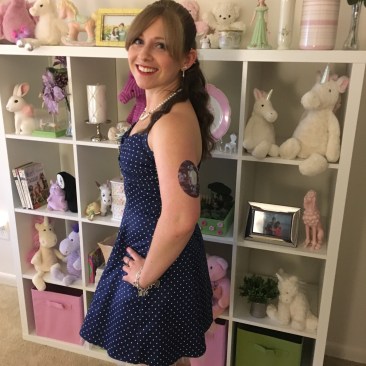
So that’s why it was wonderful to feel pretty with diabetes this past weekend.
Unicorns on my patch and in the background. Because you can’t be surrounded by too many unicorns. If only someone would tell that to my blood sugar…
I got all dressed up to go to a “punk prom” that my friend helped organize. The night was all about singing along to the angst-filled tunes of our youth, listening to local bands jam out onstage, and getting glamorous so we could pose for an endless number of photos with fellow attendees.
In the hours leading up to the event, I was a bit anxious about wearing my insulin pump and CGM in visible spots. They didn’t exactly match the dress I’d dug out from the bowels of my closet (and that I’d last worn in the 9th grade). But as I applied hairspray to my carefully coiffed curls, it hit me that I should just own the look. Sure, nothing about boring medical adhesive or the words “Dexcom G6” screams formal wear, but I had a couple tricks up my sleeve that could doll up my gear nicely.
Namely, I had Patch Peelz. Created by the folks over at Pump Peelz, this patterned tape could make my CGM look fancy. Between the unicorn print and the dark purple and blue color scheme, the patch would look like it was styled to match my dress. I couldn’t help but beam once I was 100% ready for the evening. Coordinated aesthetics aside, I felt like one of the unicorns on my patch: magical, vivacious, and yes, pretty.
And the silence was refreshing. I didn’t like being without my CGM for a week, but there’s no doubt about the one positive effect that its absence had on me: It gave me a much-needed mental break from an audible aspect of diabetes.
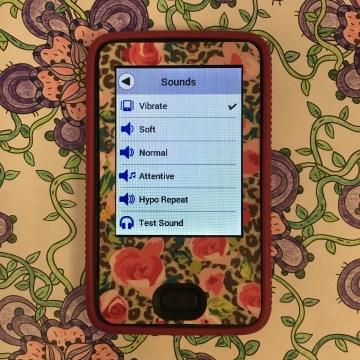
Diabetes can be LOUD sometimes. Especially in hypo repeat mode.
It was a blissful reprieve from my diabetes literally screaming at me like a needy baby. A week-long vacation from my CGM hollering at the top of its lungs “HEY YOUR BLOOD SUGAR IS HIGH DO SOMETHING ABOUT IT” or “WAKE UP YOUR BLOOD SUGAR IS LOW YOU BETTER TREAT IT RIGHT NOW.”
It’s rare that I can describe diabetes as peaceful; in this case, it was, and the experience will make me consider putting diabetes on mute a little more often.
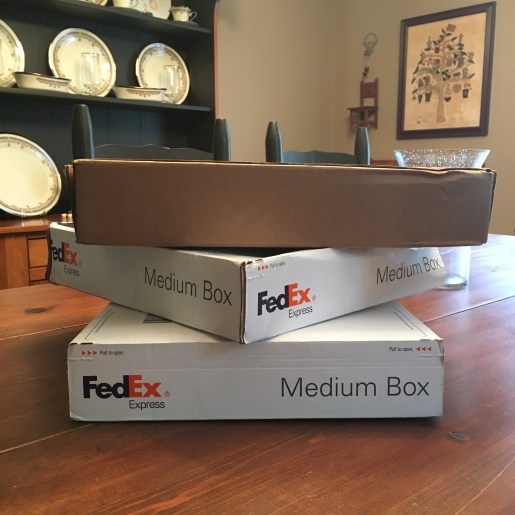
Last week, I received not one, not two, but FIVE packages in the mail. No, I didn’t go overboard with some online shopping – it was all deliveries from Dexcom to help me get my CGM up and running again.
You might be wondering: Why were there so many packages? In theory, I just needed a couple of replacement sensors and a new transmitter – couldn’t it all go in one box? Well, I wound up getting a little more than just the aforementioned supplies…
Not pictured: another two boxes I received from Dexcom. Not sure why they couldn’t send everything in one large box, but beggars can’t be choosers.
That’s because I had the stupendously (emphasis on the STUPID-sounding part of that word) great idea to power up my old G5 CGM while I waited for my G6 materials. I had a few G5 sensors leftover from before I made the transition to the G6, and to my knowledge, I had a working G5 transmitter. So I followed the procedure to get my G5 going: I inserted a G5 sensor (ouch!), snapped the transmitter into place, and started the warm-up on my G5 transmitter.
But something was…off. The Bluetooth icon was blinking in the upper left-hand corner, and I couldn’t see how much time had elapsed in the two-hour warm-up period. At a loss as to what to do next, I left the receiver on overnight to see if it would ever pick up a signal from my G5 sensor/transmitter, to no avail.
That’s when I made the “fatal error” of shutting the system down and trying to restart it. This triggered the G5 receiver to enter a reboot cycle that wouldn’t stop. Any time I pressed the circular home button, the system would buzz and the screen would light up, as if it was about to start working. After 45 seconds or so, the screen would go black again. There was no way to interrupt this reboot loop – even sticking a paper clip into the tiny hole in the back of the receiver wouldn’t correct the faulty software.
So now, not only was my G6 out of commission, but my G5 was a goner, too.
After a few phone calls to Dexcom technical support, I had answers as well as supplies sent my way. I learned that there’s a known error with the G5 system that causes the reboot cycle to launch. I should have waited longer for the G5 transmitter to connect with the Bluetooth on my receiver (i.e., I should’ve waited for the Bluetooth icon to stop blinking), but it wasn’t necessarily my fault for having a device with a known software issue. I would receive a new G5 receiver because my old one was still under warranty, as well as a G5 replacement sensor. I would NOT get a G5 transmitter, because I’m convinced the battery on the current one is still good, but I was informed that once a transmitter is activated, the battery keeps going until it runs out of juice. Interesting. That means that it could, in theory, stop working any day now, because the transmitter was activated and last used in April 2018.
Hopefully, I’ll never have to get another G5 transmitter because I’ll be able to rely on my G6 from here on out. It gives me comfort to know I have backup G5 supplies, but I’m pretty much married to my G6 at this point. Dexcom kindly sent me the required new transmitter for the G6 system, which arrived on Thursday of last week. I got a return kit for the old G6 transmitter the previous day, and on Friday, my new sensors came in along with a return kit for my defunct G5 receiver.
Sure, it was a lot of packages to sort through in the mail. And it was mildly frustrating that I had to wait two days between getting my new G6 transmitter and compatible sensors. But the most important thing is that I’m now reconnected to my G6 and feeling thankful that Dexcom delivered when I needed it most.


 Hugging the Cactus