Battery Blues

Between this post and the one from a couple of weeks ago, this blog is rapidly turning into one in which I bemoan the battery life of my diabetes devices…

The fact of the matter is, though, that I’ve definitely had my share of battery issues lately. The Omnipod DASH problem was resolved (rather swiftly), thanks to the folks at Insulet. But now it’s my Dexcom transmitter battery that’s acting up…and resulting in a whole lot of lost data (and even more frustration) for me.

If I can’t have a working pancreas can’t my diabetes devices at least have everlasting batteries?

It all started about a week and a half ago, when my Dexcom app notified me that my transmitter battery would be expiring in 3 weeks. That was to be expected – Dexcom transmitter batteries last 90 days, and according to my records, the one I’d been using was for sure approaching the expiry date.

What I didn’t expect was that the waning battery life in my transmitter would trigger multiple false blood sugar readings and periods of no readings whatsoever. At least I think my transmitter is to blame – I hadn’t experienced any issues with sensors from my last shipment and the app usually never experiences errors like this unless there’s a problem with the sensor and/or transmitter, so logic led me to conclude that my transmitter was simply losing reliability as it came closer and closer to its expiration.

My workaround was to do finger stick checks any time I was untrusting of my Dexcom, or whenever it was giving me a “no readings” alert. Plus, I’ve got a fresh transmitter ready to be activated once this one stops working, so it’s not like I’ll be without a Dexcom for an unbearable length of time.

In spite of that, I still thought this was worth talking about here on the blog because 1) I can’t remember if I’ve ever had a transmitter fade so dramatically in the last 3 weeks of its lifespan, 2) it was an exasperating situation and I needed to vent, and 3) I’m wondering if this has ever happened to anyone else before, and if there’s a workaround.

At this moment in time, I’m not quite sure what a feasible solution would be besides ripping a sensor off prematurely and sticking to finger stick checks for a few days until my annoyance ebbs…which is exactly the strategy that I decided to go with. I’m definitely looking forward to new transmitter time…

An Onslaught of Alerts

Imagine receiving the same notification on your phone every 5 minutes…over and over again…nonstop until you actually do what it’s demanding to you.

Sounds maddening, right?

Well, that’s exactly what I experienced with my Dexcom app recently. Every 5 minutes on the dot, I got a “Calibration Alert” push notification that told me to “enter new blood glucose reading to maintain your sensor accuracy”. Doesn’t sound like too big of an ask, right? Why not just do it?

Of course I just did it – the first handful of times that it asked. But when this alert persisted to appear on my phone each day, around 24 hours after I’d calibrated my Dexcom sensor, I started to get super irritated. But I was also confused. I shouldn’t have to calibrate my Dexcom, like, ever. The G6 was designed to make it so calibrations are a thing of the past. I only ever even bother to calibrate it within the first few hours of wear if I feel that the blood sugar it’s reporting is really off, and that usually forces it to correct itself and show far more accurate readings fairly quickly.

So why was my Dexcom being so forceful with the reminders for me to calibrate?

Imagine seeing this alert pop up on your phone…every 5 minutes…for an hour…or 3. That’s a few dozen reminders too many.

I knew that my best shot at finding the answer to this question was by going to the people who are intimately familiar with the ins and outs of Dexcom devices – no, not the manufacturers themselves. I’m talking about my colleagues, of course. (One of the best parts about working at a diabetes nonprofit is that my coworkers and I collectively have 100+ years of diabetes experience under our belts and constantly ask one another for advice or wisdom regarding various diabetes scenarios.)

When I asked them if they’d ever encountered anything like this, one person explained that the CGM can get a little confused if, when after the initial two-hour warm-up period, a super high or a super low blood sugar can trigger the system to get stuck – almost like it’s unsure of what it’s reading. This tracked for me because when I started up this particular sensor, the two-hour warm-up period collided with a particularly nasty low blood sugar of 35. That blood glucose value is low enough that the system can’t even pick up the number “35” – instead, it just shows that I’m “LOW”.

So as a result of this, my sensor was likely just in need of calibrations every 24 hours just to make sure it was working properly. It’s probably in the code of the software or something to prompt users to calibrate every day until the system feels more confident about what it’s reading. That makes sense and all, but dang, is it annoying. Sure, I could’ve silenced the alarms a lot faster if I just calibrated whenever I got the first alert of the day, but my schedule didn’t always allow for that. And besides, after 4 or 5 years of using the Dexcom G6, this T1D has gotten used to no more finger pricks; because of that, it’s hard to go back to old habits.

But hey, it has wound up being another diabetes scenario that I hadn’t experienced yet and just another lesson learned, so while it may have been a bit of a nuisance it was also educational. And I’m okay with that.

The Best (and Worst) Insulin Pump Infusion and CGM Sensor Sites

This blog post was originally published on Hugging the Cactus on April 1, 2020. I’m sharing it again today because it’s actually one of – if not THE – most popular blog post I’ve ever written. Maybe folks find it helpful as they ponder trying new sites or maybe they’re simply curious to learn what has and has not worked for me. Don’t worry, I spill all the details on everything – read on to get the full scoop!

Add a heading

Like many other people with diabetes, I wear two devices on my body at all times: my insulin pump (my pod) and my continuous glucose monitor (CGM). And I’m often asked whether or not these little gadgets are painful.

Fortunately, the answer is that most of the time, they aren’t. I rarely feel it when my CGM sensor or my insulin pod’s cannula pierce my skin, which makes the whole experience of wearing them a lot more comfortable – and much less dreadful when it’s time to rotate sites.

Speaking of sites and pain, though, I admit that there are some sites that, for me, tend to work better than others. The following are the different locations I use for my pod and CGM sensors, in order of what tends to be best to the worst. My stomach is my preferred spot for my pod AND my sensor.

Stomach: This is the site at which I have the best insulin absorption, so it’s a clear winner for me when it comes to my pod placement. I also find that it almost never hurts when I press up against the pod (e.g., when I roll over in bed in the middle of the night) when it’s on my belly. The same is true for my CGM sensors, which also seem to be the most accurate when they’re placed on my abdomen. I guess there’s a reason why the stomach site is the only one recommended by the FDA for the Dexcom CGM (which is what I use)!

Lower back: I have yet to try my CGM here, but I often place my pod on my lower back without issue. This site can be trickier to navigate because if I forget that my pod’s there when I’m getting dressed in the morning, I can come precariously close to accidentally knocking it off – and I have in the past. Plus, the pod can rub up against me in an unpleasant way when I’m working out; specifically, doing any sort of abdominal exercise on the ground. But it’s not something I can’t tolerate, and the insulin absorption in this location is just too good in general for me to pass over it altogether.

Upper arm: I wear my pod and CGM on my upper arms sometimes, but they don’t always adhere well for some reason. Getting dressed can be even more problematic for me if I forget that my sites are on my arms – I’ve totally ripped off pods and sensors when I’ve been taking off and putting on clothing. And for a long time, my CGM sensors would make me bleed when I inserted them in my upper arm. I never figured out why, and the problem seems to have gone away, but it definitely made me a little more wary about using my arms as a site (PLUS any devices I wear on my arms are highly visible, and I don’t always like it when people stare at them).

Thigh: Hands-down, the worst site for my pods are my thighs. For starters, wearing denim jeans – especially if they’re skinny jeans – are such a feat when wearing a thigh pod. The fabric pushes up against the pod in such a way that I prefer wearing dresses, skirts, or leggings for the three days that I have a thigh pod just so I can be more comfortable. And speaking of comfort, it’s tough for me to get into a cozy sleeping position when I have a thigh pod because I like sleeping on my stomach sometimes, and there’s just too much pressure up against my pod when it’s on my thigh. And for me, it seems that insulin absorption just isn’t great on my thighs (maybe because they’re on the muscular side). BUT, I will say…I recently tried a CGM sensor on my thigh for the first time and I didn’t hate it! The accuracy was good and it wasn’t in the way as much as a thigh pod (I keep wanting to type “tide pod”) would be. I’ve only had it on my leg for a few days now so I don’t know yet how the adhesive will hold up, but I’ll find out.

Spots I haven’t tried yet (but want to): On social media, I’ve seen people wear Dexcom sensors on their forearms (eek), upper butt cheek (tee-hee), and even on their calves. And pod placement can get even wilder with spots in the center of the back (HOW can people reach back there) and, um, the upper-breast area (one word: ouch). While I don’t think I’ll ever work up the courage to try some of those spots, I am curious about others.

The bottom line is, though, that the sites that work best for me might not work as well for you. (The same thing can be said for my worst sites.) But it is important to remember, above all, the importance of rotating sites…even though I’m clearly not a huge fan of pods on my legs, I’ll still suck it up and place them there because I know that I should be careful of scar tissue buildup.

It just makes the pod-and-sensor-change days that much more pleasant when I can move them from a disliked site to a favorite site, anyways.


Sensor Snapping by the Seashore

Sensor snapping by the seashore…try saying that five times fast.

The past several weeks have been so busy that I completely forgot about an incident that occurred when I was away on vacation in July.

An incident that I’d never experienced in my decade of using Dexcom CGMs…

It was the second-to-last day of my trip. I was blissfully soaking up the sun’s rays – it was by far the best beach day of my entire week in Maine. That meant that the sun was strong that day…so strong that I was basically applying sunscreen every hour, on the hour, because I am as pale as Casper the friendly ghost.

During one of my sunscreen applications, I noticed that the Dexcom sensor on the back of my arm was looking a little off. I mean that literally – the transmitter seemed like it was jutting out at a weird angle. Upon further inspection, I realized that the grayish-purple prong that helps keep the transmitter in place was hanging on by a thread. I was pretty surprised to make that discovery, for a few reasons: 1) I didn’t know that could happen, 2) the sensor was only about 24 hours old and nothing went awry during the application process, and 3) I couldn’t remember bumping into anything that would’ve caused a plastic piece to break off my sensor. But the most surprising part was that it was enough to cause my sensor to stop collecting readings altogether – I was getting an error message on my Dexcom app.

My broken sensor prongs and me, sitting on the beach.

I didn’t know what to do other than carefully break the prongs off all the way – they weren’t going to do me any good now – and gingerly press my transmitter down into my sensor for several minutes to see if that did anything…and no dice. I resorted to plan B, which was to wait until I got back to the house I was staying at to do some more research into the matter.

Unfortunately, the internet had nothing helpful to offer me. I was somewhat relieved to know that this has happened to other people, but definitely bummed to learn that there wasn’t a real solution other than to apply a new sensor – which wasn’t an option for me since I had only packed the one sensor for my trip. Whoops. So much for me being the diligent, prepared T1D that I thought I was.

Ultimately, I decided to rip the sensor off and deal with finger stick checks for the rest of my trip; after all, I was going to be returning home the next day. I look at the whole incident as yet another example of why it’s important to pack extras of my extras, and as a reminder to expect the unexpected in life with diabetes!

The 1 A.M. Cupcake

Zzzzz…huh? What’s that? I was sleeping so deeply…

Oh, I’m low.

Dazed, I roll out of bed and suddenly become aware of how hot I am. Beads of sweat are rolling down my back, making my pajamas stick to my skin. I look at the number on my Dexcom – there isn’t one.

It just says LOW.

I grow more alert and turn to my test kit to do a fingerstick check and verify my Dexcom reading. My meter says that I’m 44.

And suddenly, I’m feeling that low. I need sugar, stat. I could open the bottle of glucose tabs conveniently perched on my nightstand, chew 5 or 6, and then get settled into bed and fall back asleep relatively quickly. But the desire to get downstairs and eat the contents of my kitchen strikes, even though it’s 1 A.M. and eating too much at this time of night wouldn’t be good for either my blood sugar or my sleep hygiene.

Ignoring my more rational side (as well as my glucose tabs), I grab my phone, my meter, my PDM, and my bathrobe and stumble down the stairs in the dark. I turn on the ceiling fan in my living room in a desperate attempt to cool down faster before I walk into the kitchen.

My eyes fall on a cupcake sitting innocently on the counter.

This isn’t a picture from this particular incident – nobody wants to see me when I’m this low – but this is one of the cupcakes that I’d made. Violet always wants me to share.

I don’t think twice – I tear the wrapper off and three bites later, it’s gone.

I collapse on the couch, directly under my ceiling fan. I am a sweaty mess. This low is hitting me hard. I put the TV on in a futile attempt to distract myself while I wait for the cupcake to kick in, but instead of paying attention to what’s on the screen, all I can feel is gross for choosing to eat a damn cupcake at 1 in the morning instead of doing the “right” thing and treating my low from the comfort of my bed with glucose tabs.

20 minutes later, I start to feel chilly. I’m no longer perspiring and I feel all of my low symptoms subside. I’m better, so it’s time to head back upstairs and try to fall back asleep.

I toss and turn for a bit, cursing diabetes and its middle-of-the-night low blood sugar curveballs, and the stupid 1 A.M. cupcake that my diabetes somehow convinced me to eat to treat a low instead of waiting to have it at a time that I could actually enjoy it.

Diabetes strikes again, I think as I drift back to sleep.

80 Days Later…

80 days.

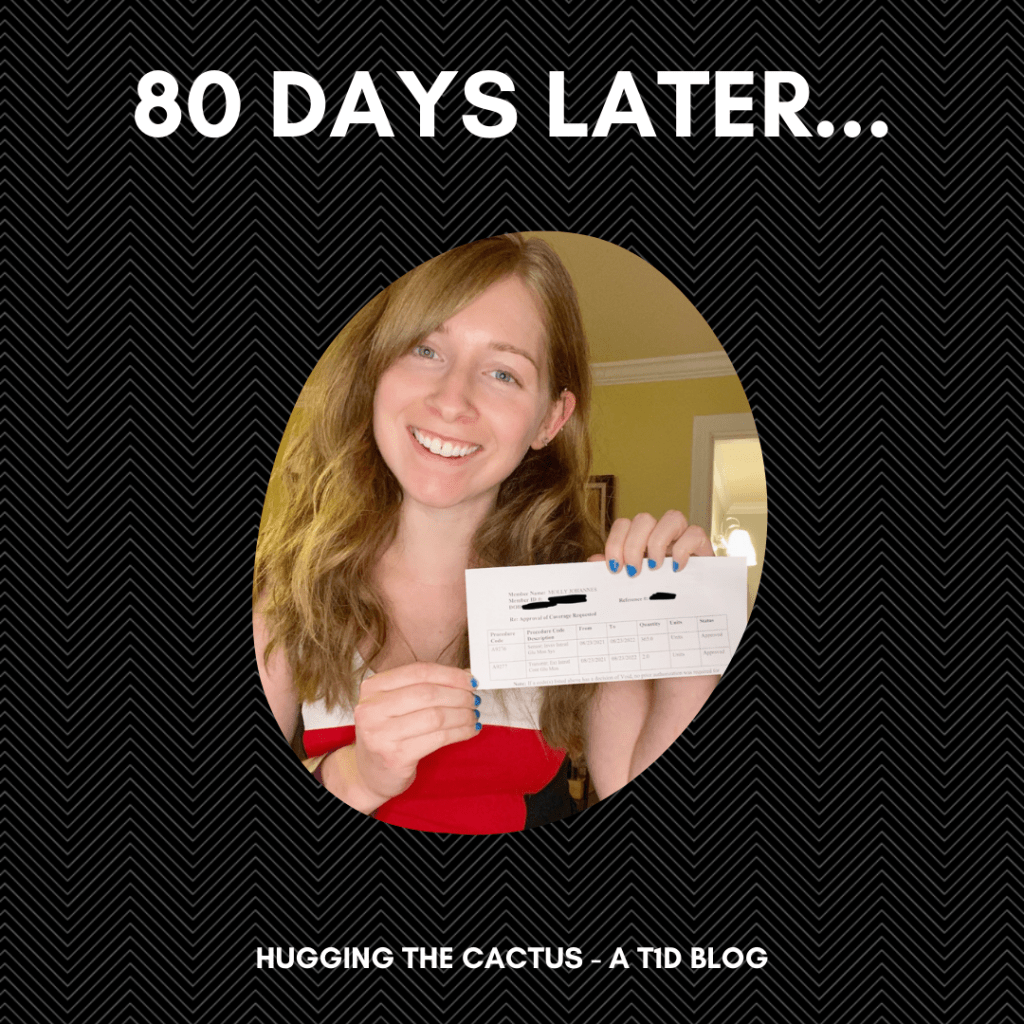
That’s how long it took for me to receive the letter from my health insurance company notifying me (at long last) that the pre-authorization for my Dexcom supplies came through – and more importantly, was approved.

Those 80 days were fraught with anxious thoughts. On a daily basis, I wondered…

When would I get my next Dexcom order? Answer: Almost three full months after I started my new job and switched health insurance.

Would I even still be able to use Dexcom under my new health plan? Answer: Yes, although I wasn’t sure for a long time seeing as I didn’t find out until recently that I needed a prior authorization in order to get Dexcom coverage.

Why was it taking so long? Answer: It took so long partly because this stuff can be time-consuming. I work full-time, maintain a home, care for my dog, and juggle a jam-packed social calendar…and don’t often have the bandwidth to be waiting on hold with my doctor’s office, my health insurance provider, and my Dexcom supplier. I was counting on all three of the aforementioned parties to do a little more of the heavy lifting for me when I should’ve depended on myself alone to make sure I got my supplies as quickly as possible.

What was I doing wrong? Answer: Honestly, even though I sound like I’m shouldering most of the responsibility in the latter paragraph, I don’t think it’s fair to pin this all on me. Sure, I could’ve and should’ve hustled harder to get my Dexcom supplies, but I put trust in a system that I already knew is fundamentally broken. Health insurance can be ridiculous complicated to understand and contend with. I’d never needed a prior authorization for anything before, so that concept was new to me. Throw a new health plan that I had zero familiarity with into the mix and I was bound to encounter some bumps in the road to get my supplies.

I was so excited to get this letter in the mail that I took a damn picture with it.

That’s why I almost cried tears of relief and joy when I finally got the letter from my insurance company that informed me my Dexcom supplies were approved. The waiting period was over. 80 days of fretting over whether or not I’d have access to a tool that has revolutionized my diabetes care and management was absolute agony. That period of time also represented the first time I was truly worried over whether or not I could continue with the diabetes regimen that works for me. I was trying to remember the days before my Dexcom, the days that I had finger pricks and finger pricks alone to base my diabetes decisions on.

I could scarcely remember those days. And the fact that they could’ve become my new reality if I didn’t figure out the Dexcom situation frightened me.

I feel very fortunate that I was eventually able to successfully place an order for my Dexcom supplies under my new health plan, but I also feel rage that the system made it so difficult, as well as utter heartbreak for those who don’t have choice when it comes to diabetes supplies or even access to life-altering (and life-saving) medications.

I’ve said it before and I’ll say it again…our healthcare system is broken. Choice and access matter.

They matter most of all when lives depend on it.

A Diabetes Waiting Game

I am smack-dab-in-the-middle of a very long, very annoying diabetes waiting game.

I’ve waited for my Dexcom sensors and transmitter refill for two months now.

I’ve waited to transition to the OmniPod DASH system for a few weeks now.

I’m very glad, and fortunate, that this waiting game does not apply to the most crucial of my diabetes supplies, which is of course my insulin.

But I’m still tired of waiting.

I don’t mind it as much for the OmniPod DASH; after all, I’d rather use up my remaining pods before diving right into full-time use of the new system.

But the Dexcom sensors and transmitter? That wait has been borderline ridiculous.

I may have to wait to use my new DASH pods, but at least I have ’em here when I’m ready to put them in action.

To sum it up, the wait is due to a series of miscommunications between me, my doctor’s office, my health insurance provider, and my DME (durable medical equipment) provider. And it sucks, because just like anyone else who has diabetes, works full-time, manages a household, and has a social life, I’m doing everything I can to address the matter when I have the time and mental bandwidth to do so, but still blame myself for not getting my prescriptions sooner.

It sucks that I feel failed by the healthcare system.

And again, I find myself feeling grateful that this is my first time experiencing anything like this in 23ish years of life with diabetes. But what’s opened my eyes is that this is a reality for some people with diabetes all the time. That doesn’t just suck – it’s unacceptable.

When will we stop having obstacles block the paths to getting essential, life-saving medications and equipment?

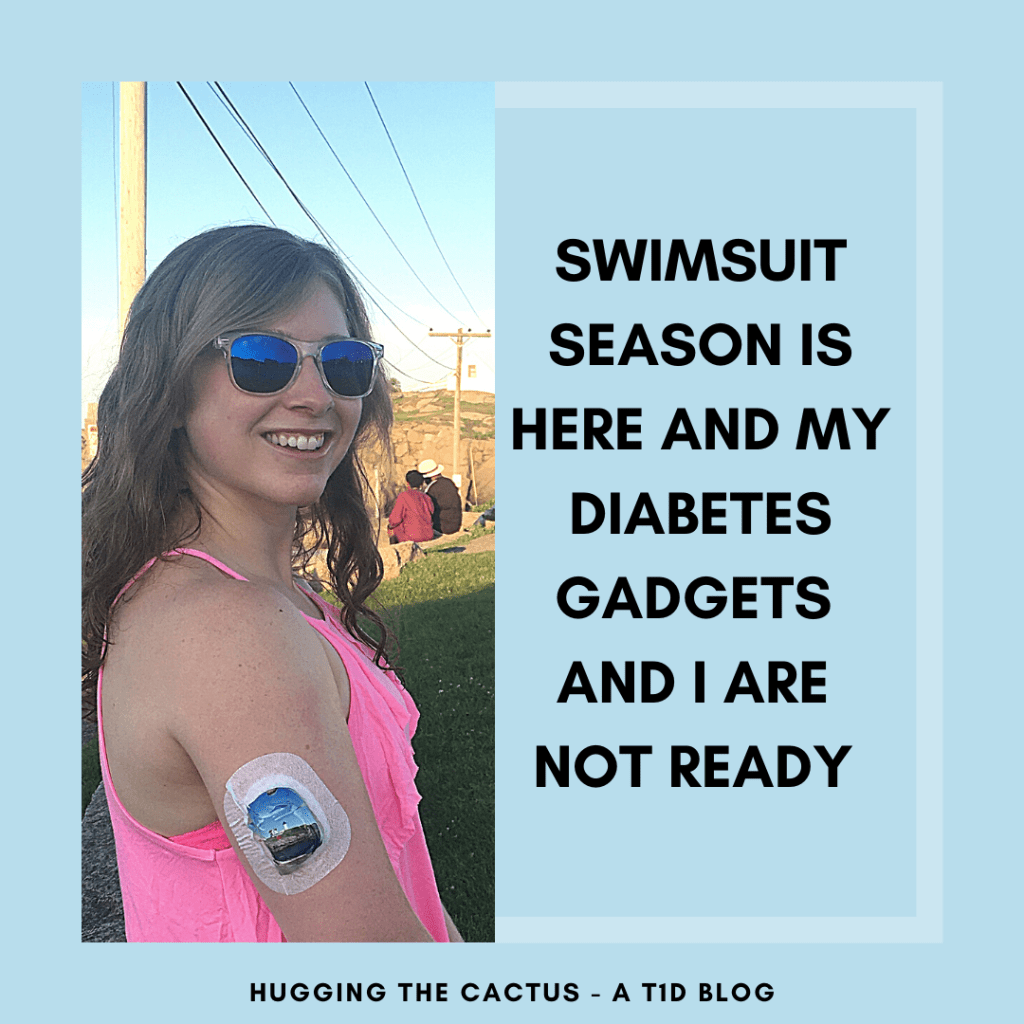
Swimsuit Season is Here and My Diabetes Gadgets and I are Not Ready

A “yay”: Summer is here!!! Hooray for warm weather, beach trips, and backyard BBQs! (Not to mention VACCINES!)

A “nay”: My pods and my CGM sensors are about to bare themselves for the world to see and we are NOT READY for it.

My confidence in my appearance is rarely, if ever, high. But I like to fake it ’til I make it and act like I’m rocking my summer wardrobe instead of stressing about how my legs or arms look in the staples of the season that are designed to show more skin.

Usually, I have a lot more success in feeling good about how my medical devices appear on my body. Whether they’re hidden under my clothes or out for the world to see, I typically don’t care because these gadgets are keeping me alive!!! And that’s a lot more important than any negative body image connotations they may create.

A picture from a time during which I was very okay with PDA (public displays of my arms).

But something about this year feels different to me. I am so not looking forward to the extra stares that my diabetes technology attracts. I’m not sure if it has to do with being sheltered in the last year and a half because of the pandemic, but whatever the cause may be, this is something I’m grappling with as the temps creep up and the temptation to hit the beach grows stronger.

I know I’m not the only one dealing with this. In fact, I was in Maine for a couple of days with my parents and I was wearing my pod on my leg, whereas my mom had hers on her arm. And we had multiple people approach us about our pods! They weren’t necessarily rude in their approaches – curiosity drove them to speak with us and that’s innocent enough – but it’s still weird to know that people are looking closely enough at our bodies to see our devices and feel comfortable enough to ask us about them. Plus, I felt extra self-conscious about it because in typical Molly fashion, I had a sunburn all around my pod thigh site…when applying sunscreen, I almost always miss the area directly around my pods because I’m afraid of the sunscreen making my adhesive weaker or interfering with the pod’s functionality. So not only did I have this big chunk of plastic sitting on my leg, it was also red all around the site, drawing even more attention to it. It was a relief when I was able to put shorts on over my swimsuit and cover up both the burn and the pod.

So while I’m not loving how wary I’ve felt lately about baring my diabetes devices, I’m also coming to terms that it’s just a sort of phase that I’m going through right now. And that’s okay. I’m also trying to remind myself that I don’t have to feel obligated to go into detailed explanations when people ask me about my pod or CGM. It’s a natural tendency that I have to use it as a teaching moment and be a good diabetes advocate, but sometimes I just don’t have the energy for it. I’m keeping my fingers crossed that as the summer season goes on, my comfortability with my diabetes devices increases and I worry less about the looks they tend to draw.

Trying to Outwalk a Low Blood Sugar

I was a mile into my regular morning walk when the beeps started.

Dammit.

The beeps were coming from my Dexcom app on my phone and they were alerting me to a low blood sugar. Rather than correcting the low, though, or even opening up the app to dismiss the alarm, I just kept walking.

Outwalk the low blood sugar, Molly.

Outwalking a low blood sugar is easier said than done.

I really couldn’t understand why my blood sugar was low in the first place considering that I had no food in my system or insulin on board (other than my standard basal rate). Fasting workouts tend to virtually guarantee stable blood sugars for me, which is wonderful because otherwise exercise tends to make me crash. But what was different about this morning? I was utterly befuddled. My Dexcom alarm chimed a second time.

Outwalk the low blood sugar, Molly.

Even more confusing was my complete and utter determination to not treat the low blood sugar until I got home. I had glucose tablets on me, so it’s not like it was a matter of lacking a treatment. Rather, I think I was more focused on maintaining my fasted state for as long as possible, since I almost always do an exercise circuit (weight lifting, cardio training, HIIT intervals, etc.) when I return home from my morning walks. My low alarm rang a third time, just as loudly as it had before.

Outwalk the low blood sugar. You’re only 15 minutes from home.

I was deaf to my Dexcom’s persistent alarms for the next 15 minutes as I somewhat floundered down the road home, letting my impatient puppy tug me along. It’s almost like she knew that I was low and was trying to hurry me home, and I was 100% okay with that because my brain was starting to get fuzzy.

Outwalk the low blood sugar…

At long last, nearly half an hour after my first low alarm sounded, I was crossing the threshold of my front door and fishing my phone from my bag. I tapped through my notifications and cleared the low alert, noting that I was 66 mg/dL and definitely needed to eat something before continuing on with my morning routine. I sighed, set my sight on the kitchen (where a low blood sugar food stash awaited me), and resigned myself to the fact that I couldn’t outwalk the low blood sugar this time.

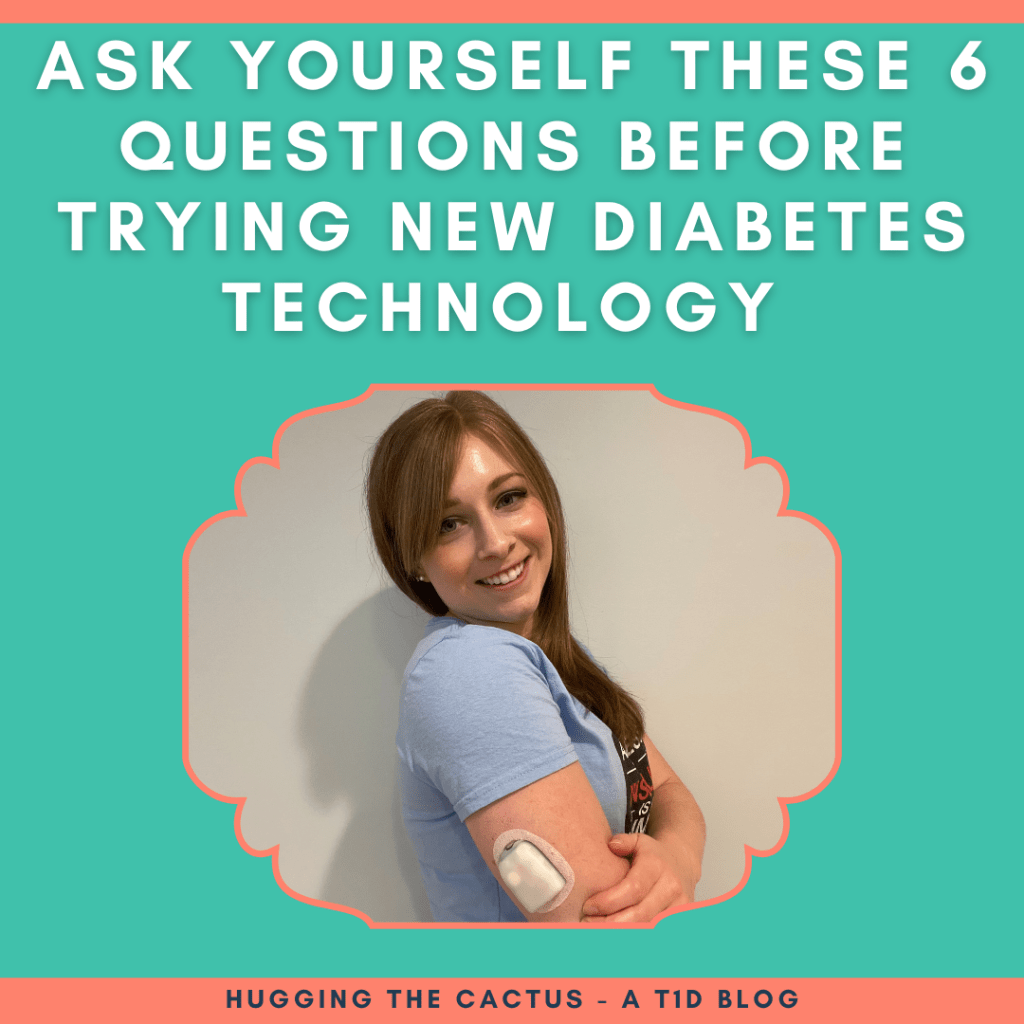
Ask Yourself These 6 Questions Before Trying New Diabetes Technology

This blog post was originally published on Hugging the Cactus on May 13, 2020. I’m sharing it again today because I think it’s super important to weigh the answers to these questions before deciding to try new diabetes technology. This is coming from someone who waited 17 years before she tried her first insulin pump, and even though it has had an enormously positive influence on my life and sometimes I wish I’d tried it sooner, I’m ultimately glad that I waited that long! Read on for more details…

So you want to try your first continuous glucose monitor. Or maybe you’re ready to leave behind multiple daily injections and switch to insulin pump therapy. Whichever diabetes device you’re looking to start using, there are some questions you’ll probably want to have answers to before decide that now’s the time to introduce new diabetes technology into your daily routine.

The following is a compilation of the questions that I thought long and hard about (literally for years) and that I wish I’d thought long and hard about before I made the transition to the OmniPod insulin pump.

1. Am I ready for it? It took me 17 years before I decided that I was ready to try an insulin pump. 17 freakin’ years!!! I spent most of that time being too afraid of introducing such a drastic change to a routine I’d had down pat for such a long period of my life. There are times when I wish I’d gone onto my insulin pump sooner, but ultimately, I’m glad that I wasn’t swayed by my family or doctors to go on it before I truly felt ready. By the time I started using my OmniPod, I had the maturity, responsibility, and emotional intelligence that I felt that I needed for an insulin pump.

2. Will I be able to afford it? Obviously, this isn’t a question that I wondered about when I was younger, but it’s one of the first things that comes to mind as an adult on her own health care plan. We all know that diabetes supplies are expensive, and it seems that the more technologically advanced something is, the more money that has to be forked over in order to obtain it. This isn’t right or fair, but it’s a simple truth and an important one to think about before choosing one pump or continuous glucose monitor over another.

3. Why do I want to start using it? I wanted to start using my OmniPod because my mom experienced great success when she started using it. And I decided to get a Dexcom CGM because I fell in love with the technology after undergoing a trial period with my endocrinologist. In both situations, I felt very much in control of my decision to start using these devices and I didn’t really listen to anyone else’s opinions. But I am very aware of the fact that social media and real-life friendships with other people with diabetes can often sway people in different directions. After all, if I saw a post on Instagram from a dia-influencer who was singing the praises of a Tandem T:slim pump, then I might seriously start thinking about switching to it (this has actually happened to me). But the bottom line is to think about the why – will this device enhance quality of life for me? Will diabetes be easier to manage with it? Will it help me achieve my A1c and/or blood sugar goals? Do I need to add something new to my routine because I’m feeling burnt out by doing things the same way all the time? Knowing why I wanted to use an OmniPod or a Dexcom CGM made me feel that much better during the whole process of learning how to use them – I felt like I had clear goals that would help me navigate the integration of these new technologies into my daily routine.

Did you know that Insulet/OmniPod has demo pods that you can wear? They don’t hold insulin or deploy a cannula, but they can give you a good sense of what it’s like to wear a pod on a daily basis!

4. Will I be comfortable wearing it 24/7? This is a big one! Pods, pumps, and CGMs are very visible, and it can be jarring to go from being “naked” to having bumps and lumps underneath clothes that can get caught on doorknobs, chairs, and the like. Personally, the benefits of my OmniPod and Dexcom outweigh something like this which is a bit superficial, but that doesn’t mean it’s not something to think about. But it’s also worth thinking about comfort and what is least painful when it comes to insulin delivery, so that’s why this is an important question to ask.

5. Do I know anyone else using it who can provide feedback from a patient’s perspective? I’ve talked about this before, but I’m not sure when, if ever, I would have seriously considered using the OmniPod if my mother hadn’t tried it first. The fact that we both have diabetes has probably made us a little closer and strengthened our bond, so if there’s anyone’s opinion that I’m going to trust when it comes to something like this, then it’s hers. I can actually remember her first few weeks on the OmniPod – in which she learned a lot of valuable lessons – and how pleased she was with it once a few months with it elapsed. She taught me the ins and outs of the OmniPod when started to use it, and I’d argue that her advice was more helpful than that of my diabetes educator. So I’d advocate gathering opinions from family and friends (if either is applicable) or the diabetes online community before going on a new diabetes device, in addition to the research component below…

6. Have I done enough research on it? …Like any smart shopper, it’s crucial to really consider all options and research them thoroughly, especially when it comes to the top contender. I definitely did not complete sufficient research before going onto the OmniPod or Dexcom; rather, I trusted that they were just right for me. If I were to switch to something else tomorrow, though, you can bet that’d I’d spend a lot of time scouring the web for every last bit of information on the device so I could make the most informed decision possible.

New diabetes technology can be both scary and exciting. But more than anything else, it can really make life with diabetes much more carefree, and I’m glad that in this day and age there are so many options available to people with diabetes that continue to be technologically impressive