How Time Traveling Affected my Blood Sugar

I traveled through time last week.

No, I didn’t use a magical device or step through a portal. It’s much more boring than that: I flew across the country, east coast to west coast, to spend a few days in Las Vegas.

Okay, there’s no way in hell that I could justifiably describe my Vegas trip as BORING.

But my point here is that flying through a couple different time zones is totally trippy. And, of course, it impacted my blood sugar. Because why wouldn’t diabetes just cooperatively come along for the ride?

I knew I should anticipate some sort of blood sugar swings going to and from my destination, I just wasn’t sure of when and how they’d hit. But I did know that when I landed in Vegas, the first thing I needed to do was adjust the time on my PDM (my insulin pump). Surely, my blood sugar would not react kindly to thinking that it was three hours later than it truly was in my new time zone. My question, though, was when should I do this? On the plane? After we landed? Should I adjust it slowly, in one-hour increments? Or should I dial it back entirely in one go?

Normally, I would’ve asked my endocrinologist what to do – but I forgot to bring it up during my last appointment with her a few weeks ago. So naturally, I asked the next best source: the Diabetes Online Community (DOC).

The answers I received were varied…

…nevertheless, I appreciated the immediate replies. I decided to quit stressing about it so much and focus on getting to the actual destination, vowing to keep an eye on my blood sugar for any suspicious trends while on the flight.

Five and a half long hours later, my travel companions and I arrived at our hotel. While in line for check in, I fixed the time on my pump and glanced at my CGM (which I didn’t bother adjusting, since none of the settings on it or my meter were dependent on time). I was steady at 97 mg/dL…not too shabby at all. And I’m pleased to say that I maintained that decent graph for the next day or so. I was nonplussed by the phenomenon, but I couldn’t complain about it.

The next few days are a different story, due to some “lifestyle choices” I made while in Vegas (c’mon, you know all I mean by that is eating junk food and imbibing alcohol). But that’s a tale for another post, coming soon.

This one’s about time travel, and while I had no issues flying TO Vegas, I did encounter trouble flying home FROM Vegas. My friends and I chose to a red-eye flight, which I don’t regret per se, but I’d never done one before and didn’t realize how much trouble I’d have falling asleep on the plane. It was disorienting enough leaving one place at 9 P.M. to arrive in another at 5 A.M., but add a freezing cold aircraft, turbulence, and an unsettled stomach to the mix, and you’ve got a recipe for disaster. As I tossed and turned in my seat, violently shivering a few times, my blood sugar was very slowly, incrementally, rising. I didn’t realize how much until we landed and drove home, where I had to bolus for an out-of-the-blue 308 mg/dL. I was so bloody tired, yet sleep evaded me further as I anxiously waited for my blood sugar to budge – which it did, but not for several, agonizingly long hours.

It definitely didn’t help matters that I wasn’t eating regularly; at the time of our arrival home, I hadn’t eaten real food in about 36 hours due to nausea that wouldn’t seem to leave me alone. I’d muscled down toast and a couple of granola bars, but not much else. I’d like to think that my entire body was just rebelling against me for spending the weekend eating too much pizza, staying up too late, and drinking a little too much whiskey, because that train of thought at least helps me make sense of my lack of appetite and recurring high blood sugars.

I’ve been back on the east coast for a couple days now, and I’m relieved to report that things have settled down. I’m eating regular meals (and I actually feel hungry for them), and besides a few flukes in my CGM graph, my blood sugars are mostly back to normal. I wish I could say that there was some big takeaway from this all: that I know exactly what to do next time I travel through time zones, or that I know just what to do to prevent it. But that’d be silly, because with diabetes, there are just too many variables. At least I CAN say that I know to take it in stride next time, to roll with the punches. Monitor my blood sugar like a hawk, correct as often as needed, eat normal meals as much as possible, and drink plenty of WATER. In any case, isn’t that what diabetes is all about…

…regardless of time travel and/or sorcery?


Training for my First 5K

At the start of the year, I told myself, this is your year. You’re going to be in the best shape of your life and finally run a 5K. I’ve never particularly enjoyed running, which is why the challenge of a 5K was more alluring than a different fitness goal. I felt that doing something I practically dreaded would make accomplishing it that much more gratifying.

But just a few short weeks into 2018, I broke a bone in my arm. I was crushed, because the kinds of physical activity I could do suddenly became severely limited. Instead of taking the injury in stride, I spent a long length of time moping over it. My exercise levels decreased and I stopped caring (for a short while, anyways) about my lean and mean pursuits. All I wanted was to heal, and heal swiftly.

Fortunately, I’ve fully recovered from the fracture, and so have my spirits. A renewed vigor took hold of me in April, and I spent many weekday mornings waking up early to complete a variety of workouts. I started to feel stronger and more confident in my athletic ability. So in the second week of May, just a few days after my 25th birthday, I decided the time was right to register for my first 5K.

And so I did, and I’ve devoted time training for it since then. It’s far from easy, but I must admit that each time I successfully complete a run, the feeling of accomplishment and pride that courses through my body makes it all worth it. It’s doubly wonderfully when I’m able to achieve in-range blood sugars before, during, and after each run.

I don’t have a convoluted strategy for stabilizing my blood sugar while running; rather, it seems to work best for me if I simply complete a fasting workout first thing in the morning. This eliminates a few variables affecting my blood sugar, including carbs consumed during a meal or insulin on board. I’ve found that I don’t even need to run a temporary basal or suspend any insulin – my body seems to do well if I’m running my normal basal rate. But with diabetes being a fickle fiend, I’m always prepared for a potential high or low blood sugar to occur on a run. In other words, portable glucose and my PDM are my constant running companions.

Race day is just a few short weeks away, and I can honestly say that I’m looking forward to it. Sure, I’m a little anxious, but I’m choosing to focus on the fact that I’m finally taking on something that tests me – and my diabetes – in all the right ways. I should be proud of that alone, but I must say, I’ll be over the moon when I get to cross that finish line.

The CGM Experiment: Comparing the Dexcom G5 to the G6

I have the extremely good fortune of being one of the first people in the world to receive the Dexcom G6, the latest in continuous glucose monitoring (CGM) technology. After spending almost two years eagerly anticipating its FDA approval, I could scarcely believe that I finally had it in my hands when it first arrived a few weeks ago.

I am partway through my second-ever G6 sensor, so I’ve had enough time to come up with some initial opinions on the system as a whole compared to the G5.

Let’s start with what I knew going into the first insertion of the G6. I knew that the transmitter would have a sleeker profile than the G5. I also was aware that the insertion process would be much more streamlined – all I would need to do is push a button and it would be on my body.  Plus, the G6 required 0 finger sticks or calibrations, could be worn for 10 consecutive days, and would no longer block acetaminophen (Tylenol) like its predecessors did. So far, me and the G6 were off to a solid start.

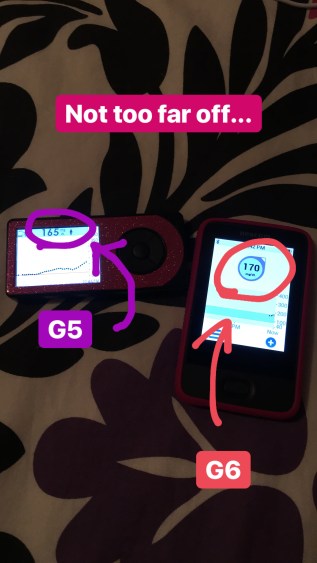
Then, it came time for me to actually put it on. Rather then end my current session with my G5, I decided to leave it on so I could see how accurate it was compared to the G6.

5af0f7d2789dd724634597

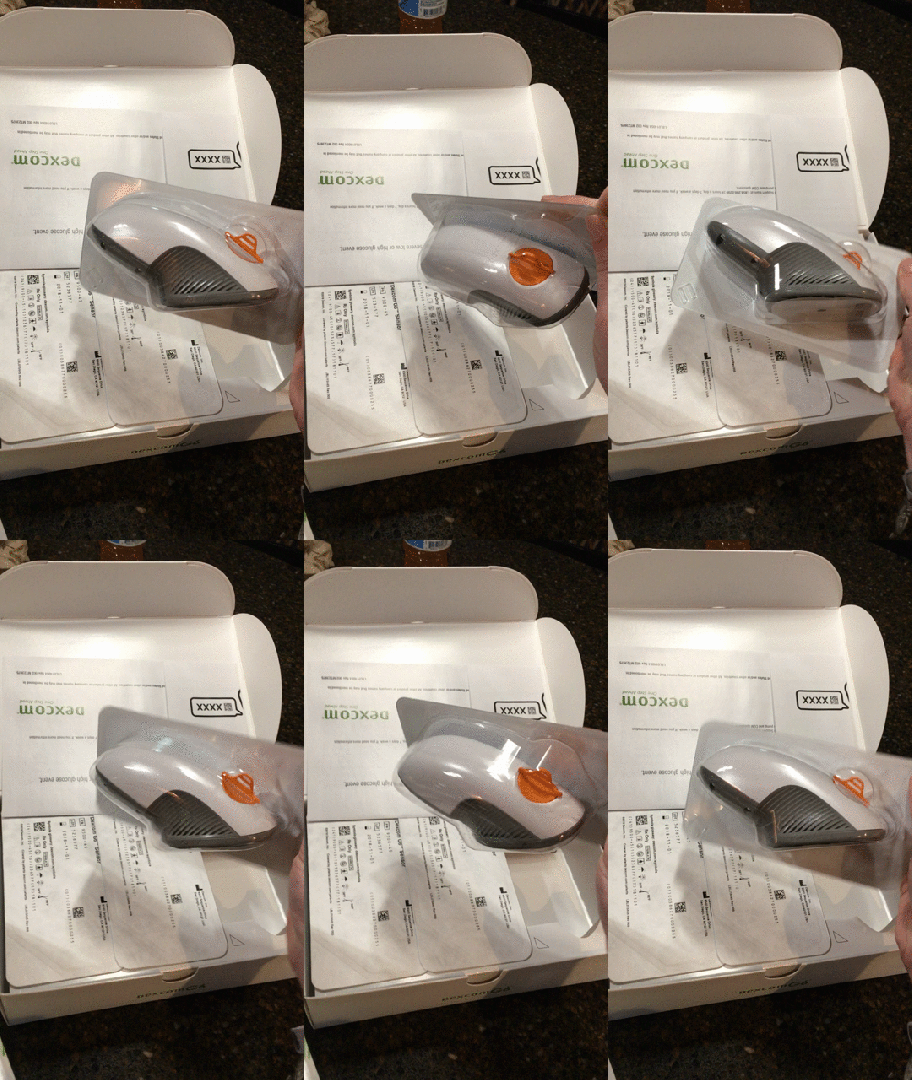
I was amazed by how easy it was to insert the G6. All I had to do was input a 4-digit code located on the sensor into my receiver. Once the code was accepted, I peeled the adhesive off the sensor, placed the system on my abdomen, folded the orange safety clip until it snapped off, and pushed the big orange button. I cringed when I did it for the first time; truthfully, I was prepared for it to hurt. It made a ka-shunk sound as the sensor inserted itself into my skin, and I…didn’t feel a thing. I marveled at how ridiculously comfortable it felt as I snapped the sleeker transmitter into place. I pressed one more button on my receiver to get the sensor warmed up, and that was it. Once two hours elapsed, my G6 system would be fully operational and could determine my blood sugar without requiring manual calibrations.

IMG_6655

While it felt great to know that I didn’t need to worry about calibrating my new device, I was more interested in seeing how well it matched up with my G5.

And I was a little let down…at least, I was in the beginning.

Initially, I was not impressed at all by the G6’s reports. They matched pretty damn closely with my G5. I was beginning to wonder whether the technology really was that excellent, and then my G6 proved to me that it was, indeed, kind of a big deal.

That moment came when it caught a low blood sugar sooner than my G5. I was feeling the early signs of a low, so it wasn’t much of a surprise when it alarmed. But what was particularly neat to me was that it was able to tell me that a serious low blood sugar (below 55 mg/dL) was oncoming in the next 20 minuets or less. In other words, it knew that I needed to treat my blood sugar right away to prevent a more urgent hypoglycemic event. That predictive feature was definitely a pleasant surprise.

As I wore my first G6 sensor for a few more days, it seemed to adjust better and better to my body. As evidenced in the above picture, it proved to be spot on when I compared it to the blood sugar readings I got from my meter. There’s absolutely still a bit of the classic CGM lag, as it takes about 15 minutes or so to catch up to what’s actually going on in the body, but that was to be expected.

I’m already on second sensor and I think it’s safe to say that I’m sold on the G6. But I don’t think that any product comparison/review is complete without a list of pros and cons, so here’s what I’ve come up with:

Pros of the G6 (compared to the G5)

  • Slimmer transmitter profile
  • 0 fingerstick calibrations (which I really loved when I didn’t have to wake up in the middle of the night to calibrate a sensor I inserted before bed)
  • Predictive low feature
  • Modern touchscreen receiver
  • Absolutely painless and foolproof application – honestly, it was THAT good that it might win me over from the G5 if that was the sole difference between the two

Cons of the G6 (compared to the G5)

  • Clunky applicator – as many other members of the DOC have noted, the system is comprised of a lot of plastic. Probably not very environmentally friendly. I wish it was possible to recycle it somehow
  • Automatic expiration after 10 days – with the G5, you could restart a sensor after a week had elapsed, and in theoryyou could use the same single sensor more than once for a few weeks in a row. The G6 automatically shuts down after 10 days, so you’re forced to put on a new sensor. This medical device is already pretty expensive, and you could at least get your money’s worth with the G5
  • No super noticeable improvement in blood sugar reporting capabilities

The bottom line is that the G6 is unquestionably an upgrade in diabetes technology. It requires fewer blood sugar checks and allows for greater discretion with its smaller size. The G6 is far from perfect, but it’s still a valued component of my diabetes toolkit. I’m excited to continue on this journey with it and discover just how much it helps me take the best possible care of myself.

My Involuntary Hiatus from the CGM

Currently, I’m on a break from my CGM for an unknown length of time.

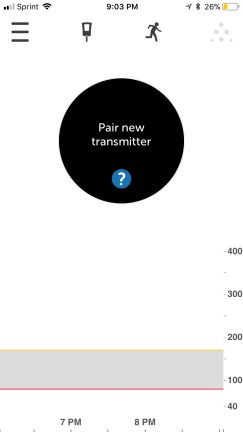
This temporary split wasn’t mutual; rather, it was due to a series of coincidences that occurred much to my chagrin. The short version of the story is that my CGM transmitter died a week earlier than I had anticipated. I thought it would be pointless to order a replacement since I was expecting the new Dexcom G6 to arrive at my house before the transmitter expired. When I learned there was a delay that would cause me to wait a little while longer, I realized I didn’t have much of a choice to go ahead and order a replacement G5 transmitter. After all, it was fly blind without my CGM for just a few days versus the possibility of missing out on that data for weeks.

fullsizeoutput_75dThe choice was obvious, and as I write this, my G5 replacement transmitter is on its way to me.
Though there’s comfort in that fact, I feel weird not having my CGM data available to me. It’s kind of nice to be wearing one less medical device on my body, but that’s really the only benefit of being without my CGM. The information it provides to me is invaluable, and an involuntary break from it makes me feel uneasy. I’m constantly reminding myself that I managed diabetes just fine for the first 15 years I had it without a CGM’s aid, which does offer a small amount of comfort. But it also reminds me how important the CGM has become in my daily care choices. Twenty-four hour, real-time updates of my blood sugar help me live a life less interrupted by my diabetes, something that’s extremely difficult to give up after 20 relentless years of dealing with it.

You really don’t know what you’ve got until it’s gone – even if it is only for a short period of time.

I’ll make the most of this situation. It will at least help me get in tune with my body’s signals when my blood sugar is high or low, which is definitely not a bad thing. And it makes me appreciate something that not every person with diabetes is lucky enough to have access to: serving as a humbling reminder of my fortunate circumstances.

Fantastic News! Dexcom G6 is Approved by the FDA

The official announcement has appeared across all sorts of social media in the last 48 hours, but I thought I’d say something about it here, too…

The FDA approved the Dexcom G6, the new and improved version of their Continuous Glucose Monitor (CGM) system!

This is particularly exciting, because the G6 comes with many new and exciting features:

  • 10-day wear (as opposed to seven days)
  • Slimmer and smaller sensor
  • Easy-to-use inserter
  • Zero calibrations necessary – the system does not require manual blood sugar inputs

Visit the Dexcom website to read about all of the details. And as more information comes out about its availability, stay tuned…

…because you may recognize a familiar name and face along the way!


Testing for Accuracy, in Addition to Blood Glucose

Blood glucose meters serve the sole purpose of checking current levels of glucose in the blood. Pretty self-explanatory, right? And it’s equally obvious that it’s crucial for all meters to generate accurate results so PWD can make the right treatment decisions based on those numbers.

Unfortunately, though, accuracy isn’t always what I get.

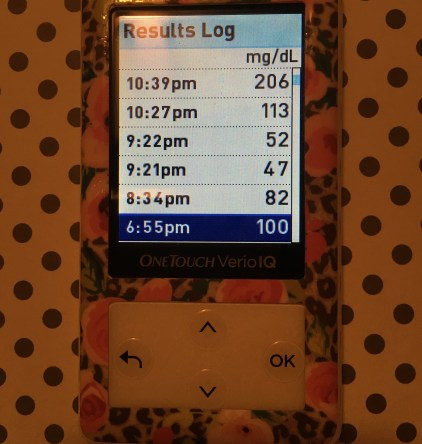
The other day, I was running low before bedtime. I corrected with an organic rice crispy treat (honestly, it was a million times better than the brand name kind). I waited nearly an hour for my blood sugar to come up. When my CGM wasn’t showing any progress, I tested: I was 47. It’s rare for me to be that low, so I tested again. 52. I believed it, especially since I was experiencing several hypoglycemic symptoms.

img_5802.jpg
My unicorn bg quickly turned into A Situation.

I chugged a glass of orange juice and plopped down on the couch to wait for signs of improvement. Before long, I was freezing cold – a sure sign I was coming up, because I had been sweating 20 minutes prior. But I didn’t feel comfortable going to bed yet. I wanted to see if my CGM would show an up arrow. When it finally did, I made my way upstairs to brush my teeth and wash my face. In the middle of my routine, though, I decided to glance at my CGM again – and saw the dreaded ??? screen.

I decided then that the Dexcom should be out of commission, a.k.a. not trusted at all, for the remainder of the evening.

I ripped it out and inserted a fresh one, not really caring that it would wake me up in two hours to be calibrated. I would need to set at least two alarms for the middle of the night, anyways, if I decided to go to bed disconnected from my Dex. So it just made sense.

Once that was done, I tested again. I was pretty tired at this point and really didn’t want to have to eat something else, so I did it as quickly as I could. In my haste, I jostled my meter just so – enough that I saw the test strip, already marked with my blood, move slightly as it brushed against my PDM and was placed next to it.

113 mg/dL flashed upon the screen. Normally, I’d be thrilled! But I furrowed my brow. Something just felt…off about that reading. So I tested again.

206.

What?!

I tested a third time – 203. Okay, something was definitely wrong. Either that 113 was wrong (likely) or my meter had just produced two wildly inaccurate blood sugars in a row (less likely).

This is one of the many times that it’s convenient to live with another PWD. I asked my mom if I could borrow her test kit and see what result it generated. Seconds later…a twin 203 popped up on the screen, reassuring me that the 113 was a fluke on my meter.

Relief with the reality and irritation with the technology washed over me simultaneously as I went to correct the high with a bolus. I was glad I wasn’t heading down again, but irked that my meter had failed me. True, it was a bit of human error there, but aren’t we at a point in technological advancements where this sort of thing just shouldn’t happen? I put my life into the “hands” of my meter, Dexcom, and OmniPod. They should produce results that are undoubtedly accurate.

I guess we aren’t quite there yet.

The Week of Never-Ending Lows

A couple weeks ago, I was convinced that I was going to go insane.

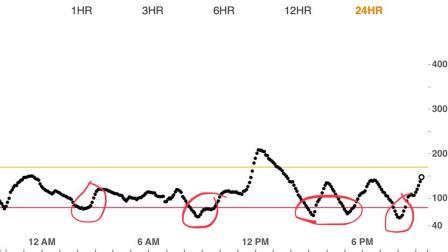
That’s because my graphs looked a lot like this for several days in a row:

28276753_2470934019799402_3452392286696220057_n

All those red circles represent low blood sugars. The first day it happened, it was annoying. The second day, it evolved into concerning. Seven long days later, I was feeling incredibly burnt out as the low streak finally came to an end.

I have NO idea what triggered these lows. My activity levels were practically non-existent and I cut back on my insulin intake as it grew more apparent that this situation was sticking around for a bit. Besides standard stress levels, I wasn’t experiencing any crazy emotional swings that could cause wacky numbers. It was that certain, ahem, time of the month – but that happens every month, and I’ve never had a series of low blood sugars as a result of it. So what gives?

My honest assessment: Diabetes is unpredictable. You think you know it so well. You think you can have a handle on it when it decides to give you a big, old middle finger, as if to say, “Joke’s on you!!!”

And that’s beyond exhausting. The physical and mental toll that a week of low blood sugars had on me is indescribable, and it made me reluctant to even talk about the experience – because enduring it was enough, why the hell should I bother writing about it?

I write about it because I want it as evidence so I can remember that I can overcome any diabetes obstacle. I write about it because I want others to know that even though I seem okay on the surface at a given time, I actually might not be due to my diabetes. I write about it because I hope that another PWD can read it and say, “Yes, that’s exactly what it’s like!” or “I can relate.”

I write about it to feel less alone, and make other people affected by T1D feel less alone.

Waiting for the Shift in Numbers

Call me crazy, but sometimes, I find myself staring at my Dexcom app in anticipation of catching the numbers changing.

It might be because I’m hoping for a change (coming down from a high, coming up from a low). Or it could be because I find a strange satisfaction in receiving real-time data of my blood sugar levels. Whatever, so be it: I’m a diabetes nerd!

I remember this particular example bringing me happiness, because I’d been hovering pretty close to my high limit (170 mg/dL) for a couple hours. So watching that three-point shift happen reassured me that I was going to come down. And sure enough, 15 minutes after capturing these screenshots, I was going down closer to my target of 100.

When it comes to diabetes…it’s the little things, right? Am I the only one who likes monitoring my CGM this closely, every once in a while? Or am I just weird?

Maybe don’t answer that last question…

Managing Diabetes When Sick

The inevitable finally happened: I caught a cold. It really didn’t surprise me, because 1) it’s cold season and 2) I’ve been running around like a mad woman the past couple weeks and missing out on sleep.

Though it was expected, it certainly wasn’t welcome. I can’t stand being limited with my activity levels, and it’s been tough enough to get by recently due to my broken arm. Alas, I spent about three full days doing nothing but sleeping and binge watching Gilmore Girls as I nursed myself back to health.

621660CD-E223-479A-8639-6E6287D78D7B
My best friend during my cold? This box of tissues.

During this time, I was extra concerned about my blood sugar levels. They tend to be better when I’m active, so I was worried about how they would fare when I was moving so little.

I admit that I probably did the wrong thing by not eating much during this time. It seemed like I needed to pump myself up with a heftier dose of insulin any time I was eating a meal, likely to compensate for the lack of movement. Even so, I seemed to spike a little too much for my liking after meals. So I really cut back on food. In hindsight, it wasn’t my best move, because even when I did eat it was not healthy (few fruits/veggies, mostly breads and fats).

But I do give myself credit for staying hydrated – a crucial step in getting better. I drank so much water, Powerade, and tea that I felt like I was constantly taking trips to the bathroom. It was worth it, though, because it’s easy to become dehydrated when sick and make a bad situation worse.

Also, I think I made the right move by taking some sick time from work. The day I woke up with a tingly throat, I thought I could soldier on and work a full day, but it became clear the moment I sat down at my desk and couldn’t focus that it would be best to just go home. I took a sick day the following day and was able to work from home the day after that, so I’m grateful that I have a flexible and understanding employer who knows that health is a priority over everything else.

As much as I loathed being mostly confined to my room for 72 hours, it was the smart call. It reminded me how important it is to listen to my body and to not push it when I’m not feeling 100%. There’s no shame in self-care.

Breakfast or a Plateful of Carbohydrates?

Look at the following image: What do you see? Breakfast, or a plateful of carbohydrates?

4B3EFDB5-F145-49D4-A3D1-7C87C4526847
Breakfast, or a plateful of carbs? Trick question, it’s both.

Trick question, it’s both.

I seldom enjoy large breakfasts like this, but when I’m treated to them, it’s more than just a savory, delicious meal. It’s also a math problem. So besides looking at a plate full of yum, I’m also looking at this:

Screen Shot 2018-02-18 at 10.11.21 AM
Looks like I’m having approximately 60 grams of tasty carbohydrates.

I can’t help it, I HAVE to look at my food this way because it helps me determine how much insulin I have to take. Once I add it up, I take the total amount (60) and divide it by 8, because that’s my morning insulin-to-carb ratio. From there, I take about 7.5 units of insulin to cover my breakfast. Of course, I’m not doing the division by myself – my pump is programmed to know all my mealtime ratios, so the only steps I’m responsible for is adding up my carbs and entering that information into my PDM.

You might think it’s a lot of work, but it’s what I’m used to, along with my fellow T1Ds. It all comes with practice, and before long, calculating carbs becomes part of the normal daily routine.

So this example is both breakfast and a plateful of carbohydrates, but that doesn’t make it any less enjoyable. After all, I’m used to crunching numbers along with my food.