A couple weeks ago, I was convinced that I was going to go insane.
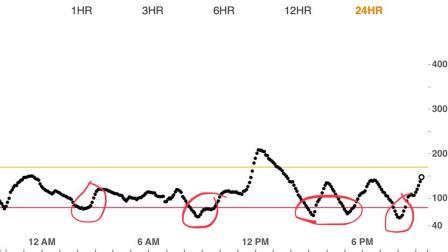
That’s because my graphs looked a lot like this for several days in a row:
All those red circles represent low blood sugars. The first day it happened, it was annoying. The second day, it evolved into concerning. Seven long days later, I was feeling incredibly burnt out as the low streak finally came to an end.
I have NO idea what triggered these lows. My activity levels were practically non-existent and I cut back on my insulin intake as it grew more apparent that this situation was sticking around for a bit. Besides standard stress levels, I wasn’t experiencing any crazy emotional swings that could cause wacky numbers. It was that certain, ahem, time of the month – but that happens every month, and I’ve never had a series of low blood sugars as a result of it. So what gives?
My honest assessment: Diabetes is unpredictable. You think you know it so well. You think you can have a handle on it when it decides to give you a big, old middle finger, as if to say, “Joke’s on you!!!”
And that’s beyond exhausting. The physical and mental toll that a week of low blood sugars had on me is indescribable, and it made me reluctant to even talk about the experience – because enduring it was enough, why the hell should I bother writing about it?
I write about it because I want it as evidence so I can remember that I can overcome any diabetes obstacle. I write about it because I want others to know that even though I seem okay on the surface at a given time, I actually might not be due to my diabetes. I write about it because I hope that another PWD can read it and say, “Yes, that’s exactly what it’s like!” or “I can relate.”
I write about it to feel less alone, and make other people affected by T1D feel less alone.
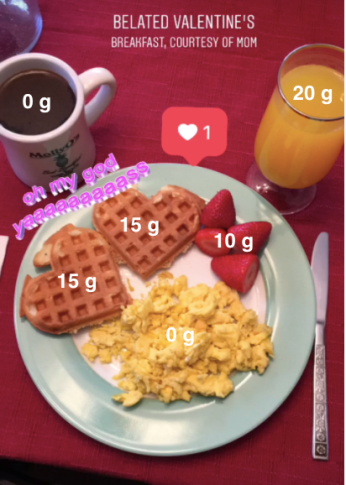
Look at the following image: What do you see? Breakfast, or a plateful of carbohydrates?
Breakfast, or a plateful of carbs? Trick question, it’s both.
Trick question, it’s both.
I seldom enjoy large breakfasts like this, but when I’m treated to them, it’s more than just a savory, delicious meal. It’s also a math problem. So besides looking at a plate full of yum, I’m also looking at this:
Looks like I’m having approximately 60 grams of tasty carbohydrates.
I can’t help it, I HAVE to look at my food this way because it helps me determine how much insulin I have to take. Once I add it up, I take the total amount (60) and divide it by 8, because that’s my morning insulin-to-carb ratio. From there, I take about 7.5 units of insulin to cover my breakfast. Of course, I’m not doing the division by myself – my pump is programmed to know all my mealtime ratios, so the only steps I’m responsible for is adding up my carbs and entering that information into my PDM.
You might think it’s a lot of work, but it’s what I’m used to, along with my fellow T1Ds. It all comes with practice, and before long, calculating carbs becomes part of the normal daily routine.
So this example is both breakfast and a plateful of carbohydrates, but that doesn’t make it any less enjoyable. After all, I’m used to crunching numbers along with my food.
Last week, I had the exciting opportunity to participate in a T1D marketing campaign! I won’t say too much about the brand or product itself, because I don’t want to share more than I’m allowed, but I WILL say that there is some very cool stuff in the works for the diabetes community – and that’s a total understatement.
A couple stills from the shoot…
…I still can’t believe that’s me!
And I also wanted to share what it was like to be on a production set like that! I arrived in Atlanta late on Thursday night, woke up early on Friday, and got myself ready to head over to the shoot for 11 A.M. From there, it was a long blur of a day. I was whisked from wardrobe to hair/makeup to a holding room to one room filled with wicked bright lights and dozens of people to another room with a plain backdrop and just a few people to another room that’s best described as a closet. Actually, that latter room was where I did an audio-only interview, and I felt just like Harry Potter in the fourth book when he was being interviewed by Rita Skeeter in a broom cupboard. Except I wasn’t being grilled by a nosy reporter like he was; on the contrary, my interviewer couldn’t have been friendlier.
This whole process took about seven hours – that’s a pretty long while to be going around from room to room and having to be on my feet for varying lengths of time. But it was so exciting that I didn’t mind one bit.
But I DID mind my blood sugars; at least, as much as I could when I wasn’t having my makeup touched up or staring into a camera, responding to questions. I had no clue how it would fare after several hours on location and minimal physical activity. I was also worried about the food/drink situation: Would I have access to ample snacks and beverages?
Fortunately, that was a total non-issue. The production company had numerous snacks and bottled water in nearly every room on set, on top of a hot lunch. Around one o’clock in the afternoon (five hours after I ate breakfast), I helped myself to a serving of salmon, squash, and green beans. I was impressed with the quality and healthiness of the food, and even more pleased to discover that among the diet drinks was unsweetened iced tea and sparkling water. Score!
Not perfect, but manageable and steady. A win in my book.
This food kept me fueled all throughout the afternoon on set, and I enjoyed steady blood sugars for the duration of the shoot. Rather than stressing about my blood sugar, I was focusing on posing for photos and answering prompts from producers. It really, truly was a one-of-a-kind experience. I feel so lucky to have been invited to partake in this campaign, and even luckier to have met a diverse and welcoming group of individuals (T1D and non-T1D) along the way.
On top of all that, I proved to myself that I CAN do “crazy” and unique things like this without my diabetes getting in the way. It’s more proof that diabetes will never stop me from living a full and extraordinary life.
Shout-out to Diabetes Social Media Advocacy (DSMA) for prompting me to write a post about this!
Often, I tell people that anything can affect diabetes. Factors like exercise and stress may seem obvious, but more subtle variables include the weather.
The winter season began less than a month ago, but it’s already been a brutal one for much of the country. In New England, we’ve had more than a foot of snow, subzero temperatures, bitter wind chill, and a surplus of ice glazing over all outdoor surfaces.
Winter weather looks pretty, but it sure can be a pain in the ass.
Besides being unpleasant to experience, harsh cold weather like this also has a bit of a negative impact on my diabetes. How? There’s a few different ways.
Cold weather limits (or increases) the types of physical activity I can do. Snowstorms make it difficult to travel, so more often than not, I’m stuck at home during wintry weather events. This means I get less movement in, which has an adverse affect on my blood sugars. I rely on getting a certain level of exercise daily, so I have to be creative when it’s snowing in order to meet these requirements. On the flip side, depending on how much snow falls, I need to shovel the driveway. This is a highly strenuous activity that can make my blood sugar drop in 15 minutes or less. As a result, I’ve got to be careful and plan accordingly when a blizzard is in the forecast.
Cold weather impacts the foods I consume. Let’s be real, when it’s freezing outside and you can’t go anywhere, healthy eating isn’t really a priority. Nothing is as comforting as a home cooked meal, whether it’s chili or chicken pot pie. And a hot chocolate is a wonderful pick-me-up post-shoveling. But the problem is these foods are heavy, rich, and laden with carbs. I have to work harder in the cold weather to attain balance with my eating and resist the temptation to fill up on starchy, satisfying food.
Cold weather affects my insulin intake. This ties into the aforementioned points, because if I’m moving less and eating more, then I naturally need to compensate for this with higher insulin dosages. I get frustrated, because it seems like I have to deal with more high blood sugars this time of year. But I know if I keep these factors in mind, it’ll help keep the highs at bay and prevent me from under-dosing.
Cold weather can sway my mood. The winter blues is a real feeling this time of year. It’s much harder to feel motivated to keep up with exercise routines or other healthy habits when the weather’s got me stranded at home. I combat it by staying busy and keeping a routine as much as I can. And when I fall off the wagon, I acknowledge that it’s okay, dust myself off, and get right back on it.
Even though cold weather brings additional challenges with it, the season is fleeting. Before I know it, spring will be here along with better blood sugar.
Whoa, who’s that dork doing a high-speed yoga routine up there?
Hi, it’s me!!
It’s kind of weird to watch a video of yourself doing yoga – especially when you see how awkward you look because the time-lapse feature on your iPhone sped it up so much.
So why did I film myself doing a yoga routine? Once I get past my self-consciousness, I look at the video to see what needs adjusting; for instance, I could sink a little deeper when I’m in my chair pose. I could also stand to slide my foot a bit higher up my leg, perhaps balance it on my thigh, when I’m in the tree pose.
Aside from looking for what needs to be improved, filming the routine also helps me understand why I do yoga. It shows me how my flexibility has increased, as well as my balance. I also realize that it shouldn’t be a surprise to me that I worked up a sweat during this practice – I’m constantly shifting from the ground to standing to various other poses. My muscles are stretching out and getting warm from the movements, so of course I’m giving my body a workout in the process.
And in turn, I’m also keeping my blood sugar stable. The yoga poses combined with controlled breathing and mind wandering does wonders for both my diabetes and my mental health. More often than not, I ride a straight line on my CGM throughout a yoga practice. It’s a great way to get in the right frame of mind at the start of a day, or unwind at the end of a long one.
Plus, there’s nothing like sinking into child’s pose (lying face down on the mat with your arms extended, your knees apart, and your rear in contact with your heels) or taking a nice long savasana (or corpse pose, in which you lie face up with your eyes closed, arms at your side, with fingers and toes spread open – without letting your muscles tense up) at the end of a practice to reset the mind.
Last week, my mom and I both rediscovered the reason why we usually order side salads with burgers or sandwiches served in restaurants: french fries. They’re tasty, carb-y, salt bombs that wreak havoc on our blood sugar. We’re both convinced that our indulgence in fries at dinner was responsible for the dramatic spikes, followed by sharp plummets, that interrupted our sleep overnight and made us understandably grumpy the following morning.
Here’s the timeline of what happened:
6:30 P.M. – Dinnertime. Ordered a chicken pesto sandwich with a side of sweet potato fries. I thought I’d be safe as long as I didn’t eat all of my fries, and if I left behind half of the bun. This certainly helped, but my carb counting was either severely off or the high amount of fat that I consumed threw my blood sugar for a loop.
7:30 P.M. – Blood sugar holding fairly steady around 160 mg/dL. Maybe restraining my carb consumption worked, after all!
9:00 P.M. – Eh, not so much. I’m seeing a diagonal arrow pointing up, indicating that I’m slowly creeping into the 200s. I’m not pleased.
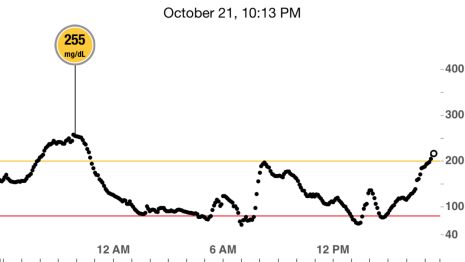
10:13 P.M. – Yep, topping out at about 255 mg/dL. Gross! I take some insulin and wait for it to kick in.
This is as high as my blood sugar got after eating the evil french fries…
11:30 P.M. – I feel relieved, I’ve come down to below 180 mg/dL and I can now go to sleep. I’m not dropping fast and I suspect that, due to the insulin I have left on board, I’ll level out around 130 mg/dL overnight.
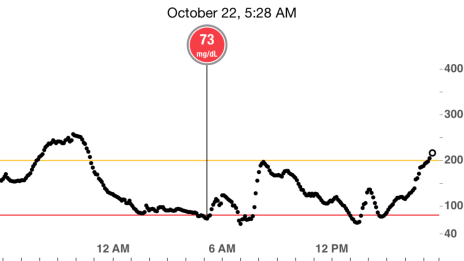
5:28 A.M. – Ah, a blissful five and a half hours of sleep before my diabetes said “LOL nope” and woke me up. I’m feeling shaky, so I roll over to check my CGM. Sure enough, I’m below my low limit (which is set at 80). My symptoms match my Dexcom graph, so I pop three glucose tablets into my mouth and plop my head back down on my pillow. I should be okay until I get up in a few hours.
…and this is one of the multiple low points I hit in the wee hours of the morning.
7:00 A.M. – Except nope! My CGM’s alarms and my low symptoms wake me up again. I’m frustrated, because it’s beyond annoying to wake up at the same time I normally do for work on a Sunday morning, and especially since it’s because of my diabetes. I reach for a granola bar that contained 22 grams of carbs (way more than I needed for my correction) and wolf it down. I toss and turn for the next hour. I can’t fall back asleep because it feels like my CGM won’t stop alerting me to what my blood sugar’s doing. It’s almost 8:00 A.M. when I decide to take a small bolus, because I definitely over-corrected for the last low.
9:30 A.M. – I get up for real and start my day. Miraculously, I test my blood sugar and it’s 148 mg/dL. I thought it would be worse but I guess the single unit of insulin I took did its job.
This is a night in the life of a PWD. This is what it’s like to have a chronic illness that doesn’t sleep. This is what it’s like to feel out of control of your own body.
And this is why I think french fries are evil – because they’re fatty, slow-releasing but high carb little jerks.
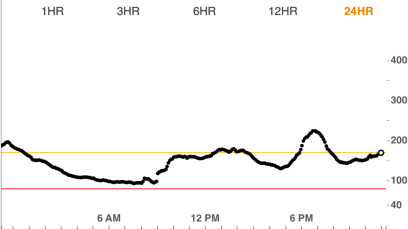
It’s not easy to figure out the insulin-to-carb ratio and basal rates that work best for you. In fact, it involves commitment, communication with your diabetes care team, and solid carb counting skills. But the work is so, totally worth it, because your blood sugar readings can look like this:
These 12- and 24-hour graphs were the result of me kicking it into high gear with my diabetes management in recent days. I can’t explain how awesome it felt to achieve graphs like this. Yes, I dipped a little lower than I would have preferred a few times, but the main accomplishment here is that I avoided the sticky highs that were frustrating me in the afternoons and in the middle of the night. Just looking at those smooth, nearly straight lines overnight brings a smile to my face.
I’d like to note that I did this WITHOUT making any special changes to my diet. In a single day, I ate fairly high carb for a PWD: around 30 grams of carbs at breakfast, another 30 at lunch, and between 40 and 50 at dinner. And depending on what my blood sugar is before bed, I’ll have another small snack, between 10 and 15 grams of carbs. So I think the main factors at play that lead to these beautiful graphs are 1) I bolused for my meals 10-20 minutes before eating them, 2) I ate the right balance (for me) of carbs, fats, and proteins, and 3) My insulin-to-carb ratios are spot-on at this time.
As long as I continue to put forth the right amount of effort, I think I’ll continue to have graphs like this. Of course, I know I’m going to slip up from time to time – occasions during which meals are a little more difficult to predict, or periods in which I experience higher stress levels – but this is okay. I constantly remind myself that diabetes is not something that can be completely tamed, no matter how hard I try. I accept that mistakes will happen along the way, and the best thing I can do is to learn from them to avoid making the same ones in the future. This acceptance, combined with perseverance and a willingness to always learn more about how my body reacts to certain foods and events, will help me meet my blood sugar goals on a more regular basis, which makes it an incredibly worthwhile pursuit.








 Hugging the Cactus