Memory Monday: That Time I Created a Diabetes Lesson Plan for Middle School Students (Part 2)

One Monday per month, I’ll take a trip down memory lane and reflect on how much diabetes technology, education, and stigma has changed over the years. Remember when…

This is a continuation of last month’s Memory Monday, in which I reflected on what it was like to work on a diabetes-oriented community action project when I was a freshman in high school. There were two main components to my project: running a School Walk for Diabetes, and educating a group of middle school students on type one diabetes.

Ugh, the thought of presenting to a group of middle school kids horrifies me now, but I guess I wasn’t so afraid at the time – you know, because I was a cooler, older, more sophisticated 14 year old lecturing the immature 12-year-old children.

*I’ll pause to allow you a moment (or several) to laugh at that mildly ludicrous notion.*

The easiest part of prepping to talk to the students was devising a lesson plan. My project partner and I put together a beautiful slideshow (complete with Comic Sans font, how professional) that we would use in the first half of the presentation. During the second half, I would show the students all of my medical equipment and demonstrate things like priming an insulin pen and testing my blood sugar. We also provided students with examples of healthy snacks for a person with diabetes and when to eat them. The formal presentation would end with us giving students the chance to ask questions.

Sounds pretty neatly put together for just a couple of freshmen, right?

Turns out, it really did go over well with the students! There were a couple technical difficulties (blast those LCD projectors), but my partner and I knew our presentation like the back of our hands, so nothing deterred us from accomplishing the goal of our lesson plan: for the students to have a greater knowledge of diabetes.

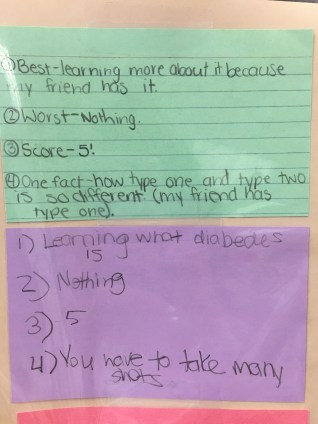
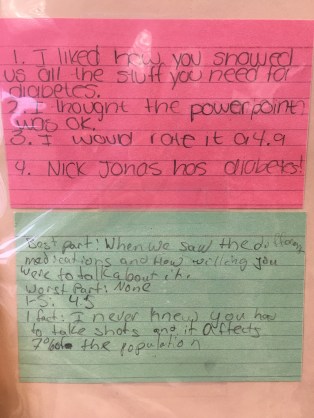
We felt like our hard work was worth it when we received completed evaluation cards from the students. We’d asked them to tell us: 1) The best part of our lesson, 2) The worst part, 3) Rate it on a scale of 1-5 (1 being worst; 5 best), and 4) Write one fact about diabetes they learned. Our average rating wound up being 4.2, which made us feel like rock stars! All these years later, I still have some of the best comment cards preserved in a binder about my project:
12

Personally, I really love how one student thought that diabetes is spelled “diabedes”. And I’m amused by how another student didn’t seem overly crazy about the PowerPoint (it must’ve been that damn Comic Sans font that ruined it).

But joking aside, this whole project still resonates with me ten years later because I think it marked the beginning of my passion for diabetes advocacy. It was one of the first times that I willingly shared my diabetes with others and let a real conversation take place about it with no holds barred.

 

Favorite Things Friday: Tabs2Go Cases

One Friday per month, I’ll write about my favorite diabetes products. These items make the cut because they’re functional, fashionable, or fun – but usually, all three at once!

Traditionally, I’ve toted glucose tablets around in a tube. My tube of tabs travels with me everywhere, because lows can be unpredictable and it’s always wise to be prepared. Though the contents of the tube have quite literally saved my life countless times, said tube is bulky. It takes up room in my diabetes kit. The tube is awkward to carry around when I go jogging, and more often than not winds up getting tucked away in my sports bra – not the most comfortable feeling.

But then a little, square, plastic container came into my world and changed how I carry around glucose tablets.

IMG_6145.JPGIMG_6144


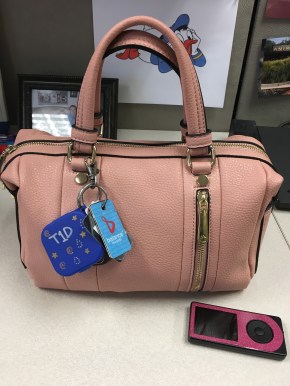
See that bright blue object attached to my purse? That’s a Tabs2Go case! It holds four glucose tablets at a time, the perfect amount to bring me back up from a low blood sugar. What I love most about it is that it’s dual purpose: It’s a case for tabs as well as a keychain. This means I can attach and detach it from my various key fobs, lanyards, and bags with ease, and as I please. I can tuck the case into my pocket without it creating an unsightly lump, and it stows away discreetly just about anywhere.

I have to give a shout out to Scott Bissinger, who created Tabs2Go and kindly supplied me with two of my own when I met him at the TypeOneNation Summit in Boston last month. Innovative products like this help to make the lives of people with diabetes a little easier, which makes me grateful.

Plus, I have to point out the fact that these cases are customizable. See the metallic embellishments I added to mine? Diabetes products that are functional and can be personalized are the real winners in my book!

3 Things I Learned From Giving up Alcohol for Lent

Unless you’re familiar with the Catholic faith, that title probably doesn’t make much sense to you. “Lent” is a period of time – the 40 days before Easter Sunday – in which Catholics traditionally practice penance, prayer, and almsgiving. In addition to avoiding the consumption of meat on Fridays during Lent, it’s also common for observers to give up something in order to focus more energy on acts of kindness and charity.

This year, I decided to give up alcohol.

Screen Shot 2018-04-08 at 7.27.46 PM
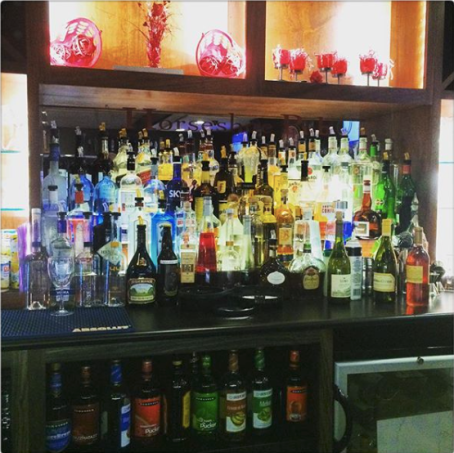
All of this, and more, was off limits throughout Lent.

I was inspired by my mom, who has eschewed alcohol during Lent for the last few years. I was a bit hesitant to take on the challenge; after all, I’m a young adult who enjoys going out and drinking every now and then. I wondered how it might affect my social life, and whether I’d experience any heckling or peer pressure from friends. But I was also open to the idea that forgoing alcohol during Lent could benefit me in some ways, so I felt ready to go forward with my plan.

Here’s what I learned from abstaining from alcohol for 40 days:

  1. My blood sugars were a little more predictable/easier to manage. One of my biggest issues with alcohol is that it’s hard to know just how many carbs are in one drink. Beer tends to be higher carb, whereas wine typically contains less. Hard liquor boasts even fewer carbs, but things get tricky when sugary mixers get added to the equation. So when I drink alcohol, I try to prepare myself for any possible scenario that could result from miscalculated carb intakes. But by giving up alcohol during Lent, I didn’t have this problem when I was dining out. I simply had to bolus for the food on my plate and enjoyed worrying less about what my blood sugar would be like later in the evening.
  2. Nobody gave me a tough time over my decision. This was a pleasant surprise, albeit one that I should’ve seen coming. After all, I’m not in college anymore. Peer pressure is practically non-existent in my life these days, and I’m thankful for its absence. If anything, my alcohol avoidance triggered discussions among my friends and colleagues, who generally seemed interested in the concept of giving something up for a length of time.
  3. It reminded me there are other (healthier!) ways to unwind that don’t involve drinking. Obviously, I knew that on a sub-conscious level. But I was automatically encouraged to explore alternative ways to relax after a long day at work. I definitely amped up the amount I exercised, and I probably ate a smidge more dark chocolate (okay, more than that) to reward myself throughout the week. And I didn’t become a shut-in on Friday and Saturday nights like I feared; rather, I participated in all my usual weekend activities, just sans alcohol. A huge plus to this was not having to worry about whacky blood sugars or who would be a designated driver – the safety element made the whole alcohol-avoidance thing much more appealing.

Does this mean that I’m going to avoid drinking alcohol forever now? No, because I still enjoy having a pint of beer, glass of wine, or specialty cocktail at my fancy. But I do feel more empowered to say “no” when I just don’t feel like drinking socially. I also feel good about cutting back on my alcohol intake overall and making a commitment to consciously deciding whether or not I want to drink. I think that my mind, body, and blood sugars will be better off.

“I’ll Have a Regular Soda, Please.”

A funny thing about life with diabetes is that new experiences occur all the time. For example, this was a first for me the other day: ordering a regular soda at a restaurant instead of a diet.

Why was this necessary? I chalk it up to a few different factors that affected my blood sugar: 1) I did strength training earlier in the day, which can make me go low several hours after the fact. 2) I ignored the diagonal down arrow that had appeared on my CGM, because I really didn’t think I’d end up below 100 mg/dL before dinner. 3) It took a long time for our dinner to come out, and I’d made the rookie mistake of bolusing soon after ordering the food. 4) I also think I miscalculated the carbs in my dinner – I’m used to ordering this particular dish, a cajun chicken salad, with a beer or two. But since I gave up alcohol for Lent (more on this in an upcoming blog post), I wasn’t getting the extra carbs from the beer, which I forgot to take into account.

So yeah, in hindsight, I could’ve seen the low blood sugar coming. But I just didn’t anticipate some of these occurrences, such as our food coming out late. This particular restaurant is usually timely, but since it was a Saturday evening and the bar was rapidly filling up, I should’ve connected the dots.

IMG_5443
Diet Coke has a special place in my part, but in a hypoglycemic emergency, it just won’t cut it.

Shoulda, woulda, coulda. There was nothing I could do about my rapidly dropping blood sugar, unless I bit the bullet and ordered a regular soda. Shoving my diet root beer to the side, I flagged down my semi-bemused bartender and asked for a regular Pepsi, trying to ignore the fact that he was joking about how “diet just wouldn’t do it for me any longer, eh”.

If only he knew that the circumstances required sugar, stat.

It only took him about 60 seconds to deliver the Pepsi, but it felt like a long time. My CGM alerted me to an urgent low and things around me were a little fuzzy. I was trying to engage in conversation with my companions, who knew that I was going low, but maybe weren’t aware of how quickly I was going down due to my determination to appear normal.

Once my Pepsi arrived, I gulped down several sips and sighed with relief as my dinner appeared soon after. I wolfed down every last bit of it within 15 minutes, taking breaks only to drink a little more soda. I knew I needed to control how much I drank, because I didn’t want to end up sky high later on in the night.

Fortunately, my blood sugar was coming back up to normal within no time, and I actually didn’t even go higher than 172 mg/dL for the remainder of the night. A huge win, all things considered. Even though it was a somewhat scary experience, I’m glad I did what I needed to in order to take proper care of myself…even if that meant drinking regular soda, which was actually pretty gross. How do people actually enjoy that saccharine sludge?!

How I Learned the Importance of Carb Counting

One recent evening, I was rummaging through the kitchen pantry and noticed a bag of “veggie stix” stashed away, waiting to get opened. The sight of the bag instantly brought back memories of a time I was blatantly irresponsible with my carb counting and insulin dosing…

IMG_6147

…It was my junior year of college. I had plans to meet with a friend for dinner at seven o’clock. While that’s a standard suppertime for many people, it was kind of late for me. So that explains why I decided to treat myself to a snack a couple hours before it was time to go, just to hold me until I had my meal. My snack of choice? A bag of veggie stix just like these were sitting in the kitchen of my on-campus apartment. I thought I’d help myself to a few, believing (naively) that I had enough self control to know when to stop shoveling them down my gullet. That’s right, instead of doing the right thing and counting out a bunch before stowing the bag away, I was blindly consuming handful after handful without dosing for a single stick.

I can’t even use the defense that these veggie stix are strangely addicting – they really are, they taste a little like those potato sticks that used to come in cans – because I knew what I was doing wasn’t good for me. I just didn’t care. I had munched my way through half of the bag when it dawned on me that it would probably be smart to stop myself from eating more. I rolled up the bag, returned to my room, and did some homework until it was time to meet with my gal pal.

Little did I know that my blood sugar was rising to potentially dangerous levels.

I didn’t find out how high I was – over 400 mg/dL – until I reached the sandwich shop and had a plate full of chicken pesto carb-y goodness waiting to be consumed. My face must’ve shown my shock, because my friend asked me if I was alright. I quickly explained to her my mistake, and took an extra large bolus to cover my food and correct my blood sugar. Once that was done, I somehow managed to stop panicking long enough to enjoy the dinner with my friend, even though I couldn’t eat a bite of mine until an hour or so after injecting my insulin.

Although it sucked to go through this, I’m kind of glad that it happened because I learned a major lesson from it: ALWAYS count my carbs. It doesn’t matter if I WANT to be lazy or pretend that my diabetes doesn’t exist, I HAVE to hold myself accountable. It may be mentally draining and a bit of a nuisance, but it’s my own health here. It’s up to me, and me alone, to manage it.

And by the way, I did just help myself to the above bag of veggie stix. I had exactly 24 pieces, which equals exactly 5.4 grams of carbohydrates – a much smaller amount than what I ate that one night five years ago.

How to Change an OmniPod

I decided to do something a little different and take video of how to change an OmniPod. Rest assured, though, that it does not take 22 seconds – it’s more like a seven-minute process.

Some things you’ll notice about my process:

  1. I fill my syringe with insulin and set it aside before deactivating my old pod. This simply means that I wear the old pod a little bit longer so there’s less of an interruption in time that I go without insulin.
  2. I use a pen to smack bubbles out of the syringe. Air bubbles will inevitably develop when drawing insulin out of a vial, so I find that gently hitting the sides of the syringe with a pen is the most effective way to get rid of the pesky air pockets.
  3. I prep my site with an alcohol swab, followed by a skin-tac wipe. The alcohol merely cleans the site, whereas the skin-tac makes the pod adhere to my skin better and longer.
  4. The new pod activates best when it is adjacent to my PDM. I always place my new pod to the right of my PDM. This helps the PDM register the new pod.
  5. It doesn’t actually hurt when I rip off an old pod. Not sure if you detected my dramatic facial expressing, but I was just yukking it up for the camera. It truly doesn’t hurt, especially if you just remove it in one swift motion.

So that’s it, the full process boiled down into 22 measly seconds. I admit that I kind of had fun making this video, even though the sight of myself sans make-up is semi-horrifying. But give me a break, I was on my way to a Pilates class! And let’s be real, diabetes isn’t always glamorous.

My Diabetes and My Dog: Do they Mix?

Clarence the puppy came home last week! I’m loving getting to know him. It’s beyond adorable to watch him explore his new environment, but it’s also a lot of work.

I knew that he might affect my diabetes, but I figured it would mainly be in positive ways: He’d help keep me active and console me when I was feeling down about it. But there’s also a couple of drawbacks. I confess that instead of my blood sugars being my number one priority, it’s Clarence that takes precedence.

IMG_6062
This little dude is my whole world right now.

It’s not like I’m completely forgetting to take care of my diabetes, or that it’s far from my thoughts. It’s more that I let things go a little longer, that I push the limits a smidgen. For instance, my first full day with him, I woke up and tested my blood sugar but did not test again until the evening. I was trusting my Dexcom readings as I got better acquainted with the puppy. And I tended to graze on food all day long instead of sitting down for real meals. In fact, dinner that first night was almost comical. My T1D mom and I ate a lukewarm meal over the course of about 40 minutes while we took turns taking Clarence outside. We were so concerned with getting him to do his business that we didn’t really care about feeding ourselves in a timely manner.

I know that it’s just a transitional phase, though. Clarence will get adjusted to his new home in due time and we’ll get used to a new routine tailored to suit both our needs and his needs.

And in case you’re wondering, I think Clarence is forming a general awareness of my diabetes. When we were playing on the floor, he walked around me and sniffed at the pod I was wearing on my lower back. He’s a bit mouthy (part of being a puppy), so I was worried he might try to nip at it. Instead, he backed away and picked up one of his toys.

Attaboy, Clarence – he’s a smart cookie.

Easter Basket Dos and Don’ts for People with Diabetes

Please don’t judge me for what I’m about to say…

…Even though I’m an adult, I still get Easter baskets. I know, I’m a bit spoiled.

The contents of said Easter baskets have varied over the years. But the ever-thoughtful Easter bunny has always been conscientious of the goodies he places within it, given my diabetes. After all, diabetes doesn’t mean I can’t enjoy Easter treats, both of the sugary and sugar-free variety.

Screen Shot 2018-03-28 at 10.03.16 AM.png
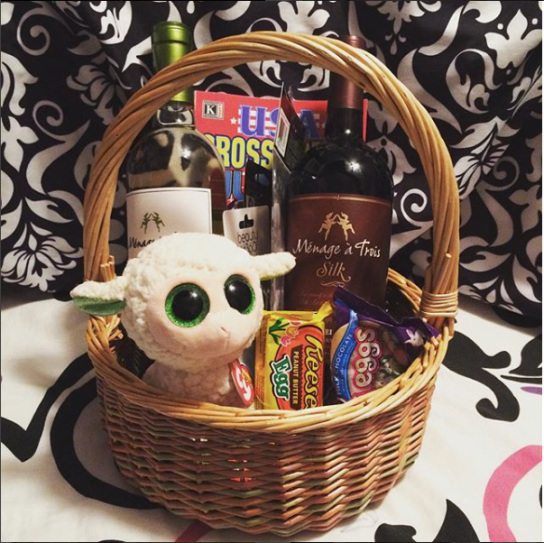
One of my favorite Easter baskets received as an adult contained a stuffed animal, two bottles of wine, a book of crossword puzzles, and Easter chocolates.

Whether a kid or an adult, here’s some ideas for an Easter basket that any T1D in your life will appreciate:

For kids:
Coloring books, markers/crayons/colored pencils, stickers, comic books, movies, frisbees, outdoor/warm weather toys, nail polish, puzzles, mini games, stuffed animals…

For adults:
Lottery tickets, gift cards, coffee, wine/beer (one of the best finds in an Easter basket, TBH), gum, other small snacks, books…

Truly, depending on who the basket is for, there’s a ton of possibilities as to what can fill it.

My thoughts on candy:
I’m the only person I know who doesn’t completely loathe sugar-free chocolates. Obviously, I prefer actual chocolate – because, you know, that’s what tastes good. But I don’t exactly love all the carbs in it. I find that snacking on sugar-free chocolates (as long as the quantity is small) satisfies a sweets craving well enough. But I also think that real treats, like Reese’s peanut butter eggs (my weakness) or Cadbury eggs (pure confectionary delight) are okay. After all, Easter is only once a year. And with carb counts widely available these days, it’s easy to know exactly how many you’re consuming.

Plus…who doesn’t love a good candy sale the day after a holiday? Talk about a great low blood sugar stash!

On another note…Happy Easter, Happy Passover, and Happy Spring to you!!!

Fantastic News! Dexcom G6 is Approved by the FDA

The official announcement has appeared across all sorts of social media in the last 48 hours, but I thought I’d say something about it here, too…

The FDA approved the Dexcom G6, the new and improved version of their Continuous Glucose Monitor (CGM) system!

This is particularly exciting, because the G6 comes with many new and exciting features:

  • 10-day wear (as opposed to seven days)
  • Slimmer and smaller sensor
  • Easy-to-use inserter
  • Zero calibrations necessary – the system does not require manual blood sugar inputs

Visit the Dexcom website to read about all of the details. And as more information comes out about its availability, stay tuned…

…because you may recognize a familiar name and face along the way!


Low Carb Lasagna Exists, and it is Amazing

Nothing screams “comfort food” quite like a hot, cheesy, and utterly delicious slice of lasagna. Unfortunately, though, said lasagna has a tendency to make my CGM scream, because consumption of the carb-laden food usually skyrockets my blood sugar.

On the bright side, a very low carb version of this dish exists, and it is just as wonderful as its starchy counterpart. The ground beef, pasta sauce, and mozzarella-parmesan blend are all there – the only bit that’s different is what’s used in lieu of pasta.

Instead of pasta, use cabbage leaves. No, I’m not kidding.

IMG_5942
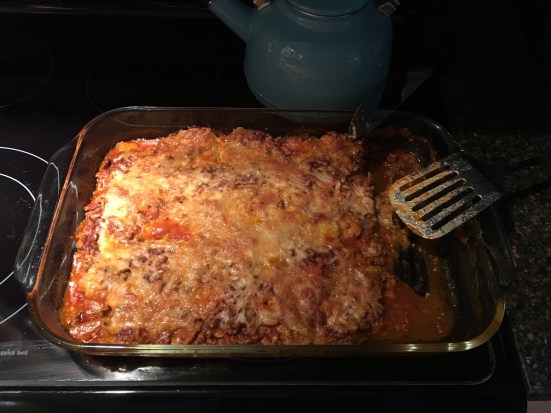
Cabbage lasagna looks and tastes just like its carb-ier alternative.

The cabbage soaks up the flavors of the sauce, meat, and cheese. As the concoction is baked, the cabbage also takes on the same consistency as pasta. It slices just as easily, and no, you really can’t taste the cabbage flavor (unless you pick out several chunks of it to eat on their own, but honestly, who does that?). It’s such a satisfying meal that I promise you won’t miss the carbs from the pasta.

Besides, if you’re like me and enjoy eating a healthy amount of carbs daily…you can always add a slice or two of garlic bread to your meal. I did just that, and in addition to having a well-rounded meal, I experienced great post-dinner blood sugars: a diabetes win!