And the silence was refreshing. I didn’t like being without my CGM for a week, but there’s no doubt about the one positive effect that its absence had on me: It gave me a much-needed mental break from an audible aspect of diabetes.
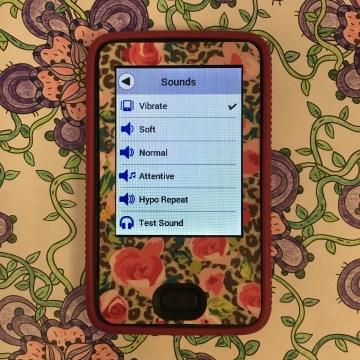
Diabetes can be LOUD sometimes. Especially in hypo repeat mode.
It was a blissful reprieve from my diabetes literally screaming at me like a needy baby. A week-long vacation from my CGM hollering at the top of its lungs “HEY YOUR BLOOD SUGAR IS HIGH DO SOMETHING ABOUT IT” or “WAKE UP YOUR BLOOD SUGAR IS LOW YOU BETTER TREAT IT RIGHT NOW.”
It’s rare that I can describe diabetes as peaceful; in this case, it was, and the experience will make me consider putting diabetes on mute a little more often.
No carbs. No dairy. No meat. No processed foods. Strictly vegetables, fruits, and shakes for the next three days. 72 hours – I could do it, right?
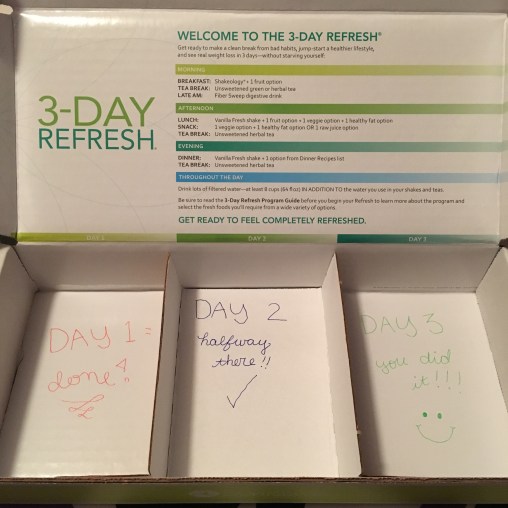
Last week, I completed a 3-Day Cleanse. My goal was that it would help me feel a little bit refreshed after a couple weeks of nonstop gluttony. I figured it’d help reset my system and make me feel less bloated and tired. I didn’t want to do a typical “cleanse” though, the kind that forces you to stop eating any and all food and stick with juices. That’s why I did this particular program – I would be eating real foods on a regular basis throughout all three days. The bonus was that it would be foods I’m familiar with and are generally low carb, which could only mean good things for my blood sugar.
My routine for all three days would follow this format: Wake up, drink a glass of water, blend a shake together with one serving size of fruit. I’d have a cup of herbal tea one hour after breakfast, and one hour after that, I’d have a fiber-filled drink. Lunch would consist of another shake, one serving of vegetables, one serving of fruit, and one spoonful of hummus. I’d have an afternoon snack of baby carrots and one spoonful of almond butter with another cup of herbal tea an hour after consuming the snack. Dinner would be one last shake, one cup of vegetable broth, and a spinach salad with olive oil and lemon juice drizzled on top. I could have a final cup of herbal tea any time in the evening.
I didn’t expect to learn as much as I did throughout the program, but those three days taught me a lot about how the things I put into my body impact not just my blood sugar, but my state of mind. Here’s what happened during my cleanse:
Day 1 – This day was by far the easiest to complete. Despite dialing back the amounts and types of foods I was consuming, I didn’t feel hungry at all – everything sated me. I was really enjoying watching my Dexcom CGM graph because it barely budged. I stayed right around 90-110 mg/dL for most of the day, probably because I was eating minimal carbs. Fewer carbs means less room for error, and this concept was definitely cemented into my mind by the end of the cleanse. I went to bed with a slight headache at the end of day 1, but a smile on my face. This would be a breeze!
Day 2 – My CGM sensor went kaput by mid-morning, and I was PISSED about it. I wanted the ability to continue tracking my blood sugars on this cleanse, and suddenly it was no longer available to me (because oh-so-conveniently, it was my last sensor in stock). Fuming over my CGM situation, I started feeling slight pangs of hunger shortly after having my fiber drink. I ate lunch as soon as I could after that, and spent much of the rest of the afternoon fighting a headache and dreading going home to see – not eat – my mom’s delicious home cooking. On the brighter side of things, my digestion seemed to be improving already and I felt a bit less bloated.
Day 3 – I went from “Oh, this cleanse will be a breeze!” to “OMG THESE ARE THE LONGEST THREE DAYS OF MY LIFE GIMME REAL FOOD AGAIN BEFORE I HAVE A MELTDOWN” in less than 48 hours. That’s gotta be a new record. I distracted myself as much as I could from my misery by burying myself in my work, which helped to a degree. But I couldn’t fight the lightheaded sensation that seemed to grip my entire body. I was confused by that – I though only eating real, plant-based foods would eliminate crummy feelings. Maybe I was experiencing a sort of withdrawal as my body got used to this new diet? I can’t confirm that, but I suspect that after a few more days, I likely would’ve felt much better…or hungrier. I’ll leave it to speculation because there is no way I’m doing this again any time soon. But MAN, am I proud of myself for completing the cleanse without cheating, not even once.
So if I felt THAT miserable toward the end of the cleanse, then why am I glad that I did it? Mainly, I’m astonished at how much easier it was to maintain my diabetes and “desirable” blood sugar levels in that three-day time period. Even without my CGM, I was still getting great results. It reinforced something that I already knew: that the body will react accordingly to the quantity and quality of foods that are used to nourish it. It made me realize that perhaps I should toy with cutting down my daily carb intake and upping my veggie/fruit/protein consumption to find out whether that positively impacts my blood sugar in the way that I think it will. This doesn’t mean I’m starting a low-carb or keto diet; rather, I’m simply going to follow a more thoughtful one.
To sum it up, this three-day cleanse/torture act/lesson (whatever you want to call it) helped make my understanding and appreciation of food much stronger, which makes it worth it in my book.
The summer heat seems to be here to stay in Massachusetts. We’ve experienced several weeks of soupy, high-heat weather that *almost* makes me long for cooler, autumnal days…but not quite, because that just means winter (and snow – blech) is right around the corner.
Truly, I do enjoy the summertime. To me, summer is about trips to the beach, ice cream consumption (and lots of it), barbecues with family and friends, long walks in the neighborhood, and endless outdoor adventures. Aside from all of those lovely things, summer also means that it’s time to be a little more diligent when it comes to my diabetes. That’s because hot weather can play some cruel tricks on a T1D’s body. What do I mean by that? Here’s five ways diabetes can be affected by hot weather.
Dehydration can lead to high blood sugar. Everyone knows that it’s important to stay hydrated when it’s hot out, but it might be less common knowledge that dehydration can directly affect blood sugar. There’s a scientific explanation for this: If not properly hydrated, the body sees an increase in blood glucose concentration because blood won’t flow as easily to the kidneys, making it difficult for the kidneys to get rid of excess glucose in urine. The best way to prevent this, naturally, is to drink plenty of water and monitor blood sugars.
Sunburn can drive up blood sugars. I’m very familiar with how a sunburn can result in higher blood sugars; in fact, just last week I was dealing with a particularly gnarly sunburn on my thighs and belly that not only made my numbers higher, but also really hurt. My skin was literally damaged, so the stress from the injury lead to retaliation from my blood sugar. Luckily, it only lasted about 48 hours, but those couple of days were challenging as I dealt with sticky highs that were practically resistant to insulin. And for the record, I DID apply sunscreen – numerous times – when I was at the beach. Next time, I’ll seek shade under the umbrella.
Sweat can make it difficult for devices to stick. I don’t know a single medical device that’s immune to prolonged exposure to moisture/water, but that doesn’t prevent me from spending as much time as I can outdoors/at the beach/by the pool in the summer. Thank goodness for Skin-Tac wipes and medical adhesive tapes that help preserve my precious pods and sensors!
“Sun-kissed skin so hot/We’ll melt your popsicle…and your insulin” – Katy Perry (with some help from Molly Johannes)
Insulin can overheat. There’s a reason why insulin vials come packaged in cartons with directions that specify what temperature insulin should stay at in order for it to be safe to use. Insulin can spoil easily when it reaches a certain temperature, so it’s important to store it in a cool place when the weather’s warm. I alternate between a mini portable cooler (that can hold 3 vials of insulin) and a pouch from FRIO – both do an excellent job at keeping my insulin cool.
Low blood sugars can occur more frequently. Summertime is prime time for outdoor activities that result in higher energy expenditure. So it’s no wonder that blood sugar tends to plummet in hot weather. Looking at it on the bright side, it’s an excuse to eat even more ice cream – but it also means that monitoring how I feel and checking blood sugars often is that much more important.
Regardless of the diabetes challenges it may cause, I love summer weather, and I know I’ll miss it the moment the first snowflake falls this year.
Read the following five sentences. Can you tell what’s wrong with them?
She’s a diabetic.
He’s testing his blood sugar right now.
Her diabetes is out of control!
Isn’t that a really bad blood sugar?
He suffers from diabetes.
Have you figured it out?
The language in those five sentences is extremely negative. “Bad,” “out of control,” and “suffers” are obviously gloomy and cynical words to use when referring to diabetes – you don’t need to be a wordsmith make that connection immediately. But what’s wrong with “diabetic” or “testing”? It’s the connotations around those words. Calling someone with diabetes a “diabetic” is labeling them with the disease and removing the actual person from the equation. Saying that a person with diabetes is “testing” their blood sugar makes it sound so…clinical. It also implies that the person could pass or fail the so-called test, adding pressure and guilt to the situation.
Choose your words wisely.
In my real-world, full-time job, I’m an editor, so it gives me great pleasure to amend those above sentences into more positive, empowering language:
She has diabetes.
He’s checking his blood sugar right now.
She’s having a tough time managing her diabetes.
How do you handle high or low blood sugar?
He lives with diabetes. (Or even better: He THRIVES with diabetes.)
Ah, much better. Never underestimate the power of words.
Last week, I wrote about some anxiety that I was feeling the day before I was due to see my endocrinologist. Now that the appointment has come and gone, I feel like I understand the reasons why I was so nervous…
Reason #1: Some part of me must’ve known that my A1c has gone up over the course of the last three months – it rose half a point, much to my dismay. I confessed to my doctor that I’ve been a little careless, particularly in the last month or so, when it comes to carb counting and healthy eating. Luckily, she wasn’t critical of me, but I almost wish that she’d reprimanded me in some way. It would’ve been the talking-to that I felt I deserved.
Reason #2: My endo permanently switched locations: She’s now based at the medical center that I used to go to when I was seeing a pediatric endocrinologist. I hadn’t been back there in about eight years, and boy, it brought back some unexpected emotions. I must admit that I had to hold back tears as I walked into the building. I don’t know why all the feelings hit me so hard, but I suspect that it might have been because of the flood of memories that flowed through my mind. It also symbolized the journey I’ve been on in just the last eight years of life with diabetes, in which I:
Transitioned from injections to a pump.
Stopped using Lantus.
Started using a Dexcom.
Improved my A1c/overall health significantly.
Decided to become a more active member in the diabetes community.
Those are some major changes, and the magnitude of them practically knocks me out as I think about the last 20 years I’ve had with diabetes.
Just making some awkward faces while I wait for my doctor. Also, I love that the exam room has a full-length mirror in it: It’s perfect for taking pictures/killing time while I wait!
Reason #3: I was meeting all sorts of new people, which is very nerve-wracking to an introverted extrovert like myself. I was used to the receptionists and nurses at the old location. I got to know them and vice versa. It made going to appointments a little easier. At this new/old location, though, I don’t know a soul except for my doctor. A reassuring smile or light conversation would’ve placated me on this visit, but perhaps those things will come in time.
Anyways, now that I’ve had time to think about the emotional aspects of this appointment…I’m going to switch gears and start doing the things that I need to do and that I am capable of doing in order to get my A1c back to where I want it. I know that I’ll get there. As my appointment wrapped up, I looked my endocrinologist in the eyes and promised her that the next time she saw me, I’d be down more than half a point. And I intend to fulfill that promise.
Memory Monday is following a slightly different format from here on out! One Monday per month, I’ll take a trip down memory lane and reflect on how much my diabetes thoughts, feelings, and experiences have unfolded over the years. Today, I remember…
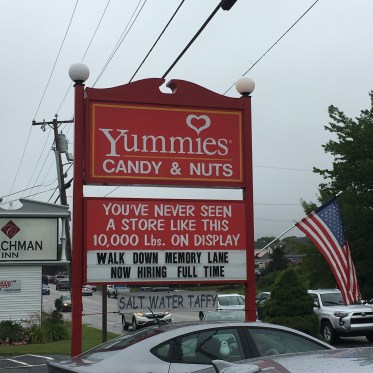
…the first time that I tried sugar-free chocolate. Not just any sugar-free chocolate, though: It was from Yummies, a massive candy emporium in Southern Maine. The store is lined, floor to ceiling, with bags upon bags of candy. You can bulk buy your favorites to your heart’s content as well as discover weird, relatively unknown confectionery creations. If you have a sweet tooth, it’s basically a saccharine paradise.
When I was younger, I watched a lot of Phantom Gourmet – partly because it was always on the TV in my Grammy’s nursing home when we visited her each Saturday afternoon, and partly because I was a growing foodie who loved learning about local hot spot eateries. At around nine years old, an episode that featured Yummies aired on TV, and I discovered that they had an entire case devoted to sugar-free chocolates in their store. I knew I had to go check it out; fortunately, my parents were willing to take me there next time we trekked up to Maine.
Yummies, also known as candy lover’s paradise.
I’ll never forget the first time I walked into that store. My jaw dropped as I laid eyes on the 10,000 pounds of candy they had on display. As I wove through the rainbow-hued aisles, I could practically feel my blood sugar spiking. But I was on a mission to find the sugar-free section that looked so delectable on television that I could practically taste it.
I heard angels sing hallelujah when I laid eyes on the aforementioned case of chocolates. There were so many choices! And all of them were made in the store, guaranteeing higher quality! It was a T1D chocolate lover’s paradise: There were fudge meltaways, peanut butter cups, almond bark, coconut clusters, sea salt caramels, chocolate peanuts, malted milk balls, peppermint patties, and even more beyond that. I remember marveling at the variety for a solid five minutes before I was told by my father to hurry up and make my selections. I don’t remember exactly what I chose, but it definitely included the meltaways and peanut butter cups. Once they were paid for and I was back in the car with my chocolate treasures, I took my first bite and could scarcely believe it was sugar free candy – that’s how awesome it tasted.
Every summer since then, I’ve made an annual visit to Yummies to pick up my tasty sugar-free chocolates. It brings back memories of being a little kid stepping into that store for the first time, memories that are almost as sweet as the candy inside.
I’d just settled into my beach chair, ready to crack open a book, when I spotted her.
She was walking as quickly as she could through the sand to help her friend carry a cooler, but not fast enough for me to miss the CGM on her upper arm. I sat up in my chair and wondered whether I should say something to her – after all, not all T1Ds are excited to encounter one another in the wild.
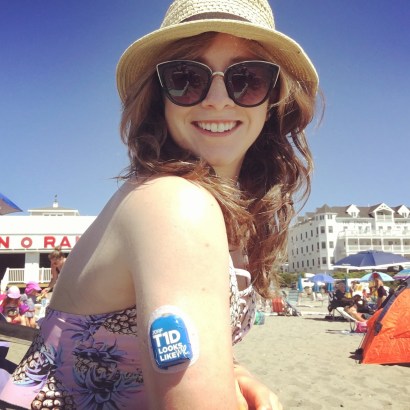
She caught up with her friend and grabbed the other end of the cooler. As they passed me, I saw she was wearing an OmniPod on her opposite arm. Not just any OmniPod, though: This one was decorated with some sort of emerald green design. I took that as a sign, a literal green light, that she probably wouldn’t mind if I said something.
“Nice OmniPod!” I called out.
She looked around, trying to locate my voice. My mother, who’d been reading the whole time and was unaware of a fellow T1D in our midst, shot a bemused look in my direction as the woman finally made eye contact with me.
“I have one too,” I said, pointing to my arm.
“Nice! I like your decoration. Do you have a Dex, too?” She asked, smiling at me.
“Yup – I’m wearing mine on my abdomen. I saw you had both and couldn’t resist saying something.”
“Well, we’ve got two OmniPodders over here,” She pointed to where she’d set up camp for the day.
Beaming, I told her that we had two in our group, as well. My mom offered her arm up to show her pod. I think that Mom was half entertained, half embarrassed over the whole exchange, so it made me happy to see her join in at the end.
The woman returned to her spot and we wished her well. Mom and I soaked up the sun for a few hours before deciding to pack up for the day. As we were getting our belongings together, a young woman approached us.
Proud to wear my pod.
“Excuse me, may I ask what is on your arms? I’ve seen numerous people wearing that sort of thing today and I can’t figure out what it is, for the life of me!”
I was going to answer for the both of us, but my mom beat me to the punch. She explained that it was an insulin pump, though other people may wear different medical devices that look similar to it. The girl, seemingly appreciating the response, remarked that it was cool and that she was surprised to see so many people wearing them on the beach. She wondered out loud if she was missing out on some sort of trend.
“Yeah, all the cool kids have them,” Mom said, and we all laughed.
I don’t know how many people on the beach that day were wearing OmniPods – or any other insulin pump, for that matter – but I do know for certain that my mom is right: All the cool kids have them, and they’re much cooler for wearing them with pride in full view of the world.
I’m feeling anxious about my appointment with my endocrinologist tomorrow.
I don’t know why. I like my doctor very much: She’s always encouraging, pleasant, and helpful. The only thing I’d change about our appointments is to slow them down a bit; sometimes, she whips through them so quickly that I forget to ask her the questions floating around in the back of my mind.
Could it be that I’m worried about my A1c test? Possibly. I don’t know whether my A1c has gone up or down in the last three months. I have stretches of time in which my blood sugar behaves the way I want it to, but I also experience clusters of days here and there of complete diabetes chaos. In the last month, for instance, there were a few too many circumstances in which my blood sugar was above 300 mg/dL. Each time, I’d correct the high, only to either experience 1) a sudden drop resulting in a low or 2) several hours of prolonged high blood sugar because it was taking the insulin a long time to take effect.
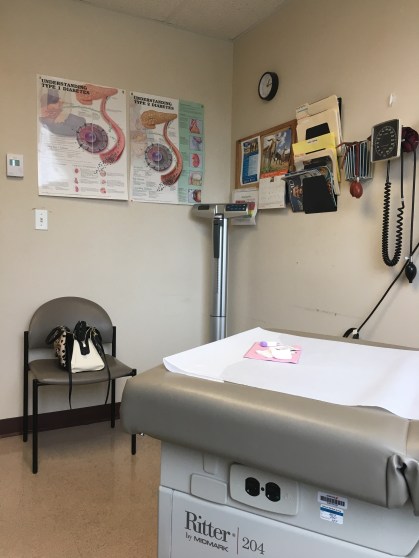
I love that there are posters about “understanding” diabetes on the wall – it’s too complex to break down into a few bullet points.
Now that I’m thinking about it, maybe those scattered, wicked-high blood sugars are the reason why I’m anxious about this appointment. I know that my doctor will probably ask me about them, and I’m going to have to admit to her that a combination of emotional eating, lack of carb counting, and general carelessness resulted in those highs. I know that she won’t judge me, but…I can’t help but judge myself for causing the blood sugar swings. The rational part of me is aware that it’s unhealthy to blame myself for occasional slip-ups, but the goodie-two-shoes, Miss “Perfect Diabetes” part of me is shaking her head in shame and disappointment.
If nothing else, this is a prime example of how diabetes can be an absolute (warning: foul language following) mind fuck.
You want to know what went wrong during my annual eye doctor’s appointment last week? Just about everything, that’s what went wrong!
Okay, that’s being over-the-top dramatic. Nothing life altering happened, thank goodness. But the appointment started out on the wrong foot when I had to wait more than an hour to be seen by the doctor. Let me tell you, there is nothing pleasant about waiting in a room that hasn’t been updated since about 1982, with ancient stacks of National Geographic as the sole source of entertainment.
Anyways, after an agonizingly long hour and change, I was finally called in to see the doctor. He started the appointment asking the usual slew of questions: How are you? How are your eyes? (My answer to both was a short, but still polite, “good”.) Then he asked the annoying question: Is your diabetes under control?
I hate that – the “under control”. It makes it seem as though diabetes can be tamed 100% of the time, like it’s a savage beast that just requires domesticating in order to live a normal life. But I answered it anyways, knowing he wouldn’t care to hear why his word choice was bothersome. “I’m doing well,” I said, my eyes wandering over to the doorway. I couldn’t understand why he’d chosen to leave the door open – the hallway to the waiting room was very short, and based on what I’d heard when other patients went in to see the doctor, everyone in the waiting room would be able to hear the entire doctor-patient interaction. Definitely not cool in my book, but instead of confronting the doctor about it, I opted to speak in a much quieter tone of voice than normal. At this point, I just wanted the appointment to be over.
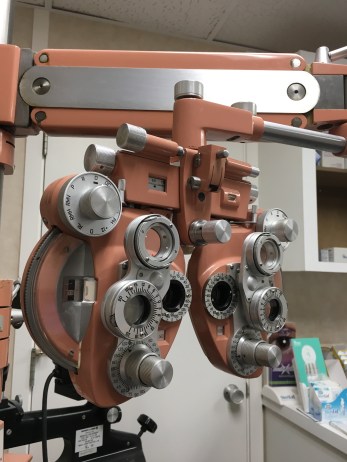
QUIZ TIME! Is this A) a medieval torture device OR B) a phoropter? (It’s B, which is the legitimate name of this piece of ocular equipment. Who knew?)
He spent 15 minutes running the standard eye tests (read the chart in front of you, does this setting make it better or worse, etc.), then dilated my eyes. I was sent back to that horrid waiting room for another 20 minute while the dilation took effect. When he called me back in to give my dilated pupils a final inspection, the following exchange happened:
Doctor: You know, I saw a patient the other day who was diagnosed with diabetes at birth.
Me: Yeah, I know a couple of people who were diagnosed as babies. It’s awful.
Doctor: Even though he’s had it his entire life, he doesn’t take very good care of it. He’s got diabetic retinopathy now. *shuffles paperwork*
Me: *Fidgeting uncomfortably in the chair, waiting for him to add to that. A long 20 seconds elapses before he finally says…*
Doctor: Fortunately, that’s not the case for you.
Um, WTF, Doc?! What’s up with that weird dramatic pause? Were you TRYING to freak me out? Mission accomplished, dude. But my oh my, such a sweet relief to hear that there is no diabetes in my eyes.
As I walked out of the building a few moments later, I couldn’t help but think about how this was a textbook example of how an appointment shouldn’t go. I left feeling an odd mix of emotions: disappointment with my doctor’s behavior as well as relief with his assessment that my eyes, at least, were proof of my well-managed (NOT under control) diabetes.
One Friday per month, I’ll write about my favorite diabetes products. These items make the cut because they’re functional, fashionable, or fun – but usually, all three at once!
One of the most crucial components of a T1D toolkit is the glucometer, also known more simply as the meter. This little device instantly measures blood sugar levels in a person with diabetes: stick a test strip in the meter, poke a finger, and wipe a drop of blood on the test strip in order to get a blood sugar check within seconds from the meter.
Ideally, a meter is used multiple times a day by a person with diabetes – the exact number depends on how often they prefer to check their levels. Personally, I check my blood sugar five or six times each day, so I’m using my meter fairly frequently. As such, it’s always been important to me that I have a meter that is accurate, user-friendly, and compact.
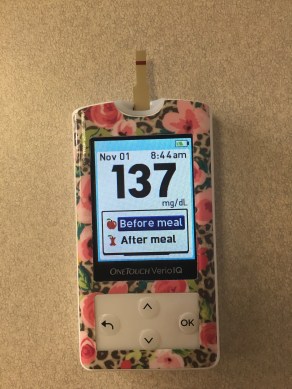
Fortunately, I found all of that with my Verio IQ meter.
I can’t imagine checking my blood sugar with any other meter.
The slim, bright white device fits nicely into my Myabetic case, making it easy to tote around with me everywhere. It’s pretty trusty and generates results commensurate with my CGM. It doesn’t run on batteries; rather, it can conveniently be recharged every 10 days or so. But my favorite feature of my meter is the back light: If I need to wake up in the middle of the night to check my blood sugar, I don’t have to switch on the lamp that sits on my nightstand. Rather, I merely stick a strip into the meter and it lights up on its own, making it easy for me to see where to wipe my drop of blood. After five seconds elapse, bam, my blood sugar reading pops up on the screen in bold numbers.
I can’t remember exactly when I started using my Verio IQ – definitely prior to college – but I’ve stuck with it for at least eight years now because it works so well for me. When I got onto the OmniPod three years ago, it never even crossed my mind to give up my Verio in favor of using the PDM to check my sugars. It might seem crazy to others that I carry around one superfluous device, but it’s what works for me.




 Hugging the Cactus