A handful of peanuts here, a couple of slices of cheese there.
A pile of popcorn followed by a spoonful of peanut butter.
A few pretzels and a small smattering of chocolate chips – because chocolate.
These snack combos, as strange as they may be, all describe some snacking behavior that I also refer to as “grazing”. Grazing is all about taking little bits of food when I’m not necessarily hungry. I equate it to eating out of boredom, except I’m not indulging on full meals or anything, I’m simply munching because the food is there and my blood sugar is acceptable enough to the point that I can freely snack without having to bolus, or worry about significant blood sugar jumps later on.
In other words, grazing is a habit I’m trying to break.
I’m not stupid. I know that the aforementioned foods I choose to graze on contain carbohydrates. Whether trace or moderate, they’re still there. And I choose to ignore them.
I don’t know why. If I want to have a snack, then that’s okay, as long as I take insulin for it. But I guess my rationale for grazing is that I’m taking “itty bitty” amounts of food that will minimally impact my blood sugar, if at all.
Then again…it’s not exactly logical when those small snacks DO wind up impacting my blood sugar. Usually, the spike happens several hours after, and each time I get angry at myself for a) not having enough self-control to resist grazing and b) not taking insulin for it when I do give in to the bad habit.
Nearly 21 years of diabetes and I’m still occasionally blown away by the minutiae of it: how just the slightest smackerels can take a toll on the straight-lined graphs I strive to achieve daily.
Can you imagine having diabetes in the 14th – 17th centuries??? The answer to that is no, you probably cannot…because without modern medicine, it wouldn’t have been possible for a T1D to survive in the Renaissance. And ‘cuz, well y’know, the Black Plague was a thing back then and lots of people didn’t survive.
But fortunately, we’re living in the 21st century, which means we have access to all sorts of things that help us manage diabetes. Still waiting on that cure, though.
Where am I going with all this?
I wanted to recount my recent trip to a Renaissance festival, in which I spent a day taking care of my diabetes while jousting tournaments, Shakespearean performances, and drunken debaucheries took place all around. And you know what? It was easier than I thought it’d be.
Sure, I didn’t check my blood sugar with my meter as much as I should have. My inner germaphobe was reluctant to rely on my meter for accurate results, seeing as there weren’t really any hand-washing stations on the fairgrounds. (Remember, this is the Renaissance…things were a little grimier in those days.) I used hand sanitizer whenever it was available to me to keep my hands clean, but it was a bit of a challenge, especially when my mitts got caked in mud post-ax throwing.
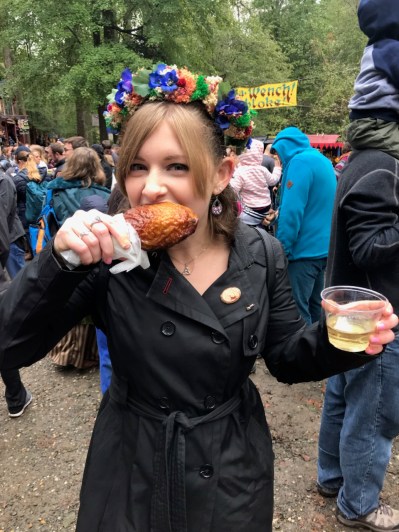
Enjoying a turkey leg alongside a serving of Chardonnay at the Renaissance Faire – y’know, to keep things classy.
Thankfully, I had my Dexcom G6 to help keep me on track as I ate my way through the fictional 16th century village. I was jazzed that several low-carb options were available to me; throughout the day, I snacked on a giant turkey leg, a Scotch egg, and spiced nuts. Maybe a “diabetes-friendly” diet would’ve been easy to follow in the Renaissance? Though I will admit that I gave in to temptation and ate (devoured) a slice of cheesecake. On a stick. And dipped in chocolate. Not low carb, but super YUM.
So even though my diet was far from nutritious at the ye olde faire, I think that all the walking around and sharp-objects-throwing kept my blood sugar in check, much to my relief. My experience at the fest is just another example of how diabetes won’t prevent me from living life to the fullest, whether it’s in the reality of 2018 or the fantasy of the 16th century.
What is LDM? According to my mother, it stands for Lovely Diabetes Mystery. The “lovely”, of course, is sarcastic, whereas the “diabetes” and “mystery” relate to a random, unforeseen diabetes medical incident – which occurred to me on Sunday, October 7th.
I woke up that morning with some abdominal pain. I rolled over soon after waking to check my CGM, and was startled to see that I’d be in the 300s for most of the night as I was sleeping. I quickly bolused for it using my PDM, and shut my eyes, hoping to get some more rest and to wake up again without stomach discomfort.
No such luck. About an hour later, I opened my eyes and looked at my PDM again, and I had barely come down. I tested to confirm, and sure enough, I’d only gone down a few points. I was worried, which was exacerbated by the weird nausea I was having. Could this be a sign of something more serious?
My mother convinced me to do a manual injection with a syringe. We both figured that that would help bring my numbers down faster, and that if I started coming down quickly, then it could mean that the pod I had just applied the day before was not working properly. We agreed that I should probably change it, to err on the side of caution.
However, I didn’t get to change my pod until much later in the day. That’s because of what happened soon after I took my manual injection.
I went to use the bathroom, certain that the churning of my stomach meant that I was about to be sick. I was standing in front of the toilet when I started sweating – profusely. On top of that, my vision went all fuzzy, and I felt totally disoriented. I knew something was wrong, so I called out for help.
My mom raced into the bathroom to find me seated on the floor, dripping in sweat. I placed myself on the floor deliberately because I was worried I might pass out and injure myself. She started cooling me down with a wet facecloth, and searched through the drawers to find a thermometer to check my temperature. She also grabbed her test kit and my lancing device, because naturally, we both assumed that perhaps my blood sugar was dropping rapidly from the insulin injection, and it might be a hypoglycemic event.
But when we checked my blood sugar, I was still in the high 200s. I was pretty scared at this point and just wanted the sweating to stop and for my vision to clear. That’s when my dad came in and made the executive decision to call an ambulance for me.
A police officer, three firefighters, and two EMTs showed up my house. I answered questions in my confused state. My vision restored and the sweating stopped, but I still felt weak and woozy. They put me into the ambulance. I was given an IV bag and medication for the nausea. It was my first time in an ambulance and it was not exciting, just weird. I didn’t like riding backwards or experiencing the twists and turns along the way.
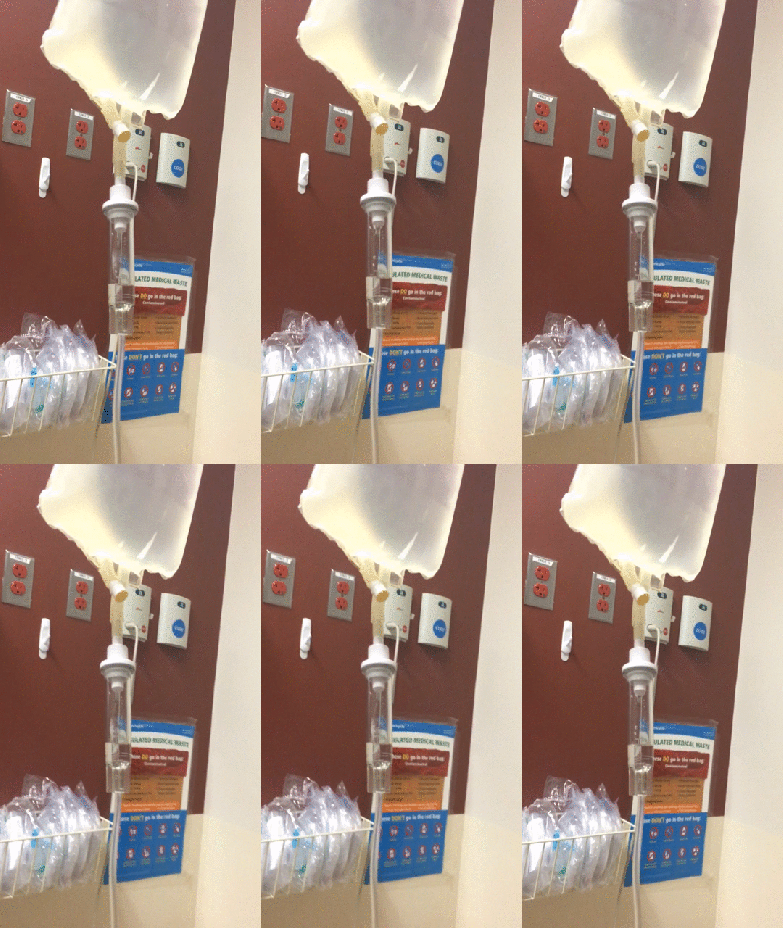
I was bored in the hospital; so naturally, I created this boomerang of my IV drip.
We arrive to the hospital. I’m whisked away into the ER. I answer a series of questions from various medical students and nurses and doctors. They draw blood for tests. I give them a urine sample for more testing. I keep on explaining the concept of my OmniPod to each one of them. No one seems to have seen it before, besides one med student who has a sister who works for Insulet. Small world!
We monitor my blood sugar closely. My tests come back normal. I eat my first foods for the day around 2 P.M.: sugar-free jello and two hard-boiled eggs. Yum…
I get an injection of insulin at the hospital. We don’t have a vial of Humalog with us – it was the one thing we forgot to grab from the house. But my dad drives home to retrieve it so I can change my pod at the hospital. My mom does it for me. I feel helpless.
The old pod comes off and we notice a definite bend in the cannula. Okay. One thing explained. I wasn’t receiving my full insulin dosages due to the bend, and unfortunately, I have no way of knowing how much insulin I was truly receiving. All I know is that it wasn’t enough, and that’s why I was running high.
I receive a diagnosis: vasovagal syncope, or pre-syncope. It’s explained to me, but I still don’t really get it. So I text my best friend, who is also a nurse. She tells me that it’s very common and can be triggered by a variety of things. The pre-syncope aspect makes more sense to me, seeing as I never truly passed out.
I’m discharged and feel so very tired. It was a long day. The following days are filled with follow-ups and message exchanges between myself, my endocrinologist, and my primary care physician. My healthcare team and I think that we come up with a plausible explanation for the hullabaloo: My body knew something was wrong. It knew that my blood sugar was abnormally high, and it knew to send signals to me that I needed to take care of it. Hence, the abdominal pain. My dehydrated state exacerbated things, and when I started sweating and lost more fluids, it was a lot for my body to experience.
Sheesh. What an ordeal. Like any diabetes-related experience, it taught me a lot, but I certainly don’t want anything like that to happen again. Shout-out to the healthcare professionals, but especially my parents, for taking damn good care of me throughout the whole episode. You’re the bomb diggity.
One Friday per month, I’ll write about my favorite things that make life with diabetes a little easier for me.
This month’s favorite thing is so damn obvious that it’s kind of shocking I haven’t written about it yet on the blog: my OmniPod insulin pump.
I love the friggen’ thing.
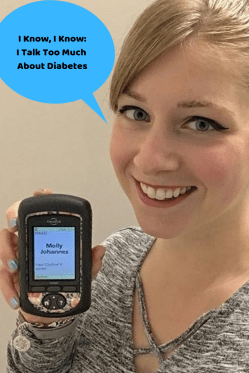
My OmniPod PDM.
I don’t know if it’s because pumping works better for me in general over multiple daily injections (MDIs), or if it’s because the OmniPod is simply the perfect pump for me. Honestly, it’s probably a combination of the two. I love how convenient it is – I can deliver insulin any time, any place, I don’t have to worry about tubing getting caught on random objects, and it lasts me for three full days (of course, only if it’s working properly…I’d estimate that it does about 90% of the time). And I love that my dosages are so much more precise compared to how they used to be when I was doing MDIs. It gives me more control, knowing that I can dose in .05 increments according to my current blood sugar levels and carbohydrate intakes.
However, it is merely another piece of diabetes technology, meaning that it does have some flaws. Sometimes pods fail for the silliest reasons, such as coming into contact with static electricity. And other times pods don’t work for no damn good reason at all, without giving the user proper notice (in the case of bent cannulas, something I recently encountered).
But for the vast majority of the time, I love my OmniPod. I’m still surprised to how quickly I adjusted to the system – the first week or two was tough, but then it was relatively smooth sailing after that period. I think it was easy for me to get used to another wearable device, because I’d already been wearing my Dexcom for a couple years by the time I got my OmniPod.
Will I wear my OmniPod for many years to come? Or will I want to switch things up and give another pump a try? Only time will tell, but for now, I think I’ll stick with what I know best in the world of insulin pumping.
First and foremost, let me apologize: I’m sorry for all of the cheesy puns that are about to follow.
Now that’s off my chest, let me put my best foot forward and write about feet.
People with diabetes are told to pay extra special attention to their feet. There’s a few things to look out for, such as circulation and nerve issues. So recently, when an old foot injury flared up, I knew trouble was afoot and I better do my best to heel it.
A couple years ago, I broke a very tiny bone (roughly the size of a corn kernel) in my foot called the sesamoid bone. It was classified as a stress fracture, so I wore a bootie and did non-weight-bearing exercises for six weeks while it heeled. I also decided to take a break from high-heel shoes and cushion my sneakers with gel inserts, which wound up being an important step in recovery. Before long, my foot was feelin’ fine and my soul was joyous.
Fast-forward to the present day, and the injury seemed to be waltzing its way back into my foot. For feet’s sake, I thought it was a thing of the past! Luckily, I’d kept my gel inserts from the first time around and started wearing them again. I didn’t want to toe the line with this foot pain – I addressed it and monitored it closely, and will continue to do so.
For now, my foot is toe-tally better. I’m reminding myself that it’s important to pay attention to my body’s signals and handle them accordingly. Foot health is absolutely not something to mess around with, and like everything else related to diabetes, I’ve got to hop to it and take good care of my feet. Can you digit?
Previously, I’ve written about what it feels like to have low blood sugar. While many people with T1D feel the same symptoms as me when they experience a low, there are even more who experience a wider variety of emotions and sensations.
Renza, a T1D Twitter friend of mine, did a little investigating into how others would describe what it’s like to have a low blood sugar. She sent a tweet that read:
#Diabetes friends. I’m crowdsourcing (again). If you had to use ONE WORD to describe how hypos/lows feel to you, what would it be. Go!! #Hypoglycaemia
She received nearly 100 responses, which I’ve compiled into the below graphic.
Looking at this word collage is a bit startling because it represents the vast array of feelings associated with low blood sugar. Most of them are negative. A handful of them start with the prefix “dis”, which describes something with an opposing force. A couple of them relate to feelings associated with eating. And just about all of them can be summed up as sensations that I wouldn’t wish on anyone.
To me, this graphic serves as a stark reminder that diabetes is more than just a chronic illness that affects the body: It affects the mind, too.
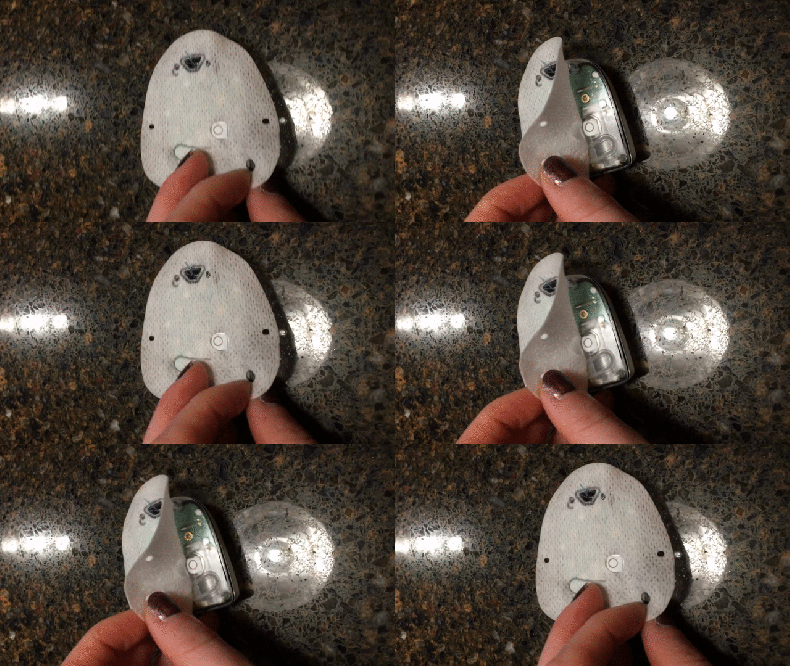
I’d only been wearing my new pod for about an hour when my arm brushed up in exactly the wrong way against a chair. Riiiiiiiip!
My pod tore right off – not from my arm, but it lifted up from the adhesive that it was glued to and dangled precariously from the still-intact adhesive stuck to my arm.
Would you have kept the pod on, or changed it?
After cursing loudly, I asked my mother for her opinion. I wanted to know if she could see the cannula, because that was the component that made me most concerned. As long as the cannula was still stuck under my skin and delivering insulin, it shouldn’t matter that my pod was a little loose – right?
She tried to peek under and around my site, but it was virtually impossible to tell whether the cannula was where it should be. I thought about it for a few moments, and decided that it would be wise to just change out the pod. The notion of tossing one that had only been in use for an hour was unappealing to me, but I know myself pretty well, and I know for damn sure that I would’ve been super paranoid about the pod functioning properly for the following 72 hours. I also figured that it couldn’t hurt to try calling Insulet to see if they would replace the kaput pod. The odds were slim, but why not try?
So after I changed my pod, I dialed up Insulet and described the situation to the customer support representative. And…I got a replacement! I was pleasantly surprised by the rep’s empathy towards the situation and how easy it was to get my replacement. She reaffirmed that I did the right thing, noting that if she’d been in my shoes, she would have called it in, too. It goes to show that when in doubt, change the pod – and don’t hesitate to call for a replacement.
October 2, 2017: The day that I hit the “publish” button and Hugging the Cactus went live.
I can’t believe it’s been one year (and one day) since this blog was officially born. So much has happened in my life in the last 365 days, both related and not related to my diabetes.
And this blog has gone through so many changes in that time span. From aesthetic to logistical, it’s been a (welcome) challenge to figure out the best way to write and run Hugging the Cactus. I’ve learned so many new things along the way and I continue to learn more on practically a daily basis.
Although I wish that diabetes wasn’t a part of my life – or anyone’s life – I’m grateful that I’ve mostly made peace with it after 20 years of living with it. Actually, scratch out the “living with it” and replace it with “thriving with it”. I used to think that was totally cheesy, but that phrase really does encapsulate what it’s like to be undeterred by diabetes.
I’m also grateful for you, the reader. There are times in which I question why I write this blog. Those times are fraught with self-doubt, writer’s block, and listlessness. But then someone reaches out to me – directly through the blog, via social media, or even in-person – and they offer support or let me know that my writing has resonated with them in some way. And that, right there, reminds me why I write this blog: to connect with others, to remind people in the diabetes community who deal with this isolating chronic illness that they’re not alone, and to raise general awareness of T1D. There are many people in this amazing tribe of ours who write better blogs, take prettier pictures, and impact a larger audience than I do, but like them, I’ve found my own voice that has allowed me to channel my experiences with diabetes in my unique, storytelling way. And I plan on continuing to do so for a long time to come.
So thank you, reader, for stopping by here three times a week and supporting my mission. I hope that you enjoy the next year’s worth of Hugging the Cactus. For now, let’s celebrate today by reminding ourselves that we’re more than our current blood sugar values or A1c levels. Celebrate by choosing to do more than just live: thrive.
Let me begin this post by saying that I do not believe I can be categorized as “basic white girl”. For those of you who aren’t familiar with the term “basic white girl” in the Urban Dictionary sense of the word, it can be defined as:
A female who conforms to her surroundings and claims she is unique. She often drinks Starbucks, wears Ugg boots in August, and posts selfies on social networking sites every. single. day. Also uses hashtags that don’t have anything to do with the picture itself.
Basic white girl starter kit includes: Uggs, Starbucks, leggings or yoga pants, pumpkin spice, every social media platform ever created, etc.
– Urban Dictionary
I’ve never owned a pair of Ugg boots. I only drink Starbucks every once in awhile, but I don’t order froufrou “bevvies” when I go – usually, I just stick with an iced coffee, black. And I certainly don’t have enough self-confidence to post a selfie on social media every damn day. That sounds exhausting.
But if an undying love for any and all things pumpkin spice scented/flavored qualifies me as “basic”, then I guess I’m gonna have to take my pumpkin spice coffee and run with it!
Since pumpkin spice manifests itself in many carb-laden treats this time of year, you might be wondering exactly how I can get away with enjoying a mass quantity of the stuff. And no, my method doesn’t involve dosing tons of insulin so I can down endless amounts of pumpkin spice M&Ms, ice cream, Oreos, yogurt, muffins, or any other kind of pumpkin-spicy product you can imagine.
It’s much simpler than that – all that I do is make it my mission each year, right around mid-August, to find as many carb-free pumpkin spice products as possible, buy them, and revel in them for the following three months.
You’d be surprised to learn how easy it is, too. Here are just a few of the pumpkin spice products I’ve stocked up on in the last few years: Gum, candles, tea, butter (yes, pumpkin spice BUTTER), hand sanitizer, soap, peanut butter…the list can go on and on, and it does, considering that the gamut of pumpkin spice offerings only increases year after year.
I’ve hunted down foods that have both pumpkin spice and a lower carb count, like Halo Top Pumpkin Pie ice cream or FiberOne bars (ugh, they’re so good it’s not fair). I’ve even mixed it up by combining pumpkin spice with some more manageable carbs, such as plain oatmeal. I just can’t get enough, especially since this is a seasonal offering that plays pretty nicely with my diabetes.
So if that makes me basic, then I’ll wear the label proudly, just as I do with my diabetes.
I write a blog about it. I vent to family about it. I almost always casually mention it to new people that I meet.
I have multiple social media profiles dedicated to it. I own several t-shirts that identify me as a person with diabetes.
It’s the first thing I think about in the morning when I wake up, and the last thing I think about before I fall asleep at night.
And yet, sometimes people complain – jokingly and seriously – that I talk about it too much.
Of course I do! I totally own up to that fact. But think about it…
Doesn’t it make sense that I talk about it so much?
…but there’s a reason for it.
It affects the most mundane decisions that I make on a daily basis. It affects my mood. It affects my body. It affects the foods I consume. It affects what I carry in my purse each day and what I pack in my luggage on vacations. It affects my finances and my gym routine and the doctors I have to see.
If someone thinks I talk too much about my diabetes, then I’d like them to understand this:
Talking about diabetes spreads awareness and saves lives.
Bold, italicized, and underlined so the message and its significance is clear. Too many people in this world just don’t understand type 1 diabetes. They don’t realize how dangerous it can be, or how it is managed. In my personal experience, being open with others, answering their questions, and dispelling diabetes myths has resulted in nothing but positive outcomes.
It’s even helped people I know save a life, because they knew what to do when a T1D close to them was experiencing a hypoglycemic event.
All because I “talked too much” about diabetes.
With that in mind…you can bet that I won’t be shutting up about it any time soon.







 Hugging the Cactus