This blog post is a response to a prompt provided by my friends at the College Diabetes Network, who are celebrating College Diabetes Week from November 12-16. Even though I’m no longer in college, I like to participate in CDW activities as much as possible to show my support for the CDN!
Invisible illnesses like diabetes can be difficult for healthy people to truly understand. Typically, they only see bits and pieces of it; for instance, when someone performs a blood sugar check or injects insulin. There’s so much that they don’t see: doctor’s appointments, late/sleepless nights, complex calculations, careful monitoring, and so forth.
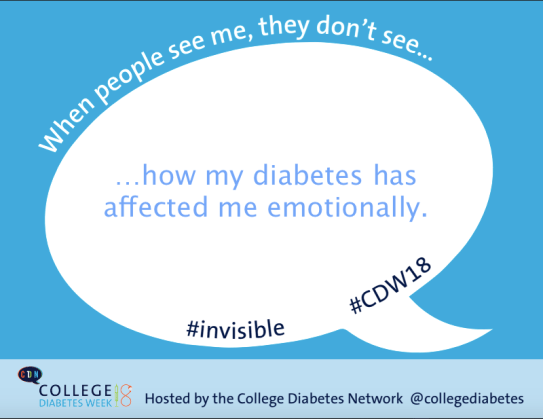
But what’s really difficult for anyone to see is the emotional impact of diabetes.
Unless I choose to open up to someone about it – which is easier said than done – then there’s no way for another person to grasp the magnitude of the emotional side of diabetes. There’s no way for someone to feel the incredible amounts of anxiety, fear, and anger that cycle through me as I deal with diabetes. While I don’t experience these emotions every single day, I DO have to experience diabetes daily, and it’s impossible for someone to know what that’s like unless they either have T1D or care for someone with it.
I don’t wish for anyone in the world who’s unfamiliar with the (literal and emotional) ups and downs of diabetes to actually learn what it’s like. But I do wish for a world that’s a little more understanding, accepting, and educated when it comes to all things related to diabetes – and that’s why I advocate.
This blog post is a response to a prompt provided by my friends at the College Diabetes Network, who are celebrating College Diabetes Week from November 12-16. Even though I’m no longer in college, I like to participate in CDW activities as much as possible to show my support for the CDN!
In my last Memory Monday, I touched on how CDN changed my life. But I didn’t go into great detail on how, exactly.
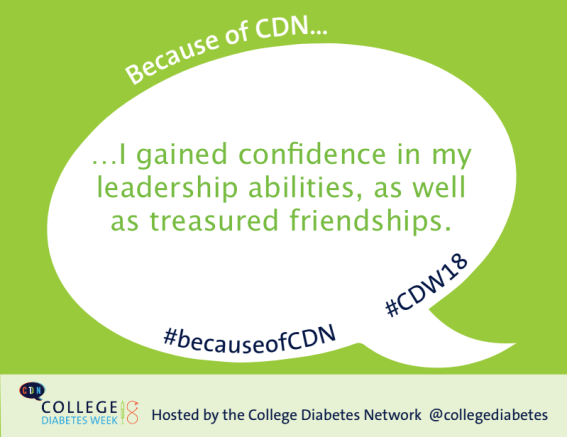
CDN was my first leadership opportunity as a young adult. In college, I became President of the UMass Amherst chapter of the CDN. That role came with tons of responsibilities: organizing meetings, recruiting new members, creating a constitution, getting approval from the student government, keeping track of chapter finances, electing an executive board…it was exhausting! But I was passionate about it and wanted to see it succeed, so I threw myself into the work of running a chapter. I took my role as a leader seriously, but also wanted to make sure that the group benefited everyone who decided to join it. I did my best to listen to member feedback and apply it accordingly to group meetings and activities, which I think shows that I’m a receptive leader.
And my involvement as a chapter leader is what brought me so many friendships. That’s because I was able to attend the inaugural CDN student retreat during my final year of college. That’s where I met student leaders just like me from colleges across the country. We commiserated on the hardships of running chapters as well as the challenges of having diabetes in college, and straight-up bonded for the few days we spent together. I felt that the retreat helped me come out of my shell a bit, and only molded me into a more confident leader with more resources than before that could help me run my chapter most effectively.
I’ve said it before, and I’ll say it again: I’m eternally grateful for all the wonderful people and opportunities that CDN has brought into my life.
This blog post is a response to a prompt provided by my friends at the College Diabetes Network, who are celebrating College Diabetes Week from November 12-16. Even though I’m no longer in college, I like to participate in CDW activities as much as possible to show my support for the CDN!
I was four years old when I was diagnosed with type 1 diabetes. I don’t have many memories from that fateful trip to the hospital. Since it was Christmas Eve, my only real concern was whether I’d be home in time to enjoy Santa’s visit!
But in the nearly 21 years that I’ve had diabetes, I’ve come to learn that there’s so many things I would have liked to know at diagnosis. I didn’t truly understand what my diagnosis meant at that young age…I don’t think I realized how it would forever change my life. I was probably more frightened than anything else, since I was being poked and prodded by seemingly endless needles.
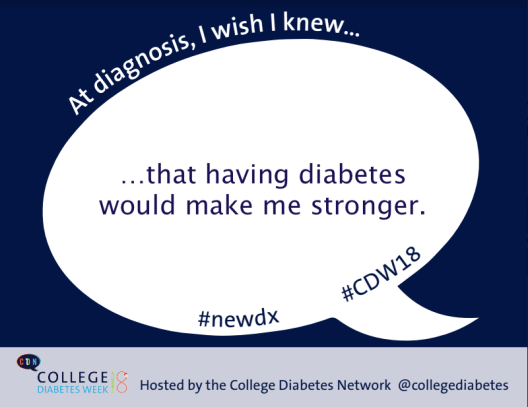
That said, I wish I could’ve told that four year old girl that having diabetes would make me stronger. Every single needle that I was stuck with would help me fight against this disease. Everything that was physical about diabetes would make me mentally stronger. The kind of strength it imparts is a different breed, one that’s difficult to describe, but one that I’m strangely grateful to have.
It always sounds slightly weird to say that I’m grateful for something associated with diabetes, but that’s what Hugging the Cactus is all about: taking the good with the bad and embracing it for what it is.
Diabetes Awareness Month may have only started a few days ago, but boy, has it been jam-packed with advocacy and awareness efforts so far! In fact, I think this is the most active year yet for most social media platforms. I’ve seen tons of different campaigns, hashtags, and posts that were all created especially for this month, and it’s absolutely wonderful to see such inspired content as well as high participation rates.
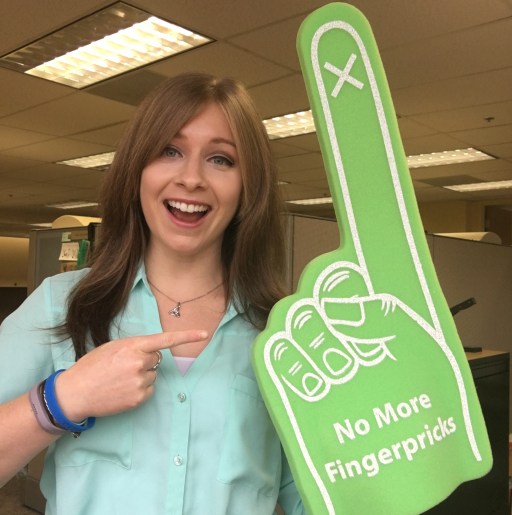
And I hope to keep the ball rolling on this! That’s why I’m sharing my #NoMoreFingerpricks post today. This campaign was launched by Dexcom and Beyond Type 1. Participants are encouraged to take a picture or video wearing the foam finger from Dexcom, or to draw an “X” on an actual finger (if they don’t have a foam finger). For every photo or video posted on Facebook/Instagram with an @Dexcom and #NoMoreFingerpricks, Dexcom will donate $1 to Beyond Type 1.
Here’s my #NoMoreFingerpricks campaign photo! And yes, I deliberately wore blue – the color of diabetes awareness.
Yup, it’s that easy to do! And it’s exactly the kind of social media campaign that can catch on quickly. Recruit your family and friends to take photos and get posting! And be sure to teach them a couple of diabetes facts and what the whole #NoMoreFingerpricks hashtag is all about. For instance, you could mention that:
34% of people with T1D know nothing or little about CGM
80% of people with T1D still prick their fingers more than 3 times a day
96% of CGM users would recommend CGM
You could even direct inquiring minds to visit nomorefingerpricks.com to learn more about continuous glucose monitoring technology and this campaign.
So…what are you waiting for?! Draw an “X” or grab that foam finger and post your photo to educate, advocate, and celebrate living beyond!
If you know me, or have read my blog before, then you know that I’m a fan of talking about the “taboo” diabetes topics. You know, the things that we have trouble talking about with our family, friends, or doctors when it comes to our diabetes. Since they’re sensitive subjects, it’s hard to figure out a way to best address them, so they’re often ignored entirely. And by ignoring them, more harm than good can happen.
That’s why I’m an advocate who likes to tackle the tough stuff. In particular, I like talking about the effects of alcohol on diabetes, because 1) I enjoy the occasional libation and 2) I had a bad experience with alcohol and my diabetes because I had no clue how to handle the two of them simultaneously.
It’s my goal and hope that by talking about how alcohol interacts with diabetes, I’ll help someone avoid getting into a sticky situation like I did back when I was in college.
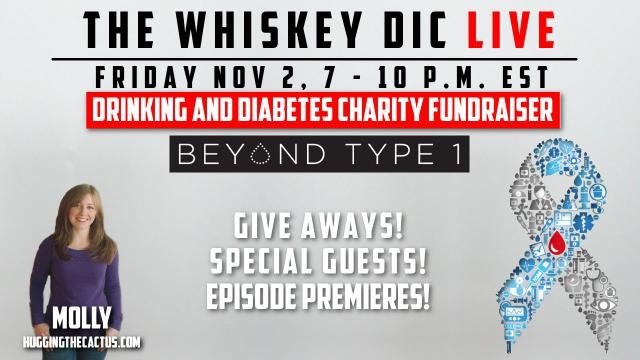
Besides writing about drinking and diabetes on my blog, I find myself talking about it with others – and tonight, LIVE, you can tune in to watch me talk about it on my colleague and friend’s YouTube channel, The Whiskey Dictionary!
Bill (a.k.a. The Whiskey Dic) is hosting a special live stream/fundraising event TONIGHT, November 2nd, from 7 – 10 P.M. EST on his channel. The proceeds from the fundraiser go directly to Beyond Type 1, an organization that Bill chose to support because he has family and friends who live with T1D. And that’s why I’m appearing on his channel: to discuss the taboo surrounding drinking and diabetes, and help him make his fundraising efforts a success!
So what else should you expect from this live fundraising event? Bill will talk more about why this cause is important to him, and give shout-outs to the various companies and distilleries that have supported the fundraiser so far. In true Whiskey Dictionary fashion, he’ll also premiere a new video review of whiskey from his channel.
When I join in hour two (around 8 o’clock), I’ll speak about my experiences with drinking safely, as well as join Bill for a drink or two. You’ll want to tune in all night, though, because you’ll have the chance to win Whiskey Dictionary giveaways! There will potentially be more guests, as well! It’s bound to be an exciting event that you won’t want to miss. Save this link to directly access the live stream tonight. Besides being a unique way to support a wonderful diabetes nonprofit, this event is also a guaranteed way for you to learn more about whiskey in an entertaining yet educational manner. Trust me, Bill knows his stuff when it comes to spirits!
Even if you can’t tune in to it live, but want to donate to the fundraiser, you can by clicking on this link. Thank you in advance for contributing to the cause. On behalf of myself and Bill, it’s greatly appreciated!
Halloween is a holiday that most people associate with candy and costumes. Since I have T1D, you might assume that I wasn’t able to partake in haunted happenings as a kiddo. But that’s far from the truth. In fact, I looked forward to Halloween every year just like any other child who enjoyed dressing up, watching It’s The Great Pumpkin, Charlie Brown, and trick-or-treating.
My parents handled trick-or-treating and my diabetes like true pros: They let me enjoy it and take home just as much candy as my older brother each year. We always wound up with fairly large hauls, and the only difference between mine and his is that mine contained a couple extra “diabetes-friendly” goodies, courtesy of my relatives.
I’m glad that they never made me feel different, or like I couldn’t celebrate it in the same way as my brother and other kids my age because of my diabetes. In turn, I bet they were glad that I was always determined to make my candy last as long as possible – they didn’t have to worry about me sneaking extra pieces, unless they were accounted for with a bolus. And we mutually enjoyed that there were plenty of “low snacks” to spare around the house to take care of any hypos that my mom or myself might have. Trust me, treating lows is always much more fun with a good piece of candy, especially if it was a Reese’s cup.
Today, I’m celebrating Halloween by wearing a costume to work and eating pizza with my coworkers. It’s definitely a departure from the Halloweens of my childhood, but no less fun. I figured I’d wrap up this holiday-centric post by remembering the good ole trick-or-treating days with some pictures of my favorite costumes I wore in my “youth”:
Circa 1995
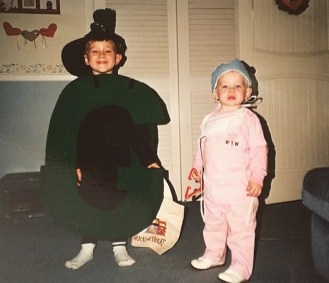
The year that I was a nurse, and my brother was the letter “G”. Yes, you read that correctly. I’m fairly certain this Halloween was so memorable because of his unique costume choice, not because it was my first time trick-or-treating.
Lady Liberty
My Statue of Liberty costume – possibly my favorite costume ever! My mom HANDMADE the entire thing, from the giant tinfoil crown to the torch that (she insisted) I kept high in the air the whole time I was trick-or-treating.
Cowgirl with an attitude
A cowgirl! This picture makes me laugh because it really captures my personality…
Cinderelly, Cinderelly!
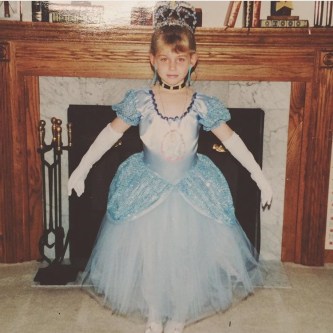
…but then again, so does this one! Cinderella is my absolute favorite Disney princess, so when I got to dress up just like her for one Halloween, it was a dream come true.
It’s leviOsa, not levioSA.
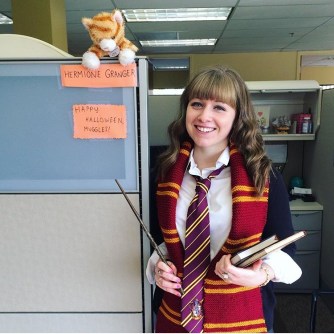
Speaking of magical characters, I loved dressing up as Hermione as an adult! I wore this costume for my first Halloween at my job. It was a hit around the office.
She really is a funny girl, that Belle
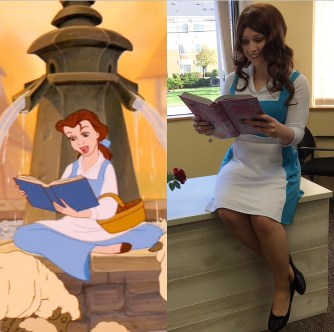
And that brings us up to last year’s Belle costume. Another Disney princess, another elaborate hairstyle, another fun outfit and character to don for a day.
Whether you indulge on some candy today, wear a costume, or merely go about your business like any other day…make it a great one and may your blood sugars be spooktacular!
One Monday per month, I’ll take a trip down memory lane and reflect on how much my diabetes thoughts, feelings, and experiences have unfolded over the years. Today, I remember…
…attending my very first CDN meeting as a college freshman who had no idea what to expect.
I remember wandering into one of the dilapidated buildings on campus, my stomach twisting in knots out of anticipation. I had no clue what to expect. I’d decided to go to the meeting partly to find out what it was like to interact with other T1Ds who were my age, and partly to placate my mother, who encouraged me to give it a shot (pun definitely intended).
When I walked into the room, I was greeted by the then-president of the UMass Amherst chapter, a couple of members, and the chapter’s adviser. I remember smiling nervously at them, introducing myself, and sitting down to join in on the animated conversation.
That would be the first and only CDN meeting in which I didn’t have much to say, only because I was too fixated on the novelty of the whole thing. Growing up, my mom and my aunt were the only two T1Ds I had in my life, and I was very okay with that. They were (and still are) excellent resources for my diabetes-related questions, so much so that my young/naive mind couldn’t see what I’d possibly have to gain by befriending other people my own age with diabetes.
If I’d known then what I know now…!
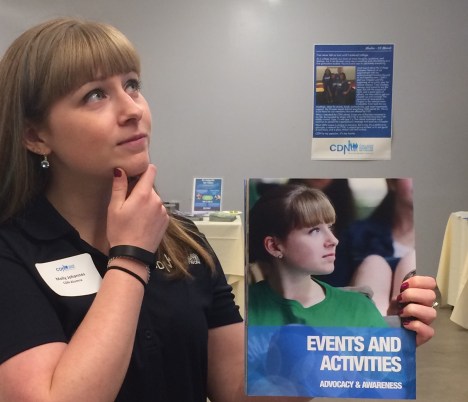
CDN became such a big part of my life that I even wound up on the cover of their Advocacy and Awareness Guide! Who woulda thunk?
To make a long story short, that meeting marked the start of something wonderful for me. A journey, of sorts, to feeling empowered with diabetes. The beginning of many treasured friendships. An introduction to leadership in the diabetes community. A foray into feeling less afraid to rely on others for emotional support when I struggle with my diabetes.
That first meeting showed me what it was like to be around peers who I don’t have to constantly explain things to because they already know the ins and outs of diabetes just as well as I do. And that is invaluable.
I like reflecting on my involvement with CDN because so many positive things are associated with it, and it’s especially fitting on this Memory Monday in question, because Diabetes Awareness Month is right around the corner! My upcoming posts will reflect that, and they’ll also address prompts provided by the CDN to celebrate College Diabetes Week. Even though I’m not in college anymore, I’m looking forward to writing posts that respond to those prompts, because they’ll serve as a great way to reflect and reminisce some more. Be on the lookout for those posts in the next two weeks!
I had a bit of a traumatizing experience at the airport a few weeks ago.
I travel fairly frequently – I’d estimate that I hop aboard a flight a dozen times or so per year. As a result, I’m well-versed in the TSA routine that goes down at every airport: Remove shoes/belts/items from pockets. Take laptops and electronic devices of similar size out of bags. Place 3-1-1 liquids in a visible spot. Let TSA agents know before stepping into the full-body scanner that I have T1D and wear a couple of devices. Step out of scanner and allow them to do a hand swab. Wait patiently for the results to come back clean, gather belongings, and move on to my gate.
It’s a very precise routine that I’ve come to anticipate and accept, so really, it’s no wonder that it was bad experience when it deviated sharply from the standard format on my last trip.
I was returning home from a long weekend in Washington, D.C. I queued myself up in the TSA line and when I got close enough to an agent, I let her know that I didn’t want to go through the full-body scanner, because I was wearing a medical device that couldn’t handle it. (The manual for my Dexcom G6 advises users to avoid full-body scanners and opt for pat-downs, metal detectors, or wands, as available. I’m a stickler for following the rules, so that’s why I stuck with the manual’s advice). I’ve had the pat-down before, and while I don’t love it, I knew it wouldn’t be intolerable.
As soon as another female agent was free to conduct the pat-down, I was waved over and subjected to the semi-embarrassing “free massage”. Once it was done, my hands were swabbed. If you aren’t familiar with the hand-swab process, it’s a protocol in which the TSA checks passengers’ hands for any traces of explosives. In other words? My swab always comes back clean.
Except this time, it didn’t. The machine dinged. This prompted a couple of TSA agents to consult one another before coming over to me and informing me that I’d have to wait an undisclosed period of time for another, higher-up female agent to come over, conduct a “more-thorough” pat-down, and forfeit my luggage for a closer inspection.
Deep down, I wasn’t worried because I knew that the more meticulous inspections would clear me for travel. But I couldn’t fight back against the anxiety that flooded throughout my body as I wondered how long I’d have to wait and how much more invasive this next pat-down would be. I struggled to conceal the tears that rolled down my cheeks as TSA agents seized my bags and rifled through them, ruining my careful packing techniques. I was humiliated, and practically had to beg them when I asked to see my cell phone and OmniPod PDM. (I could practically feel my blood sugar going up due to the stressful nature of the situation, so I wanted to check and correct it A.S.A.P.) It only got worse as I was pulled into a separate room and given a pat-down in which the agent actually pulled my pants away from my body to look down inside them, which is just as awful as it sounds. I know that they’re merely performing their job – I don’t fault them for that and appreciate that it’s far from glamorous – but it was horribly demeaning.
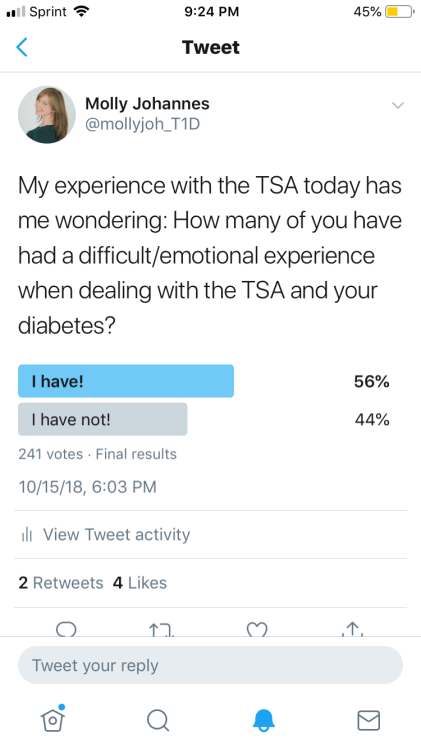
When I was finally told I could go, I wordlessly collected my belongings, fighting to shove them back into my suitcase. I made a beeline to the restroom to splash water on my face and calm down. As I waited to board my flight, curiosity took hold of me and I posted a poll on Twitter. I wanted to know if anyone else has ever had an experience like mine. Nearly 241 people answered my poll.
And I was fascinated by the results. There was no overwhelming majority; in fact, it was rather solidly split down the middle, with only a few more people reporting a negative experience with the TSA. Many of those people responded directly to my poll with tweets of their own that described their experiences:
They nearly ripped my son’s inset out of his thigh for his pump one time. Another time they took his bottle of insulin & tested it & I understand explosives come in liquid form but he was 8 years old. Another time they performed a very thorough and humiliating body pat down on me in order for him to bring his insulin on board.
I’ve never had a difficult experience w/TSA on any flights- international or domestic. They’ve all been very professional & understanding when I said I have an insulin pump/all supplies. I’m sorry you had a tough time.
My husband has to take my daughter through because I completely lose my shit on them. Every single time a hand swipe test. Unbelievable and stigmatizing.
Almost every single time and it infuriates me. They treat your supplies like you’re part of the drug cartel. One held up my bag and with so much attitude “excuse me? What is this?” And I said my medicine and another passenger screamed at the agent saying “you can’t do that!”
Same thing happened to me! They tore apart and destroyed so many of my supplies and I just watched helplessly while crying. If 29 million Americans have diabetes why is TSA so oblivious to what it looks like?!!
While these replies validated to me that I wasn’t overreacting, they also made me sad. Angry. Frustrated. Why is this a thing in some airports? Why isn’t there a better protocol in place for people with diabetes?
Perhaps the most irritating part of it all is that I don’t know for sure why this whole thing happened in the first place. I assumed that it was a fluke on the machine’s end, but after corroborating stories with so many other T1Ds, it’s got me wondering…was my diabetes a red flag of sorts to the agents? Did they think that my supplies were disguised and could be something harmful?
Again, I don’t want to discount the work that the TSA does to help keep travelers safe. I truly do appreciate it and I know that experiences vary at airports all across the world. But…we can do better. Traveling should be fun and exciting, not traumatizing.
It’s said that ignorance is bliss…but as I recently (re)learned, ignorance can cause fear and misunderstanding in times that it’s better to be honest.
The lesson was hammered into my brain after fibbing to my significant other about my blood sugar a couple of weeks ago. It was a Saturday night, we had spent the day moseying around the city, and we were looking forward to a chill evening doing a whole lot of nothing. We decided to get into a collaborative card game while we watched the Red Sox play against kick the Astros’ butts.
As we set up the game, I knew my blood sugar was high. But I ignored it, figuring that my insulin would kick in soon and bring my levels back down to normal. I should’ve known that it wouldn’t be so simple (is ANYTHING ever simple when it comes to diabetes?) because after an hour and a half, no progress was made on the BG front and my mood was worsening as a result of it. My partner, ever-attentive, asked me more than once why I seemed so cross. He even directly asked if it was related to my blood sugar, and I…didn’t exactly tell the truth.
Okay, I lied! But it was only because I didn’t want him to worry. I was already worried enough for the two of us. And I thought I was doing the right thing here. I really, truly thought my blood sugar would come down in no time at all, and I hate,hate,HATE using anything related to my diabetes as an excuse for my behavior…so rather than admit what I was going through, I brushed it off, which only exacerbated everything. Not my proudest moment.
As the night went on, we got deeper into the game and my blood sugar climbed higher. I was beyond agitated at this point, and my heart certainly wasn’t into the game. Besides neglecting to open up about my blood sugar problems, I’m also ashamed of my lack of interest in the card game. In hindsight, the healthy thing to do in this situation would’ve been to have faith in my treatment decisions and try to enjoy myself in the meantime. But I was too caught up in the negative mindset that the high blood sugar put me into, and unfortunately, it marred an otherwise perfectly nice night.
The next day, when my blood sugar situation was back to normal, I came clean to my boyfriend. I think he was a bit irked with me for hiding the truth from him, but I also think that he understood a little more after I explained why.
In this case, diabetes won…at least it did in that brief moment in time. Between ruining my mood and causing a mild rift between me and a loved one, I felt pretty damn defeated by it. In the long run, though, I think this experience will be more of a boon than a bane, because it reinforced the notion of honesty being the best policy – even when it comes to diabetes.
Low blood sugars are funny. Not ha-ha funny, but peculiar in how they affect me physically and mentally.
A few weeks ago, I had an experience with a particularly scary low. It frightened me so much that I’m only just getting around to writing about it now, because I needed some time to gather my thoughts on what happened.
I’ll set the scene: I was home alone. I had eaten a carb-heavy dinner and decided to do a 30-minute, high-intensity workout. This was definitely far from my best idea ever, because due to the high-carb intake, I had a lot of insulin on board. That, coupled with the exercise, meant that my blood sugar was bound to crash soon after completing the workout.
And it sure did.
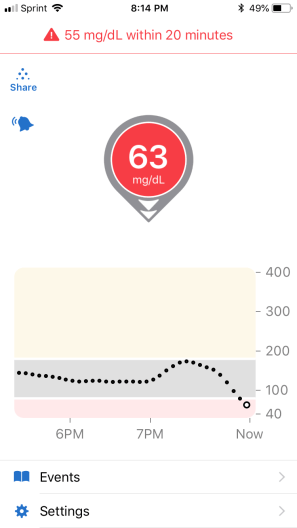
Falling rapidly.
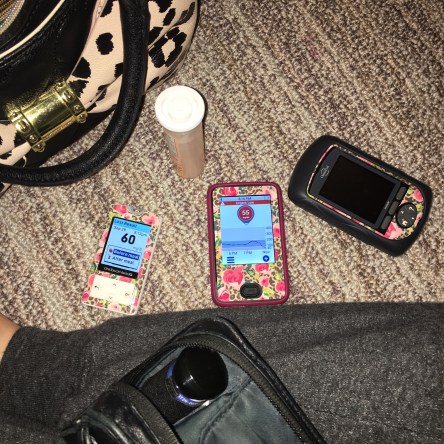
I had just stepped out of the shower and wrapped myself in a towel when I began to feel it. That sudden wave of weakness, shakiness, and dizziness. I walked to my bedroom, grabbed all of my diabetes supplies and my cell phone from my purse, and sank down to the floor with everything in front of me. I knew it would be wise to just sit there for as long as I needed, because I was afraid to go down the stairs (and possibly fall down/hurt myself in the process) in that state.
I checked my CGM, which confirmed that I was dropping quickly. I stared at the screen, panic flooding throughout my body. It occurred to me that I should probably do a finger stick check to make sure I was really that low, so I did, and saw that I was 60 mg/dL.
The scene of the incident.
Now, I’ve absolutely been lower than 60 before. It’s never a pleasant experience. But rather than using that as a comforting thought, I couldn’t help but dwell on how terrible I felt and how frightened I was to be home alone with at least four more units of insulin still working in my system.
All I could do was chew four glucose tablets, suspend my insulin delivery, and wait.
In that period of time, I was totally immobilized.
I’ll never forget how alone I felt, how out of control I felt.
I felt powerless against my diabetes. My own body.
I’ll never forget the fear that consumed me, that nearly prevented me from helping myself in this situation.
I’ll never forget texting my mother and my boyfriend, telling them what was happening, and expressing how scared I felt.
I’ll never forget bursting into tears when they didn’t reply quickly enough.
I’ll never forget turning to my T1D Twitter buddies for help by sending a tweet about what was happening, or how swiftly and comfortingly they responded to me.
And I’ll never forget how I let my mind drift as I wondered whether I’d be okay.
It sounds totally dramatic, especially for a low that, in the grand scheme of things, could’ve been much worse. I can admit that.
But I can also admit that this is one of the few times in my life that I felt truly terrified of my diabetes, and swept up in the fact that things can change so quickly with this condition that it can quite literally knock you off your feet.
Obviously, I recovered just fine that night. The glucose tablets did their trick and my low symptoms subsided. It took longer for me to calm myself down, to breathe normally, non-panicky breaths. At least my puppy was around to soothe me.
I was fine, I will be fine. But I won’t forget this incident, ever.



 Hugging the Cactus