Memory Monday: The First Time I Tried Sugar-Free Chocolate from Yummies

Memory Monday is following a slightly different format from here on out! One Monday per month, I’ll take a trip down memory lane and reflect on how much my diabetes thoughts, feelings, and experiences have unfolded over the years. Today, I remember…

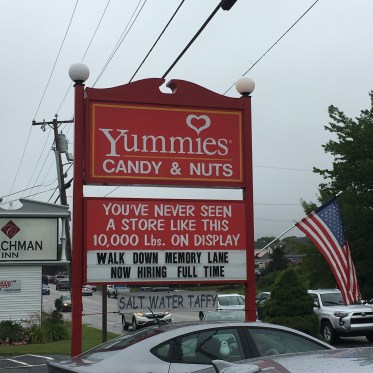
…the first time that I tried sugar-free chocolate. Not just any sugar-free chocolate, though: It was from Yummies, a massive candy emporium in Southern Maine. The store is lined, floor to ceiling, with bags upon bags of candy. You can bulk buy your favorites to your heart’s content as well as discover weird, relatively unknown confectionery creations. If you have a sweet tooth, it’s basically a saccharine paradise.

When I was younger, I watched a lot of Phantom Gourmet – partly because it was always on the TV in my Grammy’s nursing home when we visited her each Saturday afternoon, and partly because I was a growing foodie who loved learning about local hot spot eateries. At around nine years old, an episode that featured Yummies aired on TV, and I discovered that they had an entire case devoted to sugar-free chocolates in their store. I knew I had to go check it out; fortunately, my parents were willing to take me there next time we trekked up to Maine.
31E33B9B-61EB-4AC9-9894-C1AAE220D4F9
Yummies, also known as candy lover’s paradise.

I’ll never forget the first time I walked into that store. My jaw dropped as I laid eyes on the 10,000 pounds of candy they had on display. As I wove through the rainbow-hued aisles, I could practically feel my blood sugar spiking. But I was on a mission to find the sugar-free section that looked so delectable on television that I could practically taste it.

I heard angels sing hallelujah when I laid eyes on the aforementioned case of chocolates. There were so many choices! And all of them were made in the store, guaranteeing higher quality! It was a T1D chocolate lover’s paradise: There were fudge meltaways, peanut butter cups, almond bark, coconut clusters, sea salt caramels, chocolate peanuts, malted milk balls, peppermint patties, and even more beyond that. I remember marveling at the variety for a solid five minutes before I was told by my father to hurry up and make my selections. I don’t remember exactly what I chose, but it definitely included the meltaways and peanut butter cups. Once they were paid for and I was back in the car with my chocolate treasures, I took my first bite and could scarcely believe it was sugar free candy – that’s how awesome it tasted.

Every summer since then, I’ve made an annual visit to Yummies to pick up my tasty sugar-free chocolates. It brings back memories of being a little kid stepping into that store for the first time, memories that are almost as sweet as the candy inside.
Memory Monday: The Diabetes Diet, 100 Years Ago

One Monday per month, I’ll take a trip down memory lane and reflect on how much diabetes technology, education, and stigma has changed over the years. Remember when…

…insulin had yet to be discovered? Of course you don’t actually remember it, unless you were born in or prior to 1921 (and if you were, wow!!! Thanks for checking out the blog!).

Anyway, prior to the groundbreaking discovery of insulin, people with diabetes lived difficult – rather miserable, actually – lives. I started reading a book called Breakthrough: Elizabeth Hughes, the Discovery of Insulin, and the Making of a Medical Miracle a little while ago. This book has made me realize just how fortunate I am to live during a time when insulin is around (even if it is grossly overpriced).

Many parts of this book have surprised, horrified, and downright depressed me. One of the more shocking things that I’ve learned from it, though, is the diabetes diet that was prescribed to patients in the early 1900s. Patients like Elizabeth Hughes, the T1D daughter of a U.S. politician, were expected to follow a strict meal plan upon admission to the Physiatric Institute in Morristown, New Jersey. Imagine following an eating plan like this every day:

Breakfast – One egg with two and one-quarter tablespoons of string beans boiled three times, and one tablespoon each of cream and coffee.

10 A.M. – Half a small orange for a snack.

12 P.M. – Two and a half tablespoons of cod with two heaping tablespoons of Brussels sprouts boiled three times, as well as five small olives and a half pat of butter…with a cup of tea to wash it all down.

Dinner – One egg and one egg white, 2 tablespoons of spinach (yes, boiled three times), with a half pat of butter.

Oh, scratch that part about following this diet every single day – patients had to fast one day each week. No food was permitted, at all.

Does that not sound vile?

I mean, I love eggs, and I happily eat veggies on a daily basis. But I’m certain I’d get sick of them no matter how they were prepared. And veggies boiled THREE times? I would think that they’d be reduced to mush, which, according to the book, is the point. Boiling them so many times would ensure minimal carbohydrate consumption since the nutrients would basically be cooked out of the vegetable. Plus, with portions so tiny, it’s hard to imagine that anyone ever felt full after consuming a “meal”.

DD0B7735-4A89-42C5-81A4-732B91E1F4BF
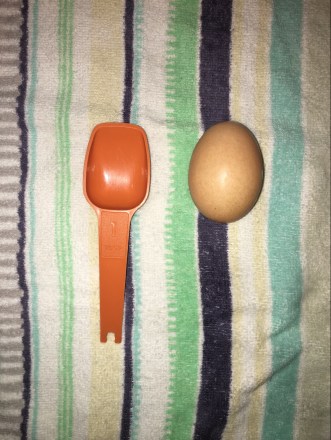
For context, one egg is about the same size as one tablespoon, meaning that portions on this diet plan were miniscule.

This extremely restrictive diet left patients yearning for pictures of food they saw in magazines, as well as severely undernourished. Following this meal plan practically guaranteed that patients would become emaciated. In fact, by the time 15-year-old Elizabeth Hughes left the Physiatric Institute, she weighed a mere 45 pounds – less than half what a healthy girl that age should weigh.

Even though I haven’t finished the book yet, it already serves as a reminder to be grateful for what I’ve got in this day in age: not just insulin, but amazing technology, wonderful doctors, and radical ongoing research in the diabetes field.

All of today’s advancements make me hopeful for the possibility of the eradication of diabetes, maybe not too far after the 100-year anniversary of the discovery of insulin.

Memory Monday: Cloudy and Clear

One Monday per month, I’ll take a trip down memory lane and reflect on how much diabetes technology, education, and stigma has changed over the years. Remember when…

…it was a thing to mix insulin?

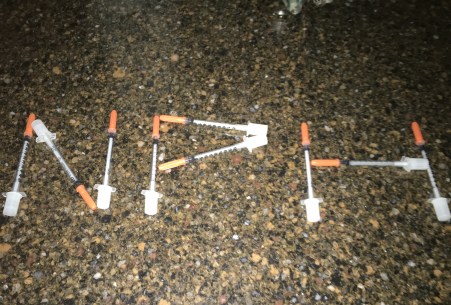
Yup, I’m referring to the days of cloudy and clear insulins – also known as NPH and Regular, respectively (insert corny Neil Patrick Harris joke here). Oh, you don’t know what I’m talking about? This is going back at least 15 years, probably more like 20, to when short-acting and long-acting insulins needed to be mixed in order to avoid having to take two separate shots. I only vaguely remember mixing my insulins, but here’s what sticks out in my memory about the process:

  • It was always “clear before cloudy” – the Regular insulin had to be drawn up in the syringe first to avoid getting any of the cloudy insulin into the clear vial.
  • The cloudy insulin needed to be rolled between the hands before inserting a syringe into it…I can’t remember why. Maybe to help bring it to room temperature, or make sure it was adequately mixed?
1019C7D1-695B-4ECC-A9F2-8F63FAF6660C
I definitely do not miss the days of filling these bad boys with two different kinds of insulin.
  • Drawing the insulins into a single syringe was nerve-wracking as hell. Precision was everything.
  • Air bubbles! They ruined everything!

I certainly don’t miss the tedious process of having to draw up insulin in such a careful, precise manner. If only I’d known how much easier an insulin pump would make my life sooner…

…but I guess that just makes me appreciate my pump more.


Memory Monday: That Time I Created a Diabetes Lesson Plan for Middle School Students (Part 2)

One Monday per month, I’ll take a trip down memory lane and reflect on how much diabetes technology, education, and stigma has changed over the years. Remember when…

This is a continuation of last month’s Memory Monday, in which I reflected on what it was like to work on a diabetes-oriented community action project when I was a freshman in high school. There were two main components to my project: running a School Walk for Diabetes, and educating a group of middle school students on type one diabetes.

Ugh, the thought of presenting to a group of middle school kids horrifies me now, but I guess I wasn’t so afraid at the time – you know, because I was a cooler, older, more sophisticated 14 year old lecturing the immature 12-year-old children.

*I’ll pause to allow you a moment (or several) to laugh at that mildly ludicrous notion.*

The easiest part of prepping to talk to the students was devising a lesson plan. My project partner and I put together a beautiful slideshow (complete with Comic Sans font, how professional) that we would use in the first half of the presentation. During the second half, I would show the students all of my medical equipment and demonstrate things like priming an insulin pen and testing my blood sugar. We also provided students with examples of healthy snacks for a person with diabetes and when to eat them. The formal presentation would end with us giving students the chance to ask questions.

Sounds pretty neatly put together for just a couple of freshmen, right?

Turns out, it really did go over well with the students! There were a couple technical difficulties (blast those LCD projectors), but my partner and I knew our presentation like the back of our hands, so nothing deterred us from accomplishing the goal of our lesson plan: for the students to have a greater knowledge of diabetes.

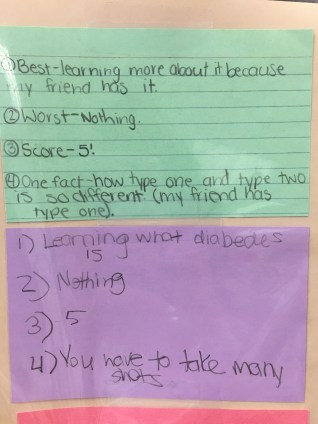
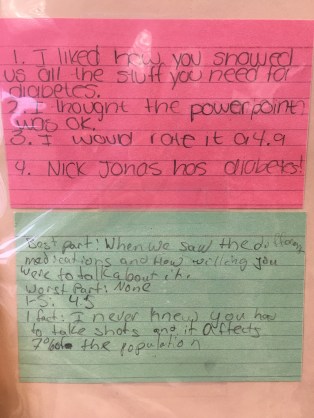
We felt like our hard work was worth it when we received completed evaluation cards from the students. We’d asked them to tell us: 1) The best part of our lesson, 2) The worst part, 3) Rate it on a scale of 1-5 (1 being worst; 5 best), and 4) Write one fact about diabetes they learned. Our average rating wound up being 4.2, which made us feel like rock stars! All these years later, I still have some of the best comment cards preserved in a binder about my project:

12

Personally, I really love how one student thought that diabetes is spelled “diabedes”. And I’m amused by how another student didn’t seem overly crazy about the PowerPoint (it must’ve been that damn Comic Sans font that ruined it).

But joking aside, this whole project still resonates with me ten years later because I think it marked the beginning of my passion for diabetes advocacy. It was one of the first times that I willingly shared my diabetes with others and let a real conversation take place about it with no holds barred.


Memory Monday: That Time I Planned a School Walk for Diabetes (Part 1)

One Monday per month, I’ll take a trip down memory lane and reflect on how much diabetes technology, education, and stigma has changed over the years. Remember when…

Okay, so I’m deviating slightly from my typical “Memory Monday” post as I take a walk down *my personal* memory lane. I’m reminiscing about that time I planned a School Walk for Diabetes at my high school as a freshman. This is going to be a two-part “Memory Monday” as next month, I’ll write about how that same year, I had to create a lesson plan and educate a whole group of middle school students about T1D, too!

But let’s focus on this part – the School Walk for Diabetes bit – first.

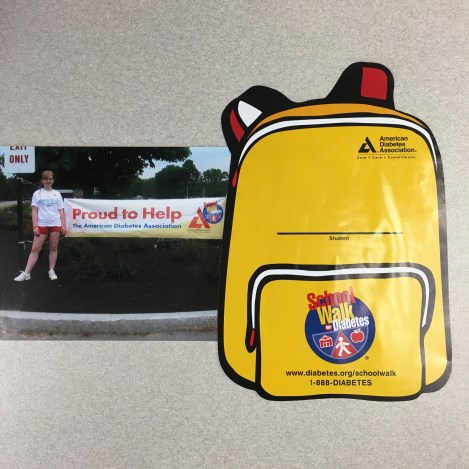
I’ll admit my memory’s a bit foggy on the matter. But fortunately, I kept the binder that documented my hard work on this project, a binder that was both hilarious and horrifying for me to look through 10 years later. I’ll also admit that it was somewhat impressive; after all, this was a massive project for a high school student to tackle. I had a project partner who contributed a great deal, though, so that absolutely helped make it a success (ahem, we got a 100% – an A+ – as our final grade, NBD).

W4D
The nerd in that picture (A.K.A. me) would end up with a 100% on this project!

As I leafed through the binder, I found a description of what it was like to organize the Walk component. We met with a couple of local teachers who were in charge of the event and told them we wanted to do anything we could to assist them as part of our project. After many email exchanges and in-person conversations, we had an action plan for how the day of the Walk would flow.

Here’s my oh-so eloquent description of the day of the walk:

May 31, 2008 – Time Spent on Project: 5 Hours

We arrived at 8:30 to help set up for the Walk. We hung a large sign in front of the school and decorated the track with balloons and motivational signs. For three hours, we stood on the track and punched holes in paper bracelets for the Walk participants as they completed a lap. A reporter was present and took our picture for the paper. The Walk was successful and we raised just under 5,000 dollars for the American Diabetes Association. We helped clean up after the Walk, which took half an hour.

Really riveting material there, huh? But truly, it’s kind of neat to see that my passion for diabetes awareness was strong even in those days. I think participating in this project marked the beginning of my comfort level with my diabetes increasing, and it’s cool to have a record of that.

I could do without the photos of me as an awkward teenager, though…

Memory Monday: 1st Generation Dexcom CGMs

One Monday per month, I’ll take a trip down memory lane and reflect on how much diabetes technology, education, and stigma has changed over the years. Remember when…

…Dexcom CGMs made their debut?

It was just over ten years ago that the Dexcom SEVEN CGM System launched. I didn’t actually know more about it, though, until a couple years after the fact. That was when my endocrinologist encouraged me to sign up for a week-long trial run with this new technology to see how I liked it.

023E152D-A6FF-4555-80F0-67764C9523BB
Then: The Dexcom SEVEN CGM System

I didn’t like it, I LOVED it. I quickly became obsessed with the ability to monitor my blood sugar levels at all times. But it’s funny to think back to how bulky and just plain different that first-generation system was compared to today’s sleek and highly functional models.

A few key differences between now and then:

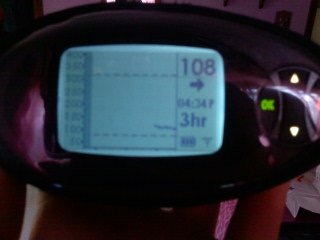
  • Size. The first CGM was large. It was roughly the size of my OmniPod PDM, which might not seem so significant, but it is when measured up against newer CGM models.
  • Display. The screen on my first CGM was very simple. No colors, no frills – just readings of my blood sugar. That was all fine, but I have to say that I’m a fan of color-coordinated blood sugar reports (red for low, yellow for high, gray for in-range numbers). In a weird way, it motivates me to keep my graph as gray as possible.
  • Distance restrictions. I hated that I had to keep my first CGM so close to me at all times, or else run the risk of losing data! It was hyper sensitive and my readings would be lost if I left the same room as the CGM for more than a couple of minutes. My CGM is now able to pick up readings from much farther away – sometimes, even when I’m downstairs and it’s upstairs.
  • Sounds. My memory is a little foggier on how the sounds compare between old and new Dexcom CGM generations, but I do recall the beeps and vibrations being far more aggressive and annoying on older models.
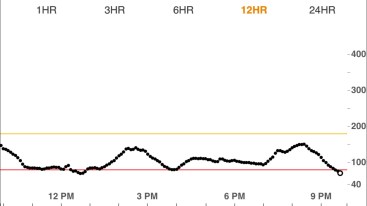
  • Smartphone access. This might be one of the biggest and best changes – the ability to download an app on your smartphone that can replace a Dexcom receiver. How awesome is that? Plus, if you choose to do so, you can invite family and friends to monitor your blood sugar along with you, which can be helpful in certain situations. Cell phones are so ingrained into society, so this move was brilliant on Dexcom’s part.
IMG_4180
Now: Dexcom data, on my iPhone!

All these improvements have made me a member of Team Dexcom for life. It’ll be neat to see what they come up with next to help make the lives of people with diabetes easier and better.

Memory Monday: BD Glucose Tablets

One Monday per month, I’ll take a trip down memory lane and reflect on how much diabetes technology, education, and stigma has changed over the years. Remember when…

…BD glucose tablets were like, the only kind of tabs available?

I remember them vividly. The tablets were came in what looked like giant packages of gum. They were orange-flavored, but colored white. And they were square, chalky, and the epitome of boring. Even so, I’m slightly embarrassed to admit that I used to sneak them from my mom’s purse when I was little. (Sorry, mom.)

I don’t really know why I did it, considering they weren’t exactly the tastiest treats. But it felt rebelliously good to take one here and there, even if I wasn’t experiencing a low blood sugar. I knew I wasn’t allowed to graze on snacks as I wanted, and I knew that it would make my blood sugar go up. I also knew that I didn’t fully understand what diabetes was and why it was so important to be careful with how many glucose tablets I ate at the tender ages of six and seven years old.

Over time, I kicked the habit. As more flavors and varieties of glucose tablets popped up in the market, I grew increasingly resentful of having to use them to treat lows in the first place. I wasn’t enticed by the tropical or berry flavor mixes; after all, they didn’t have quite the same appeal as those weird white tablets.

772D403E-BB4C-4A32-8579-3AFFE9FF404B
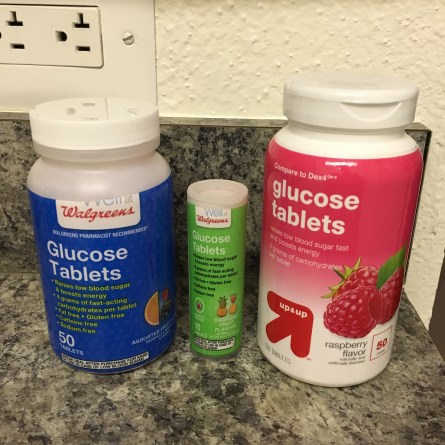
Today’s glucose tablets come in much more colorful and flavorful varieties.

Now, I’m just glad I’ve discovered ways to bring up a low quickly that don’t involve chewing chalky discs. Orange juice, mini boxes of raisins, gummies, smarties, and more all work efficiently. I still choose to carry around glucose tablets, though, because the tube they come in is discreet. Glucolift brand tablets are a personal favorite to stock the tube with, because they’re more pleasant to ingest, thanks to their quick-dissolve formula. Plus, I can’t totally hate something that’s saved my butt more times than I can count.

Memory Monday: Log Books

One Monday per month, I’ll take a trip down memory lane and reflect on how much diabetes technology, education, and stigma has changed over the years. Remember when…

…log books were a THING that PWD used to track blood sugars?

Log books were pocket-size diaries (of a sort) designed for PWD to keep track of blood sugars, insulin and carb intake, mealtimes, etc. Basically, it was the old-fashioned way of recording blood sugars so that you could bring it with you to your endo appointments so your doctor could review the book for patterns.

I remember HATING having to write down my numbers. I felt like those little log books were contraptions put in place to judge me and my numbers. Imagine an eight year old who felt judged by something like that? It’s just wrong. But I get that they had a purpose to serve, and even when I was little, I knew it was important to write everything down even if I resented doing it.

That’s why I made it more fun by drawing doodles next to certain blood sugars – a frowning face would appear when I was high, and a mini burst of fireworks would find their way next to a blood sugar of 100 (which I now refer to as a unicorn bg, along with much of the rest of the DOC). I also distinctly remember using the log book to keep track of where I was injecting my insulin: “RL” would appear on the page if I was due to give a shot into my right leg, or “LA” for my left arm. These days, I’m really good about swapping sites, mainly because it’s easy to remember, thanks to my pods. But as a kid, it was more challenging, so writing it down helped.

D07D4405-FA76-4589-BF8C-535F727B9AAD
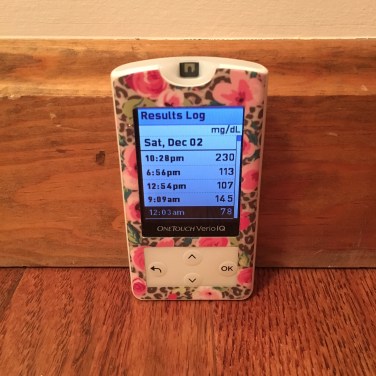
Thankful that my meter tracks my blood sugars for me now (also, that 230 mg/dL would’ve totally gotten a frown-y face back in the day).

Thank goodness for modern meters and insulin pumps that keep track of my blood sugars for me now. It’s so much easier to show up to an endo appointment and hand over my meter for the nurses to download. Plus, doing so means that my doctor and I get to review all sorts of colorful charts showing my blood sugars over a certain period of time, which is more telling and helpful than a doctor thumbing through my log book and murmuring, “I see,” every few moments.

Log books are such an archaic artifact of my diabetes history that I don’t even own any nowadays. I trashed them all, years ago, when I realized that my blood sugars from 2001 were sort of irrelevant to now. Do you still have any of your log books lying around?

Memory Monday: 60-Second Meters

One Monday per month, I’ll take a trip down memory lane and reflect on how much diabetes technology, education, and stigma has changed over the years. Remember when…

…it took blood glucose meters a full 60 seconds to generate a reading?!

A full minute to get a blood glucose reading. That just seems crazy now, considering most meters can deliver a number in a mere 5 seconds. But growing up, it was all that I had to use. I remember being sent down to the school nurse every day in elementary school to test my blood sugar before lunch. I would pace around the nurse’s office as I waited to see my number, making a game out of it. Those 60 seconds felt agonizingly long as they cut into the amount of time I had to eat my lunch. It wasn’t fun.

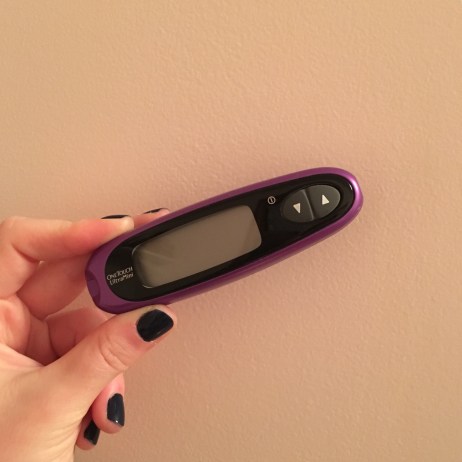
By the time I reached middle school, I obtained a OneTouch Ultra Mini blood sugar meter, which I coveted. It took only 15 seconds to check my blood sugar, and it came in a rainbow of colors! Over the years, I collected different versions of the mini in pink, blue, and purple. And as time went on, the countdown went from 15 to 5 seconds – so checking blood sugar was quicker and easier than ever before!

A8CE576A-36C9-4C8A-AB0C-35B14E48B46B
I kept one of the UltraMini meters – just in case.

These days, OneTouch meters are still my product of choice. I use the Verio IQ meter and I love how it lights up, allows data input, and tracks patterns. It serves as a reminder of the progress that’s been made in meter technology alone in the last 20 years!

What’s your blood glucose meter of choice? Why?


Memory Monday: It’s Time to Learn About Diabetes!

One Monday per month, I’ll take a trip down memory lane and reflect on how much diabetes technology, education, and stigma has changed over the years. Remember when…

…”It’s Time to Learn About Diabetes” came out on VHS, with a workbook to accompany it?

Oh, the ’90s. What a time to be alive. Nickelodeon was in its prime, boy bands and Britney Spears were all the rage, and VHS tapes preceded DVDs and Blu-Rays as the way to watch movies. In 1995, one particular VHS tape conveniently debuted one year after my diagnosis that quickly became one of my most-watched tapes of that decade:

“It’s Time to Learn About Diabetes” told the tale of two fellow ’90s kids, Cindy and Mike. This 20 minute video walked viewers through diabetes basics and it couldn’t be more supremely cheesy. I’m certain that if I were to unearth the tape today (and a VCR to play it, to boot), I would cringe for the duration of it.

It’s been about 20 years (!!!) since I last watched the tape, but here’s what I remember about it: 1) mentions of NPH and regular; 2) the kids playing on a playground when one of them experiences a low blood sugar; 3) tacky illustrations of beta cells (I think that’s what they were, anyways); 4) 60-second meter countdowns; 5) zero inclusion of insulin pumps or CGMs, because they weren’t invented yet; 6) no explanation of the difference between T1D and T2D (for that matter, I don’t think T2 was mentioned at all); and 7) really bad you’re-about-to-learn-yay-for-education-in-the-’90s introductory music.

I’m really selling this tape here, huh? In all honesty, it wasn’t a bad way for me to really understand my diabetes at a young age. After all, how many other small children do you know that can tell you what the purpose of a pancreas is? It was a different way to present vital information I needed to know and clearly, it stuck with me pretty well.

I guess it just resonates more strongly than ever with me today because it’s a reminder of how much technology and the way information is presented has changed since my diagnosis. The Internet was still pretty new when I was diagnosed, and smartphones didn’t even exist yet. Just as phones and computers were bulky and slow in those days, so was the DTech at my disposal. 20 years later, though, information is readily available at our fingertips. It’s incredibly fast and detailed, and as technology evolves, it continues to become even more streamlined. In this way, I’m glad to have been exposed to the technology, both medical and otherwise, of the ’90s: because it makes me grateful for the incredible improvements we’ve experienced since then.