A Tough Topic: Diabetes Complications

I’m broaching a subject I’ve never openly discussed in an online forum in today’s blog post…and that is diabetes complications.

The reason why I’ve never talked about complications is straightforward: They absolutely terrify me.

It’s a topic that’s so foreign and frightening to me that I don’t even know the full extent of diabetes complications. You can Google them, for sure, and discover a long list of scary conditions involving the heart, eyes, extremities, and other internal organs. But I’d rather not do that to myself, let alone the audience of this blog.

I don’t want you to think that I’m naive, though…I know that not talking about something doesn’t mean that it’ll just go away or never happen.

Recently, I became glaringly aware of this fact through the form of (what I presume to be) my own diabetes complication: tendonitis in my left hand.

In the last year or two, I’ve felt sporadic sensitivity in my left hand when I fully extend my wrist, bear any weight on it, or even when I do simple wrist rotations. I never really knew when to expect the pain, but it happened every few months and lasted about a week each time. So when I felt it again around the time I was due for my annual physical with my PCP, I decided to ask him about it.

He explained to me that, based on the type of pain and its duration, it wasn’t carpal tunnel (numbness and tingling are symptoms of that, not pain) like I thought it might be. It also wasn’t arthritis (I didn’t have swelling or reduced range of motion) or neuropathy (I wasn’t experiencing pins and needles), but he did say that those aren’t uncommon in people with diabetes. That’s when he located the exact inflamed tendon – the thick, fibrous cord that attaches muscle to bone – in my left hand/wrist that was giving me trouble.

A Tough Topic_ Diabetes Complications
Me with my new (but occasional) accessory.

Just like all the aforementioned conditions, my tendonitis is probably due to my diabetes. Although my PCP didn’t explicitly state that I definitely have it because I’ve had diabetes for 22 years, he did identify a cause-and-effect relationship between the two. But, fortunately, he also reassured me that my occasional flares of tendonitis are nothing to worry about. As long as I continue to do what I’m doing (which is supporting my hand and wrist with a brace when I experience bouts of pain, as well as rest the area as much as possible during those times), then I’ll be totally fine.

While I’m not exactly thrilled to have to deal with tendonitis, I am very relieved that I know there’s an explanation to help make sense of it all, and that I’ve been doing the right things to handle it. So even though I won’t be going out of my way to research any other diabetes complications any time soon (why on earth would I want to stress myself out unnecessarily), I have come to terms with my tendonitis as a possible complication for me. And rather than seeing it as a completely negative thing, I’ve decided to just keep doing what I’m doing, and continue to take the best possible care I can of myself and my diabetes.

They say prevention is the best medicine for a reason, right?


One Night with Diabetes

You settle into bed, ready to fall asleep after another long day.

But first, you check your blood sugar, just like you do multiple times every day.

Your glucometer reads 201.

Suddenly,  you’re a little nervous to drift off to dreamland, because you just changed your insulin pod an hour earlier and you’re not quite sure if it’s the reason behind the high blood sugar.

You wonder: Could my blood sugar be high due to a miscalculation with insulin or carbs at dinner? Is it because of my stress levels? Is it because I’m dehydrated, or because I’m starting to get sick, or because my new pod’s site is on scar tissue, or because…?

Before long, you feel incredibly exhausted because you’re cycling through what seems like an endless list of reasons why you might have an elevated blood sugar and it has zapped you mentally.

You feel your eyelids grow heavy, and just before you go to sleep, you give yourself an insulin dose that should bring your blood sugar back down before long.

You experience a broken night of sleep.

One Night with Diabetes
When you read this, put yourself in the shoes of a person with diabetes…and this is just one night with the damn thing.

Since your Dexcom app is programmed to alert you when you’re over your high threshold for an extended period of time, it goes off, practically every hour, from 10 P.M. to 1 A.M.

Every time it happens, you wake up to the sound of your Dexcom alarm blaring in your ear.

You worry about waking up others in the household before you even begin to worry about your blood sugar.

You’re pretty sure it’s not a pod problem, since your blood sugar would probably be higher if that were the culprit, but you’re too damn tired to care about the cause at this time of night.

You bolus, go back to sleep, hear a high alarm, wake up, and repeat until finally your sleep stops getting interrupted by your Dexcom.

You get a few hours of broken rest.

You wake up at 6 A.M. and realize that, after all that, your blood sugar levels are still slightly elevated.

You’re pissed that your Dexcom was off by 40+ points, as confirmed by a fingerstick check.

You take more insulin, and force yourself to get up and out of bed because it’s time to start the day: Your diabetes is waiting for nothing, least of all you.

Just another night of not enough sleep and too much worry, thanks to diabetes.

A Distant Memory: T1D Through the Teen Years

High school is a time in most people’s lives that is not fondly remembered.

I am not most people.

Generally speaking, I really liked high school. Sure, I overloaded my schedule with too many A.P. classes and extracurriculars, but I was a young overachiever in those days (now I’m just a slightly older overachiever).

Academics-wise, I enjoyed taking a variety of classes, from A.P. Psychology and Statistics to Anatomy/Physiology and Cold War Era Film (we got to watch a bunch of awesome movies in that class, everything from Them! to Dr. Strangelove). And I was lucky enough to have teachers over the years that I got along with well – I even keep in touch with some of them to this day.

I had a blast playing field hockey from 8th grade through senior year. I had very minor roles that I nevertheless fully embraced in a handful of plays. And though it was a headache at times, I was happy to be an editor of my senior yearbook.

And it might or might not be surprising to you to discover that I was one of those nerds who actually liked staying after school. My two best friends and I spent many extra hours staying in school later to better prepare ourselves for our upcoming exams, and we had an absolute ball snacking on Sociables crackers and gossiping with a select few of our teachers.

I wasn’t a total angel, though – a Friday habit that my best friend and I developed on senior year was to leave our allotted 30-minute lunch break 10 minutes early so we could sneak out down the street to buy large iced coffees to get us through the final class of the day. I know what you’re thinking: SUCH REBELS!!!

A Distant Memory_ T1D Through the Teen Years (1)
I played field hockey, attended prom, and graduated high school – all while dealing with diabetes. If I can do it, anyone can.

So it goes without saying at this point that I have lovely memories from the high school days. But you know what sticks out to me more than anything about those times?

I can’t remember a single instance in high school where my diabetes got in the way.

Diabetes didn’t, and couldn’t, stop me from doing anything in high school. I just…handled it. I participated in sports teams, clubs, and classes without it ever truly interfering in a way that sticks with me to this day.

Sure, I went everywhere with all of my supplies at all times. And yes, I injected my lunchtime insulin right in the middle of the cafeteria (and I was so damn discreet about it, AND my diabetes was common knowledge, that not one student ever commented on it…at least, not to my face). Diabetes was just a part of me, but it didn’t define me. Honestly, it was often easier to balance my blood sugars and boluses than it was to handle my heavy homework load!

I wonder whether my experience would have been different had I decided to go on a Dexcom and a pump in high school, rather than wait until early adulthood. Would the devices have made it easier to balance homework with extracurricular activities, hangouts with friends, and my weekend shifts at the movie theater? Maybe, but I don’t see the point in speculating on it now. All I know is that I did things the way that worked for me back then, and I was more than fine as a result. In fact, it’s one of the few times in my life that diabetes feels like a distant memory – it didn’t occupy as much of my brain space as it does now; rather, it was just something that was always in the background, not quite my first priority because I was too busy living the life of a normal American teenager.


The Surprise A1c

I started out 2020 with an A1c that surprised me. It was a good surprise: Anything under 7 is a win in my book.

I won’t specifically say what the number was, because I don’t really believe in doing that and I fear that it will invite unwelcome judgment and/or comparisons. But I will celebrate that achieving this A1c was far from easy. It’s required a lot of work from me in the last few months, which have generally been a very turbulent period of time for me.

It seemed like the “diabetes gods” were really testing me in the latter half of 2019. From a month of unexplained highs to random incidents of technology failing me, I felt like I was being put through the wringer. I felt like a failure on just about all diabetes fronts, and it seemed like my efforts to maintain my desired blood sugar levels were fruitless.

Hey, Handsome
More than one surprise came with an unexpected A1c result.

So that’s why I could hardly believe my current A1c reading. Maybe it seems even more impossible to me because I didn’t even get to discuss it with an endocrinologist. In fact, I never got to talk to my new endo (the one I may or may not continue to see) about any of my A1c goals. Doesn’t that seem kind of effed up? Shouldn’t my doctor want to know what I hope to accomplish, in terms of my diabetes, in the next 3-6 months?

In that regard, this A1c has surprised me in more than one way…it’s not just that I’ve managed to get here (really, I’ve managed to stay here, my A1c in the last 2-3 years has been right around this number), it’s also about how it’s more than just a measurement of my average blood sugars in a 90-day period…it’s a marker of how I feel, emotions-wise, about my diabetes. I never thought about it much before, but as I’ve grown older, it’s really become a sign for me as to whether or not I have my shit together with my diabetes. It can signify how I’ve felt about my diabetes in a given period of time, from the lowest of the low burnouts to the highest of the high determined and motivated.

Kind of crazy and yes, surprising, how a single reading can mean this much.

Just Breathe

Just breathe…a mantra easier said than done when each breath flows in and out smoothly, instead of in ragged, wheezing gasps.

I’m no stranger to asthma. I dealt with it throughout most of my childhood. The details are blurry on when I experienced my first asthma attack, but all I know is that it left me rasping and feeling (on top of sounding) like the cute little penguin from the Toy Story series, Wheezy.

The only thing that would keep my asthma symptoms at bay was nebulizer treatments. The nebulizer is one of those loud machines that generates vapors – albuterol medicine – that must be breathed in through a mouthpiece. I hated these treatments because they left me feeling shaky for a long time afterward and often caused high blood sugar, but it was much easier and more comfortable to breathe after them…so they were worth it.

Throughout my teenage and most of my young adult years, though, asthma slowly became a distant memory. I experienced it less frequently until it stopped altogether, and suddenly diabetes was the only thing I had to worry about. And I was glad for it.

But then…let’s fast-forward to the week leading up to Christmas. I was busy. I mean, wicked busy. I was running all over the place, jetting from one party to another, interacting with all sorts of people who were bringing germs from all over to each of these merry gatherings. I was getting run down and sleeping less due to the holiday celebrations, so really, it shouldn’t have surprised me when I felt the first tinge of a sort throat in church on Christmas Eve. But when that sore throat was soon followed by a tight chest and a whistling sound whenever I exhaled, I was taken aback – not to mention straight-up annoyed.

IMG_5471
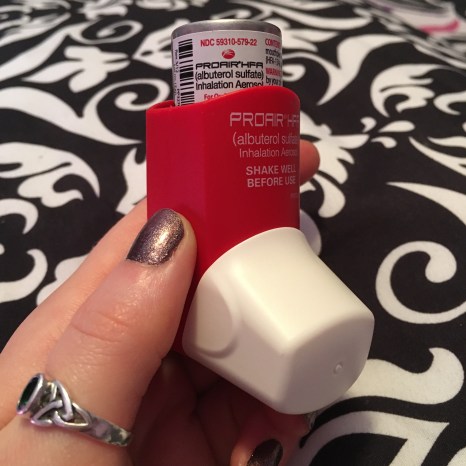
The rescue inhaler that’s been my best buddy the last couple of weeks.

I treated the initial waves of wheeziness with my rescue inhaler. But when that started to be less effective over shorter and shorter lengths of time, I knew I needed to get in touch with my primary care doctor. So I did, and I met with a nurse practitioner who diagnosed me with something new: reactive airway disease. I left the office feeling shell-shocked over a new diagnosis that would mean that I would have to use a different kind of inhaler twice daily for the next two weeks.

I was afraid to start it for many reasons, but the two biggest ones were 1) I was nervous it would make my blood sugar go up and 2) it can cause thrush (also known as an oral yeast infection, which sounds positively nightmarish) if I forget to rinse my mouth out with water after each dose.

Overall, though, it doesn’t sound like too big of a deal, right? If it helps my breathing, it shouldn’t be an issue to add this inhaler into my morning and evening routines.

Silly old me, however, did turn this into a big deal. I wasted far too much time fretting over this inhaler and saying “woe is me” for having to deal with yet another medication that was extremely expensive (I paid $56.83 for the darn thing…I have no idea what the total would have been if I was uninsured).

My logical self knows that this won’t do any good. So now, I’m getting my act together and just rolling with the punches.

I’m trying to gently remind myself…just breathe.


My 22nd Diaversary

Tomorrow is Christmas Eve (already) and it just so happens that it’s also my diabetes diagnosis anniversary…or “diaversary,” as it’s colloquially known.

This means that tomorrow marks 22 years of living with diabetes.

For some, that might mean I should celebrate with a cupcake or another special, carb-y treat. And I probably will, because it’s Christmas Eve and sweets are sure to be bountiful at any gatherings I attend tomorrow. But I don’t really plan to do so with my diaversary in mind; for me, it’s the holiday that’s got me in a more festive mood than the fact that my diabetes is 22.

I don’t really know how to feel about this diaversary. My feelings last year about my 21st were very clear: I was down in the dumps about it. I was desperate for a break. And I really didn’t say much more beyond that.

Hey Christina,.png
If you were me, would you do anything special to celebrate 22 years of diabetes?

This year is a little different. I feel the same as last year in that I would do anything for just a single day off from diabetes, but also…I guess I’ve just learned to embrace the routine of it?

I dunno. My relationship with diabetes is always going to be a bit of a roller coaster, just as my blood sugar can sometimes be. I’ll have my highs and my lows, and in between all that…is how I feel now. It exists. It’s just…there. It’s been part of me for 22 years and it will continue to be a part of me as we head into this next decade. (Where’s that cure they’ve been promising us…oh, it’s another 5 years from now, right?)

So my diabetes is 22 and I’m feeling “meh” about it. And that’s perfectly okay. I won’t deny my feelings (or lack thereof). I’ll simply just continue to live my life with diabetes, learning from both the literal and figurative highs and lows as I go along.

Merry Christmas and happy holidays, dear readers. Be well, hug your loved ones, and enjoy the spirit of the season.

Metformin Update #5: Calling it Quits

Well, well, well…looks like I’ve got another Metformin update for you all.

You’ve probably lost track of where I am in this long, twisting journey with the pill. (If you need a refresher, all you need to do is click here, here, here, here, and here.)

All caught up? Great. Now you really understand how complex my relationship with Metformin is.

There were times that I loved it. There were times that I hated it. And there were times when I simply couldn’t be sure if it was working for me the way that I’d hoped and needed it to.

METFORMIN UPDATE #2.png
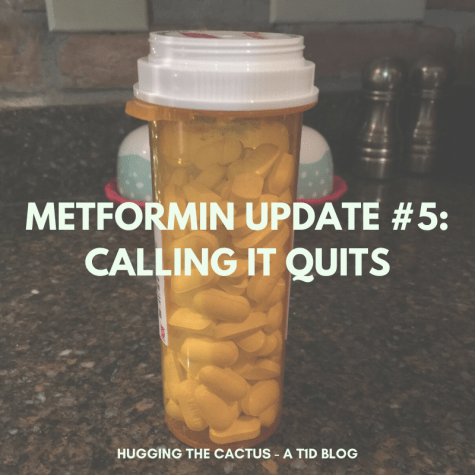
I thought Metformin was right for me, but it turns out it definitely is not.

This last go-round represented the latter thought: Metformin simply wasn’t cutting it for me.

I’d been taking one pill daily for about a month when I decided to quit. The reason why I stopped taking it is simple: I wasn’t noticing a dramatic reduction in how much insulin I take each day. It was maybe a one or two unit drop, and that just doesn’t justify me taking a pill like this on a daily basis.

Now, you might be wondering why I didn’t amp up my dose. After all, it says right on the bottle that I can take up to four pills daily. Well, I chose not to take more for a few reasons: 1) I’m in between endocrinologists right now, and don’t really have anyone to consult regarding dosage, 2) At one point in time, I thought I noticed side effects of taking Metformin, and I’ve convinced myself that any possible side effects would intensify with a higher dose, 3) I wasn’t sure whether the higher blood sugars I was dealing with in the fall were due to stress or permanent changes that my body was experiencing.

So yeah, as you can see, it’s not a cut-and-dry answer when it comes to me increasing my Metformin dose.

I feel like I’m in a better place now with my blood sugars and daily insulin intake. Certainly, things have improved compared to how they were in September and much of October. Rather than fret over taking “too much” insulin every day, I’m going to focus on things that I have greater ability to control, such as the foods I choose to eat (that may or may not impact how much insulin I need) and the levels of exercise I get each week. I feel like that’s a healthier, better way to take care of myself.

So…farewell, Metformin. I won’t miss you. I know you do great things for other people with diabetes, but I’m not sure that you and I are a good match.


Where I’m From and What my Diabetes Community is Like There

It’s November 18th which means that it’s Day 18 of the Happy Diabetic Challenge! The prompt for today was fairly simple – state where you’re from – so I decided to delve a little deeper and explain what my diabetes community is like at home…

Home is where the heart is, and it just so happens that I’ve got quite a diabetes community there, too.

I spend most of my time in Virginia these days, but I’m originally from Massachusetts. Growing up in that state shaped me as the human being that I am today, and it’s also where I had a total change in perspective when it comes to diabetes, community, and support.

4C1E580E-BF0F-4FC8-903B-BEBD322F60B9
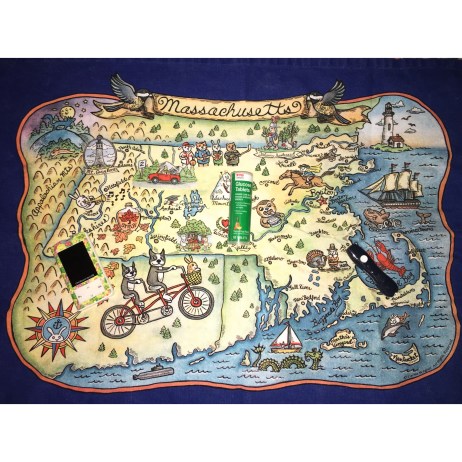
A map of Massachusetts, with a few diabetes accessories sprinkled in there.

I’ve said it many times here, but throughout my youth, I had my mom and my aunt as my type 1 influences in my life – that was it, and that was all that I needed and wanted.

Or so I thought.

When my feelings on diabetes support changed in college, I quickly discovered the value in fostering a sense of community wherever I go. So I made it a mission upon graduating to make sure that I maintained diabetes connections at home. It felt especially important as I was about to undergo another major life transition: joining the workforce full-time.

And I’m glad I fulfilled that goal. Through the power of social media, I attended a handful of diabetes meetups in the last few years that provided that sense of belonging that I yearned for and introduced me to many local T1Ds.

So as you may be able to imagine, it’s been tough for me to still receive invites to events and gatherings that I can no longer readily attend since I’m in a different state most of the time.

This is why I finally decided to do something about it. Feeling inspired by the spirit of National Diabetes Awareness Month, I found a group that meets up semi-regularly in my new location. I was nervous about it, but I made an introductory post on their page. I explained that I work from home; as such, it’s hard meet new people. And not only would I like to connect with other T1Ds, but I’m also interested in volunteering in the area.

My “bold” move paid off. Within hours, several people had commented on my post and made it known that I could reach out to them whenever to arrange a lunch or explore the city. I haven’t taken anyone up on it yet (with the Thanksgiving holiday being so close and all), but it’s really nice to know that the offers are there when I’m ready to take them up on it.

Even though the concept of “home” has been a little shaky in the last year, I know this much: Wherever I wind up, I’ll find and nurture a diabetes community there because people who just get it make even the strangest of places feel a whole lot more welcoming…and like home.

My Diabetes Hero

It’s November 6th which means that it’s Day 6 of the Happy Diabetic Challenge! Today’s prompt asks us to name our diabetes hero/heroine. Well, I have more than one…

My diabetes hero is not just one person. It’s a small group of people that I call my family. (Awwwww, how sweet.)

F428B899-72D9-4EBD-95A6-9AF8EB03C464
Me with my heroic diabetes family.

My mom, dad, and brother are all-too familiar with diabetes. My mom is T1D, like me, and my dad and my brother were the lucky ducks who got to live under the same roof as us for many years. All three of them are diabetes heroes to me, but in some very different ways.

Let’s start with my brother. He is three years older than me and I’d say we were fairly close to one another in our shared childhood. Though he doesn’t share a diabetes diagnosis with me, he grew up with diabetes just as much as I did. And do you know what’s amazing about that? I’ve never once heard him complain about it. If he has ever felt any fear or worry for my mom and I, he definitely has done a good job of internalizing it. He treats us like we have normal, functioning pancreases, and I think the reason for that is he knows that we are more than capable of taking care of our diabetes ourselves. Although his thoughts and feelings about our diabetes have yet to be verbalized, I appreciate his unique brand of support for us and I continue to be wowed that he never seemed to be bothered by the extra attention I got as a child due to my diabetes. No unhealthy sibling rivalry there!

Next up is the other Type None in our family: my dad. I’ve written about my dad in a couple of previous blog posts. He is truly the Mr. Fix It in our family. If there is a problem, he wants to solve it – especially if it is something that is causing his loved ones emotional distress. He has had more than his fair share of situations in which my mom or I were seriously struggling with our diabetes. I can only imagine how he feels when all he can do is just stand by and let us work through our issues: It’s probably a combination of helpless, angry, and worried. He’s said numerous times over the years that he’d give my mom and I his healthy pancreas if he could, and I’ve never questioned the sincerity behind that sentiment. I know he means it, and to me, that’s the kind of heroism that nobody else in my life can even begin to compete with.

And then we’ve got my diabetes partner-in-crime, my mom. How on earth she managed to deal with her OWN diabetes, in addition to mine, all throughout my childhood is completely beyond me. Besides being there for me as a source of unwavering emotional support as someone who really “gets it”, my mom’s attended practically every single endocrinology appointment with me, encouraged me to start using an insulin pump, ordered alllllll of my supplies for many years (and kept track of the stacks of associated paperwork), and helped keep me as calm as humanly possible throughout my terrifying insurance transition that took place late this past spring. Let me just restate that she did all of this and still does all of this while still dealing with her own diabetes!!!!! It’s sort of mind-blowing to me that she can stay so much calmer about her diabetes than I ever could when it comes to either of ours, but she does it, and that makes her a heck of a diabetes hero to me.

What’s really neat about my diabetes heroes, as a collective unit, is that diabetes has never and will never define our family. It’s something that lingers there in the background, for sure, but it almost never steals our attention away from our time spent together. I can’t recall a single instance in the last 22 years that diabetes really, truly disrupted our family rhythm (maybe my parents would disagree with that and count in my diabetes diagnosis, but I barely remember that).

It just goes to show that even as something as life-altering and disruptive as diabetes only made my family stronger when it hit us with a double dose.

Favorite Things Friday: “The World’s Worst Diabetes Mom” by Stacey Simms

In this edition of Favorite Things Friday, I share a great new book that I just read: The World’s Worst Diabetes Mom by Stacey Simms!

Disclosure: I bought this book on my own and this review is unpaid. I am writing this to share an excellent book that was written by someone I consider a personal friend and wonderful diabetes advocate. This is my honest review of the book.

Hey, Cactus friends! Welcome to another Favorite Things Friday post. I’m really happy to write this one up, for a few reasons: 1) Stacey Simms is a terrific human being and I’m glad we met IRL for the first time a few years ago, 2) I enjoyed reading her personal experience with diabetes, and 3) I think this book is pretty important and I’d like to share the reasons why with you all.

Oh, and it’s also got an awesomely intriguing title that will definitely make you want to know why Stacey is publicly declaring that she’s the world’s worst diabetes mom…a bold statement, indeed!

F125A585-5942-4166-AE87-36F9C0EA457B
Me and my new book!

So I don’t know about you, but I had no idea until a few years ago that there are actually a LOT of diabetes books out there. Some are memoirs, others are guides. And there’s even some that address specialty subjects, like pregnancy and diabetes.

Stacey’s book is a fusion of a memoir and a guide. It’s all about her son Benny’s diabetes diagnosis and the lessons that she and her family have learned over the years. Each chapter focuses on a different topic – examples include going to diabetes camp, playing sports with diabetes, and vacationing with diabetes – and ends with a list of questions that readers can ask themselves to help them navigate these specific scenarios.

What I liked so much about this book is that I learned a lot from it: It’s not just for those who are new to diabetes. (I’ve had diabetes for more than 20 years and I am constantly learning new things!) My eyes were really opened to the perspective of a parent whose child was just diagnosed with diabetes. Not only did it help me understand the emotions my parents were probably experiencing throughout my childhood, but it also proved to me that loved ones who don’t even have diabetes go through a lot, too. They might not have to physically endure the pokes and prods or deal with the exact same feelings that those of us with T1D do, but that doesn’t mean that they don’t feel immense guilt or worry for us because they just want to do everything in their power to help ensure that we live normal, fulfilled lives. That’s an awful lot of pressure to put on oneself.

Stacey’s honesty and transparency with her family’s diabetes experience gave the book a powerful emotional punch. She owns up to all the times that diabetes has made her cry tears of sadness or yell from frustration. And refreshingly, she doesn’t shy away from sharing the past mistakes and less-than-ideal scenarios that her, Benny, and her family had to work through. I was appreciative of that because, like Stacey, I feel that there is too much of a focus on “perfectionism” when it comes to diabetes, especially these days. It’s an impossible standard that many of us set for ourselves when we should put more attention on the little victories we achieve along the way on our individual diabetes journeys.

In the final chapter of the book, Stacey shares more of her thoughts on the pressure to be perfect. The following is my favorite passage from the book:

After reading this book, you know I don’t believe in the pursuit of diabetes perfection. Even so, I’m still surprised at how many people expect it, who strive for it and feel guilt or shame because they feel they don’t measure up. We were lucky our endo told us right away that T1D management is just as much art as science. Over the years, I’ve come up with my own philosophy about Benny’s diabetes care: Don’t worry about perfect; go for safe and happy. Do I love my child? Am I doing my best? Is he happy? Is our endo happy? Yes. Then let’s keep working in that right direction.

I’ve shared that thought with parents who’ve then burst into tears. That’s not a joke. The realization that a happy, healthy child is enough can be a revelation.

By now, I’m sure you’re ready to pick up a copy of the book and find out from Stacey herself why she gave herself the “worst diabetes mom” moniker (because yes, I deliberately did NOT explain it in this post because I think it’s best explained by the author). You can pre-order a copy of the book here, and to hear more from Stacey, be sure to check out and subscribe to her podcast “Diabetes Connections”, available on the Apple podcast app, Android, and any other podcast app of your choice.