I’m not kidding when I say I think I’ve definitively identified the worst possible time to change a CGM sensor or pod – of course, I can only speak to a Dexcom CGM sensor and an Omnipod, so it’s probable that the worst time to do a site change may vary depending on the specific piece of equipment being used.
But I’ve learned from my own experiences that the worst time to do a site change is within a one-hour window of taking a shower.
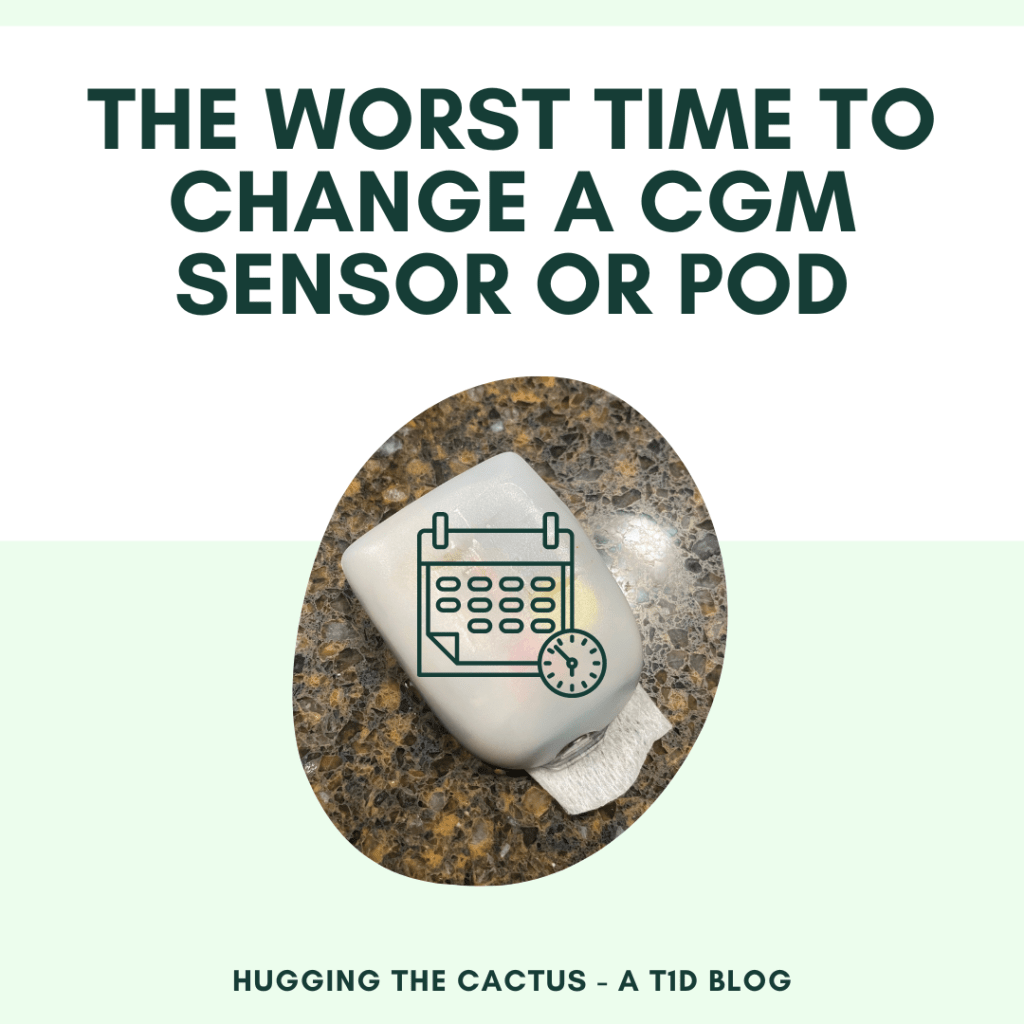
Unless you want your pod to fall off and look sad like this one, maybe avoid changing it before taking a shower.
This is because I’ve found that the sensor or pod adhesive needs a solid block of time to firmly adhere to my skin. If I shower soon after completing a site change, I can almost guarantee that the heat and steam from the shower will be enough to dissolve the adhesive and cause the sensor or pod to fall off.
I’ve played around with the timing, too, and I’ve discovered that the more time I put in between a site change and shower, the better – an hour seems to be the absolute minimum. It can be a little inconvenient in the times that I have to forgo my CGM data for a longer period than I’d like, but my goodness, is it wonderful when the stars align and I can take a completely device-free shower. This doesn’t happen often as my sensor and pod change days don’t usually happen on the same day, but it’s undeniably a nice break when it does.
So, there you have it – a word of caution from me, a semi-pro CGM and pod wearer with about a decade’s worth of experience wearing both devices – the worst time to undergo a site change. A pod or CGM failure almost always can’t be helped, but I think it’s worth knowing how to prevent the likelihood of one or both of them needing to be replaced sooner than expected.
This was originally published on Hugging the Cactus on May 7, 2018. I’m sharing it again today because for as long as I continue to wear an insulin pump and CGM, I know that this is a question that I’ll be asked. Wearing these pieces of medical technology almost all the time has certainly changed how I feel about my body and my body image, and I elaborate on that below…
A question I’m often asked is: “Can you feel your CGM or insulin pump on your body?”
The simple answer to that is: usually, no. It’s something that you just get used to. You grow accustomed to seeing a lump underneath your clothing. You adjust to putting clothes on (and taking them off) carefully to avoid accidentally ripping a site out. You acclimate to showering without being completely naked.
And, of course, you get used to the questions from strangers asking about that device stuck to you.
But the more honest answer to that question would be that there are times that I feel it more than others. For example, sometimes I forget where I’m wearing my pump until I hit it against something (I’m a major klutz who constantly runs into doorways and trip over things, almost always managing to catch my pod on whatever it is), resulting in pain at the site and a curse word or two to fly out of my mouth.
I feel it the most, though, when people stare. Whether unconsciously or purposely, people do ogle at it in very not subtle manners. Which makes me feel extremely uncomfortable. It’s worse when they don’t even ask me what it is – I’d rather have a chance to use it as a teaching moment than to have someone walk away not knowing what the device does. This tends to make swimsuit season a little less welcome for me. Nothing will stop me from donning a bathing suit at the beach or by the pool, and I do so as much as possible in the summertime. But it’s just not as fun when I’ve got to cope with lingering looks, especially when I’m an admittedly insecure person in the first place.
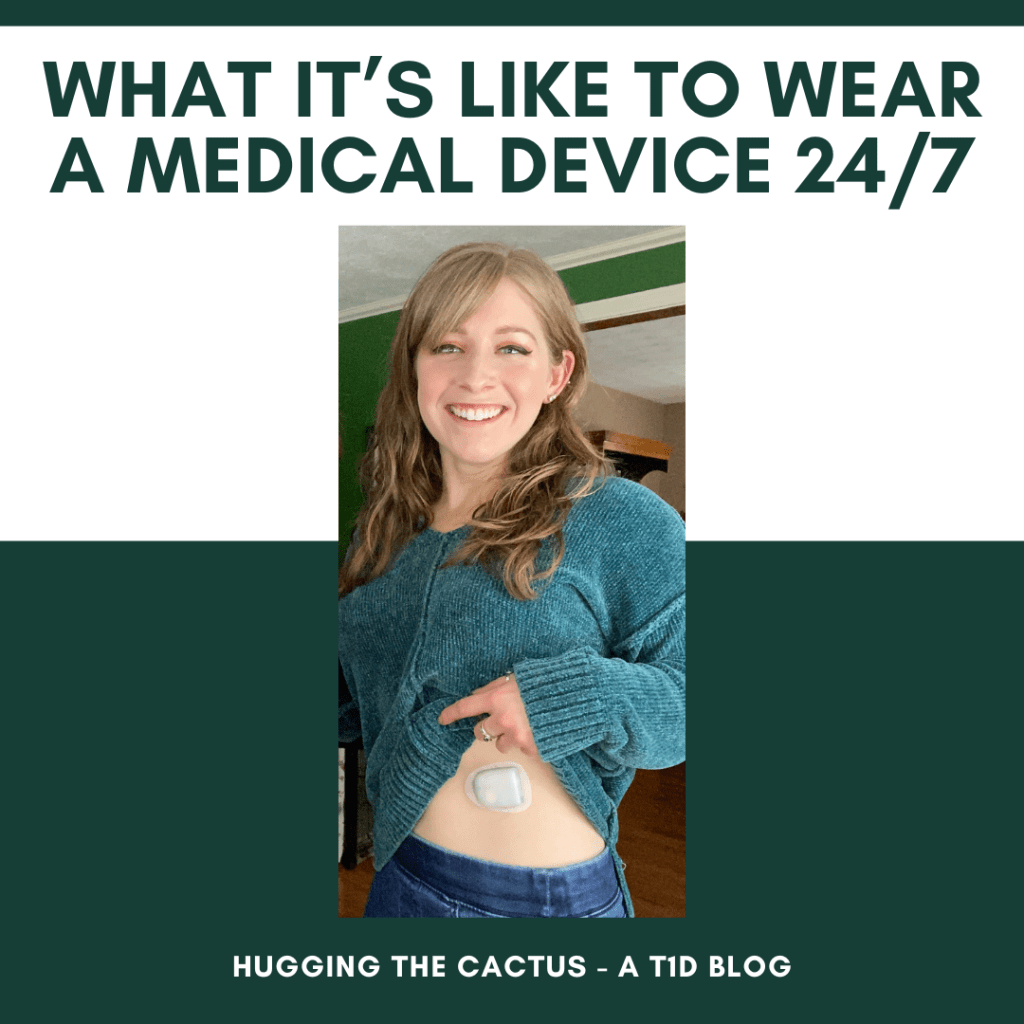
So it’s a more complex question to answer than you might realize. Wearing a medical device 24/7 is humbling. It keeps me alive. I’m privileged to have access to it. I’m grateful for the ways it’s improved my life. I’m always wearing it, but it’s not at the forefront of my mind – unless it chooses to make its presence known by alarming, or I’ve got people blatantly checking it out. It’s kind of like diabetes itself. It can make you feel a gamut of emotions, but no matter what, it’s always there. It’s just a part of me, and I can deal with that.
As someone who was so stubbornly resistant to the idea of switching from multiple daily injections (MDIs) to insulin pump for my entire childhood with T1D, I surprised myself quite a bit when I finally decided, around age 21, that I was ready to start using a pump.
And I haven’t looked back since I made that choice – that’s how much of a difference it made for me.
In my almost 10 years of pumping, I’ve realized that there is one, major piece of advice that I’d share with anyone who is looking to make a similar switch, or even go from one pump to another. It doesn’t matter if that person is newly diagnosed, a diabetes veteran, or somewhere in between. Or if a person is a pro at adapting to new technology, or wary of any kind of electronic device… because in my humble opinion, this advice applies to all. So what is it?
Don’t do it alone.
When I started using an Omnipod back in 2015, it was with the help from a team that included my endocrinologist, a diabetes care and education specialist, and a more experienced Omnipod user who I actually lived with – my mother. It was the guidance that all three of these people gave me that ensured a fairly easy transition to pump therapy.
My experience was starkly different when I went on the Omnipod 5 late this past summer. In a word, I was too cocky about it. I thought I knew enough from my prior pod experience, and had enough exposure to all the literature that had come out about the Omnipod 5, that I could make this upgrade just as seamless as it was to start up pump therapy in general. And that was most definitely not the case. I struggled for the first 8-10 weeks of life with the Omnipod 5, and it was such a rollercoaster that I seriously questioned whether or not I’d made the right decision to try out a more advanced pump.
Of course, I don’t regret switching to the 5 – not at all – now. That’s because I did finally get help, first from the nurse practitioner at my endocrinology office, and then from an educator at Omnipod who was really able to explain the 5’s algorithm to me and suggest changes that ended up working wonderfully for me within days of our conversation. It just goes to show that it’s okay to reach out for help when I’m feeling stuck with my diabetes (or when I need it in any other facet of my life, to boot), and I’m here to remind you of that, as well. Don’t do it alone. Lean on your community. Get support from healthcare professionals. And you’ll be amazed by the outcome.
I don’t often perform pod changes in public. This is mainly due to the fact that I’m most comfortable changing my pod in my own home, where I have all my supplies readily available…and more importantly, it’s where I feel safe taking off a pod from an old site and putting a fresh one onto a new location.
So you can imagine the level of unease I felt when I had no choice but to change my pod at my office for the first time since starting my new job.
I did this plenty of times at my last office job, but that was always behind the privacy of a closed conference room door that I could lock and that nobody could see into. This level of discretion meant that I could take my time with my pod changes without worrying about someone seeing me and getting the wrong idea about what I was doing (even I can admit that it looks a bit suspicious to see someone in a non-hospital setting drawing an unidentified liquid out of a vial with a syringe).
Both fortunately and unfortunately for me, my new office space is so modern in its design that every single conference room is encased with glass walls and doors – making it all too easy to peer inside each one to determine whether or not it’s occupied. That’s great for off-the-cuff meetings, but not so much for someone who needs just 5 minutes to change an insulin pump site.
Due to the lack of privacy in my office suite, I had to venture out to the main building bathrooms as a next resort. But I wasn’t just going to use any old bathroom. No, I sought out the one that had what I suspected to be the least amount of foot traffic and also the cleanest sink, because I most certainly was not going to lock myself into a stall to ensure more privacy when changing my pod. Absolutely not. Sure, it would mean that I had the stall door blocking me from view, but it also meant I’d have to change my pod without a table in front of me to put my supplies on, and I wasn’t about to do that because it would virtually guarantee that I drop something on the unsanitary bathroom floor – or worst-case scenario, maybe even break my vial of insulin. I wasn’t about to risk that, so I set about changing my pod at the bathroom sink, keeping my fingers and toes crossed the entire time that nobody would walk in while I was at any stage of the process.
My mission was accomplished; a few moments later, I was rocking a brand-new pod and also marveling over how something fairly mundane (because I do it every 72 hours or so) could cause me such anxiety and make me feel self-conscious about needing to do this medically necessary routine in public. I’m not accustomed to feeling odd about my pod and the maintenance actions I take to keep it running smoothly – and to keep myself healthy, to boot – but there’s a solid, highly realistic chance that I’ll have to publicly change my pod again in the future. Hopefully, I can work on it so that changing my pod, whether within the walls of my own home or in the most public of locations, is something that I feel normal about doing, and worry less about whether or not people are judging me over it.
My PDM (Personal Diabetes Manager) is more than just a medical device. It’s basically an extension of my body at this point.
Much like people treat cell phones as a must-have-on-me-at-all-times sort of item, that’s how I feel about my PDM. I carry it (and my cell phone, TBH) around as a small but mighty stack of technology. When I set it down somewhere and struggle to recall where I left it, I panic and can’t focus on anything else until I’ve found it. I make sure to keep the battery charged, and would argue that I get more concerned if the battery is low on that device than I do with my phone. And I’d sooner give my phone over to a toddler to play around with than consider handing off my PDM, even to a trusted family member or friend.
It’s more than just my PDM, it’s a lifeline.
In a world that remains ever-increasingly reliant on technology, there are times where I certainly wish I didn’t have to depend on my PDM so much. It would be nice to not have to carry it around all the time and fuss over it, making sure it’s charged and working properly. But just when I start to grow resentful of the device, I remember how much easier, overall, it’s made my life. It’s given me freedom that I wouldn’t have discovered if I’d chosen to stick to multiple daily injections. I also believe that, combined with my Dexcom CGM, it’s responsible for my improved blood sugars and time in range into my adulthood.
So even though I didn’t exactly wish for a PDM to be an extension of my very being, I’m glad that it is, because it’s proven to be a valuable piece of equipment in my diabetes care toolkit.
Earlier this year, I wrote a post about my dissatisfaction with my Omnipod DASH PDM’s battery life. Basically, I was frustrated that the dang thing needed to be recharged practically every day. But what bothered me even more was how suddenly the battery life would seem to drop – it would dip from 100% charged to 40% in the matter of a few short hours, and worse, it would do this totally inconsistently so it was nearly impossible to predict when my PDM would need a sudden charge.
I thought my PDM problem would be solved when I got my new Omnipod 5 PDM; however, it persisted. And that’s what indicated to me that there was some type of user error going on that I needed to get to the bottom of before I resigned myself to having to charge my PDM everyday.
So I called customer support and told them about what I was experiencing, and explained that on paper, I was doing all the right things to preserve battery life: using the dedicated charger, using minimal screen brightness, hitting the power button to shut off the screen when it wasn’t in use…I wanted to know, could they offer me any battery-saving tips?
Little did I know that a simple solution to my battery blues was just one phone call away!
That’s when I was informed that disconnecting my PDM from Wi-Fi would be a good starting place; after all, the Wi-Fi connection only comes in handy when uploading my data via Glooko. I was amazed, but the moment the customer support rep said this, it made total sense. This whole time, I’d been connected to my home’s Wi-Fi for essentially no reason because it has nothing to do with how my insulin is delivered (the system uses Bluetooth for all communications). I only ever entered my Wi-Fi information in the PDM because silly me thought it was needed for effective operation, but nope, turns out the only thing it’s good for (besides uploading data, of course) is sucking the life out of my PDM battery.
As soon as I ended the call with customer support, I turned off my PDM’s Wi-Fi settings and charged it to 100%. Nearly 24 hours later, it’s sitting pretty at 80%, a much better battery life than it was displaying previously. Problem solved, and proof that I definitely have more to learn about how to best utilize all aspects of my Omnipod 5 system!
As I approach my 25th diabetes diagnosis anniversary (coming up this Christmas Eve), I marvel over how much I continue to constantly learn about my chronic condition.
You might think that I should be an expert after all this time, but that’s definitely not true. Sure, there are many predictable aspects about diabetes by this stage in the game. I’ve learned how to read my body’s signals. I’ve got a good grip on the mundane parts of diabetes management (e.g., changing my sites, reacting and treating various blood sugar levels, exercising with diabetes without wild blood sugar oscillations, and so forth). I know quite a bit about diabetes technology, even the kinds that I’ve never used before (and I attribute much of this knowledge to my friends and coworkers with diabetes, as well as the fact that I have an inside scoop on a lot of this stuff because I work in the diabetes sector).
But this doesn’t mean I’ve learned all there is to know about diabetes, the terminology that defines it, the research that is being conducted about it, or the innovations that are consistently occurring when it comes to technologies and therapies.
Little “cartoon me” likes to learn best with a book in one hand and coffee in another – hmm, maybe ACTUAL me should adopt this strategy!
A good example of this? I heard the acronym “FNIR” for the first time the other day when I was at work. A clinician was breaking it down as standing for “flat, narrow, and in range”, which is a pattern that can be visible on a CGM device that indicates tight control over blood sugar levels. My mind was kind of blown when I heard this; while the concept itself isn’t revolutionary, I had no idea that doctors had actually defined the phenomenon. This might seem like an insignificant example about learning something new; but on the contrary, it’s major to me because it’s something I hope to achieve on a daily basis (literally) – I just didn’t have the words myself for it. Now that I know it, I’d like to be able to use it during my upcoming endocrinology appointment as a tool to describe to my doctor that I want her help getting an FNIR graph more often.
Constantly learning can be tiresome at times, but it just goes to show that it’s good for me because all roads point down a better understanding of my diabetes – something that I will always want and always shoot for.
While busy at work one afternoon, I was listening to a Spotify playlist (as I often do), when I could’ve sworn I heard my Omnipod beeping to alert me to a failure.
Oh noooo…I thought. I remember sitting in my chair, with my head cocked and music blaring, as I tried to confirm that the beep was indeed emitting from my pod.
I was so certain that my pod was failing that it didn’t even cross my mind (at least initially) that it could’ve been my music playing a little too loudly.
And then I realized…it wasn’t my pod after all. It was the song that I’d been listening to. Roughly 2:45 into the song “Honestly” by Cartel, the music rose to such a crescendo that I could’ve sworn that it was my pod failing, but nope, it was just the pitch of the sound emitting from my speakers.
What a relief! But also a stark reminder that this phenomenon occurs on the regular. I mistake beeps from standard household appliances, alarm clocks, television commercials, and the outside world in general for Omnipod beeps. And I’m struck by it every single time.
The sounds of diabetes, just like diabetes itself, are just something I’ve come to accept – in the many unique forms they appear in.
I mused to myself as my Dexcom vibrated incessantly, alerting me to the state of my blood sugar.
I’ve actually been wondering that very thought (and cursing out loud about it) more often than I’d like in recent weeks.
High blood sugar = the diabetes version of kryptonite, at least for me.
It’s been about 3 weeks since I started the Omnipod 5, and I guess my high hopes for the system to revolutionize my blood sugars came to be a little too literally. The 5 has been a godsend in terms of 1) helping me sleep through the night as I’ve only woken up once this month to correct a low OR high blood sugar and 2) catching lows before they happen or before I have to eat something in order to bring my BG back up.
But what the 5 and I are struggling with is the exact opposite of the latter, and that is catching highs before they happen – and then reacting accordingly. I’ve found that I’m dealing with more rapid and prolonged spikes than I thought I’d be. I’m doing what I can to proactively treat them myself by bolusing when they occur, but for some reason, it seems to take a solid 2-3 hours for my blood sugar to come back down nearly every time.
After consulting with some of my diabetes pals about this, and giving it some further contemplation, I’ve got a 3-step action plan to combat these highs:
Give my Omnipod 5 more time to learn my body’s patterns – I’ve heard across the community that it can take several weeks for this to happen most effectively, so I need to try to be patient and wait for the results to occur.
Continue to correct for highs when they occur, and do so swiftly. One of my colleagues said this helped a lot in the beginning, so I will continue to monitor for highs diligently and not be shy about bolusing for them (as long as I’m not stacking insulin too much).
Pre-bolus, pre-bolus, and pre-bolus some more. I’ve always been a believer in the power of the pre-bolus, especially since I know that Humalog typically takes 60-75 minutes to start working in my body. I’m going to build pre-bolusing into my schedule and try to do it at least 30 minutes before I actually eat each of my meals, and we’ll see where that takes me.
Hopefully, this plan of mine coupled with my automated insulin delivery system will nip these high episodes in the bud before long. I can’t wait for “why, high” to become “smooth sailing” and translate into beautiful, level Dexcom graphs!
As of this writing, I’ve been wearing my new Omnipod 5 pump for about 2 ½ days. I will be changing my first Omnipod 5 pod later this evening, but before then, I wanted to jot down my initial impressions of the system as a whole so far.
The PDM: A bit larger and more brick-like compared to my Dash PDM. Actually, the size is pretty on par with my iPhone. I like that the screen is larger and it seems more sensitive to touch than my Dash – all good things. Except I can’t figure out why it makes chiming sounds only sometimes after I enter my PIN! I’m sure I’ll learn the cause of that eventually…
The pod: Basically indistinguishable from my Dash pods – the only difference I’ve spotted (or rather heard) has to do with the mechanical ticking sound my pod makes when it’s delivering my basal insulin. The old pods had a set frequency, whereas the 5 pods seem to go “tick, tick, tick” in bursts of three or so. Not sure why, but I know I’m still getting my basal rate delivered, which is what counts.
The set-up: Inputting all of my settings into the 5 only took me about 15-20 minutes. It was so easy that it likely would’ve taken me less time if I wasn’t so thorough and careful about triple-checking my settings. I also think it was relatively seamless for me because I was already familiar with 90% of the PDM’s functionality – the only thing I had (and still have to) explore further is automated mode…see below.
Baby’s first automated insulin delivery system!
Automated vs. manual modes: I can go back and forth between automated (insulin delivery is automatic and the system responds to highs and lows based on data it receives from my Dexcom) and manual (I have to make my own adjustments, just like I did with the older versions of Omnipod). This was a helpful feature for me because I inexplicably got scared of automated mode the first night I wore the pod. I didn’t know what to expect from it – should I trust it right away? Would I notice it working? What if it didn’t? Ultimately, I decided I wasn’t comfortable going to sleep in automated mode, so I kept manual mode on because I wanted to have more control. I waited until the following morning before I turned it on, and since then, I’ve been on automated mode and I’ve spent a solid chunk of my time in range. A few highs here and there, but all my lows seem to be detected before I drop too much, which is just awesome.
Dexcom integration: Similar to the overall set-up of the system, it was extremely easy to get my Dexcom synced up with my Omnipod. All I had to do was enter the 6-character transmitter ID into my PDM and give it a few moments to pick up my Dexcom’s signal. And that was it! I’m sure things will get a little more dicey on days that I have to do both a pod and CGM change (coincidentally, I’m going to do just that in a few hours for the first time…eek), but I do have confidence in my ability to time the changes well so I don’t go without automated mode or Dexcom data for too long.
Let’s talk about sleep: The indisputable best part of this system so far is that I’ve slept soundly the past 3 nights. No CGM alarms going off and waking me up, no frantic shoving of food in my mouth from my bed or late night bolus delivery. And best of all, no waking up in the morning out of range. Now it’s not like that before the 5, I was waking up every night to do something diabetes-related, nor was I starting off each day with a high or low. But I was getting to a point where these things did happen at least on a weekly basis, and naturally, I was getting tired of it. So while I’m acutely aware that I need more time to get to know the system (and it also needs to figure me out), I have hope that it will help me make a major improvement in my diabetes care and management.
All in all, it’s been a relatively smooth start for me and my Omnipod 5. I totally expect some bumps down the road, because that’s normal when starting up any new piece of diabetes technology. But for now, I remain grateful for a comfortable transition to the system.








 Hugging the Cactus