“Bolus-worthy” is a term that, I believe, is semi-universally used by the diabetes community to describe food/drink that’s worth taking insulin for. Not just any typical amount of insulin, though – usually something that meets bolus-worthy criteria is something that requires extra insulin, and probably a little bit of guesswork, too.
What makes something “bolus-worthy”? And is it always truly worth it, even if it produces less-than-desirable blood sugar outcomes? I’ll attempt to answer both of these questions from my own unique point-of-view.
I think that a food or beverage is bolus-worthy when it’s something that I can’t and won’t indulge in often. It’s important to consider the “and” between those statements because it must meet both of those conditions; otherwise, it’s simply not special enough to be considered bolus-worthy. So something like the slice of carrot cake that my mom and I shared on our annual outing to a local teashop was totally worth taking extra insulin for, whereas pretty much anything I could order from a McDonald’s menu isn’t (I only ever go to fast food restaurants as last resort, and it doesn’t make me feel particularly good to eat food like that often). I believe in allowing myself carb-laden foods – ice cream, pizza, desserts from a bakery, you name it – whenever the desire strikes, but I do try to be careful about making sure I don’t do that often so that way I can have a better handle on my blood sugar levels as well as make myself more likely to really enjoy the indulgence.
But just because something fits into my “bolus-worthy” definition, is it always worth potentially paying the price of having a blood sugar I’m unhappy with later on? It depends. On an occasion like my birthday, I like to pretend that any out-of-control blood sugar levels don’t count as I eat whatever celebratory goodies I like – even though I’m subconsciously aware that of course they do, and TBH I actually prefer to stay in-range on my birthday so that my diabetes can’t steal the day from me. I guess this is kind of the beauty of the “bolus-worthy” label, though. To me, it implies that whatever it is that I’m having is reserved for special moments. That in itself makes anything worth it, if it’s contributing to the meaning behind an occasion.
And I look forward to putting this theory of mine in action on my birthday in a few short weeks, a time that I guarantee will be filled with food and drink that I deem 100% certifiably bolus-worthy!
This blog post was originally published on Hugging the Cactus on April 12, 2021. I’m sharing it again, ahead of the Easter holiday, as a reminder to myself and others that it’s perfectly okay for people with diabetes to indulge in sweets – just like everyone else, though, it’s important to do so mindfully. Read on for my tips…
If you regularly read this blog, then you know that I’m not a strict person with diabetes, in the sense that I don’t really restrict the foods that I include in my diet.
I’ve always been of the mindset that my diabetes can’t dictate what I choose to consume, though it might limit the actual quantity of a given food type that I eat.
So while my fridge and freezer is almost always stocked with fresh and frozen fruits/veggies/proteins, my pantry often stores more shelf-stable (and usually less healthy) things like crackers, cookies, and even candy. In fact, a full week post-Easter, my cabinets contain 3 bags of jellybeans, a chocolate bunny, and several Reese’s eggs. And it’s very tempting to reach into the cupboards and help myself to as much sugary sweetness as I can stomach in one sitting – screw my diabetes/blood sugar, I’ve got delectable confections to consume!
But of course, I know that indulging my cravings will only wreak havoc on my blood sugar levels, so I’ve found a few ways to curb temptation but still keep tasty treats in my home. Here’s 4 things that have worked for me:
Only eat these treats when my blood sugar is low. I call this “medically necessary” candy consumption, and let me tell you, it makes low blood sugars a whole lot more tolerable when they’re treated with something that’s more fun and yummier than chalky glucose tablets or juice boxes.
Keep them out of sight. I do my best to shove bags of treats in the very back of my top cabinets. That way, if I’m tempted to dig into them, I remember that I won’t be able to reach them unless I get a chair and rummage through the contents of the top shelves…and usually, that’s enough to take away my desire to snack on something sugary. I’m not saying it always happens, but laziness will typically beat my sweet tooth.
Pre-portion single servings of treats. I have a real problem with snacks that come in bottomless bags – it’s hard to know when to stop and my blood sugar always suffers the consequences. So I like to study the serving size on bags and use it as a guide to portion out single servings of treats. It’s much easier to bolus for whatever it may be (or treat a low blood sugar as described in tip #1) when I know the exact carbohydrate count; after all, a few handfuls of an unknown number of Skittles have far more carbs than a single serving of 15 Skittles.
Be picky about the types of treats kept in the house. My kryptonite is most definitely Reese’s cups…I love the salty/sweet combination of peanut butter and chocolate almost as much as I love my dog. So I recognized that a bad habit was forming when I kept a little bowl out in my living room filled to the brim with mini cups. I was breaking every single one of the above rules with this practice! After I realized this, I put the bowl away and stopped buying Reese’s every time I went to the grocery store. I still have other things around the house that will satisfy my sweet tooth (before Easter, I bought a package of dark chocolate Oreos that I’ve easily kept around for the last 6 weeks because they don’t tempt me in the same way that Reese’s cups do), so I’m really not depriving myself at all.
Temptation can be tricky to navigate when you have T1Ds and love sugary treats as much as I do…but as long as you can come up with ways to cope with temptation like I did, then you don’t have to feel guilty for giving in to your cravings every now and then. I sure don’t!
Forget “a diabetes first” as the title for this blog post – “a first” would suffice. That’s because I experienced *drumroll please* my very first stomach bug this past weekend! (At least, the first one that I can remember; most certainly, the first of my adulthood.)
I don’t know how I caught it and honestly, as I sit here and write this, it’s taking the very little energy I have to summarize what I dealt with over the weekend. But here’s the short version: I was out shopping with my partner on Friday evening. On our drive home, I grew increasingly nauseous and essentially bolted it to the bathroom when we made it home. I won’t cover all the gory details here, but basically, I was pretty ill for many hours. Food and drink quickly became out of the question for me, and even though my stomach was churning relentlessly, I still had enough mental bandwidth to check my blood sugar every so often to make sure it wasn’t climbing or falling.
Much to my relief, my blood sugar was the only thing that remained stable all weekend long. As I fought through waves of nausea, I was grateful that I didn’t have any insulin on board as an additional factor to contend with. It seemed like my diabetes knew I was going through enough, so the least it could do was play nice while my body dealt with the bug as best as it could.
I’ve slowly reintroduced foods into my diet today – I never would’ve thought I’d be so simultaneously excited and nervous to eat saltine crackers, rice, or plain chicken – and I’m still amazed at how my diabetes seems to be cooperating as I continue to recover. Granted, this could be because I’m eating very simple carbohydrates and not many at one time, but still. I’m appreciative of the fact that I can rest up without worrying as much about my blood sugar levels.
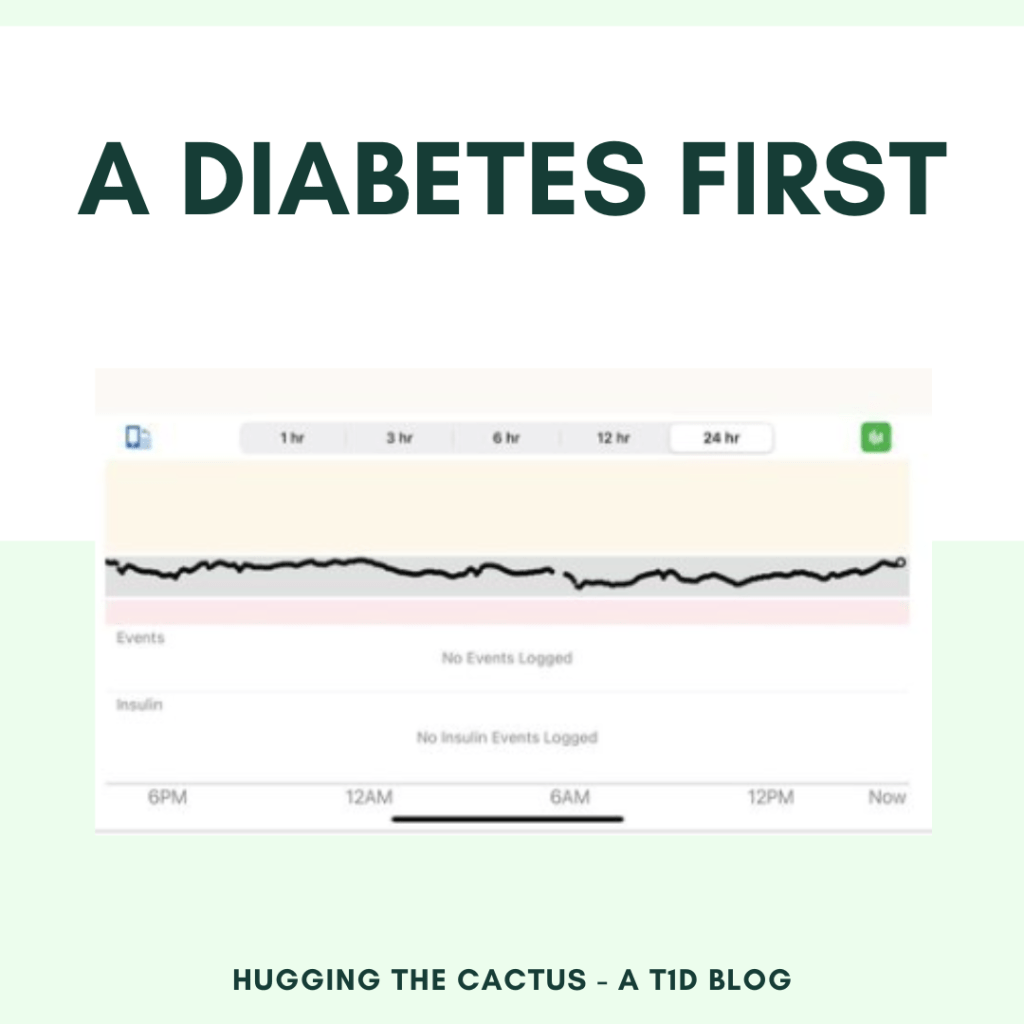
Don’t get me wrong, though…as nice as it was to have approximately 48 hours of in-range blood sugars (above 80 and below 150 on my own Dexcom graph), I definitely wouldn’t trade them in favor for a stomach bug. I’d much rather put in a little more effort on my own to obtain in-range readings than have to go through that whole ordeal again.
This was originally published on Hugging the Cactus on December 4, 2019. I’m sharing it again today because there have been many diabetes tech outages since then – and I’m certain there will be more in the future – but my question still remains: Do we take medical technology for granted? I ponder the answer to that below…
Alright, now that I’ve got THAT out of the way…
For the last several days, the DOC has been in a bit of a panic. And when I say “bit” I mean “a helluva lot”. That’s because the day after Thanksgiving, Dexcom Follow stopped working. This means that parents/caretakers who rely on the technology to monitor their child’s/loved one’s blood sugar levels were left in the dark. It sparked confusion, outrage, and downright fear, all of which only seemed to intensify over the weekend and into this week when the problem was only partially solved for most users.
Rather than coming together to support one another, the DOC swiftly divided into two camps: The first consisted of individuals who sought to gently remind others that this technology is still pretty new. It hasn’t even been around for two decades. That meant that for many years before then, people with diabetes were doing things the “old school” way, and getting by just fine. Doesn’t this mean that we should all be able to make it through unexpected technology blackouts, knowing that we have our blood sugar meters to fall back on?
The second camp was in a greater fury over the issue. This camp relied on the Dexcom G6 system because those within it simply didn’t know a life without the continuous glucose monitoring technology. For them, the outage was a bit like asking them to Google something without access to the Internet – it’s pretty much impossible, unless you’ve got an Encyclopedia handy. Oh, and it’s MUCH higher stakes, because people who don’t recognize symptoms of low or high blood sugar need this technology to work in order to stay on top of fluctuating blood sugar levels. Let’s not even get into how much is PAID for this expensive piece of medical equipment…one would argue that the high cost of supplies means that the technology should work at all times, no matter what.
If you’re like me, you can see that both of these groups have perfectly valid points. I’ve had diabetes long enough that I didn’t even use – and didn’t see the point in using – continuous glucose monitoring or insulin pumps until a few years ago. I took care of my diabetes the old fashioned way growing up: doing fingerstick checks multiple times per day, treating low blood sugars with 15 carbs then waiting 15 minutes, checking blood sugar levels about an hour after injecting insulin to make sure highs were coming down the way they should. This way of handling diabetes worked for me for a long, long time…throughout elementary, middle, and high school, right up to college.
Then I got a continuous glucose monitor (I believe it was the Dexcom G4) just before starting my freshman year of college. And I haven’t really been without a CGM device since then. It’s changed my life and helped me navigate adulthood with diabetes. Whenever I do experience periods of the technology not working the way it should, it’s infuriating because I feel like it’s not worth throwing away buckets of cash on it in those periods of inconsistency and inaccuracy.
But here’s what I’m wondering, as a result of this Great Dexcom G6 Outage of 2019…do we take this technology for granted?
Do we truly appreciate the times that it works the way it should?
Do we expect too much from something that, technologically speaking, still has a long way to go in terms of working perfectly?
Do we rely too heavily on continuous glucose monitors to provide us peace of mind when, in reality, they simply provide us with real-time updates of our blood sugar levels (i.e., it’s a stream of data)?
I don’t have answers to these questions. I can reflect on my own answers to them; furthermore, I can ponder how and why the DOC gets so divisive in these times where we should try to come together, listen to (and learn from) differing perspectives, and figure out what we can do to best support one another during trying times.
While I’m a huge fan of trending shows like The Last of Us and Wednesday (I recently finished both first seasons and fell in love with the characters on both shows/mourn the fact that they likely won’t produce second seasons until 2025), I’m also really into what my mother calls “trash TV”.
This is synonymous with reality television – think along the lines of anything that the Bravo network plays. Most of those shows symbolize pure escapism and innocently mindless entertainment for me, and I’m addicted, so much so that my trash taste in TV translates to my podcast listening.
I listen to a handful of podcasts hosted by personalities that either appear on the Bravo network or talk often about Bravo-lebrity drama, and while I usually find them wildly entertaining, I’ve noticed an emerging trend on these podcasts in recent months that makes me incredibly irritated. And that’s how often diabetes comes up as a topic on these podcasts.
Nine times out of ten, it’s about Ozempic (the type 2 diabetes drug that famous and non-famous folks alike have started using in order to lose weight). Usually, the podcast hosts are poking fun at it or spending way too much time speculating who is and isn’t using it, and it drives me up the wall. NOBODY is talking about the morality of taking a type 2 diabetes drug when they do not have that condition themselves, or the fact that since it’s become so popular it’s made it scarce and potentially unavailable to the people that really need it. Now, I’ll take a step off the soapbox for a second because obviously I 1) don’t have type 2 diabetes and 2) don’t use or need to use Ozempic; therefore, I don’t have a true stake in the game other than that I could imagine myself being even more worked up if it were a matter of people taking Humalog for similar reasons (goodness knows the rage that I would feel if Humalog was becoming virtually fetishized because taking it resulted in some desirable outcome).
I also shouldn’t sit here and judge people who go on Ozempic who have maybe tried multiple other weight loss methods that have failed them, and they’re genuinely using the drug to try and get healthier – I can empathize with that more. No, what really bothers me is the resulting dialogue that seems to happen every time Ozempic is brought up, and that is pure ignorant bliss regarding what diabetes actually is and how significant of a role it plays in the daily lives of people living with it. Multiple podcasts that I listen to have covered the Ozempic “fad”, explaining to their seemingly naive audiences that it’s a drug for diabetes, followed by a punch line about how they don’t even know the difference between type 1 and type 2, and saying things along the lines of how they hope they get diabetes just so they have an excuse to take Ozempic.
It’s gross. And quite frankly, embarrassing for these podcast hosts to admit that they know so little about a condition (and I’m speaking broadly here about both T1D and T2D) but then claim they want to be diagnosed with it so they can maybe indulge in their vanity and lose weight. There’s much better ways to make clever little jokes about diabetes and I’m getting tired of people being lazy in their comedy by continuing to be misinformed.
Maybe all of this is a signal to me that it’s time to take the trashy podcasts out of my rotation…
I guess I’m hopping on the “what I eat in a day” bandwagon.
This trend has existed long before the TikTok videos and Instagram reels in which vloggers share what they typically eat on any given day of the week – it’s also been something that tons of celebrities have been asked to share in interviews. And while I’m far from a celeb (especially Gwyneth Paltrow, who allegedly is sustained by a cup of coffee, bone broth, and steamed veggies on a day-to-day basis), I do have a certain meal routine that’s centered around my diabetes. Nobody asked me about it, but I figured, why not share it on the blog? After all, so many of the “what I eat in a day” videos and articles I’ve viewed sound a little too perfect. I often wonder how realistic folks are when they’re covering this topic, so I’m going to be pretty matter-of-fact when going through my “meal plan”, and cover how it varies on a weekday versus a weekend. So here we go:
Breakfast on a weekday: I am usually eating breakfast between 7:30 A.M. and 8:30 A.M. I love all breakfast foods, but lately my go-to has been a baked oatmeal. I prep this myself on Sundays and it makes enough servings for 6, so I’m covered for breakfast for the week. I add a couple of scoops of protein powder to it and top it with berries so that I make sure I’m getting a nice balance of carbs, fruits, and protein. One serving is roughly 30-35 grams of carbs, and I’ve found that my blood sugar fares well whenever I eat this meal, maybe spiking a bit in the hour after consuming it but settling back down nicely in no time.
Breakfast on a weekend: Anything goes! My wake-up time could be as early as 8 or as late as 10:30 or even 11 (though I don’t like sleeping my mornings away). Depending on when I wake up, I might want a breakfast sandwich or a protein smoothie, but there are other times that my partner will make me a breakfast consisting of something like hash browns, eggs, bacon, and salsa – no matter what we do, I try to keep breakfast no more than 30-40 carbs because that feels like a sweet spot for my blood sugar levels, whether I’ll be exercising in the hours after eating or even if I’m just lounging around until the afternoon.
Lunch on a weekday: I almost always have a salad or a sandwich. I like to load up my salads with lots of extras – tons of veggies, feta, bacon bits, croutons – and always top them with a protein like hardboiled eggs or chicken. If I’m having a sandwich, I’ll almost always eat it with a side of baby carrots or veggie straws (and if I’m in the office, I might indulge in a buffalo chicken wrap which comes with house-made chips – so yummy but much higher carb compared to what I’d make at home). I will eat an apple or any other fruit I have on hand for something sweet. My blood sugar is usually good after lunch, but if I see it going up too quickly or if it stays higher than I’d like it to for an extended period of time, I’ll combat that with a walk in my neighborhood or around my office suite.
Lunch on a weekend: Admittedly, it’s almost non-existent. If I have leftovers from the night before, I’ll eat that, or maybe my partner and I will split a box of frozen samosas or share a cheese plate so we’re not totally starving by dinnertime. It’s just what works best for me since all of my weekends are totally different in terms of our plans.
Dinner on a weeknight: I like to either meal prep on a Sunday night and have whatever I make carry me through the first few days of the week, or I’ll make something on a Monday evening that will produce my dinners for the next few nights. I’m a semi-lazy cook, so I like tossing veggies, starches, and proteins on a sheet pan and roast everything up (I love recipes from this website). And I have a sweet tooth, so dinner is often followed by a single serving of ice cream or a chocolate-covered frozen banana. My carb intake at dinner hovers around 45-60 grams of carbs, which I find works well because I get busy in the evenings catching up on chores around the house or running errands. The extra carbs help me stay level (and full).
Dinner on a weekend: I enjoy whenever my partner and I have a chance to make food together, because he’s a great cook and very conscientious of my diabetes when making something to eat. He helps me carb count and if we’re going out somewhere to eat/ordering takeout, he’ll offer to split higher-carb dishes with me so I can still have them without totally wrecking my blood sugar. I don’t really place limits on my carb intake for meals out because I love getting sushi, flatbread, and other high-carb menu items – I just try to keep an eye on my blood sugar levels in the hours after a meal out so I can stay on top of highs.
Snacks: I’m a grazer through and through, meaning that it’s hard for me to resist the temptation to snack on foods in my pantry throughout any given day. So I try not to keep bottomless bags of anything in my home, though I do keep things like bags of light kettle corn and single-serving snack bars on hand. But I’m also a sucker for a bowl filled with chocolates like Reese’s or Ghirardelli squares which I will shamelessly help myself to, never having more than a couple in one day because ~*balance*~ matters. Grazing can really screw up my blood sugar, though, so I try to be smart and time it so any snacks coincide with periods of higher activity (such as before I vacuum or head out to run errands).
Drinks: I try to stay hydrated on a daily basis. Besides plain water, I drink Powerade Zero to get in extra electrolytes and I’m an absolute sucker for fizzy and carbonated drinks as long as they are carb-free. I do drink beer/wine/cocktails from time to time that definitely have extra carbs, but I have learned over the years how my blood sugar will respond to a given alcohol and plan accordingly around that.
So, that’s it – an honest explanation of what I eat in a day as a person with diabetes. Some days I am more balanced and “healthy” than others, and some days I just go to town and whatever I like. My relationship with food will never be perfect because my diabetes undoubtedly influenced it, but that’s a post for a different day. For now, I’m off to have a snack to keep my blood sugar (which is 113 mg/dL as I write this) steady throughout my evening workout routine.
It was around 4 o’clock in the morning. Rain was pounding relentlessly outside my window. The power must’ve gone out, because flickering lights and the sudden sound of my heat turning back on woke me up with a start.
I tried to let the sound of the falling rain lull me back to sleep, but it was loud. I tossed and turned, doing my best to resist the temptation to check my phone and mindlessly scroll through various feeds until I felt sleepy again, but before long I gave in. As I almost always do every time I unlock my phone, I tapped on the Dexcom app so I could see what was going on with my blood sugar.
At that present moment, I was 92 and steady, but what my graph indicated to me in the previous couple of hours made me audibly gasp.
I had fallen to below 55 at some point in the middle of the night, and stayed in fairly low territory for nearly two full hours before making the slow climb back up.
That’s when it came surging back to me: The memory of waking up, some hours before, to the sound of an urgent low alarm. And then me totally ignoring it in favor of sleep.
The realization hit me as hard as the rain was striking against my rooftop, and then the tears welled in my eyes. I lay there, crying quietly, as I tried to accept the reality that choosing sleep over fixing my low blood sugar could’ve been an extreme error on my part. What if the rain and the power outage hadn’t woken me up? I recognized that given my current blood sugar graph, I would’ve been just fine, but regardless I had still slept through a low and that frightened me – I’m not sure if I’ve ever done that before. Just as I was beginning to really freak out, I felt a rush of gratitude toward my Omnipod 5. After all, it had seemingly detected the low blood sugar and then lessened my basal rate (or perhaps completely stopped delivering any basal insulin altogether) in order to bring my blood sugar back up. I felt as though the system had possibly just saved my life.
So I couldn’t help but lay there and let the tears fall, marveling at the technology that I felt indebted to at this particular moment in time, before I found myself drifting off into a dreamless sleep again.
Experience a bad diabetes day? Been there, done that – a countless number of times, really, in the last 25 years.
Most days with diabetes are “good”; by good, I mean predictable and smooth, with my numbers staying in range and absent of pod failures or inaccurate Dexcom readings. The bad days, as you might expect, are the polar opposite. Bad diabetes days are defined by rollercoaster blood sugar numbers, the ensuing side effects ranging everywhere from irritability to frustration to enraged and to downright exhaustion (just to name a few likely outcomes). Bad diabetes days happen much less often than the good days, but there’s no denying the emotional toll that they take. So what possibly keeps me going on the days that I feel most defeated by my diabetes?
Honestly, it’s the knowledge that it’s temporary. The phrase “this too shall pass” comes to mind when I think of a bad diabetes day. It’s a great reminder that as insurmountable as some bad diabetes days may feel, it won’t last forever, and the opportunity to try again will greet me the next day. To adapt from another well-known adage, the sun will rise in the morning, and I can try again and have faith in my knowledge that not every day with diabetes is bad.
It might sound trite or even a little eyeroll-worthy, but it’s the truth, and it goes a long way in comforting me throughout the days when diabetes acts up at every twist and turn.
Just over a week ago, Eli Lilly announced a 70% reduction in price for its most commonly prescribed insulins that resulted in a cap of patient out-of-pocket costs at $35 or less per month.
This news was huge and spread like wildfire across the diabetes online community. And for good reason – it’s something that so many people with diabetes have needed to happen for a very long time. Most reactions I saw were that of complete and utter joy and relief. I’ll admit that’s what I felt at first, too, until I saw the more displeased responses that directed additional frustration and rage at Eli Lilly for not taking this action sooner, or reducing the cost of insulin to make it free altogether. Those posts got me thinking.
I’ve had time to reflect and gather my thoughts on the matter, and I think I land somewhere between thrilled and bummed, myself.
This news is absolutely something to be celebrated, as it will undoubtedly assist people who struggle to afford insulin with astronomically high price tags. This is an issue that I’ve spoken about on the blog before, and while I feel very fortunate to never have personally struggled with affording my own insulin (though I’ve certainly complained about out-of-pocket costs in the past), I’ve read countless stories about individuals in the United States who’ve had to take drastic measures in order to obtain this life-saving medication. So this news is wonderful, for sure, but it also feels a little too late.
Is this response from Lilly induced by the pressure that they’ve felt from diabetes advocates in the last several years? Is it a genuine call to action to other insulin manufacturers to follow suit and slash prices? Is it all just some sort of PR stunt? My suspicion is that it’s a mixture of all three, and while this feels like a victory for now, I don’t think that I will personally be satisfied until all people with diabetes are able to get insulin for free – no bottom line, no gimmicks, no nothing other than access for all.
“I’m a big brave dog, I’m a big brave dog, I’m a big brave dog…” is a mantra that little Chuckie Finster repeats to himself, over and over again, in an episode of The Rugrats that I recall vividly from my childhood.
It’s probably so cemented in my memory because I identified a lot with Chuckie as a kid – I was constantly overly cautious, nervous to try new things and scared about breaking rules or going against the norm. While I’ve overcome many trivial fears as I’ve gotten older, I still don’t think that I’m brave, despite many people telling me that I am…almost always in the context of my diabetes.
“You inject yourself with actual NEEDLES?! You’re so brave!”
“You wear two medical devices at all times? You’re so brave!”
“You put your diabetes story out there to share with others? You’re so brave!”
These are comments I’ve received from family, friends, and total strangers over the years, and while I appreciate the sentiment, I definitely don’t think that my diabetes has made me brave. I do these things because I have to. If I chose to not take care of my diabetes, or talk about my lived experience with it, I would be a much less healthy and happy individual. In my opinion, this isn’t equivalent to bravery – it’s common sense. It’s my reality that I accepted a long time ago.
As someone who is generally anxious and constantly worried about so many things besides diabetes, I’d much rather be admired for being brave about anything else that doesn’t remotely relate to my diabetes. Call me brave for trying something new that I was genuinely terrified about, or maybe say “you’re so brave” in a situation in which I took a stand for something I believe in. Hell, I don’t even mind if you continue to think that I’m brave in my journey with diabetes, but just recognize that my diabetes doesn’t make me brave – there are so many other facets of life that require genuine courage and spirit, and for me, I prefer to think of my diabetes as one teeny, tiny speck in that much larger, grander picture.





 Hugging the Cactus