Comfort food…mac and cheese, cheeseburgers, pizza…and snacks?
Sounds like a unconventional addition to my mini laundry list of comfort food examples, but snacks (of just about any variety) go a long way in making me feel a certain degree of comfort. And this is because of – you guessed it – my diabetes.
Sometimes, diabetes can be totally unpredictable. My blood sugar could be steady one moment and crashing the next, and it’s far more stressful in circumstances where I don’t have food readily available or accessible to me.
So it might sound kind of silly, but one of the many fears and anxieties I had about starting a new job was centered around food. Would I be working in an area that was close to a grocery store or cafeteria, like my last job? Since I wouldn’t have a permanent desk in the office, would there be a place for me to store extra food to have on hand in case of emergency? Was it flat-out ridiculous for me to be so worried about access to food?
Turns out the answers to those questions were yes, yes, and definitely yes.
There’s no shortage of snacks at work, much to my relief.
Immediately, I discovered that my new office building has a full cafeteria located on the first floor that serves hot breakfast and lunch. As if that wasn’t great news in its own right, my office suite has not one, not two, but three kitchens that are available to all staff – and get this, they’re fully stocked with an assortment of beverages and foods, everything from yogurts, chips, granola bars, and Ramen noodles, all the way down to ice cream sandwiches in the freezer.
After I got the full tour of the facilities and learned that I had all of these options around me (without even having to leave the building), it dawned on me just how much of a relief this was. I do my best to be prepared as a person living with diabetes, but mistakes happen, and I’m sure there will come a day that I forget to bring an extra low snack to work or need to purchase a meal at the facilities. I was thrilled to find out that it’s no sweat, should I encounter these scenarios. And I’m really appreciative of that because I understand that not everyone has the good fortune to have these benefits provided to them through their occupation. I can’t help but feel grateful for the snack security I’ve found in this new opportunity!
As anyone who lives with diabetes knows, it’s a condition that dislikes disruptions to a daily routine.
This was one of my main concerns when it came to starting my new job last week. The position is hybrid, meaning that I can work from home and in an office as it suits my needs. The prospect of returning to an office again after more than three years of working remotely positively excited me, but I’d be lying if I said that it also terrified me. I was anxious about my first day back in an office environment (in addition to all the jitters associated with starting a new job), and more than anything, I was worried about how my diabetes would be affected by this change.
This is because I’d settled into a fairly standard routine after all this time working from home. I have a workout regimen, eating schedule, and built-in breaks throughout my day that have greatly benefited my day-to-day blood sugar levels, and I knew that returning to an office setting would prevent me from maintaining these habits.
So that’s why I entered what I’m calling “diabetes hyper-prepare mode” the night before my first day in the office so I could try and think about all the ways my day would differ working in this setting versus my own home. And thus, I came up with these three tips that resulted in a very successful diabetes (and work) day:
Tip #1: Get ready as much as possible the night before. The week that I started my new job, I did my best to recall the routines that had worked well for me when I was regularly working in an office. The first thing that came to mind was the amount of preparation I typically did each weeknight so that I could get out the door as soon as possible in the morning. This included laying out my outfit, making breakfast ahead of time, putting together a lunch, and packing my bag. This extra work the night before really paid off the following morning and meant that I hit the road at exactly the time I had planned to; plus, the food prep worked wonders as I didn’t have to waste brain power in the morning trying to think about what I might eat throughout the day. The food was all set and ready to go, and I knew its carbohydrate contents, which resulted in phenomenal blood sugar levels all morning leading up to lunchtime.
Tip #2: Maintain movement. As it turns out, a 40-minute commute combined with lots of sitting in meetings means that my movement patterns in the office are minimal. I did my best to combat this by getting up a few times throughout the day to explore my new building in 10- or 15-minute intervals. Not only did this give my eyes a break from my dual monitors, but it allowed me to stretch and get familiar with the environment. It also helped to curb my post-lunch upward sloping blood sugar, so it was definitely beneficial to my body and mind to make sure I maintained semi-regular movement during the workday.
Tip #3: Have back-up supplies on hand. When I was packing my bag the night before, I made sure to slip a meter, test strips, and fingerstick device, as well as some fruit snacks, into one of the compartments as I didn’t want to run the risk of something going awry with my CGM or needing a low snack and not having it. Of course, I didn’t experience either scenario in the office that first day, but knowing that I had these items close by went a long way in reassuring me that I was prepared to handle any diabetes scenario that might crop up during the workday. And it turned out to be fodder for reminding me that I should also have an extra pod and insulin in my bag at all times, too – next time, I’ll make sure to bring those items with me so I can have even more diabetes bases covered.
These tips might seem pretty obvious, but I was kind of awestruck by just how weird it felt to be back in an office space after a long hiatus away from one. So I think that following these tips truly did help to ground me so I could stay focused on learning my new job and meeting my colleagues, rather than letting my diabetes take center stage for the day.
One year ago today was my first day working from home due to the pandemic.
I remember my final day in the office like it happened yesterday. There were hushed conversations in conference rooms, cubicles, and the office kitchen in which we all wondered how serious things were – and how serious they might become.
We had no idea what we were in store for.
One by one, as individuals who tended to work earlier in the day left for home, I said hopeful, “see you in a month” farewells, as we were all under the impression that we could come back to the office in a month. I remarked to one colleague, who is a close friend outside of work, that I had a feeling we’d all be grateful to come back and that we’d marvel in being able to be in close proximity to one another again.
I knew then that this was the start of something unlike anything most of the world had faced before, and I even documented the strangeness of it all by taking one last selfie at my cubicle (to be fair, I’d spent my lunch break at the hairdresser’s, so my hair was on point and IMHO warranted a selfie).
And here’s the aforementioned selfie, taken on March 12, 2020 at 5:38 P.M…during my last few minutes in the office.
That would be my final selfie, for certain, in that office. Because just five months later we’d all return to it one last time in small groups to pack up our desks, as our company decided to break the lease and save money on office space.
So I’ve worked from home for a year, and will continue to do so for the foreseeable future. I’ve got so many emotions tied to that: gratitude, sadness, loneliness, anger, resentment, wistfulness…
Let me go over the positives of working from home: I’m so grateful for my job and for how deftly my colleagues and I got used to full-time remote work. Several aspects of life are made easier by working from home, such as managing my diabetes (for example, if I ever experience a pod failure, I have every and any back-up supplies I could need at home as opposed to my desk drawers, which weren’t always stocked up all the way). I save time on a commute which allows me to fit in more tasks at the start and end of my day, and honestly, working from home full-time gave me the ability to get a puppy and feel confident knowing that I would be around to take care of her.
But there are some negatives; mainly, I miss the office camaraderie like crazy. I’m lucky enough to work with a group of people that I truly enjoy being around, so it’s been tough to maintain my connections with them virtually. And truthfully, I get lonely in my condo. Going into the office five days a week not only ensured I had contact with other humans, but it also guaranteed that I’d actually leave my home during the week. I’ve never felt so sheltered in my life, and it’s a weird feeling.
I guess that if I’ve learned anything in the last 365 days, it’s how to be adaptable. Honestly, not to connect it back to diabetes – okay but this is what my blog’s about so that’s to be expected – but it’s a lot like figuring out how to deal with change as it inevitably happens. Over the years, I’ve taught myself what to do when lows and highs happen, and how to manage certain situations if and when they occur in my diabetes life. And that’s what’s happened in this last year: a whole lot of learning how to handle life’s curveballs, in general, along with the ones that diabetes tosses my way.
You might not have realized that I have a unique working arrangement when it comes to my “real” job at a financial services company: I work from my apartment in Virginia about 75% of the time. The other 25% of my time is spent working from my company’s office in Massachusetts.
It took me a long time to adjust to this part-time commuter, part-time teleworker situation. To be honest, I still need a day or two to get reacquainted with the office (or my work-from-home setup) when I come and go between the two states. It can be weird to go from being surrounded by my coworkers one day to being by myself in my home office.
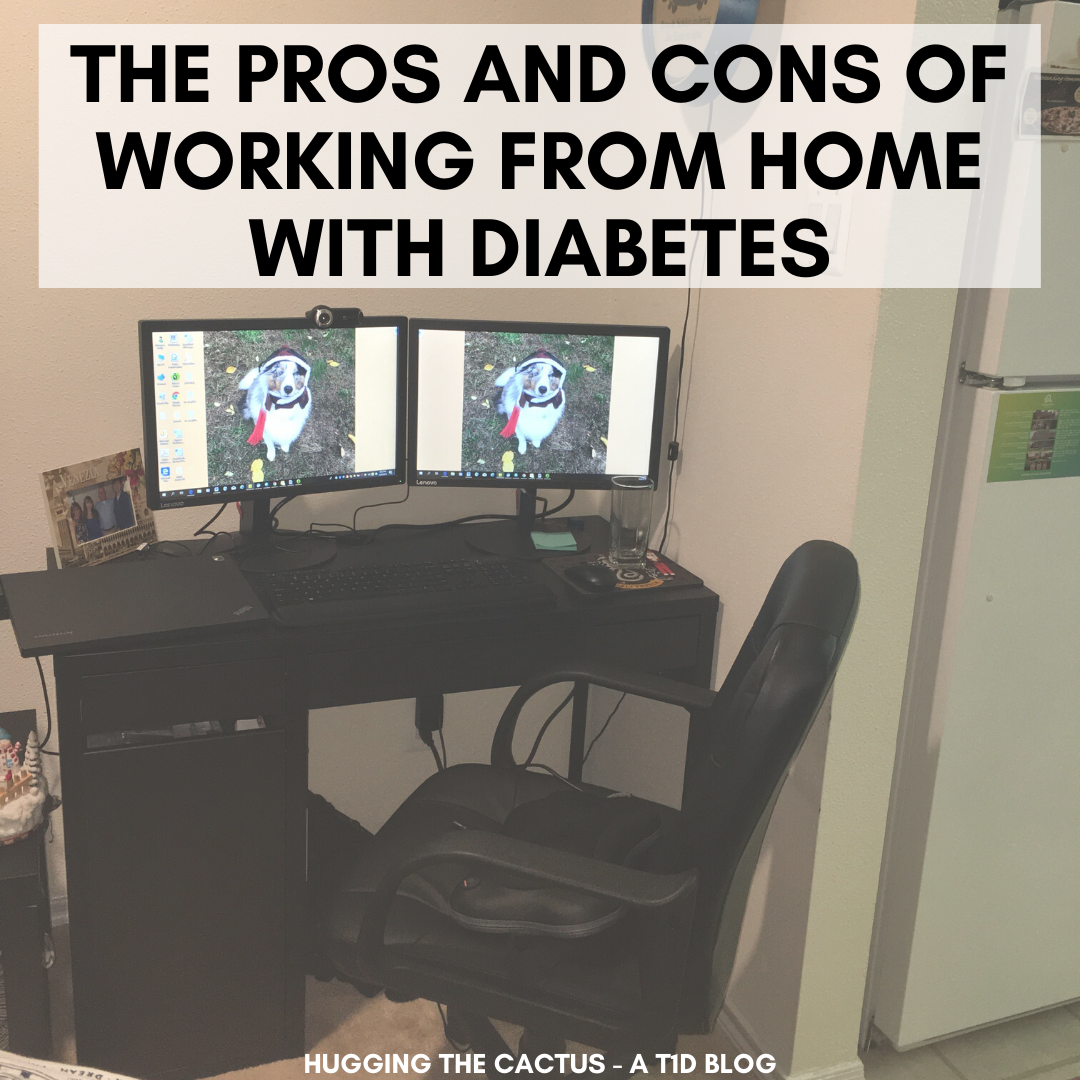
However, I’m really appreciative of the opportunity to use this workplace benefit. I know it won’t last forever; in any case, I’ve made a number of observations that have highlighted the advantages and disadvantages of working from home as it pertains to my diabetes:
Yes…my fridge is THAT close to my desk…literally within arm’s reach. Dangerous.
Pro: Access to ALL of my diabetes supplies at all times. This is hugely helpful whenever I’m having an “off” diabetes day. If I’m not sure my pod is working properly, I have all the tools at my disposal to monitor and correct the situation. It’s much easier than bringing everything I could possibly need with me into the office when I’m there.
Con: Being alone. I thrive when I’m surrounded by my coworkers. I’m able to bounce ideas off them more easily and stay connected to in-office activities. But there’s also a level of safety that I feel when I’m around my coworkers. They all know about my diabetes and are more than capable of helping me should I need it, and well, when I’m working from the apartment…the only person I can depend on is myself for 40+ hours a week. And that reality can be a little anxiety-provoking.
Pro: Ability to treat low and high blood sugars without worrying how it might impact my coworkers. The following scenario has happened to me a number of times: Blood sugar is low, I start shoving food into my face just as a coworker decides to “pop by” with a question (and vice versa when my blood sugar is high and I’m trying to correct it). When I’m dealing with these diabetes situations in the office, I worry far too much about how it impacts my coworkers when I really should just focus on myself and treating whatever it may be. It’s slightly warped thinking on my part, but that’s just one of the trickier aspects of handling diabetes in the workplace.
Con: Being much, much, MUCH more sedentary. My diabetes hates when I take “rest days” from working out. But it loves when I move as much as possible throughout the day. This is pretty easy to do when I’m working in the office: I can park my car semi-far away, I can take the stairs to navigate around the building, and I can stretch my legs during the day with a couple laps around the office. But when I’m in the apartment? I move much less because I don’t really have any place to go. I definitely stay glued to my chair more than I’d like.
Pro: Easier to call for supplies, make doctor’s appointments, etc. (all the administrative tasks associated of life with diabetes). I never want to be “that person” in the office who takes just one too many personal phone calls during the workday. I also like to maintain privacy when discussing issues sensitive to my diabetes because it’s my business. So I feel a lot better when I can handle the “administrative tasks” of diabetes from the privacy of my home, with the knowledge that I’m not disrupting my coworkers with my phone calls.
Con: My gadgets tend to be much more disruptive via webcam versus in-person. My coworkers are used to my pump and CGM making sounds in-person, but when I dial into meetings and they start beeping and hollering in the background, it’s WAY more obnoxious because I can’t always tend to them right away, and the sounds are just more alarming. Since I use a webcam for most of my meetings, I can’t just get up and silence my devices…so it’s a little tougher to navigate than when I’m in-person.
Pro: Being able to make my lunch from scratch each day. So I won’t pretend that I’m cooking gourmet lunches on a daily basis, but I am able to prepare fresher meals than I do when I go to the office. Plus, the temptation to buy food from fast-food joints is pretty much eliminated when I work from home – why bother venturing out to spend money on lunch when I already have food at the apartment?
Con: The kitchen is mere steps away and it’s stocked with all my favorites. This goes hand-in-hand with the above pro…it’s all too easy to reach into a cabinet and grab a handful of this or a spoonful of that, and I admit that I don’t always bolus for these mini snacks I grab. This, combined with my more sedentary nature, means that my blood sugars tend to be higher when I work from home.
Pro and con: No refrigerator stocked with my favorite diet sodas. All of this kitchen talk makes me think of something that could be considered a pro and con of working remotely…I can’t grab a can of diet root beer or diet ginger ale whenever I feel like it! My work fridge generously stocks a nice variety of diet sodas, so I drink a lot more of them when I’m in the office. But I don’t buy diet soda to keep in my apartment refrigerator, because I’m trying to kick the habit…though I do miss snagging sodas in the afternoons as a pick-me-up when I’m working from the apartment!



 Hugging the Cactus