They say that hindsight is 2020…well, I say that because it is officially 2020, we’re going to be hearing a lot about that little pun in the coming days and weeks.
So today marks the beginning of a new year; more significantly, an entire decade. The last time a new decade began, I was the tender age of sixteen. Ah, how young and naive I was then. If only I knew then what I did now…!
Welcome, roaring twenties!
On a more serious note, this decade of diabetes is bound to be much different compared to my last decade of diabetes. For starters, I’m beginning this one with a whole lot more T1D tech than I had in 2010: I’ve got my Dexcom CGM and my OmniPod insulin pump. I was also still in high school ten years ago; in the last decade I graduated, earned my bachelor’s degree, and I’m now five years into my career. Oh, and I also moved out of my parents’ house for the first time. Needless to say, much has happened in the last ten years, and I can’t believe I was able to summarize the biggest changes in just a couple quick sentences.
Anyways, they do indeed say that hindsight is 2020. Vision becomes clearer and you learn lessons from the mistakes you’ve made.
For me, this blog is actually a bit of its own 2020. It serves as a record of how my thoughts and feelings toward diabetes have changed, and with that comes a bit of clarity and insight. And I like it. It helps me process my diabetes and stay in tune with the emotions that come with it. So in that regard, I think a little hindsight can be healthy, as long as I don’t dwell in what I could and should have done – only what I can and will do.
With that said, Happy New Year. I wish you all a happy, healthy, and prosperous 2020.
I have an appointment with my endocrinologist today. Or should I say, the person who I hope is my new endocrinologist. I really want this patient-doctor relationship to work out!
It’s my first new endocrinologist in about ten years and I am effing nervous. It’s comparable to going out on a first date with someone, only I’m not hoping to be wooed with flowers or treated to a fancy meal.
I’m hoping that this person is someone I can trust with my health…which I value a lot more than any of the associated costs of a first date.
There are higher stakes with a new endocrinologist than with a new dating-app match.
Why is this new doctor terrifying to me? For starters, I have so many questions. What if she doesn’t like me? What if I don’t like her? What if she judges me? What if she’s too lenient? What if…? The list goes on and on.
Plus, I’m seeing her after smack dab in the middle of holiday celebrations, also known as the most turbulent time of the year for me and my blood sugars. I’ve had so many highs in the last month that I’ve tried to stay on top of, but she’s bound to notice them and ask me if this is a regular thing for me. It’s also pretty likely that my weight has gone up as a result of the many indulgences I’ve enjoyed in the last few weeks, and I’m worried about whether comments will be made on that.
Not to mention that I haven’t seen an endocrinologist since…late August, I think? And that appointment was with my “old” doctor, who left to practice somewhere far, far away. It was a bittersweet parting, and it wasn’t on amicable terms because neither of us was ready for it to be over. So I’m heading into a new potential endocrinologist relationship with that in my mind, and my new doctor has a lot to live up to when compared with my old doctor.
I just want everything to go well. I know that if it’s not a perfect fit, it’ll be pretty evident straightaway, and I can seek another new endocrinologist. But to continue with the dating metaphor, it’s not as easy as just swiping along and seeing what other nearby options I have. There are other concerns beyond location: I need to make sure my doctor can accept my insurance, on top of them being likable, knowledgable, and eager to help me manage my diabetes. It might be surprising to learn that this particular combination is a tall order, but again, when it comes to my health I refuse to just settle.
Fingers crossed, it’s a match from the start and all of my concerns will be rendered invalid late this afternoon at the conclusion of my appointment…
This post was originally published on Hugging the Cactus on October 8, 2018. I decided to re-up it today because I think we could all use a little reminder that diabetes is different for everyone. Remember…your diabetes may (almost always will) vary.
Previously, I’ve written about what it feels like to have low blood sugar. While many people with T1D feel the same symptoms as me when they experience a low, there are even more who experience a wider variety of emotions and sensations.
Renza, a T1D Twitter friend of mine, did a little investigating into how others would describe what it’s like to have a low blood sugar. She sent a tweet that read:
#Diabetes friends. I’m crowdsourcing (again). If you had to use ONE WORD to describe how hypos/lows feel to you, what would it be. Go!! #Hypoglycaemia
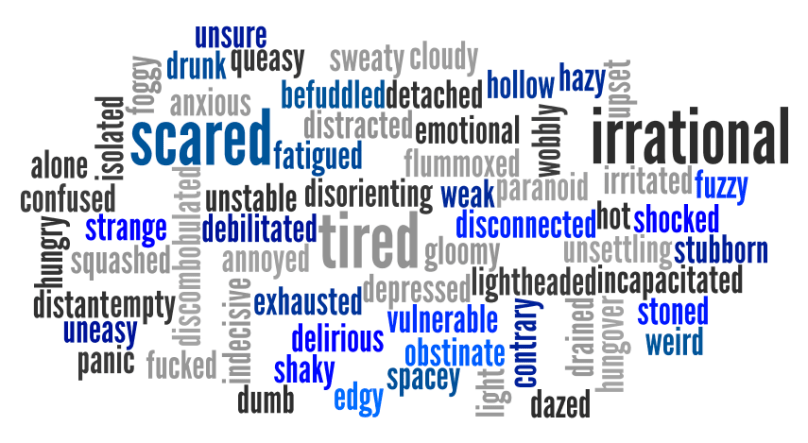
She received nearly 100 responses, which I’ve compiled into the below graphic.
Looking at this word collage is a bit startling because it represents the vast array of feelings associated with low blood sugar. Most of them are negative. A handful of them start with the prefix “dis”, which describes something with an opposing force. A couple of them relate to feelings associated with eating. And just about all of them can be summed up as sensations that I wouldn’t wish on anyone.
To me, this graphic serves as a stark reminder that diabetes is more than just a chronic illness that affects the body: It affects the mind, too.
Merry Christmas (and if you do not celebrate, happy holidays)! I am taking today (as well as Friday) off from blogging in order to give myself a much-needed break – though I will republish an old blog post on Friday, just to keep pace with things. I’ll return with fresh content on Monday, December 30th.
This silly, seasonal GIF of me is too funny (and appropriate) to not use today – and all throughout the holiday season as my blog’s banner.
Until then, here is a friendly reminder to be kind to yourself. I understand that this is not the most wonderful time of the year for everyone, and no matter how you feel about it, know that it’s okay – I hear you. Don’t beat yourself up over your blood sugars. Forgive yourself and look for the bright side when things don’t go your way. And whether you do or do not have diabetes, it’s important that you know that I genuinely appreciate you for visiting this blog and that I wish you nothing but the best today, and every day.
Tomorrow is Christmas Eve (already) and it just so happens that it’s also my diabetes diagnosis anniversary…or “diaversary,” as it’s colloquially known.
This means that tomorrow marks 22 years of living with diabetes.
For some, that might mean I should celebrate with a cupcake or another special, carb-y treat. And I probably will, because it’s Christmas Eve and sweets are sure to be bountiful at any gatherings I attend tomorrow. But I don’t really plan to do so with my diaversary in mind; for me, it’s the holiday that’s got me in a more festive mood than the fact that my diabetes is 22.
I don’t really know how to feel about this diaversary. My feelings last year about my 21st were very clear: I was down in the dumps about it. I was desperate for a break. And I really didn’t say much more beyond that.
If you were me, would you do anything special to celebrate 22 years of diabetes?
This year is a little different. I feel the same as last year in that I would do anything for just a single day off from diabetes, but also…I guess I’ve just learned to embrace the routine of it?
I dunno. My relationship with diabetes is always going to be a bit of a roller coaster, just as my blood sugar can sometimes be. I’ll have my highs and my lows, and in between all that…is how I feel now. It exists. It’s just…there. It’s been part of me for 22 years and it will continue to be a part of me as we head into this next decade. (Where’s that cure they’ve been promising us…oh, it’s another 5 years from now, right?)
So my diabetes is 22 and I’m feeling “meh” about it. And that’s perfectly okay. I won’t deny my feelings (or lack thereof). I’ll simply just continue to live my life with diabetes, learning from both the literal and figurative highs and lows as I go along.
Merry Christmas and happy holidays, dear readers. Be well, hug your loved ones, and enjoy the spirit of the season.
On second thought, that may be an understatement. I’m the type of person who always NEEDS TO HAVE a plan.
I always need to know the date, time, location, and what to expect during my length of stay when it comes to anything in life: a night out with friends, a quick trip to the grocery store, a vacation.
I always need to know what the plan is for dinner…and breakfast, and lunch, and snacks…every single day.
I always need to know what my options are should a plan not go according to my carefully thought out course of action; in other words, I take a great deal of comfort in having a Plan B…and a Plan C, Plan D…
The bottom line is, I think that my obsession with planning has a lot to do with how my diabetes has turned me into an absolute control freak over the years.
My diabetes is the reason why, for much of my life, I’ve felt like I needed to plan out everything that I do.
Let me explain: Try as I might, I will never have complete control over my diabetes. This has been a difficult reality for me to accept, but it’s the truth, and I know that nobody can ever truly control diabetes. It has a mind of its own sometimes, and the best that we can do is react accordingly to the curve balls it throws.
Since I won’t ever have control over this major, major thing in my life, I think this has triggered me to feel compelled to control everything else in my life…even things beyond my control. And yes, it’s as maddening as it sounds.
It affects myself and everyone close to me.
It is the reason why I worry so much and waste a lot of brain space on things that I shouldn’t.
And it’s something that, though I’ve come to terms with it, I would like to change because the rational part of me knows that it’s not healthy to maintain the unrealistic expectation that I can control everything that happens in my life. If I can accept things like random pod failures and unexplained high blood sugars, then shouldn’t I also be able to accept that other random things can just happen in life, such as a pipe bursting in my apartment or the car I’m driving getting a sudden flat tire?
The more rigid version of myself that existed a year ago would’ve absolutely panicked and melted down in the face of those scenarios, but the type of person I’m trying to be now actually recently handled both of those unpredictable events with a lot more coolness and calmness than I ever could have imagined.
So I guess what I’m getting at here, in a very long-winded way, is that my diabetes may have turned me into an obsessive planner control freak…but I’m just beginning to discover my ability to let go a little more and not let my diabetes affect my thinking and reactions to many other things that happen in life.
November ended a couple short weeks ago: just enough time to allow me to reflect on how I feel about National Diabetes Awareness Month (NDAM) 2019. My experience can be summed up with the following three sentiments:
It was exhausting. It might not seem like it takes a lot of effort to post daily on Instagram, but for me, this was a major commitment! It was pretty tough to come up with an engaging post for every single prompt of the Happy Diabetic Challenge. I wanted each of my posts to not only generate interest in learning more about diabetes, but I also hoped that others would notice the thoughtfully written captions and, more importantly, blog posts that went with a handful of them. I’m not sure if I succeeded, but I was proud of myself for keeping at it. But man, I still feel like I need a bit of a social media cleanse after all that posting, liking, and commenting.
It was educational. This may have been one of the most enlightening Novembers I’ve ever experienced, diabetes-wise. I feel like I heard and listened to many diverse voices in the diabetes community – and not just the T1D ones. In particular, I found myself paying closer attention to T2D perspectives, especially on Twitter. By doing that, I realized that I need to make it a point to be more inclusive when describing diabetes, in general, to others. In the past, I think I’ve made the mistake of talking about certain experiences about life with diabetes in a way that sounds exclusive to type 1, and that simply isn’t always the case. So it’s my new mission to make sure I represent other types of diabetes as best as I can on social media and in person, going forward, so that I can do my part to end diabetes stigma about all forms of it.
National Diabetes Awareness Month 2019 was a jam-packed 30-day period…to say the least.
It was empowering. Although NDAM 2019 kind of kicked my butt in terms of showing me how much I have to learn and triggering a social media burnout, it still doesn’t mitigate the fact that our amazing diabetes online community really comes together during this period of heightened awareness and advocacy. There’s something special about all of our interactions during diabetes awareness month: Whether they’re comments about how one person can relate to another, or a story about how someone changed someone else’s perspective, there’s power in these exchanges. Plus, it’s pretty neat to see how sharing the most mundane aspects of life with diabetes can result in positive change and growth.
Now that I’ve reflected on it, I’m ready to put the insanity of NDAM 2019 behind me…and feeling thankful that I have another 11 months to prepare for NDAM 2020 to make it an even better experience for myself and others.
You might not have realized that I have a unique working arrangement when it comes to my “real” job at a financial services company: I work from my apartment in Virginia about 75% of the time. The other 25% of my time is spent working from my company’s office in Massachusetts.
It took me a long time to adjust to this part-time commuter, part-time teleworker situation. To be honest, I still need a day or two to get reacquainted with the office (or my work-from-home setup) when I come and go between the two states. It can be weird to go from being surrounded by my coworkers one day to being by myself in my home office.
However, I’m really appreciative of the opportunity to use this workplace benefit. I know it won’t last forever; in any case, I’ve made a number of observations that have highlighted the advantages and disadvantages of working from home as it pertains to my diabetes:
Yes…my fridge is THAT close to my desk…literally within arm’s reach. Dangerous.
Pro: Access to ALL of my diabetes supplies at all times. This is hugely helpful whenever I’m having an “off” diabetes day. If I’m not sure my pod is working properly, I have all the tools at my disposal to monitor and correct the situation. It’s much easier than bringing everything I could possibly need with me into the office when I’m there.
Con: Being alone. I thrive when I’m surrounded by my coworkers. I’m able to bounce ideas off them more easily and stay connected to in-office activities. But there’s also a level of safety that I feel when I’m around my coworkers. They all know about my diabetes and are more than capable of helping me should I need it, and well, when I’m working from the apartment…the only person I can depend on is myself for 40+ hours a week. And that reality can be a little anxiety-provoking.
Pro: Ability to treat low and high blood sugars without worrying how it might impact my coworkers. The following scenario has happened to me a number of times: Blood sugar is low, I start shoving food into my face just as a coworker decides to “pop by” with a question (and vice versa when my blood sugar is high and I’m trying to correct it). When I’m dealing with these diabetes situations in the office, I worry far too much about how it impacts my coworkers when I really should just focus on myself and treating whatever it may be. It’s slightly warped thinking on my part, but that’s just one of the trickier aspects of handling diabetes in the workplace.
Con: Being much, much, MUCH more sedentary. My diabetes hates when I take “rest days” from working out. But it loves when I move as much as possible throughout the day. This is pretty easy to do when I’m working in the office: I can park my car semi-far away, I can take the stairs to navigate around the building, and I can stretch my legs during the day with a couple laps around the office. But when I’m in the apartment? I move much less because I don’t really have any place to go. I definitely stay glued to my chair more than I’d like.
Pro: Easier to call for supplies, make doctor’s appointments, etc. (all the administrative tasks associated of life with diabetes). I never want to be “that person” in the office who takes just one too many personal phone calls during the workday. I also like to maintain privacy when discussing issues sensitive to my diabetes because it’s my business. So I feel a lot better when I can handle the “administrative tasks” of diabetes from the privacy of my home, with the knowledge that I’m not disrupting my coworkers with my phone calls.
Con: My gadgets tend to be much more disruptive via webcam versus in-person. My coworkers are used to my pump and CGM making sounds in-person, but when I dial into meetings and they start beeping and hollering in the background, it’s WAY more obnoxious because I can’t always tend to them right away, and the sounds are just more alarming. Since I use a webcam for most of my meetings, I can’t just get up and silence my devices…so it’s a little tougher to navigate than when I’m in-person.
Pro: Being able to make my lunch from scratch each day. So I won’t pretend that I’m cooking gourmet lunches on a daily basis, but I am able to prepare fresher meals than I do when I go to the office. Plus, the temptation to buy food from fast-food joints is pretty much eliminated when I work from home – why bother venturing out to spend money on lunch when I already have food at the apartment?
Con: The kitchen is mere steps away and it’s stocked with all my favorites. This goes hand-in-hand with the above pro…it’s all too easy to reach into a cabinet and grab a handful of this or a spoonful of that, and I admit that I don’t always bolus for these mini snacks I grab. This, combined with my more sedentary nature, means that my blood sugars tend to be higher when I work from home.
Pro and con: No refrigerator stocked with my favorite diet sodas. All of this kitchen talk makes me think of something that could be considered a pro and con of working remotely…I can’t grab a can of diet root beer or diet ginger ale whenever I feel like it! My work fridge generously stocks a nice variety of diet sodas, so I drink a lot more of them when I’m in the office. But I don’t buy diet soda to keep in my apartment refrigerator, because I’m trying to kick the habit…though I do miss snagging sodas in the afternoons as a pick-me-up when I’m working from the apartment!
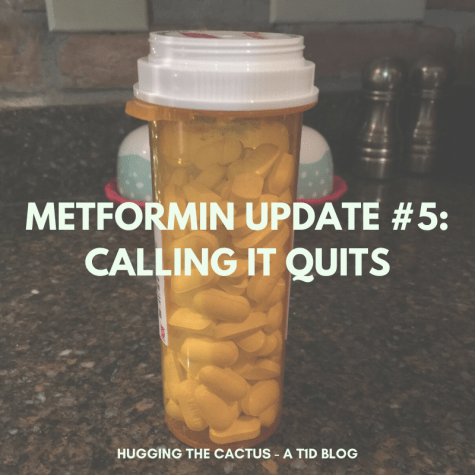
Well, well, well…looks like I’ve got another Metformin update for you all.
You’ve probably lost track of where I am in this long, twisting journey with the pill. (If you need a refresher, all you need to do is click here, here, here, here, and here.)
All caught up? Great. Now you really understand how complex my relationship with Metformin is.
There were times that I loved it. There were times that I hated it. And there were times when I simply couldn’t be sure if it was working for me the way that I’d hoped and needed it to.
I thought Metformin was right for me, but it turns out it definitely is not.
This last go-round represented the latter thought: Metformin simply wasn’t cutting it for me.
I’d been taking one pill daily for about a month when I decided to quit. The reason why I stopped taking it is simple: I wasn’t noticing a dramatic reduction in how much insulin I take each day. It was maybe a one or two unit drop, and that just doesn’t justify me taking a pill like this on a daily basis.
Now, you might be wondering why I didn’t amp up my dose. After all, it says right on the bottle that I can take up to four pills daily. Well, I chose not to take more for a few reasons: 1) I’m in between endocrinologists right now, and don’t really have anyone to consult regarding dosage, 2) At one point in time, I thought I noticed side effects of taking Metformin, and I’ve convinced myself that any possible side effects would intensify with a higher dose, 3) I wasn’t sure whether the higher blood sugars I was dealing with in the fall were due to stress or permanent changes that my body was experiencing.
So yeah, as you can see, it’s not a cut-and-dry answer when it comes to me increasing my Metformin dose.
I feel like I’m in a better place now with my blood sugars and daily insulin intake. Certainly, things have improved compared to how they were in September and much of October. Rather than fret over taking “too much” insulin every day, I’m going to focus on things that I have greater ability to control, such as the foods I choose to eat (that may or may not impact how much insulin I need) and the levels of exercise I get each week. I feel like that’s a healthier, better way to take care of myself.
So…farewell, Metformin. I won’t miss you. I know you do great things for other people with diabetes, but I’m not sure that you and I are a good match.
It’s November 25th which means it’s day 25 of the Happy Diabetic Challenge! Today’s prompt is about the cost of diabetes. Naturally, I started thinking about just how much diabetes costs me, not just in terms of money but also emotionally and physically…
We all know that diabetes is an expensive chronic illness.
Diabetes is associated with doctors appointments, pricey medical equipment, and maybe even the occasional trip to the hospital…all of those things aren’t cheap. My insulin alone would cost me $4,962.32 per year if I was uninsured (and if I do the math, this means that I would’ve spent over $100,000 in the past 22 years on JUST INSULIN). Those are not small sums of cash!
Diabetes hits those of us who are affected by it hard financially, but there are also significant emotional and physical costs associated with it.
Diabetes is so greedy, and not just in terms of how much money it costs to care for it.
Emotional – Diabetes takes a toll on my mindset (un)fairly often…and it can happen so rapidly that I barely have time to process the emotions. For example, I can go from being happy-go-lucky to angry because my Dexcom alarm went off and it’s telling me that my blood sugar is high. The anger will hit me hard and I’ll spend too much time stewing over my blood sugar and the best way to correct it.
Plus, I’d be remiss not to mention diabetes burnout. It’s the feeling of total defeat, of no longer having the desire to take proper care of diabetes. It happens to the best of us, and it’s not fun to experience. But it makes sense to feel this way from time to time, because diabetes is so demanding and relentless. People with diabetes never get a break from it, so it’s no wonder that it takes a toll on emotional well-being.
Physical – Diabetes is a physically present in many ways on my body. The OmniPod insulin pump that I wear, as well as my Dexcom CGM sensor, leave the most obvious lumps and bumps underneath my clothing that often prompt unwelcome stares from strangers. And although these devices have improved my quality of life with diabetes, they’ve also undeniably altered my body image. I never had much self-confidence when it comes to that, anyways, and my devices certainly don’t improve how I feel about my own body. I know plenty of people with diabetes who can relate to that sentiment.
There are also the scars that diabetes leaves behind. My fingers are dotted by dozens of permanent black scars left from lancets pricking them multiple times per day for the last 21+ years. I sport purple circles under my eyes pretty frequently from a lack of sleep that is, more often than not, my diabetes’ fault. And sometimes, I have unsightly red marks when I remove old pods that practically look like zits and can take days to go away because the pods’ cannulas pierced sensitive spots. These are all unattractive, physical reminders of diabetes that I can’t do a damn thing about, and it’s frustrating to have even less control over how my body appears because of this stupid chronic illness.
Diabetes is a friggen’ greedy disease.
It depletes my wallet and emotional state, and it manifests itself on my body in ugly, visible markings.
It tries so hard to rob me of everything I’ve got.
But luckily, my determination to fight back harder against it is stronger than my diabetes will ever be.






 Hugging the Cactus