Metformin Update #2: Reintroducing Myself to the Big White Pill

It’s been a minute since I wrote about my Metformin journey on the blog. The last time I posted about it, I had made the decision to stop taking it after experiencing a scary low blood sugar. That, coupled with the fact that I just didn’t feel ready to be experimenting so much with my diabetes medication, convinced me that the timing wasn’t right for me and Metformin.

Fast-forward to May 30, 2019. I had an appointment with my endocrinologist. It was a productive one, because we addressed a number of my concerns that have cropped up in the last three months. One question I had for her was whether she thought I should give Metformin another shot.
METFORMIN UPDATE #2
Really though, why do these darn pills have to be so large?

She thought that I should. We went over the benefits: it’d make my insulin more effective, thereby fighting back against my current insulin resistance and reducing my total daily intake. With less artificially-made insulin in my system, I may be reducing my risk for cancer (according to studies she’s read), and I may also shed a few of the pounds that I’ve been struggling to lose.

By the time of this appointment, I was feeling frustrated with the amounts of insulin I was using each day. Ever since I got off my parents’ health insurance plan, I’ve been super conscious about my supply of insulin as I try to figure out how I’ll afford it under my new plan. And it hasn’t been easy. So in an effort to reduce my overall insulin use, I decided it was time to give Metformin another go.

I’m more cautious this time around. My doctor and I talked about my fears and she helped me come up with a plan to reintroduce it to my diabetes care and management routine. I’m starting to take less insulin at dinnertime and I’m running a temp basal overnight to see how my blood sugars fare. We’re playing it safe by somewhat dramatically reducing my dinnertime insulin-to-carb ratio, but I’d much rather do that than be overly aggressive.

It’s only been about a week since I’ve started the new regimen. That’s not enough time for me to attest to whether or not I’ve adjusted to it, because I deliberately skipped taking Metformin on a couple nights in which I knew I’d be imbibing alcohol…again, it’s all about being smart and not introducing too many variables at once. We’ll see how it goes. Until Metformin update #3, that’s all I’ve got for now.
The $2,000 Mistake

Have you ever received an email that made you stop breathing for a moment? Did it feel like time stood still as you blinked rapidly and tried to comprehend the meaning behind it?

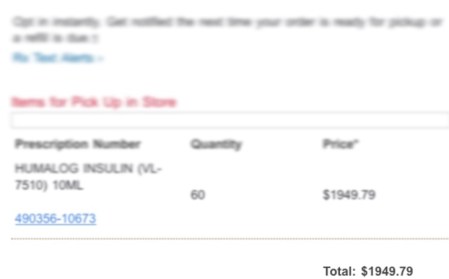
It sounds like a dramatic overreaction, but imagine getting a notification from your pharmacy notifying you that your prescription would cost almost $2,000. That’s a big old chunk of change. The mere thought of paying that much for a supply of insulin makes my heart race and my palms sweat.

51881C4A-A7D8-4A14-B960-78F85AEB970C
I nearly keeled over when I saw this dollar amount.

I’m happy to report that this was a giant mistake; for whatever reason, my doctor’s office sent my prescription for Humalog to my local pharmacy, even though I explicitly told them that I use Express Scripts for my insulin orders. It was a total mix-up, and the approximately $2,000 was an amount that I would pay if I didn’t have any insurance coverage. I do, and though I’m not sure how much I’ll be paying for my insulin yet, I know that it can’t possibly cost this much.

I’m relieved that I was able to call the pharmacy and straighten this out without spending a cent of my money. But it was also a major wake-up call to a reality that many people are forced to face when it comes to refilling insulin prescriptions. It’s not fair. (That last sentence is the understatement of the century.) I can’t make any sense of it and I don’t know how many people have no choice but to fork over such a large sum of money on a monthly basis in order to live. Thoughts of those individuals and their dire situations scare me far more than navigating the world of health insurance ever could.

While I didn’t appreciate the mini heart attack this email triggered, I guess I am glad that it alerted me to the fact that I’m going to have to be aware of things like this going forward. As I figure out my health insurance costs and coverage, I anticipate more confusion, surprises, and expenses…but hopefully I can also expect/experience a pleasant discovery or two along the way.

Hello, 26…and Goodbye, Health Insurance

Well, today is my 26th birthday. As I alluded to a few months ago in another blog post, I’ve pretty much been dreading this particular birthday.

Love always wins.

Today’s the day I’ve got to switch health insurance carriers. I’m going off my parents’ plan and signing up for the employee plan offered by my company.

Am I nervous? Yes. Am I scared? Hell yes. But am I alone? Hell, no. I’m lucky enough to be able to say that I’ve got so many resources in my life – family, friends, the DOC –  who will help me navigate the confusing world of health insurance.

I’m also well aware that many, many other T1Ds have been in this position before me. While it’s impossible to forget the horror stories about people who have been unable to afford their medication due to a lack of insurance coverage, or who have a hard time paying for insulin and other diabetes supplies in spite of having health insurance, there’s so many more people who have found ways to make it work without having to sacrifice their health or general well-being.

So I’m going to focus on how blessed I am to have resources all around me, as well as a job that offers decent health insurance (or just a job, period…there’s plenty of jobless people out there who have double the hurdles to jump over compared to someone like me). Today, I won’t dwell on my fears and anxieties about health insurance. Instead, I’ll celebrate another year of life and enjoy the day.

Every Last Drop

27 units. That’s exactly how many units of Humalog were left in my pod, and I had no choice but to literally throw them away. My pod was expired – it had been for 8 hours – and to my knowledge, 8 hours after a pod expires, it will cease working entirely.

I kept the pod on those 8 extra hours because I couldn’t bear the thought of wasting insulin.

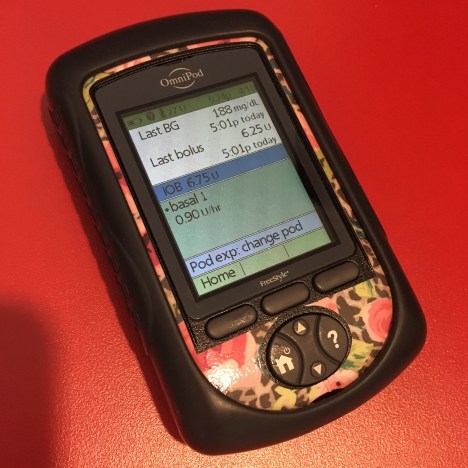
IMG_2075
27 units and no choice but to throw all of them away.

It’s a strange, messed up game that I played. I was taking a bit of a risk by wearing my pod for so long after it expired. After all, it’s just a piece of technology, and it can sometimes be difficult to know whether or not it’s working properly when it’s brand new, let alone within the window of expiration. But this is the game that I have to play, along with so many other people with diabetes, because insulin is precious.

Insulin keeps us alive.

Insulin is a need, not a want.

Insulin is exorbitantly expensive, so much so that it ranks #6 on a listing of the 10 most expensive liquids in the world.

With that in mind, tell me…would you feel comfortable throwing away even one single unit of it?

One could argue that maybe I could’ve tried to extract the 27 units from the old pod and reuse it in a new one – but to me, that’s an even more dangerous game to play. I have no clue whether that’s safe, or if there’s too much risk involved with germs and cross-contamination. Maybe I’m just paranoid, but when it comes to my health, I have to be.

So as much as it pained me to be unable to use every last drop of insulin, I made the only viable choice for me and disposed of 27 units of Humalog.

27 units, 16 units, 3 unit, 1 unit…no matter what the quantity is here, every last drop of insulin is invaluable.

When will we see change? Is it really too much to ask for insulin to be affordable to all?

The Hellacious, Headstrong High

There’s lots of different “kinds” of high blood sugar. There is the type that is self-inflicted due to inaccurate carb counting or insulin dosing. There’s the sort that can be blamed on technological error – an insulin pump failure or a cannula kink, for instance. And another kind is linked to illness, when a cold or other sickness prevents insulin from working efficiently, thereby stopping blood sugars from coming down to normal levels.

And then there’s the type of high blood sugar that simply can’t be explained. It’s high for seemingly no goddamn reason, and it’s the most frustrating high of them all.

That kind of high is also the kind that takes what feels like forever to come down.

I experienced this after a Saturday of travel earlier this month. I’m fairly accustomed to traveling, especially if it’s a quick trip on a plane or just a few short hours in the car. I say this because I’m almost positive that my hours-long high blood sugar had nothing to do with my travel day…although when it comes to diabetes, nothing can truly be ruled out.

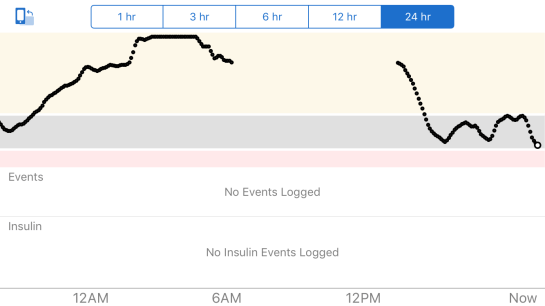
Anyways, I digress. That day involved me heading out of the house at 10 A.M. I drove to the shuttle that would take me to the airport. I got to the airport about an hour before my flight was due to take off. I went through TSA Pre-Check – my first time using the service, which I totally recommend – without any issues. I had enough time to pick up some food for a small lunch, but when I checked my CGM and noticed that my blood sugars were hovering in the 200s, I decided to deliberately pick lower-carb snacks to munch on in lieu of a real lunch. Turkey jerkey and cheddar popcorn weren’t the most filling snacks, but it was something.

I figured that by the time I got on the plane, my blood sugars would be stabilizing. No such luck. I was still in the low 200s. I took one or two more boluses during my quick hour-and-a-half long flight, thinking that I must be heading for a blood sugar crash by the time I deplaned. Nope. I was still running high, even by the time I met my partner by the baggage claim. I raised my temp basal and kept my fingers crossed that by the time we reached the restaurant we were bound for, I’d be coasting down. As we got settled at our table, I checked my blood sugar and felt slightly relieved to see that I was 183. At least I was finally below 200.

Teacher's Month 2020

I pushed blood sugar worries out of my mind for the next hour or so. I just wanted to enjoy my meal and my time with my significant other. But as we finished eating and made our back to the car, I couldn’t help but notice the repeated buzzing coming from my CGM. I was rising gradually, well on my way to 300. I tried to not panic and gave myself more insulin. We arrived home and the vicious cycle truly began. For the next three or four hours, I tested and corrected every hour, on the hour. Midway through that interval of time, I changed my pod – perhaps it stopped working properly – and prayed that the new pod would finally bring me back down.

And, spoiler alert: It eventually did. But in the agonizingly long hours I had to wait before my blood sugar was down…I experienced a bevy of emotions. I was mad. I was upset. At one point, I was very technical and rational, going through my next steps both in my head and out loud to my worried partner. He asked me what we should do in the event that my blood sugar was still elevated after a certain length of time, and that’s when I started crying tears of fear and frustration. It all felt so unfair. I was doing all the right things and it wasn’t make a difference. That was a hard reality to swallow. And I couldn’t help but cry harder when he asked me to show him how to use glucagon again (it’s been at least 3 years since he had formal training with my diabetes educator). Part of me felt better, knowing that he was prepared for adverse affects of taking so much insulin to combat a high, but I think I was more focused on and distraught by the fact that he might need to intervene, which was an especially upsetting scenario because I never want to put that responsibility on anyone.

Once I calmed down, I filled a water glass, sat down on the couch, and texted my mother, who is always my T1D sounding board. She reassured me that I was doing the right things, and that I should continue to wait and see what happened. She also advised me that I should be prepared for a crash, because sometimes, it seems like all the insulin kicks in at once when blood sugar drops too quickly/low from a high.

So I waited. I drank water. I showed my boyfriend the app on my phone that simulates glucagon injections – just in case. I played video games. I tried to keep my cool. Before long, it was nearing midnight, and I desperately wanted to curl up in bed. I went through my pre-bed routine, washing my face and brushing my teeth, knowing I’d check my blood sugar for the umpteenth time that night once I was done.

And…it was 153. Better yet, it didn’t go as low as it could have overnight: I dropped to about 75 by 8:30 A.M. All things considered, it was a decent outcome.

The hellacious, headstrong high had finally subsided. I was so, incredibly relieved. And I’m so, incredibly hopeful that I don’t experience a day like that again any time soon.

Why I’m Afraid to Turn 26

I’ve never been afraid of my birthday. In fact, I’ve looked forward to it every single year because of all the fun things that distinguish the occasion. I’m lucky to be able to say that each third of May of my life has been filled with celebration, gratitude, and cake – what’s not to like about that?

But this year is different for me. I’m turning 26, which means I’ll no longer be eligible for dependent coverage under my parents’ health plan. I’ll need to enroll in my employer’s plan and figure things out from there.

to my best buddy,
I don’t want a cake or presents for my birthday this year. I’d rather affordable health insurance.

This is terrifying to me. Why?

I’ve heard the stories.

Alec Raeshawn Smith’s story sticks out to me the most. He researched his insurance options and when he realized that the out-of-pocket costs for insulin were exorbitantly high, he decided to forgo insurance because it seemed more manageable to him.

He passed away just one month after going off his mother’s health insurance plan.

His family believes he was rationing insulin in order to survive until he could afford to buy some more.

There’s nothing about Alec’s story that isn’t tragic. It’s especially sad and frightening to someone who is about to begin navigating the confusing, expensive, and ruthless world of health insurance.

I’m hoping that I never get to a point where I need to pursue the dangerous “solution” of rationing insulin. But I’m also hoping that the biggies of insulin manufacturing – Novo Nordisk, Eli Lilly, and Sanofi – wake up and realize that they’re doing more harm than good. In 1996, just one year before I was diagnosed with diabetes, one vial of Humalog insulin (which I’ve used and continue to use since diagnosis) cost $21. Fast-forward 20 years, and Humalog costs skyrocketed to twelve times the cost at $255 per vial. Why? What could possibly justify this? How could anyone say that it is right for someone with diabetes who needs insulin to survive, and who didn’t ask for diabetes or do something to cause it, to pay that much on a regular basis to stay alive?

One thing is for sure: Insulin prices CANNOT stay as high as they are. There’s simply no reason for it, other than shameless, disgraceful greed.

And that is the simple truth of why I’m afraid to turn 26 this year.

Memory Monday: The Shattered Insulin Vial

One Monday per month, I’ll take a trip down memory lane and reflect on how much my diabetes thoughts, feelings, and experiences have unfolded over the years. Today, I remember…

…the insulin vial that my mother and I accidentally broke in the bathroom of a restaurant, many years ago. R.I.P., tiny vial of Humalog.

This goes back to the days of having to scurry off to the restroom soon after ordering our meals to check blood sugars and inject insulin. And it was a pain. We wanted to be considerate of other diners around us in the restaurant, so doing our diabetes things at the table wasn’t an option. That left us with the most logical choice, the bathroom.

On the night of the broken vial, we were having dinner at a local restaurant. Once our dinner orders were placed, we headed off to complete our routine. And it went just as expected: We knew our blood sugar levels and did the mental math necessary for figuring out our insulin intakes. If memory serves correctly, I was still at an age where I wasn’t totally comfortable with injecting myself yet and would ask my parents to help me whenever we were in a public place (I felt better about self-injecting at home, my literal comfort zone). So my mom ushered me into a stall and went about filling her syringe, then mine. Soon after she stuck me with the needle, it happened…the vial fell. I don’t know if it was my hand or her elbow that knocked it off from its perch, but something caused it to tumble down to meet its end.

Capture


It was a dramatic moment. If a slo-mo camera had captured the ordeal, I’m sure it would’ve shown my mother and I donning identical, horrified expressions as the vial smashed into smithereens on the tiled bathroom floor.


It wasn’t the end of the world; after all, we’d just taken our shots before the incident, and the vial wasn’t completely full. But it was just full enough that we were upset about all the wasted insulin that formed a small puddle on the floor.

I remember my mom gingerly picking up the pieces of the fractured vial and disposing of them, sighing as she went about the task. That whole experience resulted in a few things. 1) We made sure to get a vial protector soon after it happened to help cushion future insulin vials that were accidentally dropped and 2) We got insulin pens a bit further down the road, which proved to be much more durable and portable than vials. In fact, they made it so we could do injections at the dinner table, in the car, and just about anywhere with ease and discretion.

But this incident remains etched in my memory because it instilled always being careful with my diabetes supplies from that moment on. All of my diabetes stuff is expensive and extremely precious because of what it does for me, my mom, and millions of other people on a daily basis – it’s got to be treated carefully, always.

Why Backup Supplies are Important to a T1D

“It’s better to have it and not need it, than to need it and not have it.”

Growing up, this mantra was frequently repeated by my mother regarding my diabetes supplies. More often than not, I’d roll my eyes at the saying – not because I was annoyed with her, but because the prospect of carrying extra supplies “just in case” felt very inconvenient. My purse/backpack/overnight bag would already be crammed to maximum capacity, so squeezing in backup needles or insulin was practically impossible. But typically, I’d cave and make it all work somehow, because the fear of not having something essential when I was away from home was strong enough.

I’ve kept up this practice in my adulthood, as overnight travel and increased distance from home have become more common. And I was reminded why it’s a good idea very recently.

I was staying at a friends’ place for the night. They live about 45 minutes away from my house, which isn’t far, but it was far enough for me to want to make sure I had extra supplies. I definitely did not want to have to make that drive twice in one night, and I knew it wouldn’t even be a realistic option, because chances were good that I’d be drinking alcohol – it was game night, after all.

Capture
If you have T1D, always be prepared.

Pizza, beers, and laughs were had, and before we knew it, it was one in the morning. We all headed off to bed, and just as I do every night, I checked my blood sugar before I got totally settled.

I was wicked high – the mid-300s, actually.

I was worried, because I thought I’d been on top of my blood sugar for most of the night. I gave myself an extended bolus for the three slices of pizza I ate, limited my beer intake (too many carbs), and kept a watchful eye on my CGM. While I did know that my blood sugar was climbing, I thought that I was staying on top of it with correction doses. Apparently not.

No matter, I figured. The best I could do was take more insulin, drink some water, and try to relax a bit before bed. I didn’t want to sleep until I knew my numbers were coming down, but I also knew that my willpower to stay awake was fading. So I set an alarm on my phone to wake up in an hour and check my blood sugar again.

When I did, I was 377! I couldn’t believe it. I followed the same process again – bolused, drank water, set an alarm to wake up in another hour – and hoped for the best. But when my alarm blared again at 3 A.M. and I discovered that I was STILL stuck at 377, something told me that there was more to the story here. I lifted up my shirt to check my pod, which should’ve been securely stuck to my belly…except it wasn’t. The end with the cannula was sticking up, revealing that the cannula was not underneath the surface of my skin.

I felt simultaneously pissed off and relieved. I was mad because I’d just changed my pod earlier that day, so it should not have come off so easily. But I was relieved because finally, I had an explanation behind the super-high, super-stagnant blood sugars.

And I was seriously relieved that I’d thought to pack my insulin, a spare pod, and an alcohol swab in my overnight bag.

So there I was, changing my pod at 3 A.M. Far from fun, but it was necessary. I even wound up giving myself an injection with a syringe – yet another diabetes supply that I don’t really need to carry but had stowed away in my kit (just in case) – to ensure that my system had insulin in it to bring my blood sugar back down.

From there, it was a long night (morning!) as I set numerous alarms for the next few hours to wake up, check my blood sugar, and bolus more as needed. I couldn’t rely on my CGM for readings, because guess what? It got torn right off my arm as I tossed and turned in bed. Go figure, right? (I didn’t have a backup sensor because the CGM is one thing that isn’t exactly necessary. It makes life a helluva lot easier, but for a single overnight trip, an extra sensor wasn’t needed.)

4F83304E-8212-46EF-8223-A7D47CE2CD0C
What a long night…

I probably only got three hours of sleep that night, and I was pretty damn defeated looking at a shitty CGM graph the next day. But you know what? The whole incident serves as a stark reminder that it’s important to ALWAYS have backup supplies: You never know when you might depend on them.

Happy Birthday, America!

Today is the Fourth of July! I’ll be spending the day in our nation’s capital. While I’m not entirely sure what the day will bring, I do know that I’m bound to feel a swell of patriotic pride, as I imagine the vibe of Washington, D.C. this time of year oozes red, white, and blue.

439D9CEC-9F02-485C-811F-C60BF60811ED
The Stars and Stripes

As much as I love my country, I still think it has a long way to go. I promised myself I would refrain from getting overly political on my blog (for many reasons), but I will say this one thing: Many things about healthcare in America need to change. I found an article on the New York Times recently that opened my eyes to the dire state of the global insulin crisis. Here are some facts from that article:

  • One in four patients with diabetes are cutting back on insulin because of cost.
  • The typical cost of one vial of insulin is $130. One vial of insulin lasts no more than two weeks for a person with diabetes.
  • There is no generic form of insulin. This means that prices skyrocket since there is no competition among generics.

Why is this happening? Why do families find themselves being forced to choose between feeding their families or affording life-saving medication? It’s unacceptable that profits are valued over life in our great nation.

Things need to change. The politicians and policymakers who have the power to make right and just changes need to take a good, hard look at Americans who are crying out for help and struggling to simply live.

This topic is worthy of thousands more words, but I’ll leave it at that for now. Maybe it will open someone else’s eyes, too.

For now, have a beautiful Independence Day doing whatever it is that makes you feel free – and be safe!

Memory Monday: The Diabetes Diet, 100 Years Ago

One Monday per month, I’ll take a trip down memory lane and reflect on how much diabetes technology, education, and stigma has changed over the years. Remember when…

…insulin had yet to be discovered? Of course you don’t actually remember it, unless you were born in or prior to 1921 (and if you were, wow!!! Thanks for checking out the blog!).

Anyway, prior to the groundbreaking discovery of insulin, people with diabetes lived difficult – rather miserable, actually – lives. I started reading a book called Breakthrough: Elizabeth Hughes, the Discovery of Insulin, and the Making of a Medical Miracle a little while ago. This book has made me realize just how fortunate I am to live during a time when insulin is around (even if it is grossly overpriced).

Many parts of this book have surprised, horrified, and downright depressed me. One of the more shocking things that I’ve learned from it, though, is the diabetes diet that was prescribed to patients in the early 1900s. Patients like Elizabeth Hughes, the T1D daughter of a U.S. politician, were expected to follow a strict meal plan upon admission to the Physiatric Institute in Morristown, New Jersey. Imagine following an eating plan like this every day:

Breakfast – One egg with two and one-quarter tablespoons of string beans boiled three times, and one tablespoon each of cream and coffee.

10 A.M. – Half a small orange for a snack.

12 P.M. – Two and a half tablespoons of cod with two heaping tablespoons of Brussels sprouts boiled three times, as well as five small olives and a half pat of butter…with a cup of tea to wash it all down.

Dinner – One egg and one egg white, 2 tablespoons of spinach (yes, boiled three times), with a half pat of butter.

Oh, scratch that part about following this diet every single day – patients had to fast one day each week. No food was permitted, at all.

Does that not sound vile?

I mean, I love eggs, and I happily eat veggies on a daily basis. But I’m certain I’d get sick of them no matter how they were prepared. And veggies boiled THREE times? I would think that they’d be reduced to mush, which, according to the book, is the point. Boiling them so many times would ensure minimal carbohydrate consumption since the nutrients would basically be cooked out of the vegetable. Plus, with portions so tiny, it’s hard to imagine that anyone ever felt full after consuming a “meal”.

DD0B7735-4A89-42C5-81A4-732B91E1F4BF
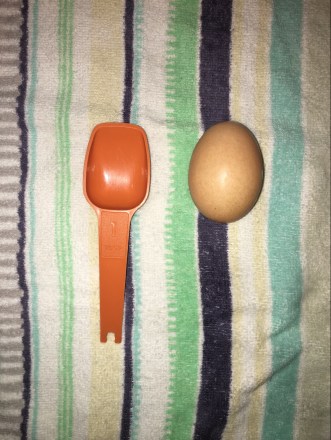
For context, one egg is about the same size as one tablespoon, meaning that portions on this diet plan were miniscule.

This extremely restrictive diet left patients yearning for pictures of food they saw in magazines, as well as severely undernourished. Following this meal plan practically guaranteed that patients would become emaciated. In fact, by the time 15-year-old Elizabeth Hughes left the Physiatric Institute, she weighed a mere 45 pounds – less than half what a healthy girl that age should weigh.

Even though I haven’t finished the book yet, it already serves as a reminder to be grateful for what I’ve got in this day in age: not just insulin, but amazing technology, wonderful doctors, and radical ongoing research in the diabetes field.

All of today’s advancements make me hopeful for the possibility of the eradication of diabetes, maybe not too far after the 100-year anniversary of the discovery of insulin.