Navigating New Insulin Pump Sites and Nerves

This was originally published on Hugging the Cactus on September 7, 2020. I’m sharing it again today because my mom and I were recently talking about pod placements and the places where we would (and would not), hypothetically, feel comfortable wearing a pod. It got me thinking about how I’ve had to work up the courage to try new sites over the years, which inspired me to write this post to hopefully help others who feel the same way about navigating new pump sites and nerves. Read on for more…

Am I the only T1D out there who feels incredibly nervous about trying new insulin infusion sites?

I’ve been this way as long as I can remember, now that I’m thinking about it. Throughout my childhood, I stubbornly stuck to injecting in my arms, legs, and upper buttocks (tee-hee) because those were the areas I felt comfortable with. I don’t think I even considered jabbing myself in my stomach until I was in my teens, and it was only after I realized the importance of site rotation and reducing scar tissue.

So it’s kind of funny that when I went on the OmniPod just over five years ago, I only used my stomach and my lower back (just above the upper buttocks region, tee-hee) for pod placements. It was partly because my guinea pig – I mean, my mom – used those areas for her pods with success, and also because I was hesitant in the beginning to wear my pods on my arms or legs because of their increased visibility.

It went that way for a couple of year – four basic sites ’round my abdomen – when it occurred to me yet again that site rotation was also important for insulin pumpers, not just MDI-ers (multiple daily injection…ers). So I added my upper arms into the mix, and soon after, my upper thighs followed.

The little diagram (courtesy of Insulet/OmniPod) above only shows a few of the sites that people with diabetes use…over the years, we’ve gotten a lot more creative!

But lately, I’ve shied away from wearing pods on my thighs because the area isn’t overly comfortable. When I roll over in my sleep at night, my pod presses up against my leg and the resulting pressure is just enough to disrupt my sleep and make it difficult for me to find a more restful position to sleep in.

As a result, I’ve started contemplating potential new pod sites, and one of the first places I went to for advice was…Instagram! Because…duh.

The DOC (diabetes online community) on Insta is a natural resource for this sort of thing because many people tend to share photos of their sites. It’s kind of a thing. One simple scroll through my feed taught me that people can get very inventive when it comes to finding new locations to place their CGMs and insulin pump infusion sites.

I saw people wearing Dexcoms on their forearms and calves. I saw pods on backs, calves, and even the upper chest area, the latter of which I found most intriguing. For men, it seems like a very accessible spot that causes little irritation, but for women? How the heck did the T1D ladies I saw with pods on their chest deal with it?

The general consensus, it seemed, was that women wearing pods on the upper chest agreed it was a site with great absorption and minimal discomfort.

I was still skeptical, though. I was worried about how it would look if I was wearing a v-neck tank with my pod poking out of, well, my bra! Then it hit me that my pod garners questions from strangers regardless of where it’s located. Furthermore, people will (probably?) be less likely to ask about it if it’s located on my chest because, um, that’s really awkward. My eyes are up here, people!!!

Then I remembered: I could give the site a try without wasting a pod because I have a demo pack that I got from a diabetes conference awhile back! The demo pack comes with a dummy pod that looks and feels just like a regular pod, but there’s no reservoir built into it, so insulin can’t be injected into it.

So right now, as I’m writing this, I’m wearing two pods: one on my upper arm that’s actually giving me insulin, and a fake one on my chest just to see how I like it. I must admit, so far, so good! I slept comfortably with it on last night and I haven’t had any issues wearing clothing or undergarments with it. I even went for a jog with it on and got pretty sweaty, but it stayed secure/I didn’t feel it bouncing around at all (thought the adhesive got a bit too damp for my liking…it stayed on but if I wasn’t careful I totally could’ve knocked it off).

While I’m still having a hard time wrapping my head around an actual cannula piercing my skin at this location (eeeek), now that I know I can handle the pod itself living there, I’m one step closer to trying (and liking) a site that’s more intimidating to me – a win in my book.

That “Thing” on my Arm

This blog post was originally published on June 12, 2019 on Hugging the Cactus. I’m sharing it again today because when you live with T1D, it’s inevitable that you’ll attract stares – and sometimes questions you’d rather not answer – from people who are befuddled by your diabetes gadgets and gizmos. This one encounter in particular is a great reminder that not all oglers have ill intent…read on for more.

“Yo, I don’t mean to be rude, but what’s that thing on your arm? Looks pretty cool.”

I turned around to face the stranger who was looking at me and asking me this question. It was well after midnight and we were on the rooftop of a fairly crowded bar. It was a balmy, summery night and I was enjoying the atmosphere with my boyfriend and my best friend. I’d had a few drinks over the course of the night, but judging by the state of everyone else on the rooftop, I was probably more sober than most of them.

That “thing” on my arm is basically my pancreas – please don’t stare at it, bro.

I could’ve answered his question in a scolding manner; it wasn’t a “thing”, it was a device that keeps me alive.

I could’ve totally dismissed him and told him to mind his own beeswax, because really, it is sort of rude to point out something on another person’s body.

I could’ve lied and told him it was something that it’s not to get him to stop bothering me.

I could’ve launched into an educational breakdown of what an insulin pump is and why my OmniPod looks the way it does.

I could’ve done any number of things, but instead I decided to say, “Oh, this is my insulin pump. I’ve got it decorated right now with a picture of a lighthouse because I like adding some style to it.” I smiled at him as a way of reassuring him that I really didn’t care that he was asking me, because I didn’t.

My straightforward answer seemed to please this random man. He told me again that he thought it was cool, and then we chatted a bit about where the lighthouse is and discovered we both have a connection to Massachusetts. Within a few brief moments, the conversation was over as we went our separate ways.

It was a perfectly harmless interaction that could’ve went a number of different ways, but to me, it’s all about context. This guy was just asking out of curiosity, and I truly don’t think he was trying to be rude about it. So I answered his question succinctly but good-naturedly, because I felt that was the only way to go about it in this busy party environment. Plus, let’s be real here…had I delved into a discussion about diabetes and devices, this drunk man probably wouldn’t have digested a single detail of my description. (Ahh, I love alliteration.) And another important point? He was damn right, my pump did look cool because of the lighthouse sticker!

But man, how much simpler it’d’ve been if I’d just been wearing my “THIS IS MY INSULIN PUMP” sticker on my pod that night.

The Dazzingly DASHing Drained Battery

Cell phones, eReaders, tablets, video game consoles, PDM devices…these are all electronic devices that rely on rechargeable batteries in order to keep them up and running. Of all those possibilities, which one do I think has the worst battery life?

Unfortunately, it’s my Omnipod PDM.

The speed at which my Omnipod DASH PDM battery drains is alarming…

It’s particularly unfortunate because the fact that the Omnipod DASH has a rechargeable PDM was one of the more exciting features to me when I first started using it. It always bothered me that I had to remember to keep AAA batteries on me at all times with the traditional Omnipod model (I know, I’m making a mountain out of a molehill with that one, but people with diabetes already have to remember to carry so many “just in case” items on us at all times that something like two measly batteries feels like a big effin’ deal). I also disliked how it was pretty difficult to predict when the traditional Omnipod PDM’s batteries would run out of juice (though I eventually did an experiment that helped me approximate the batteries’ lifespan a little better).

So imagine my delight when I learned that my DASH PDM could be recharged! This would feel like second nature to me seeing as I already own so many electronic devices that run on rechargeable batteries. According to the instructions manual for my DASH system, the battery would be able to last 3-4 days on a single charge, so it was nice to know that I’d have to expect to charge my new PDM only once or twice per week.

But in late September – only 4-6 weeks after I started using my DASH system – I noticed a slight issue. My DASH PDM was only holding a charge for a day, maybe a day and a half. This little problem exploded into a significant headache when I went on a trip to California and my PDM died right in the middle of my day trip to San Francisco, forcing my boyfriend and I to troubleshoot quickly.

I should’ve learned my lesson right then and there and called Insulet when I returned home from my trip, but…life happens. My schedule grew extremely busy, then the holidays were here, then I just…well, I grew complacent with having to recharge my PDM on a mostly daily basis. It’s embarrassing to admit it, but I only defend this behavior in a similar way to how I felt about carrying extra batteries on me at all times because there are simply far more important things to worry about when it comes to living life with diabetes. I was fine to coexist with this short battery lifespan if it meant that everything else in my little diabetes world was working okay – and since it was, I didn’t think to do anything about it…

…until recently, when I decided that maybe I should call Insulet and ask for their advice.

Thanks to their wonderful customer service team, I learned that if I were to use any charging cord or plug besides the one that came with my PDM originally, that might contribute to dazzingly dashing drained batteries. That caught my attention because I definitely wasn’t always using the right cord/plug: Often, I was just grabbing the first thing in sight around my condo seeing as so many other electronic devices can be recharged with the same style of cable.

I was reassured that I was doing all of the right things otherwise – silencing alarms when they came up, putting my screen to sleep when I wasn’t using it, and changing my system settings so the screen was programmed to go dark in the shortest amount of time possible. I was also promised a new PDM if, after a few weeks’ time of using exclusively the Omnipod DASH charger, I noticed that it was still having drained battery issues.

Sure enough, the problem has persisted, so I now owe Insulet another call to get my PDM replaced altogether. Here’s hoping that my replacement will outDASH my bad PDM in terms of battery life…

What I’m Looking Forward to the Most About the Omnipod 5

I experienced many emotions when it was announced, at long last, that the Omnipod 5 received FDA approval. The most prevalent one was joy: I was elated for myself, my mom, my coworker MJ, and all other people with diabetes who have greatly anticipated this day for what felt like ages. The thought that so much of the heavy weight associated with life with diabetes will soon be lifted off our collective shoulders is one that is thrilling beyond words.

Besides joy, I felt anxious (when will we actually have access to this technology?!), hopeful (the wait is bound to be worth it), surprise (I hadn’t expected the FDA approval this early into 2022), and…relief. That last emotion was probably the one I felt most strongly right behind my joy, and that’s because I’m taking solace in knowing that my secret diabetes struggle will be no more with the help of the Omnipod 5. And this leads me to the explanation of what I’m most looking forward to about the Omnipod 5…

I cannot wait to get my hands on the Omnipod 5…but for now, I’ll have to settle for staring at this promo image of it.

…and that is sleep. Yes, sleep. More specifically, sleeping soundly through the night, every night. Because my secret diabetes struggle has gotten in the way of that to new extremes in the last several months.

Long story short (I’ll save the long version for an upcoming blog post), my sleep is disrupted perhaps 3-4 times per week due to a low blood sugar. It’s annoying, sure, but part of the problem is my complacency in the matter. As crazy as it may sound, I’ve grown accustomed to the sound of my Dexcom alarming at any hour of the night and rolling over to grab a low snack from my nightstand drawer.

I think it’s been so easy for me to make peace with because of all the diabetes battles I could pick and choose (for example, if I had to choose waking up for lows or dealing with high blood sugars for hours on end any time of day), it’s the one that seems the most painless compared to every other possible scenario. It’s a weak explanation for this behavior, but it’s the best one I’ve got and I think that some people living with diabetes could probably understand (or even relate to) this rationale.

So that’s why I get a little teary-eyed thinking about how the automated insulin delivery mechanism of the Omnipod 5 could help reintroduce truly restful nights of sleep back into my life.

They are tears of joy, anticipation, and hope over how this new piece of technology may very well help me (and countless other people I love and care about) reclaim so many aspects of life that “normal” people take for granted.

The Major Diabetes Mistake I Made

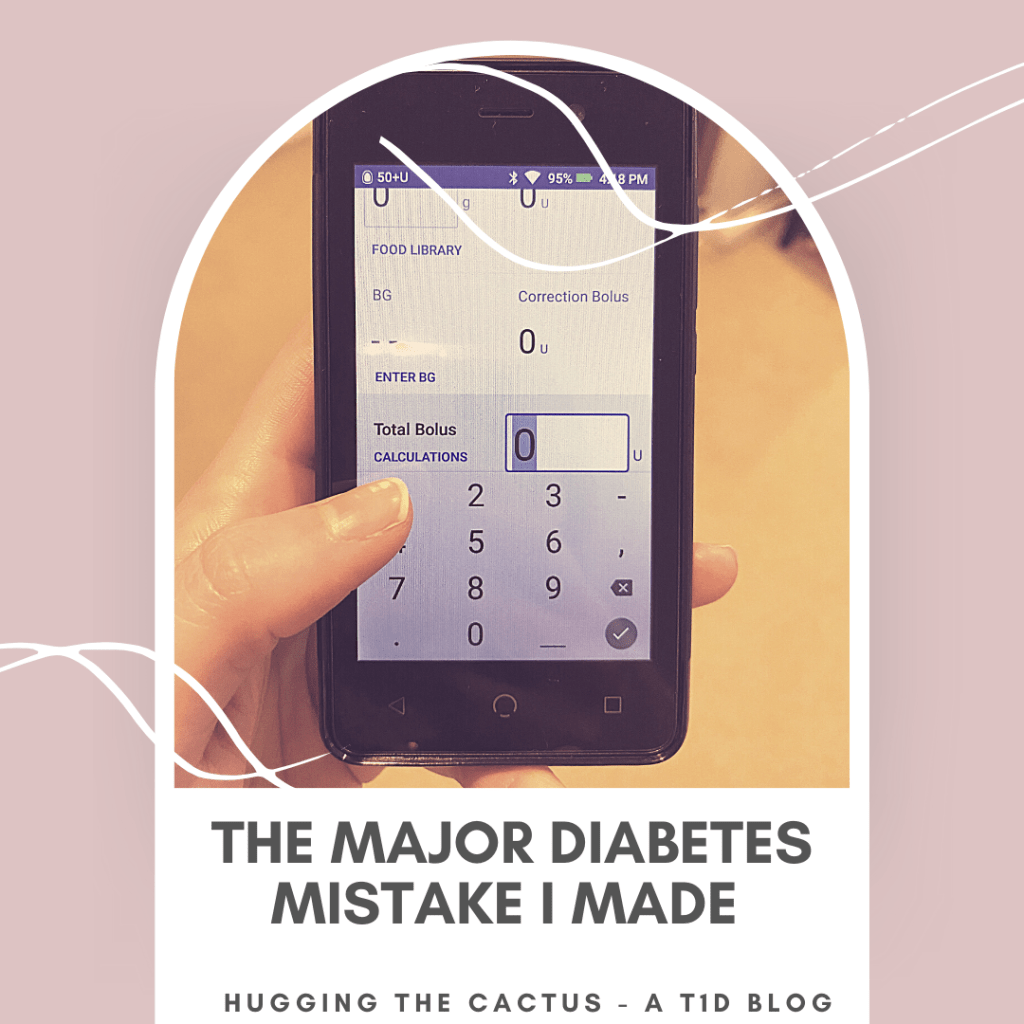
I recently experienced a diabetes first: I bolused myself for 10 units of insulin instead of the one, single unit that I had intended to give myself.

Whoops.

Major whoops.

This careless mistake occurred because I simply wasn’t paying attention when I was inputting numbers into my PDM. I thought I had entered “10” as the amount next to the number of carbs I was about to eat when in reality, I overrode my PDM’s suggestion from 1 to 10 in the total bolus calculator. And I didn’t even realize this until I heard my pod beep randomly several minutes after I’d fiddled around with my PDM. Thank goodness I did notice that beep; otherwise, I would’ve been alerted to my mistake about an hour later when my blood sugar would inevitably start to plummet.

Upon hearing that beep, I decided to check my PDM to see what was up – I assumed that maybe I had a temp basal running that I’d forgotten about, and my pod was just letting me know that it was finished. Obviously, this was not the case. When I saw that I’d bolused 10 units, a wave a panic crashed over me and I immediately started crying. My poor mother, who witnessed me making this discovery, started inquiring what was wrong and I explained to her what I’d done while I brushed angry, frustrated tears off my face. I was in disbelief that I’d done something so stupid. My mom, though, brought me back to reality and redirected my attention to the fact that I should prioritize finding food to eat that would ensure that my blood sugar wouldn’t crash any time soon. I remember taking a breath, then scanning the kitchen for something high-carb that would kick in sooner rather than later.

My eyes landed on cereal, which is notorious for causing blood sugar spikes but also incredibly easy to eat lots of…especially when you aren’t overly hungry but desperately need to eat in order to avoid a scary situation.

See my finger hovering over the digital touchscreen of my PDM? It’s pretty dang easy for said finger to slip and hit a number when I didn’t mean to do so.

So I poured myself a big bowl of Life cereal mixed with Cheerios – not my first choice when it comes to cereal, but that’s what was in my parents’ pantry and this beggar really couldn’t afford to be a chooser, given the circumstances. I sat there and stewed as I ate what was probably the least enjoyable bowl of cereal of my life because I was too busy cursing myself for making such a stupid mistake and wasting insulin that I didn’t really need. Why didn’t I check my inputs before starting my bolus? How could I have ignored my ticking pod as unit after unit of insulin pumped into my body? What kind of idiot does that to herself?

I can’t answer the first two questions, but I can take a stab at that last one – the kind of idiot who is a human who’s had diabetes for most of her life and errs from time to time, just like any other human being with or without diabetes.

Sure, I was furious with myself for screwing up like this, but all things considered…it was bound to happen eventually. We all make mistakes and it’s impossible to double-check every action taken in life. I’ve had some time and space to process this incident, and I’ve forgiven myself for this reason coupled with the fact that I’ve never done anything like this before in two dozen years of life with diabetes. That’s a significant amount of time to go without an incident like this!

Plus, with that forgiveness comes the value of an important lesson learned, which is to be more mindful when I’m taking a bolus. It’s so easy to mistype something on a computer keyboard or when texting someone and this scenario is no different from that. I need to be better about being my own autocorrect, but balance the weight of that responsibility with the knowledge that I’m a human who is managing diabetes 24/7, which is exhausting, and that perfection is a myth.

Major diabetes mistake made, lesson learned, and time to move onward and upward.

Diabetes Hurts (Sometimes)

“Gimme a sec, I’m multitasking right now…owwwwwww!”

I was talking to my boyfriend on the phone and changing my Dexcom sensor at the same time when I was caught off-guard by (and yelped in surprise at) the sharp sting of the sensor’s needle plunging into my arm. It was a sting that evolved into a burn that lasted a solid 24 hours, much to my discomfort.

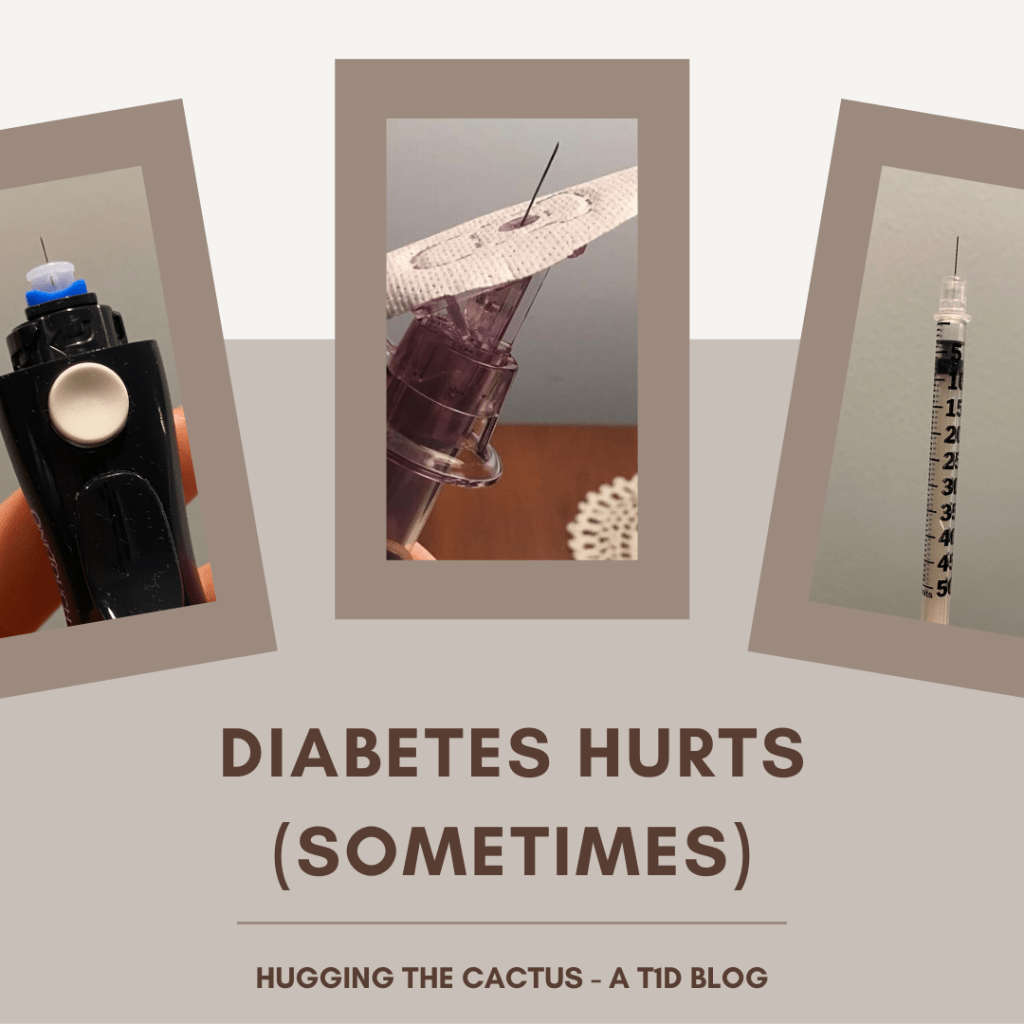
Examples of just a few of the many needles that I’m constantly poking myself with.

People often ask me whether or not my diabetes devices hurt. The answer is almost always no, because I’ve grown accustomed to the constant pricks and pokes. But once in a blue moon, I have a sensor or pod insertion that hurts so badly that my eyes well up with tears or I have to deal with a night or two of uneasy sleep, because it aches any time I roll over onto the stinging site.

It doesn’t matter that I’ve had at least 30,000 (yes, I did the math) shots and site changes over the years – diabetes still hurts, sometimes, and that’s just talking about the damage it does physically.

Diabetes hurts mentally, too, though that type of scarring is a whole lot more difficult to quantify.

The bottom line? Diabetes doesn’t hurt all of the time, but on the rare occasions it does, it’s a painful reminder that this is just the way of life for people like me who’ve got no other choice than to deal with it.

Out of Site, Out of Mind

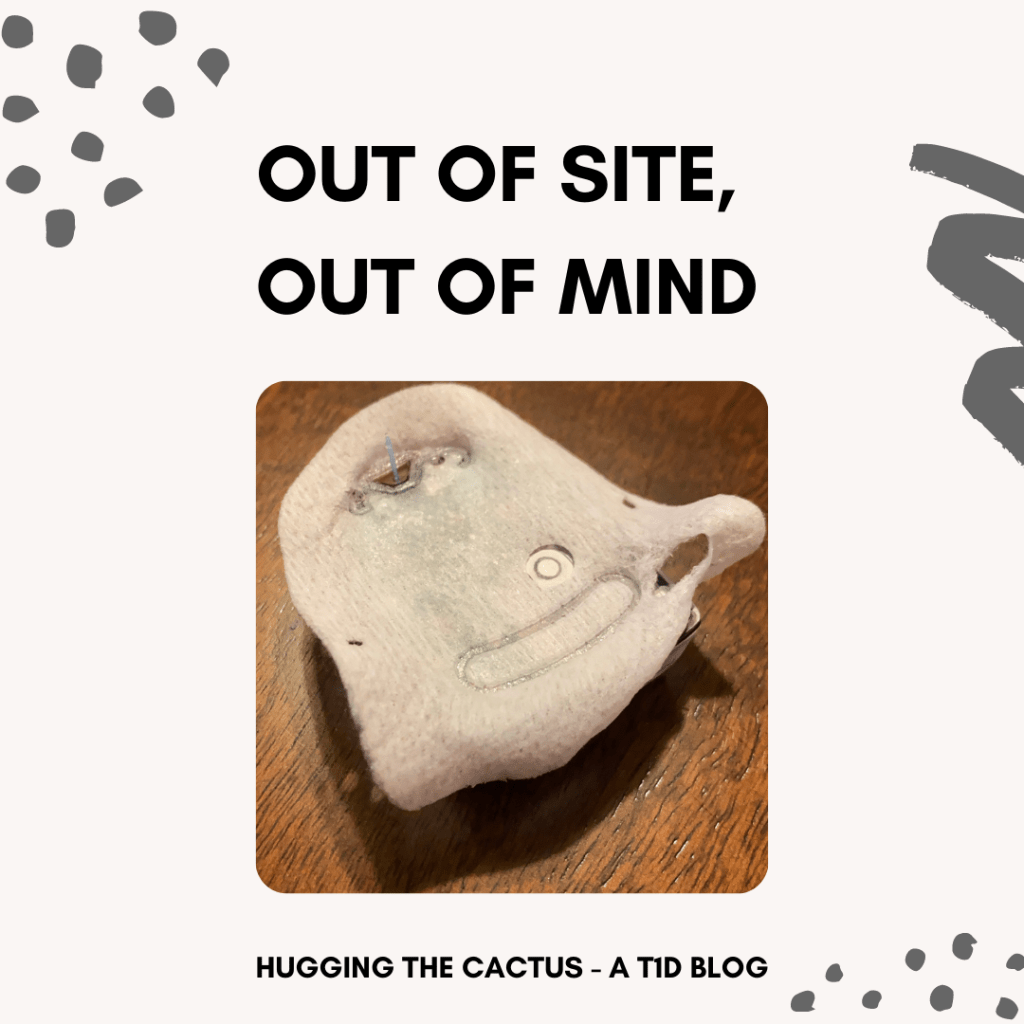
I knew I wanted to write a blog post about how I forgot to change my pod last week, and I knew I wanted to give it some sort of clever title…

…so out of site, out of mind is what I came up with. After all, my pump site was completely out of sight for me, which is one reason why I forgot it.

You’d think that it’d be impossible to forget about the device I have to wear 24/7, but it’s the sort of thing you get used to pretty quickly.

You’d think that after being on the Omnipod for almost 7 years, I’d never forget that I have to change my pod every 3 days. But just like I sometimes forget to reply to a text message or take a load of laundry out of the dryer, it slipped my mind the other night until just before I went to bed.

That’s when I was faced with a choice: Should I change the pod right then and there before I went to sleep, or let it expire overnight and change it first thing in the morning?

There were pros and cons to each. If I changed the pod before bed, then I wouldn’t have to worry about a screaming pod waking me up in the wee hours of the morning (well, I would if it failed, but the chances of that happening were small). But if I waited until the morning, I would ensure that the 30+ units of insulin still left in the pod would get used up as much as possible. It would also mean that I could push back my regular pod change by one whole day, which sounded appealing – until I remembered that it would mean that I’d have to change my pod on a Saturday when I’m double-hosting family, then friends, at my home.

So I sucked it up and changed my pod before going to sleep, knowing that in an hour and a half it would go off to remind me to check my blood sugar (to make sure that the pod was functioning properly), but feeling okay about this because I’d much rather deal with a gentle reminder over an aggressive malfunction alarm.

Now to the whole reason why I decided to share this seemingly insignificant anecdote in the first place: This is just one diabetes-related decision that I had to make on this particular day. I can’t even tell you how many other choices I had to make prior to this concerning which foods I ate, how much insulin I took, when I exercised, when I ate my meals, and so forth.

Diabetes is a disease defined by decisions. Fortunately, this one about when to change my pod was an easier one to make…but unfortunately, there are many others that are much more difficult. And I think all people with diabetes deserve goddamn decision-making trophies because of the funny conundrum of having no choice but to live life by making decisions.

The Biggest Diabetes Mistake I Made on My Trip to California

A couple weeks ago, I shared about my fears over flying again for the first time since before the pandemic.

Fast-forward to now and I’m happy to report that basically none of those fears came to fruition over the course of my trip…

…but of course I did experience one snafu that was definitely avoidable.

All smiles in scenic California in this pic, but I definitely wasn’t grinning like this when I made my mistake.

The biggest diabetes mistake I made on my trip to California was neglecting to charge my OmniPod DASH PDM as often as it (apparently) needs to be charged.

I’m not going to make excuses for myself because I should’ve planned better, but I will say that I’ve only been on this system for about six weeks or so now…and I’m still getting used to some of the PDM’s quirks. In particular, I have yet to figure out exactly how often I need to charge my PDM. It runs on a lithium ion battery, which is the same thing that most cell phones use. So one might make the assumption that I’d need to charge the PDM daily, but that’s definitely excessive – I’d guess that I only use about 20% of the PDM’s battery each day, but of course that depends on how frequently I need to bolus or play around with my basal rates. However, using that rationale, I’ve been charging the PDM every 3-4 days, or whenever I notice the battery falling to a 20% or less charge.

My logic failed me, though, when I falsely assumed that my PDM’s battery would last a day trip into San Francisco when it had a 40% charge.

I still have no idea what happened – all throughout my day walking the hilly streets of San Fran, I was careful to turn off my PDM screen whenever I wasn’t actively looking at it, and I was only turning it on to bolus slightly more than usual (I was basically snacking my way through the city the whole afternoon).

I consider myself pretty lucky, though, because I made the discovery that my PDM battery was dead towards the end of our day, right when we were headed on the subway back to our Airbnb: If there was a time for this to happen, it’s definitely better at the end of the day’s activities rather than at the beginning or somewhere totally inconvenient.

At least, this was what I tried to futilely tell myself in an attempt to feel better about my negligence.

Instead of feeling better, I was beating myself up over making what felt like a rookie mistake. I should’ve charged the PDM because, after all, there was no way that I was about to go into a brand new city for the first time with my phone battery at 40%, so why on earth did I think it was okay to do that with my PDM? Moreover, how the heck did this happen in the first place – does the battery really just drain super quickly and/or easily?

I knew there was no point in trying to figure out why it happened at that point in time – it was more important for me to charge the PDM as soon as possible so that my partner and I could experience In-N’-Out for the first time on our way back to the Airbnb as we had planned.

So, because he is brilliant and calm in “emergency” situations (unlike me), he came up with a plan: I’d head over to In-N’-Out, order our food, and wait for him in our rental car while he ran up the street to a nearby CVS to see if they sold any USB cables (you know, the types of charging cables that everyone has because most electronics are charged with those). And his strategy worked out beautifully. Soon after I had our bag of In-N’-Out in hand, he arrived at the car with the charging cable and I was able to plug my PDM into it so I could bolus for dinner right then and there instead of having to delay it. (We could’ve just waited until we were back at our Airbnb, but then I would’ve either had to eat a cold burger [blech] or eaten it fresh and run the risk of my blood sugar jumping up without the necessary insulin in my system. Obviously, we went with the more appealing option.)

All things considered, if that was the biggest diabetes mistake I made in California, then I’d say I did pretty good – more to come soon on my strategies for maintaining decent blood sugars while on vacation.

As for now, I’ll leave you with this – In-N’-Out is kinda overrated.

First Impressions: The OmniPod DASH

At long last, the day has come…the day for me to share my first impressions of the OmniPod DASH!

Full disclosure: I’ve only been using the system for 3 days as of this writing. But I thought it was important to capture my beginning thoughts on how it works because they’re bound to change over time as I gain more experience and familiarity with the system.

So without further ado, here’s a bullet point list (‘cuz who doesn’t love a good list) that hits the highs and lows – yes, pun intended – of the DASH so far:

  • It was shockingly easy and fast to set up. I was worried about inputting all my settings from my old OmniPod into the DASH system and assumed that I would need a block of time to do so. This is why I decided to do my set up on a free and clear Sunday afternoon with minimal distractions around me. Turns out, though, that I didn’t need so much time set aside – it took me exactly 10 minutes to get all my settings straightened away. In fact, it probably would’ve taken closer to 8 minutes if I hadn’t agonized over choosing my background photo for my lock screen! The PDM made the entire setup process extremely intuitive and easy to navigate, much to my relief.
  • The PDM is incredibly high-tech…and, at times, suffers from that. I’ve spent a lot of time marveling over the clean, sleek design of both the touchscreen and the PDM itself. It’s almost identical to my iPhone, which I think is both a pro and a con because I can see myself confusing one for the other in the future (though it’d be extremely obvious which was which once I unlocked the device). The touchscreen and menus are thoughtfully designed, but my big beef with them is twofold: 1) Some menus are totally buried – it took me an embarrassingly long time to figure out how to set a temp basal and 2) Anyone who ever claims to suffer from “fat fingers” or struggles to hit the right buttons 100% of the time on a smartphone might find navigation on the PDM to be a challenge. The good news is that it’s really easy to go back if you’ve mistakenly navigated to a menu that you didn’t need and to correct any accidentally hit buttons, but I could definitely see some users taking issue with the operation of the touchscreen as a whole – even though I personally haven’t found it bothersome.
Shout-out to the Insulet/OmniPod website for providing a much better image of the DASH PDM and pod than I ever could!
  • The pod change process has a new addition to it. DASH users have the option to record the site of their new pods, a feature that I think is pretty neat! I’ve always been pretty good about rotating sites, but having a record of exactly where I’ve placed my pods over time is bound to be helpful so I don’t ever use one particular site too much.
  • Speaking of the pod change process…I almost activated a pod when it wasn’t even on my body yet. I’m used to the pod change process consisting of multiple pages on my PDM that outlines everything step-by-step. The DASH system aims to consolidate things a bit and features more than one step on a page. This was all fine and dandy up until I hit the last step of the process – I touched the button to activate the pod, thinking that I was navigating to the last page in the setup process! This was mostly user error because I should’ve read the screen more carefully, but luckily, I had to hit a “confirm” button in order to actually activate the pod (so there’s basically 2 buttons that have to be hit to activate a pod, not one).
  • So far, I’m unsure how I feel about the rechargeable battery feature. I thought this would be a huge improvement over the old OmniPod, which took 2 AAA batteries, but now I’m having some doubts. Those AAA batteries easily lasted 6 weeks – maybe even longer. Now I’m going to have to recharge the DASH PDM at least once or twice a week, depending on how often I’m actively using it. This is going to be a slight pain, but according to what I’ve read, the PDM is still useable when it’s charging, so that makes it more tolerable. But I’m also thinking from the perspective of someone who is away from home at least a few nights a month – this is going to be just ANOTHER charger that I have to remember to pack every time I go away, which is a bit of a bummer.
  • The system sounds are SO MUCH BETTER!!! OMG, I think the days of OmniPod beeeeeeeeeeeeeeeeeeeeeeeeps are in the past! I haven’t noticed any of those lingering, ear-shattering beeps yet; instead, they seem to have been replaced with a pleasant chiming sound. I’m sure that over time, I’ll grow to hate that sound, too, but for now I’m just loving that I’m not being pestered with pod reminders by those grating beeps!

Like any diabetes device, I knew there would be some faults with the DASH system. But generally speaking, those faults are extremely minor and I’m still thrilled that I’m on this new system…and extremely curious as to how my thoughts and feelings about it will change over time. I’ll be sure to post about my new discoveries and experiences with it in the future!

Why I Went with an OmniPod Insulin Pump

This post was originally published on Hugging the Cactus on February 28, 2020. I’m sharing it again today because while my affection for the pump is still very much intact, I still wish at times that I had explored other options. But that doesn’t deter my excitement about switching to the DASH soon! Read on to learn about the one major factor that made me decide to go with an OmniPod over all the other insulin pumps out there.

Choosing an insulin pump therapy can be stressful and overwhelming, especially if you’ve never pumped before.

Factors like tubed vs. tubeless, whether or not your insurance will cover a given pump, ease of use, reservoir capacity, and many others all play into the big pump decision…

Weird to think that soon, I will no longer be using this exact same OmniPod system!

…if you’re like most (logical) people.

But if you’re me, then you count on pretty much one thing when making the choice: familiarity. I solely relied on the fact that someone I knew and trusted used the OmniPod and had a positive experience with it, and that person is my mother. On top of that, I waited a solid 2-3 years after she started to use it before it was my turn, because I wasn’t willing to even think about trying it until I could feel fairly confident that I would even like it myself.

Luckily, I’ve been on it for just over five years now without any major issues. While I do love it more than I ever liked multiple daily injections, I do wish I had thought it over some more before just going with it…especially now that there are other insulin pumps out there with some amazing features. I know that the manufacturer of the OmniPod, Insulet, has some great upgrades in the works, but it can be hard to wait for them.

If I could go back in time, I’d definitely do more research before semi-idly deciding that the OmniPod is right for me. Of course, I could make the switch to a new insulin pump in the future…but if and when I do decide to try something else down the road, I know I’ll make much more of an effort to really learn everything I can about my options before committing to a new piece of diabetes technology.