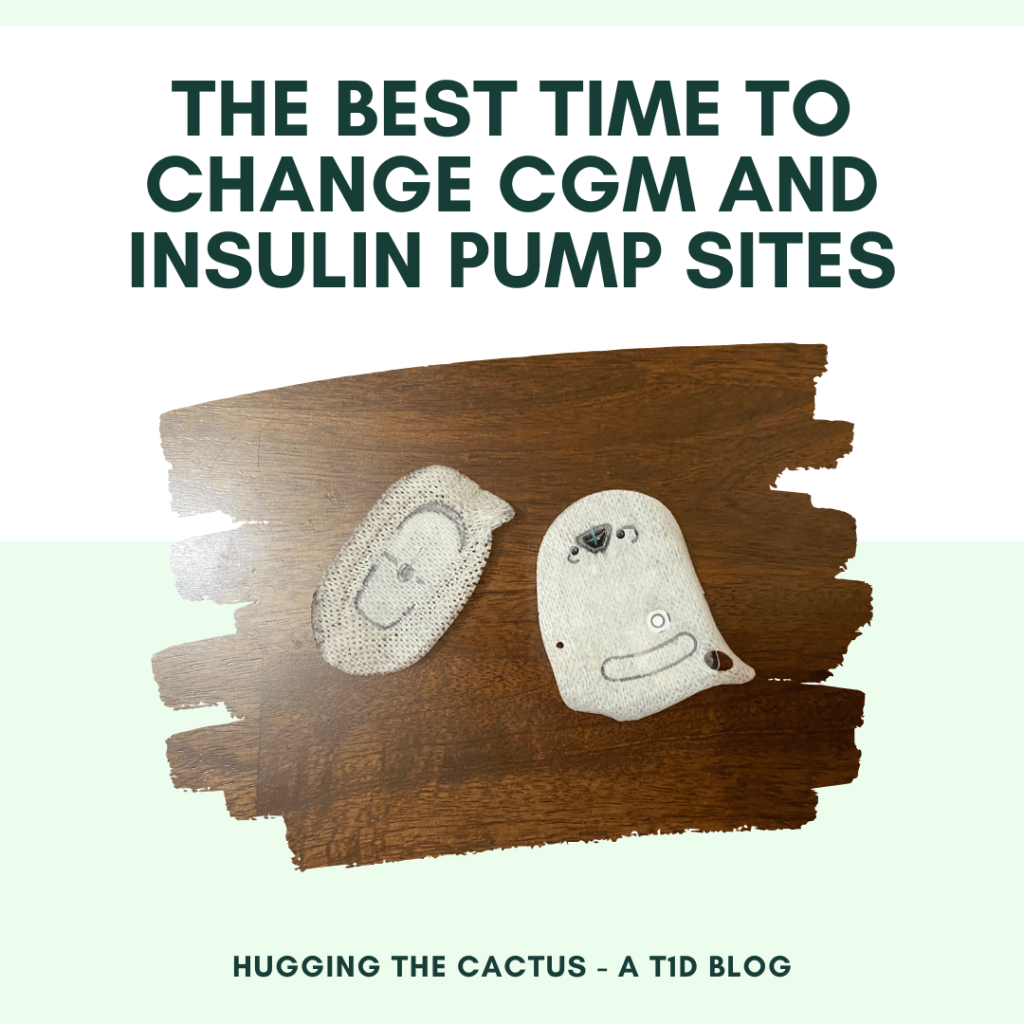
There IS a definitive best time to change a CGM and/or insulin pump site. It’s rare, but when the stars align and both sites need to be changed around the same time on the same day, then that is the magical occasion that allows for a device-free shower. So for me, syncing up pod and Dexcom sensor changes with the time that I plan to take a shower is by far the most wonderful and ideal time to go out with the old, in with the new.
Think about it. These two devices are meant to be worn 24/7, 365. The only time they ever come off my body is so I can rotate sites and put fresh sensors/pods on. This means that I’ve got two medical devices attached to my body at (just about) all times. And I’m totally used to that, except for the times that I somehow forget about my pod and CGM and manage to knock them off my body while changing clothes or, you know, just walking around – and apparently into – doorways/gates/etc.
So when a pod change coincides with a CGM sensor change, I embrace this as an opportunity to enjoy being free from my devices for a short window of time – and for me, the length of time it takes for me to shower is just perfect for taking a break and not having to worry about 1) cleaning around my devices, 2) bumping them into my shower door, or most importantly of all 3) rising blood sugar levels as this short time span isn’t long enough for me to face any consequences of not having an active bolus.
These might seem like trivial reasons to relish a device break so much, but it really is the only time that I am reminded that my body is aided by the devices, not defined by them. It’s nice to see my skin free of them both, even if it’s only for a short while.
It was approximately 8 A.M. on a weekday. I was in my kitchen, figuring out what I should eat for breakfast. I begin to take out all the things I usually put into a fruit smoothie – almond milk, protein powder, frozen fruit – when I noticed the ticking.
Tick, tick, tick…
My eyes wandered over to the clock affixed to my kitchen wall; certainly, that was the source of the sound. I walked up to it and held my ear close before remembering that said clock has not functioned properly since the day it was put up (that’s a long story, one that hopefully ends in me repairing it eventually). I could rule out the clock.
Tick, tick, tick…
It sounded like a small winged insect, maybe one that was drawn to light, repeatedly flying into my overhead kitchen light. I squinted up, trying to avoid getting blinded by the brightness, as I attempted to locate a flying insect. I couldn’t see anything.
Tick, tick, tick…
I was getting annoyed now. Where was this coming from? Was I imagining it? I felt like a character from the old Harry Potter Puppet Pals YouTube video that was popular when I was a teenager. If you haven’t seen it, it’s worth a watch for a little giggle, but basically it features main characters from the Harry Potter series goofing about and singing their names while Professor Snape attempts to identify what is making a mysterious ticking noise in the background.
It was only after this silly video popped into my mind that it dawned on me…
…the ticking was coming from my pod. I’d picked up my PDM and started a bolus before I went into the kitchen. I just completely forgot that I’d done so.
Tick, tick, tick…beep!
Soon after this realization struck me, I started laughing at myself, and then my pod declared that the bolus was finished delivering with a single “beep”. I found it funny how something that I do multiple times each day still has the ability to confuse all common sense out of me. My pod makes ticking sounds, sometimes one or two at a time, and other times a series of dozens, all the time. More often than not, I’m oblivious to the sound, and I really only ever tune in to ensure that a bolus is getting delivered or whenever it’s reaaaaaaally quiet all around me and it’s the only sound to be heard. But apparently, it can still catch me off-guard to the point that I forget it exists.
At least I found out the source of the ticking, though.
(Gotta give credit where credit is due on inspo for this blog post’s title – Judith Viorst authored the children’s book Alexander and the Terrible, Horrible, No Good, Very Bad Day in 1972 and a movie that was loosely based on it came out in 2014. I admit that I’ve seen neither but as someone who has appreciation for books and movies, I can at least claim an awareness of both and a deep appreciation for such a memorable title.)
At the end of July, I had my worst 24 hours of diabetes in literal years.
I’m being a little dramatic, but really, everything that could go wrong pretty much did. And what made it that much worse is that it just happened to coincide with my girls’ weekend with my college friends.
It all started after dinnertime. I had flatbread from a local restaurant that I frequent, and I substituted traditional crust in favor of cauliflower crust – my hope being that this would have less of an impact on my blood sugar levels.
No such luck. In the 3-4 hours post-dinner, my blood sugar steadily climbed, reaching a peak of the low 300s at its highest. It just didn’t make sense! I had 4 pieces of flatbread. They weren’t massive. Veggies were the only topping. Maybe it was my pod? When I went to check my PDM to see how much insulin I had on board for what felt like the fiftieth time that evening, I discovered that I’d been burning through so much insulin that I only had a few units left in the pod, meaning that I’d definitely have to change it before I went to bed to ensure I didn’t run out of insulin overnight.
I was super annoyed as a result of my hyperglycemic state and the need to do a premature pod change, but apparently also exhausted by the ordeal as I lapsed into an early sleep in my armchair while my friends stayed up. By the time I snapped out of my slumber, I was groggy, thirsty, and upset that my diabetes was affecting my ability to hang out. When we all turned in for the evening around midnight, I went to bed hoping that my mood and blood sugars would be turned around by the time I woke up in the morning.
Except they didn’t. I woke up in the middle of the night with not one, but two separate low blood sugars. My broken sleep combined with the wild oscillations of my blood sugar caused me to roll out of bed with a stinging pain in my eyes and a defeated spirit that I tried my best to hide from my friends, but to no avail. In fact, I ended up in a heap on the floor, crying to them as I apologized for my grumpy mood and attempted to explain to them what had gone wrong in the last 12 hours. They were all very understanding and supportive, but I felt horrible for being so temperamental and curt with them; after all, none of this was their fault. I promised them that I’d cry it out, wash my face, get dressed, and spend the rest of my time with them with an adjusted attitude.
This mostly worked – we were able to enjoy bagels and lattes for breakfast, as well as a long walk in the first truly gorgeous morning of weather we’ve had since May. My attention was absolutely still partially focused on my diabetes, especially since bagels are notoriously tricky to bolus for, but my resulting spike from indulging in one wasn’t too bad since it was offset by the walk.
By the time my friends departed, my blood sugar was mostly back under control. This must be when things started turning around for me, right? Wrong! As I cleaned up my condo, I ripped my pod – the one that I had just applied the previous evening – clean off my leg. Cursing, I tried to calm myself down because this was something I could easily fix. I decided to call my boyfriend while I did the pod change routine, which was yet another mistake on my part as I accidentally deployed the cannula before the pod was even on my body.
It was like a comedy of errors. I shouted – yes, legitimately yelled – to my bemused boyfriend that I had to go. I needed to get this pod change done and over with, distraction-free. So I repeated the process, only to find that pod #2 was unusable because the cannula was poking out.
Was the universe laughing at me at this point? It sure felt like it.
Third time’s the charm, I told myself as I audibly sighed out of frustration. And thank goodness that it really, truly was – the third attempt at putting a new pod on was the one that did the trick. I remember falling back in my chair after the pod was securely attached on my body. The rollercoaster blood sugars and the unpredictable technology demands truly drained me, and this was just one 24-hour window of dealing with diabetes.
Thank goodness most days aren’t like this terrible, horrible, no good, very bad diabetes day!
This blog post was originally published on Hugging the Cactus on June 19, 2020. I’m sharing it again today because truth be told, I needed to hype myself up a bit about having my diabetes devices be a lot more visible during the summer months. As I’ve gotten older I’ve grown less comfortable having them on display, but it’s inevitable when I’m wearing short sleeves, shorts, or a bathing suit. Read on to learn about the other things that make diabetes a little less invisible in the summertime…
Sun’s out, guns pumps out, amirite guys?
The summertime season is in full swing, and now that it’s here I’m thinking of the various ways my diabetes is more pronounced in the warmer weather. It’s much more visible, leading to many more questions, but what are the cues that give it away to others? I thought of four…
Visible sites. Shorts-and-t-shirts weather makes it much harder to place pods or CGM sensors in discrete locations. And if I’m going to the beach? There’s no way that I can even attempt to hide my devices. That’s probably why I make them even more obvious with…
…Pump and sensor art. I’ve written about Pump Peelz and GrifGrips in the past – they make adhesives and skins that are specially designed to fit pods, PDMs, pumps, meters, and more. The products they make are truly little works of art for diabetes devices, and I like to make sure all of mine are decked out in the summer months so I can show off tech that’s not only functional, but also stylish.I’m looking forward to donning my best beach-y Pump Peelz on what I hope will be many trips to the beach this summer.
It’s tough to “hide” diabetes in the summer when short sleeves and tank tops become wardrobe staples.
Gadget tan lines. Or if you’re like me, it’s more like sunburn lines. That’s because each summer, without fail, I somehow manage to neglect the space around my pod or my sensor, so when it’s time to remove it, there’s a huge red circle around the perimeter of where the device was situated. Maybe this year I’ll actually learn my lesson and take the time to apply sunscreen properly so I can avoid the very not-cute sunburn circles.
Travel coolers. This is probably the least obvious sign of diabetes in the summertime, but to those in the know, coolers meant to protect insulin are pretty recognizable compared to regular coolers. Whether it’s a Frio cooling pouch or another brand of insulin cooler, people with diabetes tend to carry these throughout the summer months in order to prevent insulin from spoiling due to heat exposure.
When my pod fails, it’s pretty obvious due to the fact it’ll emit a long, loud, impossible-to-miss BEEEEEEEEEEEPing sound. (Said sound tends to inspire immediate rage, but also relief because at least my device is letting me know that it’s not working properly.)
What’s less obvious is when a pod is malfunctioning, and the beeping sound doesn’t get triggered. In this context, I define “malfunctioning pod” as a pod that’s leaking insulin, or a pod that appears to have deployed the cannula correctly into my skin, but somehow it’s become dislodged.
Both of those scenarios are infuriating because they’re much more difficult to discover.
But lately, I’ve found myself dealing with both – more than likely, it’s just totally random, but it also may be due in part to the fact that I sometimes have more trouble with pods in the summertime. Heat and humidity don’t always bode well for my pod’s adhesive, and my pods have fallen victim to peeling up and off my body as a result of my sweaty summertime skin.
Since I’ve got recent experience with both types of malfunctioning pod as described above, I decided to share my tips on how to identify (and then deal with) these phenomenons:
Leaky pod: The first sign that my pod is leaking insulin is my blood sugar being higher than usual. If I’m bolusing for foods that I consume on a regular basis and seeing serious spikes afterward, I check my site by lightly running my fingertips around my pod, and then sniffing them to see if I can detect the pungent scent of insulin. It might sound kind of funny to go about it that way, but it really is the best way to confirm a leak as it’s riskier to just up and rip the pod off my skin to look for puddled insulin underneath. If I do smell insulin after my sniff test, then I will go ahead and change the pod – and double confirm my suspicions by looking at the leaky pod’s adhesive at that point in time. More often than not, the adhesive will be visibly wet around where the cannula is, and that is always a signal to me that the pod was indeed leaking and therefore responsible for my high blood sugars. And on a very rare occasion, a leaky pod will be obvious before it even goes on my body (as shown in the below photo), making it much easier to handle as I can address it before it starts to negatively impact my levels.
Dislodged cannula: You would think that I would immediately know if a cannula was no longer poking my skin, but honestly, it’s difficult to tell when it gets jostled out of place! And it’s even harder to figure out if the adhesive surrounding the pod is fully intact. So what are the signs of this happening? Well, high blood sugar is the main one, but I’ve also realized that itchy skin is another. It’s strange and I don’t have an explanation for it, but when my cannula is on the cusp of ejecting (or already has), my skin gets super itchy. If I’m experiencing that itchy sensation and my adhesive has already begun to peel around the edges, I don’t even question going through with a pod change, as I’m almost always able to visually confirm that my cannula is out of place. When I don’t have that visual guidance, it’s much more of a crapshoot and I still almost always end up changing my pod in an attempt to stabilize my blood sugar levels. After removing it, I can sometimes see that the cannula was bent at a funny angle or something to that effect, but I don’t always get that verification. In that instance, I just chalk it up to a fussy pod and then do my best to move on from it.
The big takeaway here? More often than not, my pods work exactly as they should. Every now and then, though, I have to deal with one that malfunctions – whether it’s a total failure or one of the other situations I described above. I’ve found that when I’m in doubt or suspicious that my pod isn’t working right, then it’s best to troubleshoot within reason before making the judgment call to change it. I’d much rather have to change my pod prematurely in order to maintain in-range blood sugars than deal with 3 full days (the lifespan of one pod) filled with highs and frustration.
It’s said that good things come in small packages – and, at 5 foot, 3 inches, I’m inclined to agree in most cases.
But when it comes to diabetes devices, I’m not sure that saying still rings true for me.
When Tandem recently announced FDA clearance of the Tandem Mobi pump, which boasts the title of being the world’s smallest and most durable insulin delivery system, I started wondering about device sizing and best practices. As someone who tends to misplace things like my car keys and cell phone on a semi-regular basis, I usually appreciate it when my belongings are large enough to be easily visible from a distance; thereby, making them instantly locatable when I forget where I last put something down. I totally get that, as a tubed insulin pump, it’s almost impossible to misplace a Tandem Mobi (especially when it’s physically attached to a body), but I still think it’s worth thinking about the practicality of sizing for diabetes devices.
Yes, at first glance, smaller size likely means greater convenience and levels of discretion – two things that people with diabetes undoubtedly appreciate. But a pump that’s so small that it can fit inside the tiny coin pocket of my blue jeans (yes, that pocket that really serves no other purpose than to home a quarter or two) just seems like it’s begging to be lost or forgotten somewhere. Again, I’m fully acknowledging that the Mobi isn’t like my Omnipod due to the tubed versus tubeless design, but I’m imagining any component of my Omnipod system (the pod or the PDM) shrinking down in size and finding myself cringing rather than rejoicing. I just know that if either were smaller, I’d definitely be more likely to misplace my PDM more often, or fret over a teenier pod reservoir because logic dictates that a smaller pod would mean a smaller reservoir, causing a need for more frequent pod changes due to size alone.
So this begs the question: Is smaller really better when it comes to diabetes devices? Or, does small translate to convenience or annoyance for other people with diabetes? One thing’s for sure, smaller seems to be the way of the future for medical technology in general, so I may just have to get used to the idea that my diabetes devices are going to shrink over time and that I will just need to keep an open mind about that.
Even a tubeless insulin pump isn’t immune to unexpected detachment.
I’ve fallen victim to this phenomenon a handful of times over the years, and it struck me yet again earlier this month.
I’d been complaining to my partner that my pod was beginning to itch; specifically, right around the cannula. I’d also noticed that the adhesive was sticking up around most of the edge and assumed that perhaps the lack of full contact was creating the itching sensation. Writing that just now, let alone thinking it, doesn’t make much sense. But I was looking for some sort of explanation as to why my skin was itching underneath my pod, and this was the one I settled for. I decided to apply a Pod Pal (the Omnipod-provided medical tape that fits perfectly around a pod) and just deal with any lingering itchiness for the remaining 12-ish hours that my pod would be on.
Surprisingly, the itchiness faded only an hour or two after I initially noticed it, which was great! What was less-than-ideal, though, was that the itchiness likely went away because something – maybe a certain way I had moved my body, or it could’ve been me jostling my pod somehow in just the wrong manner and not noticing it – caused my cannula to pop out…meaning that the insulin I had given myself for dinner likely didn’t deliver. Well, that explained the strong insulin odor my nostrils had detected as well as my skyrocketing blood sugar levels, per my CGM.
Luckily, it was pretty easy for me to handle this unforeseen circumstance. However, it was annoying to have to change the pod earlier than I wanted to, and I didn’t love that my blood sugar crept into the 300s for a few hours that evening due to the lack of insulin. This disconnection rattled me, and in the days following it I realized that I’m feeling a diabetes disconnection on more than just the device front.
It’s also striking me on the community front.
I’ve felt more disconnected from the diabetes community in the last 6 months than I have in potentially my entire adult life. I know that part of this is due to the fact that I no longer work in diabetes, but I think it’s also because I’ve struggled to relate to a lot of what’s out there, at least what’s shared online, anyways. I feel like I can’t quite relate to the desire to express my life with diabetes 24/7, and yet I also very much don’t want to shelter this part of my life and miss talking to others about the ins and outs of it. It’s a weird gray area that I’m in, and it’s a little disconcerting to feel this disconnected from a community I may not have always embraced, but one that I’ve grown to appreciate, respect, and learn so much from.
So what do I do about this feeling? It’s not as simple as taking off the old pod and putting a new one on…or is it? Do I a) dare to step out of my comfort zone a little bit and explore opportunities to reconnect with the diabetes community (whether in-person or virtually), or do I b) ride it out and spend some time reflecting on whether my needs, as a person who has lived with diabetes for more than 25 years, have changed? Option A feels overwhelming as I really don’t know where to start, and option B feels pretty scary as I don’t know whether giving up peer support is something that I should really pursue at this particular juncture in my diabetes journey since it’s helped me in indescribable ways in the last decade.
I suppose that time will tell what is right for me, and I accept knowing that my needs may or may not change over time – and whether they do or don’t is perfectly reasonable. I take a lot of comfort in knowing that.
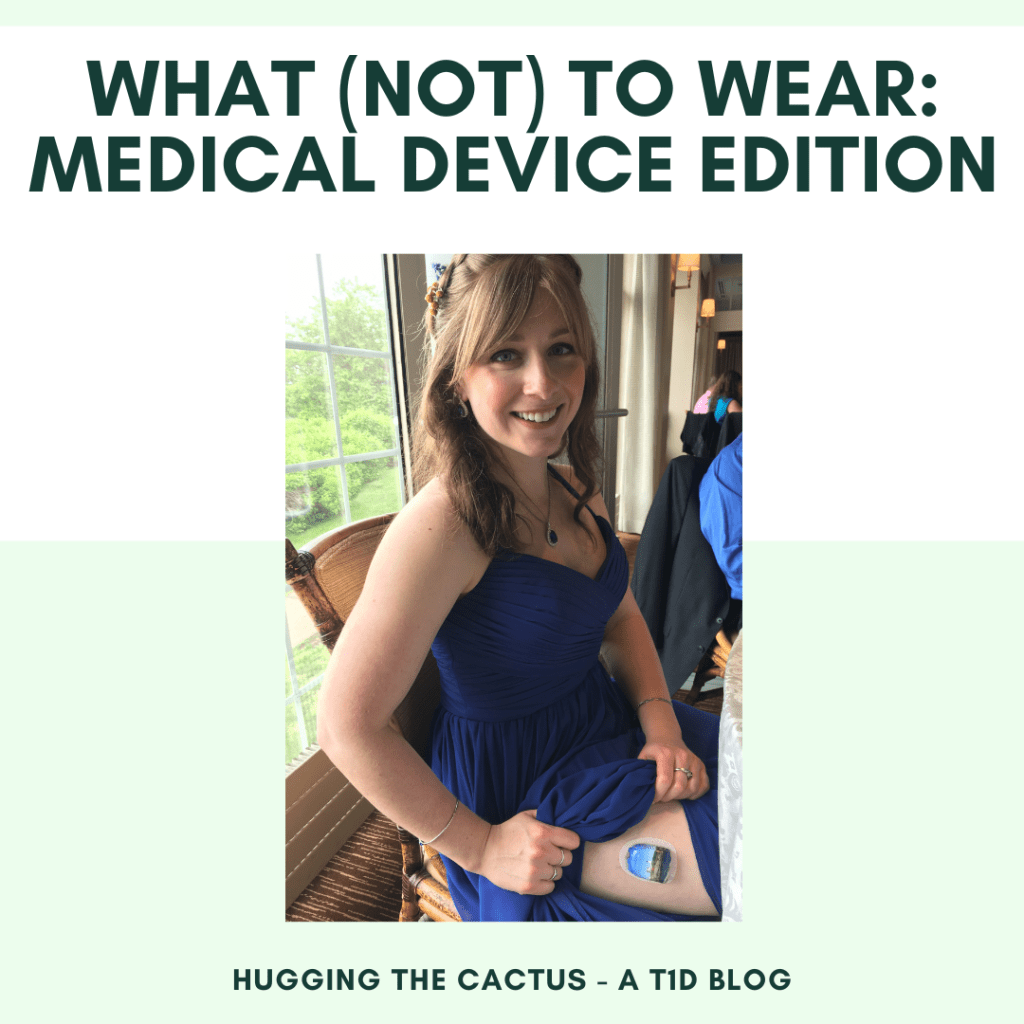
I’m going to two weddings this spring and summer and rather than stressing about which dress I’ll wear to each, I’m finding myself more focused on where I’ll wear my insulin pump and my CGM.
It might sound like I’m making a mountain out of a molehill, but truly, I’m having a hard time deciding whether or not I want to make an effort to hide my devices or don them proudly along with my formalwear. Now when I say “hide”, I don’t mean that I want them out of sight because I’m ashamed of them or anything negative like that. It couldn’t be further from the truth. I’m proud of and grateful for my pump and CGM, but that doesn’t mean that I want them to be front and center on a special occasion. I’d rather let my style – my dress, my make-up, and my jewelry – shine because they’re more reflective of who I am as a person. My diabetes is also a part of my identity, but I don’t want to showcase it if it can be avoided. I also don’t want to attract stares, because whether I like it or not, people will always look and wonder what my pod and CGM are and why I have to wear them.
At a family wedding a few years ago, I was proud to showcase my cute pod sticker…but these days, I’m not so sure that I want to go about advertising my diabetes so boldly at a couple of upcoming weddings!
So based on that logic alone, I’m leaning towards wearing my pod and CGM on sites around my abdomen or legs, keeping them neatly tucked away underneath my wedding attire. But I also need to take into account my site change days. My pod is changed every 3 days, and my CGM sensor is replaced every 10 days. I could plan backwards from the wedding dates and figure out where I need to place my pod and sensor according to that, but let’s be real here: I don’t always have the mental bandwidth to plan that far in advance. Pod and sensor site changes are so routine to me at this point that I just kind of go through the motions every time that I change them, and don’t give much thought to their particular placement beyond making sure that I’m properly rotating my sites. Maybe I’m just being lazy by claiming it’s too much extra work, but honestly, there’s so much work that already goes into diabetes on a daily basis that I just don’t want to give in and plan out a site change timeline that guarantees covered-up diabetes devices.
We’ll see what happens, but one thing is for sure: Whether I showcase my sensor and pod in visible spots or if I choose to keep them covered up, I won’t let my diabetes spoil any aspect of having a great time celebrating at both weddings.
It was around 4 o’clock in the morning. Rain was pounding relentlessly outside my window. The power must’ve gone out, because flickering lights and the sudden sound of my heat turning back on woke me up with a start.
I tried to let the sound of the falling rain lull me back to sleep, but it was loud. I tossed and turned, doing my best to resist the temptation to check my phone and mindlessly scroll through various feeds until I felt sleepy again, but before long I gave in. As I almost always do every time I unlock my phone, I tapped on the Dexcom app so I could see what was going on with my blood sugar.
At that present moment, I was 92 and steady, but what my graph indicated to me in the previous couple of hours made me audibly gasp.
I had fallen to below 55 at some point in the middle of the night, and stayed in fairly low territory for nearly two full hours before making the slow climb back up.
That’s when it came surging back to me: The memory of waking up, some hours before, to the sound of an urgent low alarm. And then me totally ignoring it in favor of sleep.
The realization hit me as hard as the rain was striking against my rooftop, and then the tears welled in my eyes. I lay there, crying quietly, as I tried to accept the reality that choosing sleep over fixing my low blood sugar could’ve been an extreme error on my part. What if the rain and the power outage hadn’t woken me up? I recognized that given my current blood sugar graph, I would’ve been just fine, but regardless I had still slept through a low and that frightened me – I’m not sure if I’ve ever done that before. Just as I was beginning to really freak out, I felt a rush of gratitude toward my Omnipod 5. After all, it had seemingly detected the low blood sugar and then lessened my basal rate (or perhaps completely stopped delivering any basal insulin altogether) in order to bring my blood sugar back up. I felt as though the system had possibly just saved my life.
So I couldn’t help but lay there and let the tears fall, marveling at the technology that I felt indebted to at this particular moment in time, before I found myself drifting off into a dreamless sleep again.
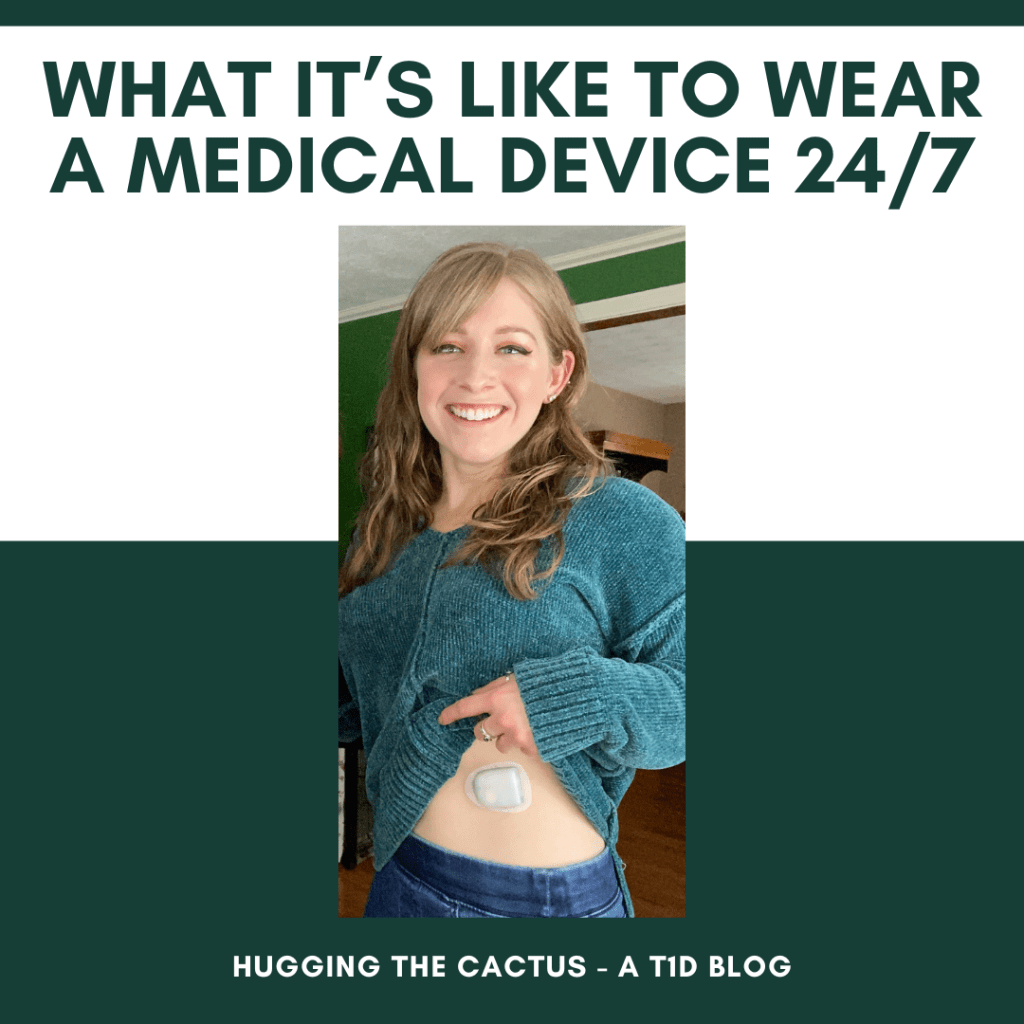
This was originally published on Hugging the Cactus on May 7, 2018. I’m sharing it again today because for as long as I continue to wear an insulin pump and CGM, I know that this is a question that I’ll be asked. Wearing these pieces of medical technology almost all the time has certainly changed how I feel about my body and my body image, and I elaborate on that below…
A question I’m often asked is: “Can you feel your CGM or insulin pump on your body?”
The simple answer to that is: usually, no. It’s something that you just get used to. You grow accustomed to seeing a lump underneath your clothing. You adjust to putting clothes on (and taking them off) carefully to avoid accidentally ripping a site out. You acclimate to showering without being completely naked.
And, of course, you get used to the questions from strangers asking about that device stuck to you.
But the more honest answer to that question would be that there are times that I feel it more than others. For example, sometimes I forget where I’m wearing my pump until I hit it against something (I’m a major klutz who constantly runs into doorways and trip over things, almost always managing to catch my pod on whatever it is), resulting in pain at the site and a curse word or two to fly out of my mouth.
I feel it the most, though, when people stare. Whether unconsciously or purposely, people do ogle at it in very not subtle manners. Which makes me feel extremely uncomfortable. It’s worse when they don’t even ask me what it is – I’d rather have a chance to use it as a teaching moment than to have someone walk away not knowing what the device does. This tends to make swimsuit season a little less welcome for me. Nothing will stop me from donning a bathing suit at the beach or by the pool, and I do so as much as possible in the summertime. But it’s just not as fun when I’ve got to cope with lingering looks, especially when I’m an admittedly insecure person in the first place.
So it’s a more complex question to answer than you might realize. Wearing a medical device 24/7 is humbling. It keeps me alive. I’m privileged to have access to it. I’m grateful for the ways it’s improved my life. I’m always wearing it, but it’s not at the forefront of my mind – unless it chooses to make its presence known by alarming, or I’ve got people blatantly checking it out. It’s kind of like diabetes itself. It can make you feel a gamut of emotions, but no matter what, it’s always there. It’s just a part of me, and I can deal with that.




 Hugging the Cactus