I am not the kind of person who scrolls through social media looking for posts that will make me angry. And I’m certainly not the kind of person who likes the idea of calling someone out on their perceived wrongs via social media (or any other medium) because I think that it’s usually not constructive.
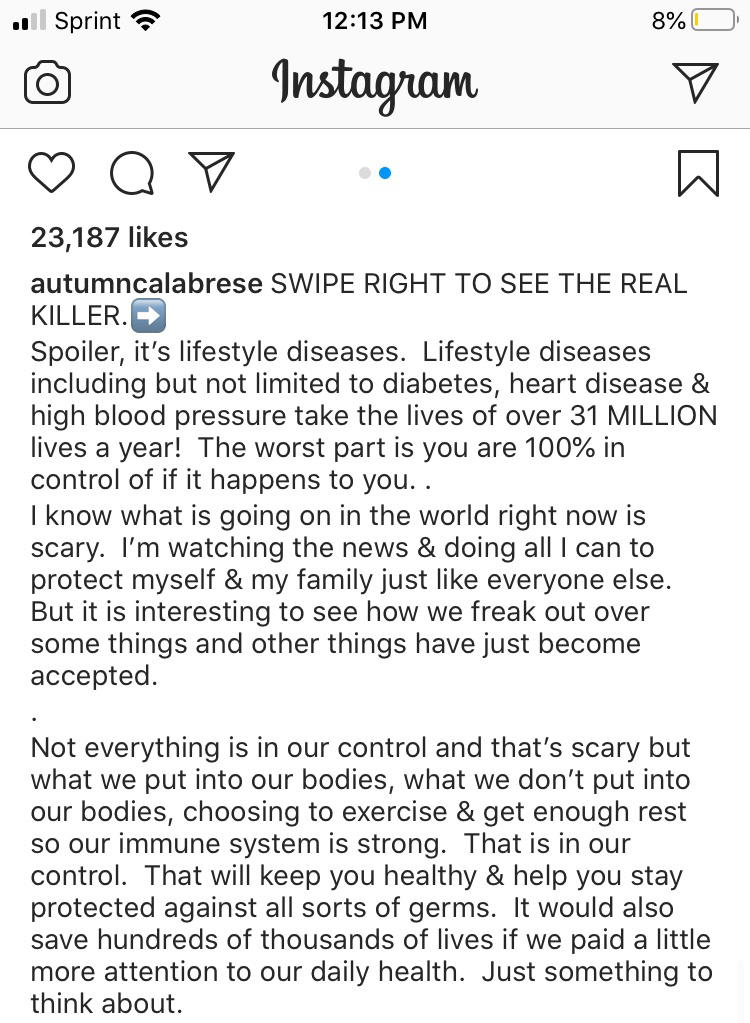
But I am the kind of person who thinks that word choice matters. So when I saw Autumn Calabrese, a celebrity fitness and nutrition expert, post the following text on Instagram, I got pretty upset. (Click photos to see them more clearly).
1 of 2
2 of 2
Autumn’s caption
I’m not going to lie, I was pretty upset by this post. I’ve followed Autumn on Instagram for almost two and a half years now, ever since I subscribed to the popular Beachbody workout app. I really like her 21 Day Fix workout program because it kicks my butt every time in just 30 minutes. She comes across as a fun person who is really passionate about her job and enjoys the opportunity to help others, which is why I decided to follow her Instagram profile. Normally, I enjoy her posts because they’re filled with motivating fitness and eating tips that promote a healthier lifestyle. She definitely knows what she’s talking about when it comes to exercise and eating properly.
But after seeing this post, I think that Autumn – and people like her who are not educated in the minutiae chronic conditions like diabetes – needs to step off her soapbox.
She is using her post to say that diabetes – mind you, just generic “diabetes”, there’s no mention of any of the many types – is a lifestyle killer. She says that “the worst part about it is that you are 100% in control of if it happens to you.”
OMG. No, no, NO.
Forget that she was using the current coronavirus outbreak to promote her healthy eating plan (which in itself is a pretty weird way to advertise something) – she came after the diabetes community with this post. Now, I’ll never know what her true intent was, and I don’t care if Autumn was talking about a specific type of diabetes here. That doesn’t make a damn difference. The problem with this post is that she is perpetuating diabetes stigma and alluding to a myth that an individual has control over whether or not they get diabetes. Posts like this are the reason why there is so much confusion and misunderstanding when it comes to all types of diabetes, and I think she should be ashamed of herself for putting this on her profile.
It’s even more upsetting that she immediately got defensive when people started writing comments under her post, trying to inform and educate her. I was one of those people, and I think that I kindly and respectfully directed her to learn more by visiting beyondtype1.org so she could be better informed on all types of diabetes and maybe find out why what she wrote was harmful. Sadly, I never got a response, and her post remains on her profile, unchanged.
You can lead a horse to water, but you can’t make it drink. You can also unfollow a person on social media and write a blog post to get your feelings out there, so that’s just what I’ll do here.
If you’re a reality TV junkie like me, then chances are you’ve probably watched Survivor at some point during its 20-year (and counting) run.
And if you’ve never seen a single episode, it’s still highly likely that you’re familiar with the concept of the show:
Find a group of strangers willing to be stranded on an island for 40 days
Make them compete against one another in tribes, then individually, for food/other rewards and “immunity” from tribal council
Force the losing tribe to go to tribal council and vote one of their own off the island (“the tribe has spoken”, anyone?)
Watch as a jury of voted-off contestants selects a winner, also known as the sole survivor
Plunk a bunch of cameras in front of these people and watch all of their antics, including plenty of twists and turns introduced by the producers, that happen in-between
Marvel over how Jeff Probst has not aged a day in the 20-year time span and looks like a million bucks in front of these dirty, hungry people who are actually competing for a million bucks
So yeah, that’s the basic premise…it might sound like a stupid show to some, but I know that Survivor has a devout and large fan following that includes my dad.
Growing up, my dad, my brother, and I watched Survivor almost religiously. We’d ooh and ahh when tribes pulled off unsuspected victories and make bets on who would be voted off the show each week. We’d have our favorites and our far-from-favorites that we rooted for and against. The three of us were nuts about the show for years, until one day we weren’t and only my dad continued to tune in.
Yes, that it is a photo of me on the last day of 5th grade, wearing my very own Survivor buff around my head…a buff that I still actually own.
Things changed for me this season, though…Survivor, Season 40 (!), takes previous winners and pits them against each other for the title of perhaps the ultimate sole survivor. The prize is a cool two million this time around, and I decided to start watching because I wanted to see how winners from when I watched fared in a show that would be a very different experience for them compared to when they first played.
And I’m having a lot more fun watching than I expected. Even though a couple of my early favorites were voted off too soon, there’s a chance for someone to re-enter the game thanks to the “edge of extinction” rules. This means that, for a few minutes each episode (so far), the camera focuses on the voted-off survivors who are trying to earn a way back into the game by surviving the edge of extinction.
Again…I get that this all sounds hokey so far. But what’s actually pretty cool to me is that I found a bit of inspiration from one of the survivors who is trying to fight the edge of extinction.
And that survivor is Ethan. I remember watching Ethan in two previous seasons of Survivor. I tooooootally had a crush on him (my brother made fun of me for it and yes, I know Ethan is happily married now) in his first season, which he won, and I remember being thrilled when it was announced that he’d compete a second time in an all-star contestant season. On TV, he came across as a friendly, smart guy who wasn’t cutthroat like some of the other contestants, but just as determined to win, so rooting for him was natural and it was crushing when he was eventually voted off.
It’s been 16 years since he last played the game, and a lot has happened to the guy in that span of time. In 2009, Ethan was diagnosed with a rare form of Hodgkin’s lymphoma. From what I’ve read, he endured a difficult battle with cancer that lasted four years. Obviously, I don’t know details about that time in his life, but I can only imagine how emotionally and physically challenging it was to face that ordeal…certainly, though, it was much more difficult than competing on Survivor.
Fast-forward to the present: Ethan’s back in the game after that long gap of time away from it in which he’s faced a serious health condition. He might be on the Survivor-dubbed edge of extinction right now, but that doesn’t mean he isn’t fighting to stay in the game.
In fact, during last week’s episode, Ethan was struggling to complete the challenge that he and the other voted-off contestants had to do before sundown. It was a physically grueling task that required Ethan and the others to climb up and down a treacherous, steep path over and over again. As a viewer, seeing him lose his balance, become super pale, and admit to the other contestants that he wasn’t okay was hard to watch – he looked like what it feels like to have a severe low blood sugar. I was practically convinced that he was going to be forced to tap out of the game altogether, especially when he was visited by one of the show’s paramedics.
But then…he turned it all around, drawing on the strength he gleaned from literally fighting his way back from a different kind of edge of extinction from his cancer battle, and finished the challenge. It was a pretty spectacular comeback.
On-camera, Ethan explained how he was able to push through:
I wanted to complete this for myself, I did not want to quit. I want to set a good example for everyone who’s been through a health challenge and thinks that they can’t do it anymore…you can do it, you can get through those hard moments.
I kept saying to myself, remember when you were getting spinal taps, radiation…I started saying the mantras I was saying when I was going through chemotherapy to get me through those moments.
Watching this, I felt incredibly awe-struck by Ethan’s courage and resilience…and I felt like he was speaking directly to me, as well as any other person who is dealing with a health problem, whether it’s type 1 diabetes, cancer, or anything else. While all of these conditions vary greatly from each other, it’s amazing just how much the right mindset can help fight against whatever it may be.
So I’m writing this post to say thank you to Ethan for sending some inspiration my way, and undoubtedly, the ways of so many other individuals who struggle with the mental and physical side effects of an illness. Thank you for reminding us that we have to just keep going and do whatever it takes to overcome the obstacles we face.
First, let me apologize for adding to what seems like a never-ending cycle of news and media about COVID-19, a.k.a. the coronavirus. But I wanted to write this post because a friend of mine works for a company that sent out a communication about it that I found…interesting, to say the least.
The email in question was about the company’s current coronavirus protocol. The following is an excerpt from the email, provided by my friend:
If you have or live with someone who has a medical condition that the WHO has highlighted as being at higher risk for complications from the virus (elderly, immunocompromised state, chronic conditions such as diabetes, chronic lung disease, and cardiovascular disease), you are strongly urged to work from home if possible with your job function. If you cannot work from home, please consult with your manager.
So…the wording of this email struck me as a little odd for a few reasons. If I worked for this company, I’d wonder: 1) Just because I have one of the named chronic conditions, does this mean I must seriously reconsider my present working environment even though nobody in my office travels internationally? 2) What exactly does “strongly urged” mean, anyways? and 3) What is a manager expected to do if someone cannot work from home, for whatever reason? Make up their own set of rules? Force someone to come in or not come in? And if the latter is the case…would a paycheck have to be forfeited?
I’m absolutely amazed that I managed to find a stock image that wasn’t terrifying for this particular blog post and topic…
As I pondered the answers to these questions, I also started to think that there was a chance I was overreacting to the wording of the email. So I asked other friends how they felt about it and they reacted the same way I did. Everyone was generally confused by the message that this was saying (or not saying) about people living with chronic conditions and how they should handle a situation like this.
Plus, I can’t shake the feeling that emails like this just add to all the hype/panic that we’re already being inundated with, and if I were to receive something like this, it certainly wouldn’t do anything to ease my normally-anxious mind. It’s getting more and more challenging to tune it all out…
…but on the bright side, at least I know how to properly wash my hands and sneeze/cough into my elbow. So I’ll continue those common-sense practices every day, and when I’m doing my own work, I’ll be glad it’s from the comfort of my own cubicle.
I’m broaching a subject I’ve never openly discussed in an online forum in today’s blog post…and that is diabetes complications.
The reason why I’ve never talked about complications is straightforward: They absolutely terrify me.
It’s a topic that’s so foreign and frightening to me that I don’t even know the full extent of diabetes complications. You can Google them, for sure, and discover a long list of scary conditions involving the heart, eyes, extremities, and other internal organs. But I’d rather not do that to myself, let alone the audience of this blog.
I don’t want you to think that I’m naive, though…I know that not talking about something doesn’t mean that it’ll just go away or never happen.
Recently, I became glaringly aware of this fact through the form of (what I presume to be) my own diabetes complication: tendonitis in my left hand.
In the last year or two, I’ve felt sporadic sensitivity in my left hand when I fully extend my wrist, bear any weight on it, or even when I do simple wrist rotations. I never really knew when to expect the pain, but it happened every few months and lasted about a week each time. So when I felt it again around the time I was due for my annual physical with my PCP, I decided to ask him about it.
He explained to me that, based on the type of pain and its duration, it wasn’t carpal tunnel (numbness and tingling are symptoms of that, not pain) like I thought it might be. It also wasn’t arthritis (I didn’t have swelling or reduced range of motion) or neuropathy (I wasn’t experiencing pins and needles), but he did say that those aren’t uncommon in people with diabetes. That’s when he located the exact inflamed tendon – the thick, fibrous cord that attaches muscle to bone – in my left hand/wrist that was giving me trouble.
Me with my new (but occasional) accessory.
Just like all the aforementioned conditions, my tendonitis is probably due to my diabetes. Although my PCP didn’t explicitly state that I definitely have it because I’ve had diabetes for 22 years, he did identify a cause-and-effect relationship between the two. But, fortunately, he also reassured me that my occasional flares of tendonitis are nothing to worry about. As long as I continue to do what I’m doing (which is supporting my hand and wrist with a brace when I experience bouts of pain, as well as rest the area as much as possible during those times), then I’ll be totally fine.
While I’m not exactly thrilled to have to deal with tendonitis, I am very relieved that I know there’s an explanation to help make sense of it all, and that I’ve been doing the right things to handle it. So even though I won’t be going out of my way to research any other diabetes complications any time soon (why on earth would I want to stress myself out unnecessarily), I have come to terms with my tendonitis as a possible complication for me. And rather than seeing it as a completely negative thing, I’ve decided to just keep doing what I’m doing, and continue to take the best possible care I can of myself and my diabetes.
They say prevention is the best medicine for a reason, right?
It’s November 26th which means it’s day 26 of the Happy Diabetic Challenge! Today’s prompt is about diabetes and exercise. There’s so much I could say on the subject, so I decided to settle for a bit of a round-up post that explains what I’ve learned about exercising with diabetes over the years…
I exercise on a daily basis.
This statement is not a faux-humble brag, nor is it an exaggeration. Unless I’m sick, I work out in some form or fashion every single day. My workouts will vary in their intensity, but one thing is consistent: My diabetes plays a major role in how long, when, and what type of exercise I choose to do.
Since I grew up playing sports, I’ve had just about my entire lifetime with diabetes to figure out how to make it peacefully coexist – or, at least, merely coexist – with whatever exercise routine I’m completing. As a result, I’ve learned quite a few lessons along the way, and I’ve come to recognize several patterns that my diabetes follows when I exercise:
My diabetes is practically BFFs with exercise.
1. My diabetes is happiest if I work out first thing in the morning. I never thought I’d be the type of person who works out before eating breakfast, but trial and error has taught me that this is the way to go in order to better manage my blood sugars during a workout. Fasting exercise has worked wonders on my blood sugars: I never have to worry about dealing with an insulin-on-board-inducing low blood sugar, nor do I have to be concerned about what the food I ate prior to my workout will do to my blood sugars while I’m exercising.
2. Different types of exercise affect me (and my blood sugars) in different ways. Many people probably relate to me when I say that weightlifting and high-intensity interval training (HIIT) often yield stable blood sugars during workouts but then trigger the need for more insulin hours later, whereas cardio (such as dancing, running, or circuit training) usually causes sudden drops in blood sugar levels. Of course, it depends on the timing, duration, and intensity of the workout, but it’s interesting to see how different types will require me to react in different ways in terms of my diabetes care.
3. Sometimes I need to suspend my insulin, sometimes I don’t. Again, whether or not I suspend my insulin – or even run a temp basal – depends heavily on when and how I exercise. If I’m doing my morning routine (which happens 75% of the time), then I don’t really do anything with my basal rates: I just keep them running normally. But if I’m taking a midday walk or decide to exercise in the evening, I often have to do something about my basal rate to avoid crashes or spikes. Insulin suspensions or temp basals are wait-and-see situations in those cases.
4. The hardest part about exercise and diabetes is that I can do the exact same routine every day and get different results. If I worked out at precisely the same time, for the same amount of time, and with the same sequence of movements every single day, then…my diabetes wouldn’t give a damn. Every day of life with diabetes is different because of the variables that inevitably cross my path. Things like mood, that time o’ the month, stress, diet, illness, and more can cause major changes in my blood sugar levels. It’s my job to react accordingly to those changes, but that doesn’t mean I always hit the mark on the first try. So with that in mind, it can sometimes be hard to accurately predict how my blood sugar will fare after every single exercise routine. Just thinking about it can be more exhausting than the workout itself.
5. My diabetes is my biggest motivator/fuels my desire to exercise. At the end of the day, I work out because of my diabetes, not because I’m trying to sculpt washboard abs (though I wouldn’t complain if that actually happened). My diabetes loves exercise: It results in an increase in insulin sensitivity and it helps tame my blood sugar levels overall. How could I not be motivated to work out every day with outcomes so tangible?
It’s November 25th which means it’s day 25 of the Happy Diabetic Challenge! Today’s prompt is about the cost of diabetes. Naturally, I started thinking about just how much diabetes costs me, not just in terms of money but also emotionally and physically…
We all know that diabetes is an expensive chronic illness.
Diabetes is associated with doctors appointments, pricey medical equipment, and maybe even the occasional trip to the hospital…all of those things aren’t cheap. My insulin alone would cost me $4,962.32 per year if I was uninsured (and if I do the math, this means that I would’ve spent over $100,000 in the past 22 years on JUST INSULIN). Those are not small sums of cash!
Diabetes hits those of us who are affected by it hard financially, but there are also significant emotional and physical costs associated with it.
Diabetes is so greedy, and not just in terms of how much money it costs to care for it.
Emotional – Diabetes takes a toll on my mindset (un)fairly often…and it can happen so rapidly that I barely have time to process the emotions. For example, I can go from being happy-go-lucky to angry because my Dexcom alarm went off and it’s telling me that my blood sugar is high. The anger will hit me hard and I’ll spend too much time stewing over my blood sugar and the best way to correct it.
Plus, I’d be remiss not to mention diabetes burnout. It’s the feeling of total defeat, of no longer having the desire to take proper care of diabetes. It happens to the best of us, and it’s not fun to experience. But it makes sense to feel this way from time to time, because diabetes is so demanding and relentless. People with diabetes never get a break from it, so it’s no wonder that it takes a toll on emotional well-being.
Physical – Diabetes is a physically present in many ways on my body. The OmniPod insulin pump that I wear, as well as my Dexcom CGM sensor, leave the most obvious lumps and bumps underneath my clothing that often prompt unwelcome stares from strangers. And although these devices have improved my quality of life with diabetes, they’ve also undeniably altered my body image. I never had much self-confidence when it comes to that, anyways, and my devices certainly don’t improve how I feel about my own body. I know plenty of people with diabetes who can relate to that sentiment.
There are also the scars that diabetes leaves behind. My fingers are dotted by dozens of permanent black scars left from lancets pricking them multiple times per day for the last 21+ years. I sport purple circles under my eyes pretty frequently from a lack of sleep that is, more often than not, my diabetes’ fault. And sometimes, I have unsightly red marks when I remove old pods that practically look like zits and can take days to go away because the pods’ cannulas pierced sensitive spots. These are all unattractive, physical reminders of diabetes that I can’t do a damn thing about, and it’s frustrating to have even less control over how my body appears because of this stupid chronic illness.
Diabetes is a friggen’ greedy disease.
It depletes my wallet and emotional state, and it manifests itself on my body in ugly, visible markings.
It tries so hard to rob me of everything I’ve got.
But luckily, my determination to fight back harder against it is stronger than my diabetes will ever be.
This post initially appeared on Hugging the Cactus on February 26, 2018. Since I’ve already dealt with two bouts of congestion and coughing this cold and flu season, I figured it was appropriate to republish this post to remind myself of my philosophy when I’m run down with illness: Don’t push myself and give my body time to rest as much as it needs in order to get better faster.
The inevitable finally happened: I caught a cold. It really didn’t surprise me, because 1) it’s cold season and 2) I’ve been running around like a mad woman the past couple weeks and missing out on sleep.
Though it was expected, it certainly wasn’t welcome. I can’t stand being limited with my activity levels, and it’s been tough enough to get by recently due to my broken arm. Alas, I spent about three full days doing nothing but sleeping and binge watching Gilmore Girls as I nursed myself back to health.
My best friend during my cold? This box of tissues.
During this time, I was extra concerned about my blood sugar levels. They tend to be better when I’m active, so I was worried about how they would fare when I was moving so little.
I admit that I probably did the wrong thing by not eating much during this time. It seemed like I needed to pump myself up with a heftier dose of insulin any time I was eating a meal, likely to compensate for the lack of movement. Even so, I seemed to spike a little too much for my liking after meals. So I really cut back on food. In hindsight, it wasn’t my best move, because even when I did eat it was not healthy (few fruits/veggies, mostly breads and fats).
But I do give myself credit for staying hydrated – a crucial step in getting better. I drank so much water, Powerade, and tea that I felt like I was constantly taking trips to the bathroom. It was worth it, though, because it’s easy to become dehydrated when sick and make a bad situation worse.
Also, I think I made the right move by taking some sick time from work. The day I woke up with a tingly throat, I thought I could soldier on and work a full day, but it became clear the moment I sat down at my desk and couldn’t focus that it would be best to just go home. I took a sick day the following day and was able to work from home the day after that, so I’m grateful that I have a flexible and understanding employer who knows that health is a priority over everything else.
As much as I loathed being mostly confined to my room for 72 hours, it was the smart call. It reminded me how important it is to listen to my body and to not push it when I’m not feeling 100%. There’s no shame in self-care.
I’m not a medical professional by any stretch of the imagination. But I am a highly opinionated person who happens to have a chronic illness and who feels strongly about vaccinations such as the flu shot.
So with that in mind, let me say that I truly believe it’s of the utmost importance that you get your flu shot this fall.
Whether you have diabetes or someone you know and love has diabetes, you need to help protect yourself (and your loved one) by getting your flu shot. Why? Because it’s common knowledge that people with diabetes simply have weaker immune systems. I’ve made it a practice, along with many other people with diabetes, to keep up-to-date on this vaccination annually because I know how easy it is to get it – and actually, I was excited to get it done this year because my best friend since childhood administered it to me herself. I’ve never had so much fun getting a shot before!
Yes, I know, not everyone is as fortunate as me to have a best friend who will stick you in the arm to help protect you during this year’s flu season. But it doesn’t matter who gives it to you, just get it done.
It doesn’t matter if you’re afraid of needles (besides, they have nasal flu vaccines).
It doesn’t matter if you have a “great immune system” and “never get sick”.
It doesn’t matter if you don’t think you have time to go and get it done, because really, if you have time to read this post then you definitely can hit up your local pharmacy for a quickie shot.
I’ll get off my soapbox for now, because I’m sure you’ve stopped reading this post now in order to figure out when and where you can get yours! 😉
Do you have diabetes and will turn 26 in the near future? Will you be forced to switch from your parents’ health insurance to your own plan? If the answer to both of those questions is “yes”, then you’ll definitely want to take a minute to read my tips on how to make the transition as smoothly as possible. And even if you answered “no”, you still might find this to be a worthwhile read because chances are, either you or someone you know will have to go through this process, whether or not you/they have diabetes.
Here are the three most valuable tips I have for anyone who just turned, or is about to turn, 26 years old and is concerned about switching health care plans:
I figured out these tips the hard way. Save yourself a lot of frustration and time by following them A.S.A.P.
Tip #1: Ask your doctor for copies of all of your prescriptions. Do this well before your actual birthday. That’s what I did, anyways – I had a scheduled appointment with my endocrinologist at the end of April. That’s when I requested a copy of every single prescription she’s ever written for me, including for medications that I don’t really use anymore (e.g., Lantus, the long-acting insulin I used prior to my insulin pump). Then, I made multiple copies of these prescriptions, taking care to separate the originals from the copies. This tip really came from my mother, who told me that having the prescriptions now would save me trouble later. And she was right: When I did send in my Humalog prescription to Express Scripts, I did so with more confidence because I didn’t have to scramble to request it from my doctor.
Tip #2: Start the process of reordering supplies as soon as possible. Even if it means starting to reorder things on your actual birthday…do it. I’d say this is especially important if you’re running low on supplies. It took me nearly two months to start receiving stuff. Part of this was my fault because I procrastinated, and was also at an advantage because my mother took the time to order me plenty of extra supplies before I made the switch. But it was also the fault of the companies I was ordering from, who, for various reasons, didn’t send out my supplies on time or needed a longer period of time to review my orders before shipping them out. I’m lucky that I can say that I was never truly worried that I was going to run out of supplies, but the thought did cross my mind a few times, and it was unpleasant. So save yourself from aggravation and just get the ball rolling as soon as you can.
Tip #3: Keep records of everything. I keep a physical folder that contains receipts, prescriptions, photocopies, notes, and various other documents related to my health. I can’t say for sure what I’ll actually need to keep or throw away in the coming months, but I do know that it’s smart to hold onto this stuff in the beginning. That way, during my company’s next open enrollment period, I’ll be able to make informed decisions regarding things like how much money to put in my flexible spending account (FSA). Plus, any notes that I’ve taken during phone calls have already proved immensely helpful as I’ve needed to track down specific customer service representatives in order to take care of issues that have come up. It can be a little cumbersome to remember to keep all these papers, but I know it’s the right thing to do and that there’s no way that I’ll regret it.
BONUS Tip #4: Advocate for yourself until you get what you need. At first, I felt extremely awkward for calling Dexcom and Insulet every single day for a week. But then I realized that I shouldn’t. They weren’t going to make sure that I had my supplies: I had to depend on myself to do that. I also felt a bit stupid asking just about every customer service representative that I spoke to how everything works, but I eventually got over that, too, because it’s vital to understand this stuff, even when it seems extraordinarily complicated. So I’d tell anyone who’s going through this process, or who is about to go through it, to keep up the hustle. Don’t ever feel shame for asking too many questions or calling too many times; when it comes to all this, the limit doesn’t exist. Ask others for help when you need it (I spoke with all sorts of people in the DOC about my issues, and goodness knows that my mother provided me with all sorts of advice and support throughout this) and, with their assistance and a little determination on your part, you’ll get through this tiresome transition.
If something unexpected happens to me in terms of my health, I can almost always safely blame diabetes for causing whatever it may be. But when I absolutely, definitely cannot blame my diabetes, I can’t help but feel angry at my body for rebelling at me in ways that it shouldn’t. Particularly when those ways end up with me making a trip to the emergency room.
Let me set the scene: It was a Tuesday evening, around 7:45 P.M. My partner and I were watching an episode of Stranger Things (we’re not caught up yet so please, don’t spoil it for me). Suddenly, I felt an itch on my upper left arm. Like anyone would, I scratched it. But then it got more intense. Like, really, seriously itchy. I rolled up my sleeve so I would be able to scratch with greater ease, and was surprised to feel some bumps emerging on the itchy patch of skin.
I peeled off my sweater and stepped into better lighting in the bathroom so I could examine the area better. There was a large patch of red, inflamed skin on my arm that was covered with bumps that looked like hives. I was dumbfounded. Unsure of what triggered the hives, but alarmed by how swollen and irritated my arm looked, I shot a couple text messages to my EMT father and nurse best friend, who both advised me to get my arm looked at stat.
Stranger things have happened in my life with diabetes (just had to sneak a pun in there)
And that’s how I found myself in a crowded emergency room, tearful and furious at my body, on a random weeknight. Part of me was relieved that my diabetes didn’t seem to have anything to do with this (but see my recent post on Metformin and you’ll understand that I have some theories about that being the cause). But the other part of me was so pissed off that my body just couldn’t be normal for once. I felt that my body was lashing out at me like an unruly child, declaring its anger towards me in the form of an incredibly itchy, ugly rash. I couldn’t help but stew over the whole situation the entire time I waited to see a doctor.
Long story short, a dose of Benadryl cleared up the hives within an hour. The doctor was unable to determine a cause, since I couldn’t think of anything new introduced to my diet or any new scents/lotions/detergents used in my household. And insect bites got ruled out because the doctor was certain that a bite would be more localized and not spread in a giant patch on my arm. I’m still perplexed at how it happened, but I guess I just have to make peace with the fact that it did and be grateful for 1) making a total recovery from it and 2) not experiencing any issues with my blood sugars as a result of it.
When diabetes isn’t responsible for an ER trip, it means that it’s okay to still be upset about it, but also glad for not having to explain the intricacies of diabetes to every doctor and nurse that walks into the room…because I can’t think of a single PWD that would ever feel happy about taking on that happy task.












 Hugging the Cactus