It’s interesting how my thoughts and feelings about life with diabetes have changed over the years.
Take, for instance, this blog post I wrote three years ago in which I wrote about my strange, strained relationship with food. I blamed my diabetes for significantly impacting how I feel about food because I have to be so careful every time I eat and make sure I carb count accurately so I don’t experience blood sugar swings while also trying to maintain a healthy, balanced diet…yeah, it’s a lot to think about every single time that I eat a snack or a meal.
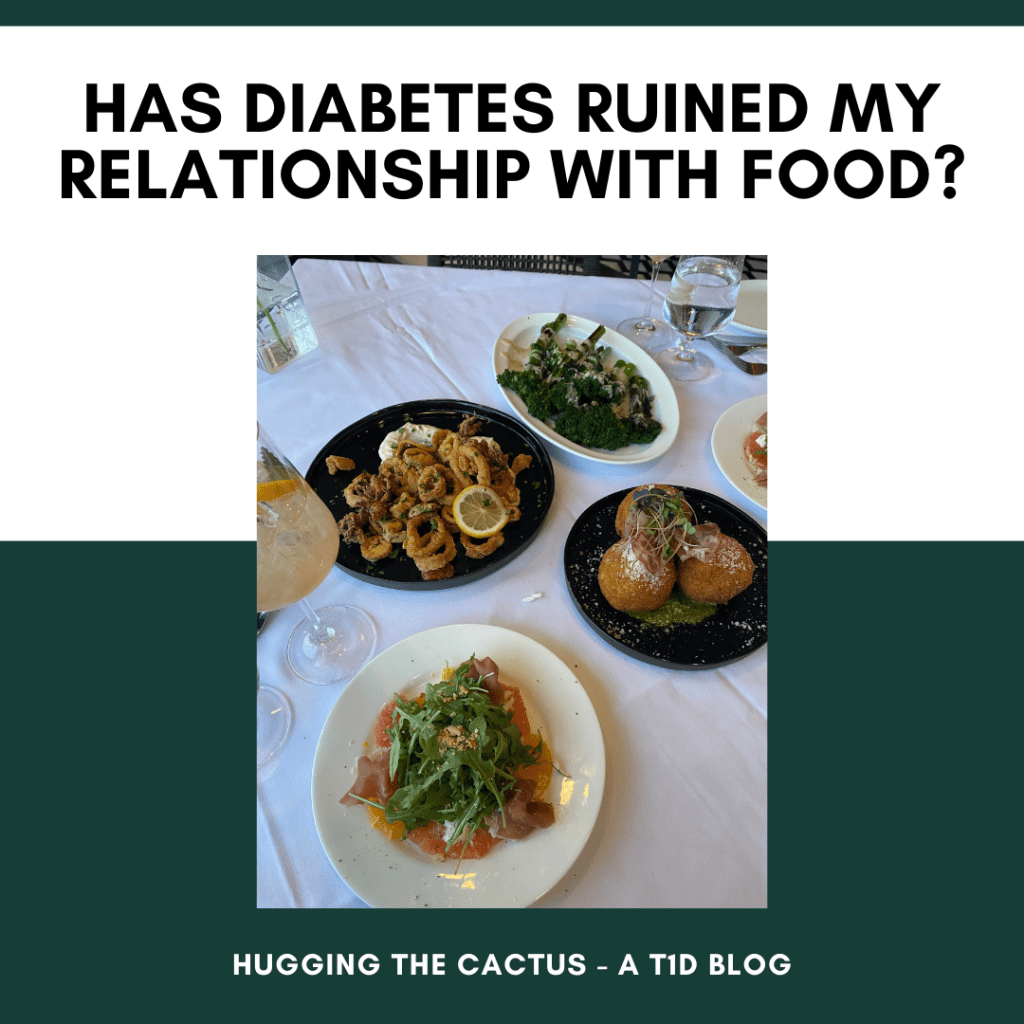
So when I revisited that post in question and was reminded of my complex thoughts on food, I couldn’t help but wonder…has my diabetes really ruined my relationship with it?
My answer to this question now is a definitive no.
Do I get annoyed having to carb count everything that I eat? Sometimes, I do, that’s for damn sure. But for the vast majority of the time, it’s honestly more of a reflex for me than anything else – I’ve gotten very used to this practice in my 25+ years with diabetes, and it has become second nature over that span of time.
Plus, it’s not as though my diabetes has prevented me from enjoying the foods that I like eating, or the ones that I want to try for the first time. It can definitely mess with the timing of when I eat certain foods due to factors like glycemic index or overall carbohydrate content, but this is something that I can typically work around. Even if I don’t nail my carb count for each and every thing that I eat (which trust me, I can mess this up several times in a given week if I’m eating a wider variety of foods), I can still learn from it and apply it to the next time that I eat whatever it was that threw me off my carbohydrate game.
I’m not saying that my relationship with food is easy – it can be far from it. But I am recognizing that perhaps I’ve been a bit harsh in my previous evaluations of how I feel about food from a diabetes perspective. Maybe now that I’m taking some time to think about it more and realizing that I’m able to enjoy a nutritious and delicious menu of food, despite my diabetes, I can begin to look at my relationship with food from other angles and find ways to gain a greater appreciation for how it fuels me to live a full life – pun intended.
Don’t go into the kitchen at work, where you know there’s a platter of delectable-looking donuts, just waiting to be devoured.
Don’t do it! Don’t -!
Oh…well, you did it…at least they’re cut into quarters, so it’s not like you’re having a full donut. Just one-quarter donut is enough to satisfy your mid-morning snack craving.
Except you’ve got a post-lunch sweet tooth going on, and you’re aware that there’s plenty more goodies up for grabs in the kitchen.
Ah, another quarter of a donut polished off. Both were tasty, but no more. Not unless I want to gamble with my CGM graph and see my numbers spike due to a rapid amount of carb intake in a relatively short window of time…
The above scenario is precisely what happened to me on a day in which my self-control was difficult to reign in. But it got me thinking about self-control, in general, in the context of living with type 1 diabetes. After all, I could’ve totally gone bananas and helped myself to a whole bunch of donuts and nothing would’ve stopped me, other than the brief need to calculate my carb intake and do my best to bolus accurately for it. (And if anyone saw me scarfing down a whole bunch of donuts; well, then…I think I would’ve been extremely embarrassed so that would’ve likely stopped me, too.) Since I prefer not to consume tricky-to-bolus-for things like donuts on a regular basis, and since I’d like to avoid judgment for eating all the donuts, that might imply that I have a certain amount of self-restraint. It could also indicate that generally speaking, I make wise food decisions and only indulge in treats in limited quantities.
So with that said, does my diabetes give me a greater sense of self-control?
The donut pieces I had IRL were not nearly as pretty as these ones.
I say yes and no…because my levels of self-control fluctuate on a daily basis, much like the weather, my mood, or any other number of things.
I’m a person living with type 1 diabetes, but ahead of that diabetes diagnosis is being a person – meaning that I’m human and I deal with cravings just like anyone else. Sometimes I can satisfy my cravings with a small portion, other times I want to go wild and have multiple servings of whatever it might be that’s tempting my taste buds. And yes, there are even some times in which I can completely walk away from (or steer clear) of whatever food that’s up for grabs – whether it’s due to my blood sugar levels in the moment or because I simply don’t want the free bagels or leftover cookies from Panera. Whatever direction I might oscillate in, I take comfort in knowing that first and foremost, it’s okay to help myself to indulgences as long as I bolus responsibly, to the best of my ability, for them. I’m still working on not beating myself up for it when I don’t nail the bolus and pay the consequences in the form of high blood sugar, but at least I can say that I know myself well enough to know that this is an issue of mine.
Self-control is just a small puzzle piece in the broader diabetes management picture. It’s a component that’s worth considering in many different contexts, certainly, but it’s more about knowing where it fits in with all the other pieces and finding acceptance in the fact that it might not always stay at the same levels – just like my actual blood sugar.
Butter boards. TikTok ramen noodles. A McDonald’s McFlurry and hash brown sandwich. Something called a “Jennifer Aniston salad” that I’m pretty sure Jennifer Aniston herself denied ever eating and claimed it was instead a type of Cobb salad (though who really cares, I’m sure either iteration is tasty).
What do the above foods have in common, besides sounding vaguely like fever dreams cooked up by someone with an insatiable (or maybe, possibly some-type-of-high-induced) appetite?
Why, these are all viral recipes that have been trending online in the last year or so, largely thanks to TikTok…a platform that I try to avoid because of things like this that make me insanely hungry.
Have I tried any of the aforementioned “recipes” or food combos? No, even though the Jennifer Aniston salad sounds pretty good, and actually quite healthy. I tend to steer clear of the trends because a lot of them are a little too out there for me to be remotely interested in (sorry, but I’d take a traditional cheese board over an icky-sounding butter board any day of the week), or they’re so laden with carbohydrates that just aren’t bolus-worthy to me that my taste buds aren’t even tempted.
But the one that did pique my interest recently is cottage cheese cookie dough – both in the form of ice cream and non-frozen form.
Cottage cheese? Cookie dough? Together??? This duo also sounded really bizarre to me, but it was getting so hyped up on my Instagram feeds that I knew I had to try it for myself. The first recipe I made consisted of four simple ingredients: cottage cheese, honey, peanut butter, and chocolate chips. Easy enough. I tossed everything but the chocolate chips into my blender and whipped it all together until the consistency was smooth, then poured it into a container, added the chocolate chips in, gave it a good stir, and then put it into my freezer overnight. I tried it the next day and couldn’t believe how delicious it tasted! As someone who is generally repulsed by cottage cheese, I was most pleasantly surprised by how it instantly became more appetizing in appearance once all the curds were blended out of it.
But I was less impressed by how much honey I needed to use in this particular recipe: 1/3 cup, which contains roughly 90 grams of carbs! I knew it was a key ingredient to help sweeten up the concoction, but I also knew that since I found it so yummy it would be difficult to resist eating it in large quantities…making it tricky to bolus for and causing unwanted blood sugar spikes. So I figured the next batch I put together would need some modifications.
I went to one of my favorite healthy foodie Instagram accounts, @eatingbirdfood, for some inspiration. This is one of the places that lauded the benefits of protein-packed cottage cheese cookie dough in the first place, so I figured she’d have a recipe I could adapt to suit my needs. Sure enough, she had one that I decided to make over. Here was her original ingredient list:
1 cup of cottage cheese, any kind
2 tbsp maple syrup
1 tsp vanilla
1 cup almond flour
1 tbsp natural peanut butter or almond butter
1/4 cup vanilla protein powder
1/2 cup chocolate chips
Not a bad starting point for my own take, considering the ingredient with the most carbs was the easiest one for me to sub out. I replaced the 2 tablespoons of maple syrup with sugar-free syrup, and I decided to use 2 scoops of my own low-carb vanilla protein powder instead of measuring with a full quarter-cup (sometimes, you just have to measure with your heart…as I did with the chocolate chips, pouring in a generous amount of semi-sweet ones instead of more-sugary milk chocolate ones). I also skipped the vanilla because I figured my protein powder would add enough of a vanilla-y punch to my recipe.
I combined everything and immediately fell in love with my version of cottage cheese cookie dough. It really did resemble real cookie dough, only my version contained only a few grams of carbohydrates and way more protein. It’s been a long time since I genuinely enjoyed something sweet that wasn’t so bad for me, and that wasn’t a boring old serving of fruit. And it had a minimal impact on my blood sugar levels, making this recipe a genuine keeper all around. Maybe it’s a sign that I should play around more with some of the more interesting-sounding viral recipes that are out there – I’m looking at you, dunkaroo dip – and adapt them to suit my (and my diabetes’) tastes!
Random confession time: I used to think that I couldn’t order anything at “fancy” coffee shops like Starbucks other than a plain, black coffee.
Truthfully, I do drink my coffee black 99% of the time. I used to load it up with Splenda and a generous pour of cream, but in an effort to reduce my artificial sweetener intake (and cut excess calories from the cream), I started drinking it black in my late teens and haven’t really looked back…
…except for when I find myself ogling the incredible-sounding concoctions from places like Starbucks.
Vanilla sweet cream cold brew? Iced brown sugar oatmilk shaken espresso? Mocha cookie crumble frappuccino? All of those sound fantastic, and I don’t even know what “shaken espresso” or “cold brew” really means! But besides having appealing monikers, these drinks’ names also imply heavy sugar contents, and that scares me as a person with diabetes who tries to avoid sugary drinks (I’d rather “save” my daily carbohydrate intake for actual food). Moreover, I’ve always assumed that it wasn’t worth it to ask for substitutions in those drinks, so up until recently I’ve just stayed away from them.
Things changed, though, when I won a couple of Starbucks gift cards at work and I decided that I wanted to venture out of my comfort zone. I wanted to try a “fancy” drink, dammit, or at least one that was a notch or two above my usual plain black coffee! So I hit up the website to see what my options were, and in pursuit of as much nutritional information as I could find.
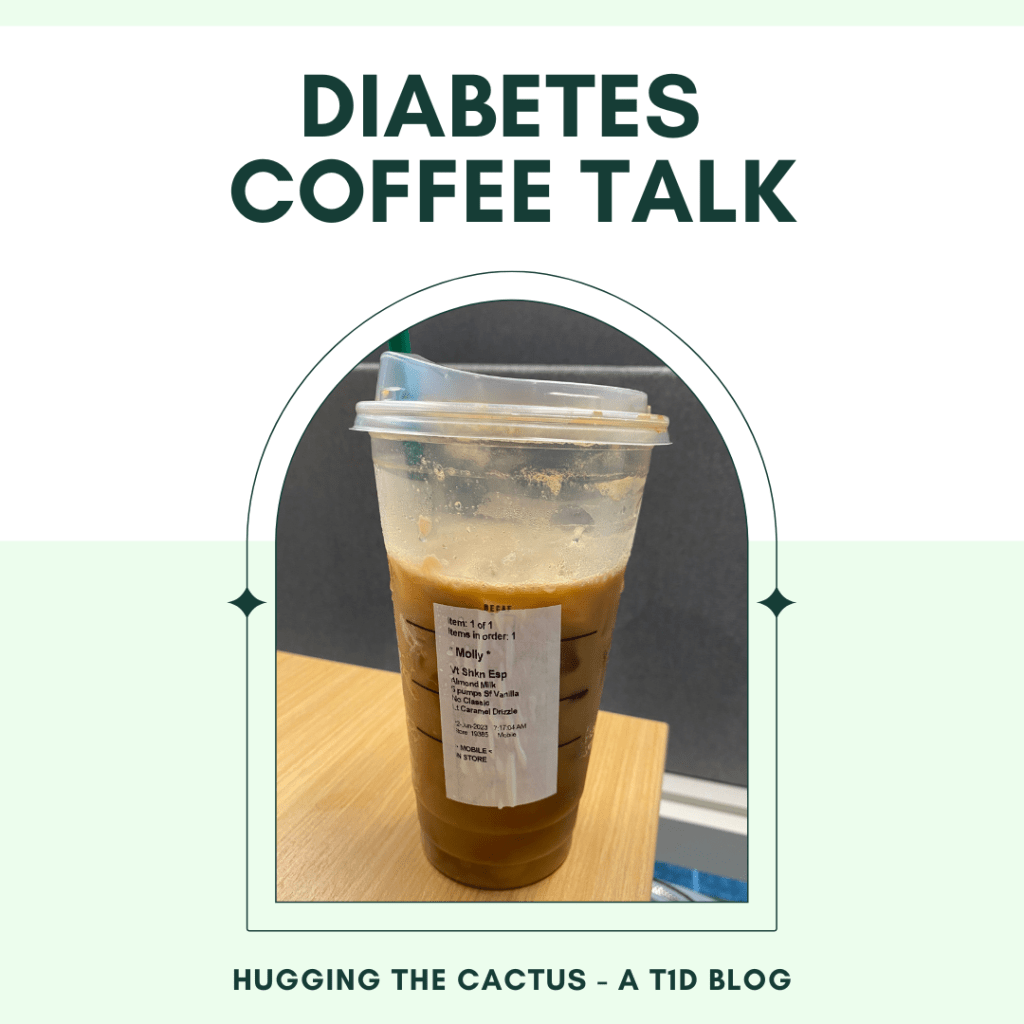
I was pleasantly surprised to discover two things: One being that nutritional information was extremely easy to locate, and the other being that I could customize any drink of my choosing by clicking on it and making modifications to my heart’s desire. So I started with the most intriguing-sounding drink – the shaken espresso – and swapped out the oatmilk for almond milk (which is much lower carb), the vanilla syrup for sugar-free vanilla syrup (they don’t have many sugar-free syrup options, but they do have basic flavors which was just fine by me), and a light caramel drizzle for fun (I liked that you could choose to make the drizzle light, regular, or extra). The website updated in real-time to reflect my customization options, so I had a sense of how many carbs the drink would contain. I opted to make it a large – venti in Starbucks-speak – and picked it up from the closest café to me.
I’m happy to report that my drink upgrade was delicious and didn’t spike my blood sugar like I feared its sugary counterparts would. It was a total win! And a learning experience to do a little more research before making assumptions about what I can and can’t have from different restaurants. I have to remind myself that many places are making strides to not only make nutritional information more accessible, but to also accommodate people with food sensitivities/allergies. So swaps aren’t necessarily an uncommon or unreasonable request for most spots oblige.
Duly noted (and appreciated) by this person with diabetes.
Do you ever wish that you could put diabetes on pause? I sure as hell dream about it, but remain grounded in the reality that it’s not exactly practical since it demands so much of my attention on a daily basis.
But that doesn’t mean that I don’t do my damnedest to make this wish come true on occasions in which I really, really, really don’t want to diabetes to dominate my mind.
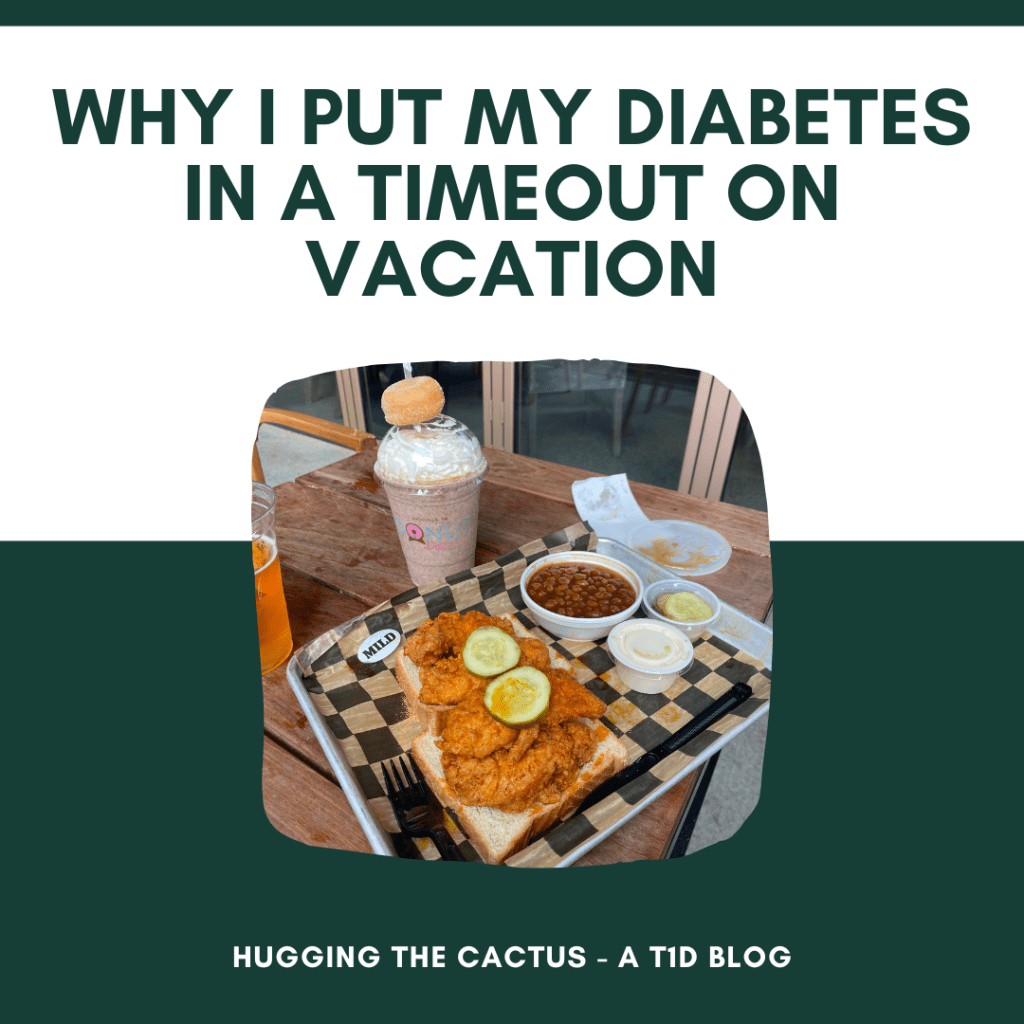
Take my recent trip to Nashville for example. I went with my boyfriend and a couple of our friends for a long weekend – not much time at all when you think about how how much there is to explore in a happening place like that. So I was determined to make the most of every moment and went into the trip with a plan to cut myself some slack on the diabetes front. Sure, I’d do what I could to maintain solid blood sugar control, but I was also excited to indulge on a variety of yummy foods and drinks that I wouldn’t normally consume out of fear over what they might do to my levels.
So this meant I ate things like:
Fried chicken (still drooling just thinking about my meal from Prince’s)
Hush puppies
Beer
Margaritas
Moonshine
Deep fried cinnamon roll bites
A nutella milkshake that had TWO donuts – yes, donuts – blended in with the ice cream
Red velvet cookie dough (literally served in a cup from NoBaked in Assembly Row…check it out)
And plenty of other things!
Don’t get me wrong, a lot of these items were shared with my partner and friends. It’s not like I was consuming a full plate of cinnamon roll bites (described as “cubed, deep fried in waffle batter, tossed in cinnamon sugar, and topped with cream cheese icing”) on my own! But I was happily sampling and doing my best to carb count, making educated guesses and combatting my (several instances of) high blood sugar with extra insulin and exercise (we got upwards of 20,000 steps each day).
Putting my diabetes in a timeout for this trip initially felt unrealistic, and maybe even a little unnecessary. After all, I didn’t have to eat so many carb-heavy foods that I knew would annihilate my blood sugar levels. But it was important for me to be able to enjoy every aspect of this vacation and not let my diabetes take away from that. I didn’t want high blood sugar alarms to interrupt my appreciation of all the live music, so when I got them, I either took more insulin or silenced them. I didn’t want pesky pod changes to interfere with our plans for the day, so I monitored how much insulin was left in my reservoir and changed it when I was in my hotel for the night rather than waiting to do it at a less-than-ideal time, say, right before we hopped onto our pedal tavern tour of downtown Nashville. I didn’t want to chance my CGM sensor failing on me, so I brought extra, plus my test kit (neither of which I ended up needing to use). Above all, though, I didn’t allow every out-of-range blood sugar spoil my day. I figured that this 4-day trip was a single, small puzzle piece in the big picture of my diabetes, and this mindset contributed to a much more fun vacation.
Maybe next time, though, I won’t have to resort to putting my diabetes in a timeout because I’ll master bolusing for the full list of treats mentioned above…we’ll see!
This blog post was originally published on Hugging the Cactus onMarch 7, 2022. I’m sharing it again today because I (and other people with diabetes) constantly battle the misconception that I can’t eat foods that contain sugar/carbohydrates. Why, just the other day, someone who has known me since I was 12 years old made a comment about how I couldn’t eat cookies! In that situation, I smiled politely and gently corrected the individual, but the bottom line remains: This is some diabetes stigma that I’d like to defeat. Read on for more…
Yes, I have diabetes.
Yes, I can eat cheesecake and pizza.
Yes, I can actually eat whatever I want – I just have to know the carbohydrate content of whatever I’m consuming (and being mindful of portion size doesn’t hurt either).
Yes, I’m telling you this because at the time of this writing, that’s actually what I had for lunch this afternoon: homemade pizza and cheesecake. The pizza crust was store-bought, but everything else – from the sauce to the cheesecake crust to the strawberry topping – was made by me and it was damn good.
I guess I’m just taking a moment to 1) congratulate myself on semi-mastering the home-cooked versions of these two foods, but also to 2) reflect on how there’s so much stigma, STILL, on what people with diabetes can/can’t or should/shouldn’t eat. It’s wild to me that there are countless people in our world who misunderstand that a diabetes diagnosis automatically eliminates certain food groups from an individual’s diet.
Let me say it louder for those in the back who can’t hear: People with diabetes can eat whatever they want. Diabetes varies from person to person, and so do dietary preferences – so just because one person with diabetes might follow a strict keto diet, it doesn’t mean that ALL people with diabetes do. It doesn’t make it right or wrong for a person with diabetes to choose or not choose to eat certain things – period, bottom line, end of the story.
And by the way – I took a big old bolus of insulin for aforementioned pizza and insulin and my blood sugar didn’t spike past 188 mg/dL several hours later – score! So I’m also using this blog post to remind myself that it’s okay to eat “treat” foods like this from time to time, and that does not make me a bad diabetic.
“Bolus-worthy” is a term that, I believe, is semi-universally used by the diabetes community to describe food/drink that’s worth taking insulin for. Not just any typical amount of insulin, though – usually something that meets bolus-worthy criteria is something that requires extra insulin, and probably a little bit of guesswork, too.
What makes something “bolus-worthy”? And is it always truly worth it, even if it produces less-than-desirable blood sugar outcomes? I’ll attempt to answer both of these questions from my own unique point-of-view.
I think that a food or beverage is bolus-worthy when it’s something that I can’t and won’t indulge in often. It’s important to consider the “and” between those statements because it must meet both of those conditions; otherwise, it’s simply not special enough to be considered bolus-worthy. So something like the slice of carrot cake that my mom and I shared on our annual outing to a local teashop was totally worth taking extra insulin for, whereas pretty much anything I could order from a McDonald’s menu isn’t (I only ever go to fast food restaurants as last resort, and it doesn’t make me feel particularly good to eat food like that often). I believe in allowing myself carb-laden foods – ice cream, pizza, desserts from a bakery, you name it – whenever the desire strikes, but I do try to be careful about making sure I don’t do that often so that way I can have a better handle on my blood sugar levels as well as make myself more likely to really enjoy the indulgence.
But just because something fits into my “bolus-worthy” definition, is it always worth potentially paying the price of having a blood sugar I’m unhappy with later on? It depends. On an occasion like my birthday, I like to pretend that any out-of-control blood sugar levels don’t count as I eat whatever celebratory goodies I like – even though I’m subconsciously aware that of course they do, and TBH I actually prefer to stay in-range on my birthday so that my diabetes can’t steal the day from me. I guess this is kind of the beauty of the “bolus-worthy” label, though. To me, it implies that whatever it is that I’m having is reserved for special moments. That in itself makes anything worth it, if it’s contributing to the meaning behind an occasion.
And I look forward to putting this theory of mine in action on my birthday in a few short weeks, a time that I guarantee will be filled with food and drink that I deem 100% certifiably bolus-worthy!
This blog post was originally published on Hugging the Cactus on April 12, 2021. I’m sharing it again, ahead of the Easter holiday, as a reminder to myself and others that it’s perfectly okay for people with diabetes to indulge in sweets – just like everyone else, though, it’s important to do so mindfully. Read on for my tips…
If you regularly read this blog, then you know that I’m not a strict person with diabetes, in the sense that I don’t really restrict the foods that I include in my diet.
I’ve always been of the mindset that my diabetes can’t dictate what I choose to consume, though it might limit the actual quantity of a given food type that I eat.
So while my fridge and freezer is almost always stocked with fresh and frozen fruits/veggies/proteins, my pantry often stores more shelf-stable (and usually less healthy) things like crackers, cookies, and even candy. In fact, a full week post-Easter, my cabinets contain 3 bags of jellybeans, a chocolate bunny, and several Reese’s eggs. And it’s very tempting to reach into the cupboards and help myself to as much sugary sweetness as I can stomach in one sitting – screw my diabetes/blood sugar, I’ve got delectable confections to consume!
But of course, I know that indulging my cravings will only wreak havoc on my blood sugar levels, so I’ve found a few ways to curb temptation but still keep tasty treats in my home. Here’s 4 things that have worked for me:
Only eat these treats when my blood sugar is low. I call this “medically necessary” candy consumption, and let me tell you, it makes low blood sugars a whole lot more tolerable when they’re treated with something that’s more fun and yummier than chalky glucose tablets or juice boxes.
Keep them out of sight. I do my best to shove bags of treats in the very back of my top cabinets. That way, if I’m tempted to dig into them, I remember that I won’t be able to reach them unless I get a chair and rummage through the contents of the top shelves…and usually, that’s enough to take away my desire to snack on something sugary. I’m not saying it always happens, but laziness will typically beat my sweet tooth.
Pre-portion single servings of treats. I have a real problem with snacks that come in bottomless bags – it’s hard to know when to stop and my blood sugar always suffers the consequences. So I like to study the serving size on bags and use it as a guide to portion out single servings of treats. It’s much easier to bolus for whatever it may be (or treat a low blood sugar as described in tip #1) when I know the exact carbohydrate count; after all, a few handfuls of an unknown number of Skittles have far more carbs than a single serving of 15 Skittles.
Be picky about the types of treats kept in the house. My kryptonite is most definitely Reese’s cups…I love the salty/sweet combination of peanut butter and chocolate almost as much as I love my dog. So I recognized that a bad habit was forming when I kept a little bowl out in my living room filled to the brim with mini cups. I was breaking every single one of the above rules with this practice! After I realized this, I put the bowl away and stopped buying Reese’s every time I went to the grocery store. I still have other things around the house that will satisfy my sweet tooth (before Easter, I bought a package of dark chocolate Oreos that I’ve easily kept around for the last 6 weeks because they don’t tempt me in the same way that Reese’s cups do), so I’m really not depriving myself at all.
Temptation can be tricky to navigate when you have T1Ds and love sugary treats as much as I do…but as long as you can come up with ways to cope with temptation like I did, then you don’t have to feel guilty for giving in to your cravings every now and then. I sure don’t!
I guess I’m hopping on the “what I eat in a day” bandwagon.
This trend has existed long before the TikTok videos and Instagram reels in which vloggers share what they typically eat on any given day of the week – it’s also been something that tons of celebrities have been asked to share in interviews. And while I’m far from a celeb (especially Gwyneth Paltrow, who allegedly is sustained by a cup of coffee, bone broth, and steamed veggies on a day-to-day basis), I do have a certain meal routine that’s centered around my diabetes. Nobody asked me about it, but I figured, why not share it on the blog? After all, so many of the “what I eat in a day” videos and articles I’ve viewed sound a little too perfect. I often wonder how realistic folks are when they’re covering this topic, so I’m going to be pretty matter-of-fact when going through my “meal plan”, and cover how it varies on a weekday versus a weekend. So here we go:
Breakfast on a weekday: I am usually eating breakfast between 7:30 A.M. and 8:30 A.M. I love all breakfast foods, but lately my go-to has been a baked oatmeal. I prep this myself on Sundays and it makes enough servings for 6, so I’m covered for breakfast for the week. I add a couple of scoops of protein powder to it and top it with berries so that I make sure I’m getting a nice balance of carbs, fruits, and protein. One serving is roughly 30-35 grams of carbs, and I’ve found that my blood sugar fares well whenever I eat this meal, maybe spiking a bit in the hour after consuming it but settling back down nicely in no time.
Breakfast on a weekend: Anything goes! My wake-up time could be as early as 8 or as late as 10:30 or even 11 (though I don’t like sleeping my mornings away). Depending on when I wake up, I might want a breakfast sandwich or a protein smoothie, but there are other times that my partner will make me a breakfast consisting of something like hash browns, eggs, bacon, and salsa – no matter what we do, I try to keep breakfast no more than 30-40 carbs because that feels like a sweet spot for my blood sugar levels, whether I’ll be exercising in the hours after eating or even if I’m just lounging around until the afternoon.
Lunch on a weekday: I almost always have a salad or a sandwich. I like to load up my salads with lots of extras – tons of veggies, feta, bacon bits, croutons – and always top them with a protein like hardboiled eggs or chicken. If I’m having a sandwich, I’ll almost always eat it with a side of baby carrots or veggie straws (and if I’m in the office, I might indulge in a buffalo chicken wrap which comes with house-made chips – so yummy but much higher carb compared to what I’d make at home). I will eat an apple or any other fruit I have on hand for something sweet. My blood sugar is usually good after lunch, but if I see it going up too quickly or if it stays higher than I’d like it to for an extended period of time, I’ll combat that with a walk in my neighborhood or around my office suite.
Lunch on a weekend: Admittedly, it’s almost non-existent. If I have leftovers from the night before, I’ll eat that, or maybe my partner and I will split a box of frozen samosas or share a cheese plate so we’re not totally starving by dinnertime. It’s just what works best for me since all of my weekends are totally different in terms of our plans.
Dinner on a weeknight: I like to either meal prep on a Sunday night and have whatever I make carry me through the first few days of the week, or I’ll make something on a Monday evening that will produce my dinners for the next few nights. I’m a semi-lazy cook, so I like tossing veggies, starches, and proteins on a sheet pan and roast everything up (I love recipes from this website). And I have a sweet tooth, so dinner is often followed by a single serving of ice cream or a chocolate-covered frozen banana. My carb intake at dinner hovers around 45-60 grams of carbs, which I find works well because I get busy in the evenings catching up on chores around the house or running errands. The extra carbs help me stay level (and full).
Dinner on a weekend: I enjoy whenever my partner and I have a chance to make food together, because he’s a great cook and very conscientious of my diabetes when making something to eat. He helps me carb count and if we’re going out somewhere to eat/ordering takeout, he’ll offer to split higher-carb dishes with me so I can still have them without totally wrecking my blood sugar. I don’t really place limits on my carb intake for meals out because I love getting sushi, flatbread, and other high-carb menu items – I just try to keep an eye on my blood sugar levels in the hours after a meal out so I can stay on top of highs.
Snacks: I’m a grazer through and through, meaning that it’s hard for me to resist the temptation to snack on foods in my pantry throughout any given day. So I try not to keep bottomless bags of anything in my home, though I do keep things like bags of light kettle corn and single-serving snack bars on hand. But I’m also a sucker for a bowl filled with chocolates like Reese’s or Ghirardelli squares which I will shamelessly help myself to, never having more than a couple in one day because ~*balance*~ matters. Grazing can really screw up my blood sugar, though, so I try to be smart and time it so any snacks coincide with periods of higher activity (such as before I vacuum or head out to run errands).
Drinks: I try to stay hydrated on a daily basis. Besides plain water, I drink Powerade Zero to get in extra electrolytes and I’m an absolute sucker for fizzy and carbonated drinks as long as they are carb-free. I do drink beer/wine/cocktails from time to time that definitely have extra carbs, but I have learned over the years how my blood sugar will respond to a given alcohol and plan accordingly around that.
So, that’s it – an honest explanation of what I eat in a day as a person with diabetes. Some days I am more balanced and “healthy” than others, and some days I just go to town and whatever I like. My relationship with food will never be perfect because my diabetes undoubtedly influenced it, but that’s a post for a different day. For now, I’m off to have a snack to keep my blood sugar (which is 113 mg/dL as I write this) steady throughout my evening workout routine.
I have strong opinions about ice cream. Potentially controversial ones:
Chocolate ice cream is the weakest flavor out there.
My ratio of ice cream to mix-ins is…gimme ALL the mix-ins. The more chopped-up chunks of goodness, whether it be cookie dough or candy, the better.
Ice cream tastes best when it’s a little softened – like, almost to the point of being soft-serve consistency. I used to microwave my ice cream for about 20 seconds when I was a kid before eating it and loved every drop of my ice cream “soup”.
See? I warned you. Those are some triggering statements I just made about my personal ice cream preferences. But one not on that list, that I think most people would happen to agree with me on, is that sugar-free ice cream just ain’t it.
Even my parents’ dog, Clarence, can’t resist a delicious serving of ice cream (of course, he gets the special doggie kind, saving the good stuff for us humans).
“Oooh, Molly, look! They have sugar-free ice cream on the menu, are you going to get some?” One of my truly well-meaning girlfriends asked me this, ever-so innocently, on a recent ice cream outing.
I remember raising my eyebrows incredulously as my eyes scanned the regular list of ice cream compared to the sugar-free options. There were dozens of delectable-sounding regular ice cream flavors: all the traditional ones, plus more exotic ones like cotton candy, blueberry pie, s’mores, German chocolate cake, coffee kahlua cream…and then in direct opposition to that were TWO, yes TWO meagerly sugar-free choices: black raspberry and coffee.
I turned to my friend and, as non-condescendingly as I possibly could say it, told her that those “choices” had to be a joke and that furthermore, sugar-free ice cream just ain’t it for me. If I’m going to eat ice cream (and I’ve consumed LOTS of it this summer, let alone throughout my lifetime), then I’m going for the real stuff – no question about it. So with the air cleared on that particular matter, we both got matching ice creams (the blueberry pie flavor with blueberry and graham cracker swirled in a vanilla cream base) and enjoyed the heck out of them.






 Hugging the Cactus