The Impact of Diabetes on My Relationship with Food

There’s no cutesy lead-in to this post…I’m going with a very straightforward statement here:

Diabetes has caused me to have a very weird and strained relationship with food.

How? Oh, let me count the ways…

Diabetes has positively impacted my relationship with food because it has helped me understand the importance of nutrition. I’ve had to learn how carbohydrates, proteins, and fats affect my levels, as well as the role that the glycemic index of foods play into the picture. I’m also grateful that diabetes has caused me to realize there are limits – I can’t mindlessly eat huge quantities of food (though on occasion I do, more on that in a minute). I must measure everything out, and I believe that this forced sense of portion control has helped me maintain a (mostly) healthy weight.

But diabetes has also, absolutely, negatively impacted my relationship with food.

Here’s pretend cartoon me, being absolutely adorable as she calmly whips up a feast in the kitchen (LOL there’s so much wrong about that sentence)!!!

For starters, I can get so fed-up with having to account for every single morsel I consume in a given day – I resent having to take insulin for foods I’d otherwise find enjoyable. Plus, there’s a lot of guilt associated with my regular food consumption. “Should you eat that?” is question I hear not just from others, but from myself as I have to think about whether certain foods are worth not just the calories, but also the amount of insulin that I have to dose for it. And don’t even get me started on how literally unsavory it is to have to eat food when I’m already full but dealing with a low blood sugar…

In a word, my relationship with food is complicated…and I don’t hesitate to blame my diabetes for that. Don’t get me wrong: At the end of the day, I loooooooove food. Really, there’s very few things that I don’t (or won’t) eat or at least try. I enjoy consuming a large variety of foods and I like to eat veggies almost as much as I like eating chocolate (that may be a bit of a stretch, but I think you get my point).

It’s just unfortunate that my diabetes forces me to overthink every food choice that I make. So I’m that much more hopeful for the day which I can eat food without having to think twice about it, without having to feel guilt, shame, doubt, anger, sadness…nothing but pure enjoyment.

The Best Time to Do a Pod Change

Whether you’re new to using an insulin pump or a seasoned pro, you might be wondering if there’s a time of day that’s most ideal to do a pod/site change.

And I’m here to tell you…there isn’t a one-size-fits-all answer. (Sorry!)

Like many aspects of life with diabetes, the best time to do a pod change will be different for everyone.

However, I do feel pretty strongly about what works best for me, and I can explain why it does. Maybe that will help you or a T1D in your life decide what makes the most sense for your individual situation!

The best time to do a pod or an insulin pump site change will probably vary for most people with diabetes, just like so many other things.

In my opinion, the best time to change my pod is within the 3-hour window after I’ve eaten dinner. Since I typically eat at about 5:30/6 o’clock, this means that I like to change my pod no later than 9 o’clock at night (but preferably sometime around 8).

Here are the reasons why:

  • I can take my dinnertime bolus using a pod that I know for certain is acting the way it should.
  • That timeframe is early enough for me to verify that my new pod is acting the way it should before I go to bed.
  • Usually, I don’t eat much in the evenings after dinner, so even if my new pod isn’t working right, it’s not too big of a deal because it’s not like I’ll be bolusing for mealtime carbohydrates.
  • When I change my pod at other times of the day, it interrupts other aspects of my daily flow (e.g., my wake-up time or my work schedule).
  • There’s something to be said for ending my day with a fresh pod and incorporating the pod change into my bedtime wind-down routine.

Of course, I’ve had to change my pod at less-than-ideal times (I recently did a 6 A.M. pod change because I was deliberately wearing my pod for the maximum 80 hours and it was not my favorite way to start my day). Pods fail or get knocked off and I’ve learned to roll with the punches by having back-ups at all times.

But since I know my best time for a pod change, it’s really nice when I can stick with it…because any reliable aspect of life with diabetes is one that makes it ever-so-slightly more tolerable.

Throwback to My First Day With the OmniPod

Life is incredibly busy lately; as a result, I don’t have as much time as I’d like to write brand-new blog posts! But I thought this would be a fun throwback to publish today: the post I wrote for ASweetLife.org on January 21, 2015. It’s all about how I got started with my first (and only) insulin pump, the OmniPod. I’ve written so much about it here in the last few years and it recently occurred to me that I’ve never gone into much detail on how my first day with it went. Fortunately, I rediscovered this post, which does a great job at capturing all the emotions I experienced that day. Read on for more…

Today marks a new beginning for me. After seventeen years of taking insulin shots, I’ve made the move to a higher form of technology: the insulin pump! My pump of choice? The OmniPod, which appealed to me mainly because it is tubeless and my mother also uses it.

As the day went on, I experienced an array of emotions. I woke up feeling pumped (ha-ha, diabetic humor) because I realized I would be taking my last shot via insulin pen for the time being at breakfast. It was pretty anti-climatic, but a major moment for me nonetheless.

Some anxiety started settling in around midday. This was partly due to the fact I knew my visit with my diabetes educator would last roughly three hours in duration. I wasn’t exactly thrilled about having to spend a good chunk of my day off at the doctor’s office. I also had a few lingering questions. When would I take my first bolus? When would I be able to eat my next meal? Would it hurt when I inserted a new pod? I was driving myself nuts with my ceaseless stream of questions.

When it came time for me to actually leave for my appointment, I felt as ready as ever. I decided it would be best to just go with the flow and be patient as I listened to everything my diabetes educator needed to say to me.

Turns out there are no cutesy cartoons of insulin pumps out there (go figure)…but this woman looks like she COULD be playing with a new pump (a huge, futuristic one, that is).

Much to my relief, the three hours flew by more rapidly than I thought they would. In that span of time, I learned not only the basics of my pump, but the finer points that I may not have necessarily understood or picked up on my own. And I was reassured when upon inserting my first pod, I learned that it’s painless – my Dexcom causes more of an unpleasant pinch than the OmniPod system.

By the time I left the office, I had three more follow-up appointments scheduled and a fully active pump stuck on my belly. I didn’t give it much more thought until dinnertime, where I tested (more diabetic humor!) its abilities. I was impressed with how simple the entire insulin delivery process was, and I liked that my PDM would beep periodically to inform me of the status of my bolus.

Post-dinner, though, brought some frustration. As I write, I am still higher than I would like to be. It could be due to anything, which makes it especially irritating. Maybe I miscalculated my carb intake, or maybe my basal rate or insulin-to-carb ratio needs tweaking. For now, all I can do is accept the fact that the beginning of this new regimen will bring lots of trial-and-error with it and monitor my blood sugars carefully – it means waking up a couple times during the night, but I know I just have to do it.

I am not looking forward to this start-up period, but I am hopeful for what it will bring and what I can learn from it. I do look forward to sharing my experiences along the way, so stay tuned for my next post about my transition!

Stress, Anxiety, and Health-Care Open Enrollment

Open enrollment season has officially started and I am officially stressed about it.

Like many employed Americans, I have health insurance through my workplace plan. My yearly opportunity to choose my benefits for 2021 kicked off on October 15th and I have until the 29th to make my elections.

I can’t stand open enrollment season.

What, exactly, makes me so anxious about open enrollment? Well, for starters, I’m never certain that I’m choosing the best plan for me. I know that I’m extremely lucky to be able to choose between three different options – many others aren’t so fortunate – and truly, my company offers tools to make the process as smooth and understandable as possible.

But…health insurance matters are confusing!

There’s too much math involved for me, a person who considers herself allergic to basic arithmetic!

There’s too much unpredictability in it all – how am I supposed to know how many times I may need to meet with specialists next year? How am I supposed to forecast any possible health issues besides my diabetes? How do I go about guessing things that are impossible to guess?

Do I stick with the plan that I’ve been on for the last year and a half or so, that has high co-payments for my doctor appointments but the lowest deductible? Or do I change it up and go on a high deductible plan with a lower premium?

Please reassure me that I’m not the only person with diabetes who absolutely loathes this entire process and overthinks it every step of the way…

I’m Right, You’re Wrong: Debating with T1D

This blog post was originally published by Hugging the Cactus on September 12, 2018. I’m reposting it today because it is still incredibly important and relevant: We ALL must work together and treat one another with respect. Life with diabetes is hard enough on its own! Diabetes online community, I love and value you so much…please just remember to be kind to others. Continue reading for my thoughts on why I think it’s fruitless to debate one another regarding diabetes…

I found the diabetes online community (DOC) a few years ago – or perhaps it found me – and to this day, I’m incredibly grateful for it. It’s introduced me to new friends and it’s always been a reliable source of information. Whether I’m lamenting a low blood sugar at 2 A.M. or asking if anyone has advice on a pod problem at 2 P.M., odds are I’ll have someone reaching out to me within minutes in some form or fashion. That kind of on-the-fly support is invaluable.

That being said…the DOC is not always a perfect safe haven.

I'm Right, You're Wrong_ Debating with T1D
It isn’t productive to argue over who is “right” and “wrong” when it comes to diabetes care and management because it’s highly individualized.

In fact, if there was one thing I could change about it, it would be to make it a judgment-free space: because all too often, people are unfairly judged for how they choose to manage their own diabetes.

I’m not saying that people aren’t entitled to opinions. Of course they are! But what happened to respectfully disagreeing with people?

I’ve seen situations like the following across different social media platforms:

  • People getting attacked for following low/medium/high-carb diets
  • People getting criticized for sharing “good” and “bad” blood sugars/A1cs
  • People getting judged for dealing with diabetes burnout – as well as people getting judged for sharing their diabetes triumphs
  • People getting discouraged from posting only the pretty parts of diabetes

We can’t keep doing this to each other. Just because a certain diet or T1D management strategy works out well for one person, doesn’t mean that it will work the same for another. That’s because diabetes is not a one-size-fits-all condition.

And we shouldn’t be judging one another for our differences. In fact, our differences can teach us so much more than our similarities can. We should celebrate one another for living with diabetes: doing the best we can, day after day, whether it yields “ideal” or “not ideal” results. Because it’s damn difficult to manage, and anyone who says otherwise is being judgmental.

We can learn and grow from one another, which is pretty powerful, as long as we refrain from this “I’m right, you’re wrong” attitude.

4 Tips on How to Handle Hunger Pangs and High Blood Sugar

One of my Instagram followers recently reached out to me and asked for some advice.

…can you make a blog post about how to reduce temptation when blood sugars are high. Whenever my blood sugars are low, I [don’t] really want to eat but of course I have to but for some reason when they are high, I’m soooo hungry and I’m just tempted to eat tons of carbs! Help!!

I liked this comment for several reasons. One, this person told me it was tough for her to ask me about this in such a public forum, so I applaud her for stepping out of her comfort zone. Two, it’s an excellent blog topic suggestion. Three, I can absolutely relate to feeling hungrier than normal when my blood sugar is high. And four, I’m sure others can, too!

Pizza is great (for obvious reasons) but maybe a little less so when blood sugar is high…

I’ve always kind of assumed that I get hungry when my blood sugar is high because at that moment in time, food is practically forbidden…so it becomes incredibly appealing, even though it’s not always advisable to eat with a high blood sugar (because depending on what food it is, it could make high blood sugar go up even more).

So thanks to this comment on my IG profile, I started thinking about the ways I fight off hunger pangs when my blood sugar is high and came up with these 4 tried-and-true tricks I’ve learned over the years:

#1: Make a smorgasbord of low carb snacks. My mom will appreciate my use of the word “smorgasbord” in this tip because that’s exactly what she used to call the plate of snacks she’d fix for me when my blood sugar was high throughout my childhood. She’d assemble an array of low carb goodies – cheese, pepperoni, olives, nuts, pickles – that would satisfy my hunger without raising my blood sugar even further. As a child, I felt special because I was virtually getting my very own charcuterie board (just minus the crackers) and that made high blood sugars much more bearable.

#2: Drink plenty of water (or other low/no carb beverage). I’ve heard medical professionals, nutritionists, fitness experts, and the like say time and time again that one reason we might feel hungry at a given moment in time is because our bodies are trying to tell us that we’re actually thirsty, not hungry. So it makes a lot of sense to stay super hydrated when dealing with a high blood sugar because it can stave off hunger as well as help flush out our systems.

#3: Seek distractions. I write more about this in an upcoming blog post, but when my blood sugar is high, it’s important for me to not dwell on it too much because it seems like it takes it that much longer to come back down. So I distract myself in every possible way: I find an activity to do, TV to watch, a family member or friend to talk to…this helps me forget about the high as well as any cravings for food that may come along with it.

#4: Remember…this too shall pass! Again, I gotta give my mom some credit for this one because she says this motto to me all the time. When I’m feeling extra hungry and experiencing a high blood sugar, I just try to remind myself that both the high and the desire to snack are fleeting. Sure, they’re not fun to deal with at the same time, but knowing that they’re only temporary makes everything easier.

How Keeping Constantly Busy Helps (and Hurts) My Diabetes

I don’t fare well when I have too much idle time.

I’m the type of person who needs to stay as busy as possible: I like being productive and having the satisfaction of saying that I’ve accomplished something each day. That doesn’t always mean that I’m successful, but I do my damnedest to make sure that I check off at least one item from my to-do list on a daily basis.

And I don’t like saying “no” to others, so whenever someone asks for my help, I’m on it. It doesn’t matter if it’s a family member, close friend, or an acquaintance – I do what I can when I’m called on for help, and as you might be able to imagine, this is both good and bad for me.

How Keeping Constantly Busy Helps (and Hurts) My Diabetes
Who DOESN’T love the satisfying feeling of checking items off from a to-do list?!

In terms of diabetes management, it’s great because when I am particularly busy, this means that I’m probably not sitting around a whole lot – the constant go-go-go makes my blood sugars pretty happy. Plus, having a packed schedule keeps my mind occupied when I need to think about something – anything, really – other than my diabetes. If I’m having a tough diabetes day, I don’t have to dwell on it; instead, I have tasks X, Y, and Z to do. If I’m waiting for a stubborn high blood sugar to come back down, then I can start working on a project rather than stare at my CGM for the next hour. 

So in this way, keeping myself busy is a fabulous way to take my attention away from diabetes when I desperately need the mental break from it…but it’s also harmful at times, because let’s face it, there are many times in life where I really do need to concentrate on my diabetes care and management.

Whether it’s a big or small task that I’m working on, I put 110% of myself into it, which means that I really don’t have extra thinking room for my diabetes. Some examples of times that I’ve been far too lost in what I was doing to give diabetes a second thought are when I’ve been in the middle of a knitting project and my Dexcom is went off but I actively ignored it in order to keep my focus on whatever row I was working on (and my blood sugar stayed higher for longer than it should have), or when I should’ve taken a break from writing social media posts for my friend to eat something because my blood sugar needed it, but I just wanted to finish the job first.

Now that I’ve figured out how my diabetes is helped and hurt by my jam-packed days, will I continue to stay constantly busy? The answer is definitely. But I will also try to remember the importance of balance in order to keep my diabetes at the forefront of my mind in a healthy manner.

My Guide to Navigating Diabetes and Research Studies

I’m about one month into a study that involves T1D subjects and it’s been interesting, to say the least.

As far as I’m aware, nothing prevents me from going into more detail on what this study is, but I’d prefer to err on the side of caution and just provide the basics: It’s a 90-day study that requires me to wear a FitBit and answer two daily surveys about my sleep and exercise habits.

This isn’t my first rodeo with a diabetes-related study; in fact, I’ve done a dozen or so over the years with varying degrees of involvement. This might be the most intense one yet, though, because of its duration (most diabetes studies I’ve done have lasted a couple hours, at most). Since it is a more thorough study, it’s got me thinking about how I go about handling my diabetes when taking part in studies. Here are my tips on how to navigate the two in a way that reflects proper diabetes management as well as preserves the integrity of a given study.

It can be trickier than it initially seems to navigate around diabetes issues when participating in a research study.

Research the legitimacy of the organization conducting the research. I make every effort to find out who, what, when, where, why, and how the researchers will benefit from my participation. If it’s a well-formed study, then it’s pretty easy to find out all of this information because the organization will lay it all out before I can even sign up to be a participant. In my opinion, a research study that doesn’t tell participants what their data will be used for isn’t one worth doing.

Decide what I’m comfortable and not comfortable with sharing. Some studies can be quite…nosy when it comes to certain information. In the name of research (and ONLY in the name of research), I’m comfortable sharing some data like my weight, height, and even my A1c. I’m a little less cool with sharing, say, my entire medical history, and by that I mean that I wouldn’t do it. Some things I simply prefer to keep private so I always check in with myself before signing up for a study to make sure that I keep my comfort levels a priority.

Don’t be ashamed to ask about incentives. I can’t be the only one who has done a study in order to earn some quick cash. In keeping with the above statement about comfort/privacy, though, I haven’t done a study that I wasn’t comfortable with just to make money. But it’s definitely highly motivational when I’m in the process of learning whether I’m eligible for a study, and having a tangible reward given to me for my participation is inarguably nice.

Stop worrying about being judged for my diabetes decisions throughout the duration of the study. If I’m in a study that’s asking about my last 3 months’ worth of blood sugar levels or my last 6 A1c readings, I have to remind myself that I won’t be judged for the answers that I provide. After all, the researchers aren’t there to pat me on the back for doing a “great job” at “controlling” my diabetes or to scold me for not taking better care of myself. They are there to collect cold, hard data. So it’s important for me to remember that whether I’m an outlier, top-data-point, bottom-data-point, or something in between, it doesn’t make me any less of a human being with type 1 diabetes who tries her best each day.

Embrace the unique opportunities to make a difference. Not everyone I know has the chance to participate in research studies, so I view any research being done on type 1 diabetes specifically as a unique way for me to contribute to new discoveries (and possibly even a cure). Deep down, I’m a bit of a science geek who truly appreciates the methodology behind studies and experiments, so I really do think it’s special that I get to be a subject in some real-life research.

Why I Decided to Get Baqsimi (and How I Got It)

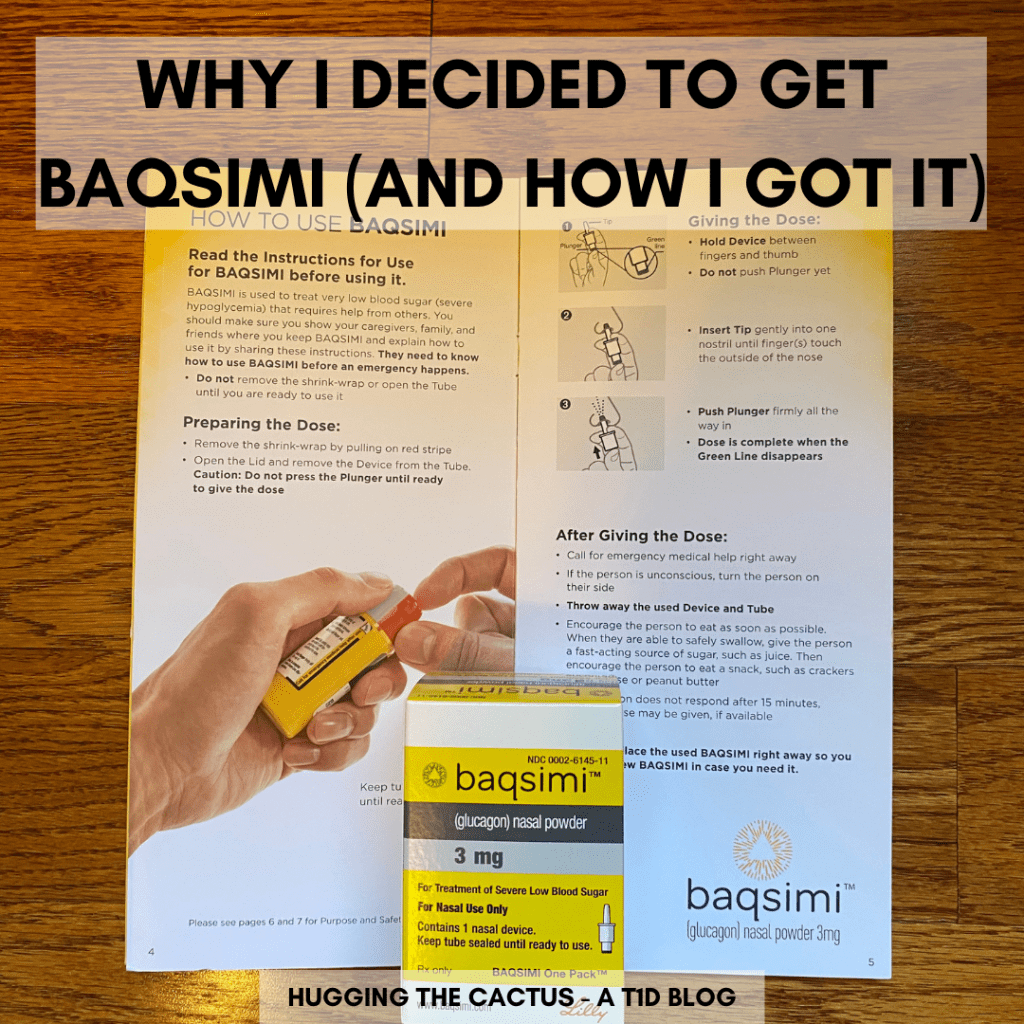
Say hello to my new little friend…Baqsimi!

For anyone who may be unfamiliar with Baqsimi, it’s a relatively new form of glucagon that comes as a nasal spray. I haven’t had to use it yet (and I hope that I don’t ever have to, really), but there’s a lot of pros to Baqsimi when comparing it to a traditional glucagon kit:

  • It’s shelf-stable – it doesn’t have to be refrigerated.
  • It doesn’t expire until 2.5 years from now.
  • It’s completely ready to go as-is, no mixing or measuring needed.
  • It’s compact and totally portable.
  • It’s easy to use (and understand how to use!).
Baqsimi is incredibly easy to use: remove shrink wrap, insert into nostril, and push plunger all the way in to dose. That’s it!

All of those factors contributed to my decision to finally pull the trigger and ask my endocrinologist about writing a prescription for me. It’s not that I’m suddenly worried that I’ll need Baqsimi; for me, it’s more of a peace-of-mind situation. I always thought that my glucagon kit was next to impossible. Sure, I know how to use it, but I have to refresh my memory every so often because there are so many steps involved in the process: inject the syringe into the vial, mix the contents, wait for the glucagon to turn clear, stick the syringe back into the vial, withdraw the liquid, and then finally do the injection…there’s a lot going on there. And if I actually did need glucagon one day due to a severe hypo, I wouldn’t exactly be able to easily walk whoever I was with through the process because I’m sure I’d be totally incapable of doing so (depending on how bad my symptoms were).

It’s just a lot to ask of every single one of my family members and friends to know exactly how to inject glucagon into me in the event I ever needed one of them to do that, so having Baqsimi on hand takes so much of that fear and anxiety away.

And the icing on top of the cake is that it was super easy for me to get Baqsimi…like, it only took a few hours, which is amazing. All I did was reach out to my endocrinologist’s office using their online messaging system, ask my doctor for a script, and…bam. It was sent into my local pharmacy, and before long, I was cruising through the drive-thru with my dog to pick it up. I’m lucky, too, because all I had to pay was $25, thanks to my insurance (sometimes, it’s not as bad as I think it is).

Twenty-five bucks for peace of mind and a life-saving medication…that’s something I can get behind. I’m glad Baqsimi has finally joined my diabetes toolkit.

Diabetes Detective Work: Solving the Mystery of Prolonged High Blood Sugar

When it comes to solving the mystery of why I recently experienced high blood sugar for a prolonged period of time, let’s just say I was a wannabe Sherlock Holmes.

I’m going with “wannabe” here because I lacked the satisfaction of deducing the exact culprit, but at least I had my wits about me enough to come up with a few reasonable explanations.

Diabetes Detective Work_ Solving the Mystery of Prolonged High Blood Sugar
I wish that a magnifying glass was all it took to figure out the “why” situations in life with diabetes.

The scenario: I was riding between 200 and 250 for hours. I did a temporary increase of my insulin for a bit, took 2-3 micro-doses of insulin (in order to avoid stacking), and did my best to stay hydrated while avoiding carbs. And I barely budged, much to my frustration. All throughout dinner that night, I was anxiously eyeing my Dexcom and hoping to level out before long. It was only after I went on a 45-minute after-dinner walk that I started to drop, and it took me quite a while longer than usual for me to be totally back within range.

The questions: Did my mid-afternoon pod change throw something off? Was my carb counting wrong? Was it something I ate? Was my pod working the way it should’ve been? Did I get enough exercise throughout the day? Too much? Was it due to anxiety or stress? Some other factor that never even crossed my mind?

The clues: A couple of clues helped me eliminate the cause of the high blood sugar. For starters, it couldn’t have been the insulin – it’d been refrigerated and I’d been using the same vial for a couple of weeks without any issue. It also likely wasn’t either of my pods, because the one I’d worn for the full 3 days had worked fine, and the new one that I applied mid-afternoon did work for the full 3 days…even though it seemed to take some time to adjust to my body. I definitely didn’t eat the healthiest meal (my entree may have been a green salad, but I also ordered a sugary cocktail and had fried pickles as an appetizer). And I was dealing with slightly higher levels of stress than usual.

The case cracked (sorta): All of those aforementioned conditions combined could have contributed to the high blood sugar. Unfortunately, I can’t quite say with certainty that they did, because on paper, I did everything right in order to combat the highs. That’s just the thing with diabetes, though: You can do everything “perfectly”, and the way it “should” be done, but sometimes you can’t prevent these little mysteries from popping up and keeping life with diabetes…ah, well, “interesting”.