Doctors Who Just “Get It”

Doctors who just “get” diabetes are the best.

And I’m not exclusively talking about endocrinologists here, because really, they’re the ones who specialize in diabetes…so, you know, they are supposed to just get it.

I’m talking about the other medical professionals that people with diabetes might see in addition to their endocrinologist.

Take me, for example…I see a primary care physician, a dentist, an allergist, an OB/GYN, and an ophthalmologist.

And only a couple of those specialists really understand what it means to have a T1D patient in their care.

Doctors Who Just _Get It_
It’s really nice when my doctors don’t question my authority on my own diabetes.

For example, I saw my allergist back in February (before all this COVID stuff) to see if she could switch me to a nasal spray that cost less than the $45 per month I was paying (because let’s be real, if I can save money on a prescription, I’m going to do it). The appointment was supposed to be quick and easy, but it turned into a two-hour affair (!) because she was concerned about my asthma.

I highlighted my issues with asthma in a post from January. The big takeaway from my most recent spells of wheeziness is that the inhaled steroid I was taking to deal with it at the time was making my blood sugar skyrocket, and I felt like I had to choose between breathing comfortably and maintaining healthy blood sugar levels…not an ideal this-or-that scenario by any standards.

So when my allergist detected some “squeakiness” (her words, not mine, and it makes me laugh because that’s a cute way to refer to the rasping gasping of asthma) in my lungs when she was listening to my breathing with a stethoscope, she asked me to catch her up on my history with asthma. When I did, she immediately understood my reluctance about taking the inhaled steroid, and prescribed me a new medication that will reduce my asthma symptoms as well as some of my allergy symptoms.

I’m never going to be thrilled, per se, about adding yet another medication into the mix: It’s just one more thing that I have to remember to do each day at a certain time. But what did excite me about this prescription is that I’ve noticed a real difference since I’ve started taking it. And more importantly, I felt heard by my allergist. She didn’t write off my concerns about the inhaled steroid, she took extra time during the appointment to run tests, and we had a back-and-forth dialogue in order to get to the bottom of things.

It was a stark contrast to the appointment I’d had with a nurse practitioner from my PCP’s office in which I was prescribed the inhaled steroid DESPITE having voiced my concerns, and the appointment was over within minutes.

It’s a bummer that not all medical professionals “get” diabetes, but it’s also a reminder that as patients, we can make a difference by continuing to advocate for ourselves until they do understand.

My First Endo Appointment of 2020

My first endocrinologist appointment of the year is coming up next week and it’s got me feeling allllllll sorts of emotions…

Anxiety. This tops the list because, well, I haven’t been to a medical office since the coronavirus outbreak started. My doctors have either asked me to reschedule my appointments, or I’ve been able to see them virtually. I know that my endocrinologist’s practice has many protocols in place now to make the experience as sanitary and safe as possible, but it still does put me on edge.

Fear. I’m afraid of what my A1c will be. Yup, I’m actually scared to know this reading that should, in reality, help me manage my diabetes better. I know, I know – the A1c is just one way to measure how well I’m taking care of my diabetes, the one number isn’t a total reflection of my “success”. But I can’t help but be worried that I’ll be disappointed by my results, even though I know I’ve tried my best in the last few months to achieve one that makes me happy.

Beige and Gray Minimalist Quote Instagram Post
Who would’ve thought that a simple follow-up with my endocrinologist would evoke so many emotions?

Skepticism. The last time I saw my endocrinologist was just a couple days after Christmas…and it was my first meeting with her. It was her suggestion that I return in six months as opposed to the usual three, which I thought was a little weird, but I just went with it. However, I’m now wondering if this was the right call, because how on earth is she even going to remember more than six months later? I’m concerned that we’ll spend most of our time catching up on things that I didn’t want to discuss during this important follow-up, but I’m cautiously optimistic that it will go better than I’m currently expecting it to go.

Curiosity. I’m HELLA curious as to what my doctor will say about my diabetes management in the last six months. Will she tell me that I’m doing a good job? Will she scold me? Will she take the time to review my latest lab results? Will she help to address my needs so that the next time I see her, I’ll have less trepidation over our visit? I’m very eager to find out the answers to those questions.

Listlessness. Perhaps the most unusual feeling I’ve had about this appointment is…lack of interest in it. I’m nervous about physically getting out of the house to go to it, and I’m wondering about the outcome of it, but the mere thought of going right now just isn’t sparking much of anything within me. I haven’t really thought about the questions I might ask her during the appointment; instead, the only thing I’m truly focused on is the logistics of getting there and actually sitting in the appointment. Otherwise, I’m just feeling a little tired when I think about it, like I’ve already gone and it’s drained me of my energy. This could be due to some burnout that I suspect I’m contending with at the moment, but for now, all I know is that unless I leave the appointment feeling positive in some fashion, then this whole “six month follow-up” thing just might not cut it for me and my own diabetes care and management routine.

A Nightmare-Induced High Blood Sugar?

I’d never tried competitive eating before, but there I was, tying a bib around my neck and preparing to eat as many pancakes as I could within a certain window of time.

Sounds like a T1D’s nightmare, right? Attempting to bolus for an unknown amount of high-carb food that will be consumed within a matter of minutes…

…well, that’s because it was this T1D’s nightmare!

Yes, I had an actual dream (but I’m calling it a nightmare because of what happened when I woke up) that I was in a pancake-eating competition. So bloody random, weird, and kind of funny. Unfortunately for me, I never found out how I fared in the competition, because just as it was about to begin I woke up to the sounds of my CGM (both my receiver and the app on my phone) buzz-buzz-buzzing.

Blearily, I rolled over in bed to silence both of them…but my eyes opened wide when I saw what was on the screen(s).

284 with an up arrow!

Look at the stars.
The more I think about it, the more it begins to make sense…nightmares COULD definitely cause high BGs. After all, just about anything else can make my BG go up or down!

Immediately, I grabbed my meter so I could confirm that I was, indeed, that high. One finger prick later, I discovered that yes, I WAS that high – just over 300, in fact.

I was absolutely bewildered. It made no sense that I was so high. I’d been 85 just before bed and had a small package of animal crackers (15 total grams of carbohydrates) to ensure stability throughout the night. That was hours before, at around 8 P.M., so they should’ve been through my system by the time I woke up to the high, at 2 A.M. Moreover, my high alarm on my CGM is set to 180, so I’d slept through numerous alarms. That was frustrating, but I’m relieved I did eventually wake up to correct the high…the alternative, staying in a deep sleep and waking up to a sky-high number to start my day, was definitely worse.

I was struggling to make sense of the high but I knew it was more important to treat it and stay awake until I knew I was coming back down. That way, I could rule out my pump as the problem. Sighing, I took my bolus, got up out of bed, grabbed a cold water bottle from the fridge, and trudged back up the stairs to prop myself up and watch some TV to make the next hour or so go by faster.

By 3:30 A.M., I’d watched three full episodes of Sex and the City (thank you, E! Network, for playing that show at such an odd hour) and my blood sugar had tumbled back down approximately 100 points. I felt like it was now safe for me to go back to sleep, so I drifted back off to dreamland…and continued having really weird freakin’ dreams for the rest of the night (one involving me auditioning to be the voice of Moana, the Disney princess, in the movie…I can’t even begin to fathom how or why I dreamt about that).

Days later, I still don’t know how the high happened. But I think I’m closer to a conclusion: It must’ve been all those damn pancakes that I ate in my dr- I mean, nightmare.

“My Black Diabetic Life Matters” – A Post by Sydnee Griffin

This post was originally published on the T1International website on June 15, 2020, and is written by Sydnee Griffin. I reached out to Sydnee and asked if I could re-post it here because Sydnee’s words opened my eyes to the medical side of racism and the importance of supporting my Black friends (and all Black voices) with and without diabetes. Thank you for sharing your story, Sydnee. 

dcfe851d4b73a1ade687020fece39328
“Follow and highlight local Black and non-Black POC on social media. Listen to their stories, speak out and support them.”

My diagnosis story is so similar to numerous other type 1’s, I almost never tell it. I had the weight loss, the extreme thirst, the irritability, and the constant hunger. Paired with abdomen pain that was similar to that of menstrual cramps, all of these things signaled ‘puberty’ to my 16 year old brain. I had been living with the discomfort for so long, it was no longer new to me.

I remember a handful of things about being admitted to the hospital and the time I spent there. The first is the hospital staff telling me if I had gone home and waited for the test results to come on Monday, I probably wouldn’t have made it through the weekend. The second is the amount my family needed to advocate for my care during my stay. From the office of my primary care physician to the hospital itself, my mother had to speak up in order for me to get the treatment I needed and in a timely manner. Though the initial night of the hospital is fuzzy, I remember my mother going back and forth with the ER technicians imploring that I needed to be put on an IV ASAP. She noted that I had lost significant color and all of the questioning could be done while I was hooked up. The back and forth seemed to go on for hours. When I left the hospital I remember wondering, “Why did my mom have to beg those people to do their job when I was visibly sick?” A few years later after I had dealt with numerous visits, checkups, and insurance calls, I became aware of the medical side of racism.

A quick Google search will take you to a few sites that define the term medical racism (i.e. racism and prejudice that carries over into the medical field) and even more articles about the instances occurring. What do Beyoncé, Serena Williams, and I all have in common? We all have experienced medical racism that could have easily cost us our lives – and so have numerous other Black people. It’s one of the things I don’t share with my white friends that I’ve made online who have type 1 diabetes.

Another occurrence I see fairly often with my non-white friends with diabetes is questioning over their diagnosis. My friends who look like me are familiar with the question, “You’re type one? Are you sure?” This is a question that my white friends are rarely ever asked. This is because type 2 diabetes is more prevalent in communities of color, but also because type 1 diabetes organizations and type 1 diabetes social media accounts often promote the image of the skinny white kid as the face of type 1 diabetes.

I recently made an Instagram account to help connect with others living with type 1 diabetes and to become a face of the community. Before I got involved, the biggest thing I noticed was the lack of Black representation on diabetes Instagram. There are a handful of them that I follow, and it’s great that they’re there – but I had to scour Instagram for them. So even, as they exist, they’re not getting nearly the same amount of attention or recognition as their white counterparts. And it’s easy to say, maybe their content isn’t as engaging (you’d be wrong, but let’s entertain the idea!) – you mean to tell me not a one of them is as popular as your local white type 1 blogger? I can search through the hashtag #t1dlookslikeme and not find a single Black person under the “popular” posts.

These are the things that contribute to both misdiagnoses in the doctor’s office and stigma outside of the doctor’s office. These are the things that need to change and the things that we can change that don’t involve getting a degree in medicine.

How can we change them? For starters, follow and highlight local Black and non-Black POC on social media. Listen to their stories, speak out and support them. Right now, I’m seeing a ton of white people with diabetes online who are complaining about people wanting them to speak up on the protests and police brutality occurring now. Some see their account as something that’s only for diabetes content. Hearing that is really disappointing, as I’ve pointed out to quite a few of them. Because I’m Black and diabetic every day.

I have to worry about police brutality in addition to blood sugars and health outcomes. So when they tell me they don’t think the two are related, or “diabetes content” it really shows me where their head is at. It is a privilege to solely be marginalized with your one disability. I have had to grapple with myself as a Black person about whether or not I am doing enough with signing petitions and donating, because I can’t be out protesting due to living with diabetes and COVID-19 still being prevalent. It is a privilege to not have to worry about diabetes and COVID-19 and a privilege to not have to worry about being racially discriminated against in a healthcare setting or any other setting.

To my Black diabetic friends – I am here online if you need an ear, or support, or help in any way. Please don’t feel like you’re alone. We are here, we are strong, and we aren’t going anywhere. For anyone looking to get educated right now, myself and lots of other Black social media users are posting helpful resources on how to donate and support even if you’re immunocompromised.

Don’t think that you as a white person or non-Black POC need to necessarily make a statement. There are tons of Black voices you should and can amplify in this time. We are similar in so many ways when it comes to this disease, but we are also different in so many as well. You have Black friends. You have friends with diabetes. Both see you when you don’t support them. They notice as you advocate for affordable insulin to save their lives, but don’t declare that their Black life matters. You need to know their lives are in danger in more ways than one. Support them through this like you would support them with any other diabetes related struggle.

A Shout-Out to Fathers of Children with Diabetes

Yesterday was Father’s Day, but today I’d like to take the opportunity to give a shout-out to my dad – and all fathers – who care for children, young, fully grown, or any stage in between, with diabetes.

All dads, generally speaking, don’t get enough credit for all that they do for their families. I know that I am fortunate enough to say that growing up, and to this day, my dad (and mom) provided me with everything a child could ask for: a loving home, plenty of food to eat, and endless support, to name a few.

But on top of that, my dad took care (and continues to take care) of both his child and his wife with diabetes. He does everything in his power to make sure that we want for nothing and has dealt with alllllll the highs and lows – and everything in between – over the years.

Thanks for everything!

My dad has always been the “fixer” in the family. When a problem pops up, he just wants a solution to it. So it’s no wonder that he’s felt helpless on the occasions that there’s literally nothing he can do to help with diabetes except wait for the insulin or sugar to kick in (depending on whatever the case may be).

But the other thing you should know about my dad is that he gives everything in his life 110%. Professionally and personally, he never half-asses anything. And I’ve always found that extremely inspiring. He’s a role model for me in that his give-it-your-all attitude and work ethic has taught me to give my diabetes my all. For that, and so much more, I’m thankful.

My dad – just like my mom – is the real MVP. He has done so much for the both of us during this stay-at-home situation, between picking up groceries each week and running all of our errands for us in order to limit our time out of the house. My dad deserves credit, and so do all other T1D dads: You’re doing great. As you help us navigate this new normal, we realize that there’s already so much you do for us. You’re doing your best in these weird times and your loved ones see that and appreciate it more than you could ever know.

Thank you to all the dads out there, but particularly mine: Thank you for helping to keep me grounded during this “challenging time”, and for, well, everything else you’ve done for me in my 27 years (both the non-diabetes things and the diabetes-related things).

Four Signs of Diabetes in the Summertime

Sun’s out, guns pumps out, amirite guys?

The summertime season is in full swing, and now that it’s here I’m thinking of the various ways my diabetes is more pronounced in the warmer weather. It’s much more visible, leading to many more questions, but what are the cues that give it away to others? I thought of four…

Visible sites. Shorts-and-t-shirts weather makes it much harder to place pods or CGM sensors in discrete locations. And if I’m going to the beach? There’s no way that I can even attempt to hide my devices. That’s probably why I make them even more obvious with…

…Pump and sensor art. I’ve written about Pump Peelz and GrifGrips in the past – they make adhesives and skins that are specially designed to fit pods, PDMs, pumps, meters, and more. The products they make are truly little works of art for diabetes devices, and I like to make sure all of mine are decked out in the summer months so I can show off tech that’s not only functional, but also stylish.

Four Signs of Diabetes in the Summertime
I’m looking forward to donning my best beach-y Pump Peelz on what I hope will be many trips to the beach this summer.

Gadget tan lines. Or if you’re like me, it’s more like sunburn lines. That’s because each summer, without fail, I somehow manage to neglect the space around my pod or my sensor, so when it’s time to remove it, there’s a huge red circle around the perimeter of where the device was situated. Maybe this year I’ll actually learn my lesson and take the time to apply sunscreen properly so I can avoid the very not-cute sunburn circles.

Travel coolers. This is probably the least obvious sign of diabetes in the summertime, but to those in the know, coolers meant to protect insulin are pretty recognizable compared to regular coolers. Whether it’s a Frio cooling pouch or another brand of insulin cooler, people with diabetes tend to carry these throughout the summer months in order to prevent insulin from spoiling due to heat exposure.


Conference Calls and Low BGs

Some things in this world simply belong together.

Peanut butter and jelly. Batman and Robin. Mickey and Minnie. Name an iconic pair, and…

…I can guarantee that it won’t be conference calls and low blood sugars.

Indeed, I can attest to how much the two DON’T belong together because I faced a rather annoying one the other day.

It happened during one of the many weekly meetings that I now attend virtually along with the rest of my department at work. Not only do I have to dial into these meetings, but there is a video component, as well. Fortunately for me, all that I’m doing is listening during these meetings instead of talking, so I can stay on mute for the duration of most of them, and occasionally make various facial expressions that show I’m listening.

So I was, indeed, on mute when the shrill BEEEEEEEEEEEEP BEEPBEEPBEEPBEEP of my CGM receiver started. And thank goodness I was, because that sound is enough to derail anyone’s line of thought.

But rather than address the low right away, I was a little stupid about it.

rld
I turned off my webcam for approximately 30 seconds just so I could capture how agonizing the wait for my blood sugar to come back up was.

I decided to wait as long as possible before I corrected it.

I know, I know – that’s a dangerous game to play. But hear me out! My meeting was running from 12:30 to 1:30. I planned on having lunch right after the meeting, and it was already 1 o’clock when my CGM started shrieking. I thought I could wait to treat it with my lunch food…but that’s not what ended up happening.

I started feeling low, low. Like, shaky, sweaty, unable to focus on anything that my group was discussing, and ravenously hungry.

So I did what any person with diabetes would do when their blood sugar is that low – the only thing to be done, of course, was to whip off my head phones, turn off my camera, sprint into the kitchen, wolf down a handful of raisins, and jump back onto the call.

Oh, and turn off the camera again for another 30 seconds or so (in the 15 minute window of time it took for my blood sugar to stabilize) to capture a picture of myself on the struggle bus that is the recovery process from a low.

The whole ordeal stood out to me because it’s very different from the last low that I remember experiencing during a work meeting. That one happened when we were all still in the office, and I had to get up and dismiss myself from the conference room so I could grab a package of fruit snacks from the office kitchen.

That one was much more disruptive, but I handled it much more promptly than this one.

This one wasn’t even noticed by a single person on the conference call (and if someone did see me pop off camera for a moment, I’m sure they just assumed I was having connectivity issues).

This one I didn’t react to immediately, and I ended up being punished for it because I missed out on some meeting information due to my inability to concentrate and the need to finally treat it.

This one and that one do have one thing in common, though: Low blood sugars absolutely do not complement meetings, conference calls, or any sort of work-related task, ever.

Why Does Everything Have to Be so Complicated? (Musings on Diabetes and Emotions)

I hope that the moment you read the title of this blog post, Avril Lavigne’s smash hit from 2002 got stuck in your head (sorry, not sorry).

On a related note, it felt like it was the right phrase to use as a title for this post.

In the past, I’ve written how diabetes has turned me into a bit of a control freak (meaning that I don’t do well with the curve balls it sometimes launches into my path). I prefer a schedule – nothing too regimented, just enough to know what to expect in terms of diabetes issues in a day. And that’s not always possible; hence, I have some control-freak tendencies.

Lately, I’m also wondering if diabetes has made me more emotional.

The thought occurred to me when I was deep in self-reflection mode, a place I’ve found myself going to again and again throughout my quarantine. I started thinking about instances in which I let my blood sugar influence my mood, and I realized that it happens more often than I care to admit.

White and Blue Emojis Animated Social Media Graphic
Life with diabetes sometimes means reacting like all of these emojis within a matter of moments.

I wonder if the tie between my emotions and my diabetes exists because my diabetes requires me to be so attentive to my body at all times that it’s also caused me to have a heightened awareness of my emotions and what may be causing them. I definitely allow blood sugars, both high and low, to affect how I feel when they happen. I let the successes and failures of diabetes technology influence my mood. And when I start to get down in the dumps about non-diabetes things, it often turns into full-blown diabetes burnout.

Diabetes is complicated on its own.

But to think that it interferes with my emotions, too?

Isn’t it enough for diabetes to impact me just physically and leave my mental state out of it?


Have You Signed the Type 1 Diabetes Access Charter?

On Wednesday afternoon, I signed a charter intended to bolster worldwide diabetes advocacy. The charter was launched by T1International and I’m sharing it here with you to encourage you to sign it, too. Here’s some more information on it, pulled directly from the T1International website:

Around the globe today, people with type 1 diabetes are dying because they cannot afford or get ahold of insulin, supplies, education and treatment.

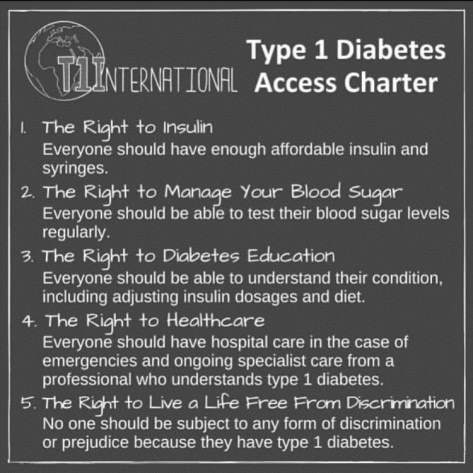
To survive and live a full life, everyone with type 1 diabetes has the right to the following:

1. The right to insulin
Everyone should have enough affordable insulin and syringes.

2. The right to manage your blood sugar
Everyone should be able to test their blood sugar levels regularly.

3. The right to diabetes education
Everyone should be able to understand their condition, including adjusting insulin dosages and diet.

4. The right to healthcare
Everyone should have hospital care in the case of emergencies and ongoing specialist care from a professional who understands type 1 diabetes.

5. The right to live a life free from discrimination
No one should be subject to any form of discrimination or prejudice because they have type 1 diabetes.

In addition to magnifying diabetes advocacy efforts globally, the charter is also used to influence the actions of governments and organizations so that policies can be changed and the rights of people with type 1 diabetes can be prioritized.

It took me fewer than 30 seconds to sign the charter, and I put this blog post together in under 10 minutes. Join me by signing and spreading the word about it to help people living with type 1 diabetes have access to vital insulin, supplies, healthcare, education, and freedom that are necessary in order to survive and live full lives.

Haste Makes Waste (of Pods)

Have you ever been in such a hurry to do something within a certain period of time that it works to your disadvantage?

I guess there’s a reason why they say haste makes waste…

…especially when haste results in accidentally whacking your insulin pump off your arm.

I was reminded that this can happen the other day when I had my friend over for some socially distant hang time. Just because we had to stay six feet apart during her whole visit didn’t mean that I had to be a bad host, though, and I was in a rush to bring some Goldfish for us to snack on while we sat in the sun outside. I flitted about the kitchen, grabbing the bag, a plate, and some napkins to bring out with me. When I went to open the sliding door that would take me from the kitchen to the porch, I gave myself just enough room for my body to slip through it sideways.

I should’ve walked through the opening slowly; rather, I dashed through it like I was about to cross the finishing line of a race – and my pod was suddenly, a bit violently, ripped off my arm in the process.

“ArrrrrRRRRRRRggggHHHH!” (I think that’s a pretty good approximation of the sound that I made when it happened.)

Green Yellow Paint Strokes Birthday Instagram Post
I wish I had a picture of how absurd it looked to have my pod dangling from my arm; alas, taking photos wasn’t a priority of mine in this situation.

My friend, alarmed by my animalistic emanation, asked if I was okay. I came to my senses and calmly explained that I’d just knocked my pod off my arm, and she looked on in horror as she saw it dangling by an adhesive’s thread on the site.

“Doesn’t that hurt?!” she asked in dismay.

I reassured her that no, while the actual sensation of the pod ripping off my skin didn’t hurt, it definitely stung that I was now forced to replace it even though it had only been in use for less than a full day. It sucks when I can’t use my supplies to their fullest extent because each time something like this happens, there’s a dollar amount attached to what I’m wasting, and what’s worse is that I can’t blame it on anyone or anything except myself.

Ah, well…a fresh pod was applied and no harm was done in the end. But next time I try to enter or exit that sliding door, you can bet I’ll be a lot more careful when I do so.