Four whole years of Hugging the Cactus! I can hardly believe it.
As I think about 1,460 days of running my blog, other milestone numbers related to it come to mind:
605 blog posts that I’ve written
595 comments from readers (you guys are the best)
51,276 unique visitors – WOW
71,662 total views – OMG what
100 dollars earned (one month ago, WordPress paid me my first $100 for featuring ads on my blog. The honest-to-goodness truth is that I never intended to earn money from my blog, but the fact that I have is pretty cool considering the following bullet point…)
INNUMERABLE HOURS spent writing new blog posts and coming up with graphics to accompany them – if I even attempted to calculate the amount of time, then I think my head would explode
It’s not surprising I’m thinking of the numbers behind Hugging the Cactus; after all, diabetes is a chronic condition based on numbers. People with diabetes spend all day long monitoring, calculating, and thinking about numbers. So it feels pretty natural to me to think about the numbers that have built Hugging the Cactus from a tiny little passion project to a bigger, more meaningful passion project.
And I can’t help but feel extraordinary gratitude for the numbers of people that have motivated, encouraged, and supported me and this blog – people who read this blog daily, weekly, or every once in a blue moon all fuel my desire to keep maintaining this blog and keep proving to me, time and time again, the power of the community that diabetes created. It’s a very special thing to be a part of.
With that said…here’s to four years, and plenty more to come.
This post originally appeared on Hugging the Cactus on September 23, 2020. Just over one year later, I’m sharing it again because it’s a reminder that life with diabetes is filled with the unexpected, and it’s important to be proactive when dealing with these curveballs. Read on to find out how I handled the broken insulin vial…
As soon as I opened the package, I knew something was wrong.
The contents of said package were five vials of insulin – my regular 90-day supply. On the surface, nothing seemed wrong. They arrived in their usual styrofoam cooler that was taped shut. After removing the tape, I saw four ice packs next to the plastic packaging containing the insulin vials; again, this was all expected.
When I picked up the plastic package and used scissors to cut it open, though, a pungent odor greeted my nose.
A medicinal, harsh, familiar scent…the smell of insulin.
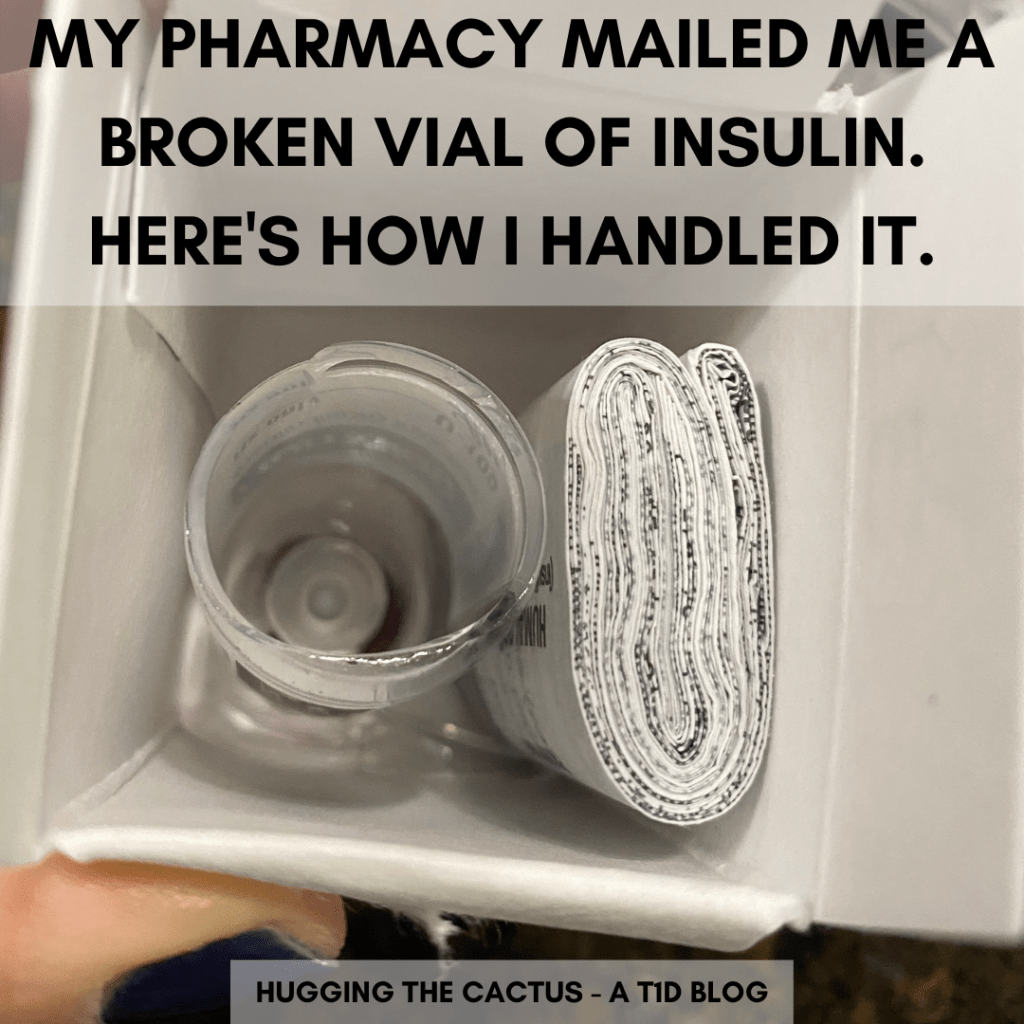
Upon further investigation, I discovered that one of the five cardboard boxes encasing the vials was totally damp to the touch. Gingerly, I opened it from the bottom flap, which was sticking out slightly due to the wetness. That’s when I saw the shattered insulin vial: Somehow, the bottom part of the vial had broken, spilling and wasting all of its contents.
I wish that smell-o-vision was a thing, because OMG…the smell coming from this was STRONG.
I was shocked. In all my years of diabetes, nothing like this had ever happened to me before!
I didn’t really give my next step a second thought: Immediately, I jumped on the phone with Express Scripts, which is the mail order pharmacy that I use for my insulin and some other medications. I spoke with and explained the issue to a customer service representative, who connected me with a technician that promised a replacement vial would be mailed to me at no additional cost to make up for the broken one. I asked if they needed me to send the broken one back to them, but I was reassured that it wouldn’t be necessary because I had called them so they could document the incident.
My issue was resolved, just like that, in fewer than 15 minutes. While it was annoying to have to take time out of my day to figure that out, I’m very happy that I got a replacement quickly and easily. But really, where was quality control on this one?!
Insulin is expensive, as we all know. And to see that a perfectly good vial full of it was rendered useless due to defective packaging was a major punch to the gut, indeed.
This was originally published on Hugging the Cactus on May 25, 2018. I decided to share it again today because in light of my travels last week and this week, I thought it’d be fun to revisit how my blood sugar was impacted by a long flight. Read on to learn more about my last long flight experience…
I traveled through time last week.
No, I didn’t use a magical device or step through a portal. It’s much more boring than that: I flew across the country, east coast to west coast, to spend a few days in Las Vegas.
Okay, there’s no way in hell that I could justifiably describe my Vegas trip as BORING.
But my point here is that flying through a couple different time zones is totally trippy. And, of course, it impacted my blood sugar. Because why wouldn’t diabetes just cooperatively come along for the ride?
Travelbetes is guaranteed to keep me on my toes.
I knew I should anticipate some sort of blood sugar swings going to and from my destination, I just wasn’t sure of when and how they’d hit. But I did know that when I landed in Vegas, the first thing I needed to do was adjust the time on my PDM (my insulin pump). Surely, my blood sugar would not react kindly to thinking that it was three hours later than it truly was in my new time zone. My question, though, was when should I do this? On the plane? After we landed? Should I adjust it slowly, in one-hour increments? Or should I dial it back entirely in one go?
Normally, I would’ve asked my endocrinologist what to do – but I forgot to bring it up during my last appointment with her a few weeks ago. So naturally, I asked the next best source: the Diabetes Online Community (DOC).
The answers I received were varied; nevertheless, I appreciated the immediate replies. I decided to quit stressing about it so much and focus on getting to the actual destination, vowing to keep an eye on my blood sugar for any suspicious trends while on the flight.
Five and a half long hours later, my travel companions and I arrived at our hotel. While in line for check in, I fixed the time on my pump and glanced at my CGM (which I didn’t bother adjusting, since none of the settings on it or my meter were dependent on time). I was steady at 97 mg/dL…not too shabby at all. And I’m pleased to say that I maintained that decent graph for the next day or so. I was nonplussed by the phenomenon, but I couldn’t complain about it.
The next few days are a different story, due to some “lifestyle choices” I made while in Vegas (c’mon, you know all I mean by that is eating junk food and imbibing alcohol). But that’s a tale for another post, coming soon.
This one’s about time travel, and while I had no issues flying TO Vegas, I did encounter trouble flying home FROM Vegas. My friends and I chose to a red-eye flight, which I don’t regret per se, but I’d never done one before and didn’t realize how much trouble I’d have falling asleep on the plane. It was disorienting enough leaving one place at 9 P.M. to arrive in another at 5 A.M., but add a freezing cold aircraft, turbulence, and an unsettled stomach to the mix, and you’ve got a recipe for disaster. As I tossed and turned in my seat, violently shivering a few times, my blood sugar was very slowly, incrementally, rising. I didn’t realize how much until we landed and drove home, where I had to bolus for an out-of-the-blue 308 mg/dL. I was so bloody tired, yet sleep evaded me further as I anxiously waited for my blood sugar to budge – which it did, but not for several, agonizingly long hours.
It definitely didn’t help matters that I wasn’t eating regularly; at the time of our arrival home, I hadn’t eaten real food in about 36 hours due to nausea that wouldn’t seem to leave me alone. I’d muscled down toast and a couple of granola bars, but not much else. I’d like to think that my entire body was just rebelling against me for spending the weekend eating too much pizza, staying up too late, and drinking a little too much whiskey, because that train of thought at least helps me make sense of my lack of appetite and recurring high blood sugars.
I’ve been back on the east coast for a couple days now, and I’m relieved to report that things have settled down. I’m eating regular meals (and I actually feel hungry for them), and besides a few flukes in my CGM graph, my blood sugars are mostly back to normal. I wish I could say that there was some big takeaway from this all: that I know exactly what to do next time I travel through time zones, or that I know just what to do to prevent it. But that’d be silly, because with diabetes, there are just too many variables. At least I CAN say that I know to take it in stride next time, to roll with the punches. Monitor my blood sugar like a hawk, correct as often as needed, eat normal meals as much as possible, and drink plenty of WATER. In any case, isn’t that what diabetes is all about…
Tomorrow, I’m boarding a plane again for the first time in more than a year and a half.
I’m having some feelings about it.
According to my calculations, it’s been 629 days since I last boarded a plane. That’s wild considering I used to fly a couple times a month in 2019.
The primary feeling is excitement. I’ve missed traveling – not the flying part – but I’ve missed the opportunity to see new sights and experience new things. I’ve been extra excited for this trip because my partner and I are both going to California for the first time for a friend’s wedding, so we definitely have a lot to look forward to regarding our plans.
But the secondary feeling is anxiety. A whole lot of it. I don’t quite know what to expect when it comes to traveling in this weird, not-so-new normal we’ve got going on. The only thing I do know is that I’m going to take as many precautions as possible (including masking up, carrying hand sanitizer, eating outdoors whenever possible, etc.) and try my best to quell my anxieties by taking comfort in knowing that I’m doing what I can to protect myself and others.
Of course, it’s easier said than done to conquer these anxious thoughts, and my pre-existing worries about traveling with diabetes complicate matters. For example, I’ve always had concerns about managing my blood sugars on flights. I’ve never been on one this long before (it’ll be about 6 hours), so I’m a bit stressed about that. Other pain points linger in the back of my mind: What will I do about meals? Will I have enough back-up supplies? Will I remember all my devices (and their respective charging cables)? Are my nerves going to drive my partner bananas? (He’s the most patient person I’ve ever met so I will be putting that to the test on this trip!)
So staying healthy and well, in addition to making sure I take good care of my diabetes, are top of mind. It makes me long for the days when getting from point A to point B was the most pressing part of planning a trip…
Through writing this blog post, though, I think I’ve come to realize that I’ve got to keep a third thing top of mind: having fun. The first two things are obviously important, but so is enjoying every minute of this vacation.
Up until last weekend, the closest I’d ever come to going on a camping trip was that time I “camped out” in my parents’ backyard when I was 5 or 6 years old. (And that barely counts because I only stayed outside long enough to roast marshmallows before I decided I hated the idea of sleeping in a tent and ran back inside, leaving my dad and my brother to fend for themselves in our suburban wilderness).
Fast-forward 22 years later to when a real camping opportunity presented itself to me: I decided I should give it a real try and guess what? I had a great time!
But also guess what? Beyond thinking about how I might keep my insulin cool, I put very little thought into my diabetes before going on this camping trip. There was no logic behind this decision other than I decided to just wing it; after all, I’d only be gone for 2 nights.
I recently got a crash course in camping with diabetes.
My lack of careful planning caused me to experience a crash course in camping with diabetes. Here’s what I learned (and wished I’d considered before I left for the trip):
Keeping insulin cool isn’t as simple as tossing it into a cooler filled with ice packs. The one part of my trip I assumed I didn’t have to overthink turned out to be not so simple. I thought ice packs would do a good job of keeping my insulin at the right temperature. What I did not think about was all the other food (raw meat, veggies, etc.) that had to stay cool, too – which meant that the ice packs were pulling double duty and not staying as cold as I thought they would. This problem was easily solved with the addition of bagged ice to our cooler, but that, in turn, created a smaller issue by getting my insulin carton wet (meaning I had to throw the packaging away when we returned home). Not a big deal, but next time I’ll definitely bring an extra plastic bag or something else to help keep my insulin vial and its protective carton dry in addition to cool.
Setting up a campsite lowers blood sugar just as quickly as any other type of exercise. When we arrived to our campsite, it was around dinnertime on Friday evening, which meant we only had about an hour and a half before the sun started setting – so it was important that we prioritize setting up our tent instead of eating food. Hauling all of our stuff from the car, moving things around, blowing up our air mattress, and other steps taken in order to set up a cozy campsite meant a lot of physical steps taken, which lowered my blood sugar pretty quickly. Fortunately, I had plenty of snacks on hand, which leads to my next point…
Bringing tons of extra low snacks is a wise decision. I have my partner to thank for thinking to buy a package of gummies at the store (on top of s’more supplies and trail mix) that would help supplement the snacks that I’d already put in my backpack before we left for the trip. These gummies proved to be one of the best purchases of the weekend considering I had to eat three packs of them in the middle of the first night of our trip! It just goes to show that there’s no such thing as too many low blood sugar supplies.
Pre-bolusing isn’t conducive to cooking over a campfire. I’ve gotten into the habit of pre-bolusing for my meals, which means that I take insulin somewhere between 15 and 30 minutes before I actually start eating. This was not something that would work out well when my meals were being cooked over a campfire because we had no clue when our food would be ready. Turns out, it takes a lot longer to cook a single burger over a fire than it does to cook a whole package of them on the grill! This wasn’t a huge deal – it really just meant that I experienced a couple more immediate blood sugar jumps than usual.
All in all, camping with diabetes turns out to be something that really doesn’t require that much extra prep or special considerations. While it undoubtedly would’ve made it easier to know these things beforehand, they’re also things that I only could’ve learned from going camping for real – not just out in the backyard.
Some weird food combinations actually work – I know this for a fact because I Googled it and the Google machine is always right…right?
Okay, so maybe I’m not brave enough to try combos like olive oil and ice cream or oreos in orange juice, but at least I can tell you about an odd food pairing that most definitely does not work.
And that, my friends, is anything minty with apple juice.
I should know because I got to try this less-than-delightful combo two nights in a row…thanks to diabetes.
If you’re guessing that I experienced a low blood sugar immediately after brushing my teeth and chose to correct it with apple juice both times, then you’re a smart cookie (or at least a cookie who can put two and two together).
On the first occasion this happened, I figured that drinking a juice box for the low was probably the wisest decision because I wouldn’t have to worry about getting food stuck in my teeth – I could maybe even drink the juice without needing to brush again.
I was very wrong about this.
10/10 would not recommend drinking apple juice right after brushing teeth.
The moment I started drinking my apple juice, my taste buds were rocked by the unpleasant union of minty freshness with tart sweetness. It was truly disgusting and I wanted nothing more than to brush my teeth again…but laziness and exhaustion (from both my day and my blood sugar) caused me to collapse into bed instead. I fell asleep with that weird bitter taste lingering, much to my chagrin.
So you can bet that when the exact same thing happened the following night – my Dexcom alerted me to a low within 60 seconds of me finishing my teeth brushing – I forced myself to brush my teeth again because I simply couldn’t stand the minty-apple-y taste.
And I decided to make a mental note, after this second encounter with nasty minty apple juice, that I would check my Dexcom before brushing from that point onward.
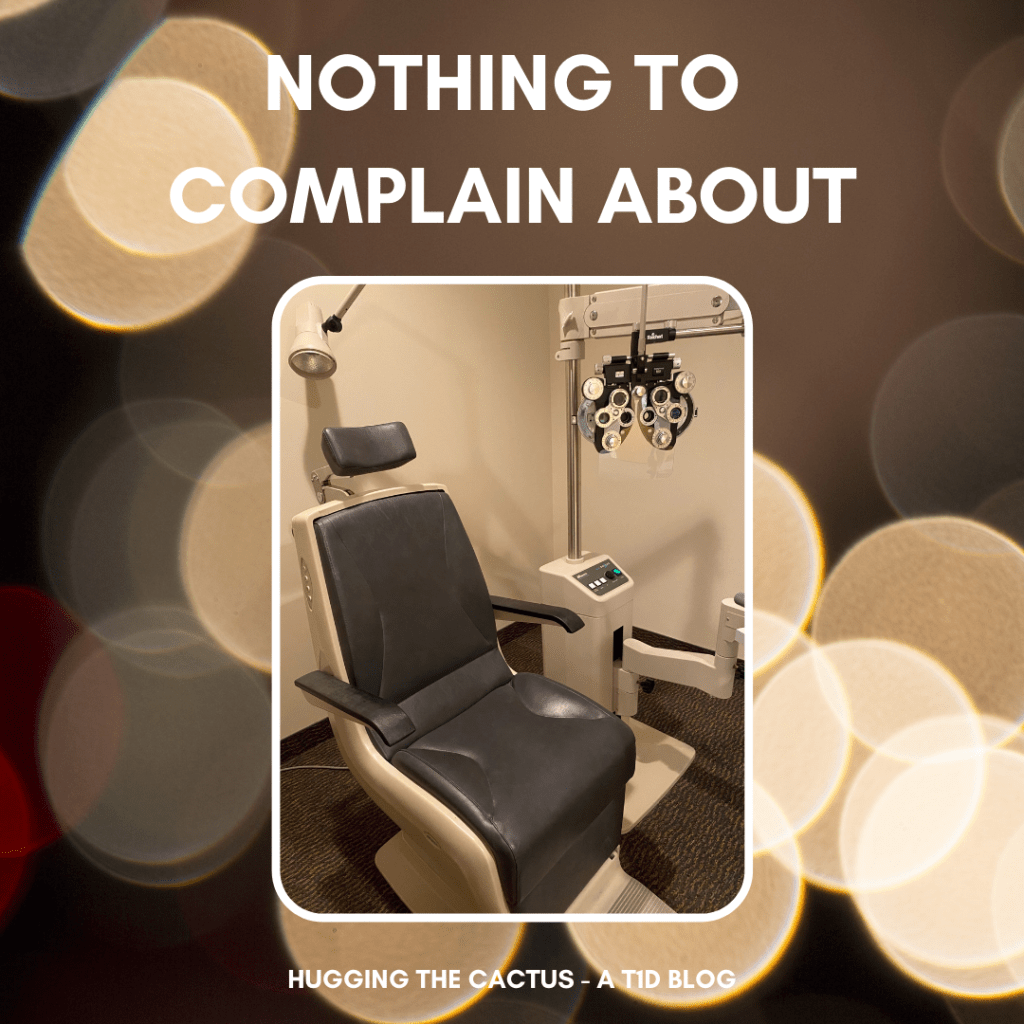
I’m writing this blog post from my ophthalmologist’s office – I’m sitting in a chair in an exam room, waiting for my eyes to dilate so my doctor can complete the exam.
Just before my eyes were dilated, I checked in for the appointment and went over my information with a nurse who works here. During the check-in, she asked me how my eyes fared in the last year.
The chair from which I wrote most of this blog post – on my phone, to boot! (It takes time for eyes to dilate, okay?!)
“I have nothing to complain about, all is well!” I said to her.
“That’s great to hear. After all, after a year like we’ve had, it’s nice when there’s no complaints about something.” She replied.
I sat here in this chair and smiled under my mask. Too true. It’s refreshing when there aren’t any complaints about any aspect of my health and well-being, considering diabetes can be such a pill.
And I’m happy to report (now from the comfort of my own desk chair) that I have “gorgeous retinas”, according to my ophthalmologist.
At long last, the day has come…the day for me to share my first impressions of the OmniPod DASH!
Full disclosure: I’ve only been using the system for 3 days as of this writing. But I thought it was important to capture my beginning thoughts on how it works because they’re bound to change over time as I gain more experience and familiarity with the system.
So without further ado, here’s a bullet point list (‘cuz who doesn’t love a good list) that hits the highs and lows – yes, pun intended – of the DASH so far:
It was shockingly easy and fast to set up. I was worried about inputting all my settings from my old OmniPod into the DASH system and assumed that I would need a block of time to do so. This is why I decided to do my set up on a free and clear Sunday afternoon with minimal distractions around me. Turns out, though, that I didn’t need so much time set aside – it took me exactly 10 minutes to get all my settings straightened away. In fact, it probably would’ve taken closer to 8 minutes if I hadn’t agonized over choosing my background photo for my lock screen! The PDM made the entire setup process extremely intuitive and easy to navigate, much to my relief.
The PDM is incredibly high-tech…and, at times, suffers from that. I’ve spent a lot of time marveling over the clean, sleek design of both the touchscreen and the PDM itself. It’s almost identical to my iPhone, which I think is both a pro and a con because I can see myself confusing one for the other in the future (though it’d be extremely obvious which was which once I unlocked the device). The touchscreen and menus are thoughtfully designed, but my big beef with them is twofold: 1) Some menus are totally buried – it took me an embarrassingly long time to figure out how to set a temp basal and 2) Anyone who ever claims to suffer from “fat fingers” or struggles to hit the right buttons 100% of the time on a smartphone might find navigation on the PDM to be a challenge. The good news is that it’s really easy to go back if you’ve mistakenly navigated to a menu that you didn’t need and to correct any accidentally hit buttons, but I could definitely see some users taking issue with the operation of the touchscreen as a whole – even though I personally haven’t found it bothersome.
Shout-out to the Insulet/OmniPod website for providing a much better image of the DASH PDM and pod than I ever could!
The pod change process has a new addition to it. DASH users have the option to record the site of their new pods, a feature that I think is pretty neat! I’ve always been pretty good about rotating sites, but having a record of exactly where I’ve placed my pods over time is bound to be helpful so I don’t ever use one particular site too much.
Speaking of the pod change process…I almost activated a pod when it wasn’t even on my body yet. I’m used to the pod change process consisting of multiple pages on my PDM that outlines everything step-by-step. The DASH system aims to consolidate things a bit and features more than one step on a page. This was all fine and dandy up until I hit the last step of the process – I touched the button to activate the pod, thinking that I was navigating to the last page in the setup process! This was mostly user error because I should’ve read the screen more carefully, but luckily, I had to hit a “confirm” button in order to actually activate the pod (so there’s basically 2 buttons that have to be hit to activate a pod, not one).
So far, I’m unsure how I feel about the rechargeable battery feature. I thought this would be a huge improvement over the old OmniPod, which took 2 AAA batteries, but now I’m having some doubts. Those AAA batteries easily lasted 6 weeks – maybe even longer. Now I’m going to have to recharge the DASH PDM at least once or twice a week, depending on how often I’m actively using it. This is going to be a slight pain, but according to what I’ve read, the PDM is still useable when it’s charging, so that makes it more tolerable. But I’m also thinking from the perspective of someone who is away from home at least a few nights a month – this is going to be just ANOTHER charger that I have to remember to pack every time I go away, which is a bit of a bummer.
The system sounds are SO MUCH BETTER!!! OMG, I think the days of OmniPod beeeeeeeeeeeeeeeeeeeeeeeeps are in the past! I haven’t noticed any of those lingering, ear-shattering beeps yet; instead, they seem to have been replaced with a pleasant chiming sound. I’m sure that over time, I’ll grow to hate that sound, too, but for now I’m just loving that I’m not being pestered with pod reminders by those grating beeps!
Like any diabetes device, I knew there would be some faults with the DASH system. But generally speaking, those faults are extremely minor and I’m still thrilled that I’m on this new system…and extremely curious as to how my thoughts and feelings about it will change over time. I’ll be sure to post about my new discoveries and experiences with it in the future!
Sensor snapping by the seashore…try saying that five times fast.
The past several weeks have been so busy that I completely forgot about an incident that occurred when I was away on vacation in July.
An incident that I’d never experienced in my decade of using Dexcom CGMs…
It was the second-to-last day of my trip. I was blissfully soaking up the sun’s rays – it was by far the best beach day of my entire week in Maine. That meant that the sun was strong that day…so strong that I was basically applying sunscreen every hour, on the hour, because I am as pale as Casper the friendly ghost.
During one of my sunscreen applications, I noticed that the Dexcom sensor on the back of my arm was looking a little off. I mean that literally – the transmitter seemed like it was jutting out at a weird angle. Upon further inspection, I realized that the grayish-purple prong that helps keep the transmitter in place was hanging on by a thread. I was pretty surprised to make that discovery, for a few reasons: 1) I didn’t know that could happen, 2) the sensor was only about 24 hours old and nothing went awry during the application process, and 3) I couldn’t remember bumping into anything that would’ve caused a plastic piece to break off my sensor. But the most surprising part was that it was enough to cause my sensor to stop collecting readings altogether – I was getting an error message on my Dexcom app.
My broken sensor prongs and me, sitting on the beach.
I didn’t know what to do other than carefully break the prongs off all the way – they weren’t going to do me any good now – and gingerly press my transmitter down into my sensor for several minutes to see if that did anything…and no dice. I resorted to plan B, which was to wait until I got back to the house I was staying at to do some more research into the matter.
Unfortunately, the internet had nothing helpful to offer me. I was somewhat relieved to know that this has happened to other people, but definitely bummed to learn that there wasn’t a real solution other than to apply a new sensor – which wasn’t an option for me since I had only packed the one sensor for my trip. Whoops. So much for me being the diligent, prepared T1D that I thought I was.
Ultimately, I decided to rip the sensor off and deal with finger stick checks for the rest of my trip; after all, I was going to be returning home the next day. I look at the whole incident as yet another example of why it’s important to pack extras of my extras, and as a reminder to expect the unexpected in life with diabetes!
Dazed, I roll out of bed and suddenly become aware of how hot I am. Beads of sweat are rolling down my back, making my pajamas stick to my skin. I look at the number on my Dexcom – there isn’t one.
It just says LOW.
I grow more alert and turn to my test kit to do a fingerstick check and verify my Dexcom reading. My meter says that I’m 44.
And suddenly, I’m feeling that low. I need sugar, stat. I could open the bottle of glucose tabs conveniently perched on my nightstand, chew 5 or 6, and then get settled into bed and fall back asleep relatively quickly. But the desire to get downstairs and eat the contents of my kitchen strikes, even though it’s 1 A.M. and eating too much at this time of night wouldn’t be good for either my blood sugar or my sleep hygiene.
Ignoring my more rational side (as well as my glucose tabs), I grab my phone, my meter, my PDM, and my bathrobe and stumble down the stairs in the dark. I turn on the ceiling fan in my living room in a desperate attempt to cool down faster before I walk into the kitchen.
My eyes fall on a cupcake sitting innocently on the counter.
This isn’t a picture from this particular incident – nobody wants to see me when I’m this low – but this is one of the cupcakes that I’d made. Violet always wants me to share.
I don’t think twice – I tear the wrapper off and three bites later, it’s gone.
I collapse on the couch, directly under my ceiling fan. I am a sweaty mess. This low is hitting me hard. I put the TV on in a futile attempt to distract myself while I wait for the cupcake to kick in, but instead of paying attention to what’s on the screen, all I can feel is gross for choosing to eat a damn cupcake at 1 in the morning instead of doing the “right” thing and treating my low from the comfort of my bed with glucose tabs.
20 minutes later, I start to feel chilly. I’m no longer perspiring and I feel all of my low symptoms subside. I’m better, so it’s time to head back upstairs and try to fall back asleep.
I toss and turn for a bit, cursing diabetes and its middle-of-the-night low blood sugar curveballs, and the stupid 1 A.M. cupcake that my diabetes somehow convinced me to eat to treat a low instead of waiting to have it at a time that I could actually enjoy it.
Diabetes strikes again, I think as I drift back to sleep.








 Hugging the Cactus