T1D Plus the TSA Equals Trauma

I had a bit of a traumatizing experience at the airport a few weeks ago.

I travel fairly frequently – I’d estimate that I hop aboard a flight a dozen times or so per year. As a result, I’m well-versed in the TSA routine that goes down at every airport: Remove shoes/belts/items from pockets. Take laptops and electronic devices of similar size out of bags. Place 3-1-1 liquids in a visible spot. Let TSA agents know before stepping into the full-body scanner that I have T1D and wear a couple of devices. Step out of scanner and allow them to do a hand swab. Wait patiently for the results to come back clean, gather belongings, and move on to my gate.

It’s a very precise routine that I’ve come to anticipate and accept, so really, it’s no wonder that it was bad experience when it deviated sharply from the standard format on my last trip.

I was returning home from a long weekend in Washington, D.C. I queued myself up in the TSA line and when I got close enough to an agent, I let her know that I didn’t want to go through the full-body scanner, because I was wearing a medical device that couldn’t handle it. (The manual for my Dexcom G6 advises users to avoid full-body scanners and opt for pat-downs, metal detectors, or wands, as available. I’m a stickler for following the rules, so that’s why I stuck with the manual’s advice). I’ve had the pat-down before, and while I don’t love it, I knew it wouldn’t be intolerable.

As soon as another female agent was free to conduct the pat-down, I was waved over and subjected to the semi-embarrassing “free massage”. Once it was done, my hands were swabbed. If you aren’t familiar with the hand-swab process, it’s a protocol in which the TSA checks passengers’ hands for any traces of explosives. In other words? My swab always comes back clean.

Except this time, it didn’t. The machine dinged. This prompted a couple of TSA agents to consult one another before coming over to me and informing me that I’d have to wait an undisclosed period of time for another, higher-up female agent to come over, conduct a “more-thorough” pat-down, and forfeit my luggage for a closer inspection.

Deep down, I wasn’t worried because I knew that the more meticulous inspections would clear me for travel. But I couldn’t fight back against the anxiety that flooded throughout my body as I wondered how long I’d have to wait and how much more invasive this next pat-down would be. I struggled to conceal the tears that rolled down my cheeks as TSA agents seized my bags and rifled through them, ruining my careful packing techniques. I was humiliated, and practically had to beg them when I asked to see my cell phone and OmniPod PDM. (I could practically feel my blood sugar going up due to the stressful nature of the situation, so I wanted to check and correct it A.S.A.P.) It only got worse as I was pulled into a separate room and given a pat-down in which the agent actually pulled my pants away from my body to look down inside them, which is just as awful as it sounds. I know that they’re merely performing their job – I don’t fault them for that and appreciate that it’s far from glamorous – but it was horribly demeaning.

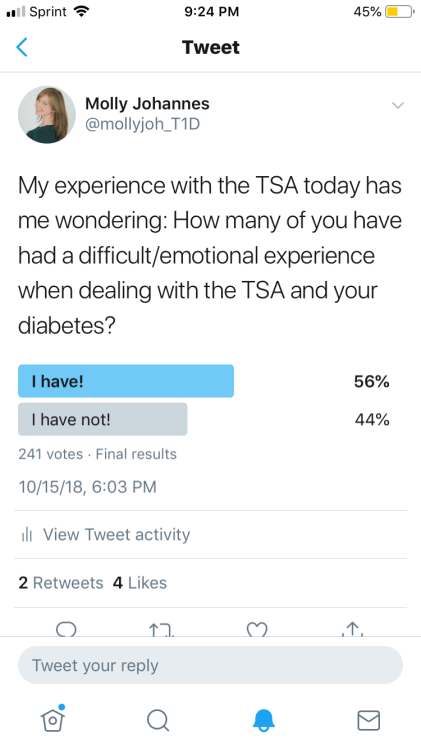
When I was finally told I could go, I wordlessly collected my belongings, fighting to shove them back into my suitcase. I made a beeline to the restroom to splash water on my face and calm down. As I waited to board my flight, curiosity took hold of me and I posted a poll on Twitter. I wanted to know if anyone else has ever had an experience like mine. Nearly 241 people answered my poll.
E384054F-7E7B-4AC6-BEE9-568554B9EDBB

And I was fascinated by the results. There was no overwhelming majority; in fact, it was rather solidly split down the middle, with only a few more people reporting a negative experience with the TSA. Many of those people responded directly to my poll with tweets of their own that described their experiences:

They nearly ripped my son’s inset out of his thigh for his pump one time. Another time they took his bottle of insulin & tested it & I understand explosives come in liquid form but he was 8 years old. Another time they performed a very thorough and humiliating body pat down on me in order for him to bring his insulin on board.

I’ve never had a difficult experience w/TSA on any flights- international or domestic. They’ve all been very professional & understanding when I said I have an insulin pump/all supplies. I’m sorry you had a tough time.

My husband has to take my daughter through because I completely lose my shit on them. Every single time a hand swipe test. Unbelievable and stigmatizing.

Almost every single time and it infuriates me. They treat your supplies like you’re part of the drug cartel. One held up my bag and with so much attitude “excuse me? What is this?” And I said my medicine and another passenger screamed at the agent saying “you can’t do that!”

Same thing happened to me! They tore apart and destroyed so many of my supplies and I just watched helplessly while crying. If 29 million Americans have diabetes why is TSA so oblivious to what it looks like?!!

While these replies validated to me that I wasn’t overreacting, they also made me sad. Angry. Frustrated. Why is this a thing in some airports? Why isn’t there a better protocol in place for people with diabetes?

Perhaps the most irritating part of it all is that I don’t know for sure why this whole thing happened in the first place. I assumed that it was a fluke on the machine’s end, but after corroborating stories with so many other T1Ds, it’s got me wondering…was my diabetes a red flag of sorts to the agents? Did they think that my supplies were disguised and could be something harmful?

Again, I don’t want to discount the work that the TSA does to help keep travelers safe. I truly do appreciate it and I know that experiences vary at airports all across the world. But…we can do better. Traveling should be fun and exciting, not traumatizing.

Diabetes and Honesty: Don’t be Afraid to Speak Up

It’s said that ignorance is bliss…but as I recently (re)learned, ignorance can cause fear and misunderstanding in times that it’s better to be honest.

The lesson was hammered into my brain after fibbing to my significant other about my blood sugar a couple of weeks ago. It was a Saturday night, we had spent the day moseying around the city, and we were looking forward to a chill evening doing a whole lot of nothing. We decided to get into a collaborative card game while we watched the Red Sox play against kick the Astros’ butts.

As we set up the game, I knew my blood sugar was high. But I ignored it, figuring that my insulin would kick in soon and bring my levels back down to normal. I should’ve known that it wouldn’t be so simple (is ANYTHING ever simple when it comes to diabetes?) because after an hour and a half, no progress was made on the BG front and my mood was worsening as a result of it. My partner, ever-attentive, asked me more than once why I seemed so cross. He even directly asked if it was related to my blood sugar, and I…didn’t exactly tell the truth.

diabetes honesty

Okay, I lied! But it was only because I didn’t want him to worry. I was already worried enough for the two of us. And I thought I was doing the right thing here. I really, truly thought my blood sugar would come down in no time at all, and I hate, hate, HATE using anything related to my diabetes as an excuse for my behavior…so rather than admit what I was going through, I brushed it off, which only exacerbated everything. Not my proudest moment.

As the night went on, we got deeper into the game and my blood sugar climbed higher. I was beyond agitated at this point, and my heart certainly wasn’t into the game. Besides neglecting to open up about my blood sugar problems, I’m also ashamed of my lack of interest in the card game. In hindsight, the healthy thing to do in this situation would’ve been to have faith in my treatment decisions and try to enjoy myself in the meantime. But I was too caught up in the negative mindset that the high blood sugar put me into, and unfortunately, it marred an otherwise perfectly nice night.

The next day, when my blood sugar situation was back to normal, I came clean to my boyfriend. I think he was a bit irked with me for hiding the truth from him, but I also think that he understood a little more after I explained why.

In this case, diabetes won…at least it did in that brief moment in time. Between ruining my mood and causing a mild rift between me and a loved one, I felt pretty damn defeated by it. In the long run, though, I think this experience will be more of a boon than a bane, because it reinforced the notion of honesty being the best policy – even when it comes to diabetes.


An Incident I Won’t Forget

Low blood sugars are funny. Not ha-ha funny, but peculiar in how they affect me physically and mentally.

A few weeks ago, I had an experience with a particularly scary low. It frightened me so much that I’m only just getting around to writing about it now, because I needed some time to gather my thoughts on what happened.

I’ll set the scene: I was home alone. I had eaten a carb-heavy dinner and decided to do a 30-minute, high-intensity workout. This was definitely far from my best idea ever, because due to the high-carb intake, I had a lot of insulin on board. That, coupled with the exercise, meant that my blood sugar was bound to crash soon after completing the workout.

And it sure did.

16E24606-06FB-447B-90B5-BEF2FA19E4CA
Falling rapidly.

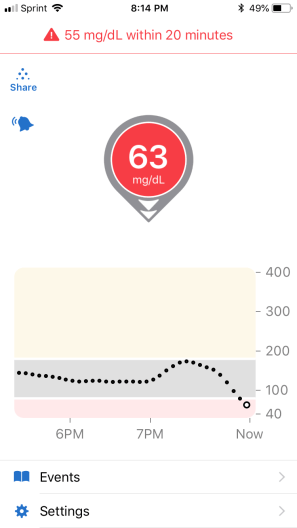
I had just stepped out of the shower and wrapped myself in a towel when I began to feel it. That sudden wave of weakness, shakiness, and dizziness. I walked to my bedroom, grabbed all of my diabetes supplies and my cell phone from my purse, and sank down to the floor with everything in front of me. I knew it would be wise to just sit there for as long as I needed, because I was afraid to go down the stairs (and possibly fall down/hurt myself in the process) in that state.

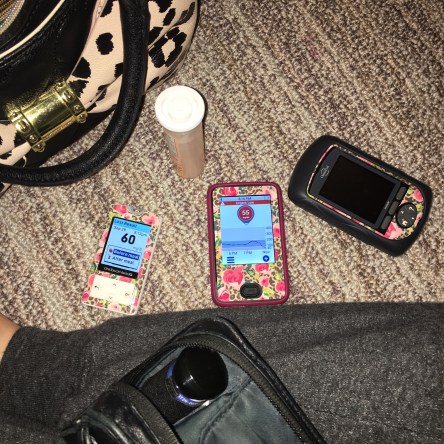
I checked my CGM, which confirmed that I was dropping quickly. I stared at the screen, panic flooding throughout my body. It occurred to me that I should probably do a finger stick check to make sure I was really that low, so I did, and saw that I was 60 mg/dL.


4219504D-CA13-4224-B5BA-9C90BB58F79D
The scene of the incident.

Now, I’ve absolutely been lower than 60 before. It’s never a pleasant experience. But rather than using that as a comforting thought, I couldn’t help but dwell on how terrible I felt and how frightened I was to be home alone with at least four more units of insulin still working in my system.

All I could do was chew four glucose tablets, suspend my insulin delivery, and wait.

In that period of time, I was totally immobilized.

I’ll never forget how alone I felt, how out of control I felt.

I felt powerless against my diabetes. My own body.

I’ll never forget the fear that consumed me, that nearly prevented me from helping myself in this situation.

I’ll never forget texting my mother and my boyfriend, telling them what was happening, and expressing how scared I felt.

I’ll never forget bursting into tears when they didn’t reply quickly enough.

I’ll never forget turning to my T1D Twitter buddies for help by sending a tweet about what was happening, or how swiftly and comfortingly they responded to me.

And I’ll never forget how I let my mind drift as I wondered whether I’d be okay.

It sounds totally dramatic, especially for a low that, in the grand scheme of things, could’ve been much worse. I can admit that.

But I can also admit that this is one of the few times in my life that I felt truly terrified of my diabetes, and swept up in the fact that things can change so quickly with this condition that it can quite literally knock you off your feet.

Obviously, I recovered just fine that night. The glucose tablets did their trick and my low symptoms subsided. It took longer for me to calm myself down, to breathe normally, non-panicky breaths. At least my puppy was around to soothe me.

I was fine, I will be fine. But I won’t forget this incident, ever.

Grazing: My Bad Habit

A handful of peanuts here, a couple of slices of cheese there.

A pile of popcorn followed by a spoonful of peanut butter.

A few pretzels and a small smattering of chocolate chips – because chocolate.

These snack combos, as strange as they may be, all describe some snacking behavior that I also refer to as “grazing”. Grazing is all about taking little bits of food when I’m not necessarily hungry. I equate it to eating out of boredom, except I’m not indulging on full meals or anything, I’m simply munching because the food is there and my blood sugar is acceptable enough to the point that I can freely snack without having to bolus, or worry about significant blood sugar jumps later on.

In other words, grazing is a habit I’m trying to break.

grazing

I’m not stupid. I know that the aforementioned foods I choose to graze on contain carbohydrates. Whether trace or moderate, they’re still there. And I choose to ignore them.

I don’t know why. If I want to have a snack, then that’s okay, as long as I take insulin for it. But I guess my rationale for grazing is that I’m taking “itty bitty” amounts of food that will minimally impact my blood sugar, if at all.

Then again…it’s not exactly logical when those small snacks DO wind up impacting my blood sugar. Usually, the spike happens several hours after, and each time I get angry at myself for a) not having enough self-control to resist grazing and b) not taking insulin for it when I do give in to the bad habit.

Nearly 21 years of diabetes and I’m still occasionally blown away by the minutiae of it: how just the slightest smackerels can take a toll on the straight-lined graphs I strive to achieve daily.

Diabetes in the Renaissance

Can you imagine having diabetes in the 14th – 17th centuries??? The answer to that is no, you probably cannot…because without modern medicine, it wouldn’t have been possible for a T1D to survive in the Renaissance. And ‘cuz, well y’know, the Black Plague was a thing back then and lots of people didn’t survive.

But fortunately, we’re living in the 21st century, which means we have access to all sorts of things that help us manage diabetes. Still waiting on that cure, though.

Where am I going with all this?

I wanted to recount my recent trip to a Renaissance festival, in which I spent a day taking care of my diabetes while jousting tournaments, Shakespearean performances, and drunken debaucheries took place all around. And you know what? It was easier than I thought it’d be.

Sure, I didn’t check my blood sugar with my meter as much as I should have. My inner germaphobe was reluctant to rely on my meter for accurate results, seeing as there weren’t really any hand-washing stations on the fairgrounds. (Remember, this is the Renaissance…things were a little grimier in those days.) I used hand sanitizer whenever it was available to me to keep my hands clean, but it was a bit of a challenge, especially when my mitts got caked in mud post-ax throwing.

587E26CB-B564-463E-815B-B5CF73256412
Enjoying a turkey leg alongside a serving of Chardonnay at the Renaissance Faire – y’know, to keep things classy.

Thankfully, I had my Dexcom G6 to help keep me on track as I ate my way through the fictional 16th century village. I was jazzed that several low-carb options were available to me; throughout the day, I snacked on a giant turkey leg, a Scotch egg, and spiced nuts. Maybe a “diabetes-friendly” diet would’ve been easy to follow in the Renaissance? Though I will admit that I gave in to temptation and ate (devoured) a slice of cheesecake. On a stick. And dipped in chocolate. Not low carb, but super YUM.

So even though my diet was far from nutritious at the ye olde faire, I think that all the walking around and sharp-objects-throwing kept my blood sugar in check, much to my relief. My experience at the fest is just another example of how diabetes won’t prevent me from living life to the fullest, whether it’s in the reality of 2018 or the fantasy of the 16th century.

A Diagnosis of LDM

What is LDM? According to my mother, it stands for Lovely Diabetes Mystery. The “lovely”, of course, is sarcastic, whereas the “diabetes” and “mystery” relate to a random, unforeseen diabetes medical incident – which occurred to me on Sunday, October 7th.

I woke up that morning with some abdominal pain. I rolled over soon after waking to check my CGM, and was startled to see that I’d be in the 300s for most of the night as I was sleeping. I quickly bolused for it using my PDM, and shut my eyes, hoping to get some more rest and to wake up again without stomach discomfort.

No such luck. About an hour later, I opened my eyes and looked at my PDM again, and I had barely come down. I tested to confirm, and sure enough, I’d only gone down a few points. I was worried, which was exacerbated by the weird nausea I was having. Could this be a sign of something more serious?

My mother convinced me to do a manual injection with a syringe. We both figured that that would help bring my numbers down faster, and that if I started coming down quickly, then it could mean that the pod I had just applied the day before was not working properly. We agreed that I should probably change it, to err on the side of caution.

However, I didn’t get to change my pod until much later in the day. That’s because of what happened soon after I took my manual injection.

I went to use the bathroom, certain that the churning of my stomach meant that I was about to be sick. I was standing in front of the toilet when I started sweating – profusely. On top of that, my vision went all fuzzy, and I felt totally disoriented. I knew something was wrong, so I called out for help.

My mom raced into the bathroom to find me seated on the floor, dripping in sweat. I placed myself on the floor deliberately because I was worried I might pass out and injure myself. She started cooling me down with a wet facecloth, and searched through the drawers to find a thermometer to check my temperature. She also grabbed her test kit and my lancing device, because naturally, we both assumed that perhaps my blood sugar was dropping rapidly from the insulin injection, and it might be a hypoglycemic event.

But when we checked my blood sugar, I was still in the high 200s. I was pretty scared at this point and just wanted the sweating to stop and for my vision to clear. That’s when my dad came in and made the executive decision to call an ambulance for me.

A police officer, three firefighters, and two EMTs showed up my house. I answered questions in my confused state. My vision restored and the sweating stopped, but I still felt weak and woozy. They put me into the ambulance. I was given an IV bag and medication for the nausea. It was my first time in an ambulance and it was not exciting, just weird. I didn’t like riding backwards or experiencing the twists and turns along the way.

91045270-BB56-4755-AC8C-3CDE532AF6B6
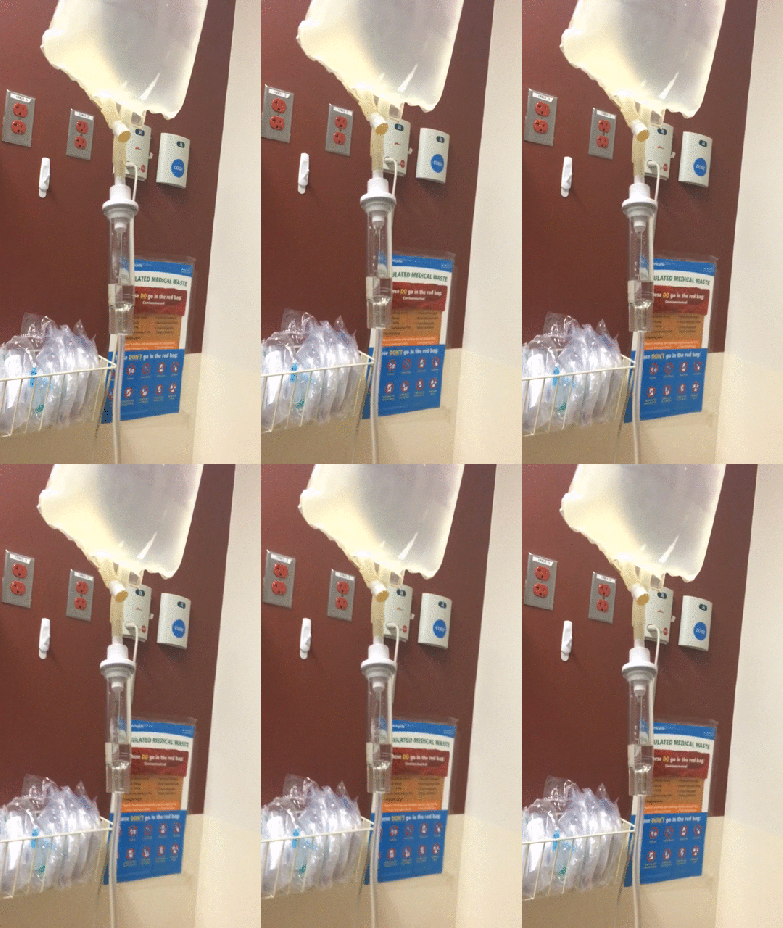
I was bored in the hospital; so naturally, I created this boomerang of my IV drip.

We arrive to the hospital. I’m whisked away into the ER. I answer a series of questions from various medical students and nurses and doctors. They draw blood for tests. I give them a urine sample for more testing. I keep on explaining the concept of my OmniPod to each one of them. No one seems to have seen it before, besides one med student who has a sister who works for Insulet. Small world!

We monitor my blood sugar closely. My tests come back normal. I eat my first foods for the day around 2 P.M.: sugar-free jello and two hard-boiled eggs. Yum…

I get an injection of insulin at the hospital. We don’t have a vial of Humalog with us – it was the one thing we forgot to grab from the house. But my dad drives home to retrieve it so I can change my pod at the hospital. My mom does it for me. I feel helpless.

The old pod comes off and we notice a definite bend in the cannula. Okay. One thing explained. I wasn’t receiving my full insulin dosages due to the bend, and unfortunately, I have no way of knowing how much insulin I was truly receiving. All I know is that it wasn’t enough, and that’s why I was running high.

I receive a diagnosis: vasovagal syncope, or pre-syncope. It’s explained to me, but I still don’t really get it. So I text my best friend, who is also a nurse. She tells me that it’s very common and can be triggered by a variety of things. The pre-syncope aspect makes more sense to me, seeing as I never truly passed out.

I’m discharged and feel so very tired. It was a long day. The following days are filled with follow-ups and message exchanges between myself, my endocrinologist, and my primary care physician. My healthcare team and I think that we come up with a plausible explanation for the hullabaloo: My body knew something was wrong. It knew that my blood sugar was abnormally high, and it knew to send signals to me that I needed to take care of it. Hence, the abdominal pain. My dehydrated state exacerbated things, and when I started sweating and lost more fluids, it was a lot for my body to experience.

Sheesh. What an ordeal. Like any diabetes-related experience, it taught me a lot, but I certainly don’t want anything like that to happen again. Shout-out to the healthcare professionals, but especially my parents, for taking damn good care of me throughout the whole episode. You’re the bomb diggity.

Favorite Things Friday: My OmniPod

One Friday per month, I’ll write about my favorite things that make life with diabetes a little easier for me.

This month’s favorite thing is so damn obvious that it’s kind of shocking I haven’t written about it yet on the blog: my OmniPod insulin pump.

I love the friggen’ thing.

Untitled design
My OmniPod PDM.

I don’t know if it’s because pumping works better for me in general over multiple daily injections (MDIs), or if it’s because the OmniPod is simply the perfect pump for me. Honestly, it’s probably a combination of the two. I love how convenient it is – I can deliver insulin any time, any place, I don’t have to worry about tubing getting caught on random objects, and it lasts me for three full days (of course, only if it’s working properly…I’d estimate that it does about 90% of the time). And I love that my dosages are so much more precise compared to how they used to be when I was doing MDIs. It gives me more control, knowing that I can dose in .05 increments according to my current blood sugar levels and carbohydrate intakes.

However, it is merely another piece of diabetes technology, meaning that it does have some flaws. Sometimes pods fail for the silliest reasons, such as coming into contact with static electricity. And other times pods don’t work for no damn good reason at all, without giving the user proper notice (in the case of bent cannulas, something I recently encountered).

But for the vast majority of the time, I love my OmniPod. I’m still surprised to how quickly I adjusted to the system – the first week or two was tough, but then it was relatively smooth sailing after that period. I think it was easy for me to get used to another wearable device, because I’d already been wearing my Dexcom for a couple years by the time I got my OmniPod.

Will I wear my OmniPod for many years to come? Or will I want to switch things up and give another pump a try? Only time will tell, but for now, I think I’ll stick with what I know best in the world of insulin pumping.

For Feet’s Sake!

First and foremost, let me apologize: I’m sorry for all of the cheesy puns that are about to follow.

Now that’s off my chest, let me put my best foot forward and write about feet.

People with diabetes are told to pay extra special attention to their feet. There’s a few things to look out for, such as circulation and nerve issues. So recently, when an old foot injury flared up, I knew trouble was afoot and I better do my best to heel it.

A couple years ago, I broke a very tiny bone (roughly the size of a corn kernel) in my foot called the sesamoid bone. It was classified as a stress fracture, so I wore a bootie and did non-weight-bearing exercises for six weeks while it heeled. I also decided to take a break from high-heel shoes and cushion my sneakers with gel inserts, which wound up being an important step in recovery. Before long, my foot was feelin’ fine and my soul was joyous.

Untitled design

Fast-forward to the present day, and the injury seemed to be waltzing its way back into my foot. For feet’s sake, I thought it was a thing of the past! Luckily, I’d kept my gel inserts from the first time around and started wearing them again. I didn’t want to toe the line with this foot pain – I addressed it and monitored it closely, and will continue to do so.

For now, my foot is toe-tally better. I’m reminding myself that it’s important to pay attention to my body’s signals and handle them accordingly. Foot health is absolutely not something to mess around with, and like everything else related to diabetes, I’ve got to hop to it and take good care of my feet. Can you digit?

The Emotions of Low Blood Sugar

Previously, I’ve written about what it feels like to have low blood sugar. While many people with T1D feel the same symptoms as me when they experience a low, there are even more who experience a wider variety of emotions and sensations.

Renza, a T1D Twitter friend of mine, did a little investigating into how others would describe what it’s like to have a low blood sugar. She sent a tweet that read:

friends. I’m crowdsourcing (again). If you had to use ONE WORD to describe how hypos/lows feel to you, what would it be. Go!! #Hypoglycaemia

She received nearly 100 responses, which I’ve compiled into the below graphic.

Capture

Looking at this word collage is a bit startling because it represents the vast array of feelings associated with low blood sugar. Most of them are negative. A handful of them start with the prefix “dis”, which describes something with an opposing force. A couple of them relate to feelings associated with eating. And just about all of them can be summed up as sensations that I wouldn’t wish on anyone.

To me, this graphic serves as a stark reminder that diabetes is more than just a chronic illness that affects the body: It affects the mind, too.

When in Doubt, Change the Pod

I’d only been wearing my new pod for about an hour when my arm brushed up in exactly the wrong way against a chair. Riiiiiiiip!

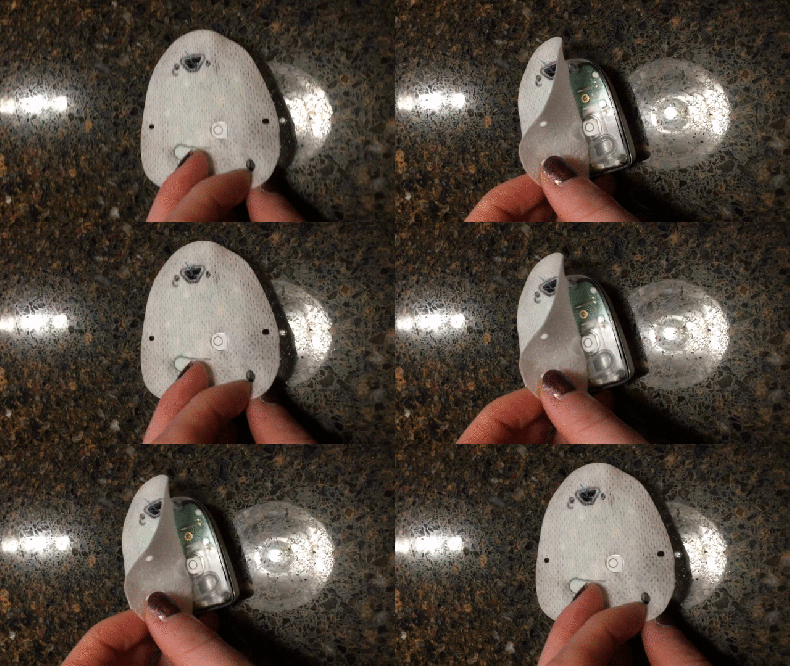
My pod tore right off – not from my arm, but it lifted up from the adhesive that it was glued to and dangled precariously from the still-intact adhesive stuck to my arm.

9121BF44-6E91-4DCE-865A-5401B59A7CA5
Would you have kept the pod on, or changed it?

After cursing loudly, I asked my mother for her opinion. I wanted to know if she could see the cannula, because that was the component that made me most concerned. As long as the cannula was still stuck under my skin and delivering insulin, it shouldn’t matter that my pod was a little loose – right?

She tried to peek under and around my site, but it was virtually impossible to tell whether the cannula was where it should be. I thought about it for a few moments, and decided that it would be wise to just change out the pod. The notion of tossing one that had only been in use for an hour was unappealing to me, but I know myself pretty well, and I know for damn sure that I would’ve been super paranoid about the pod functioning properly for the following 72 hours. I also figured that it couldn’t hurt to try calling Insulet to see if they would replace the kaput pod. The odds were slim, but why not try?

So after I changed my pod, I dialed up Insulet and described the situation to the customer support representative. And…I got a replacement! I was pleasantly surprised by the rep’s empathy towards the situation and how easy it was to get my replacement. She reaffirmed that I did the right thing, noting that if she’d been in my shoes, she would have called it in, too. It goes to show that when in doubt, change the pod – and don’t hesitate to call for a replacement.