If you have a partner/spouse, relative, or friend with type one diabetes, it can be difficult to know how to best support that person when they’re experiencing struggles related to diabetes. You might try to offer a shoulder for your loved one to lean on, but that might not always work. Your loved one might push you away or continue to internalize their issues. It can create turbulence in your relationship with one another, and it’s frustrating all around.
So what can you do?
As someone who both has T1D and loves others with T1D (my mom, my aunt, many good friends), I believe that the best way to react is to just listen. Whenever I’ve faced serious struggles or emotional turmoil due to diabetes, nothing has helped me quite like a person who spares time for me to listen to me. Whether I just need to spew out an angry diatribe (LOL at the pun), cry about my problems, talk through issues, or seek advice, it’s worked wonders on me to know that I have individuals in my life who are willing to listen to me. Let me emphasize the listen part once again – listen, not tell me that I’m right or wrong, or offer advice (unless I specifically ask for it).
I get it; sometimes, it’s easier said than done to just listen. A few people I know are so determined to help me fix the problem that they can’t help but react emotionally along with me when I’m dealing with diabetes drama. But trust me, that usually heightens (rather than alleviates) the tension.
It’s all about teamwork. Give and take is involved. Often, enormous amounts of patience are required. Sometimes, it takes awhile for the struggles to subside. But one thing that is certain is that your loved one with diabetes will always thank you and be grateful for your support in their time of need. It’ll strengthen your relationship as well as function as proof that diabetes can’t break your bond, no matter how hard it might try.
Is it just me, or does anyone else anxiously await checking lab results after getting blood work done? And am I the only one who excitedly reads through results, looking for anything abnormal so I can see which area of my health I need to work on? It’s kind of like whenever I handed in a paper or took an exam in college – I always logged onto the student portal multiple times in the days after to check for posted grades. I do the exact same thing with my patient portal.
I know, I know, I’m weird. I prefer to call it quirky.
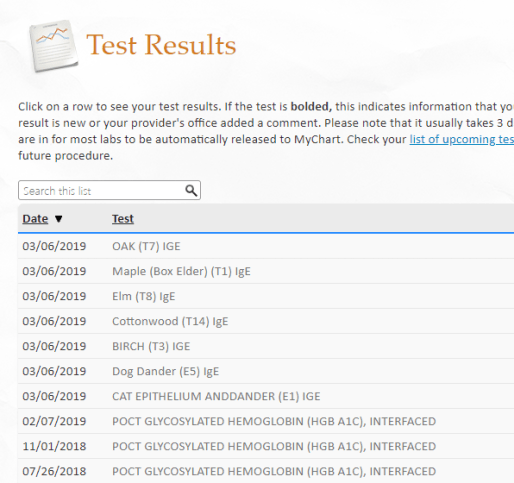
An *utterly fascinating* screenshot of some of the allergens I’ve been tested for in the past.
I started thinking about this little idiosyncrasy a few days ago, after I got lab results back from my allergist. She had me go into a lab to get 10 vials of blood drawn so it could be tested to see what types of allergies I had. Fun!!! In the days following, I checked my patient portal dozens of times to see whether the results were up. And when they finally were, I was obsessed with poring through them and seeing how much sense I could make of them.
And I’ll admit, I love looking at lab results because I have a historical view of just about anything and everything I’ve been tested for in my life, and that includes my A1c levels. On more than one occasion, I’ve fallen down the black hole of comparing and contrasting my results over the years. It’s interesting to see how I can trace back certain A1c levels to different events going on in my life at the time it was checked, and more than anything, I enjoy seeing how much I’ve improved in the last decade.
So if this habit of mine sounds plain strange to you, then I don’t want to be normal…I want to be informed. I always want to be informed when it comes to my own health, because ultimately, I’m the one responsible for it, as well as the one who will do everything in her power to improve it.
I had to end things with P.B. I’m pretty distraught over it, but I know that it’ll do me some good in the long run. Absence is supposed to make the heart grow fonder, right?
If you’re wondering who or what I’m talking about…P.B. is, of course, peanut butter.
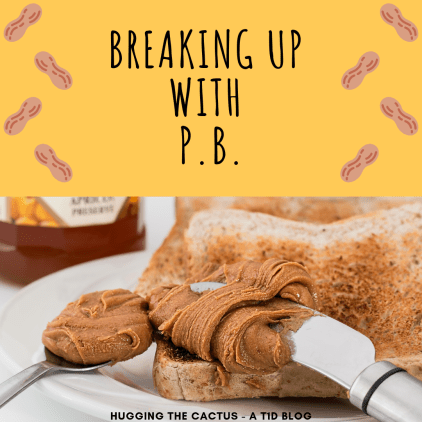
Looking at the above image of P.B. is almost enough to make me drool.
It’s that time of year again – the Lenten season, otherwise known as the six weeks prior to Easter during which Catholics traditionally practice penance, prayer, and almsgiving. In addition to avoiding the consumption of meat on Fridays during Lent, it’s also common for observers to give up something in order to focus more energy on acts of kindness and charity.
Last year, I gave up alcohol for Lent and wrote all about it in this blog post. This year, I’ve decided to really test myself by forgoing peanut butter during Lent.
And yes, this truly is a toughie for me…anyone who knows me knows that I love peanut butter. I love it too much. I eat unhealthy amounts of it. If I have a bad day at work, I have a couple spoonfuls of peanut butter. If I need a quick boost of protein, there’s peanut butter. If I’m giving my dog a taste of peanut butter, then you can bet your bottom dollar that I’ll be giving some to myself, too.
I know there are far worse foods out there to be pretty much addicted to – but peanut butter isn’t exactly the healthiest. The kind we keep around the house is not the natural/healthy stuff free from additives. It’s the Skippy/Peter Pan/Reese’s peanut butter jars that we have in stock…it’s the good stuff that tastes sinfully sugary and fatty.
To intensify matters, peanut butter is my go-to food when my blood sugar is high but I’m craving something delicious. Now that I can’t have it for this window of time, I’m going to have to find an alternative that works…and no, I can’t just consume a different type of nut butter. I’m not eating any of it during Lent because I’m choosing to give up ALL of it. If I indulged on almond butter, I feel like that would just make me want peanut butter more, so I’m avoiding any and all temptation. Honestly, my reliance on peanut butter as a food to eat in just about any situation is making me curious as to how my blood sugars will respond without it for this length of time. There’s a chance they could improve; after all, peanut butter is not without carbohydrates or sugar. So I’m cautiously optimistic that I’ll be glad I gave it up for Lent. Hopefully, by the end of this period of time, the distance will have done some good and lessen the strength of my addiction, as well as maybe even help me lose some weight. Time will tell. As for now, anyone have any suggestions on what could possibly, temporarily replace P.B. for me?!
Unintentionally, I set a personal record the other day. I experienced my lowest low blood sugar – 34 mg/dL. I was alone. And it was terrifying.
Around 1 A.M., I woke up to my CGM buzzing and alerting me to what I presumed was a mild low blood sugar. I definitely felt like I was low, so I quickly ate three glucose tablets without checking and confirming my low on my blood glucose meter. And soon after that, things got really weird.
I tossed and turned for 15 minutes as I tried to fall back asleep. But I just couldn’t get comfortable. To make matters worse, a bizarre, numb sensation invaded my left arm. As I became more and more aware of it, my breathing started to run a bit ragged – almost like I was having a panic attack. Between the breathing and the numbness, I knew something was very wrong.
What would you have done in this situation?
So I bolted upright in bed and grabbed my meter and kit to do a blood sugar check. And that’s when the number 34 popped up on the screen. I swore out loud, and almost immediately began sweating profusely. As beads formed around my hairline and streams trickled down my back, I reached for my bottle of glucose tablets as well as my phone. I ate three more tablets – wondering why the three I’d eaten 15 or so minutes ago seemed to have no affect – and contemplated dialing 911. After all, I was completely alone and there was no telling whether I’d pass out or need assistance from someone. In that moment in time, I craved talking to someone, anyone, who might be able to stay on the phone with me while I waited for my blood sugar to come back up.
Like a complete idiot, though, I decided not to call 911 and instead took to Twitter…*insert face palm here*. I know what you’re thinking, why the eff did I do that? Two reasons: 1) I wasn’t exactly thinking clearly and 2) I knew that someone, somewhere, within my diabetes online community would be awake and possibly willing to talk to me.
Thank goodness my intuition was right…my sweet friend, Heather, who I had the pleasure of meeting IRL five years ago, responded to my tweet a few minutes after I posted it. She offered to call, but by this point in time, I had made it downstairs and into the kitchen just fine and was helping myself to a cupcake I’d baked earlier in the day (oh, how convenient my passion for baking can be…sometimes). I exchanged a few tweets with her back and forth, and before I knew it, 45 minutes passed from the onset of my scary low blood sugar symptoms. I ambled back upstairs to my bed and checked my blood sugar before getting settled back into it. I was surprised to see I was only 72; after all, I’d consumed about 50 grams of carbohydrates in the last hour, and for me, that’s a lot! Most of my meals don’t even contain that many carbs!
Bemused and exhausted, I slumped against my bed frame and distracted myself by scrolling aimlessly through social media channels. My body and my mind craved rest. Much to the relief of both, I was able to get it before long, once I got confirmation from my CGM and my meter that I was finally above the 100 mark. I knew that I’d likely go up much higher (and I certainly did, waking up at 289 the next morning), but at the time, I just didn’t care. All that mattered was that I was going to be okay.
I’ve been reflecting on the incident on and off the last few days. I’m trying to process what happened and how it happened – was it my new Metformin that triggered it? Was it stress that I had experienced earlier in the day manifesting itself? I drank one beer before I went to bed, could that have done it? Did I take too much insulin before bed, even though I was certain I hadn’t? Lord knows that it could’ve been any combination of those factors, or none of them…but I can tell you this: I haven’t taken Metformin since it happened out of fear. I’ll talk to my endocrinologist soon and revisit my dosing plan with her. I can also tell you that, even as I continue to process the entire ordeal, I’m feeling so lucky that I was lucid enough to take proper care of myself. I know there are many other T1Ds who can’t say the same and have experienced much more awful low blood sugar incidents, so I’m simply counting my blessings right now.
What would you have done, had you been in my shoes? Would you have called 911, a family member, a friend? Would you have waited it out?
One Monday per month, I’ll take a trip down memory lane and reflect on how much my diabetes thoughts, feelings, and experiences have unfolded over the years. Today, I remember…
…the first time I drank alcohol and how it affected my diabetes – more specifically, my blood sugars. And that’s right folks, I CAN recall it…fortunately, this experience does not coincide with my first time actually getting drunk.
Don’t worry, Mom and Dad, you won’t recoil in horror while reading this post!!!
My first time drinking alcohol occurred during my first week of college, freshman year. So…college of me.
My freshman year dormitory held fewer than 100 students. Due to the relatively small nature of the building, everyone started bonding and forming friend groups pretty quickly. By the time our first weekend on-campus rolled around, we were all itching to get together, continue to get to know one another, and naturally, drink like delinquents.
That Friday night, I was sitting on the floor of my friends’ dorm room – Emma and Kira had the largest, swaggiest digs in our whole friend group, if not the entire dormitory – when our friend Chris entered, holding a full bottle of grape-flavored Svedka vodka in his hands. I remember him making the rounds, pouring us shots of vodka that we would drink as a group. As he filled shot glasses, I started feeling extremely nervous. I had zero prior experience with alcohol, let alone vodka. So many questions flitted through my mind: Would I feel drunk right away? What was it going to taste like? Does the grape flavor mean that it contains more sugar, and would it make my blood sugar go up?
I barely had time to contemplate answers, though, when people started lifting their shot glasses into the air and toasting the beginning of our college careers. Even though I was sweating bullets, I smiled and cheered along with everyone else as we tossed back our shots…
…which tasted absolutely foul. I’m pretty sure I almost retched, but did what I could to contain myself because I didn’t want to seem like a loser. I’ll never forget thinking to myself, this shit tastes just like how nail polish remover smells. How can people possibly drink and enjoy this?
I sat there, internalizing all my thoughts and feelings about drinking my first shot of alcohol, and just tried to blend in with the group. But it was kind of difficult for me to do, because at some point in the night, my anxious thoughts consumed me and I abstained myself from drinking anything else. I was too caught up in the unknown, and I cared too much about how this one little innocent shot of vodka might impact my diabetes.
As I would come to find out later that night, one shot of vodka had zero-to-no affect on my blood sugars. And of course, in time, my fears about alcohol and my blood sugars faded because I educated myself on how to do it safely. I learned that every type of alcohol has a different carbohydrate content. I discovered what did and didn’t work for me, often in a controlled environment. But I wouldn’t change my first encounter with it at all because the shared experience of drinking shitty grape vodka with this group of strangers, on the first Friday night of college, is one of the many shared experiences that turned them into some of my dearest friends. That, I can raise a glass to…as long as it’s not filled with Svedka anything.
There’s a bunch of famous T1Ds who would be really cool to meet: Victor Garber, Sonia Sotomayor, Derek Theler, to name a few. And obviously, there’s Nick Jonas, who is probably the most popular of them all. But there’s a different musician with diabetes who I’d be even more eager to meet than Nick – nothing against the guy, of course.
Who do I have in mind? Why, the one and only Bret Michaels, the lead singer of the rock band Poison.
This might surprise some of you – I don’t exactly seem like the type who’s into that sort of music. But I totally am. Nothin’ But a Good Time, Unskinny Bop, and Talk Dirty to Me are among my favorite Poison songs. They’re simply excellent to dance and sing along to, and to play on Guitar Hero (which I did often in the game’s heyday, and absolutely pretended to be a rock and roll guitar QUEEN every time I played it).
And I somewhat ashamedly admit to indulging in Rock of Love when it regularly aired on Vh1. It was Bret’s dating show, and it was like The Bachelor on steroids. Total reality TV trash, but I was hooked on it and never missed a season.
Okay, so you get the idea that Bret Michaels might be a stereotypical rock star who revels in big hair, eyeliner, and female company…but he’s different from most because like me, he has type 1 diabetes.
It would be friggen’ sweet if Bret Michaels saw this post.
From what I’ve read and understand, he was only a couple years older than me when he was diagnosed. Growing up, he was the only kid with diabetes in school, which presented its challenges. Arguably, the stigma surrounding diabetes in those days was much stronger, and Bret struggled when his classmates and their parents misunderstood his condition and how it came about. But that didn’t stop Bret from developing into a self-motivated individual. Along with his parents, he started the first youth camp for T1Ds, which still exists today in Pennsylvania. As he grew into adulthood, his passion for music and creativity flourished, and he became a founding member of the band known as Poison today. It took time for Poison to achieve success, but through hardship Bret persevered and took comfort in music as a therapeutic outlet.
It must’ve been difficult for Bret to admit to the world that he had diabetes, but after collapsing onstage at the Madison Square Garden in 1987, he had little choice but to share his story. Instead of dwelling on possible repercussions, though, he chose to work harder rather than give up. Poison’s popularity grew over the years as they found widespread commercial success, but Bret never forgot about supporting diabetes charities like JDRF and the American Diabetes Association. He even founded his own charity that supports youths with diabetes and helps them afford diabetes camps.
I can’t help but appreciate the fact that he’s devoted much of his life to being a performer as well as a philanthropist – neither are easy, and to do both and still manage to take care of his diabetes is something that I think is amazing. That’s why I say move over, Nick Jonas (though he has also done so much for diabetes organizations) – I’d like to meet who I consider the OG T1D philanthropist/celeb, Mr. Bret Michaels.
In the last few weeks, I’ve told most people in my life that I will be moving to Virginia (from Massachusetts) at the end of March. I have a lot of feelings about making the move: anxiety, excitement, anticipation, fear, optimism, and curiosity are chief among them.
And naturally, one of my top concerns is how my diabetes will adjust to my move. I imagine that the first week or so will be the most challenging. Between moving boxes and setting things up inside, I’ll be doing quite a bit of strenuous physical activity. It’s not that I’m not used to it (I exercise pretty much every day), or that I’ll have to do it alone (my boyfriend, who I’m moving in with, is going to help). It’s more so that I’m worried about the emotions I’ll be experiencing as I go through the moving-in process…and how those emotions will manifest themselves in my blood sugars. The “what ifs” keep running through my mind. What if I have trouble getting my prescriptions? What if I can’t find the right health-care team for me in Virginia? What if my diabetes struggles with the change? What if, what if, what if?
Moving is an emotional process that can affect more than just mental health.
Don’t get me wrong – I really am excited to make this move. I’ve lived in the same small town my entire life, and though my love for it and the people who live there will never waver, it’s time to see what else is out there. And it’s really time to stop sustaining a long-distance relationship with my boyfriend. The last four years have been exhausting as we’ve traveled back and forth to visit each other for fleeting periods of time.
But I do know myself, and I remember quite clearly how I handled going off to college for the first time. I cried. For like, three days straight. I also marveled at the dining halls and the endless options available to me. Translation? I let my emotions drive my food choices and, in turn, my blood sugars suffered. But then…I started getting into a routine. I ate meals more regularly. I started exercising. I kept my mind occupied. And I started meeting new people and forming friendships that I cherish to this day. I grew from a naive teenager into a young adult with her shit *somewhat* together who started to accept a lot more responsibility in life. I finally became accountable for my diabetes in a way that I never was before, and even though it scared me initially, I recognize that it was ultimately exactly what I needed to do.
So I’m seeing the parallels here between my transition to college and my current transition with this move. I know that I’ll cry and be scared and miss my family and friends, but I also know that it’ll get easier as I establish my rhythm. The same can be said about my diabetes – it may protest in the beginning and be turbulent and unpredictable, but I’ll tame the savage beast…because I always find a way to.
Here’s to a new chapter in my life, one marked by more independence, self-growth, and positive change. And my goodness, here’s to frequent flier miles and the fact that home will always be one short plane ride away. Massachusetts can’t get rid of me that easily.
Normally, I don’t eat snacks after I’ve had a starter course at a restaurant, and my order’s in for my entree…because that’s just weird. I’m going to a restaurant to eat food, anyways (presumably a meal), so why on earth would I need to eat a snack in between courses?
Diabetes. Duh. Diabetes is always the answer (or root of the problem).
How annoying it was to start feeling shaky and sweaty, only to discover that my blood sugar was almost in the 60s soon after devouring my app and placing my dinner order. How irritating to know that the two chicken wings I just ate contained virtually zero carbs; therefore, would not do anything to boost my blood sugar any time soon. And how obnoxious it was, looking around the crowded restaurant and realizing it’d likely take some time for my meal to come out – and that the food I’d ordered was also relatively low carb (a bun-less turkey burger with side salad), and would also do nothing to correct my low.
You can see that I held off on correcting the low for as long as possible…but then the shakiness started.
Can you tell that I was just a bit irked at the situation?
I did what I had to do – reach into my backpack to grab one of the leftover granola cups from the pack of two I’d started earlier that day. I ate it quickly, crushing the wrapper in my hand and shoving it hastily back into my bag, hoping that no one saw me eating food that wasn’t from the restaurant like a wackadoodle.
And I swear, within five minutes, our food was out. I was happy but also just mad that I had to snack in between my appetizer and my main course. But diabetes is like a petulant toddler – it doesn’t care what you want or need, it just demands. It’s more demanding than any person or thing in my life. It’s exhausting, but there’s no choice other than to just oblige its needs, even if it means eating when you don’t want to.
Human beings are naturally curious creatures. So it’s never really surprised me when, upon discovering my T1D, people tend to ask me boatloads of questions about what it’s like. And it’s definitely not at all shocking that many of these questions are recurring.
Here’s a list of seven questions that I’m almost always asked when I encounter someone who’s just learning about my diabetes. You’ll notice a trend as you read, because even though there’s “no such thing” as a stupid question, this list kinda gets dumber as it goes on. There, you’ve been warned…
7. What does it mean when your blood sugar is high/low?
This is definitely a fair question. I never expect someone who is unfamiliar with diabetes to know the meaning of hypoglycemia or hyperglycemia. I actually kind of appreciate being asked this question, because it helps me spread awareness. The more people that know how to react in severe high or low blood sugar cases, the better, IMHO.
6. Why do you wear all of those devices?
Another decent question – I never mind explaining how my CGM and my pump work, but I do mind when people say ignorant things, like “Oh, are those patches to help you quit smoking?” *Eye roll*
5. Can you eat/drink [fill-in-the-blank]?
Ugh…I get why people ask me this, but it’s a little more tiring to explain. My answer is usually along the lines of: “I can eat or drink whatever I like, but I need to take insulin to account for it. So I try to eat a limited amount of carbs at a time, because that means I have to take less insulin, and there’s less room for error.” But even after that easy-to-understand explanation, the typical follow-up questions are “BUT CAN YOU EAT CAKE/COOKIES/ICE CREAM/ANY SUGARY FOOD?!” And that’s when I lose a bit of my patience, TBH.
4. Does it hurt when you check your blood sugar/give yourself a shot?
I mean, no? I’m not trying to be facetious or anything, but really, after 21+ years of checking blood sugar and giving myself insulin multiple times per day…there’d be a real issue if it hurt every single time. I concede that there are the occasional sites that sting, but it’s not nearly as bad as many people seem to assume.
3. What’s that beeping sound/ARE YOU GOING TO EXPLODE?!
Honestly…use common sense. What’s the likelier scenario here: That my devices have built-in alarms, or that I’m going to spontaneously combust?
2. How did you get diabetes/WHAT DID YOU DO WRONG?
This. is. such. an. ignorant. question. Nobody, myself included, did anything “wrong” that resulted in my diabetes diagnosis. I didn’t catch it and no number of lifestyle changes could have prevented me from developing diabetes. My immune system merely decided to attack and destroy the insulin-producing beta cells that lived in my pancreas. There’s no real answer as to how diabetes is caused, though genetics likely play a role in it. Don’t worry, you won’t “catch” the ‘betes by being in my presence.
1. Do you have the…bad kind of diabetes? This question is THE WORST of them all because there is no good kind of diabetes! Gestational, type 2, LADA…none of them are favorable. They all suck. They all require constant care, regulatory medications, and endocrinology expertise. So please for the love of all that is sacred and holy, next time you hear someone ask this question, gently inform them that there’s no such thing as good/bad diabetes.
Low blood sugars in the middle of the night are far from pleasant. But they’re especially grating when you’re just trying to have a sleepover with your best friends and your CGM alarms loudly and urgently, rousing more than just me from a peaceful slumber.
Dammit, diabetes…you’ve done it again.
I don’t know how or why the low happened. I went to bed around 1 A.M. – we had stayed up late talking, drinking wine, and eating snacks – and at that time, my blood sugar was 156. You can’t get much better than that, and it felt even sweeter because we’d eaten pizza for dinner earlier in the evening.
I thought I’d be fine overnight. I might come down a smidgen due to the unit and a half I took to cover a slice of fabulous flour-less chocolate cake (utterly heavenly), but I made the assumption that I wouldn’t come crashing down.
I should know by now…never assume with diabetes.
So it happened at about a quarter of four in the morning – a witching hour, in my mind. I woke to the frantic buzz buzz buzzing of my CGM and quickly acknowledged it, then reached for my tube of glucose tablets. I did it as silently as I could, seeing as I was sharing the room space with my three gal pals. From what I could tell, my super slow glucose tablet chewing didn’t even cause my friends to stir. It seemed that I’d successfully managed to avoid waking anyone up, thank goodness.
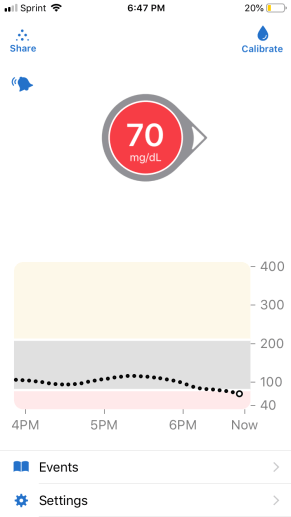
I was just starting to fall back into a doze when the frantic low CGM alarm blared – BEEP beep BEEP beep BEEEEEEEEEEEP. Ugh! Upon hearing the first beep I snatched up my receiver, silenced the alarm, and scooped up my test kit and my phone. I tiptoed out of the bedroom from which we were all nesting to the living room, where I searched through my backpack for the Skittles I’d purchased earlier in the day…because that’s right, this 3:45 low blood sugar hadn’t been my first in the last twelve-hour window of time.
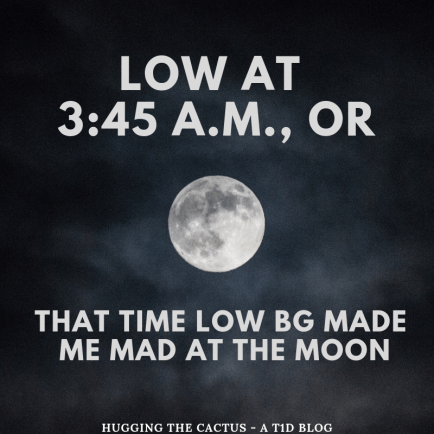
Low blood sugar in the middle of the night can make you feel weird things…such as anger towards the moon.
I plopped myself on the couch and started furiously chewing Skittles. I remember looking out to the sliding glass doors and to the balcony and to the parking lot and then finally up to the sky to see the moon shining brightly at me. It was positively dazzling, yet infuriating with its cheerful gleam. I wanted to yell at it to stop looking so happy. I muttered to myself, “this sucks,” and reclined a bit on the couch while I waited to come up from the low.
Everything was fine within 15 minutes. I was on my way up and could safely go back to bed. And again, I congratulated myself for not waking anyone up.
Or so I thought.
“Did anyone hear my CGM go off in the middle of the night?” I asked my girlfriends, approximately six hours after the incident when we were all awake and about to head out to breakfast.
“Yes! I was wondering what that loud, aggressive noise was,” said one. I cringed, an apology lingering on the tip of my tongue, when she continued with an “are you okay? Don’t worry about the noise, I fell back asleep soon after.”
I was grateful for her reassurance, but also for her concern. It felt good to know that ultimately, she didn’t give (apologies for language) two shits about the actual sound that my low blood sugar caused, she was just worried that I recovered from it okay and could get back to sleep soon after.
I smiled to myself. Hours before, I’d been cursing the moon for merely existing and dealing with an annoying, random low blood sugar. But now, I was cruising at a great morning BG and I was on my way to get a delicious breakfast with my gal pals. Diabetes has its moments, but I sure as heck appreciate it when it cooperates during the ones that matter most. So in hindsight, the 3:45 A.M. low was nothing more than a temporary annoyance, and I was just glad that the worst thing it did was interrupt my sleep (and mine alone) for 10 minutes rather than ruin actual precious time spent with my friends.





 Hugging the Cactus