What Happened When My Blood Sugar Crashed in the Grocery Store

I knew something was wrong when the walls of the soda and seltzer aisle felt like they were closing in on me, Star Wars-trash-compactor style.

You would think a blood sugar is no sweat (pun intended) in a place where food is so easily accessible, but this experience was far from it.

On a recent trip to the grocery store, I went low. And when I say low, I mean low – I wasn’t just shaky, I was sweating literal bullets and having a hard time seeing straight in front of me.

My boyfriend – thank goodness he was there – knew something was wrong just by looking at me. He suggested that I grab some fruit snacks from my backpack and I heeded, tearing open the small foil packet and tossing the contents back as quickly as I could. I chewed, grimacing as I tasted the strangely saccharine, perfume-y gummies, but I barely cared about the taste. I just wanted to feel better. That’s when my boyfriend placed a hand on my back, noting my clammy state, and escorted me over to the dining area at the front of the store.

“Just stay here, I only have a few things left to grab. Maybe you’ll be feeling better by checkout time,” he said, before asking me if I was okay to be left alone.

I was. I hated that he was seeing my like this, in this vulnerable, sweaty state that seemed impossible in the chilly air of the grocery store. I told him I would sit and wait there for him, fighting the feeling that I was a small child waiting for a parent to finish up some boring adult task. As I nearly collapsed onto a chair, all I wanted to do was shrink so nobody could see me: It seemed as though all sets of eyes in the vicinity were locked on me, the perspiring wonder who looked quite unwell.

I was only on my own for about 5 minutes, but time dragged as I anxiously awaited my boyfriend’s approach to the checkout line. I thought I’d wanted to be alone as I let the fruit snacks kick in, but turns out the opposite was true. I clung to his side as I slowly registered that I felt safer around someone who knew exactly what was wrong with me and how to handle it if things got worse.

As we exited the store and loaded the groceries into the car, I noted that my shakiness was dissipating, as was the beads of sweat on my body. This low episode was over and I was relieved to be on the other side of it. I was also relieved that I didn’t have to go through it alone: turns out lows are a bit more bearable when you have someone else with you to help you through them.

It’s No Big Deal

“Does it hurt?”

“Wait, no, I’m not ready!”

“I’m LITERALLY afraid that I’m going to hurt you!!!”

These are all phrases uttered by my dear friend who was ultra-curious about the site change I had to do in the middle of our hangout. She wanted to watch me do it, but I stepped it up a notch by asking her to play a key role in it: I invited her to remove my old pod from my leg.

A routine pod change is no big deal to me.

“Just do it, it’s just like ripping off a band-aid. I can guarantee you won’t hurt me.” I said, in an attempt to reassure her. I also swore I wasn’t lying just to make her feel better, because I’ve rarely ever experienced a pod-rip-off that truly hurt.

“But there’s something in you, right? Like a needle?” Her face creased with worry. I smiled and told her that yes, there was a cannula that was in my skin, but I couldn’t feel it.

“Let me start it for you,” I said, when I realized she still wasn’t quite ready to rip it away. I peeled up an edge of the adhesive and she started squirming.

“You don’t have to do it if you don’t want to -” I said, but just as the words left my mouth, she finally tore off the pod. Much to my chagrin, a drop of blood appeared and she squealed as I began to apologize profusely and explain emphatically that it didn’t hurt, it’s just that sometimes blood will appear and nothing can be done about it.

“I can’t believe you have to do this every 3 days…” she said, her eyes widening in wonder. I told her I’ve done it so many times now – literally just over a thousand, according to my calculations – that it’s no big deal. I’m used to it. It’s just life with diabetes…lots of repetition and more math than I’d like.

I accepted my reality a long time ago, and I’m truly at a place where it’s no big deal.

A Weekend of Bagels, Pizza, Ice Cream, and…Good Blood Sugar?

Would you believe me if I told you that last weekend, I ate mostly carbs for 36 hours straight and totally avoided high blood sugars the whole time?

I looooove carbs. Almost as much as Oprah Winfrey loves bread.

It sounds wild, but it’s the truth! I went on my annual weekend getaway with my college besties and it was the loveliest time filled with sunshine, conversation, and tons of delicious food. I can’t remember the last time I ate that much in such a short window of time, but it was all worth it, especially because my blood sugars didn’t pay the price for it for once.

Here’s the breakdown of what I ate:

  • Friday:
    • 2 slices of Mediterranean-style pizza and 3 chicken tenders for dinner, the first official meal of the weekend trip
    • 2 glasses of wine
    • Handfuls of crackers and cheese because who doesn’t love that with wine
  • Saturday
    • 1 blueberry bagel accompanied by 1 fried egg for breakfast
    • Salad and heaping scoop of ice cream for lunch
    • Pita chips for a snack
    • Panko-crusted haddock with jasmine rice and veggies for dinner
    • 2 cans of cider (and maybeeeee a glass or two of bubbly)
  • Sunday
    • 1 everything bagel slathered in goat cheese plus 1 fried egg for breakfast
    • 2 slices of leftover pizza for lunch, which is also when I arrived home from the trip

It definitely wasn’t my healthiest, most balanced weekend of eating, but I’m more than okay with that because it was about enjoying my time with my friends and indulging a little rather than stressing the whole time about bolusing and blood sugars. And you know what, I think that my laidback, let’s-just-savor-this approach is partially the reason why I had such stellar weekend blood sugar levels. That, coupled with extended boluses for most of my meals (you know that pizza and bagels contain alllll the slow-acting carbohydrates), really helped me achieve the relaxing weekend that I wanted.

Now if only I could get away with this on a regular basis – as I write this, my blood sugar is coasting from a peak of 248 back into the low 190s after I dared to consume a bagel at lunch in the middle of my busy workweek. But it’s all good, and maybe just evidence that I should try to remember to live in the moment on weekends of fun like this one and prevent diabetes/blood sugar from taking center stage. Perhaps that’s the key to more stable numbers.

If nothing else, this serves as a reminder to me that even with diabetes, I can still enjoy a sh*t ton of carbs every now and then.

What I Wish I’d Said to My Dia-Bullies

Growing up, I had a pretty normal (and lovely) childhood, despite my diabetes. My parents always made me feel supported and equipped with the tools I needed to advocate for myself, even at a young age. They played an instrumental role in educating my relatives, teachers, friends, and friends’ parents as to what my diabetes looked like and the ways it might make me different from the other kids – different, but never excluded from anything because it didn’t necessitate that.

Thanks to my parents’ help and the fact that they fostered self-advocacy skills for me early on, I almost never had a problem with my peers when it came to my diabetes. In fact, I’m lucky that just about all of my friends were very understanding and accommodating of my diabetes, even at young ages. It’s not often that I think about the ones that weren’t, but when I do, I can’t help but label them as my childhood “dia-bullies”.

You might be surprised to learn what I wish I’d said to my dia-bullies.

I dealt with two of those kinds of kids growing up: Once in elementary school, and again in eighth grade. In both scenarios, these dia-bullies were cruel about my condition. They often told me the things that I couldn’t and couldn’t do – whether it be participate in gym class, eat a shared classroom treat for a birthday, or maintain any semblance of a conventionally healthy lifestyle. These comments were infrequent, but when they were vocalized, they hurt…and obviously had quite the impact on me as I remember them all these years later.

Back then, I “dealt” with these comments by not responding to them in any way, shape, or form. I didn’t tell my teachers or my parents what was said and even though I knew how to talk about diabetes by then, I didn’t quite have the voice to stick up for myself and tell these dia-bullies that they were wrong.

But now? I have a voice. A powerful one, at that. So as I reflect on what was said to me when I was younger, I can’t help but wish I’d said this very simple phrase to my dia-bullies:

You’re wrong.

I wish I’d told them that there judgments were not only incorrect, but harmful. I wish I could tell them to just watch as I moved throughout elementary, middle, and high school at the same pace as everyone else, participating in the same sports, extracurriculars, and honors classes, seldom missing out on anything due to diabetes. And I wish I could’ve told them that those words would stick with me for years to come, motivating me to prove to myself and the world that diabetes does not mean living within limits.

Most interestingly of all, a small part of me does wish I could tell them…thanks, I guess, for being an unexpected source of inspiration to conquer my diabetes. Isn’t it funny, the strange places you can get encouragement from?

What It’s Like to Wake Up in the Middle of the Night with Low Blood Sugar

You stir suddenly from a dreamless sleep, knowing that something must’ve disturbed your slumber but not quite sure what it may have been.

This blog post was inspired by a recent middle-of-the-night low that went…well, exactly as I wrote it here. I wrote in the second-person perspective so you might be able to imagine what it’s like, if it’s something you’ve never experienced before.

Reflexively, you reach over to where your phone is perched on your nightstand. You check your notifications and confirm what you’d been hoping wouldn’t be a problem tonight: Your blood sugar is low and you must do something to fix it.

You unroll a couple of Smarties from their package, almost surprised at how dexterously you do so. After all, it’s an odd skill to have honed over the course of your life to be really good at opening up packages of the food just moments after you were sleeping soundly, but you’re accustomed to it. You chew up the Smarties as quickly as you can, grimacing slightly as their sweet-sour taste mingles with traces of toothpaste from when you brushed your teeth before bed. You sink back against your pile of pillows, sighing, as you wait for your blood sugar to come back up.

You wait. You wait some more. You scroll mindlessly through various apps on your phone. You’re not feeling better. You wonder to yourself, how much more do I have to do to fix this? You wish you weren’t alone right now. Low blood sugars are scary to deal with on your own, especially when they sneak up like this in the middle of the night.

Your mind begins to spiral as those nasty “what ifs” enter your thoughts. What if you plummet further? What if you lose a lot of sleep over this one pesky low? What if you don’t recover from this low and…?

Just as you begin to think of the most unpleasant scenario, you realize that your shakiness has subsided. The sweat on your skin has dried and your vision seems to be less foggy – it’s hard to tell in the dark, but not wanting to turn on anymore lights, you settle back into bed more comfortably and close your eyes.

You hope you can go back to sleep quickly. You hope that you don’t have to wake up again for the rest of the night for any blood sugar-related issues. You hope that you aren’t exhausted because of this one tomorrow.

You hope that tomorrow night is different, but with diabetes, you never know.

The Hardest Part About Having Diabetes

The hardest part about having diabetes is experiencing the mental and physical challenges that come with managing it…and knowing that a loved one with diabetes goes through those exact same hardships, and there’s nothing to be done about it (besides supporting the loved one as much as possible).

Difficult mode: Activated, when a loved one also has diabetes.

I say this because my mom also has type 1 diabetes, as I’ve mentioned on this blog before. As I’ve gotten older, I’ve grown to appreciate more and more over time just how much it took for my mom to take care of both her diabetes and mine throughout my childhood and teenage years, in addition to her many other responsibilities. I have a lot of respect for how she handled everything (relating to and apart from diabetes) with grace and tact, and how she made sure that I handled the transition from her being my primary diabetes caregiver to me independently taking care of it when I was ready to do so.

But with age and my increasing awareness of just how much my mom had on her plate also comes an greater sense of sadness, lamentation, and resentment over the fact that my mom knows just how hard diabetes can be because she literally has to live with it, too. Every time that I have a tough diabetes day, whether it be a series of technology fails or a stubborn high that just won’t come down, I think of my mom and wish that she didn’t have to deal with the same shit, too.

This post follows a somewhat rough diabetes week for me, defined by a string of frustrating blood sugars and a total lack of adequate sleep. It sucks to know that my mom also goes through weeks very much like this from time to time, but rather than wallowing in that, I’d say it’s important to recognize that we are both so much stronger for getting through them. That, coupled with the undeniable fact that diabetes helps us understand one another in a very unique way is something much more positive to focus on.

5 Ways Hot Weather Affects Diabetes

I’ve posted this on Hugging the Cactus a couple of times now – once in 2018 and again last year. I’m sharing it a third time today because we are in the throes of summertime now that July has arrived, and I needed a little reminder as to why it’s important to take certain precautions when it’s hot outside to take the best possible care of myself and my diabetes…

The summer heat seems to be here to stay in Massachusetts. We’ve experienced several weeks of soupy, high-heat weather that *almost* makes me long for cooler, autumnal days…but not quite, because that just means winter (and snow – blech) is right around the corner.

Truly, I do enjoy the summertime. To me, summer is about trips to the beach, ice cream consumption (and lots of it), barbecues with family and friends, long walks in the neighborhood, and endless outdoor adventures. Aside from all of those lovely things, summer also means that it’s time to be a little more diligent when it comes to my diabetes. That’s because hot weather can play some cruel tricks on a T1D’s body. What do I mean by that? Here’s five ways diabetes can be affected by hot weather.

Another thing to know about hot weather and diabetes? It will most definitely trigger ice cream cravings. Bolus accordingly.
  1. Dehydration can lead to high blood sugar. Everyone knows that it’s important to stay hydrated when it’s hot out, but it might be less common knowledge that dehydration can directly affect blood sugar. There’s a scientific explanation for this: If not properly hydrated, the body sees an increase in blood glucose concentration because blood won’t flow as easily to the kidneys, making it difficult for the kidneys to get rid of excess glucose in urine. The best way to prevent this, naturally, is to drink plenty of water and monitor blood sugars.
  2. Sunburn can drive up blood sugars. I’m very familiar with how a sunburn can result in higher blood sugars; in fact, just last week I was dealing with a particularly gnarly sunburn on my thighs and belly that not only made my numbers higher, but also really hurt. My skin was literally damaged, so the stress from the injury lead to retaliation from my blood sugar. Luckily, it only lasted about 48 hours, but those couple of days were challenging as I dealt with sticky highs that were practically resistant to insulin. And for the record, I DID apply sunscreen – numerous times – when I was at the beach. Next time, I’ll seek shade under the umbrella.
  3. Sweat can make it difficult for devices to stick. I don’t know a single medical device that’s immune to prolonged exposure to moisture/water, but that doesn’t prevent me from spending as much time as I can outdoors/at the beach/by the pool in the summer. Thank goodness for Skin-Tac wipes and medical adhesive tapes that help preserve my precious pods and sensors!“
  4. Insulin can overheat. There’s a reason why insulin vials come packaged in cartons with directions that specify what temperature insulin should stay at in order for it to be safe to use. Insulin can spoil easily when it reaches a certain temperature, so it’s important to store it in a cool place when the weather’s warm. I alternate between a mini portable cooler (that can hold 3 vials of insulin) and a pouch from FRIO – both do an excellent job at keeping my insulin cool.
  5. Low blood sugars can occur more frequently. Summertime is prime time for outdoor activities that result in higher energy expenditure. So it’s no wonder that blood sugar tends to plummet in hot weather. Looking at it on the bright side, it’s an excuse to eat even more ice cream – but it also means that monitoring how I feel and checking blood sugars often is that much more important.

Regardless of the diabetes challenges it may cause, I love summer weather, and I know I’ll miss it the moment the first snowflake falls this year.

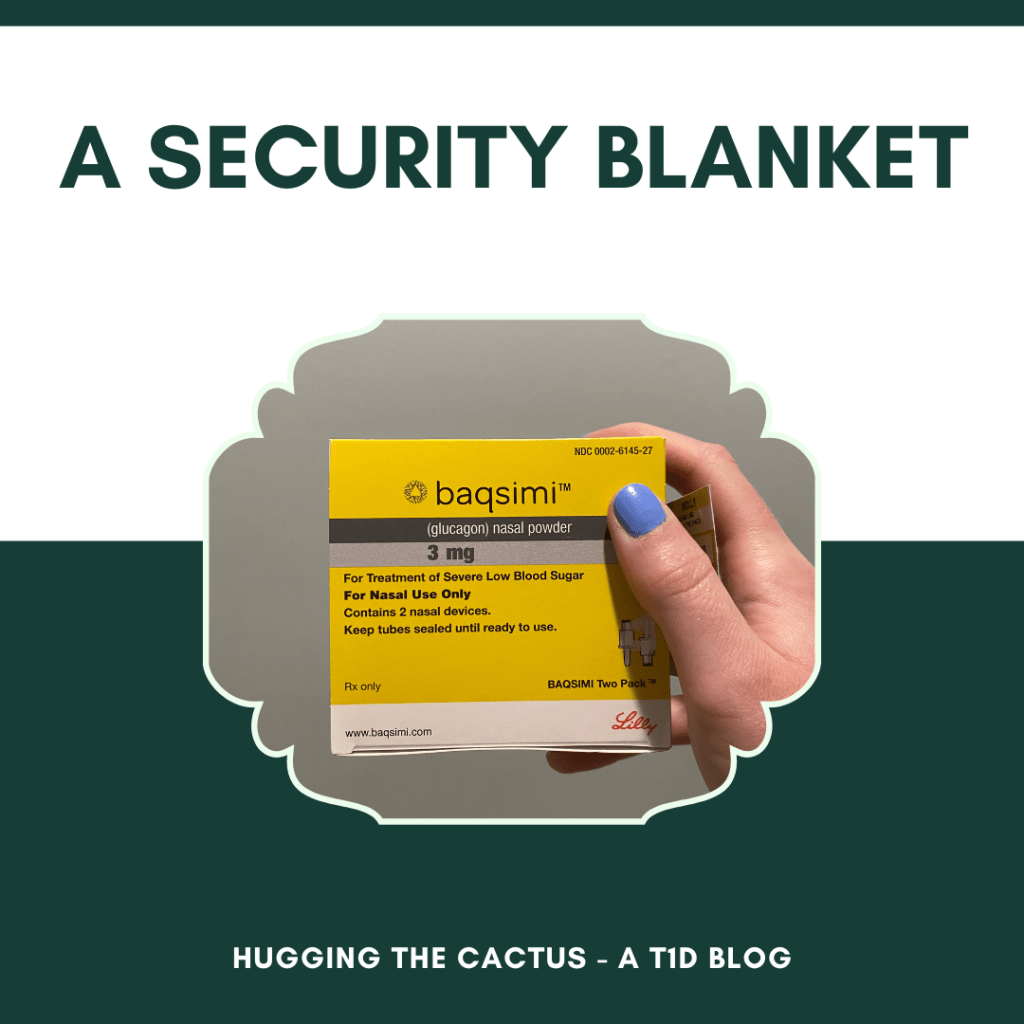
A Security Blanket

I never thought I’d come to think of a nasal spray as a security blanket, or something that would provide me great ease of mind, but that’s exactly how I feel about my Baqsimi prescription.

I’m all stocked up on Baqsimi for the time being.

Baqsimi is a nasal glucagon that is a million times easier to use (or at least, understand how to use) in an emergency situation than those old red kits from the days of yore. In all my years of diabetes, I never could remember step-for-step what the process was like for using glucagon – in fact, I had an app downloaded on my phone just so I could practice it every so often as a refresher, but even with the app I felt ill-equipped to use glucagon on myself, or anyone else for that matter.

That’s why when I first heard about Baqsimi a few years ago, I breathed a sigh of relief. Finally, there was an option out there besides glucagon! The freedom to have choice, rather than be forced to stick with something, goes a long way in life with diabetes…in life, period. I was excited that I could choose to keep Baqsimi on hand just in case I ever did experience a severe hypo, a possibility that has always frightened me, especially when I started living alone a year and a half ago.

And when I was recently taking inventory of my diabetes supplies, only to discover that my Baqsimi was expired, I made it a priority to get it refilled as soon as I could because of just how much I’d reaped the benefits of peace of mind. So I made a point of calling my doctor and asking for fresh prescriptions for both Baqsimi and insulin, because it just so happened that I was running low on my Humalog stash.

A couple days later, I went to the CVS drive-thru, picked up the prescriptions, and drove home. While driving, I couldn’t help but feel so grateful that it was actually easy for once to do something for me and my diabetes that was necessary and would provide me comfort. If only it could be like that every time.

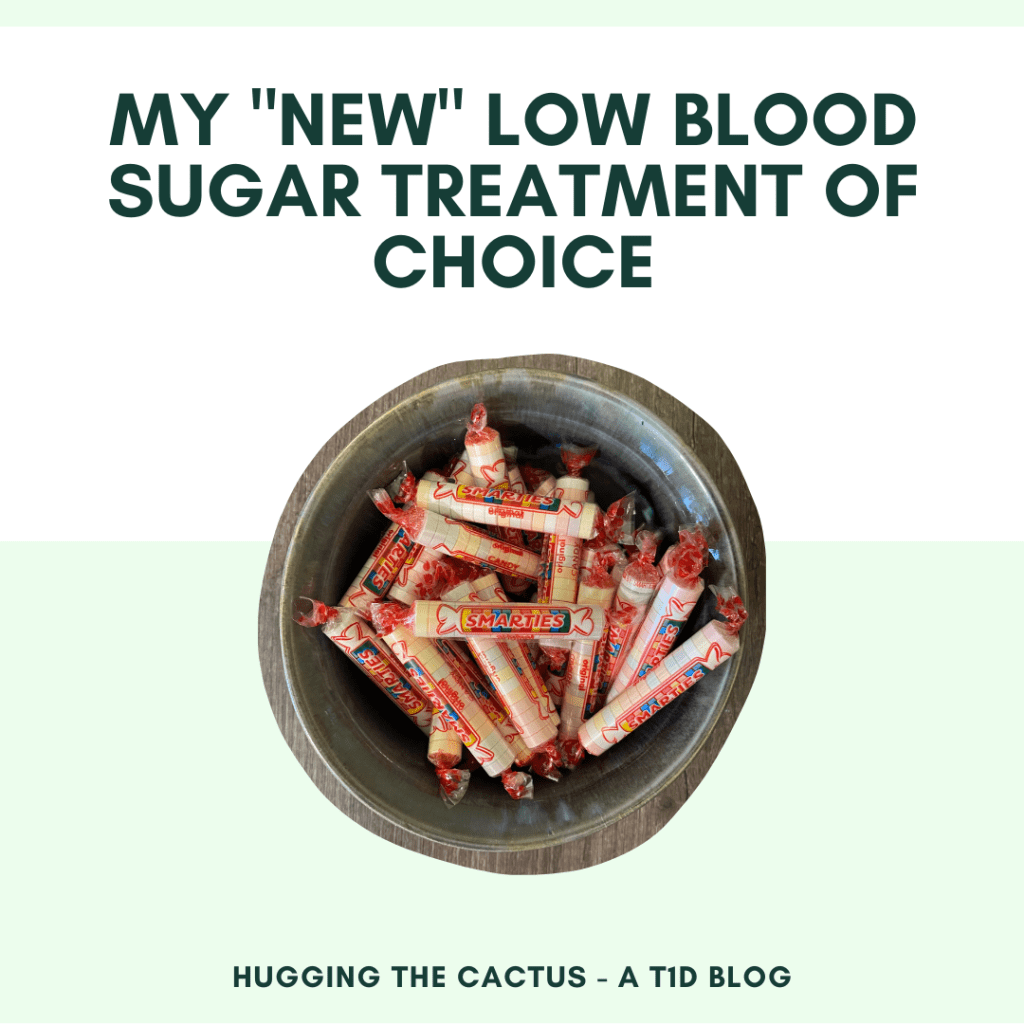
My “New” Low Blood Sugar Treatment of Choice

The concept of a “low blood sugar treatment” makes me giggle, because it implies that the glucose (sugar) needed to bring levels back within range is basically medicinal. Sugar? As medicine??? Kind of, sort of, pretty much when it comes to fixing a low.

Over the years, my preferred low treatment has taken many forms. In the early days of my diabetes, it was usually glucose tablets or orange juice. In most of my youth, juice boxes were number one, but as I got older I felt ridiculous carrying those around, so I switched to fruit snacks and kept glucose tablets around as an old reliable. In college, I loved mini boxes of yogurt-covered raisins (they were great for less urgent lows, with roughly 10 grams of carbs in one teensy little portable package). And in my adulthood, I’ve rotated through a mix of all the aforementioned items, but with a brand-new one entering the forefront for me as of late.

And that new one is…Smarties!

One of the many Smarties stashes I’ve got scattered around my home.

Yup, Smarties, the classic candy that just might be the most ideal low blood sugar treatment I’ve used in recent years. There’s solid grounding behind that logic: For starters, Smarties come bundled up in tiny rolls that are easy to slip just about anywhere – a pocket, a glovebox, a nightstand, and the list goes on. Smarties don’t melt and withstand just about any weather condition. They’re also perfectly portioned, with one roll containing 6 grams of carbs so it’s convenient to eat just one for a slightly low blood sugar or 2-3 for more stubborn lows. There are even giant Smarties rolls that are great for when I need a quick blood sugar boost before a workout – I just eat one or two individual giant-size Smarties and I’m good to go. And despite being reminiscent of chalky glucose tabs, they do taste significantly better and I swear they dissolve faster compared to their drugstore counterpart.

All those pros and nary a con for me to nitpick…I think I’ve finally found the best low blood sugar treatment for myself – for now, anyways.

How to Travel Smoothly and Safely with Diabetes

Traveling plus diabetes can equal…a lot of chaos. At least, it does for me when I don’t take the time to properly prepare for a trip.

I’ve got some tricks up my sleeve when it comes to traveling with diabetes…

However, I’m happy to say that my most recent trip to New Orleans was remarkably mayhem-free, thanks to the steps I took in the couple of weeks leading up to the trip (all that covid nonsense aside). In fact, it went so smoothly for me that I decided now would be a great time to document what I did that helped me travel with minimal stress but maximum organization, before I forget everything I did! So here’s what worked for me:

  1. Making a list. Roughly two weeks prior to my trip, I physically wrote out a list of every single item – related and unrelated to my diabetes – that I’d need to pack for my trip. As I packed little by little in that span of time, I checked off items when I added them to my suitcase. It was satisfying to see the number of items dwindle so that by the morning of my trip, I only had a few things left to pack and I wasn’t worried about forgetting anything major.
  2. Having extra snacks on hand. A few days before my trip, I went to the grocery store and bought snacks. Like, a bunch of them. A few boxes of granola bars, some fruit snacks, things that were generally easy to transport and wouldn’t melt in any condition. This ensured that I would have food on hand at all times for any scenario, whether it be a low blood sugar or simply staving off hunger.
  3. Optimizing organization. One of my favorite “tricks” when it comes to packing is utilizing storage cubes! Some people might find them totally unnecessary, but for me, they equate instant organization. When they’re filled completely, they become little rectangles with handles attached to them, so packing my suitcase with the filled cubes is almost like planning a game of Tetris – except it’s even more satisfying because I know I’m doing myself a favor by sorting clothing items away from medical supplies, and keeping things like charging cables separate from my toiletries.
  4. Storing insulin properly. The last thing that I pack for any trip is my insulin. It’s literally the final thing I slip into my backpack before locking up my house. This is to help keep it cold for as long as possible, but then to also prolong the cold temperature of my insulin storage pouch. It does a pretty good job of keeping insulin cool, but on a longer travel day where I’m logging a couple hours of ground transportation, a couple hours of airport waiting, and a few more hours of actually air time, it does lose some of its effectiveness as the ice packs slowly melt. So I like doing what I can to keep the ice packs as cold as possible for as long as possible.
  5. Wandering the airport to keep blood sugar at bay. This might be the one element of my last trip that I would’ve liked to change, because I didn’t have as much time as I would’ve liked to pace around the airport before boarding my flights. I have used this strategy effectively in the past, though – my blood sugar and my restless body have both benefited from a few extra steps prior to a flight.
  6. Keeping all supplies within reach. Any diabetes supply, whether it was as sensitive as my insulin or as mundane as a back-up vial of test strips, stayed secure in my “personal item” – the bag that you can bring on a plane that doesn’t have to be stored in the overhead storage bin, it can actually go under the seat in front of you. For me, it’s not worth running the risk of needing any type of supply in the middle of a flight, only to be unable to reach it because it’s tucked away in storage (or worse, a checked bag that you can’t access at all). Knowing that I can get anything I might need, at any time, goes a long way in curbing my anxiety.
  7. Eating consistent meals. In my humble opinion, I actually think the options at airports are pretty decent these days and that makes it relatively easy to find an option that will work at any given mealtime. For example, I got a Starbucks breakfast sandwich the morning of my trip that helped my blood sugars stay steady, and on my trip back home I found a Caesar salad that was lighter on carbs to eat for lunch, which didn’t spike my already-slightly-high blood sugar further. I was tempted to skip those two particular meals because I was running short on time, but I’m glad I ultimately made eating a priority because I do think it made my numbers more stable.
  8. Staying hydrated. Last but certainly not least, I always have a bottle of water on hand when traveling. Always! I make it a mission to down at least one full bottle before going through security (that way I don’t have to waste it by chucking it), and then one of my first tasks post-security is to find either a water bottle refill station (most airports have these now and they’re awesome) or a store selling water bottles. It’s important to stay hydrated everyday, not just travel days, but there’s something about the stress of travel that makes me extra keen to keep drinking water. Plus, high blood sugars are already a nuisance to deal with – without water, they’d be even more insufferable and tricky to deal with when also trying to get from point A to point B!

So those are the things that I did to make this last round of travel go so well. What about you? Do you do anything special to prep for a trip that wasn’t featured on my list? Let me know in the comments!