Thank You

Today’s blog post is intended to be short, but sweet: I want to take this as an opportunity to say thank you.

To my sweetie,


Since I published my post last Friday about being “dia-feated”, a dozen or so members of the DOC – and even a couple nonmembers – have reached out to me via social media to share their words of encouragement with me:

“…I enjoy your blog posts and your voice is important to me”

“…your blog reached one person, and that’s enough (for me)”

“I read your blog all the time, and it helps me.”

Each message expressed similar sentiments using different words: Don’t give up. My voice matters to someone.

Again, the intention of that post was never to drive traffic to my blog or messages to my inbox. I was merely trying to express some sentiments that I’d been feeling for a few weeks now. But the fact that so many people DID, in fact, take the time to reach out to me and exchange a few messages with me meant the world. I found each one to be uplifting and truly touching, and if you were one of the individuals who wrote to me, I can’t thank you enough.

It’s funny – but truly wonderful – how kind words from friends and strangers alike can do so much to revitalize your soul and make you see what’s right in front of you: an amazing, supportive community who just gets it.

Thank you.

What Every Parent of a T1D Child Needs to Know

I may not be the parent of a T1D child, but I am the T1D child of my parents. So I have a unique perspective on the concerns and fears that a parent of a T1D child might have.

I also have a little more insight on these concerns and fears through my interactions with many parents of T1D children over the years. These parents had children of all ages: from toddler to teenager. Their children ranged from newly diagnosed with diabetes to multi-year veteran of T1D. Despite these differences in ages and years with diabetes, they’ve all had something major in common: An intense fear over the day when their child would make the transition from living under their roof to living independently, on a college campus or in another living situation.

You are a rare gem. (1).png

The mere thought of their beloved son or daughter going through this was enough to make some of these parents on the verge of tears. It was heartbreaking, but also somewhat confusing to me. I understand the unconditional love that parents have for their children, so naturally, they were terrified at the thought of their children feeling alone as they made the transition to young adulthood, or frightened by the prospect of their children suddenly not wanting to take care of their diabetes anymore. But what I didn’t get was why they automatically assumed the worst.

What if their child thrived in this transition? What if their child found a wonderful group of people, such as the College Diabetes Network, that helped them through this period in life (like I did)? What if their child was ready to manage everything on his or her own? Certainly, it would be a source of pride for a parent to witness his or her child do well and embrace independence.

On the flip side, if a young adult with T1D struggled to make the transition smooth…well, I told many of these parents that it’s okay. Because I struggled. A lot, actually. But I made it through. The longer I spent away from home, the more I realized that it was time for me to hold myself accountable in terms of diabetes management. There was never really any big “aha” moment for me. It was more of a slow-and-steady recognition of the fact that the shitty blood sugars I was constantly dealing with could only be changed by me, and me alone. So I took the steps I needed to; naturally, with the support of my parents.

I guess that’s kind of the two-fold message I’m trying to convey here to worried parents of T1D children: 1) Have faith in your child’s ability to adapt to change, and 2) Never underestimate how your support, in any form, can mean the world to your child. Don’t be afraid to have conversations with him/her so you can get on the same page and understand how you’re both feeling about this new life stage. That way, you can find out exactly what kind of support you can offer to your child that he/she will find most helpful.

The bottom line: Parents with T1D children, it’ll be okay. Just like people with diabetes know they’re not alone in their struggle against it, you should also know that there are many other parents out there who probably feel the same as you.

In that way, we’re never truly alone when dealing with new challenges or changes in our lives. Once that’s realized, it becomes a million times easier to figure out the best way to tackle them with your support system by your side.

Stress: The Root of my Diabetes Problems

My summer hasn’t gone as I imagined it would.

I’ve had a lot of unexpected shit to deal with. I prefer not to get into details, because too much of my time and thoughts have been preoccupied by aforementioned shit. In the grand scheme of things, though, I have enough common sense to acknowledge that the shit I’ve dealt with isn’t too terrible…I’ll be able to learn and grow from it, ultimately.

In fact, I’ve already started taking in a lesson it’s taught me about diabetes and stress.

Before all this stuff started happening, I knew that stress could affect blood sugar levels. But I guess I never gave much thought as to how long or how dramatically it could affect blood sugar levels.

AFDE9F13-A0CA-448B-B1F3-ACE7E13D167C
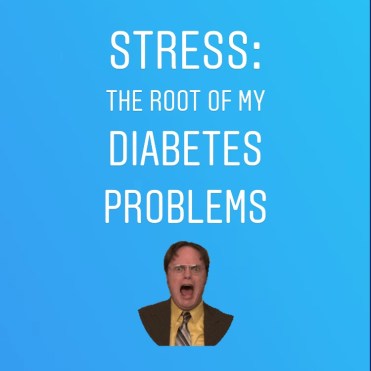
This image of Dwight Schrute basically sums up how I feel lately.

Unfortunately, I found out firsthand how much havoc stress can wreak on blood sugars. I received some stressful news one Monday afternoon and had to combat high blood sugars between then and dinnertime. Into the evening, I was munching on a bunch of different snacks – I tend to stress eat – so I chalked up the resulting high blood sugars to my lack of restraint.

When the high blood sugars continued for three straight days, though, I knew something was wrong. I’d eat meals that I’d had plenty of times before, and contend with elevated blood sugars for hours after. I’d give myself bolus after bolus, sometimes even stacking insulin, and my blood sugar would barely budge. It was maddening, seeing my levels hover stubbornly in the 190-240 mg/dL range. It was only when I started bolusing very aggressively for food and increasing my temp basal that I finally got a reprieve from high blood sugars.

This whole ordeal has taught me that I’ve grossly underestimated stress when it comes to its impact on diabetes management and blood sugar levels. Not only does stress drive my blood sugar levels up, but it also makes it that much harder for me to confidently manage my diabetes, overall. It’s very sneaky in how it attacks blood sugar and, frustratingly, there’s never any surefire way of telling when my diabetes will calm down again when I’m undergoing a stressful situation.

Maybe this is a sign that I’ve got to find a better way to cope with stress. Meditation, yoga, exercise, more self-care…I’ve definitely been slacking on all of that lately. Just like I won’t be underrating how stress affects my diabetes any time soon, I’ll also remember to take into account how beneficial it is to just…relax.


Dia-Feated.

I feel defeated when it comes to just about every aspect of my life with diabetes as of late.

I feel defeated in terms of my blood sugars lately: I’ve experienced too many highs due to an ever-present fear of low blood sugars.

I feel defeated in terms of what my A1c reading might be at my endocrinologist appointment next month: I don’t even have a clue as to what the value might be right now, but my intuition is telling me that it’s higher than I want it to be, which sucks because I’ve tried hard to keep it down.

B80D7D9B-0596-4E9B-8D08-34F3EE1078FE

I feel defeated in terms of my diabetes supplies: I’ve had to pay a lot more money than I ever anticipated for them. I turned 26 less than 6 months ago and I’m having trouble imagining paying so much money for my supplies for the rest of my life, let alone the rest of the year. I know I’m not alone, but knowing that others are struggling (in very different and similar ways) makes me feel worse.

I feel defeated in terms of this blog: I feel like nobody else really cares about it except me. This is fine in some ways because one of the reasons why I write this blog is because it’s a form of therapy for me. But in other ways, this makes me sad because another reason why I started Hugging the Cactus was to make a positive impact, somehow, on the diabetes community that I love so much. But it’s hard. There’s many bigger, louder, more important voices in the online space that simply have a better reach than me. These people know how to connect with their audience in a way that makes a more profound impact than I ever could. Lately, I’m asking myself, “why bother” a lot more than I’m saying to myself “keep it up”.

I’m not writing about my diabetes-related feelings of defeat – my dia-feat – to garner sympathy or attention. I’m just trying to keep it real. It’s a little different than what I would consider conventional “diabetes burnout” to be, because I do still have that desire to thrive and do well with my diabetes management…but things just aren’t quite going my way.

I know that other people like me feel this way sometimes.

And I know that the dia-feat won’t last forever.

But it is important for me to acknowledge it now, so I can start figuring out how to dust myself off and pick myself back up soon.


3 Things That Make Low Blood Sugars Tolerable

Okay, to be TOTALLY honest, low blood sugars aren’t – and won’t ever be – fun. Nine times out of ten, they can be inconvenient, upsetting, and even scary (depending on how low it is). But like most things associated with diabetes, I try to look at the bright side every now and then to remind myself that it could be worse. So even though I don’t welcome low blood sugars in just about any circumstance, I decided to look at them, and their less-than-pleasant side effects, from another perspective. Hence, this three-item list that explains what makes low blood sugars slightly more tolerable to me.

8

  1. The sweat.
    I detest sweating. I don’t care if sweat is the result of a good workout or a day spent at the beach – it’s gross either way. And it’s definitely not an attractive low blood sugar symptom. But…on the other side…I tend to sweat a LOT when my blood sugar is low and it makes me feel like I’ve just had an excellent workout without any effort or exertion on my part. So I guess it’s kinda like gleaning the health benefits that you’d get from sitting in a sauna for a bit? IDK…it’s a bit convoluted but just agree with me on this one.
  2. The excuses.
    I’ve made it a personal mission to try to avoid using my diabetes as a scapegoat. There are times, though, that it really does prevent me from doing something in a timely manner/when I’m asked. For example, if I’m experiencing a low blood sugar at work and a colleague comes by to talk to me and ask me for something, I do find it’s best to let them know that I can’t attend to it right away because of the blood sugar. Nine times out of ten, people understand, and they let me treat it accordingly. And it gives me time to just relax and deal with it, taking the stress away from a situation by simply being honest about it (so I guess it isn’t really an excuse, but sometimes I feel a little guilty about using a low as an out on something. Low guilt is real, people!).
  3. The cake. (Or really any food when you’re low. Because it all tastes delicious. But nothing is quite as satisfying as cake.)
    I think the inspiration for this blog post came when I was enjoying a big, fat slice of cake in order to bring my blood sugar back up. My goodness, some foods just taste beyond amazing when I’m using them to treat a low. The sweeter it is, the more satisfying it is to both my taste buds and blood sugar levels. And anyone who has experienced a low blood sugar before (people with and without diabetes) can attest to the fact that food is simply a million times better when it’s being consumed at a time that your body is URGENTLY telling you to feed it.

Alright…now that I’m looking back at these three things, I’m kind of laughing at myself. Because I can TRY to make low blood sugars a more positive thing, but let’s be real, they still kind of suck. But I guess there’s no harm in trying to be upbeat about them.


The Low I Didn’t Feel

Do you ever feel so engrossed in a task that something (like the time) sneaks up on you, and totally disarms you and puts you in panic mode?

That’s sort of what happens when you don’t feel the symptoms of a low blood sugar. Usually, I’m lucky enough to say that I feel my low blood sugar symptoms – shakiness, sweating, dizziness – but unexpectedly, I didn’t feel them during a recent low blood sugar episode. And it nearly knocked me off my feet.

I’d been traveling all day long. I’d taken an Uber from my apartment to the airport, where I waited a couple hours to catch my flight, which was so turbulent that I nearly yakked on the tarmac. When I finally arrived to the airport and lugged my bags up to the hotel room that I was staying at, I was struck by how queasy my stomach still felt and chalked it up to after effects of the turbulence.

I figured my body was just mad at me for skipping dinner. It was already 9 at night and I didn’t really want to go back down to the crowded terminal just to get a mediocre fast-food dinner. That’s when I decided to check my blood sugar: That would determine how necessary food was for me at that point in time.

4EC5B343-0D2D-4F1B-95FD-A9197FE6548A
The low I didn’t feel.

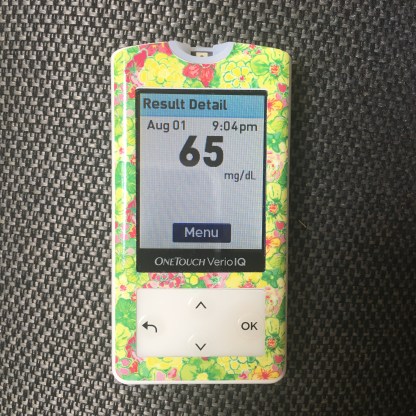
Just as I was taking my kit out of my bag, my CGM alarmed. According to it, I was low – low enough that I’d be below 55 within the next 20 minutes. “Impossible”, I thought. I feel my low symptoms coming on when I’m 80 mg/dL sometimes, so I was convinced there was something wrong with my CGM. I proceeded with the fingerstick check. The result popped up on my screen: 65. What? How? I could’ve chalked it up to a long travel day, but at that moment in time, I didn’t care about the cause. I only cared about the fact that I didn’t feel it whatsoever.

It was scary and an unpleasant surprise. As I sat down on the hotel bed and crammed M&Ms in my mouth, I felt a little confused about how I got so low (especially since I’d been eyeing my slightly-elevated blood sugar all day). But mostly I felt gratitude for my CGM. Times like these make me feel incredibly privileged to have one. I find its alarms annoying and I don’t love wearing an extra thing on my body, but its functionality makes it totally worth it.

Managing T1D at Sea

Yo ho, yo ho, a pirate’s life for meeeeee…

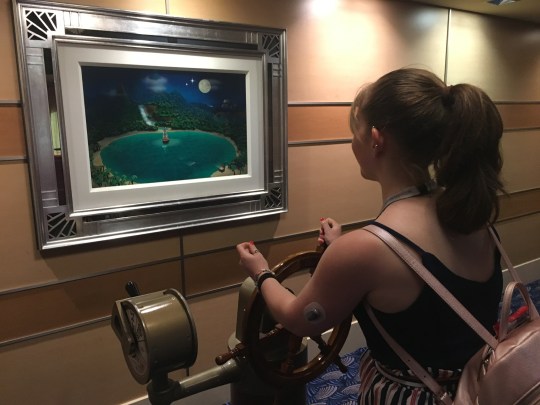
I gleefully sang this song multiple times throughout my short Disney cruise getaway earlier this month. I love cruises. I love Disney. I love tropical islands. So I got to combine my love for all three by embarking on a cruise to the Bahamas with my boyfriend that was planned sort of last minute, but desperately needed nonetheless.

3A8207E0-BA1C-4791-ADE7-A12236CF6C74
When it comes to diabetes management on a cruise ship, I’m the captain (who does what she can to navigate safely through rough waters).

I’m so glad we went, even if it did involve a helluva ton of preparation time. Because as you’ve probably figured it out by now, traveling with diabetes requires extra work. But traveling with diabetes knowing that you’ll be stranded in the middle of the ocean for part of the time necessitates apocalypse-level planning.

There was a whole list of questions I needed to answer as I packed my bags for the trip. How many pods should I bring with me? How much insulin? How would I keep said insulin cool? What types of snacks should I have on hand? Should I bother bringing Glucagon? What about chargers for all of my devices?

The answer to most of those questions was…just bring more supplies than I think I’ll need. For instance, I brought triple the number of pods than I’d actually go through over the course of a four-night trip. I packed extra snacks – a few unopened boxes of granola bars and a whole bottle of glucose tablets. I don’t even know how many alcohol swabs or spare syringes I brought, that’s how many I crammed in my luggage. And I deemed that two bottles of Humalog, plus Glucagon, would be ample (after all, I’d rather have it all and not need it than need something random and not have it).

I ended up purchasing a cooling case on Amazon that would allegedly keep my insulin cool during the day trips we’d make to the islands. I say “allegedly” because it wound up not being that great (otherwise, I’d add a link here to purchase it). After a day on Disney’s private island, Castaway Cay, in which the cooling case never left the shade of our umbrella, I returned to our state room to discover the contents of the case were a bit warmer than I had expected. Disappointing, but the insulin still seemed safe to use.

In terms of meals and snacks on the boat, there was a plethora of foods to choose from. Oh, and virtual 24/7 access to a soft-serve ice cream machine. Aaaaand a lot of tempting tropical libations. I tried to stick to healthy options and incorporate vegetables or proteins at each meal, and of course I drank plenty of water, but it was vacation and I couldn’t resist a Mickey waffle at breakfast each morning or the occasional mojito-filled coconut. So it’s not totally surprising that on average, I ran a bit higher than I’d normally like for the whole cruise, but I don’t regret it because it’s really hard to judge how much insulin to take or food to consume when the days are jam-packed with physical activities and sun exposure. And I accomplished my goal of avoiding low blood sugars as much as I could, because I absolutely did not want to be stranded on the sand treating a low when I could’ve been swimming in the most gloriously warm turquoise waters with sea creatures.

Even though my diet wasn’t the healthiest, I was able to combat some of those choices with a lot of movement during the cruise. Between strolling the walking track that was on deck three of the ship, bicycling on Castaway Cay, snorkeling/swimming at the beach, and walking ALL OVER both land and ship to get wherever I wanted to go, I clocked some seriously miles on this vacation. Who would’ve thought that being on a boat would lead to so much exercise getting automatically incorporated into my day?

So sure, going on a cruise vacation does add an extra layer of stress to trip preparation. But trust me when I say it’s worth it. I was blissfully happy during the whole cruise and, even though I didn’t need more than half the supplies I brought with me, I enjoyed the peace of mind it resulted in because I’d taken the time to think things through. It just goes to show that diabetes can’t prevent the enjoyment of any type of travel.

My Diabetes Hates Weddings

So basically everyone in my life right now is engaged, or on the fast-track to getting engaged.

And that’s awesome! No, seriously, it’s an exciting time for a lot of my family and friends. And I’m happy to be part of it all because I like going to weddings. Who doesn’t love to celebrate love?

Well, I can tell you what doesn’t love to celebrate love…MY DIABETES.

My diabetes effing hates weddings.

My diabetes hates weddings SO much that I’ve yet to go to one where it doesn’t act up in some way.
My New PDM (1)

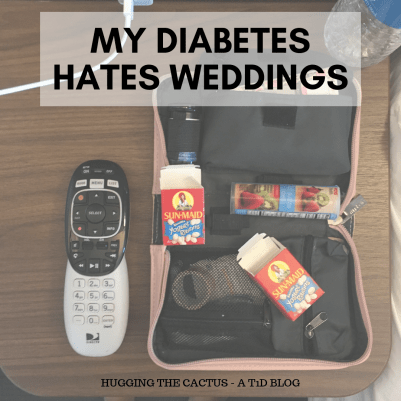
I was naive enough to think that it would actually be a good diabetes day during the last wedding I attended. And it was, for the most part: I woke up, had a Dunkin Donuts sandwich for breakfast, got dressed and made-up. I showed up for the ceremony with a slightly low blood sugar that was swiftly corrected with a mini box of raisins (oh, if only I knew how many more I’d consume that night…).

I was fine, right through the cocktail hour and the start of dinner. But that’s where the troubles began. You see, there weren’t many passed hors d’oeuvres during the cocktail hour, and I could’ve really used some because I hadn’t eaten anything besides the sandwich and the raisins all day long. By the time dinner started, I was ravenous and basically shoved anything within arm’s reach into my mouth. This included a lot of cheese, meats, and pieces of flatbread.

If I’d actually been thinking about how my blood sugars usually respond to slow-acting carbs in things like flatbread, I might’ve actually wound up okay. But over the course of the next several hours, as wedding guests were whooping it up on the dance floor, my blood sugar was making a slow and steady climb up into the 300s! When I finally realized this, I started taking correction boluses that, apparently, were far too aggressive…because when I finally ended the night in my hotel room around 1:30 A.M., I was in the 70s. And dropping.

My lowest blood sugar was 43 that night. I ate multiple packs of raisins, 5 or 6 glucose tablets, a FiberOne bar, and half a pack of peanut butter crackers. All between the hours of 1:30 and 4 in the morning. It was exhausting. I was tearful and sweating so badly at one point that it looked like I had just come out of the shower. I even wound up sending my sleepy boyfriend down to the lobby at one point to buy me an orange juice, because I was running out of low blood sugar remedies. I drank half of it and was relieved to see my CGM showing, at long last, a diagonal up arrow. I couldn’t believe that I’d just spent the last few hours hovering below my “low” threshold on my CGM, but I didn’t waste any more time thinking about it – I was extraordinarily tired and happy to finally go to sleep.

But now that I’ve had time to think about it, I’ve realized that I need a new strategy for myself and my diabetes when it comes to weddings. I’m going to be my cousin’s maid of honor next month, for goodness’ sake, so I want to do everything I can to ensure “decent” (i.e, blood sugars under 200 but over 80) for the special day.

A key to success, I think, will be regularly scheduled meals and making sure that I avoid an empty stomach at all costs.


Adventures in Low-Carb Snacking

I’ve logged a lot of miles on the road this summer. From planned trips back to my home state of Massachusetts to weekend getaways to neighboring states, I’ve spent many hours in the car. Conversations with my partner and friends on the phone, as well as podcasts, have helped time pass…but so has snacking on a variety of road-ready foods.

I admit that I often don’t choose the healthiest road trip snacks. I tend to gravitate towards “comfort” foods – anything from peanut M&Ms to cheese-flavored chips. I wish that I craved something better for me, like carrot sticks or celery stalks, but my intense dislike for long hours on the road coupled with the need for convenient foods only (i.e., nothing that needs refrigeration) results in me making less desirable snack choices.

In turn, my junk food cravings are typically disastrous on my blood sugar. I do bolus for the junk, but since I’m forced to sit idle in the car, I face more frequent and intense blood sugar spikes than I would if I were able to get some movement in shortly before or after consuming the food. So not only do I end up eating food that’s bad for me, I also have to deal with the consequences on my blood sugar, and it’s a lose-lose situation.

That’s why I created a little game for myself during my last long car ride. When my boyfriend and I stopped at a gas station to fill up the tank before driving for four hours, I decided to go into the convenience store that was located there and scour the shelves for the lowest-carb snack foods I could find that were also remotely appetizing.

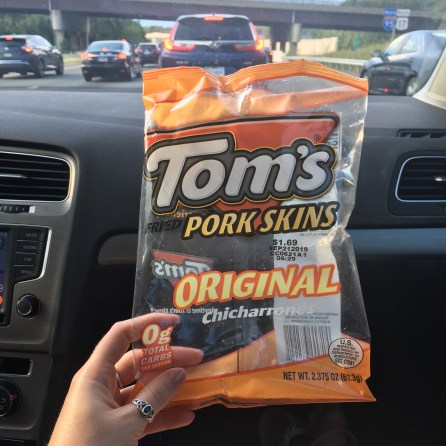
Enter…”pork skins”.

low carb snack
The big selling point of this snack? The fact that it’s 0 carbs per serving!

The name itself is positively revolting, but the actual snack is a savory wonder for a T1D. It’s got 0 carbs in the ENTIRE bag. It also happens to be chock full of protein and is relatively low in calories. What a find! We totally crushed the entire bag in about two hours flat.

Other findings from this particular trip include a lower-carb bag of trail mix that was incredibly satisfying. I was pleased to have found one that wasn’t a mix of 20% nuts and 80% candy/dried fruit, because the latter is what always messes up my blood sugar. I also snagged a bag of beef jerky, because I can always count on that to be a delicious low-carb treat.

And my drink of choice? I found a blue Gatorade Zero, which I’d never had before because it’s not sold in stores I go to when I’m up north. I loved it and was especially appreciative for it after a weekend of not getting enough fluids.

All in all, it was kind of fun to see what kinds of snacks I could find that wouldn’t do damage to my blood sugar. I wound up finding some stuff that’s bound to become staples for future road trips, and was so sated by the combination of them that I didn’t even need to cook dinner when I got to my apartment. Turns out that low/lower-carb snacks pretty much rule!