It’s All Good

I’m still not used to having an endocrinology appointment every 6 months.

For my first two decades with diabetes, I saw an endocrinologist (or diabetes nurse practitioner [NP]) every 3 months. In hindsight, this sounds like a slightly aggressive amount of visits, but it’s what worked for me for a long time. Those appointments often served as motivation for me to do better, as well as learn about new diabetes care options available to me. And I’m fairly certain that they were a good opportunity for my parents and healthcare team to put their heads together, at least when I was younger, and come up with ways to make life with diabetes easier for me.

But as I’ve grown older and become more independent in my diabetes journey, I’ve relied a little less on these four-times-per-year check-ins. I don’t know exactly when, but in the last few years, my diabetes appointments became more of a nuisance than a boon…and I think my provider at the time recognized that. She suggested reducing my appointment frequency to twice a year, and since making that change I’ve greatly benefited from it.

And it’s why, when I attended my first appointment of the year recently, it felt like a nice little status check of where I’m at with my diabetes. In fact, that’s exactly how my NP kicked off the appointment: She asked me, “how are you doing? Is there anything new going on that you’d like to discuss?”

It felt great to be able to tell her: It’s all good.

Nothing new, no major complaints. We did chat a bit about my “diabetes cure” fluke from last month, in which we came up with no definitive answers but I was encouraged to monitor my blood sugars around my cycle a bit more carefully to see if I could come up with any patterns. We also went over my bloodwork and she was pleased to report to me that everything looked good, which is always reassuring to hear. The appointment ended with a check of my feet and thyroid, as they always do, and then I was free to go.

Even though we didn’t make any changes to my diabetes management, it was still worthwhile and comforting to know that my care team agrees with me that everything is all good and to keep up what I’m doing. That, in its own unique way, is enough motivation for me to do the best possible job taking care of my diabetes between now and the next appointment. It really is all good, and I’m grateful for (and proud of) that.
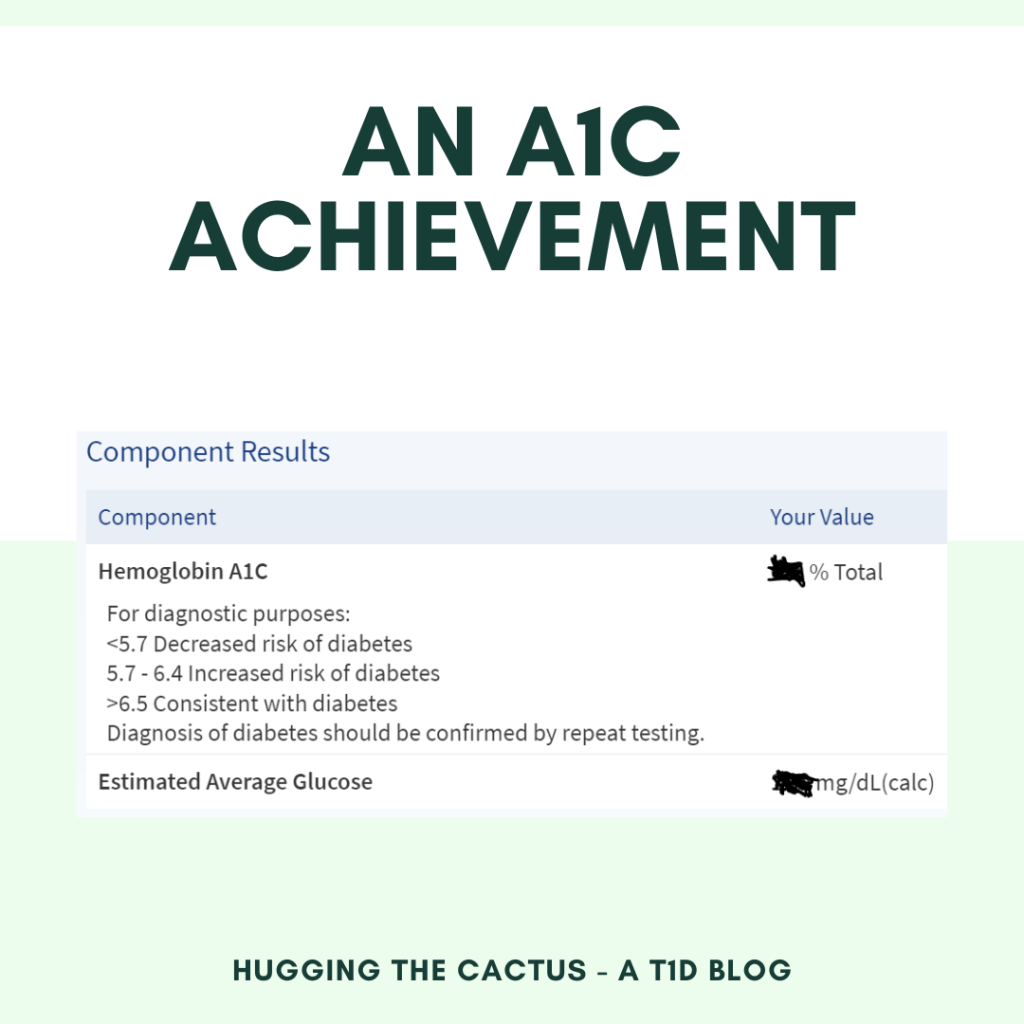
An A1c Achievement

Since transitioning to the Omnipod 5 roughly 8 months ago (and obtaining a deeper understanding of how the algorithm works), I strongly suspected that I would be pleased by the results of my next A1c reading. What I did not expect that it would be my best reading in four years – maybe even longer than that, if only I could see my results dating further back!

While I’m not going to share the exact number here, for reasons I’ve written about in this past blog post, I am writing about this little victory of mine because I needed to take a moment and reflect on how far I’ve come in my diabetes journey. For many, many years, I rejected the notion of diabetes technology. I was stubbornly resistant to exploring it whatsoever, likely out of fear that the change would have negative consequences on my health or standards of living. While I wish I could go back in time and encourage my younger self to give it a chance or explain how it would benefit me, I’m just grateful for the fact that I did eventually come around to trying it and realizing how much it changed my diabetes care and management for the better.

Don’t get me wrong, I’m still very much a proponent of time in range compared to A1c – and I’m thrilled to report that my time in range has also significantly improved since I switched to the 5. But for me, I can’t help but attach some extra value to my A1c, maybe because it was the standard measurement of diabetes “control” for most of my life with diabetes so far. So it feels really good and natural to celebrate my latest A1c achievement.

A Temporary Diabetes Cure

I always envied people who experienced a diabetes “honeymoon” period. I used to think, how nice it must be to have some extra time to prepare for fulltime life with diabetes and not quite rely on insulin injections right off the bat! I also always assumed that, after 25 years living with diabetes, that the honeymoon phase had absolutely skipped over me, and I was positive I’d never get to experience it.

Turns out, my diabetes – that saucy little minx – likes to keep me on my toes as it recently surprised me with an abrupt 48-hour window of time in which it seemed like my diabetes was cured.

That’s the only way I can describe what transpired. It was the strangest thing. One day, I woke up, ate breakfast, and took insulin for it – just as I always do. Except instead of my blood sugar spiking or even leveling out after eating, it started to drop, which was strange because I ate a fairly typical meal that morning. At the time, I thought nothing of it and just ate some extra carbs before my blood sugar went too low.

No big deal, right? But this phenomenon happened again, following both my lunch and dinner. It was especially inconvenient in the evening, as I had a volleyball game and wanted my number to be up so I could play. I had some fruit snacks before the game to keep my levels up, but was surprised when even after that, I was dropping by the tail end of our third and final match. I remember being out on the court, trying to track the ball as my team bumped it back and forth over the net with the other team, knowing full well that my blood sugar was going low but feeling determined to stay in the game until it was over. The moment the final whistle blew, I ran to grab even more fruit snacks, and felt both annoyed and confused by the whole situation.

The following day, I decided I wasn’t going to mess around anymore. I wanted to cut my mealtime insulin doses in half to see if that helped me at all. It was a solid idea, but it didn’t prove to do much to help as I again dropped after breakfast and lunch. Okay, so clearly that course of action wasn’t enough. Maybe I could try switching from automated mode to manual on my Omnipod 5 PDM and put myself fully in control, rather than leaving it up to technology. I set a temp basal decrease to ensure I was getting very little basal insulin, and resolved to enjoy my pizza dinner that evening with friends.

Of course, pizza is notoriously difficult to bolus for, so I knew I’d have to do even more extra work in order to prevent my blood sugar from dipping. So not only did I take half the amount of insulin than normal, but I also did an extended bolus so that I wouldn’t get it all upfront. I ate two fairly large slices of pizza and also had a generous serving of chips that I technically didn’t include in my bolus calculations. So imagine my bewilderment when, 2-3 hours post-pizza, I was still going low. I poured myself a glass of regular soda, and it became my companion for the remainder of the evening. I’d take sips as I saw my graph report blood sugars that never went higher than 110, but fluctuated for the most part between 60 and 90.

It was wild, and I was actually getting pretty worried about the whole situation. I couldn’t make sense of it. I ran through all the variables that could’ve caused this to happen – was I wearing my pod in a strange site? Was it because of my period? Could it be due to my activity levels or changes in the weather? I weighed so many possibilities in my mind and came up with nothing definitive, so I went to my next best resource for input…the diabetes online community.

I asked around for input and was – as always – so grateful to the folks who reached out and served as thought partners with me. Based on what I learned, the most likely culprit is hormonal changes. In fact, perhaps it was a bit of a birthday gift from my diabetes as I ushered in a new age/phase in life. It’s still totally bizarre that it happened, but a friend reassured me of her own experiences with the same temporary phenomenon as she’s experienced menopausal shifts. So, maybe…just maybe this was the explanation I was looking for, and perhaps the whole thing happened to signify the start of my upcoming cycle.

I won’t ever know for certain if that was indeed the cause of my temporary reprieve from diabetes, but at least I can find a little comfort in knowing that I got through it (as my blood sugars and insulin needs bounced back with a vengeance the following day) and that I had the support and feedback from friends and strangers alike the whole time.

CGM or Security Blanket?

So…remember all the times on this blog that I wrote about how important it is, as a person with diabetes, to be prepared at all times? And how it’s vital to have a back-up in case something unexpected happens with technology?

Well, apparently I don’t take my own advice. I mean, I usually do, but once in a blue moon, I am forgetful. Or negligent. In this particular scenario, I was both, because I simply didn’t pay attention to the fact that my CGM sensor was due for a change…and I was stuck at my workplace office, roughly 45 minutes from home, without my meter or a backup sensor in my bag. So when my CGM sensor expired at 1:48 in the afternoon, I realized that I wouldn’t have a means of checking my blood sugar until I returned home for the day. And I was a bit freaked out about that.

My biggest concern was that my blood sugar levels would run high and I wouldn’t know for certain or be able to do anything about it. I’d eaten more carbohydrates at lunchtime than usual, and had low confidence that I’d guessed the carb count accurately.

Instead of losing my cool or deciding to head home early, though, I impressed myself by choosing to ride it out. I felt sure that I’d be able to pick up my body’s signals if my blood sugar began to run low (which is definitely scarier than it running high for too long, anyways), and if it were high? Well, then, I’d just have to cut my losses and correct for it as soon as I got home. It’s never fun to have high blood sugar when it can be so easily fixed with an insulin dose, but given my options in this particular scenario I decided that I’d make peace with it, should that end up being my outcome.

It was a long 3ish hours, flying blind without my security blanket I mean, CGM, but I made it through and checked my blood sugar with my meter the moment I arrived home. And guess what? All that worrying about being high was for nothing because I was sitting pretty at 82 – a stellar blood sugar level in ordinary circumstances, but one that felt especially victorious after this less-than-ideal situation I got myself into.

The whole experience opened my eyes to the fact that my CGM is more than just a piece of diabetes technology to me, it’s a security blanket. It makes me feel that much more confident in making the majority of my diabetes-related decisions on a daily basis. And while it’s great that I have my CGM’s data available to me most of the time, it’s also an indication that maybe I could stand to be a little less reliant on it and trust myself and my own body a bit more. Maybe I could stand to check my graph 50% less than I do each day (believe me, I glance at it frequently, definitely more than I need to) to build a healthier boundary between me and my CGM. Or maybe I can do a better job at keeping tabs on my back-up supplies so I don’t run into this again.

Or…maybe I can totally do both of those things to do a better job of becoming my own source of security when it comes to my diabetes. I like the sound of that.

30

Today I turn 30 years old!

What a strange sentence to write, since oftentimes I feel that I am simultaneously much younger and much older than 30. I’ve got a childish sense of humor and a penchant for video games and shirking responsibilities, but I also quite enjoy going to bed early and have my fair share of aches and pains that I complain about almost daily. But in reality, I’m merely entering my third decade of life, and taking my 25 years of diabetes (so far) along with me.

I’m also bringing the following mantra into my thirties: The best is yet to come. That’s because I have an unshaking faith in knowing that I’ll make many of my goals, hopes, and dreams turn into a reality in this decade – I will manifest them into existence, dammit, if that’s what it takes.

In addition to my excitement over this realization, it’s also beginning to dawn on me that this attitude can apply more specifically to my life with diabetes. I’ve seen for myself in the last 25 years just how far we’ve come, in terms of everything from standards of care to technology. How can I not have confidence, then, in the belief that the best is yet to come for myself and all other people living with diabetes? I can say with utmost certainty that the technology will only continue to get better, accessibility barriers will continue to be broken down, affordability will continue to improve, and my own diabetes care and treatment will continue to adapt and advance as time goes on.

So today, rather than mourning the end of my roaring 20s, I’m welcoming my 30s with open arms and the expectation (to riff on the movie 13 Going on 30, in which turning 30 means that one will be 30, flirty, and thriving) that they will be marked by a period of thriving with the knowledge that the best truly is yet to come.

The First Time I Self-Injected Insulin

LEAVE A COMMENT

This blog post was originally published on February 9, 2019, on Hugging the Cactus. I’m sharing it again today because it’s a great reminder that trying new things (in terms of both diabetes and life in general) can be scary but definitely worth it. Oh, and that I have a really great dad. Read on for more…

The first time I self-injected insulin, I was absolutely terrified at the mere thought of it.

Since I’ve never really minded needles that much, you’d think that self-injecting would be a cinch for me. That couldn’t be further from the truth, at least for the first few times that I had to do it.

It goes back to one endocrinologist appointment when I was nine, maybe ten years old. My doctor and my parents were talking about how I was reaching an age where I should start to take on a little bit more responsibility in terms of my diabetes care. I don’t remember whether my endo or my parents suggested it, but one of the two parties said that a good starting place would be to start giving myself my own insulin.

Initially, I protested. I hated the idea. But I warmed up to it when my parents reassured me that they would check the syringe for me before I stuck it into my skin. At this point in time, I’d practiced drawing up my own insulin dosages. I’d pass the syringe along to my mother or father for the actual injection. So I had the first step in the process down pat, and it only made sense for me to put two and two together and do it all independently.

Since I was hemming and hawing over the prospect, though, my endo had the brilliant idea to practice on my father with a saline injection right then and there, given that he was willing for me to do it. As he rolled up his sleeve, I grinned wickedly (I was annoyed with him for some trivial reason that day) and waited while my doctor prepared the saline injection. As she brought it over, I panicked a little, and I must’ve asked two or three times whether it was actually safe for me to do this. Because even if I was irritated with him, for whatever stupid thing it was, I didn’t actually want to hurt him.

Once I was adequately assured that the injection would be harmless, I took the syringe into my hand, took a deep breath, and stuck it into my dad’s arm. I remember pushing down on the plunger slowly, and my dad sitting in the chair, totally composed and un-bothered by the sensation. When I took the needle out of his arm, I exhaled loudly, not realizing that I had been holding my breath the whole time. What can I say, it was a nerve-wracking feeling. It’s not every day that you learn how to inject yourself, or someone else for that matter, with a syringe.

Over the course of the next week or two, I practiced my new skill on oranges supplied to me courtesy of my parents. With each practice injection, my confidence grew and I realized that it wasn’t that scary. I would press the orange against my leg or my arm, pinch at its peel, and give it an injection of salt water – super quick, super easy.

In no time at all, I felt brave enough to give myself my first self-injection. Just like I did with my dad in the doctor’s office, I breathed deeply before plunging it into my leg, exhaling only when I was done. And I felt the satisfaction of having done it on my own, which was sweeter than I thought it would be.

Working up the courage to self-inject is just one example of many experiences I’ve had with diabetes and being afraid to try something new. Whether it was trying a CGM for the first time or transitioning to a pump, each new thing I introduced to my diabetes care and management routine scared the hell out of me at first. But just like I proved to myself that self-injecting was nothing to be afraid of, I’ve shown myself time and time again that new things for diabetes aren’t always so bad.

Yes, I Can Eat That

This blog post was originally published on Hugging the Cactus on March 7, 2022. I’m sharing it again today because I (and other people with diabetes) constantly battle the misconception that I can’t eat foods that contain sugar/carbohydrates. Why, just the other day, someone who has known me since I was 12 years old made a comment about how I couldn’t eat cookies! In that situation, I smiled politely and gently corrected the individual, but the bottom line remains: This is some diabetes stigma that I’d like to defeat. Read on for more…

Yes, I have diabetes.

Yes, I can eat cheesecake and pizza.

Yes, I can actually eat whatever I want – I just have to know the carbohydrate content of whatever I’m consuming (and being mindful of portion size doesn’t hurt either).

Yes, I’m telling you this because at the time of this writing, that’s actually what I had for lunch this afternoon: homemade pizza and cheesecake. The pizza crust was store-bought, but everything else – from the sauce to the cheesecake crust to the strawberry topping – was made by me and it was damn good.

I guess I’m just taking a moment to 1) congratulate myself on semi-mastering the home-cooked versions of these two foods, but also to 2) reflect on how there’s so much stigma, STILL, on what people with diabetes can/can’t or should/shouldn’t eat. It’s wild to me that there are countless people in our world who misunderstand that a diabetes diagnosis automatically eliminates certain food groups from an individual’s diet.

Let me say it louder for those in the back who can’t hear: People with diabetes can eat whatever they want. Diabetes varies from person to person, and so do dietary preferences – so just because one person with diabetes might follow a strict keto diet, it doesn’t mean that ALL people with diabetes do. It doesn’t make it right or wrong for a person with diabetes to choose or not choose to eat certain things – period, bottom line, end of the story.

And by the way – I took a big old bolus of insulin for aforementioned pizza and insulin and my blood sugar didn’t spike past 188 mg/dL several hours later – score! So I’m also using this blog post to remind myself that it’s okay to eat “treat” foods like this from time to time, and that does not make me a bad diabetic.

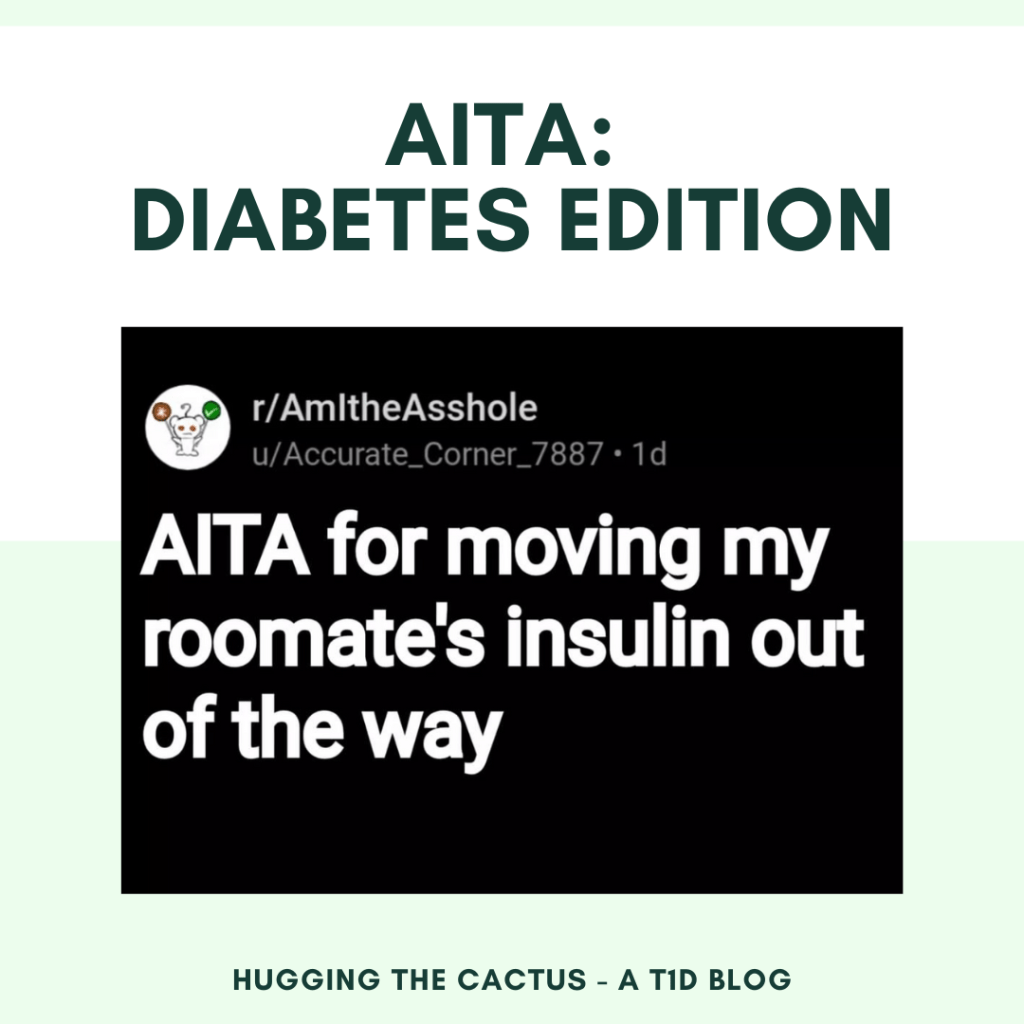
AITA: Diabetes Edition

If you aren’t familiar with the acronym AITA, then let me break it down for you: It stands for “am I the asshole”?

It stems from Reddit, which is basically a ginormous discussion thread website. It provides a forum for people to post stories in which they’re unsure whether they’ve acted like, well, an asshole. Then other folks who see the initial post can chime in with their opinion on whether they think yes, the OP (original poster) did act selfishly/foolishly/asshole-ly or no, the OP acted in accordance with what they would have done, had they been in that person’s shoes. It can be a wildly entertaining guilty pleasure to fall down the rabbit hole of these discussion threads and deduce for oneself if a perfect stranger on the Internet did indeed act like an asshole in a given situation or not.

I found myself immersed in one of these AITA threads that my cousin sent me because, of course, it had to do with diabetes. Long story short, the OP wondered AITA for moving their roommate’s insulin out of the way, causing said roommate to panic and be forced to resort to an emergency insulin supply because they were unable to locate what had been stored in the refrigerator. Now, in just that context alone, I would’ve said that the OP wasn’t an a-hole because they probably just didn’t know any better, but as I scrolled further along in the thread I discovered that they thought it was fine to do and that diabetics were fine in historical times when there was no refrigeration. And he took his ignorance a step further by posting a comment about how he didn’t know what the big deal was about taking a vial of “sugar water” – yes, that’s what he called insulin – out of the fridge.

That’s when I immediately realized, yep, the OP can wear the AITA crown with certainty. This whole anecdote might come across as a teensy weensy blip in the universe of Internet discussion threads, but to me, it stands out as a perfect example that even people who are closest to those living with T1D can get such a significant detail about it so, incredibly wrong. And it’s proof that we’ve got a long way to go in terms of educating the world on the importance and purpose of insulin, apparently, even though stories about it have hit so many headlines in recent years.

TL;DR (another Reddit acronym meaning too long; didn’t read): Let’s get it straight, now, that insulin is a life-saving medication that needs to be stored properly in order for it to be used – and IMHO (in my humble opinion), never take it away from a person living with diabetes without asking them about it first.

Flatbread Failure

Any type of pizza, plus diabetes, usually equals one giant headache in terms of nailing a correct insulin dosage.

Nine times out of ten, my blood sugar ends up high in the hours following a pizza meal. This is a fairly common phenomenon for people with diabetes, because even though pizza contains high amounts of carbohydrates, it also contains a large amount of fat that ends up delaying the digestion of pizza – resulting in a belated blood sugar spike. My go-to workaround for this is to do an extended insulin bolus, meaning that I take part of my insulin dose at mealtime and my pump will deliver the remaining dose later on, but it can be tricky to nail the timing of it.

So imagine my surprise when, after enjoying an evening out with my boyfriend in which we split a very tasty flatbread pizza (half buffalo chicken, half brussels sprouts and bacon), my blood sugar didn’t spike even a little bit post-meal. In fact, it actually ended up tanking – so much so that over the course of 2 hours, I had to eat 3 packs of fruit snacks and a handful of leftover Easter candies in order to keep it from dropping too much.

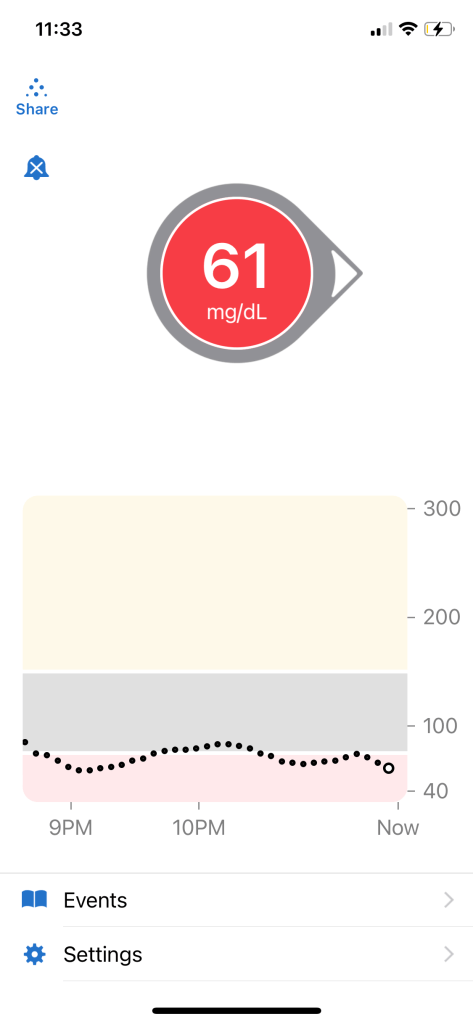
My mind was blown. I had actually eaten more flatbread slices than I normally do during this meal – the two of us nearly demolished a large-size flatbread, which is quite a feat – and so I bolused for 60 grams of carbs, using the manual mode on my Omnipod 5 PDM to enable an extended bolus in which I gave myself half my insulin dose upfront with the remaining half to follow 1 hour later. I actually thought I was underestimating the total carbs I’d consumed, especially considering I had two cocktails with my meal. But nope, I had completely missed the mark on this one and paid the price as I did whatever I could to keep my blood sugar up in the hours before I planned to go to bed. You can see from my CGM graph below that this was a bit of a prolonged struggle, one that kept me up much later than I would’ve liked.

But, oh well. That’s just how it is with diabetes sometimes, and I remain optimistic that I can nail the pizza bolus next time. After all, I’ve done it before, so I can do it again. And this is the kind of bolus experiment that’s kind of enjoyable – any excuse to have some delicious pizza.

What (Not) to Wear: Medical Device Edition

I’m going to two weddings this spring and summer and rather than stressing about which dress I’ll wear to each, I’m finding myself more focused on where I’ll wear my insulin pump and my CGM.

It might sound like I’m making a mountain out of a molehill, but truly, I’m having a hard time deciding whether or not I want to make an effort to hide my devices or don them proudly along with my formalwear. Now when I say “hide”, I don’t mean that I want them out of sight because I’m ashamed of them or anything negative like that. It couldn’t be further from the truth. I’m proud of and grateful for my pump and CGM, but that doesn’t mean that I want them to be front and center on a special occasion. I’d rather let my style – my dress, my make-up, and my jewelry – shine because they’re more reflective of who I am as a person. My diabetes is also a part of my identity, but I don’t want to showcase it if it can be avoided. I also don’t want to attract stares, because whether I like it or not, people will always look and wonder what my pod and CGM are and why I have to wear them.

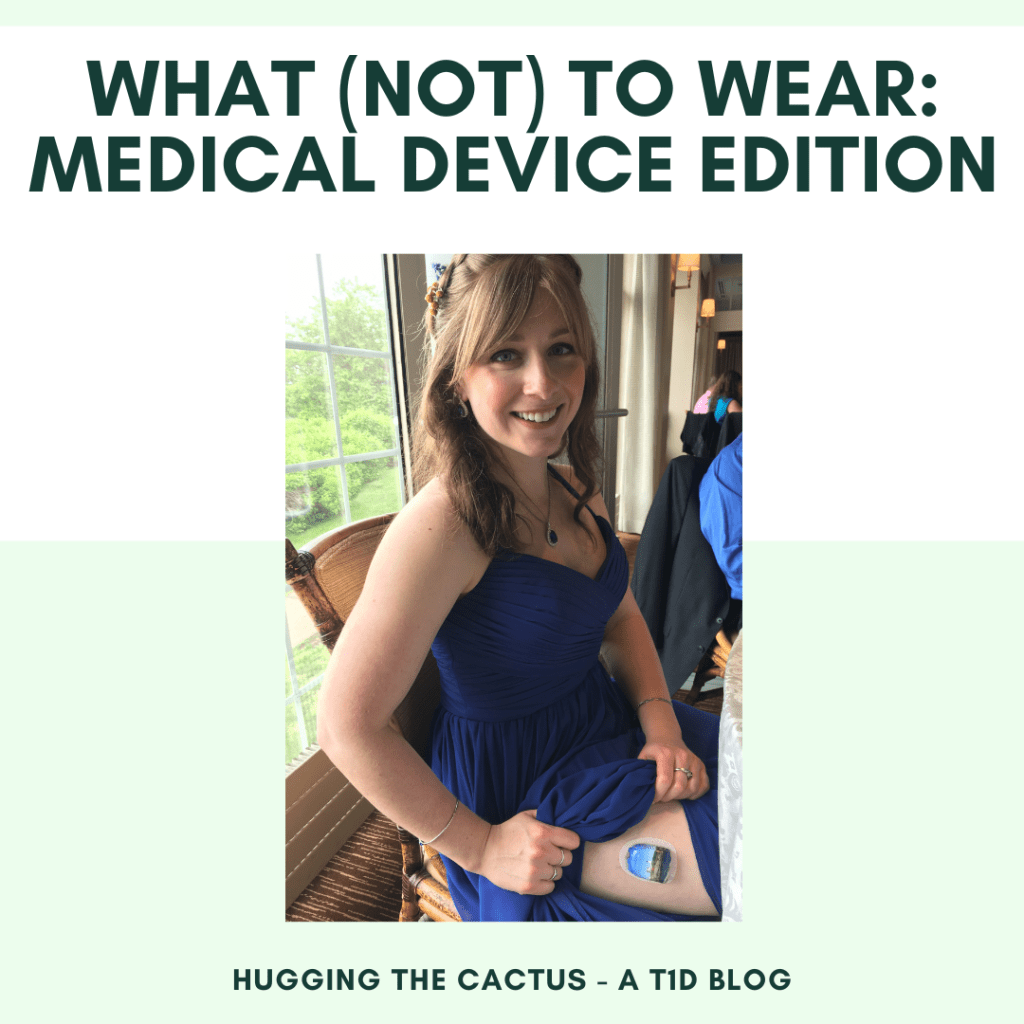
At a family wedding a few years ago, I was proud to showcase my cute pod sticker…but these days, I’m not so sure that I want to go about advertising my diabetes so boldly at a couple of upcoming weddings!

So based on that logic alone, I’m leaning towards wearing my pod and CGM on sites around my abdomen or legs, keeping them neatly tucked away underneath my wedding attire. But I also need to take into account my site change days. My pod is changed every 3 days, and my CGM sensor is replaced every 10 days. I could plan backwards from the wedding dates and figure out where I need to place my pod and sensor according to that, but let’s be real here: I don’t always have the mental bandwidth to plan that far in advance. Pod and sensor site changes are so routine to me at this point that I just kind of go through the motions every time that I change them, and don’t give much thought to their particular placement beyond making sure that I’m properly rotating my sites. Maybe I’m just being lazy by claiming it’s too much extra work, but honestly, there’s so much work that already goes into diabetes on a daily basis that I just don’t want to give in and plan out a site change timeline that guarantees covered-up diabetes devices.

We’ll see what happens, but one thing is for sure: Whether I showcase my sensor and pod in visible spots or if I choose to keep them covered up, I won’t let my diabetes spoil any aspect of having a great time celebrating at both weddings.