It’s said that good things come in small packages – and, at 5 foot, 3 inches, I’m inclined to agree in most cases.
But when it comes to diabetes devices, I’m not sure that saying still rings true for me.
When Tandem recently announced FDA clearance of the Tandem Mobi pump, which boasts the title of being the world’s smallest and most durable insulin delivery system, I started wondering about device sizing and best practices. As someone who tends to misplace things like my car keys and cell phone on a semi-regular basis, I usually appreciate it when my belongings are large enough to be easily visible from a distance; thereby, making them instantly locatable when I forget where I last put something down. I totally get that, as a tubed insulin pump, it’s almost impossible to misplace a Tandem Mobi (especially when it’s physically attached to a body), but I still think it’s worth thinking about the practicality of sizing for diabetes devices.
Yes, at first glance, smaller size likely means greater convenience and levels of discretion – two things that people with diabetes undoubtedly appreciate. But a pump that’s so small that it can fit inside the tiny coin pocket of my blue jeans (yes, that pocket that really serves no other purpose than to home a quarter or two) just seems like it’s begging to be lost or forgotten somewhere. Again, I’m fully acknowledging that the Mobi isn’t like my Omnipod due to the tubed versus tubeless design, but I’m imagining any component of my Omnipod system (the pod or the PDM) shrinking down in size and finding myself cringing rather than rejoicing. I just know that if either were smaller, I’d definitely be more likely to misplace my PDM more often, or fret over a teenier pod reservoir because logic dictates that a smaller pod would mean a smaller reservoir, causing a need for more frequent pod changes due to size alone.
So this begs the question: Is smaller really better when it comes to diabetes devices? Or, does small translate to convenience or annoyance for other people with diabetes? One thing’s for sure, smaller seems to be the way of the future for medical technology in general, so I may just have to get used to the idea that my diabetes devices are going to shrink over time and that I will just need to keep an open mind about that.
This was originally published on Hugging the Cactus on December 4, 2019. I’m sharing it again today because there have been many diabetes tech outages since then – and I’m certain there will be more in the future – but my question still remains: Do we take medical technology for granted? I ponder the answer to that below…
Alright, now that I’ve got THAT out of the way…
For the last several days, the DOC has been in a bit of a panic. And when I say “bit” I mean “a helluva lot”. That’s because the day after Thanksgiving, Dexcom Follow stopped working. This means that parents/caretakers who rely on the technology to monitor their child’s/loved one’s blood sugar levels were left in the dark. It sparked confusion, outrage, and downright fear, all of which only seemed to intensify over the weekend and into this week when the problem was only partially solved for most users.
Rather than coming together to support one another, the DOC swiftly divided into two camps: The first consisted of individuals who sought to gently remind others that this technology is still pretty new. It hasn’t even been around for two decades. That meant that for many years before then, people with diabetes were doing things the “old school” way, and getting by just fine. Doesn’t this mean that we should all be able to make it through unexpected technology blackouts, knowing that we have our blood sugar meters to fall back on?
The second camp was in a greater fury over the issue. This camp relied on the Dexcom G6 system because those within it simply didn’t know a life without the continuous glucose monitoring technology. For them, the outage was a bit like asking them to Google something without access to the Internet – it’s pretty much impossible, unless you’ve got an Encyclopedia handy. Oh, and it’s MUCH higher stakes, because people who don’t recognize symptoms of low or high blood sugar need this technology to work in order to stay on top of fluctuating blood sugar levels. Let’s not even get into how much is PAID for this expensive piece of medical equipment…one would argue that the high cost of supplies means that the technology should work at all times, no matter what.
If you’re like me, you can see that both of these groups have perfectly valid points. I’ve had diabetes long enough that I didn’t even use – and didn’t see the point in using – continuous glucose monitoring or insulin pumps until a few years ago. I took care of my diabetes the old fashioned way growing up: doing fingerstick checks multiple times per day, treating low blood sugars with 15 carbs then waiting 15 minutes, checking blood sugar levels about an hour after injecting insulin to make sure highs were coming down the way they should. This way of handling diabetes worked for me for a long, long time…throughout elementary, middle, and high school, right up to college.
Then I got a continuous glucose monitor (I believe it was the Dexcom G4) just before starting my freshman year of college. And I haven’t really been without a CGM device since then. It’s changed my life and helped me navigate adulthood with diabetes. Whenever I do experience periods of the technology not working the way it should, it’s infuriating because I feel like it’s not worth throwing away buckets of cash on it in those periods of inconsistency and inaccuracy.
But here’s what I’m wondering, as a result of this Great Dexcom G6 Outage of 2019…do we take this technology for granted?
Do we truly appreciate the times that it works the way it should?
Do we expect too much from something that, technologically speaking, still has a long way to go in terms of working perfectly?
Do we rely too heavily on continuous glucose monitors to provide us peace of mind when, in reality, they simply provide us with real-time updates of our blood sugar levels (i.e., it’s a stream of data)?
I don’t have answers to these questions. I can reflect on my own answers to them; furthermore, I can ponder how and why the DOC gets so divisive in these times where we should try to come together, listen to (and learn from) differing perspectives, and figure out what we can do to best support one another during trying times.
My PDM (Personal Diabetes Manager) is more than just a medical device. It’s basically an extension of my body at this point.
Much like people treat cell phones as a must-have-on-me-at-all-times sort of item, that’s how I feel about my PDM. I carry it (and my cell phone, TBH) around as a small but mighty stack of technology. When I set it down somewhere and struggle to recall where I left it, I panic and can’t focus on anything else until I’ve found it. I make sure to keep the battery charged, and would argue that I get more concerned if the battery is low on that device than I do with my phone. And I’d sooner give my phone over to a toddler to play around with than consider handing off my PDM, even to a trusted family member or friend.
It’s more than just my PDM, it’s a lifeline.
In a world that remains ever-increasingly reliant on technology, there are times where I certainly wish I didn’t have to depend on my PDM so much. It would be nice to not have to carry it around all the time and fuss over it, making sure it’s charged and working properly. But just when I start to grow resentful of the device, I remember how much easier, overall, it’s made my life. It’s given me freedom that I wouldn’t have discovered if I’d chosen to stick to multiple daily injections. I also believe that, combined with my Dexcom CGM, it’s responsible for my improved blood sugars and time in range into my adulthood.
So even though I didn’t exactly wish for a PDM to be an extension of my very being, I’m glad that it is, because it’s proven to be a valuable piece of equipment in my diabetes care toolkit.
Earlier this year, I wrote a post about my dissatisfaction with my Omnipod DASH PDM’s battery life. Basically, I was frustrated that the dang thing needed to be recharged practically every day. But what bothered me even more was how suddenly the battery life would seem to drop – it would dip from 100% charged to 40% in the matter of a few short hours, and worse, it would do this totally inconsistently so it was nearly impossible to predict when my PDM would need a sudden charge.
I thought my PDM problem would be solved when I got my new Omnipod 5 PDM; however, it persisted. And that’s what indicated to me that there was some type of user error going on that I needed to get to the bottom of before I resigned myself to having to charge my PDM everyday.
So I called customer support and told them about what I was experiencing, and explained that on paper, I was doing all the right things to preserve battery life: using the dedicated charger, using minimal screen brightness, hitting the power button to shut off the screen when it wasn’t in use…I wanted to know, could they offer me any battery-saving tips?
Little did I know that a simple solution to my battery blues was just one phone call away!
That’s when I was informed that disconnecting my PDM from Wi-Fi would be a good starting place; after all, the Wi-Fi connection only comes in handy when uploading my data via Glooko. I was amazed, but the moment the customer support rep said this, it made total sense. This whole time, I’d been connected to my home’s Wi-Fi for essentially no reason because it has nothing to do with how my insulin is delivered (the system uses Bluetooth for all communications). I only ever entered my Wi-Fi information in the PDM because silly me thought it was needed for effective operation, but nope, turns out the only thing it’s good for (besides uploading data, of course) is sucking the life out of my PDM battery.
As soon as I ended the call with customer support, I turned off my PDM’s Wi-Fi settings and charged it to 100%. Nearly 24 hours later, it’s sitting pretty at 80%, a much better battery life than it was displaying previously. Problem solved, and proof that I definitely have more to learn about how to best utilize all aspects of my Omnipod 5 system!
It arrived on a seemingly ordinary Wednesday, during a week in which I really needed a pleasant surprise.
I opened my front door to take my pup out to do her business when I noticed a large package on my front steps.
I wasn’t expecting anything to come in the mail, so I eagerly tore into it once my dog and I returned indoors.
And this sight was before me:
Violet is just as curious and excited about the Omnipod 5 as I am!
Yup, I’m the proud owner of an Omnipod 5 – finally!
I won’t be starting it until early next month, though. And I’ve got good reasons to delay it: 1) I’m traveling a decent part of August and I know from experience (or shall I say, my dear mom’s experience) to never try new diabetes technology when you’re out of routine, 2) I have about a month’s worth of old pods to use up before I officially switch over – I can’t imagine not using up my full supply just so I can get started on the new system faster. As I’m sure you must know by now, diabetes supplies are extremely expensive and I am diligent about using up every last pod, CGM sensor, and of course, insulin vial, before it goes into the trash.
While it’s a bit of a tease to know that automated insulin delivery is literally just feet away from me right now, it’s mostly very exciting to know that I have this to look forward to in the coming weeks. It’s nerve-wracking to go on new d-tech, yes, but the rave reviews of the Omnipod 5 have far outweighed any anxieties I have about starting the system.
And once I do, you can bet that I’ll be blogging about it!
This was originally published on Hugging the Cactus on September 7, 2020. I’m sharing it again today because my mom and I were recently talking about pod placements and the places where we would (and would not), hypothetically, feel comfortable wearing a pod. It got me thinking about how I’ve had to work up the courage to try new sites over the years, which inspired me to write this post to hopefully help others who feel the same way about navigating new pump sites and nerves. Read on for more…
Am I the only T1D out there who feels incredibly nervous about trying new insulin infusion sites?
I’ve been this way as long as I can remember, now that I’m thinking about it. Throughout my childhood, I stubbornly stuck to injecting in my arms, legs, and upper buttocks (tee-hee) because those were the areas I felt comfortable with. I don’t think I even considered jabbing myself in my stomach until I was in my teens, and it was only after I realized the importance of site rotation and reducing scar tissue.
So it’s kind of funny that when I went on the OmniPod just over five years ago, I only used my stomach and my lower back (just above the upper buttocks region, tee-hee) for pod placements. It was partly because my guinea pig – I mean, my mom – used those areas for her pods with success, and also because I was hesitant in the beginning to wear my pods on my arms or legs because of their increased visibility.
It went that way for a couple of year – four basic sites ’round my abdomen – when it occurred to me yet again that site rotation was also important for insulin pumpers, not just MDI-ers (multiple daily injection…ers). So I added my upper arms into the mix, and soon after, my upper thighs followed.
The little diagram (courtesy of Insulet/OmniPod) above only shows a few of the sites that people with diabetes use…over the years, we’ve gotten a lot more creative!
But lately, I’ve shied away from wearing pods on my thighs because the area isn’t overly comfortable. When I roll over in my sleep at night, my pod presses up against my leg and the resulting pressure is just enough to disrupt my sleep and make it difficult for me to find a more restful position to sleep in.
As a result, I’ve started contemplating potential new pod sites, and one of the first places I went to for advice was…Instagram! Because…duh.
The DOC (diabetes online community) on Insta is a natural resource for this sort of thing because many people tend to share photos of their sites. It’s kind of a thing. One simple scroll through my feed taught me that people can get very inventive when it comes to finding new locations to place their CGMs and insulin pump infusion sites.
I saw people wearing Dexcoms on their forearms and calves. I saw pods on backs, calves, and even the upper chest area, the latter of which I found most intriguing. For men, it seems like a very accessible spot that causes little irritation, but for women? How the heck did the T1D ladies I saw with pods on their chest deal with it?
The general consensus, it seemed, was that women wearing pods on the upper chest agreed it was a site with great absorption and minimal discomfort.
I was still skeptical, though. I was worried about how it would look if I was wearing a v-neck tank with my pod poking out of, well, my bra! Then it hit me that my pod garners questions from strangers regardless of where it’s located. Furthermore, people will (probably?) be less likely to ask about it if it’s located on my chest because, um, that’s really awkward. My eyes are up here, people!!!
Then I remembered: I could give the site a try without wasting a pod because I have a demo pack that I got from a diabetes conference awhile back! The demo pack comes with a dummy pod that looks and feels just like a regular pod, but there’s no reservoir built into it, so insulin can’t be injected into it.
So right now, as I’m writing this, I’m wearing two pods: one on my upper arm that’s actually giving me insulin, and a fake one on my chest just to see how I like it. I must admit, so far, so good! I slept comfortably with it on last night and I haven’t had any issues wearing clothing or undergarments with it. I even went for a jog with it on and got pretty sweaty, but it stayed secure/I didn’t feel it bouncing around at all (thought the adhesive got a bit too damp for my liking…it stayed on but if I wasn’t careful I totally could’ve knocked it off).
While I’m still having a hard time wrapping my head around an actual cannula piercing my skin at this location (eeeek), now that I know I can handle the pod itself living there, I’m one step closer to trying (and liking) a site that’s more intimidating to me – a win in my book.
Imagine receiving the same notification on your phone every 5 minutes…over and over again…nonstop until you actually do what it’s demanding to you.
Sounds maddening, right?
Well, that’s exactly what I experienced with my Dexcom app recently. Every 5 minutes on the dot, I got a “Calibration Alert” push notification that told me to “enter new blood glucose reading to maintain your sensor accuracy”. Doesn’t sound like too big of an ask, right? Why not just do it?
Of course I just did it – the first handful of times that it asked. But when this alert persisted to appear on my phone each day, around 24 hours after I’d calibrated my Dexcom sensor, I started to get super irritated. But I was also confused. I shouldn’t have to calibrate my Dexcom, like, ever. The G6 was designed to make it so calibrations are a thing of the past. I only ever even bother to calibrate it within the first few hours of wear if I feel that the blood sugar it’s reporting is really off, and that usually forces it to correct itself and show far more accurate readings fairly quickly.
So why was my Dexcom being so forceful with the reminders for me to calibrate?
Imagine seeing this alert pop up on your phone…every 5 minutes…for an hour…or 3. That’s a few dozen reminders too many.
I knew that my best shot at finding the answer to this question was by going to the people who are intimately familiar with the ins and outs of Dexcom devices – no, not the manufacturers themselves. I’m talking about my colleagues, of course. (One of the best parts about working at a diabetes nonprofit is that my coworkers and I collectively have 100+ years of diabetes experience under our belts and constantly ask one another for advice or wisdom regarding various diabetes scenarios.)
When I asked them if they’d ever encountered anything like this, one person explained that the CGM can get a little confused if, when after the initial two-hour warm-up period, a super high or a super low blood sugar can trigger the system to get stuck – almost like it’s unsure of what it’s reading. This tracked for me because when I started up this particular sensor, the two-hour warm-up period collided with a particularly nasty low blood sugar of 35. That blood glucose value is low enough that the system can’t even pick up the number “35” – instead, it just shows that I’m “LOW”.
So as a result of this, my sensor was likely just in need of calibrations every 24 hours just to make sure it was working properly. It’s probably in the code of the software or something to prompt users to calibrate every day until the system feels more confident about what it’s reading. That makes sense and all, but dang, is it annoying. Sure, I could’ve silenced the alarms a lot faster if I just calibrated whenever I got the first alert of the day, but my schedule didn’t always allow for that. And besides, after 4 or 5 years of using the Dexcom G6, this T1D has gotten used to no more finger pricks; because of that, it’s hard to go back to old habits.
But hey, it has wound up being another diabetes scenario that I hadn’t experienced yet and just another lesson learned, so while it may have been a bit of a nuisance it was also educational. And I’m okay with that.
This post was originally published on Hugging the Cactus on June 3, 2020. I’m sharing it again today because I have seriously benefited from learning the “true” length of time that a single OmniPod lasts on my body. Read on to learn more…
When people notice my OmniPod insulin pump, the first question that I’m asked is “what IS that?”
After I explain that it’s my insulin pump, and it’s called a pod, the second question I’m asked is some variation of “how long does it last?”
The canned answer that I provide is something about having to change it every three days, because that’s how the OmniPod is advertised.
But I’ve used this pump for years now and never bothered to really test this three-day limit. I’ve known for a long time that my pod works a handful of hours after the expiration alarm starts chiming, but I wasn’t sure about exactly how many hours I had before a pod expired for good.
So, the other day, I decided to find out.
Have you ever made your pod last longer than 80 hours? If so…are you a wizard???
My pod expired at 10:22 A.M. Since I prefer to change my pods in the evening, I figured it was the perfect time for this little experiment, assuming that the pod really would last me for the majority of the day.
And, well, it did! At 10:22 on the dot, the pod beeped at me to notify me that it was expired. And in the six hours after that, it would alarm every hour (on the 22nd minute) to remind me, time and time again, that it was expired. In the seventh hour – beginning at 5:22 P.M. – my PDM started chirping at me on and off every 15 minutes or so. First it was because I was running out of insulin, but then it was to really get the point across that my pod was expired!
I was determined to use every last drop of insulin in the pod, though, so I bolused for my dinner around 5:45 and I was pleased to discover that I got my full dose of insulin without any issues. As I was cleaning up after dinner, that’s when the signature OmniPod BEEEEEEEEEEEEEEEEEP went off as one blaring, unceasing alarm. I checked the time: 6:22 P.M.
So there was my answer. An OmniPod can last precisely 80 hours after you initially activate it for the first time (or in other words, 8 hours after you receive the first expiration message)…as long as it still has insulin in it. It’s definitely something good to know for sure now, because in the future, it might come in handy and help me avoid wasting precious insulin.
This blog post was originally published on Hugging the Cactus on May 13, 2020. I’m sharing it again today because I think it’s super important to weigh the answers to these questions before deciding to try new diabetes technology. This is coming from someone who waited 17 years before she tried her first insulin pump, and even though it has had an enormously positive influence on my life and sometimes I wish I’d tried it sooner, I’m ultimately glad that I waited that long! Read on for more details…
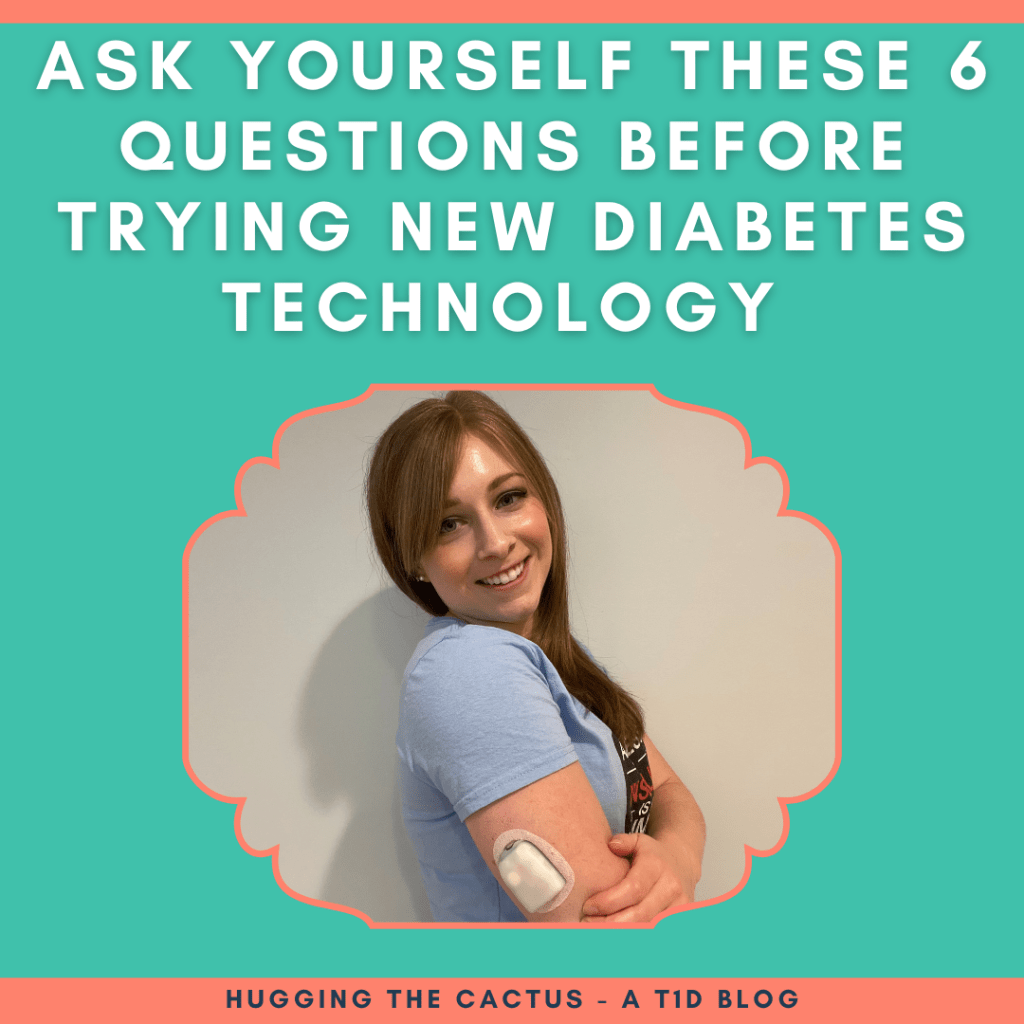
So you want to try your first continuous glucose monitor. Or maybe you’re ready to leave behind multiple daily injections and switch to insulin pump therapy. Whichever diabetes device you’re looking to start using, there are some questions you’ll probably want to have answers to before decide that now’s the time to introduce new diabetes technology into your daily routine.
The following is a compilation of the questions that I thought long and hard about (literally for years) and that I wish I’d thought long and hard about before I made the transition to the OmniPod insulin pump.
1.Am I ready for it? It took me 17 years before I decided that I was ready to try an insulin pump. 17 freakin’ years!!! I spent most of that time being too afraid of introducing such a drastic change to a routine I’d had down pat for such a long period of my life. There are times when I wish I’d gone onto my insulin pump sooner, but ultimately, I’m glad that I wasn’t swayed by my family or doctors to go on it before I truly felt ready. By the time I started using my OmniPod, I had the maturity, responsibility, and emotional intelligence that I felt that I needed for an insulin pump.
2. Will I be able to afford it? Obviously, this isn’t a question that I wondered about when I was younger, but it’s one of the first things that comes to mind as an adult on her own health care plan. We all know that diabetes supplies are expensive, and it seems that the more technologically advanced something is, the more money that has to be forked over in order to obtain it. This isn’t right or fair, but it’s a simple truth and an important one to think about before choosing one pump or continuous glucose monitor over another.
3.Why do I want to start using it? I wanted to start using my OmniPod because my mom experienced great success when she started using it. And I decided to get a Dexcom CGM because I fell in love with the technology after undergoing a trial period with my endocrinologist. In both situations, I felt very much in control of my decision to start using these devices and I didn’t really listen to anyone else’s opinions. But I am very aware of the fact that social media and real-life friendships with other people with diabetes can often sway people in different directions. After all, if I saw a post on Instagram from a dia-influencer who was singing the praises of a Tandem T:slim pump, then I might seriously start thinking about switching to it (this has actually happened to me). But the bottom line is to think about the why – will this device enhance quality of life for me? Will diabetes be easier to manage with it? Will it help me achieve my A1c and/or blood sugar goals? Do I need to add something new to my routine because I’m feeling burnt out by doing things the same way all the time? Knowing why I wanted to use an OmniPod or a Dexcom CGM made me feel that much better during the whole process of learning how to use them – I felt like I had clear goals that would help me navigate the integration of these new technologies into my daily routine.
Did you know that Insulet/OmniPod has demo pods that you can wear? They don’t hold insulin or deploy a cannula, but they can give you a good sense of what it’s like to wear a pod on a daily basis!
4. Will I be comfortable wearing it 24/7? This is a big one! Pods, pumps, and CGMs are very visible, and it can be jarring to go from being “naked” to having bumps and lumps underneath clothes that can get caught on doorknobs, chairs, and the like. Personally, the benefits of my OmniPod and Dexcom outweigh something like this which is a bit superficial, but that doesn’t mean it’s not something to think about. But it’s also worth thinking about comfort and what is least painful when it comes to insulin delivery, so that’s why this is an important question to ask.
5.Do I know anyone else using it who can provide feedback from a patient’s perspective? I’ve talked about this before, but I’m not sure when, if ever, I would have seriously considered using the OmniPod if my mother hadn’t tried it first. The fact that we both have diabetes has probably made us a little closer and strengthened our bond, so if there’s anyone’s opinion that I’m going to trust when it comes to something like this, then it’s hers. I can actually remember her first few weeks on the OmniPod – in which she learned a lot of valuable lessons – and how pleased she was with it once a few months with it elapsed. She taught me the ins and outs of the OmniPod when I started to use it, and I’d argue that her advice was more helpful than that of my diabetes educator. So I’d advocate gathering opinions from family and friends (if either is applicable) or the diabetes online community before going on a new diabetes device, in addition to the research component below…
6.Have I done enough research on it? …Like any smart shopper, it’s crucial to really consider all options and research them thoroughly, especially when it comes to the top contender. I definitely did not complete sufficient research before going onto the OmniPod or Dexcom; rather, I trusted that they were just right for me. If I were to switch to something else tomorrow, though, you can bet that’d I’d spend a lot of time scouring the web for every last bit of information on the device so I could make the most informed decision possible.
New diabetes technology can be both scary and exciting. But more than anything else, it can really make life with diabetes much more carefree, and I’m glad that in this day and age there are so many options available to people with diabetes that continue to be technologically impressive
Whether you’re new to using an insulin pump or a seasoned pro, you might be wondering if there’s a time of day that’s most ideal to do a pod/site change.
And I’m here to tell you…there isn’t a one-size-fits-all answer. (Sorry!)
Like many aspects of life with diabetes, the best time to do a pod change will be different for everyone.
However, I do feel pretty strongly about what works best for me, and I can explain why it does. Maybe that will help you or a T1D in your life decide what makes the most sense for your individual situation!
The best time to do a pod or an insulin pump site change will probably vary for most people with diabetes, just like so many other things.
In my opinion, the best time to change my pod is within the 3-hour window after I’ve eaten dinner. Since I typically eat at about 5:30/6 o’clock, this means that I like to change my pod no later than 9 o’clock at night (but preferably sometime around 8).
Here are the reasons why:
I can take my dinnertime bolus using a pod that I know for certain is acting the way it should.
That timeframe is early enough for me to verify that my new pod is acting the way it should before I go to bed.
Usually, I don’t eat much in the evenings after dinner, so even if my new pod isn’t working right, it’s not too big of a deal because it’s not like I’ll be bolusing for mealtime carbohydrates.
When I change my pod at other times of the day, it interrupts other aspects of my daily flow (e.g., my wake-up time or my work schedule).
There’s something to be said for ending my day with a fresh pod and incorporating the pod change into my bedtime wind-down routine.
Of course, I’ve had to change my pod at less-than-ideal times (I recently did a 6 A.M. pod change because I was deliberately wearing my pod for the maximum 80 hours and it was not my favorite way to start my day). Pods fail or get knocked off and I’ve learned to roll with the punches by having back-ups at all times.
But since I know my best time for a pod change, it’s really nice when I can stick with it…because any reliable aspect of life with diabetes is one that makes it ever-so-slightly more tolerable.








 Hugging the Cactus