Comfort food…mac and cheese, cheeseburgers, pizza…and snacks?
Sounds like a unconventional addition to my mini laundry list of comfort food examples, but snacks (of just about any variety) go a long way in making me feel a certain degree of comfort. And this is because of – you guessed it – my diabetes.
Sometimes, diabetes can be totally unpredictable. My blood sugar could be steady one moment and crashing the next, and it’s far more stressful in circumstances where I don’t have food readily available or accessible to me.
So it might sound kind of silly, but one of the many fears and anxieties I had about starting a new job was centered around food. Would I be working in an area that was close to a grocery store or cafeteria, like my last job? Since I wouldn’t have a permanent desk in the office, would there be a place for me to store extra food to have on hand in case of emergency? Was it flat-out ridiculous for me to be so worried about access to food?
Turns out the answers to those questions were yes, yes, and definitely yes.
There’s no shortage of snacks at work, much to my relief.
Immediately, I discovered that my new office building has a full cafeteria located on the first floor that serves hot breakfast and lunch. As if that wasn’t great news in its own right, my office suite has not one, not two, but three kitchens that are available to all staff – and get this, they’re fully stocked with an assortment of beverages and foods, everything from yogurts, chips, granola bars, and Ramen noodles, all the way down to ice cream sandwiches in the freezer.
After I got the full tour of the facilities and learned that I had all of these options around me (without even having to leave the building), it dawned on me just how much of a relief this was. I do my best to be prepared as a person living with diabetes, but mistakes happen, and I’m sure there will come a day that I forget to bring an extra low snack to work or need to purchase a meal at the facilities. I was thrilled to find out that it’s no sweat, should I encounter these scenarios. And I’m really appreciative of that because I understand that not everyone has the good fortune to have these benefits provided to them through their occupation. I can’t help but feel grateful for the snack security I’ve found in this new opportunity!
As anyone who lives with diabetes knows, it’s a condition that dislikes disruptions to a daily routine.
This was one of my main concerns when it came to starting my new job last week. The position is hybrid, meaning that I can work from home and in an office as it suits my needs. The prospect of returning to an office again after more than three years of working remotely positively excited me, but I’d be lying if I said that it also terrified me. I was anxious about my first day back in an office environment (in addition to all the jitters associated with starting a new job), and more than anything, I was worried about how my diabetes would be affected by this change.
This is because I’d settled into a fairly standard routine after all this time working from home. I have a workout regimen, eating schedule, and built-in breaks throughout my day that have greatly benefited my day-to-day blood sugar levels, and I knew that returning to an office setting would prevent me from maintaining these habits.
So that’s why I entered what I’m calling “diabetes hyper-prepare mode” the night before my first day in the office so I could try and think about all the ways my day would differ working in this setting versus my own home. And thus, I came up with these three tips that resulted in a very successful diabetes (and work) day:
Tip #1: Get ready as much as possible the night before. The week that I started my new job, I did my best to recall the routines that had worked well for me when I was regularly working in an office. The first thing that came to mind was the amount of preparation I typically did each weeknight so that I could get out the door as soon as possible in the morning. This included laying out my outfit, making breakfast ahead of time, putting together a lunch, and packing my bag. This extra work the night before really paid off the following morning and meant that I hit the road at exactly the time I had planned to; plus, the food prep worked wonders as I didn’t have to waste brain power in the morning trying to think about what I might eat throughout the day. The food was all set and ready to go, and I knew its carbohydrate contents, which resulted in phenomenal blood sugar levels all morning leading up to lunchtime.
Tip #2: Maintain movement. As it turns out, a 40-minute commute combined with lots of sitting in meetings means that my movement patterns in the office are minimal. I did my best to combat this by getting up a few times throughout the day to explore my new building in 10- or 15-minute intervals. Not only did this give my eyes a break from my dual monitors, but it allowed me to stretch and get familiar with the environment. It also helped to curb my post-lunch upward sloping blood sugar, so it was definitely beneficial to my body and mind to make sure I maintained semi-regular movement during the workday.
Tip #3: Have back-up supplies on hand. When I was packing my bag the night before, I made sure to slip a meter, test strips, and fingerstick device, as well as some fruit snacks, into one of the compartments as I didn’t want to run the risk of something going awry with my CGM or needing a low snack and not having it. Of course, I didn’t experience either scenario in the office that first day, but knowing that I had these items close by went a long way in reassuring me that I was prepared to handle any diabetes scenario that might crop up during the workday. And it turned out to be fodder for reminding me that I should also have an extra pod and insulin in my bag at all times, too – next time, I’ll make sure to bring those items with me so I can have even more diabetes bases covered.
These tips might seem pretty obvious, but I was kind of awestruck by just how weird it felt to be back in an office space after a long hiatus away from one. So I think that following these tips truly did help to ground me so I could stay focused on learning my new job and meeting my colleagues, rather than letting my diabetes take center stage for the day.
As Carrie Bradshaw would say…”and just like that”, another National Diabetes Awareness Month (NDAM) has come and gone.
And yes, I learned a couple of lessons in the past 30 days.
For starters, I learned that my mindset going into NDAM was identical to my mindset at the end of it: Pace yourself. Life with diabetes is a marathon, not a sprint, and it deserves to be treated as such.
I also learned that it’s a whole lot easier to drown out the deafening noise of NDAM online when I choose to be mindful about how much content I consume during the month of November. I kept my focus on everything that pertained to my work at the time, and I decided to remove my personal feelings about social media and NDAM from the equation. That made it so much easier to keep my attention on the specific initiatives I was hoping to accomplish during the month, and I was able to make sure that work stayed separate from anything I shared on my blog.
And finally, this particular NDAM reminded me that you get out of it what you put into it. I could’ve put my heart and soul into diabetes advocacy last month and I’m sure I would’ve gained so much from that experience, but since I had enough self-awareness to realize I just didn’t have the same number of spoons to give this year as I have in years past, I made the conscious decision to cut back. I don’t regret it for a second, especially considering that this extra attention could be placed on my actual lived experience with diabetes and taking extra steps to improve my management. That manifested itself into one of the best endocrinology appointments I’ve had in recent years, and truly, what more could I want out of NDAM? After all, I can’t be the kind of advocate that I’d like to be if I’m not taking proper care of myself…so if the only outcome I have from this NDAM is that I’m finally feeling confident in myself and my use of my diabetes devices, then I have absolutely no regrets about that whatsoever.
This blog post was originally published on Hugging the Cactus onAugust 4, 2021. I’m sharing it again today because I’m starting a new job! I’m thrilled about this new opportunity and as I was planning to make the switch to a new healthcare plan, I found my own advice to be pretty helpful. Read on for all 4 of my tips…
Hi, my name is Molly and I have type 1 diabetes, and although I am extremely grateful for health insurance, I also hate every aspect of it.
When I aged out of my parents’ health insurance plan two years ago, I was completely lost and overwhelmed by choosing my new plan. How much would I have to pay for my supplies? Would everything be covered? Could I keep my doctors? How much money should I put into my FSA? The answers to these questions took me a good chunk of time to figure out, and I only started feeling good about my knowledge of my old job’s health insurance plan in the last year or so.
As a result, the only thing that made me less excited to start my new job was the burden of having to figure out a new health insurance plan. And for good reason, it turns out, because it has been a challenge to say the least. But there are a handful of things I’ve learned along the way that I don’t think I’ll ever forget so that I can have an better experience the next time I need to change health plans. Here are my tips for making the transition from one health insurance plan to another as easy as possible:
1.Take stock of ALL my supplies before starting the new job (and before losing my old job’s health coverage). This was, without a doubt, the best thing I could’ve done for myself before I started my new job. In my last few weeks with my former company, I looked through all of my diabetes supplies and inventoried them. I kept a running list of the most important items (things like insulin, Dexcom sensors/transmitters, and pods) and decided that even if I had plenty of those things, I would still place an order for them before losing my health insurance. This ended up being a fantastic idea because it took me a solid couple of weeks at my new job to figure out which health plan would work best for me, and in that span of time, my supply stash was dwindling. On top of that, it took several more weeks for me to get all my prescriptions straightened away (more on that in tip 3), so I was especially grateful that I had seriously stocked up before leaving my old job.
2.Compare plans extensively. Like I mentioned above, I spent a couple weeks reading through my plan options before I finally settled on one. It took me so long because I wanted to feel 100% comfortable with my new plan, and I knew that I had a 4-week period to complete my research before committing to a new plan. Plus, my new job uses a website that offers a health insurance plan comparison tool (a super cute one, to boot, that explains all things insurance in layman’s terms) that I was happy to take advantage of during the decision-making process.
3. Send as many messages and make as many phone calls as it takes until everything about the new plan is crystal clear. For me, this including calling my local pharmacy and sending toooons of online messages to my doctor’s office, as well as my new health insurance provider. I honestly felt like I was playing a game of telephone – you know, that game that kids play where they have to whisper a message into each other’s ears as a test of listening and communicating effectively – because it seemed that nobody would take accountability for sending my prescriptions to the right place or understanding exactly how I needed help. So in the last few weeks of July (leading into the first few weeks of August, really, ‘cuz I’m still working on this), I made a vow to myself that I’d get to the bottom of everything and get my prescriptions fully straightened away. I’m happy to report I’ve made substantial progress, but I’d be lying if I said it didn’t require a lot of my spare time and energy.
4. Talk to coworkers and ask for their feedback on plans. This might be unique to me because I work for a diabetes organization and my colleagues have an intimate knowledge of health insurance hurdles combined with a chronic illness, but even so, I remember asking coworkers at my previous job about their thoughts on the health insurance offerings and I got some solid feedback from that. So that’s why I decided to ask around at the new job, and of course I was met with helpful replies that made my transition a little smoother.
The biggest lesson I learned throughout this process? I realized I need to give myself a little grace. This stuff isn’t intuitive to anyone (unless you’re some sort of health insurance guru). I shouldn’t beat myself up because the system is more complicated than it needs to be. And bottom line is that I need to focus on the fact that I have choice when it comes to health insurance, period, because I know that there are too many people out there who can’t say the same.
So I guess in a way I am glad for the challenges presented to me by my health coverage.
On the surface, “gratitude” and “diabetes” don’t exactly go together like peanut butter and jelly…but for me, they are natural companions.
Every year since I’ve been a diabetes blogger, I’ve done some sort of post that explains why I’m grateful for diabetes around the Thanksgiving holiday. It’s a nice opportunity for me to take time to reflect and express appreciation for some obvious and not-so-obvious people and things.
Of course, there are a number of repeats year after year, including my family, friends, and partner; my dog, the roof over my head, the food on my plate, and so forth.
But as changes take place over time, additions are made to my list. Here are some new ones for this year:
New opportunities. Yesterday marked my final day working at a diabetes nonprofit. This Monday, I’ll begin a new job and continue my writing/editing career at a company that I’m thrilled to join. I’ve got mixed emotions about leaving diabetes behind professionally, but one thing is for certain – as a member of the diabetes community, I’m excited to continue being an active advocate and supporter of the people and programs that I’ve encountered in the last year and a half.
Access to diabetes supplies. I’ve always taken my diabetes supplies accessibility for granted. I don’t struggle to afford the medications and technologies I use (though it would certainly make my life easier if it was cheaper) and I am fortunate enough to have a solid supply on hand at all times. I know that other people with diabetes can’t say the same: an awful reality, but one that opens my eyes to something I should never take for granted.
Another thing I was grateful to do this past year? Travel to New Orleans for the ADA’s Sci Sessions and be surrounded by literally thousands of incredible people working to make a difference in the lives of people living with diabetes.
Exploring hobbies. I’ve had the wonderful chance in the last year to explore hobbies both old and new. I’ve recently picked up my knitting needles again and have made solid progress on my first sweater in a couple of years. I’ve been borrowing more books digitally from the public library so I can rekindle my love for reading. And I’ve been able to try tons of unfamiliar pastimes that I’ve grown to really embrace, such as volleyball, tabletop games, and even video gaming. It’s been a goal of mine to refamiliarize myself with the concept of down time and using it as a chance to do things that make me happy, and I’m so glad that I’ve leaned into this.
Diabetes itself. Yes, I am thankful for diabetes. Here’s why: I could spend all my time resenting it for (occasionally) making my life miserable. A long time ago, though, I chose to embrace diabetes for what it is. In turn, I’ve learned to be grateful for diabetes because of all it has brought and taught me…friendship, independence, discipline, and so much more. After all, this December 24th will mark my 25th anniversary with it – how could I not choose to find gratitude in something that’s been a part of me for nearly as long as I’ve been alive?
It seems especially significant that my departure from my role at a diabetes non-profit is just before the Thanksgiving holiday, which is a perfect time to express gratitude. So it is with zero exaggeration when I convey how grateful I am for this community, and in turn, for diabetes itself.
This post was originally published on Hugging the Cactus on October 8, 2018. I’m sharing it again today because as I sat down to write a new post, my blood sugar tanked…frustrating the hell out of me by taking away any and all creativity. But it did remind me of the timelessness of this post, and how the emotions of a low blood sugar can be so varied. Read on for more…
Previously, I’ve written about what it feels like to have low blood sugar. While many people with T1D feel the same symptoms as me when they experience a low, there are even more who experience a wider variety of emotions and sensations.
Renza, a T1D Twitter friend of mine, did a little investigating into how others would describe what it’s like to have a low blood sugar. She sent a tweet that read:
#Diabetes friends. I’m crowdsourcing (again). If you had to use ONE WORD to describe how hypos/lows feel to you, what would it be. Go!! #Hypoglycaemia
She received nearly 100 responses, which I’ve compiled into the below graphic.
Looking at this word collage is a bit startling because it represents the vast array of feelings associated with low blood sugar. Most of them are negative. A handful of them start with the prefix “dis”, which describes something with an opposing force. A couple of them relate to feelings associated with eating. And just about all of them can be summed up as sensations that I wouldn’t wish on anyone.
To me, this graphic serves as a stark reminder that diabetes is more than just a chronic illness that affects the body: It affects the mind, too.
Diabetes, diabetes, diabetes! That’s all I hear and think about, all day long, day in and day out…
I risk sounding like Jan Brady from The Brady Bunch with that opening line, but since November 1st, diabetes is THE only thing on my mind – thanks to NDAM 2022 kicking off, among other factors.
That’s why the timing of my latest endocrinology appointment was particularly fortuitous – until I sat down in that doctor’s office, I hadn’t quite realized just how desperately I needed help from my healthcare team. And it wasn’t until we talked through my specific concerns that I realized that I’m actually doing a lot better on the diabetes front than I had assumed…and recognition of that, plus my obvious desire to aim for even more improvement, has gone a long way in changing my attitude.
In fact, you could say that this appointment totally revitalized how I feel about my diabetes lately, and I’m thankful that it happened before I got swallowed up in the throes of burnout.
I went into the appointment hoping that I would gain clarification around my use of the Omnipod 5 system. I started using it a couple of months ago, and from day one, I remained confident that it would revolutionize my diabetes care. That’s only been half true since I started using it, as the immediate and most obvious improvement happened to my nighttime blood sugars. But my daytime levels, particularly after breakfast and lunch, continued to mystify me.
This particular diabetes appointment came in the nick of time.
As I explained all this to my nurse practitioner, she listened without judgment – the first factor that went into boosting my diabetes spirits. What she said next was the second boon, and that was that I wasn’t alone in my struggle to adjust well to the automated insulin delivery. She validated that what I was feeling was normal, and that there were adjustments we could make as a team that would hopefully result in better utilization of the technology.
The third thing she did for me was put me in touch with someone at Insulet who would be able to answer my questions about the algorithm and fill in the blanks about the components of it that weren’t clicking with me. She made this connection for me before the end of our appointment, and witnessing her do so made me feel better about having one less hoop to jump through post-appointment…and goodness knows, when it comes to the admin side of diabetes, any assistance I can get on making phone calls or sending messages is a huge help.
This single, thirty-minute appointment took a huge weight off my shoulders that I’ve been carrying around all summer and fall this year. Of course, there’s still work to be done on my part, and little things like remembering to refills prescriptions are still my responsibility alone. But I’m feeling a lot more confident in my ability to make the progress that I’ve been so eager to achieve, and that alone is massive – and even more special, having happened during NDAM.
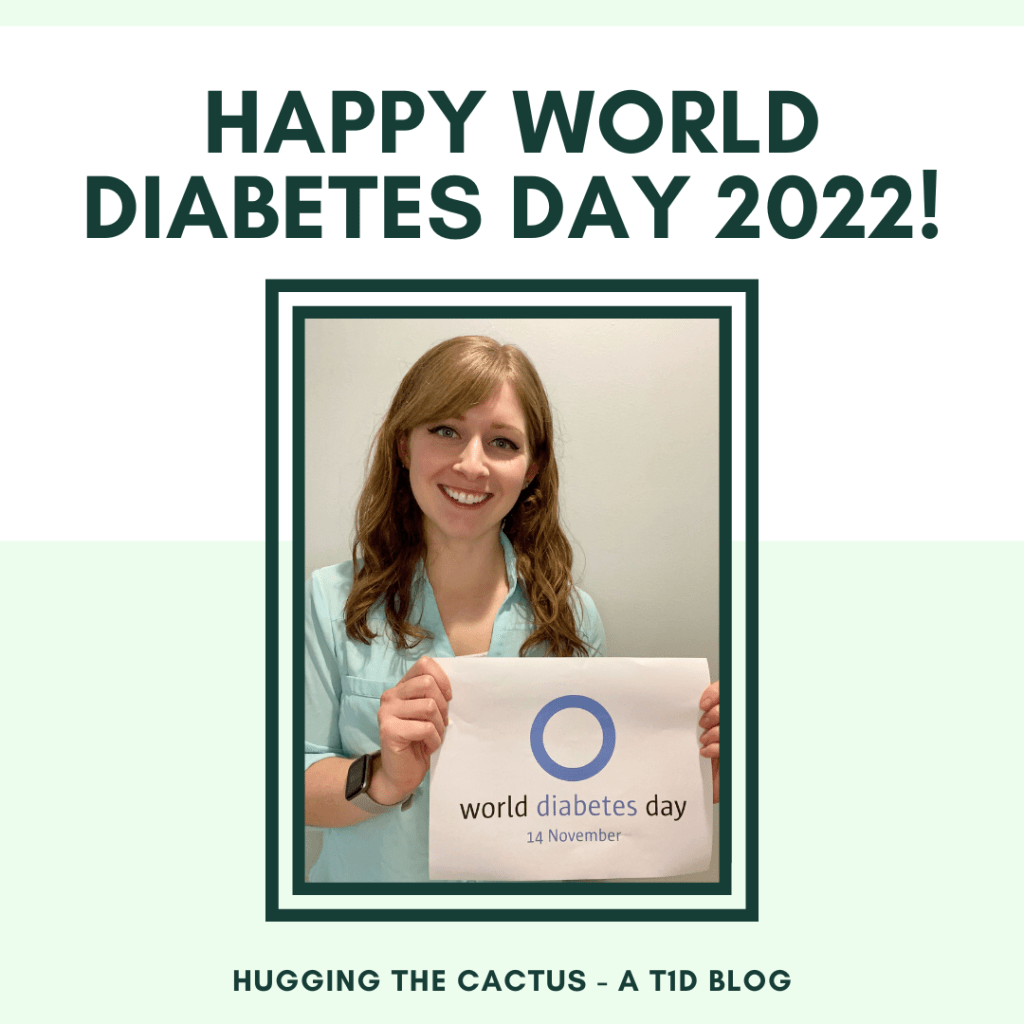
Today is the day – World Diabetes Day (WDD), which also happens to be the birthday of Sir Frederick Banting, who co-discovered insulin along with Charles Best one hundred years ago.
Today is the day to wear blue, the official color of diabetes awareness, and use the blue circle as a symbol of unity within the global diabetes community.
I’m one of the 537 million adults living with diabetes in the world. (Statistic pulled from IDF Diabetes Atlas)
Today, and every day, I (as well as millions of others) do my best to live a life uninhibited by diabetes. It isn’t always easy, but the resilience, knowledge, and support it has unwittingly introduced to me has shaped me into a person who has diabetes, as opposed to a person who is controlled by diabetes.
Today, I celebrate my own strength as well as that of our community, and take time to reflect on this year’s theme: access to diabetes care. I acknowledge my privilege in having an abundance of that, and I am angered when I think about the millions of people around the world who lack it. As I look to tomorrow, and all the days after WDD and NDAM, I greatly look forward to and anticipate the day when medicine, technology, support, and care are all made available to the people with diabetes who need them.
“Pride” isn’t exactly the first word that comes to mind when I think of my diabetes. In fact, a whole slew of other nouns and verbs top my list of words that I associate with diabetes, including but not limited to: strength, resilience, acceptance, guilt, anger, worry, identity…
But I’m not writing this post to focus on those other words – pride is the one I want to talk about here, and I want to explain why I’m proud of my diabetes story.
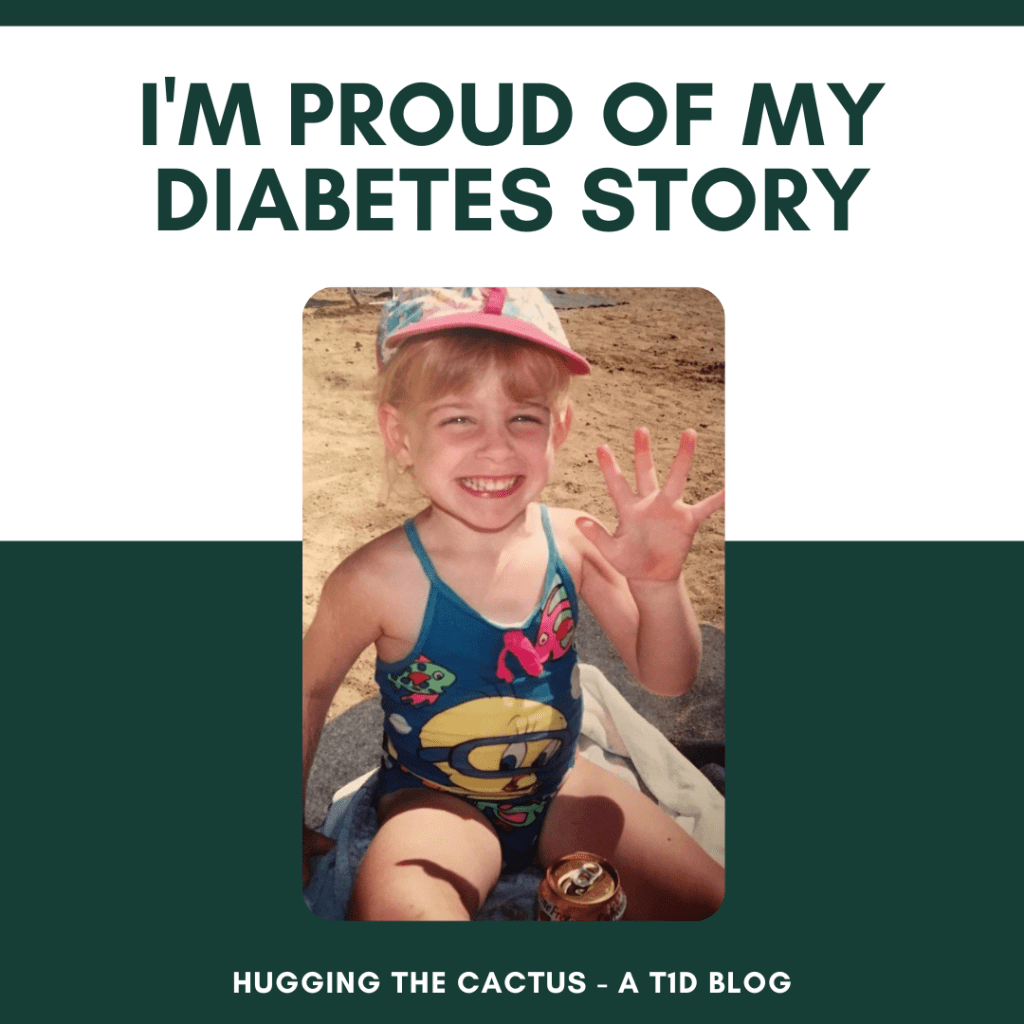
You can’t tell that the little girl (me about 23 or 24 years ago) in this picture has type 1 diabetes. The only clue, perhaps, is the Diet Coke can you can just barely see.
Diabetes has always been part of my life; actually, from the moment I was born. This is because I have family members who live with type 1 diabetes, just like me. I don’t really remember what life was like before my own diagnosis, and I’m grateful for that because I never felt like it made a dramatic disruption (well, besides for making its presence known within my body on Christmas Eve, but I was four years old at the time and the holidays were definitely never soiled for me because of diabetes).
As I reflect on what it was like to grow up with diabetes, I also find myself appreciative of the fact that I’m hard-pressed to find any actual evidence of it besides doctors’ records. I’ve flipped through my parents’ photo albums countless times over the years and there’s not one photograph of me laying in a hospital bed, injecting myself with insulin, or showing any signs of diabetes except for maybe the stray Diet Coke can or blood sugar meter in the background of a picture. That’s just further proof that my diabetes was never the focus, it was more so about me living and experiencing a totally normal, loving childhood.
All that makes my sudden entrée into the diabetes community, beginning in my young adulthood, that much more surprising. The transition from living under my parents’ roof to suddenly being on my own in college was, in a word, jarring – so peer support was crucial for me in order to navigate this change successfully. It didn’t happen overnight, I had heaps of help along the way, and it was far from easy, but in my mind I’ve done a good job of handling my diabetes and all the responsibilities that come with adulthood in the last decade.
And that’s what I’m proud of. I’m proud of myself for getting to this part in my journey, the part where I feel well-equipped to live a life uninhibited by my diabetes. I’m proud that I’m able to talk about my diabetes experience with a sense of confidence and capability. I’m proud that I’ve learned how to advocate for myself in various settings, whether it’s with my healthcare team or in the workplace. And I’m definitely proud of myself for the way I talk about my diabetes story: It contains chapters that are unfiltered and authentic to me, and I think that they illustrate how I came to accept my diabetes long ago and use it as a source of courage in my daily life.
I hope that other people with diabetes can also find a similar sense of pride in their own experiences with this chronic condition.
Well, we’re (somehow) officially one week into National Diabetes Awareness Month (NDAM) 2022 and I’ve got to say…I’m feeling particularly aware this year.
Aware of the sheer scope of people affected by diabetes.
Aware about the amount of work that still needs to be done to defeat diabetes stigma.
Acutely aware that insulin and other necessary diabetes medications and supplies are too expensive and need to be more affordable/accessible to all.
Aware of how all the work (including but not limited to advocacy, peer support, and individual management of the condition itself) is done 24/7, 365 – not just during the span of one month.
You could say this makes me overly aware of the weight and significance of NDAM; and while this is certainly true, it’s also totally accurate that NDAM – and life with diabetes itself – is a marathon, not a sprint.
NDAM/life with diabetes is a marathon that requires proper pacing.
Thank you to a tweet by Mike Durbin that I saw on the first of the month for reminding me of this.
I agree with Mike’s advice to pace myself throughout NDAM, to get involved as I see fit, and to take a break if and when I need it. To an outsider, these words of wisdom may seem obvious, but to someone like me who lives with diabetes, works in diabetes, and immerses herself in the diabetes community, they ring particularly loudly and clearly during this chaotic period that has no shortage of spirit, heart, and good intentions.
So for the next 21 days, I’m excited about plugging away on my marathon’s path, and happy to take breaks here and there for myself so I can cheer on and support everyone else who’s on this journey with me.




 Hugging the Cactus