Blood glucose meters serve the sole purpose of checking current levels of glucose in the blood. Pretty self-explanatory, right? And it’s equally obvious that it’s crucial for all meters to generate accurate results so PWD can make the right treatment decisions based on those numbers.
Unfortunately, though, accuracy isn’t always what I get.
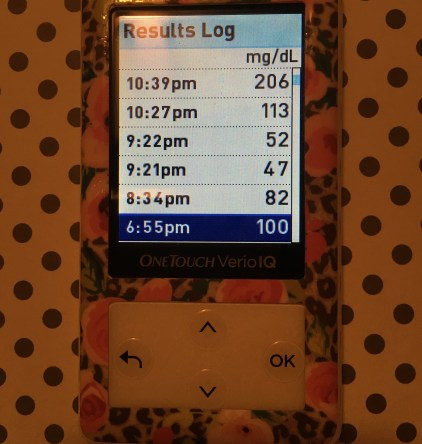
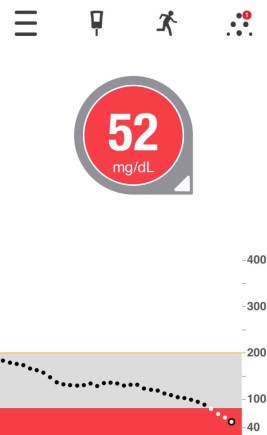
The other day, I was running low before bedtime. I corrected with an organic rice crispy treat (honestly, it was a million times better than the brand name kind). I waited nearly an hour for my blood sugar to come up. When my CGM wasn’t showing any progress, I tested: I was 47. It’s rare for me to be that low, so I tested again. 52. I believed it, especially since I was experiencing several hypoglycemic symptoms.
My unicorn bg quickly turned into A Situation.
I chugged a glass of orange juice and plopped down on the couch to wait for signs of improvement. Before long, I was freezing cold – a sure sign I was coming up, because I had been sweating 20 minutes prior. But I didn’t feel comfortable going to bed yet. I wanted to see if my CGM would show an up arrow. When it finally did, I made my way upstairs to brush my teeth and wash my face. In the middle of my routine, though, I decided to glance at my CGM again – and saw the dreaded ??? screen.
I decided then that the Dexcom should be out of commission, a.k.a. not trusted at all, for the remainder of the evening.
I ripped it out and inserted a fresh one, not really caring that it would wake me up in two hours to be calibrated. I would need to set at least two alarms for the middle of the night, anyways, if I decided to go to bed disconnected from my Dex. So it just made sense.
Once that was done, I tested again. I was pretty tired at this point and really didn’t want to have to eat something else, so I did it as quickly as I could. In my haste, I jostled my meter just so – enough that I saw the test strip, already marked with my blood, move slightly as it brushed against my PDM and was placed next to it.
113 mg/dL flashed upon the screen. Normally, I’d be thrilled! But I furrowed my brow. Something just felt…off about that reading. So I tested again.
206.
What?!
I tested a third time – 203. Okay, something was definitely wrong. Either that 113 was wrong (likely) or my meter had just produced two wildly inaccurate blood sugars in a row (less likely).
This is one of the many times that it’s convenient to live with another PWD. I asked my mom if I could borrow her test kit and see what result it generated. Seconds later…a twin 203 popped up on the screen, reassuring me that the 113 was a fluke on my meter.
Relief with the reality and irritation with the technology washed over me simultaneously as I went to correct the high with a bolus. I was glad I wasn’t heading down again, but irked that my meter had failed me. True, it was a bit of human error there, but aren’t we at a point in technological advancements where this sort of thing just shouldn’t happen? I put my life into the “hands” of my meter, Dexcom, and OmniPod. They should produce results that are undoubtedly accurate.
Okay, this isn’t a real blog post. But this is a very accurate representation of my diabetes lately. It’s like a moody teenager, filled with sudden ups and downs and likely to sour the mood of everyone around it.
Hey, diabetes? Get it together? Pretty please, with sugar-free sprinkles on top?
Call me crazy, but sometimes, I find myself staring at my Dexcom app in anticipation of catching the numbers changing.
It might be because I’m hoping for a change (coming down from a high, coming up from a low). Or it could be because I find a strange satisfaction in receiving real-time data of my blood sugar levels. Whatever, so be it: I’m a diabetes nerd!
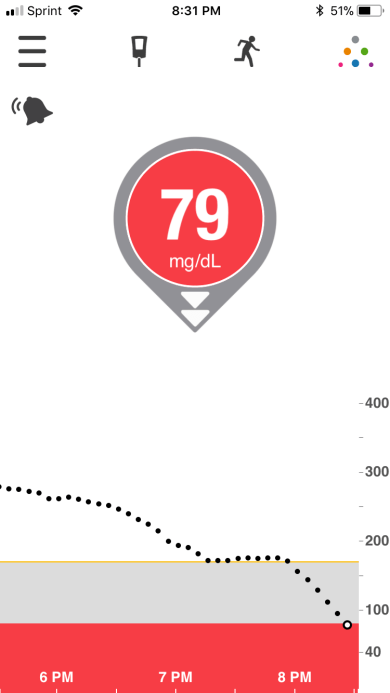
Watching the 3 point drop…
…brought me a bizarre sense of delight.
I remember this particular example bringing me happiness, because I’d been hovering pretty close to my high limit (170 mg/dL) for a couple hours. So watching that three-point shift happen reassured me that I was going to come down. And sure enough, 15 minutes after capturing these screenshots, I was going down closer to my target of 100.
When it comes to diabetes…it’s the little things, right? Am I the only one who likes monitoring my CGM this closely, every once in a while? Or am I just weird?
One Monday per month, I’ll take a trip down memory lane and reflect on how much diabetes technology, education, and stigma has changed over the years. Remember when…
…Dexcom CGMs made their debut?
It was just over ten years ago that the Dexcom SEVEN CGM System launched. I didn’t actually know more about it, though, until a couple years after the fact. That was when my endocrinologist encouraged me to sign up for a week-long trial run with this new technology to see how I liked it.
Then: The Dexcom SEVEN CGM System
I didn’t like it, I LOVED it. I quickly became obsessed with the ability to monitor my blood sugar levels at all times. But it’s funny to think back to how bulky and just plain different that first-generation system was compared to today’s sleek and highly functional models.
A few key differences between now and then:
Size. The first CGM was large. It was roughly the size of my OmniPod PDM, which might not seem so significant, but it is when measured up against newer CGM models.
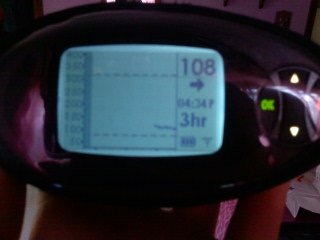
Display. The screen on my first CGM was very simple. No colors, no frills – just readings of my blood sugar. That was all fine, but I have to say that I’m a fan of color-coordinated blood sugar reports (red for low, yellow for high, gray for in-range numbers). In a weird way, it motivates me to keep my graph as gray as possible.
Distance restrictions. I hated that I had to keep my first CGM so close to me at all times, or else run the risk of losing data! It was hyper sensitive and my readings would be lost if I left the same room as the CGM for more than a couple of minutes. My CGM is now able to pick up readings from much farther away – sometimes, even when I’m downstairs and it’s upstairs.
Sounds. My memory is a little foggier on how the sounds compare between old and new Dexcom CGM generations, but I do recall the beeps and vibrations being far more aggressive and annoying on older models.
Smartphone access. This might be one of the biggest and best changes – the ability to download an app on your smartphone that can replace a Dexcom receiver. How awesome is that? Plus, if you choose to do so, you can invite family and friends to monitor your blood sugar along with you, which can be helpful in certain situations. Cell phones are so ingrained into society, so this move was brilliant on Dexcom’s part.
Now: Dexcom data, on my iPhone!
All these improvements have made me a member of Team Dexcom for life. It’ll be neat to see what they come up with next to help make the lives of people with diabetes easier and better.
A few days ago, I wrote about what it’s like to prepare for travel with diabetes. It may have surprised you to learn how many steps are involved! But the work doesn’t end when en route to the destination…
It doesn’t matter if I’m going to be stuck in a car for several hours, flying on a plane, or – my worst nightmare – waiting in the airport for a delayed flight: There are additional steps I like to take when traveling to help ensure my blood sugar is steady and I’m adequately prepared with my supplies.
At the airport…
…with my bag o’ tricks (diabetes supplies)
These steps include:
Checking my blood sugar often. I don’t like to rely completely on my CGM; after all, it can be inaccurate from time to time. So I tend to perform more blood sugar checks than usual while I’m waiting at the airport or sitting shotgun in a car. But if I’m the one driving, I (obviously) wait to check at rest stops as time allows.
Seeking healthy snacks. It’s definitely easier for me to find healthy options when I’m on a road trip – I can simply pack meals and snacks ahead of time. The airport is a little trickier for me, though. Sometimes, I’m tempted by candy or chips – comfort foods – because I’m not a huge fan of flying and like to do anything to take my mind off it. Luckily, though, even if I don’t make the healthiest choice, everything I’m consuming does have a carbohydrate count that’s easily accessible. This helps me take the correct insulin dosage and removes some extra thought from the process.
Getting as much movement in as possible. If this means taking laps in an airport terminal, so be it. I know that my diabetes responds well to exercise throughout the day, but it’s next to impossible to get movement in when cooped up in a car or plane. So what if I look kind of weird at a rest stop doing jumping jacks next to my car? At least I know I’m doing my body some good.
One thing I’d like to note is that the airport comes with some added fun: the TSA!!! (Insert sarcasm here.) That means I also have to be prepared for going through security. Some PWD have reported terrible experiences with the TSA, which is why I’ve devised a protocol for myself when traveling so I can (hopefully) avoid a bad interaction.
This plan consists of:
Having my ziplock bag of diabetes supplies at the ready in my carry-on in case I’m asked to remove it,
Telling the TSA agent conducting the body scan that I have T1D, and pointing out the locations I’m wearing my pod and CGM sensor,
Knowing that I’ll probably be asked to touch my sites (over my clothing), and
Allotting for the extra time it takes to get my hands swabbed.
So far, so good with this little strategy of mine. I’ve found that it works best to stay cool, calm, and collected throughout the whole TSA process. It’s a miserable one at best, but I might as well not exacerbate it by getting in a panic about my diabetes supplies.
After all that, what do I possibly have left to do once I actually arrive at my destination? Be on the lookout for my third and final post in this little series of travel procedures – but certainly not my last on traveling with diabetes, in general!
Not too long ago, I was fondly reminiscing about my college days. So many stories, so many of them related to diabetes in some manner. But this one that I’m about to share is one of the funniest, most cringe-worthy stories. Hopefully, you’ll be delighted by my awkward adventure:
It was the night of the “senior ball”. This was a dance held at the Mullins Center at the UMass Campus for graduating seniors. I was particularly excited to attend mine, because it presented me with an opportunity to see all of my college friends again. Technically speaking, I didn’t graduate with them – due to extra course credits and an overloaded schedule, I was able to graduate one semester earlier than the rest of my friends. This means I last hung out with the group in December; fast-forward to May, and it had been nearly five months since I last saw my crew.
So this meant we had to celebrate! As I got ready at my friend’s apartment, we caught up on each others’ lives and drank some wine. By the time we were ready for the grand ole ball, we were feeling more than ready to dance the night away.
Drinking and diabetes: Things can get a little…dicey, when celebrating special occasions.
And we certainly did. We spent several hours that evening taking pictures, laughing with friends, snacking on appetizers and sipping more wine. And in the middle of it all, my Dexcom CGM somehow managed to vanish from my purse’s strap. I didn’t realize this until I needed to check my CGM to stay updated on my blood sugar, so I had no idea how much time had passed between then and when I lost the CGM.
What I do know for sure, though, is that I instantly panicked when I discovered it was gone. I rely heavily on my CGM when I’m at an event like this. It’s really useful for me to stay alert of how I’m trending, especially when I’m drinking alcohol. Typically, I know what to expect in terms of my blood sugar when I’m imbibing in different kinds of alcohol, but having my CGM handy makes me feel more secure.
So that’s why I freaked out. How the hell was I supposed to find my CGM in the Mullins Center? For context: It’s an arena that can hold almost 10,000 people. There weren’t quite that many attending the ball, but there were enough bodies in there to guarantee that searching for my CGM wouldn’t be easy.
I admit it, I was a little tipsy, so that definitely didn’t help in the situation.
After telling my friends what happened, and a brief group effort to search for my CGM, I knew I needed more manpower. So I found a police officer and told him what was going on. Once he found out I was a diabetic, he sat me down in a chair – he must’ve been afraid I’d pass out or something – and he assured me that we’d locate it by the end of the night. He struck up conversation with me while we waited for news from the other officers who were on the case. I had nothing else to do, so I gamely chatted with him.
I have no idea how much time passed. It could’ve been 20 minutes or 2 hours, but in a matter of time, my CGM was found. I jumped for joy when it was returned to me, cradling it in my arms. Meanwhile, the police officer seemed kind of bummed. He took something out of his pocket – a card – circling a number on it before handing it to me. “That’s my number,” he said, “just in case you need me again.”
I took it, nonplussed, and thanked him for his assistance. He nodded, and watched as I walked away to rejoin my friends. We all walked home and passed out soon after, exhausted from the fun but chaotic night.
The next morning, I woke up and rummaged through my purse to get my meter and CGM so I could do my first BG check of the day. As I looked through, I found a card in my bag – the cop’s card. I chuckled out loud, explained what happened to my friends, who laughed riotously as I relayed my interaction with him the night before.
“Molly, face it – you got hit on by a cop while you nearly had a medical crisis.”
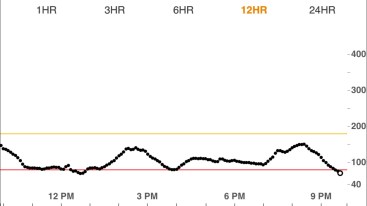
It’s not easy to figure out the insulin-to-carb ratio and basal rates that work best for you. In fact, it involves commitment, communication with your diabetes care team, and solid carb counting skills. But the work is so, totally worth it, because your blood sugar readings can look like this:
These 12- and 24-hour graphs were the result of me kicking it into high gear with my diabetes management in recent days. I can’t explain how awesome it felt to achieve graphs like this. Yes, I dipped a little lower than I would have preferred a few times, but the main accomplishment here is that I avoided the sticky highs that were frustrating me in the afternoons and in the middle of the night. Just looking at those smooth, nearly straight lines overnight brings a smile to my face.
I’d like to note that I did this WITHOUT making any special changes to my diet. In a single day, I ate fairly high carb for a PWD: around 30 grams of carbs at breakfast, another 30 at lunch, and between 40 and 50 at dinner. And depending on what my blood sugar is before bed, I’ll have another small snack, between 10 and 15 grams of carbs. So I think the main factors at play that lead to these beautiful graphs are 1) I bolused for my meals 10-20 minutes before eating them, 2) I ate the right balance (for me) of carbs, fats, and proteins, and 3) My insulin-to-carb ratios are spot-on at this time.
As long as I continue to put forth the right amount of effort, I think I’ll continue to have graphs like this. Of course, I know I’m going to slip up from time to time – occasions during which meals are a little more difficult to predict, or periods in which I experience higher stress levels – but this is okay. I constantly remind myself that diabetes is not something that can be completely tamed, no matter how hard I try. I accept that mistakes will happen along the way, and the best thing I can do is to learn from them to avoid making the same ones in the future. This acceptance, combined with perseverance and a willingness to always learn more about how my body reacts to certain foods and events, will help me meet my blood sugar goals on a more regular basis, which makes it an incredibly worthwhile pursuit.
I rolled over onto my stomach and groggily opened my eyes. I checked the time – 1:30 A.M. I felt beads of sweat form on my forehead and back. I kicked my blankets off my body just as I heard my CGM vibrate: five urgent, successive buzzes, a grating sound. I knew what it meant without looking at the screen. My blood sugar was low, and I had to do something about it.
Low blood sugar is never fun, but especially when it happens in the middle of the night.
Blindly, I groped around in the dark, my arm hanging off my bed as I searched the floor for my purse. Once I located it, I rummaged through the inside, looking for a miniature box of raisins that I knew would boost my blood glucose up. I found them and ate them quickly, sitting upright in bed. As I chewed, I registered the sensation that occurs once in a blue moon with these middle-of-the-night lows…
…Raging hunger.
It’s that feeling that you have when your blood sugar gets below a certain point.
That feeling of utter starvation.
That feeling that deprives you of good common sense.
That feeling that forces you to get out of bed, even though the rational part of your mind just wants you to go back to sleep.
Damn it. I’ve succumbed to it, again.
It’s not like this happens every time I have a low at ungodly hours of the morning. In fact, it probably only happens to me four or five times throughout the year. Maybe because I fight against it so hard, since I know that it’ll lead to nothing but high blood sugar and regret.
These thoughts cross my mind, but it’s fleeting. I make my way down the stairs, pausing to grab my bathrobe to keep me warm (the sweating will stop soon and it will be replaced by nonstop chills). Hey, at least I have enough logic at this moment in time to remember the BATHROBE of all things!!!
I turn the light on in the kitchen, blinking rapidly to clear the sleep from my eyes. And then I raid the cabinets.
Fistfuls of Smart Food popcorn are devoured one minute, and in the next, I’m swallowing spoonfuls of crunchy peanut butter (my dear, delicious vice). I take a pinch of Parmesan from the fridge and a tiny tower of Toasteds crackers to complete my smorgasbord. I wash it all down with sparkling water and remove myself from the kitchen before I can do any more damage.
I don’t know what’s more sad – the fact that I gave in to these carnal hunger pangs even though I knew my blood sugar would be fine after having the raisins, or that my snacking was absurdly out of control for 1:30 in the morning. Truly, the knowledge that I must’ve consumed close to 400 calories – roughly how much I eat at lunchtime each day – was disgusting to me.
I could blame it on my lack of self-control. I could blame it on the early morning hours and my sleepy state. I could blame it on the peanut butter for being so addicting.
But instead of beating myself up for a snack attack in the witching hours, I’ll just accept it happened and blame it on the hypoglycemia for striking me when I was vulnerable. It happened, it’s over, it’s time to move on and try harder next time.
It all started when I realized my Dexcom CGM wasn’t holding a charge. It went from needing a charge twice a week to practically every day. I knew this wasn’t right, so during the first week of July, I found myself reaching out to Dexcom support to see how I could go about getting it replaced.
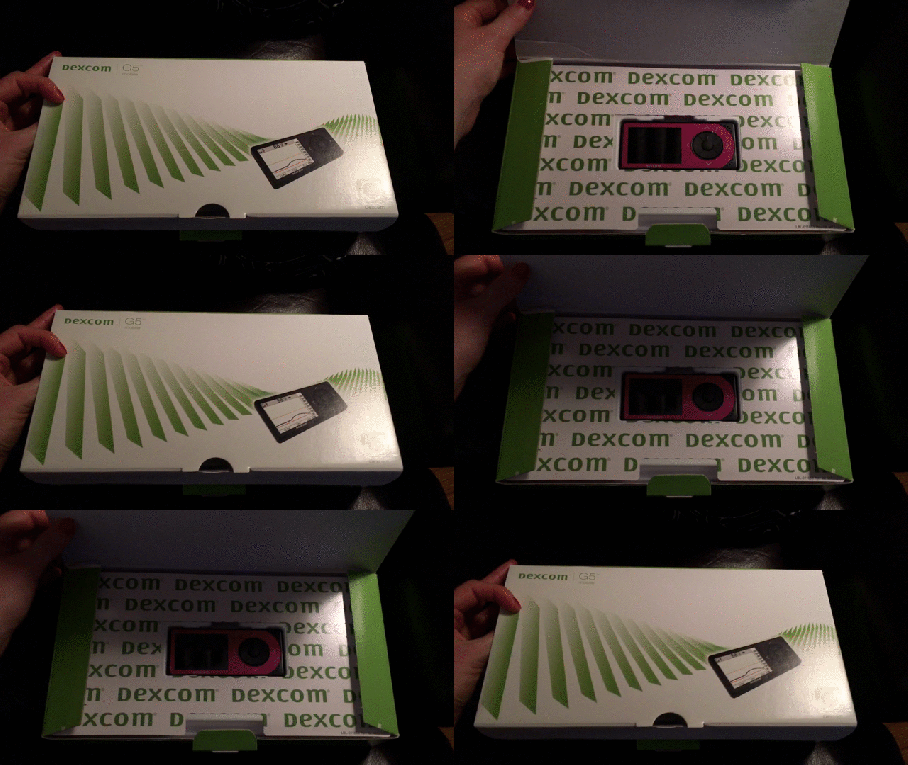
Three months later, I finally have my new Dexcom G5 CGM.
Of course, it shouldn’t have taken most of July, all of August, and part of September for me to get my new CGM. But it did, and resulted in my mother spending hours on the phone with Dexcom and our insurance provider on my behalf as well as countless communications exchanged between me and my endocrinologist’s office.
What was with the holdup? There were a few factors at play here, which is why I thought it was important to share this ordeal with you all. That way, if you or a loved one encounter an issue like this in the future, maybe you can learn from my mistakes and get your CGM sooner rather than later.
At last, my new (pink!) Dexcom has arrived.
Factor #1: The CGM was out of warranty. Normally, I would’ve had it replaced much faster if my Dexcom drama happened within one year of initially receiving the device. But I’d been using the same receiver (the handheld component of the CGM that displays blood sugars in real time) for like…four years. That was issue number one because Dexcom can’t do anything about products that have an expired warranty. Now, I know to get in touch with them every year to get a new receiver and to ensure that I’ll always have one that can be replaced.
Factor #2: My medical supply providers have changed recently. This one’s a bit out of my control, but a couple years ago, Neighborhood Diabetes was divested and sold to Liberty Medical. This meant I wouldn’t receive my sensors or any other CGM supplies from Neighborhood, like I had for a few years. So from then until now, I was getting my sensors from Express Scripts, which also ships my insulin to my home. But for other reasons, my mom and I discovered back in August that we would need to use Better Living Now to supply my Dexcom sensors. Getting confused yet? Yeah, this all went over my head, too. I’m extremely lucky that my mom helped me out and solved this confusing insurance situation.
Factor #3: Communication was poor. And I have to take some blame here, because I should’ve been checking the inbox that my endocrinologist’s office uses to communicate with me. I missed a couple of messages sent by a nurse at the office, and when I did finally see them, I was in a rush to reply and didn’t read his messages as thoroughly as I should have. This resulted in, I’m sure, frustration on both ends as we tried to explain what was going on to one another. There’s a reason why people say that communication is key, and I bet we would’ve had answers a little sooner if we had been on top of things.
That’s the story, in a nutshell and without getting too much into the insurance side of things. I’m just relieved that I finally have my new CGM, and it works great. It’s pretty cool to see my blood sugars displayed on my iPhone, too, using the Dexcom app. And I’m pretty grateful that I have an awesome mother who really came through for me, as well as an endocrinology team that was willing to bear with me through all this Dexcom drama.








 Hugging the Cactus