4 Cocktails That Have Little or No Impact on My Blood Sugar

YAY, it’s FRIDAY! *Does happy dance*

In order to “cheers” the weekend’s arrival, I might indulge in an alcoholic bevvy or two tonight.

And if you’re like most people who are curious about my diabetes, you may be wondering…how does alcohol affect my blood sugar?

Remember that it’s different for everyone, but personally, alcohol itself (hard liquor/spirits) doesn’t really impact my blood sugars too much. More often than not, it’s the sugary juices, syrups, and sodas that are found in mixed drinks that are wreaking havoc on my levels. That doesn’t mean I don’t allow myself to have a carb-o-licious margarita or a frozen cocktail (a local bar makes them with ice cream and they’re incredible) from time to time, but I definitely don’t do it frequently because the inevitable blood sugar spike just isn’t worth it.

So what do I stick to instead? I have a few go-to cocktails that play nice with my diabetes:

1 – Gin and tonic. Did you know that diet tonic water is a thing? It is, and it can be purchased by the bottle from just about any grocery store. I love having diet tonic water as an option because it eliminates the carbohydrates that are found in regular tonic water. This means that any carbs in this cocktail are coming from the gin, and it’s such a trace amount that I don’t need to factor it into a bolus (again, this is just what works for me). All I do is pour my gin and diet tonic water over a tall glass of ice, add a squeeze of lime juice, and enjoy knowing that I’ve created a nearly carb-free cocktail.

2 – Rum and Diet Coke. People always seem surprised when they see me drinking rum because of the connotation that it’s a sugary spirit. But I’ve never noticed rum impacting my blood sugar more than any other spirit such as bourbon, scotch, tequila, or gin. So when I’m leaning towards something that’s on the sweeter side in terms of taste but not heavy on carbs, I’ll go with a rum and diet coke.

4 Cocktails That Have Little or No Impact on My Blood Sugar
Raise a glass to the weekend…and to drinking *safely* with diabetes!

3 – Whiskey on the rocks (or mixed with diet soda). This is pretty bare-bones in terms of mixology, but I’ve found that I can’t go wrong with this simple combination when I’m in the mood for something to sip slowly and enjoy. Whiskey purists might disagree with how “on the rocks” I tend to get, but I like whiskey best when it’s as cold as possible and, truthfully, a little watered down. But ice or no ice, I know that whiskey won’t make my blood sugar budge, which makes it a-okay in my book.

4 – A glass of wine. Okay, so this isn’t technically a cocktail, but it’d be very remiss of me to exclude wine from this roundup. Not only am I a big fan of whites, reds, and bubbly alike, but it just so happens that wine gets along very well with my blood sugar. The only time that I run into real trouble is if I’m drinking something super sweet like Moscato (which is rarely, if ever, because it’s waaaaay to saccharine for my tastes) or mixing the wine with something (such as Prosecco and orange juice for a mimosa). Otherwise, I know that a glass (or two) of most wines is the perfect way for me to unwind without it having a negative impact on my blood sugar.

To wrap up this particular post, I’m including a few links from Beyond Type 1 below about drinking and diabetes. I’ve found that this topic in general invites a lot of questions, so the resources on their website can help address some of the trickier ones. Remember that if you have diabetes, make sure that you go about it safely if and when you decide to drink alcohol (and if you don’t, that’s perfectly okay, too)!

How much alcohol and what type is best with diabetes?

Why doesn’t glucagon work with alcohol?

Why and how to adjust your basal rate when drinking

The Alcohol and Diabetes Guide


5 Reasons Why I Took a Break from Continuous Glucose Monitoring

I’ve decided to take a break from continuous glucose monitoring. This means that for an undefined period of time – maybe 3-4 days, a week, or a few weeks – I’m not going to wear my Dexcom G6 CGM.

Initially, I wanted to give myself a break because I was just burnt out from wearing it all the time and feeling so dependent on it. But as I started thinking about more, I realized that there were some other really great reasons for me to take a break from my CGM:

1 – I wanted to wear one less device. It can be tough to wear two medical devices 24/7. Sometimes I get super self-conscious of them. Other times they just aren’t comfortable to wear, such as when I roll over one the wrong way when I’m sleeping at night. So it’s nice to feel a little more free with one less device stuck to my body at all times.

2 – I was sick of the constant data feed. All those alarms going off whenever I cross my high or low threshold are straight up annoying!!! I know I could just turn them off on my CGM receivers, but the point of them (for me) is to try to maintain as tight of a control on my numbers as possible. But now that I’m intentionally not wearing my CGM, I’m realizing how much I appreciate the reprieve from all that buzzing and beeping.

Pink Minimalist Kindness Quote Instagram Post
There’s lots of reasons to take a break from continuous glucose monitoring, but sometimes one is enough.

3 – I have some new blood glucose meters to try. The only way that I can really put my new meters to the *test* (lol) is to use them – and goodness knows that I have very little desire to do manual finger stick checks when I’m wearing my CGM.

4 – I’d like to hold myself more accountable. I rely on my Dexcom heavily at all times. I look to it before I start exercising, before I eat something, before I do anything, really. I bolus using the data it provides and trust it implicitly. But I’ve recognized that by developing this habit, I’ve become lazy. I don’t measure out food as much because I figure that if I bolus too much or too little for it, I can just watch what my Dexcom tells me and treat from there. It’s kinda sloppy, in my humble opinion, so I’m trying to put more of the trust back in myself for my diabetes monitoring.

5 – I’m trying to reacquaint myself with my body’s cues. Before CGM technology, I was really good at recognizing high and low blood sugar symptoms…but then I started using a CGM and found myself reacting to highs and lows (e.g., treating them prematurely), even if I didn’t feel those high/low symptoms. So I want to retrain myself so I can make sure I never lose that ability, because I think it’s important to know exactly how my body alerts me to various blood sugars, rather than depending solely on a piece of technology to do it for me.


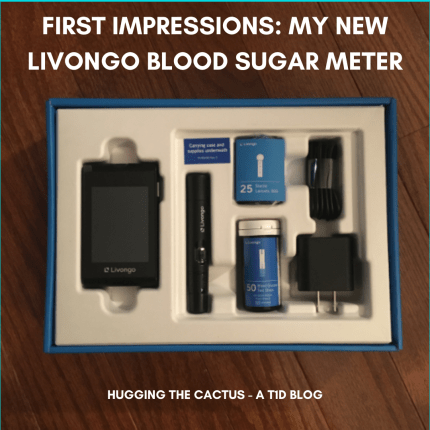
First Impressions: My New Livongo Blood Sugar Meter

I shared that my company is offering a sweet new benefit for its associates with diabetes: a free blood sugar meter with free refills on test strips and lancets as the need arises.

Great perk, right?!

Naturally, I took advantage of this offer as soon as I could, seeing as I was eager to start playing around with a new meter (I talk about the reasons why in this blog post).

While I waited for my new meter to come in the mail, I did some research on it. I was excited to learn that it would be a back-lit, full-color touchscreen. It looked sleek and modern, and I was impressed that it seemed to have a lot more features compared to my blood sugar meters of yore (I still remember having to use a giant droplet of blood and waiting an entire minute for my blood sugar results to appear on a very clunky screen…oh, the 90s). I couldn’t remember the last time I was so pumped about a new piece of diabetes equipment – my anticipation for this Livongo meter was hiiiiiiiigh.

First Impressions_ My New Livongo Blood Sugar Meter
Here she is – my new Livongo meter which I’ve dubbed Livi. Because what else would you call it?!

So when it arrived, I eagerly checked out all of its features. It is, indeed, a well-designed meter – though a bit heftier than I was expecting. Maybe I’m too used to the lightweight nature of my Verio IQ, but this Livongo meter almost feels like a chunky smartphone. It’s not as big as my OmniPod PDM, but it’s in that neighborhood.

I was more so surprised by the test strips – they looked and felt huge compared to my Verio strips! They reminded me of the test strips I used in the first few years of my diabetes diagnosis.

I admit that I didn’t have the patience to read through the instruction manual, I just jumped right into my first blood sugar check. After all, once you’ve used any one type of meter, it’s pretty easy to figure out how the rest of ’em work: insert a test strip, prick a finger, swipe blood onto the strip, and wait for results.

That’s exactly how this meter works, with one caveat. Once I inserted the test strip into the machine, I got a message that notified me the machine was “checking” the test strip. Uhh…checking for what, exactly? I’m not really sure, but the “check” took about 3 seconds before a soft-pitched beep let me know that I could put my blood onto the test strip.

So I did, but I was mildly bemused by the actual amount of blood the strip needed – it felt like it needed more than my Verio strips. I have no idea if this is truly the case, but there is distinct design difference between the strips beyond the hardiness of the Livongo strips, which are not only at least double the size of Verio strips but also feature a vertical line for the blood sample rather than a horizontal. It’s slightly trickier to get just the right amount of blood onto the strip, and I admit that I’ve wasted 2-3 test strips at a time with the Livongo machine so far because I was unsuccessful in getting enough blood on the strips.

Anyways, once I applied blood to the strip, I noticed that the machine didn’t countdown to my results – it merely informed me it was processing them. My very first check with the Livongo was high, in the 250s, and I was yet again surprised when I received an actual message along with my results.

“Your blood sugar is high. Did you know that exercising after meals can help lower blood sugar?”

(I should note that the meter knew I’d just eaten dinner because once it makes the blood sugar result available, you notify the machine whether or not this result was before/after a meal/snack, and then you let it know how you feel – you can select from a handful of pre-loaded options.)

I was taken aback by the message because, well, of course I knew that my number wasn’t great, and I’ve always known that exercising after meals can help bring blood sugar down. This meter is kind of funny, because as I continue to use it, it populates a bunch of different messages depending on my blood sugar in a given moment. Sometimes I get a “kudos”, other times I get random facts about nutrition like, “did you know that spinach is a great source of potassium?” Maybe if I was a newly diagnosed person with diabetes who didn’t know much about nutrition or ways to improve blood sugar levels, I’d find these tidbits of advice more helpful, but for someone as experienced as me they come across as both funny and judge-y.

Since receiving the meter, I’ve used it to check my blood sugar dozens of times and I’m still formulating my opinion on it in terms of its accuracy, usability, design, and overall appeal. I’ll say this for now: I’m intrigued enough by the meter and its ability to immediately send blood sugar data to a cell phone/computer via Bluetooth. It’s definitely one of the most high-tech blood sugar meters I’ve ever used and the touchscreen does make it kind of fun to play around with.

I plan on making a video to better showcase the actual experience of doing a blood sugar check with the Livongo, and I’ll have a full review available in the coming weeks. Stay tuned!

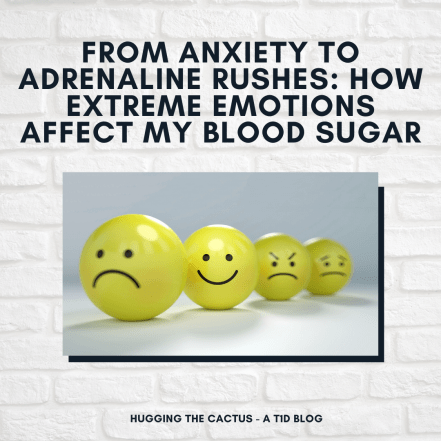
From Anxiety to Adrenaline Rushes: How Extreme Emotions Affect My Blood Sugar

You know that feeling you get in the pit of your stomach when you receive bad news? It’s like your heart falls to the floor and your stomach starts swirling from the perceived sensation.

That’s unpleasant enough on its own, but for me, it can also cause blood sugar issues.

The same thing can be said for when I’m on a literal roller coaster (which doesn’t happen often, but when it does, involves extreme coercion from family or friends) – I get that awful swooping sensation on top of some sort of blood sugar impact.

Every leaf speaks bliss to me, fluttering from the autumn tree.
Do you know how difficult it is to find a picture depicting an adrenaline rush that isn’t a cliche shot of a roller coaster or skydiver? Hence…a slew of moody “smiley” faces.

Whether it’s anxiety, adrenaline, fear, or just a rush of unidentifiable feelings, there’s no doubt about it: Extreme emotions tend to make my blood sugar unhappy by causing it to spike.

I’ve always been somewhat aware of this phenomenon, but I started thinking about it more last week when I got some upsetting news. (I’m okay, please don’t start to speculate on what it was…just a personal matter that I don’t care to discuss in greater detail here. Love y’all for understanding and respecting that.)

Actually, it’s kind of interesting to think about how the sequence of events unfolded last Thursday. I received a message that caused me to instantly panic. I was going to learn the context behind the message about a half hour after I got it, so in the interim, I was pacing all around the house and trying to figure out what exactly was going on. My stomach was roiling, my palms were coated in a light sheen of sweat, and my already-unruly hair frizzed out even more….

…and my CGM trend started going up, up, up, ever so slowly but noticeably.

I didn’t do anything to correct my blood sugar – at least, not right away. I waited until after I heard the specific news that had gotten me so worked up to really pay attention to my rising levels. I probably could have made my high blood sugar less severe by running a temporary basal increase right after I initially freaked out, but obviously, I had other things on my mind than my diabetes at that moment in time.

The whole experience was a stark reminder that food and insulin are far from the only things that impact blood sugar levels. Raw human emotion did that to me, and it will do that to me again in the future.

It sucks, but isn’t it also fascinating to think about how diabetes is totally a physical and emotional chronic condition, in every possible way?

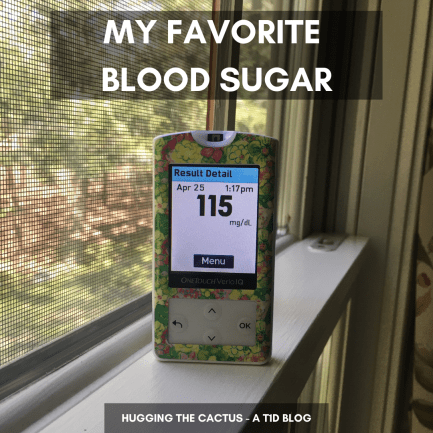
My Favorite Blood Sugar

I have a favorite blood sugar reading. Can you guess what it is?

…Probably not. So I’ll just tell you. My favorite blood sugar reading of all time is…

115 mg/dL.

My Favorite Blood Sugar
Apparently the last time (on record) that my blood sugar was my favorite number was on April 25th – I’m sure I had an especially good day because of that.

I can justify my favoritism for this seemingly random reading, too. For starters, 115 literally contains my favorite number ever, 5. (I think it’s my favorite number because I was born in the fifth month, May, and it’s so easy to count in multiples of 5.)

115 also represents “perfect” stability to me. I’m guaranteed not to feel the shakiness of a low or the grumpiness of a high at this level. At 115, I can most likely even have a small snack (no more than 15 carbs, but still) and not have to take a single drop of insulin for it (given that I’m exercising for at least 15 minutes post-snack-consumption, of course).

Hmm…there’s definitely a pattern going on there with that trifecta of fifteens, but I digress.

A blood sugar of 115 makes me feel…invincible. Almost like I’m the proud owner of a functioning pancreas.


“Real People” Sick

I’m sick. I’ve just got a cold, but my throat and head are aching so much that it’s knocked the wind out of me.

I spent the weekend confined to my bed, only getting up to blow my nose, use the bathroom, and eat something every now and then…not that I’ve had much of an appetite.

I think this is my body’s way of punishing me. It’s trying to force me to slow down, and I have no choice but to heed its commands.

I guess I shouldn’t be surprised…I’ve purposely kept myself as busy as possible in the last month. I’m always involved in something, whether it’s making plans with people, distracting myself with a new pet betta fish (his name is Tyrion and I love him), or crafting up a storm (I’m almost done knitting my first sweater and I’ve made two hats within the last two weeks). I’ve had a rough start to the year and unconsciously decided at some point or another that the best way to cope was to not cope at all. Hence, my body is rebelling against me, making it impossible for me to engage in any of the activities that would keep me busy.

And I’m annoyed.

1D453D78-461E-4A8C-9A66-1E7215334562
A sick PWD must have these essentials: a fully loaded test kit and a cup of tea made with honey and lemon. (Don’t forget to bolus.)

The silver lining is that my blood sugar/my diabetes don’t seem to be bothered by the cold. I’m sure my numbers would be better if I was exercising regularly, but that’s to be expected.

So I’m what we, people with diabetes, call “real people” sick: I’m definitely fighting something, but since it’s not affecting my blood sugars, it doesn’t have anything to do with my diabetes. And that’s a relief. Because handling sickness ON TOP OF out-of-control blood sugars/diabetes would be enough to drive me insane right now.

It’s almost nice that my blood sugar isn’t the first thing I’m worried about at the moment; instead, my priority is on relieving the pressure in my head and catching up on sleep. But I admit that it’s also frustrating because slowing down means that all of my other concerns, bothers, and feelings have time to catch up with me.

I guess all I can do now is practice being patient with myself (ha) so I can resume my routine of going from one thing to the next as soon as possible. And hey, I’ve had a genuine excuse to lay in bed and binge-watch Sex and the City for hours, so it can’t be all that bad, right?

How I Handle “Roller Coaster” Blood Sugar Days

“Roller coaster” blood sugar days happen to the best of us. Wild fluctuations from high to low and back again are sometimes just part of life with diabetes, but that doesn’t make them any less frustrating. So how can they be handled without losing your mind?

The answer is simple, and probably a bit unsatisfying: I just take the highs and lows as they happen. Rather than dwelling on the literal big picture of ups and downs that my CGM displays, I decide to treat each instance uniquely and have faith in the fact that everything will stabilize eventually.

How I Handle _Roller Coaster_ Blood Sugar Days
Honestly, give me high and low blood sugars over the twists and turns of a real roller coaster any day of the week.

For example, a recent weekday started off wicked badly for me when I had a low blood sugar at around 4 A.M. I did the thing that you’re not supposed to do and totally over-treated it (whoops), resulting in me having to take insulin to counteract the carbs. Well, I didn’t take quite enough insulin, because I was pretty high still when I woke up again a couple hours later. I took an aggressive bolus for the high and did my morning exercise routine…

…which backfired on me because soon after completing my workout and eating a quick breakfast, I was dropping like crazy. I’m almost certain that most other T1Ds would agree with me when I say that having a low blood sugar right after eating (and taking insulin for said meal) is SO obnoxious. I knew my carbs would kick in eventually, though, so I opted to suspend my insulin and went about getting ready for work…

…only to be sky-high again when I arrived to the office. I took another big bolus, knowingly stacking my insulin but not caring because I just wanted to get my blood sugar down…

…and that absolutely worked like a charm! By lunchtime, I was low again and literally eating frosting out of a Tupperware container (don’t @ me). Usually, I have zero restraint when it comes to sweet things like frosting and I was worried that I’d gone overboard with my spoonfuls of it. But magically, the low/high roller coaster stopped for the rest of the day after that! In fact, I was level between 90 and 110 for THE REST OF THE NIGHT.

I’m not saying it was worth it to deal with the incessant ups and downs all morning and part of the afternoon; rather, I’m trying to point out that I just did what I could in order to get off the roller coaster ride and it paid off  by the day’s end.

Sometimes, with diabetes, it’s more important to focus on blood sugar in the moment rather than stress about what it did or what it’s going to do. That way, I find that I can help treat my diabetes the way it needs me to treat it then and there rather than trying to anticipate what it might do later on. It’s all about perspective and remembering to keep it simple, even if it doesn’t always yield the fastest results.

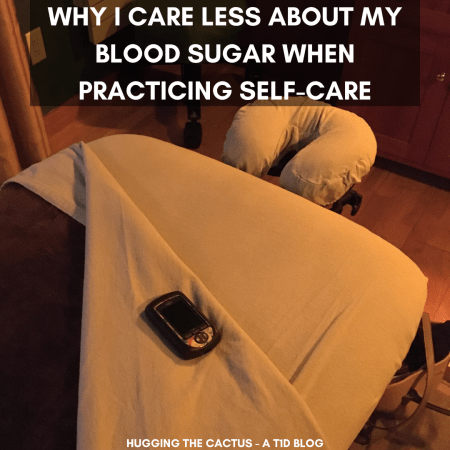
Why I Care Less About My Blood Sugar When Practicing Self-Care

Do you ever let your blood sugar run high on purpose?

I do. But only when I feel it’s necessary. One such occasion is when I’m treating myself to a spa day.

I don’t do that often (because it’s hella expensive), but I looooove unwinding by getting an hour-long massage or a facial. And the last thing that I want to worry about when I’m pampering myself is my blood sugar.

I don’t want to hear any alarms going off, I don’t want to check my blood sugar, I don’t want to bolus, and I certainly don’t want to dwell on diabetes during a period of time in which I’m supposed to relax. Because diabetes is the opposite of relaxing, and anyone who lives with it in any capacity deserves to have a mental break from it as often as possible.

I also never, ever want a low blood sugar to happen when I’m practicing self-care. Talk about a total buzzkill! In my imagination, nothing could be more disruptive to a moment of zen than hearing a low alarm go off and having to roll off a massage table to grab a tube of glucose tabs, all while being mostly naked. NO THANKS.

Red Valentine Countdown Social Media Post
Right after this picture, the PDM, Dexcom, and phone were all tucked away for an hour that flew by too fast.

So I will purposely let my blood sugar run high when I’m practicing self-care because for that window of time, it’s super important to me to forget about diabetes, the biggest source of stress in my life, and focus on enjoying a mini vacation from it. And it’s not like I’m ever letting myself climb dangerously high (because dealing with a 250+ blood sugar during self-care sounds almost as awful as having a low) – I usually aim for 150-180.

For me, it’s incredibly worth it to just let it go and embrace being slightly out of range for a blissful (but all too short) period of time.

5 Things I’ve Learned about Exercising with Diabetes

It’s November 26th which means it’s day 26 of the Happy Diabetic Challenge! Today’s prompt is about diabetes and exercise. There’s so much I could say on the subject, so I decided to settle for a bit of a round-up post that explains what I’ve learned about exercising with diabetes over the years…

I exercise on a daily basis.

This statement is not a faux-humble brag, nor is it an exaggeration. Unless I’m sick, I work out in some form or fashion every single day. My workouts will vary in their intensity, but one thing is consistent: My diabetes plays a major role in how long, when, and what type of exercise I choose to do.

Since I grew up playing sports, I’ve had just about my entire lifetime with diabetes to figure out how to make it peacefully coexist – or, at least, merely coexist – with whatever exercise routine I’m completing. As a result, I’ve learned quite a few lessons along the way, and I’ve come to recognize several patterns that my diabetes follows when I exercise:

Your only limit is you.png
My diabetes is practically BFFs with exercise.

1. My diabetes is happiest if I work out first thing in the morning. I never thought I’d be the type of person who works out before eating breakfast, but trial and error has taught me that this is the way to go in order to better manage my blood sugars during a workout. Fasting exercise has worked wonders on my blood sugars: I never have to worry about dealing with an insulin-on-board-inducing low blood sugar, nor do I have to be concerned about what the food I ate prior to my workout will do to my blood sugars while I’m exercising.

2. Different types of exercise affect me (and my blood sugars) in different ways. Many people probably relate to me when I say that weightlifting and high-intensity interval training (HIIT) often yield stable blood sugars during workouts but then trigger the need for more insulin hours later, whereas cardio (such as dancing, running, or circuit training) usually causes sudden drops in blood sugar levels. Of course, it depends on the timing, duration, and intensity of the workout, but it’s interesting to see how different types will require me to react in different ways in terms of my diabetes care.

3. Sometimes I need to suspend my insulin, sometimes I don’t. Again, whether or not I suspend my insulin – or even run a temp basal – depends heavily on when and how I exercise. If I’m doing my morning routine (which happens 75% of the time), then I don’t really do anything with my basal rates: I just keep them running normally. But if I’m taking a midday walk or decide to exercise in the evening, I often have to do something about my basal rate to avoid crashes or spikes. Insulin suspensions or temp basals are wait-and-see situations in those cases.

4. The hardest part about exercise and diabetes is that I can do the exact same routine every day and get different results. If I worked out at precisely the same time, for the same amount of time, and with the same sequence of movements every single day, then…my diabetes wouldn’t give a damn. Every day of life with diabetes is different because of the variables that inevitably cross my path. Things like mood, that time o’ the month, stress, diet, illness, and more can cause major changes in my blood sugar levels. It’s my job to react accordingly to those changes, but that doesn’t mean I always hit the mark on the first try. So with that in mind, it can sometimes be hard to accurately predict how my blood sugar will fare after every single exercise routine. Just thinking about it can be more exhausting than the workout itself.

5. My diabetes is my biggest motivator/fuels my desire to exercise. At the end of the day, I work out because of my diabetes, not because I’m trying to sculpt washboard abs (though I wouldn’t complain if that actually happened). My diabetes loves exercise: It results in an increase in insulin sensitivity and it helps tame my blood sugar levels overall. How could I not be motivated to work out every day with outcomes so tangible?

Dealing with Diabetes When You’re the Maid of Honor

No, no, no. Not today diabetes. Dammit.

The morning of my cousin’s wedding, I woke up to a blood sugar of 237 after a night of fighting elevated levels. There was no rhyme or reason for the high blood sugar – I hadn’t eaten a single thing for 16 hours at that point, but I had changed my pod an hour or two before going to bed.

Why You Should Get a Flu Shot (If You Haven't Gotten One Already) (2)
When you’re the MOH and you also happen to have diabetes, you worry about a lot more than just your speech or your makeup.

WTF was wrong? Was the pod’s cannula bent? Was I high due to wedding day jitters? Would the highs persist all day?

These were the thoughts racing through my mind almost as soon as I woke up the morning of my cousin’s wedding.

I didn’t have time to worry about my MOH speech, or whether my hair would turn out the way I wanted to, or even to drink a celebratory mimosa while I got ready with the rest of the bridal party – I was too preoccupied by my elevated blood sugar.

All I could bother to think about was a potential solution before we all walked down the aisle.

Somewhere between applying my eyeshadow and having the 111th bobby pin secured in my hair (yes, it truly took 111 bobby pins to make my intricate braided up-do possible), I remembered “The Incident” from last year. I’d slept through a high blood sugar that, the following morning, refused to come down. As my frustration grew, so did the pain in my belly that lead me to the bathroom, where I came very close to passing out. One ambulance trip and ER visit later, I discovered that my pod’s cannula was bent, leaving me with no doubt that a pod malfunction was responsible for the whole ordeal.

With that memory vividly replaying in my mind, I made the executive decision to change my pod a couple hours before we were due at the wedding venue. And I can’t even begin to explain how happy I am that I listened to my intuition to do so. Upon removing it, I noticed blood at the site – not as bad of a sign as a bent cannula is, but a possible indicator of a problem. By the time we were in the venue’s bridal suite, my blood sugar was sitting pretty at 90 and I was finally able to focus on the beautiful, meaningful afternoon.

Sure, it was a stressful morning and far from an ideal situation, but I am extremely proud of myself for how I handled it. I didn’t panic the way I normally do. I didn’t shed any anxiety tears. I kept the issue pretty well-concealed from the bride, who shouldn’t have to worry about her MOH’s health on her special day. My calm approach paid off, and though it sucked to waste almost two days’ worth of insulin when I disposed the wonky pod, I knew I should pay closer attention to the fact that I did what needed to be done.

And even better was that my diabetes mostly cooperated with me the rest of the day. It didn’t stop me from delivering a fantastic speech with the matron of honor. It didn’t prevent me from enjoying some tasty wedding food, cake and all. It certainly didn’t keep me from tearing up the dance floor with my enthusiastic family. And it didn’t end my night early as I went out with my boyfriend, the newlyweds, and the matron of honor and her husband to a bar to shoot some pool and continue our celebrations.

Turns out that dealing with diabetes when you’re the maid of honor has a lot to do with keeping a cool head and living in the moment, two things that are so important to do in a variety of situations.