Memory Monday: 1st Generation Dexcom CGMs

One Monday per month, I’ll take a trip down memory lane and reflect on how much diabetes technology, education, and stigma has changed over the years. Remember when…

…Dexcom CGMs made their debut?

It was just over ten years ago that the Dexcom SEVEN CGM System launched. I didn’t actually know more about it, though, until a couple years after the fact. That was when my endocrinologist encouraged me to sign up for a week-long trial run with this new technology to see how I liked it.
023E152D-A6FF-4555-80F0-67764C9523BB
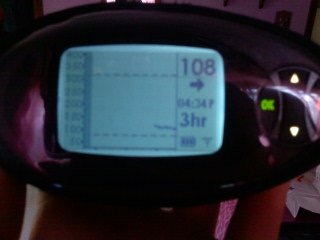
Then: The Dexcom SEVEN CGM System

I didn’t like it, I LOVED it. I quickly became obsessed with the ability to monitor my blood sugar levels at all times. But it’s funny to think back to how bulky and just plain different that first-generation system was compared to today’s sleek and highly functional models.

A few key differences between now and then:

  • Size. The first CGM was large. It was roughly the size of my OmniPod PDM, which might not seem so significant, but it is when measured up against newer CGM models.
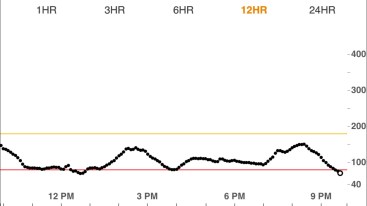
  • Display. The screen on my first CGM was very simple. No colors, no frills – just readings of my blood sugar. That was all fine, but I have to say that I’m a fan of color-coordinated blood sugar reports (red for low, yellow for high, gray for in-range numbers). In a weird way, it motivates me to keep my graph as gray as possible.
  • Distance restrictions. I hated that I had to keep my first CGM so close to me at all times, or else run the risk of losing data! It was hyper sensitive and my readings would be lost if I left the same room as the CGM for more than a couple of minutes. My CGM is now able to pick up readings from much farther away – sometimes, even when I’m downstairs and it’s upstairs.
  • Sounds. My memory is a little foggier on how the sounds compare between old and new Dexcom CGM generations, but I do recall the beeps and vibrations being far more aggressive and annoying on older models.
  • Smartphone access. This might be one of the biggest and best changes – the ability to download an app on your smartphone that can replace a Dexcom receiver. How awesome is that? Plus, if you choose to do so, you can invite family and friends to monitor your blood sugar along with you, which can be helpful in certain situations. Cell phones are so ingrained into society, so this move was brilliant on Dexcom’s part.
IMG_4180
Now: Dexcom data, on my iPhone!

All these improvements have made me a member of Team Dexcom for life. It’ll be neat to see what they come up with next to help make the lives of people with diabetes easier and better.

Behind the Scenes: Shooting a T1D Marketing Campaign

Last week, I had the exciting opportunity to participate in a T1D marketing campaign! I won’t say too much about the brand or product itself, because I don’t want to share more than I’m allowed, but I WILL say that there is some very cool stuff in the works for the diabetes community – and that’s a total understatement.

And I also wanted to share what it was like to be on a production set like that! I arrived in Atlanta late on Thursday night, woke up early on Friday, and got myself ready to head over to the shoot for 11 A.M. From there, it was a long blur of a day. I was whisked from wardrobe to hair/makeup to a holding room to one room filled with wicked bright lights and dozens of people to another room with a plain backdrop and just a few people to another room that’s best described as a closet. Actually, that latter room was where I did an audio-only interview, and I felt just like Harry Potter in the fourth book when he was being interviewed by Rita Skeeter in a broom cupboard. Except I wasn’t being grilled by a nosy reporter like he was; on the contrary, my interviewer couldn’t have been friendlier.

This whole process took about seven hours – that’s a pretty long while to be going around from room to room and having to be on my feet for varying lengths of time. But it was so exciting that I didn’t mind one bit.

But I DID mind my blood sugars; at least, as much as I could when I wasn’t having my makeup touched up or staring into a camera, responding to questions. I had no clue how it would fare after several hours on location and minimal physical activity. I was also worried about the food/drink situation: Would I have access to ample snacks and beverages?

Fortunately, that was a total non-issue. The production company had numerous snacks and bottled water in nearly every room on set, on top of a hot lunch. Around one o’clock in the afternoon (five hours after I ate breakfast), I helped myself to a serving of salmon, squash, and green beans. I was impressed with the quality and healthiness of the food, and even more pleased to discover that among the diet drinks was unsweetened iced tea and sparkling water. Score!

14789128-556D-49CF-8596-80C88D2AEABB
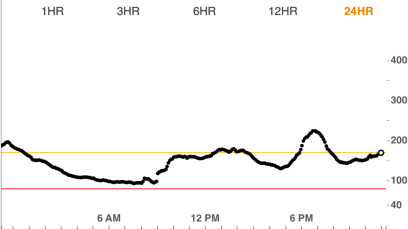
Not perfect, but manageable and steady. A win in my book.

This food kept me fueled all throughout the afternoon on set, and I enjoyed steady blood sugars for the duration of the shoot. Rather than stressing about my blood sugar, I was focusing on posing for photos and answering prompts from producers. It really, truly was a one-of-a-kind experience. I feel so lucky to have been invited to partake in this campaign, and even luckier to have met a diverse and welcoming group of individuals (T1D and non-T1D) along the way.

On top of all that, I proved to myself that I CAN do “crazy” and unique things like this without my diabetes getting in the way. It’s more proof that diabetes will never stop me from living a full and extraordinary life.

Highs Happen, and That’s Okay

Nothing makes me feel as defeated as high blood sugar.

Maybe it’s because it takes so long for my blood sugar to come back down from a high.

Maybe it’s because I feel like I directly caused it – miscalculated my carb intake, or snuck in a snack that I shouldn’t have.

40072427-73BB-45FB-B4E5-F6564C46D3B0
Most of these highs occurred due to a bent cannula in my pod a couple weeks ago.

Maybe it’s because it makes me feel like I’ve lost all control. That I can’t do anything but monitor the situation and take more insulin as necessary. I hate feeling so dependent, so trusting, of my insulin alone.

Maybe it’s because the technology has failed me, and there’s few things more frustrating than that. Imagine doing everything the “right” way, the way you’re supposed to, and getting the “wrong” results. You begin to question everything and your emotions get the better of you.

Whatever the reason is, I know I’ve got to work on accepting the fact that highs happen. I’ve dealt with many over the years, and I know I’ll encounter plenty more in the future. They’re upsetting, tiring, and irritating. They test my patience as I wait for long stretches of time for my insulin to finally kick in and stabilize my blood sugar. They are one of the more mentally and physically draining components of type 1 diabetes management.

But highs happen, and that’s okay.

Diabetes Data Overload

I’ve always been a words girl – never a big fan of numbers. So isn’t my T1D ironic, being that it’s an illness ruled by numbers?

Think about it. PWD have a ridiculous number of…numbers to be concerned about on a daily basis. Between blood sugar checks, insulin dosage calculations, carbohydrate counting, basal rate testing, and more, there’s a lot to take into account.

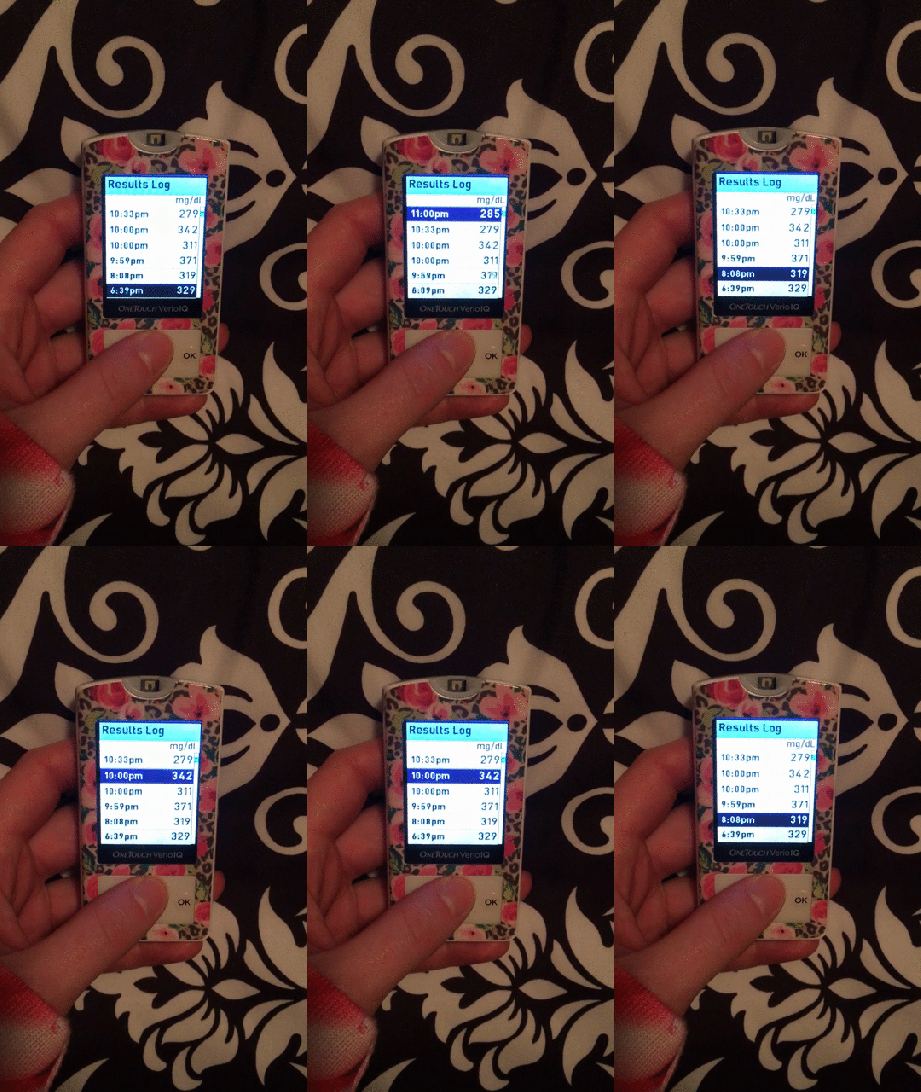
And as time has gone on and technology has evolved, it seems like these numbers are constantly accessible on an endless volume of devices. I can determine trends using my Dexcom CGM – using either my mobile app or my sparkly pink receiver. I can scroll through my record log of blood sugars on my meter. I can find out how much insulin I took in one day using my OmniPod. I can even download several weeks’ worth of blood sugar graphs from my Dexcom by simply hooking it up to a computer.

It’s information overload.

As much as I love having the ability to access all of this data, it’s also too much to swallow at times. I could drive myself nuts looking through days’ worth of graphs and logs to figure out why I was inexplicably high at 3 o’clock in the morning one day, but I can also just chalk it up to a fluke and better spend my energy worrying about my blood sugar in the present (as opposed to the past).

The point is, it’s exhausting to have my life dictated by all this data. I wish I could take a break from it sometimes, but then again, it’s helped me become more accountable for my own health. And I can still express my hatred for numbers by using my love of words, so it’s not all that bad.

Does Cold Weather Affect Diabetes?

Shout-out to Diabetes Social Media Advocacy (DSMA) for prompting me to write a post about this!

Often, I tell people that anything can affect diabetes. Factors like exercise and stress may seem obvious, but more subtle variables include the weather.

The winter season began less than a month ago, but it’s already been a brutal one for much of the country. In New England, we’ve had more than a foot of snow, subzero temperatures, bitter wind chill, and a surplus of ice glazing over all outdoor surfaces.

58E267DF-932A-4CCB-B9BC-D98EA252DAF7
Winter weather looks pretty, but it sure can be a pain in the ass.

Besides being unpleasant to experience, harsh cold weather like this also has a bit of a negative impact on my diabetes. How? There’s a few different ways.

Cold weather limits (or increases) the types of physical activity I can do. Snowstorms make it difficult to travel, so more often than not, I’m stuck at home during wintry weather events. This means I get less movement in, which has an adverse affect on my blood sugars. I rely on getting a certain level of exercise daily, so I have to be creative when it’s snowing in order to meet these requirements. On the flip side, depending on how much snow falls, I need to shovel the driveway. This is a highly strenuous activity that can make my blood sugar drop in 15 minutes or less. As a result, I’ve got to be careful and plan accordingly when a blizzard is in the forecast.

Cold weather impacts the foods I consume. Let’s be real, when it’s freezing outside and you can’t go anywhere, healthy eating isn’t really a priority. Nothing is as comforting as a home cooked meal, whether it’s chili or chicken pot pie. And a hot chocolate is a wonderful pick-me-up post-shoveling. But the problem is these foods are heavy, rich, and laden with carbs. I have to work harder in the cold weather to attain balance with my eating and resist the temptation to fill up on starchy, satisfying food.

Cold weather affects my insulin intake. This ties into the aforementioned points, because if I’m moving less and eating more, then I naturally need to compensate for this with higher insulin dosages. I get frustrated, because it seems like I have to deal with more high blood sugars this time of year. But I know if I keep these factors in mind, it’ll help keep the highs at bay and prevent me from under-dosing.

Cold weather can sway my mood. The winter blues is a real feeling this time of year. It’s much harder to feel motivated to keep up with exercise routines or other healthy habits when the weather’s got me stranded at home. I combat it by staying busy and keeping a routine as much as I can. And when I fall off the wagon, I acknowledge that it’s okay, dust myself off, and get right back on it.

Even though cold weather brings additional challenges with it, the season is fleeting. Before I know it, spring will be here along with better blood sugar.

Sun Salutations and Stable BG: Yoga Does the Trick for my Diabetes

1C08F38B-F61A-4747-BDA2-FD3A32F8315C

Whoa, who’s that dork doing a high-speed yoga routine up there?

Hi, it’s me!!

It’s kind of weird to watch a video of yourself doing yoga – especially when you see how awkward you look because the time-lapse feature on your iPhone sped it up so much.

So why did I film myself doing a yoga routine? Once I get past my self-consciousness, I look at the video to see what needs adjusting; for instance, I could sink a little deeper when I’m in my chair pose. I could also stand to slide my foot a bit higher up my leg, perhaps balance it on my thigh, when I’m in the tree pose.

Aside from looking for what needs to be improved, filming the routine also helps me understand why I do yoga. It shows me how my flexibility has increased, as well as my balance. I also realize that it shouldn’t be a surprise to me that I worked up a sweat during this practice – I’m constantly shifting from the ground to standing to various other poses. My muscles are stretching out and getting warm from the movements, so of course I’m giving my body a workout in the process.

And in turn, I’m also keeping my blood sugar stable. The yoga poses combined with controlled breathing and mind wandering does wonders for both my diabetes and my mental health. More often than not, I ride a straight line on my CGM throughout a yoga practice. It’s a great way to get in the right frame of mind at the start of a day, or unwind at the end of a long one.

Plus, there’s nothing like sinking into child’s pose (lying face down on the mat with your arms extended, your knees apart, and your rear in contact with your heels) or taking a nice long savasana (or corpse pose, in which you lie face up with your eyes closed, arms at your side, with fingers and toes spread open – without letting your muscles tense up) at the end of a practice to reset the mind.

Can’t beat the benefits of yoga.

The Cookie Conundrum

Merry Christmas, dear reader! I hope you enjoyed a wonderful holiday yesterday. Thank you for your continued support of my blog. I’m looking forward to continue writing in the new year! Enjoy this new blog post about my favorite food weakness this time of year.

Hi, my name is Molly, and I have an addiction to cookies.

Not just any kind of cookies, though – Christmas cookies, to be exact. I think my obsession with them truly took shape when I was in eighth grade. That’s when my aunts, cousins, and I gathered for our first annual Christmas cookie swap, a joyous occasion during which we spend an afternoon sampling cookies we’ve baked. It’s just as glorious as it sounds.

Unless you’ve got diabetes, of course.

D38B3F51-F358-4ABA-8778-9291ED7F7073
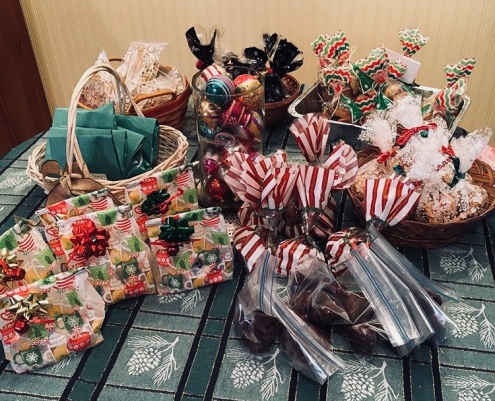
Bags and baskets filled with sweet little sugar bombs (A.K.A. cookies!!!)

I say that because it seems no matter what I do, my blood sugar always ends up high after partaking in the cookie consumption. And I’ve tried many different strategies to combat it, including:

  • Pre-bolusing
  • Breaking cookies in half to cut down on the carb intake
  • Running a temp basal rate
  • Exercising pre- or post-swap, depending on my blood sugar

I’m fully aware that I don’t HAVE to eat the cookies – I could go to the swap and watch everyone else try them and plaster a fake grin on my face – but honestly, how miserable does that sound? I fully believe that just because I have diabetes, it doesn’t mean that I should deprive myself. And as a disclaimer, I’m not sitting there wolfing down cookie after cookie like I’m the Cookie Monster: My family sets out just enough so that each person can try one cookie from all participating bakers. So usually, accounting for all the cookies I split in half, I eat approximately 6-7 whole cookies (which vary in size but are typically no larger than 3-4 inches in diameter). All that said, I still account for at least 45 grams of carbohydrates when I bolus for the cookies, which should have me covered…

…in theory, anyways.

Hence, my cookie conundrum, which occurred yet again when I participated in the 2017 swap. I spent a solid few hours in the late afternoon and early evening battling blood sugars in the high 200s and low 300s, which proved to be extra challenging without my CGM’s aid (I had to remove it because the dreaded ??? appeared and wouldn’t go away for several hours). But I handled it: I managed to get my numbers back down, try an array of fabulous cookies, and spend an afternoon with my wonderful family members.

Cookie conundrum overcome, if you ask me.

Memory Monday: Log Books

One Monday per month, I’ll take a trip down memory lane and reflect on how much diabetes technology, education, and stigma has changed over the years. Remember when…

…log books were a THING that PWD used to track blood sugars?

Log books were pocket-size diaries (of a sort) designed for PWD to keep track of blood sugars, insulin and carb intake, mealtimes, etc. Basically, it was the old-fashioned way of recording blood sugars so that you could bring it with you to your endo appointments so your doctor could review the book for patterns.

I remember HATING having to write down my numbers. I felt like those little log books were contraptions put in place to judge me and my numbers. Imagine an eight year old who felt judged by something like that? It’s just wrong. But I get that they had a purpose to serve, and even when I was little, I knew it was important to write everything down even if I resented doing it.

That’s why I made it more fun by drawing doodles next to certain blood sugars – a frowning face would appear when I was high, and a mini burst of fireworks would find their way next to a blood sugar of 100 (which I now refer to as a unicorn bg, along with much of the rest of the DOC). I also distinctly remember using the log book to keep track of where I was injecting my insulin: “RL” would appear on the page if I was due to give a shot into my right leg, or “LA” for my left arm. These days, I’m really good about swapping sites, mainly because it’s easy to remember, thanks to my pods. But as a kid, it was more challenging, so writing it down helped.

D07D4405-FA76-4589-BF8C-535F727B9AAD
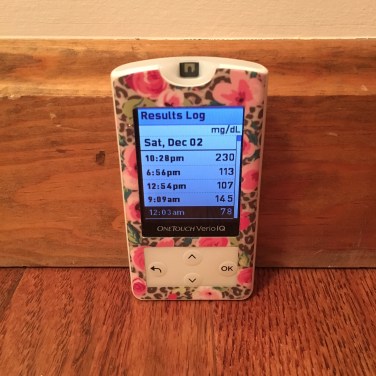
Thankful that my meter tracks my blood sugars for me now (also, that 230 mg/dL would’ve totally gotten a frown-y face back in the day).

Thank goodness for modern meters and insulin pumps that keep track of my blood sugars for me now. It’s so much easier to show up to an endo appointment and hand over my meter for the nurses to download. Plus, doing so means that my doctor and I get to review all sorts of colorful charts showing my blood sugars over a certain period of time, which is more telling and helpful than a doctor thumbing through my log book and murmuring, “I see,” every few moments.

Log books are such an archaic artifact of my diabetes history that I don’t even own any nowadays. I trashed them all, years ago, when I realized that my blood sugars from 2001 were sort of irrelevant to now. Do you still have any of your log books lying around?

The Emotional Roller Coaster (Otherwise Known as High Blood Sugar)

I tested three times in the span 60 seconds the other night.

Why?

High blood sugar.

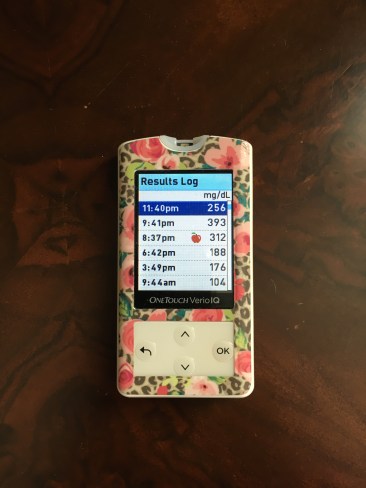
That was the culprit. For five hours, I was high – over 300 mg/dL, to be exact. I still can’t quite explain how it happened. I didn’t eat more than my usual amount of carbohydrates at dinner. I didn’t deviate at all from my mealtime routine; the only thing that maybe affected this was the fact that I had to change my pod that night.

But still. It was maddening, sitting there and watching my blood sugar climb and stick to the 300s. I did everything I should do to correct it: increase my temp basal, take corrective boluses, drink water, refrain from eating. And yet, the high persisted. All I wanted to do was go to sleep, but I was afraid to. Yes, afraid to get the rest that my body needed! That’s what diabetes does sometimes – it instills fear that you can’t shake until those numbers change the way that you need for them to. It’s paralyzing; it’s helplessness in its purest form.

It’s why I ended up stacking my boluses that night, even though I knew it might not be a smart call. But I was so stuck in the high 200s and low 300s. What else was I supposed to do? I even tested THREE times in 60 seconds because I thought that my meter was wrong. I desperately wanted it to show that I was coming down, and felt tears sting my eyes when I realized it wasn’t. I had no choice but to wait some more, so I made myself comfortable in bed and watched the Gilmore Girls (because a nonstop dialogue and excellently obscure pop culture references are good for the soul). I could only get semi-absorbed in Lorelai and Rory’s back-and-forth banter though, because my mind was otherwise occupied by the nagging high blood sugars.

AE7904C6-733F-468F-9901-454AD509D4F9
I couldn’t help testing over and over again, hoping for any sort of positive change.

Finally, I saw that I was coming down to the mid-200s shortly before 11:30 P.M. I decided it was safe to close my eyes. But I didn’t dare do so until I set an alarm for about an hour from then, just so I could continue to monitor my blood sugar. I woke up when it blared, and let out a massive sigh of relief when my CGM showed I was floating down to 150 mg/dL.

I fell back asleep only to wake up again, two hours later: This time, it was because of a low blood sugar. I tested, saw that I was 67, and corrected it. But falling asleep wasn’t as easy this time around. Again, I felt fear – what if I continued to drop down? What if I corrected too much? I was so emotionally exhausted and consumed by the feeling that it took me well over an hour to drift back to sleep.

When I woke for work the next morning, I was 148. The evening’s episode was over. But my head was spinning as I did my best to analyze what I could and should have done better.

And this is when I told myself to stop. I had to stop beating myself up and going over every choice I made. I had to remind myself I did the best I could in that moment, and that should be enough. It is enough.

I pick myself up, dust myself off, and move on.

Hypoglycemia Strikes Again

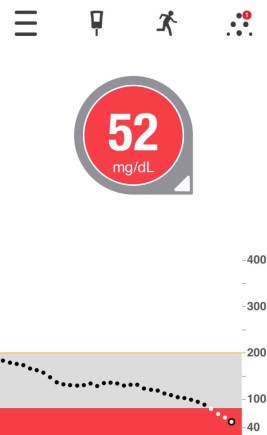
I rolled over onto my stomach and groggily opened my eyes. I checked the time – 1:30 A.M. I felt beads of sweat form on my forehead and back. I kicked my blankets off my body just as I heard my CGM vibrate: five urgent, successive buzzes, a grating sound. I knew what it meant without looking at the screen. My blood sugar was low, and I had to do something about it.

lowbg
Low blood sugar is never fun, but especially when it happens in the middle of the night.

Blindly, I groped around in the dark, my arm hanging off my bed as I searched the floor for my purse. Once I located it, I rummaged through the inside, looking for a miniature box of raisins that I knew would boost my blood glucose up. I found them and ate them quickly, sitting upright in bed. As I chewed, I registered the sensation that occurs once in a blue moon with these middle-of-the-night lows…

…Raging hunger.

It’s that feeling that you have when your blood sugar gets below a certain point.

That feeling of utter starvation.

That feeling that deprives you of good common sense.

That feeling that forces you to get out of bed, even though the rational part of your mind just wants you to go back to sleep.

Damn it. I’ve succumbed to it, again.

It’s not like this happens every time I have a low at ungodly hours of the morning. In fact, it probably only happens to me four or five times throughout the year. Maybe because I fight against it so hard, since I know that it’ll lead to nothing but high blood sugar and regret.

These thoughts cross my mind, but it’s fleeting. I make my way down the stairs, pausing to grab my bathrobe to keep me warm (the sweating will stop soon and it will be replaced by nonstop chills). Hey, at least I have enough logic at this moment in time to remember the BATHROBE of all things!!!

I turn the light on in the kitchen, blinking rapidly to clear the sleep from my eyes. And then I raid the cabinets.

Fistfuls of Smart Food popcorn are devoured one minute, and in the next, I’m swallowing spoonfuls of crunchy peanut butter (my dear, delicious vice). I take a pinch of Parmesan from the fridge and a tiny tower of Toasteds crackers to complete my smorgasbord. I wash it all down with sparkling water and remove myself from the kitchen before I can do any more damage.

I don’t know what’s more sad – the fact that I gave in to these carnal hunger pangs even though I knew my blood sugar would be fine after having the raisins, or that my snacking was absurdly out of control for 1:30 in the morning. Truly, the knowledge that I must’ve consumed close to 400 calories – roughly how much I eat at lunchtime each day – was disgusting to me.

I could blame it on my lack of self-control. I could blame it on the early morning hours and my sleepy state. I could blame it on the peanut butter for being so addicting.

But instead of beating myself up for a snack attack in the witching hours, I’ll just accept it happened and blame it on the hypoglycemia for striking me when I was vulnerable. It happened, it’s over, it’s time to move on and try harder next time.