Does Cold Weather Affect Diabetes?

Shout-out to Diabetes Social Media Advocacy (DSMA) for prompting me to write a post about this!

Often, I tell people that anything can affect diabetes. Factors like exercise and stress may seem obvious, but more subtle variables include the weather.

The winter season began less than a month ago, but it’s already been a brutal one for much of the country. In New England, we’ve had more than a foot of snow, subzero temperatures, bitter wind chill, and a surplus of ice glazing over all outdoor surfaces.

58E267DF-932A-4CCB-B9BC-D98EA252DAF7
Winter weather looks pretty, but it sure can be a pain in the ass.

Besides being unpleasant to experience, harsh cold weather like this also has a bit of a negative impact on my diabetes. How? There’s a few different ways.

Cold weather limits (or increases) the types of physical activity I can do. Snowstorms make it difficult to travel, so more often than not, I’m stuck at home during wintry weather events. This means I get less movement in, which has an adverse affect on my blood sugars. I rely on getting a certain level of exercise daily, so I have to be creative when it’s snowing in order to meet these requirements. On the flip side, depending on how much snow falls, I need to shovel the driveway. This is a highly strenuous activity that can make my blood sugar drop in 15 minutes or less. As a result, I’ve got to be careful and plan accordingly when a blizzard is in the forecast.

Cold weather impacts the foods I consume. Let’s be real, when it’s freezing outside and you can’t go anywhere, healthy eating isn’t really a priority. Nothing is as comforting as a home cooked meal, whether it’s chili or chicken pot pie. And a hot chocolate is a wonderful pick-me-up post-shoveling. But the problem is these foods are heavy, rich, and laden with carbs. I have to work harder in the cold weather to attain balance with my eating and resist the temptation to fill up on starchy, satisfying food.

Cold weather affects my insulin intake. This ties into the aforementioned points, because if I’m moving less and eating more, then I naturally need to compensate for this with higher insulin dosages. I get frustrated, because it seems like I have to deal with more high blood sugars this time of year. But I know if I keep these factors in mind, it’ll help keep the highs at bay and prevent me from under-dosing.

Cold weather can sway my mood. The winter blues is a real feeling this time of year. It’s much harder to feel motivated to keep up with exercise routines or other healthy habits when the weather’s got me stranded at home. I combat it by staying busy and keeping a routine as much as I can. And when I fall off the wagon, I acknowledge that it’s okay, dust myself off, and get right back on it.

Even though cold weather brings additional challenges with it, the season is fleeting. Before I know it, spring will be here along with better blood sugar.

Traveling with T1D: Upon Arrival

Bags packed? Check. Made it to the airport? Check. Boarded the plane? Check. Touchdown? Check. I’ve made it through the actual travel part of my trip. Yay! But after all that, I’ve still got a routine to follow, even though I’ve reached my destination.

C17960F7-CD51-4441-81DE-84B3FB5EF8AB
This little cooler comes in handy when en route to a destination, but I always feel much better when I can get my insulin vials into an actual refrigerator.

It’s pretty straightforward, really. I simply need to determine where to keep my diabetes supplies for the duration of my stay. If I’m in a hotel room, I locate the mini fridge and stash my insulin vials  in there. I tend to keep everything else (pods, swabs, etc.) out of plain sight in order to avoid attracting attention from housekeeping. I mean, if I was going in and out of hotel rooms all day long and noticed that one contained a bag filled with needles, I’d probably get a little suspicious. So this means my other supplies live in my suitcase for the week, in an easily accessible pocket.

It’s easier if I’m going to be visiting with friends or family. I still find a fridge to home my insulin, but I worry less about “hiding” my supplies. I’m able to keep them in a spot that’s convenient for me, which helps make site changes throughout my trip a smoother process.

Speaking of site changes, I find them particularly annoying when I’m on vacation. It feels like I have to plan a day – or several days in a row – around the fact that I’ve got an upcoming site change. But planning is a part of T1D management, so I’ve come to accept that I need to be diligent with scheduling activities and meals around it.

Sometimes site changes are no big deal on a trip, other times they’re a whole event (like when my mom and I went to Disney and had to change our pods in the parks – going into a family bathroom to do it was not overly fun). And other, more seldom times, site changes are reminders of why it’s so important to pack extra supplies on a trip.

Case in point: My family and I went on a Caribbean cruise a few years ago. It was an amazing vacation, but also one that presented a few challenges regarding diabetes. I was spending a lot of time in the sun and on beaches, and that took a toll on my pods a couple of times. I had to rip off pods prematurely twice on this trip and replace them with my backups. Thank goodness I had thought to bring a pod for every single day of the vacation (seven days, seven pods) – because I wound up using five of them. So I never feel badly about obsessively packing tons of extra supplies that I might not necessarily use, because I never know when they’ll come in handy.

Travelbetes. It can be kinda complicated; hence, it requires its own word. But it’s worth it in the end, because my choice to travel independently with diabetes shows that it won’t stop me from seeing new places.

Diabetes in the Wild

Diabetes in the wild refers to a random encounter with another T1D when out and about. My favorite recent occurrence of this happened when I was in Disney World with my mom (also a T1D). We had just entered Animal Kingdom. I was sporting my pod on the back of my upper arm.

IMG_4625
I don’t think Timon noticed my pod, but another T1D in the park sure did!

“Hey, Podder!” I heard someone yell. For a split second, I thought someone was saying, “hey, Potter,” you know, like the Harry Potter kind of Potter.

I looked around and saw a girl a few years younger than me waving her arms in my direction. When we made eye contact, she smiled and pointed at her pod. I gave her a thumbs up and the moment was over as quickly as it happened.

But it puts a smile on my face when I think about it, because it goes to show how awesome these chance meetings are – they serve as little reminders that even when I may feel like the odd duck in a crowd due to my pod, I’m not as alone as I think I am when it comes to diabetes.

Traveling with T1D: During the Trip

A few days ago, I wrote about what it’s like to prepare for travel with diabetes. It may have surprised you to learn how many steps are involved! But the work doesn’t end when en route to the destination…

It doesn’t matter if I’m going to be stuck in a car for several hours, flying on a plane, or – my worst nightmare – waiting in the airport for a delayed flight: There are additional steps I like to take when traveling to help ensure my blood sugar is steady and I’m adequately prepared with my supplies.

These steps include:

  • Checking my blood sugar often. I don’t like to rely completely on my CGM; after all, it can be inaccurate from time to time. So I tend to perform more blood sugar checks than usual while I’m waiting at the airport or sitting shotgun in a car. But if I’m the one driving, I (obviously) wait to check at rest stops as time allows.
  • Seeking healthy snacks. It’s definitely easier for me to find healthy options when I’m on a road trip – I can simply pack meals and snacks ahead of time. The airport is a little trickier for me, though. Sometimes, I’m tempted by candy or chips – comfort foods – because I’m not a huge fan of flying and like to do anything to take my mind off it. Luckily, though, even if I don’t make the healthiest choice, everything I’m consuming does have a carbohydrate count that’s easily accessible. This helps me take the correct insulin dosage and removes some extra thought from the process.
  • Getting as much movement in as possible. If this means taking laps in an airport terminal, so be it. I know that my diabetes responds well to exercise throughout the day, but it’s next to impossible to get movement in when cooped up in a car or plane. So what if I look kind of weird at a rest stop doing jumping jacks next to my car? At least I know I’m doing my body some good.

One thing I’d like to note is that the airport comes with some added fun: the TSA!!! (Insert sarcasm here.) That means I also have to be prepared for going through security. Some PWD have reported terrible experiences with the TSA, which is why I’ve devised a protocol for myself when traveling so I can (hopefully) avoid a bad interaction.

This plan consists of:

  1. Having my ziplock bag of diabetes supplies at the ready in my carry-on in case I’m asked to remove it,
  2. Telling the TSA agent conducting the body scan that I have T1D, and pointing out the locations I’m wearing my pod and CGM sensor,
  3. Knowing that I’ll probably be asked to touch my sites (over my clothing), and
  4. Allotting for the extra time it takes to get my hands swabbed.

So far, so good with this little strategy of mine. I’ve found that it works best to stay cool, calm, and collected throughout the whole TSA process. It’s a miserable one at best, but I might as well not exacerbate it by getting in a panic about my diabetes supplies.

After all that, what do I possibly have left to do once I actually arrive at my destination? Be on the lookout for my third and final post in this little series of travel procedures – but certainly not my last on traveling with diabetes, in general!

Traveling with T1D

In a few days, I’ll be jetting off to Washington, D.C. for a week! I’m always filled with a nervous excitement in anticipation of all kinds of trips. Whether they’re to a faraway place or close to home, just a few days long or two weeks, there’s a certain level of preparation I need to do that involves more than picking out a few outfits.

Yep, you guessed it – I’ve got to prepare for apocalypse.

Okay, okay, I’m being dramatic. But not really, because I’ve got to think of every possible diabetes scenario that could happen when I’m away. I could experience multiple pod failures, the batteries might go on my PDM, I could lose the charge on my Dexcom or Verio IQ meter, I might run out of insulin – the list of possibilities goes on and on. How the heck do I go about making sure I have everything I could need on a trip, and backups, to boot?

IMG_5249
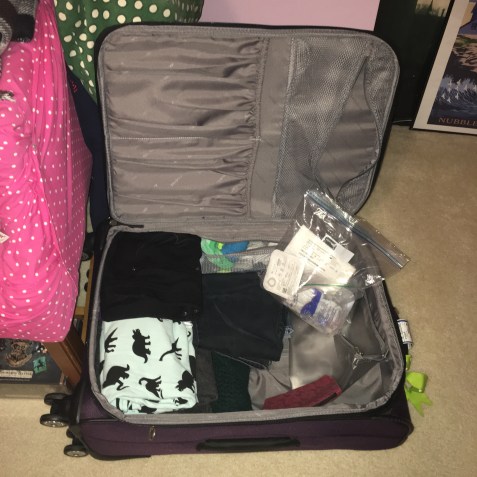
A peek inside my (barely packed) suitcase. Note: The pods/backup supplies will go into my carryon…whenever I get around to packing it…!

Here’s a walkthrough of the steps I take to prepare myself for a trip of any length:

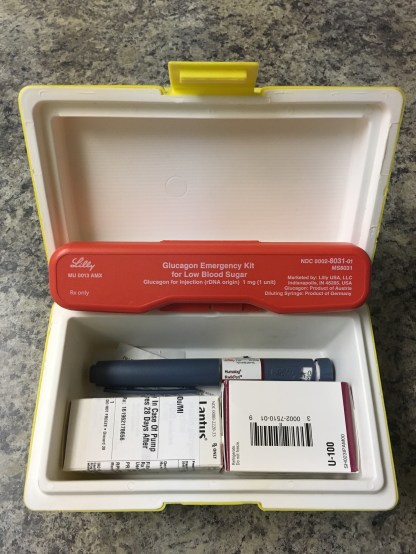
  • 7 Days Before I Leave – I come up with a good, old-fashioned and handwritten list of supplies that I’ll need. This includes (but is not limited to): spare pods, alcohol swabs, skin-tac wipes, Humalog vials, backup Lantus vial, backup Humalog pen, Glucagon kit, backup syringes/pen needles, extra lancets, chargers for my meter and Dexcom, extra batteries for my PDM, a bottle of Glucose tablets, extra low snacks.
  • 3-4 Days Before I Leave – I begin to take items out that don’t need refrigeration or special attention. I’ll add them to my carry-on – NOT my suitcase, because that’s not a good idea (what if I got separated from it somehow?) – in a clear gallon-sized ziplock bag. That way, if for any reason I need to take these items out of my carry-on, I don’t have to rifle through it in order to quickly locate them.
  • 1 Day Before I Leave – I charge all of my devices completely. I also double check my PDM to ensure that the battery in it is relatively full. I also run through my handy dandy list from a few days ago to see if I’m missing anything.
  • 4-6 Hours Before I Leave – This is when I’m about to leave the house to head to the airport, and I’m trying to finish up with the last-minute packing. I add my insulin to the clear baggie in my carry-on and check to see that I’ve got extra snacks in both the carry-on and my purse.
  • Just Before I Leave – One of the last things I do before heading over to the airport is check my blood sugar. I have a Dexcom, but it’s not always accurate, so I like to take that extra step of obtaining a fresh reading from my meter.

Bear in mind, these are all of the steps I take before I leave for a trip – there are many more in the during and after phases! Stay tuned for my follow-ups on what it’s like for a PWD during the actual travel part, and what it’s like upon arriving to the destination.

Sun Salutations and Stable BG: Yoga Does the Trick for my Diabetes

1C08F38B-F61A-4747-BDA2-FD3A32F8315C

Whoa, who’s that dork doing a high-speed yoga routine up there?

Hi, it’s me!!

It’s kind of weird to watch a video of yourself doing yoga – especially when you see how awkward you look because the time-lapse feature on your iPhone sped it up so much.

So why did I film myself doing a yoga routine? Once I get past my self-consciousness, I look at the video to see what needs adjusting; for instance, I could sink a little deeper when I’m in my chair pose. I could also stand to slide my foot a bit higher up my leg, perhaps balance it on my thigh, when I’m in the tree pose.

Aside from looking for what needs to be improved, filming the routine also helps me understand why I do yoga. It shows me how my flexibility has increased, as well as my balance. I also realize that it shouldn’t be a surprise to me that I worked up a sweat during this practice – I’m constantly shifting from the ground to standing to various other poses. My muscles are stretching out and getting warm from the movements, so of course I’m giving my body a workout in the process.

And in turn, I’m also keeping my blood sugar stable. The yoga poses combined with controlled breathing and mind wandering does wonders for both my diabetes and my mental health. More often than not, I ride a straight line on my CGM throughout a yoga practice. It’s a great way to get in the right frame of mind at the start of a day, or unwind at the end of a long one.

Plus, there’s nothing like sinking into child’s pose (lying face down on the mat with your arms extended, your knees apart, and your rear in contact with your heels) or taking a nice long savasana (or corpse pose, in which you lie face up with your eyes closed, arms at your side, with fingers and toes spread open – without letting your muscles tense up) at the end of a practice to reset the mind.

Can’t beat the benefits of yoga.

Happy New Year!

Dear reader,

Happy 2018! I wanted to take a moment to wish you well. I hope the new year brings you health and happiness!

44592AD7-719A-45F6-95C1-2C59907BC8F7
Fireworks!!!

Like many others, I’ve come up with a few New Years resolutions that I’d like to fulfill in 2018. One revolves around this blog – I want to increase the variety of content featured here and, overall, improve it so it has a bigger impact on the diabetes community and beyond.

That’s where YOU enter the picture. Have a suggestion for me? Let me know! This blog isn’t just about me – it’s about you, too. That’s why I want to make sure I’m making good use of this site and offering content and insight that you care about. Thank you in advance for your ideas. I sincerely appreciate them!

Curious about my other goals for 2018? Look for a follow-up post about ’em sometime in the next couple of weeks. Sharing them will help keep me accountable, right?

Be well,

Molly

What it Feels Like to Have Low Blood Sugar

Diabetes evokes curiosity for those who are not familiar with it. I’ve been asked many questions over the years – can you eat sweets, does it hurt when you give yourself shots, do you have to protect your pump from water, just to name a few – all relatively easy-to-answer, yes-or-no questions. But every now and then, someone will ask harder questions. And one that I’ve struggled to answer in a succinct manner is: What does it feel like to have low blood sugar?

There isn’t really a simple answer. I guess my textbook response is to rattle off a list of common hypoglycemic symptoms: shakiness, dizziness, sweating, slurred speech, weakness. But I know that other PWD experience slightly different symptoms, such as feeling cold instead of sweaty, or drastic changes in personality. And there are even some PWD who don’t experience any symptoms due to hypoglycemia unawareness.

So how exactly do I response to a question like that, one that’s more loaded than it appears?

lowbg
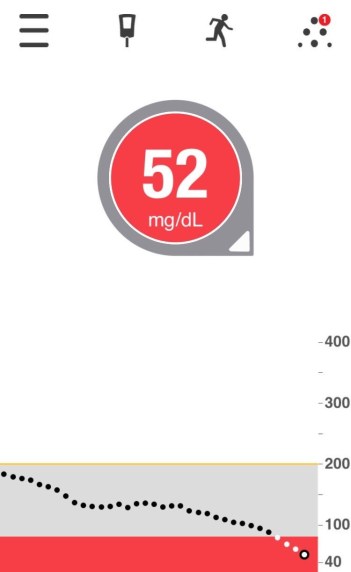
A graphical representation of a sudden low – I guarantee I was not feeling great when this one hit.

I could tell the asker to imagine feeling simultaneously ravenous and disoriented. I could tell them to picture walking into the kitchen and feeling like inhaling the entire contents of the pantry – that’s how intensely your body craves sugar.

I could tell them to think about what it’s like to wake up in the middle of the night drenched in sweat. It might seem like a reaction to a nightmare, but it’s the body trying to convey a message that is, by some miracle, supposed to be grasped by someone who was just trying to get a solid night’s sleep.

I could tell them to envision feeling like energy is sapped out of every pore in the body abruptly, with little warning.

I could tell them that sometimes, it results in pure panic, particularly when no fast-acting carbohydrates are on hand or when no one is around to help you.

I could tell them that low blood sugar is one of the biggest sources of anxiety for many PWD, that it causes a deeply rooted fear. That it can sometimes lead to a PWD making unhealthy choices just to avoid a low from happening in the first place.

I could say all of this to anyone who asked me this question – and I still don’t think it would completely convey what it’s like to have low blood sugar.

How would you describe it to someone asking you about it? Would you use the terse medical explanation, or would you try to talk about how it really feels?

Leave your responses in the comments – I’d like to know how you handle this. And if you thought this was an interesting post, let me know. I’m thinking of doing a series about how I answer the more complicated diabetes-related questions I’m asked.

The Cookie Conundrum

Merry Christmas, dear reader! I hope you enjoyed a wonderful holiday yesterday. Thank you for your continued support of my blog. I’m looking forward to continue writing in the new year! Enjoy this new blog post about my favorite food weakness this time of year.

Hi, my name is Molly, and I have an addiction to cookies.

Not just any kind of cookies, though – Christmas cookies, to be exact. I think my obsession with them truly took shape when I was in eighth grade. That’s when my aunts, cousins, and I gathered for our first annual Christmas cookie swap, a joyous occasion during which we spend an afternoon sampling cookies we’ve baked. It’s just as glorious as it sounds.

Unless you’ve got diabetes, of course.

D38B3F51-F358-4ABA-8778-9291ED7F7073
Bags and baskets filled with sweet little sugar bombs (A.K.A. cookies!!!)

I say that because it seems no matter what I do, my blood sugar always ends up high after partaking in the cookie consumption. And I’ve tried many different strategies to combat it, including:

  • Pre-bolusing
  • Breaking cookies in half to cut down on the carb intake
  • Running a temp basal rate
  • Exercising pre- or post-swap, depending on my blood sugar

I’m fully aware that I don’t HAVE to eat the cookies – I could go to the swap and watch everyone else try them and plaster a fake grin on my face – but honestly, how miserable does that sound? I fully believe that just because I have diabetes, it doesn’t mean that I should deprive myself. And as a disclaimer, I’m not sitting there wolfing down cookie after cookie like I’m the Cookie Monster: My family sets out just enough so that each person can try one cookie from all participating bakers. So usually, accounting for all the cookies I split in half, I eat approximately 6-7 whole cookies (which vary in size but are typically no larger than 3-4 inches in diameter). All that said, I still account for at least 45 grams of carbohydrates when I bolus for the cookies, which should have me covered…

…in theory, anyways.

Hence, my cookie conundrum, which occurred yet again when I participated in the 2017 swap. I spent a solid few hours in the late afternoon and early evening battling blood sugars in the high 200s and low 300s, which proved to be extra challenging without my CGM’s aid (I had to remove it because the dreaded ??? appeared and wouldn’t go away for several hours). But I handled it: I managed to get my numbers back down, try an array of fabulous cookies, and spend an afternoon with my wonderful family members.

Cookie conundrum overcome, if you ask me.

Christmas Eve and 20 Years of Diabetes

Merry Christmas Eve, to all those who celebrate it! Christmas is one of my absolute favorite holidays. I love spending time with my family and friends, attending mass, baking (and eating) Christmas cookies, and decorating the tree. This time of year is pure magic; a time when I feel most joyful.

This Christmas Eve also marks my 20th year of living with type one diabetes. I don’t remember much from that night in 1997, seeing as I was only four years old. I recall tons of family members visiting me in the hospital and bringing gifts for me. One of the gifts I received was a honey-colored teddy bear that I particularly liked and hugged often throughout my hospital stay.

17179361-5AF6-412D-8EF7-885A71AD55F1
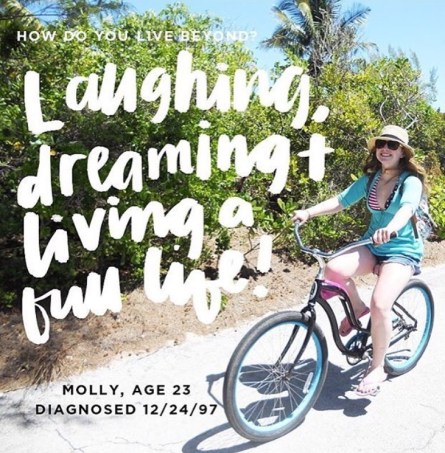
Beyond Type 1 featured me on their Instagram Wall of Warriors last year. This is how I #LiveBeyond.

Twenty years with diabetes is a long time. Too long, especially since every couple of years since my diagnosis I’ve been told that a cure would be found “soon”. I’ve come to accept the fact that “soon” just might not be within this lifetime, and rather than dwell on that, I choose to focus on the joy of life itself. How lucky am I to live a full life, surrounded by loved ones, employed full-time, with a roof over my head and food on my plate? How lucky am I to be able to have access to the insulin I need and to have a choice when it comes to the pump and meter I use? How lucky am I to have the knowledge and willpower it takes to manage a chronic illness every second of every day?

I’m extraordinarily lucky. I’m blessed.

That’s what I’m focusing on joy on this significant diaversary. I’m embracing the spirit of the season and recognizing the good in this life. Diabetes takes things away from me sometimes – a full night’s sleep, an occasional dessert, a missed trip to the gym – but I refuse to let it take my joy.