Bret Michaels Appreciation Post

There’s a bunch of famous T1Ds who would be really cool to meet: Victor Garber, Sonia Sotomayor, Derek Theler, to name a few. And obviously, there’s Nick Jonas, who is probably the most popular of them all. But there’s a different musician with diabetes who I’d be even more eager to meet than Nick – nothing against the guy, of course.

Who do I have in mind? Why, the one and only Bret Michaels, the lead singer of the rock band Poison.

This might surprise some of you – I don’t exactly seem like the type who’s into that sort of music. But I totally am. Nothin’ But a Good Time, Unskinny Bop, and Talk Dirty to Me are among my favorite Poison songs. They’re simply excellent to dance and sing along to, and to play on Guitar Hero (which I did often in the game’s heyday, and absolutely pretended to be a rock and roll guitar QUEEN every time I played it).

And I somewhat ashamedly admit to indulging in Rock of Love when it regularly aired on Vh1. It was Bret’s dating show, and it was like The Bachelor on steroids. Total reality TV trash, but I was hooked on it and never missed a season.

Okay, so you get the idea that Bret Michaels might be a stereotypical rock star who revels in big hair, eyeliner, and female company…but he’s different from most because like me, he has type 1 diabetes.

BRET MICHAELS APPRECIATION POST
It would be friggen’ sweet if Bret Michaels saw this post.

From what I’ve read and understand, he was only a couple years older than me when he was diagnosed. Growing up, he was the only kid with diabetes in school, which presented its challenges. Arguably, the stigma surrounding diabetes in those days was much stronger, and Bret struggled when his classmates and their parents misunderstood his condition and how it came about. But that didn’t stop Bret from developing into a self-motivated individual. Along with his parents, he started the first youth camp for T1Ds, which still exists today in Pennsylvania. As he grew into adulthood, his passion for music and creativity flourished, and he became a founding member of the band known as Poison today. It took time for Poison to achieve success, but through hardship Bret persevered and took comfort in music as a therapeutic outlet.

It must’ve been difficult for Bret to admit to the world that he had diabetes, but after collapsing onstage at the Madison Square Garden in 1987, he had little choice but to share his story. Instead of dwelling on possible repercussions, though, he chose to work harder rather than give up. Poison’s popularity grew over the years as they found widespread commercial success, but Bret never forgot about supporting diabetes charities like JDRF and the American Diabetes Association. He even founded his own charity that supports youths with diabetes and helps them afford diabetes camps.

I can’t help but appreciate the fact that he’s devoted much of his life to being a performer as well as a philanthropist – neither are easy, and to do both and still manage to take care of his diabetes is something that I think is amazing. That’s why I say move over, Nick Jonas (though he has also done so much for diabetes organizations) – I’d like to meet who I consider the OG T1D philanthropist/celeb, Mr. Bret Michaels.



My Thoughts on Moving from MA to VA

In the last few weeks, I’ve told most people in my life that I will be moving to Virginia (from Massachusetts) at the end of March. I have a lot of feelings about making the move: anxiety, excitement, anticipation, fear, optimism, and curiosity are chief among them.

And naturally, one of my top concerns is how my diabetes will adjust to my move. I imagine that the first week or so will be the most challenging. Between moving boxes and setting things up inside, I’ll be doing quite a bit of strenuous physical activity. It’s not that I’m not used to it (I exercise pretty much every day), or that I’ll have to do it alone (my boyfriend, who I’m moving in with, is going to help). It’s more so that I’m worried about the emotions I’ll be experiencing as I go through the moving-in process…and how those emotions will manifest themselves in my blood sugars. The “what ifs” keep running through my mind. What if I have trouble getting my prescriptions? What if I can’t find the right health-care team for me in Virginia? What if my diabetes struggles with the change? What if, what if, what if?

Succulent Sundays
Moving is an emotional process that can affect more than just mental health.

Don’t get me wrong – I really am excited to make this move. I’ve lived in the same small town my entire life, and though my love for it and the people who live there will never waver, it’s time to see what else is out there. And it’s really time to stop sustaining a long-distance relationship with my boyfriend. The last four years have been exhausting as we’ve traveled back and forth to visit each other for fleeting periods of time.

But I do know myself, and I remember quite clearly how I handled going off to college for the first time. I cried. For like, three days straight. I also marveled at the dining halls and the endless options available to me. Translation? I let my emotions drive my food choices and, in turn, my blood sugars suffered. But then…I started getting into a routine. I ate meals more regularly. I started exercising. I kept my mind occupied. And I started meeting new people and forming friendships that I cherish to this day. I grew from a naive teenager into a young adult with her shit *somewhat* together who started to accept a lot more responsibility in life. I finally became accountable for my diabetes in a way that I never was before, and even though it scared me initially, I recognize that it was ultimately exactly what I needed to do.

So I’m seeing the parallels here between my transition to college and my current transition with this move. I know that I’ll cry and be scared and miss my family and friends, but I also know that it’ll get easier as I establish my rhythm. The same can be said about my diabetes – it may protest in the beginning and be turbulent and unpredictable, but I’ll tame the savage beast…because I always find a way to.

Here’s to a new chapter in my life, one marked by more independence, self-growth, and positive change. And my goodness, here’s to frequent flier miles and the fact that home will always be one short plane ride away. Massachusetts can’t get rid of me that easily.

When Diabetes Makes You Eat More in Between the Appetizers and the Main Course

Normally, I don’t eat snacks after I’ve had a starter course at a restaurant, and my order’s in for my entree…because that’s just weird. I’m going to a restaurant to eat food, anyways (presumably a meal), so why on earth would I need to eat a snack in between courses?

Diabetes. Duh. Diabetes is always the answer (or root of the problem).

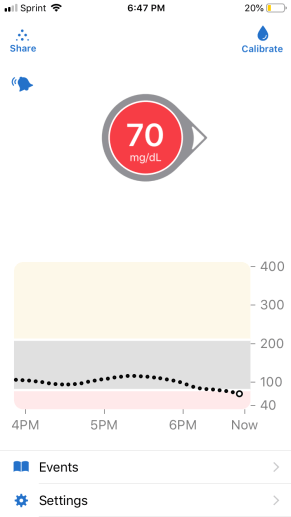
How annoying it was to start feeling shaky and sweaty, only to discover that my blood sugar was almost in the 60s soon after devouring my app and placing my dinner order. How irritating to know that the two chicken wings I just ate contained virtually zero carbs; therefore, would not do anything to boost my blood sugar any time soon. And how obnoxious it was, looking around the crowded restaurant and realizing it’d likely take some time for my meal to come out – and that the food I’d ordered was also relatively low carb (a bun-less turkey burger with side salad), and would also do nothing to correct my low.

4A4C70F8-D388-4A66-8380-250DE52E655B
You can see that I held off on correcting the low for as long as possible…but then the shakiness started.

Can you tell that I was just a bit irked at the situation?

I did what I had to do – reach into my backpack to grab one of the leftover granola cups from the pack of two I’d started earlier that day. I ate it quickly, crushing the wrapper in my hand and shoving it hastily back into my bag, hoping that no one saw me eating food that wasn’t from the restaurant like a wackadoodle.

And I swear, within five minutes, our food was out. I was happy but also just mad that I had to snack in between my appetizer and my main course. But diabetes is like a petulant toddler – it doesn’t care what you want or need, it just demands. It’s more demanding than any person or thing in my life. It’s exhausting, but there’s no choice other than to just oblige its needs, even if it means eating when you don’t want to.

7 Questions People Always Ask Me About Type 1 Diabetes

Human beings are naturally curious creatures. So it’s never really surprised me when, upon discovering my T1D, people tend to ask me boatloads of questions about what it’s like. And it’s definitely not at all shocking that many of these questions are recurring.

I've missed you terribly!

Here’s a list of seven questions that I’m almost always asked when I encounter someone who’s just learning about my diabetes. You’ll notice a trend as you read, because even though there’s “no such thing” as a stupid question, this list kinda gets dumber as it goes on. There, you’ve been warned…

7. What does it mean when your blood sugar is high/low?
This is definitely a fair question. I never expect someone who is unfamiliar with diabetes to know the meaning of hypoglycemia or hyperglycemia. I actually kind of appreciate being asked this question, because it helps me spread awareness. The more people that know how to react in severe high or low blood sugar cases, the better, IMHO.

6. Why do you wear all of those devices?
Another decent question – I never mind explaining how my CGM and my pump work, but I do mind when people say ignorant things, like “Oh, are those patches to help you quit smoking?” *Eye roll*

5. Can you eat/drink [fill-in-the-blank]?
Ugh…I get why people ask me this, but it’s a little more tiring to explain. My answer is usually along the lines of: “I can eat or drink whatever I like, but I need to take insulin to account for it. So I try to eat a limited amount of carbs at a time, because that means I have to take less insulin, and there’s less room for error.” But even after that easy-to-understand explanation, the typical follow-up questions are “BUT CAN YOU EAT CAKE/COOKIES/ICE CREAM/ANY SUGARY FOOD?!” And that’s when I lose a bit of my patience, TBH.

4. Does it hurt when you check your blood sugar/give yourself a shot?
I mean, no? I’m not trying to be facetious or anything, but really, after 21+ years of checking blood sugar and giving myself insulin multiple times per day…there’d be a real issue if it hurt every single time. I concede that there are the occasional sites that sting, but it’s not nearly as bad as many people seem to assume.

3. What’s that beeping sound/ARE YOU GOING TO EXPLODE?!
Honestly…use common sense. What’s the likelier scenario here: That my devices have built-in alarms, or that I’m going to spontaneously combust?

2. How did you get diabetes/WHAT DID YOU DO WRONG?
This. is. such. an. ignorant. question. Nobody, myself included, did anything “wrong” that resulted in my diabetes diagnosis. I didn’t catch it and no number of lifestyle changes could have prevented me from developing diabetes. My immune system merely decided to attack and destroy the insulin-producing beta cells that lived in my pancreas. There’s no real answer as to how diabetes is caused, though genetics likely play a role in it. Don’t worry, you won’t “catch” the ‘betes by being in my presence.

1. Do you have the…bad kind of diabetes?
This question is THE WORST of them all because there is no good kind of diabetes! Gestational, type 2, LADA…none of them are favorable. They all suck. They all require constant care, regulatory medications, and endocrinology expertise. So please for the love of all that is sacred and holy, next time you hear someone ask this question, gently inform them that there’s no such thing as good/bad diabetes.


That Time Low BG Made Me Mad at the Moon

Low blood sugars in the middle of the night are far from pleasant. But they’re especially grating when you’re just trying to have a sleepover with your best friends and your CGM alarms loudly and urgently, rousing more than just me from a peaceful slumber.

Dammit, diabetes…you’ve done it again.

I don’t know how or why the low happened. I went to bed around 1 A.M. – we had stayed up late talking, drinking wine, and eating snacks – and at that time, my blood sugar was 156. You can’t get much better than that, and it felt even sweeter because we’d eaten pizza for dinner earlier in the evening.

I thought I’d be fine overnight. I might come down a smidgen due to the unit and a half I took to cover a slice of fabulous flour-less chocolate cake (utterly heavenly), but I made the assumption that I wouldn’t come crashing down.

I should know by now…never assume with diabetes.

So it happened at about a quarter of four in the morning – a witching hour, in my mind. I woke to the frantic buzz buzz buzzing of my CGM and quickly acknowledged it, then reached for my tube of glucose tablets. I did it as silently as I could, seeing as I was sharing the room space with my three gal pals. From what I could tell, my super slow glucose tablet chewing didn’t even cause my friends to stir. It seemed that I’d successfully managed to avoid waking anyone up, thank goodness.

I was just starting to fall back into a doze when the frantic low CGM alarm blared – BEEP beep BEEP beep BEEEEEEEEEEEP. Ugh! Upon hearing the first beep I snatched up my receiver, silenced the alarm, and scooped up my test kit and my phone. I tiptoed out of the bedroom from which we were all nesting to the living room, where I searched through my backpack for the Skittles I’d purchased earlier in the day…because that’s right, this 3:45 low blood sugar hadn’t been my first in the last twelve-hour window of time.

Digital Imaging Specialist
Low blood sugar in the middle of the night can make you feel weird things…such as anger towards the moon.

I plopped myself on the couch and started furiously chewing Skittles. I remember looking out to the sliding glass doors and to the balcony and to the parking lot and then finally up to the sky to see the moon shining brightly at me. It was positively dazzling, yet infuriating with its cheerful gleam. I wanted to yell at it to stop looking so happy. I muttered to myself, “this sucks,” and reclined a bit on the couch while I waited to come up from the low.

Everything was fine within 15 minutes. I was on my way up and could safely go back to bed. And again, I congratulated myself for not waking anyone up.

Or so I thought.

“Did anyone hear my CGM go off in the middle of the night?” I asked my girlfriends, approximately six hours after the incident when we were all awake and about to head out to breakfast.

“Yes! I was wondering what that loud, aggressive noise was,” said one. I cringed, an apology lingering on the tip of my tongue, when she continued with an “are you okay? Don’t worry about the noise, I fell back asleep soon after.”

I was grateful for her reassurance, but also for her concern. It felt good to know that ultimately, she didn’t give (apologies for language) two shits about the actual sound that my low blood sugar caused, she was just worried that I recovered from it okay and could get back to sleep soon after.

I smiled to myself. Hours before, I’d been cursing the moon for merely existing and dealing with an annoying, random low blood sugar. But now, I was cruising at a great morning BG and I was on my way to get a delicious breakfast with my gal pals. Diabetes has its moments, but I sure as heck appreciate it when it cooperates during the ones that matter most. So in hindsight, the 3:45 A.M. low was nothing more than a temporary annoyance, and I was just glad that the worst thing it did was interrupt my sleep (and mine alone) for 10 minutes rather than ruin actual precious time spent with my friends.

Molly, Meet Metformin

You may have read the title to this post and said to yourself, “Met-WHAT?”

Metformin is the new medication I’ve started taking (along with my typical insulin) to help regulate my blood sugars.

Maybe you didn’t make it all the way to that second sentence; instead, maybe you just Googled Metformin to learn more about it. And you probably immediately got confused, because the Google search results explained that Metformin is a medication normally prescribed to people with type 2 diabetes. You know that I have type 1, though, so what gives? Why am I taking this new pill?

You see, for about a year or so, my endocrinologist has been gently encouraging me to try Metformin. She expressed concerns over the fact that I’ve had diabetes for more than 20 years, and in that span of time, I’ve had to take a lot of insulin. Like, an incalculable amount. And while that insulin helps to keep me alive, there’s also risks associated with it. Namely, she explained to me that there’s research that indicates that people with type 1 who rely on large amounts of insulin have a higher risk of developing cancer later in life.

ClearanceYard Sale

Whoa. The “c” word. Something I never thought I’d hear during a doctor’s appointment. If you know me personally at all, then I’m sure it’s not hard to imagine that I pretty much shutdown at the mention of “cancer”. Almost immediately, I panicked and asked why she thought this research was worth mentioning. She said that it was part of her reasoning for wanting me to start Metformin. The idea is that it would make my insulin more effective, and ultimately decrease the amount of insulin I need each day. She went into a little more detail, mentioning that the only side effects tend to be nausea/upset stomach – and that’s when I stopped listening. I politely told her that I didn’t think Metformin was a wise option for me at that time, and later that day, when I took to Twitter to ask other T1Ds what they thought, I gained swift validation that I’d made the right decision: Other T1Ds with Metformin experience told me that the stomach issues they had when taking it were miserable and that they wouldn’t recommend giving it a try. Plus, I consulted with my T1D pharmacist aunt, and her opinions matched those of the other T1Ds on Twitter. So that was all I needed to hear to feel at peace with my choice to not take Metformin.

In fact, it was enough for me to turn my endocrinologist’s offer down during our next two or three appointments. I was relieved that she never pushed me to try it, but there was a small part of me that wondered whether I should give it more serious consideration. Maybe I should let her talk me into a little, rather than brushing it away and using fear as my excuse.

So we did talk about, during my most recent visit with her earlier this month. She gave me some more compelling reasons to consider taking it. Not only could I reduce my insulin intake, but it might also help me with some preexisting digestive issues I’ve had since childhood. When I asked her about the negative side effects on the stomach that I’d read about online, she told me that she would only prescribe me the “extended release” version of Metformin, which had a much lower (if any) chance of inducing nausea or any less…desirable gastrointestinal disorders.

This news definitely perked me up. We discussed a plan for introducing Metformin to my body: Start by taking one pill daily after dinner. Increase by one pill each week until I’m at four pills per day, the limit. At any point in time, I could message her with questions if I started to notice low blood sugars in the evening.

I felt reassured by this logical plan, as well as her explanations of the benefits of Metformin. So I bit the bullet and I’m in my first week of incorporating it into my post-dinner routine. I can’t say that I’ve noticed even the slightest difference, which isn’t a bad thing. I imagine that will change as my dosage increases.

I intend to blog about this new journey with Metformin; not just for the sake of keeping track of how it affects me, but to also help inform other T1Ds who may have been or may be in the same situation that I was. We’ll just have to see how it goes, but for now, rest assured that I’ll be honest in my writings about my Metformin experience. At this moment in time, I can’t help but feel hopeful that down the road, I’ll be glad I made this decision when I felt ready for it, as opposed to when I was fearful of it.

A T1Diary of my Recent Endo Appointment

I’m trying something new here today, folks. As you can see, this blog post features not just words, but video, too. How exciting! The aforementioned video shows the before, during, and after of my most recent endocrinologist appointment. I share a touch more than I normally would in this format, and I cover something that’ll be a big subject in one of my upcoming blog posts.

Originally, I shared this video (in short clips) directly to Instagram, where it would live in my stories for 24 hours before going away. But the thought occurred to me to save and splice the video segments together to create a full video, albeit a poorly manufactured one. I’ve decided to call it my first attempt at video blogging, otherwise known as vlogging.

Fear not, my fellow wordsmiths: I still plan on writing actual blog posts. I’m not sure how regularly I’ll be vlogging. But I can promise that if people kinda dig this, then I’ll make a point to vlog semi-regularly. I can also promise that the videos will be a bit shorter and shot in one take, because 1) I don’t think anyone wants to hear/watch me blabber for more than a couple minutes and 2) it’ll help ensure that I don’t jump around from topic to topic. And for the sake of full disclosure, I’m not lovin’ my once-a-month Favorite Things Friday post as much as I used to…so this may eventually replace it. We’ll see.

So, without further ado, enjoy this little video from me…and remember that it was initially created for Instagram, which encourages users to make very short video/photo clips, and helps explain why this whole package is a bit choppy. And please do let me know, in the comments or on various social media channels (accessible in the upper-right hand menu of the Hugging the Cactus homepage), what your thoughts are on vlogging.


The Hellacious, Headstrong High

There’s lots of different “kinds” of high blood sugar. There is the type that is self-inflicted due to inaccurate carb counting or insulin dosing. There’s the sort that can be blamed on technological error – an insulin pump failure or a cannula kink, for instance. And another kind is linked to illness, when a cold or other sickness prevents insulin from working efficiently, thereby stopping blood sugars from coming down to normal levels.

And then there’s the type of high blood sugar that simply can’t be explained. It’s high for seemingly no goddamn reason, and it’s the most frustrating high of them all.

That kind of high is also the kind that takes what feels like forever to come down.

I experienced this after a Saturday of travel earlier this month. I’m fairly accustomed to traveling, especially if it’s a quick trip on a plane or just a few short hours in the car. I say this because I’m almost positive that my hours-long high blood sugar had nothing to do with my travel day…although when it comes to diabetes, nothing can truly be ruled out.

Anyways, I digress. That day involved me heading out of the house at 10 A.M. I drove to the shuttle that would take me to the airport. I got to the airport about an hour before my flight was due to take off. I went through TSA Pre-Check – my first time using the service, which I totally recommend – without any issues. I had enough time to pick up some food for a small lunch, but when I checked my CGM and noticed that my blood sugars were hovering in the 200s, I decided to deliberately pick lower-carb snacks to munch on in lieu of a real lunch. Turkey jerkey and cheddar popcorn weren’t the most filling snacks, but it was something.

I figured that by the time I got on the plane, my blood sugars would be stabilizing. No such luck. I was still in the low 200s. I took one or two more boluses during my quick hour-and-a-half long flight, thinking that I must be heading for a blood sugar crash by the time I deplaned. Nope. I was still running high, even by the time I met my partner by the baggage claim. I raised my temp basal and kept my fingers crossed that by the time we reached the restaurant we were bound for, I’d be coasting down. As we got settled at our table, I checked my blood sugar and felt slightly relieved to see that I was 183. At least I was finally below 200.

Teacher's Month 2020

I pushed blood sugar worries out of my mind for the next hour or so. I just wanted to enjoy my meal and my time with my significant other. But as we finished eating and made our back to the car, I couldn’t help but notice the repeated buzzing coming from my CGM. I was rising gradually, well on my way to 300. I tried to not panic and gave myself more insulin. We arrived home and the vicious cycle truly began. For the next three or four hours, I tested and corrected every hour, on the hour. Midway through that interval of time, I changed my pod – perhaps it stopped working properly – and prayed that the new pod would finally bring me back down.

And, spoiler alert: It eventually did. But in the agonizingly long hours I had to wait before my blood sugar was down…I experienced a bevy of emotions. I was mad. I was upset. At one point, I was very technical and rational, going through my next steps both in my head and out loud to my worried partner. He asked me what we should do in the event that my blood sugar was still elevated after a certain length of time, and that’s when I started crying tears of fear and frustration. It all felt so unfair. I was doing all the right things and it wasn’t make a difference. That was a hard reality to swallow. And I couldn’t help but cry harder when he asked me to show him how to use glucagon again (it’s been at least 3 years since he had formal training with my diabetes educator). Part of me felt better, knowing that he was prepared for adverse affects of taking so much insulin to combat a high, but I think I was more focused on and distraught by the fact that he might need to intervene, which was an especially upsetting scenario because I never want to put that responsibility on anyone.

Once I calmed down, I filled a water glass, sat down on the couch, and texted my mother, who is always my T1D sounding board. She reassured me that I was doing the right things, and that I should continue to wait and see what happened. She also advised me that I should be prepared for a crash, because sometimes, it seems like all the insulin kicks in at once when blood sugar drops too quickly/low from a high.

So I waited. I drank water. I showed my boyfriend the app on my phone that simulates glucagon injections – just in case. I played video games. I tried to keep my cool. Before long, it was nearing midnight, and I desperately wanted to curl up in bed. I went through my pre-bed routine, washing my face and brushing my teeth, knowing I’d check my blood sugar for the umpteenth time that night once I was done.

And…it was 153. Better yet, it didn’t go as low as it could have overnight: I dropped to about 75 by 8:30 A.M. All things considered, it was a decent outcome.

The hellacious, headstrong high had finally subsided. I was so, incredibly relieved. And I’m so, incredibly hopeful that I don’t experience a day like that again any time soon.

Is a Bleeder a Reader? My Take on a Bloody Dexcom G6 Insertion

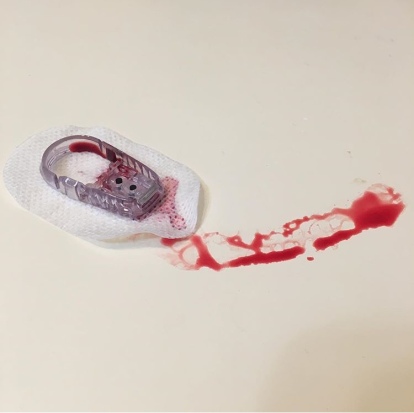
This blog post probably shouldn’t be read by anyone who gets squeamish when discussing blood or when viewing photos that show any amount of it…my apologies in advance for a bloody gross blog post, but I thought this was a good topic for discussion. 

I placed the new Dexcom G6 sensor on my abdomen, hovering my index finger above the large orange insertion button. I pressed it, exhaling as I felt the minute needle pierce my skin’s surface. I looked down, and started to rub the adhesive in circles to make sure it was stuck, when I saw blood. Not just a drop, but a decent-sized pool forming beneath the sensor. Before long, just about the entire surface of the white adhesive was soaked in red.

Yeah, this was going to be a no-go.

It’s pretty rare for me to experience blood at the site of a Dexcom sensor. If I had to put a number on it, I would say less than 10% of my insertions draw blood. An even smaller amount – like, 2% – have caused me to bleed as much I did in the scenario described above. But I know I’m not alone in my bloody sensor experiences – it’s something that many other T1Ds who use a Dexcom have gone through.

There’s a bit of debate, though, that I’ve noticed in the past on Twitter threads and Instagram posts. What to do with a bleeder? Keep it and assume that it’ll read blood sugars normally? Or change it immediately and call Dexcom for a replacement?

Are bleeders readers? Or does it depend?

1B278EF4-8498-4968-81F9-9134870F3C1E
Do you think that bleeders are readers?

I’m going to go with…it depends.

Obviously, in that situation I described in the opening of this post, I decided that it wasn’t a good idea to keep the sensor on my body. There was too much blood and I didn’t trust that it would adhere well to my body. I didn’t know how long it would take for the blood to stop (only a few minutes, but still), and I couldn’t be sure that it wouldn’t mess up my readings. On top of that, I wasn’t trying to stain my clothing, if I could help it.

So in that circumstance, I did change my sensor right away, and was glad that the second try resulted in a much cleaner, blood-free insertion. I called Dexcom, explained what happened to the customer support representative, and got a replacement sensor mailed to me.

However, just about any other time I bleed upon a sensor insertion, it tends to be a minuscule amount of blood. I usually don’t even notice until it’s time to replace the sensor, and there’s a bit of dried blood left on the site. Other times, I’ll see small beads of blood forming underneath the spot where the transmitter snaps in. And there’s been a couple of occasions that I’ve bled a fair amount and been totally unaware of it until I caught my reflection in the mirror and noticed the blood staining the white adhesive. And in all of those cases, I’ve kept the sensor on for the full ten days, without noticing any discrepancies in my readings.

All that considered, in my inexpert opinion, I think that bleeders usually are readers and that they’re safe to continue wearing. Of course, there will be exceptions, like when there’s just too much blood to salvage the sensor. But every time I’ve kept using a bloody sensor, I’ve had the same amount of success with its functionality…so yes, I think that for me, bleeders are indeed readers.


Favorite Things Friday: My Very-Precise Pod Change Procedure

One Friday per month, I’ll write about my favorite things that make life with diabetes a little easier for me.

Not too long ago, it occurred to me that I am very, very, very, very, very strict about following a specific protocol every three days when I change my pod. In fact, it rarely deviates, but when it does (due to circumstances beyond my control), it throws me off track, like, a lot…which is why the way I do it is my favorite way.

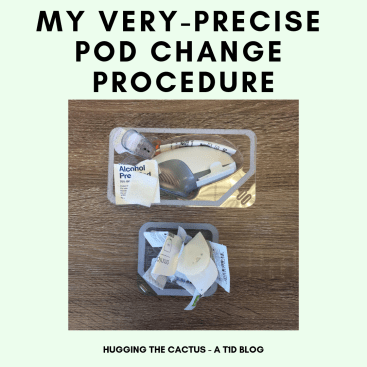
my pod change procedure
Detritus from a typical set of site changes.

What’s so precise about my pod change procedure? Let me walk you through it…

Step 1) The numero uno thing I do, a half hour before I start my procedure for real, is remove a vial of insulin from the refrigerator. I’ve always been told that it’s important to let the insulin reach room temperature for at least 30 minutes before I start the pod change process. My mother was the one who told me that this step is crucial, because years ago, she’d heard from a representative at Insulet that room temperature insulin works best with pods for whatever reason.

Step 2) Once my insulin has reached room temperature, I set myself up at the island in the kitchen to go through the rest of the process. I make sure I have a totally clear area and ample lighting before I start on step #2.

Step 3) Next, I take an alcohol swab and wipe the top of the insulin vial that I’m drawing insulin from, and then I wipe my new site.

Step 4) Before even touching my PDM, I grab my syringe, stick it into the vial, and suck up the amount of insulin I’ll need for the next three days. This is usually somewhere between 100 and 150 units.

Step 5) This is where I deactivate my old pod, and jab at the buttons on my PDM to start the new pod activation process. The only reason why I get insulin into the syringe first is to minimize the amount of time I spend without a pod on my body. You might be surprised to learn that a short period of time without insulin can make a difference on blood sugar levels, but that’s just the way it is.

Step 6) I fill the new pod with insulin and hit a button to get it to start priming. During the priming period, I use an adhesive wipe around the new pod’s site to help it stick better to my skin.

Step 7) I finish up the process of removing the pod’s needle cap, then the adhesive stickers. I apply it with care to the new site and put pressure on it as I wait for the cannula to inject itself under my skin’s surface. And then I’m good to go!

Of course, I can’t always follow these steps as I’ve outlined them above. And while it messes me up a bit, and I usually have to take a little longer to change it, I roll with the punches and get it done. For instance, when I last visited Disney World, I had to change my pod in one of the park’s dimly-lit family restrooms with my mom using her outstretched hands as my mini work surface…far from ideal, but it was what it was.

Like all things associated with diabetes, I guess that I take comfort in keeping a routine, even with something as minor as a pod change.