A Passive Aggressive Email to My Diabetes

Ah, emails. They’re an effective way to communicate with colleagues, but just like text messages or any other written bit of information, it’s almost always impossible to gauge the tone of an email; thereby, making it really easy to misconstrue the meaning behind some of them.

Some, but not all.

In those other scenarios, it’s obvious what the sender was intending to convey if the email is peppered with particular language that is best characterized as passive aggressive. This language is polite and direct, but maybe said with a little bit of an attitude depending on the context. And almost everyone is guilty of sending an email with passive aggressive language within it, myself included.

There’s scarcely been a single time in which I actually wanted to come across as aggressive, or worse, disrespectful. But by the same token, it can be difficult to mask frustration when something was clearly conveyed in a prior communication or when you’re seeking feedback that nobody is providing to you.

So as I contemplated passive aggressive emails, and the phrases that typically comprise them, it dawned on me that there is definitely an email recipient that I’d love to send a fully charged, passive aggressive communication to…and that is, of course, my diabetes. Without further ado, here’s what I’d say in it:

Dear diabetes,

I wanted to circle back and ask you for an update. Sorry to bother you again, but I’m looking for feedback on how I could improve our working relationship.

As per my last email to you, I want to work smarter, not harder with you. As we discussed, your disruptions throughout my day affect more than just my productivity; moreover, they make it difficult for me to maintain a positive attitude. We both have a shared goal to maintain in-range blood sugars and in order to make that happen, I want to better understand your approach. What kinds of changes, if any, do you need me to make so I can help you thrive? Please advise. I’d be happy to escalate this issue to management, but in order to use time and resources more effectively, I wanted to follow up with you again first.

In order to maintain clarity, it’s important for you to reply at your earliest convenience. This is just my friendly reminder to you that I’d greatly appreciate your input or suggestions. Should you need further clarification, please don’t hesitate to contact me.

Thanks in advance,

Molly

Oooh, just merely crafting that pretend email made my fingertips tingle with the sarcasm as I typed. I’m not sure I’ve ever written something that was so clearly dripping with frustration and scorn, but I gotta say, it felt kinda nice.

And genuinely, I would greatly appreciate getting some type of response from my diabetes. It’s not like I’m going through burnout right now, but there have been some truly head-scratching moments in my life with diabetes lately that make me go “whyyyyyyyyyyy thoughhhhhhhhhh” in my most whiny tone of voice. Its unpredictability can get a little old, and I just want to know what I could or should be doing differently in order to handle it better.

Guess I’ll just have to find some solace in at least capturing my feelings here, and knowing that the periods of unpredictability will come and go, just as my blood sugar will rise and lower.
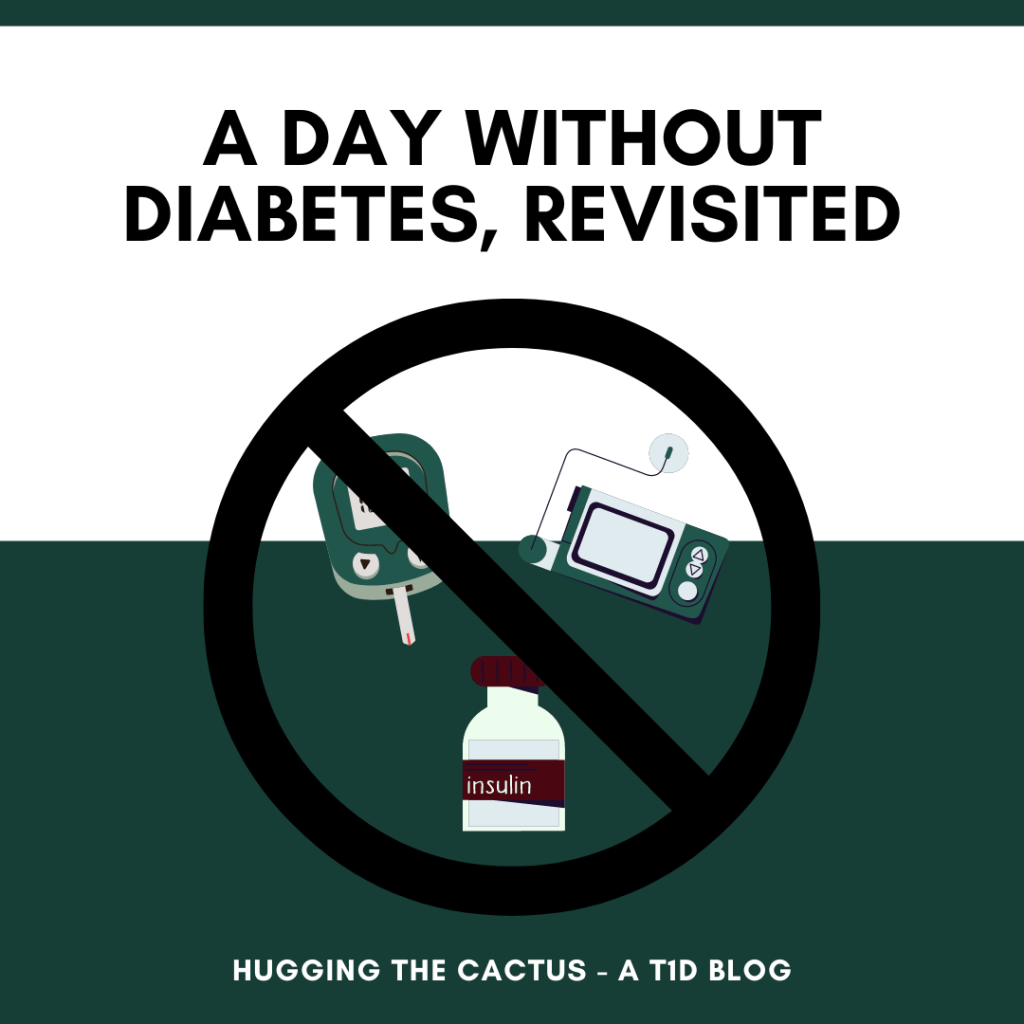
A Day Without Diabetes, Revisited

A day without diabetes…it’ll happen, one day. Who knows when. But until that happy time, it’s fun to think about what a day without diabetes would look like for me. Originally, I dreamed up a diabetes-free day 5 years ago (which you can read about here); while what I wrote then is still pretty much 100% true for me now, I think it’s more enjoyable to think about the bigger picture rather than get into the nitty-gritty details – though I definitely wouldn’t say no to any of the specifications I got into my previous post!

What does the bigger picture look like? In a word, bliss. In a list, something like this:

  • Eat whatever the hell I want without repercussions
  • Exercise in any form without my blood sugar levels stopping me
  • Enjoy the silence created by no beeping or alarming devices
  • Embrace a device-free body
  • Evade needles of all shapes and sizes, excess medications, and tiny blood droplets that won’t stain my clothing because they aren’t there
  • Experience peace of mind in knowing that my decisions for the day would not be sway in any form by diabetes

I think it’s that last bullet point that resonates with me more than any of the others – “experience peace of mind”. While I can certainly attain that even while actively managing my diabetes, it’s not quite the same because there’s always a part of me, even if it’s tinier than a speck of dust, that will worry about diabetes. I can’t ever seem to get rid of it. But I could if I were to ever experience a day without diabetes.

That’s why I remain hopeful, if not naively optimistic, that I’ll get to experience one – and many others, to boot, if I want to get really enthusiastic about it – in my lifetime.

The Last Time I Cried About My Diabetes

It was around 4 o’clock in the morning. Rain was pounding relentlessly outside my window. The power must’ve gone out, because flickering lights and the sudden sound of my heat turning back on woke me up with a start.

I tried to let the sound of the falling rain lull me back to sleep, but it was loud. I tossed and turned, doing my best to resist the temptation to check my phone and mindlessly scroll through various feeds until I felt sleepy again, but before long I gave in. As I almost always do every time I unlock my phone, I tapped on the Dexcom app so I could see what was going on with my blood sugar.

At that present moment, I was 92 and steady, but what my graph indicated to me in the previous couple of hours made me audibly gasp.

I had fallen to below 55 at some point in the middle of the night, and stayed in fairly low territory for nearly two full hours before making the slow climb back up.

That’s when it came surging back to me: The memory of waking up, some hours before, to the sound of an urgent low alarm. And then me totally ignoring it in favor of sleep.

The realization hit me as hard as the rain was striking against my rooftop, and then the tears welled in my eyes. I lay there, crying quietly, as I tried to accept the reality that choosing sleep over fixing my low blood sugar could’ve been an extreme error on my part. What if the rain and the power outage hadn’t woken me up? I recognized that given my current blood sugar graph, I would’ve been just fine, but regardless I had still slept through a low and that frightened me – I’m not sure if I’ve ever done that before. Just as I was beginning to really freak out, I felt a rush of gratitude toward my Omnipod 5. After all, it had seemingly detected the low blood sugar and then lessened my basal rate (or perhaps completely stopped delivering any basal insulin altogether) in order to bring my blood sugar back up. I felt as though the system had possibly just saved my life.

So I couldn’t help but lay there and let the tears fall, marveling at the technology that I felt indebted to at this particular moment in time, before I found myself drifting off into a dreamless sleep again.

Don’t Say This to a Person with Diabetes

This blog post was originally published on Hugging the Cactus way back in 2018. I’m sharing it again today because I think it’s important for people to know that they don’t have to feel sorry for me when it comes to my diabetes. Read on to understand why that’s my perspective…

Today’s blog post is going to be short and sweet, and about a subject that I think every person with diabetes deals with whenever they tell someone new about their diabetes.

It doesn’t matter how diabetes comes up in conversation. Whether it’s in a joking, serious, educational, happy, sad, or angry manner, the person I’m talking to almost always says…

“I’m sorry.”

Sometimes, I think it’s because society has instilled this weird reflex in people to apologize for something that they didn’t do. Other times, I think it’s because people just don’t know how else to respond to something that may be sobering or grounded in reality. But the simple fact of the matter is…

People need to stop apologizing to me, and other people with diabetes, for having it.

Here’s why:

  1. It doesn’t make sense.
  2. We weren’t given a choice – it’s a simple truth that we’ve learned to accept.
  3. It makes me feel strange, because it’s almost like the other person is taking accountability for my diabetes.
  4. I believe that human beings apologize too much, in general, and it diminishes apologies when they matter most or are most sincere.
  5. I’m not sorry that I have diabetes, so why should someone else be?

While I genuinely empathize with and appreciate people who apologize as a knee-jerk response, I’m just here to gently tell them that it isn’t necessary. Save “I’m sorry” for times that it’s warranted, and not for something like having diabetes, a matter in which no one has a choice.

The Language of Diabetes: Is it a “Chronic Illness”, a “Disease”, or a “Condition”?

What would you say if someone asked you to identify diabetes as one of the following: 1) a chronic illness, 2) a disease, or 3) a condition?

My response would be…it’s not so clear-cut for me. It’d change depending on how I felt about my diabetes at a given moment in time.

What word(s) would you use to identify diabetes?

So for example, on the days when diabetes dominates all of my thoughts and emotions with its unrelenting nature, I’d be more inclined to call it a chronic illness. On those occasions, my diabetes seems determined to remind me that it’s not going anywhere, and that I’d better just accept that it’s here to stay.

But when diabetes is straight-up pissing me off – say because of a medical device failure or a stubborn high blood sugar that won’t come down – I’d call it a disease. It seems to be a fitting title for something that’s acting in a disordered nature, and goodness knows it infuriates me to no end when the elements of diabetes that I can more usually control act out unpredictably.

And then it’s when diabetes and I are just mutually co-existing. I’m aware of it, and it’s aware of me, but it doesn’t have the ability to impact my emotions like it does when it’s behaving more like a chronic illness or a disease. When diabetes is my condition, I have it – it doesn’t have me.

I could be reaching a bit here with my musings on associating diabetes with different words, but truly, language is powerful in diabetes (and really, in all aspects of life). Words and phrases have connotations and significance depending on the contexts in which they’re used, making their endless combinations utterly fascinating. Because of this, I believe that examining the specific language around diabetes is extremely interesting as I think about the ways I describe my own diabetes experience and how that involves my emotions.

And what’s really cool is that there’s no right or wrong way about the words I choose to use regularly around my diabetes because it’s my story to tell. Here’s a friendly reminder that the same applies to you, too.

Is it Possible to Decentralize Diabetes?

First of all…what does that question even mean? What does it mean to decentralize diabetes?

In this context, I think of it as deprioritizing diabetes (maybe that’s the better word to use here, but let’s bear with me…let’s stick with decentralize). It’s knocking it down a few pegs rather than keeping it as a permanent fixture at the top of my to-do list.

So I guess this question should be phrased less generally – because of course it’s possible to decentralize diabetes – and more specifically target me, as an individual who is solely responsible for her diabetes care and management…

…is it possible for me to decentralize diabetes from my life?

I’m of two minds when it comes to landing on an answer. On the one hand, I can’t really imagine myself ever being successful at decentralizing diabetes. I’m always thinking about it. Every decision I make, consciously or subconsciously, is made knowing that it will have implications (in some way or another) on my diabetes. Even when I’m asleep, I can’t escape diabetes because if it’s not directly impacting my slumber by waking me up, then it’s the first thing I think of each day because I do a blood sugar check the moment my eyes are open.

On the other hand…

I’ve been using an Omnipod 5 since late August/early September and although I struggled to adapt to it until recently, it’s since come to represent what feels like a diabetes reprieve. For the first time in my life, I’m thinking of diabetes a teensy-weensy bit less, and I do think that my newfound understanding of the automated insulin delivery system is directly responsible for that. It’s been scary to relinquish control that I’ve maintained for so long over every aspect of my diabetes routine – and hand it over to a piece of technology, to boot – but it’s finally beginning to pay off. Which reiterates the question: Is it really, truly possible for me to decentralize diabetes and let myself be a person first, rather than a diabetic first?

After writing this post and musing further on the subject, I’d comfortably say…it very well could be. With some more time and heaps of patience, I do think I can get to a point where my whole world revolves a little less closely ’round my diabetes.

8 Things About Diabetes That Make Me Want to Rip My Hair Out

This post was originally published on Hugging the Cactus on June 5, 2020. I’m sharing it again today because I’ve had my fair share of moments lately in which I’ve genuinely felt like ripping out my hair (or punching the wall) over my diabetes! Read on and find out if you agree with this list – and leave a comment to let me know what you’d add!

Life with diabetes can be the opposite of a cakewalk. In fact, it can be so frustrating at times that I seriously consider ripping my hair out due to sheer agitation.

When thinking about the things that drive me nuts about diabetes, I came up with a list of 8 occasions in which I come this CLOSE to losing my freakin’ marbles:

1. When low blood sugars refuse to come up…

2. …And when high blood sugars refuse to come back down.

I’m considering these first two as separate list items because the scariness of a lingering low and the frustrating nature of a stubborn high can be two very different types of “GAAAAAAAAHHHH!” But both can be especially suck-y when you feel and know that you’ve been doing everything right to treat them without experiencing the expected results.

3. Pod and CGM sensor failures.

Oooh, any sort of device failure can be so exasperating any time of day. But they’re worse when they happen at inconvenient times, such as in the middle of the night or during an important conference call. All diabetes technology should work flawlessly at all times, but that’s not always the reality that we live in.

4. Inaccurate results.

I can’t stand when my blood sugar meter or my CGM report false readings. Sometimes, I’ll check my blood sugar two times in a row just to see how close both readings are to one another, and it makes me want to throw my meter across the room when I see that they’re off by 20+ points. Once, I had a reading that was off by more than 50 points! That makes a major difference in how much insulin I give myself in that moment in time, so inaccurate results can really derail my blood sugars for hours after.

When I first found this illustration, I could’ve sworn the lady was flipping the bird…which would also be an accurate depiction of what these 8 things make me feel like doing!

5. Folds in the adhesive.

Whenever I apply a fresh sensor or a pod, I try to be super careful and make sure that the adhesive sticks smoothly…but despite my best efforts, that doesn’t always happen. Folds in the adhesive are far from the worst thing in the world, but they do make it more difficult for my devices to stick on for the full length of time that I need to wear them, and I usually end up having to add tape around them to reinforce the hold. More tape = more folds = more irritation!!!

6. Unexplained blood sugars.

Anyone with diabetes has been there, done that. You could follow the exact same routine from one day to the next, even eating the same foods at the same times, and get totally different blood sugar results. Or maybe you thought that you bolused perfectly for a meal, only to find out hours later that you’re much higher or lower than you anticipated. Whatever the reason behind them may be, unexplained blood sugars are just obnoxious.

7. Screeching alarms.

Speaking of things that are obnoxious, let’s talk about wailing OmniPod or Dexcom alarms for a hot second. There’s nothing like a resounding BEEEEEEEEEEEEEEEEEEEP to ruin your day!

8. The INSANE costs of our supplies.

Undoubtedly, the thing that most makes me want to rip my hair out when it comes to diabetes is the cost of supplies. I’ve blogged more and more recently about the criminal cost of insulin – since the 1990s, the cost of insulin has increased over 1,200% (!!!) – and I’ll continue to do so until EVERYONE with diabetes can afford this life-saving medication. We never asked for diabetes to happen to us. But it did. And the fact that many people with diabetes have to make sacrifices in order to, well, survive, is simply not okay, and the most infuriating thing about living with this chronic illness.