I feel defeated when it comes to just about every aspect of my life with diabetes as of late.
I feel defeated in terms of my blood sugars lately: I’ve experienced too many highs due to an ever-present fear of low blood sugars.
I feel defeated in terms of what my A1c reading might be at my endocrinologist appointment next month: I don’t even have a clue as to what the value might be right now, but my intuition is telling me that it’s higher than I want it to be, which sucks because I’ve tried hard to keep it down.
I feel defeated in terms of my diabetes supplies: I’ve had to pay a lot more money than I ever anticipated for them. I turned 26 less than 6 months ago and I’m having trouble imagining paying so much money for my supplies for the rest of my life, let alone the rest of the year. I know I’m not alone, but knowing that others are struggling (in very different and similar ways) makes me feel worse.
I feel defeated in terms of this blog: I feel like nobody else really cares about it except me. This is fine in some ways because one of the reasons why I write this blog is because it’s a form of therapy for me. But in other ways, this makes me sad because another reason why I started Hugging the Cactus was to make a positive impact, somehow, on the diabetes community that I love so much. But it’s hard. There’s many bigger, louder, more important voices in the online space that simply have a better reach than me. These people know how to connect with their audience in a way that makes a more profound impact than I ever could. Lately, I’m asking myself, “why bother” a lot more than I’m saying to myself “keep it up”.
I’m not writing about my diabetes-related feelings of defeat – my dia-feat – to garner sympathy or attention. I’m just trying to keep it real. It’s a little different than what I would consider conventional “diabetes burnout” to be, because I do still have that desire to thrive and do well with my diabetes management…but things just aren’t quite going my way.
I know that other people like me feel this way sometimes.
And I know that the dia-feat won’t last forever.
But it is important for me to acknowledge it now, so I can start figuring out how to dust myself off and pick myself back up soon.
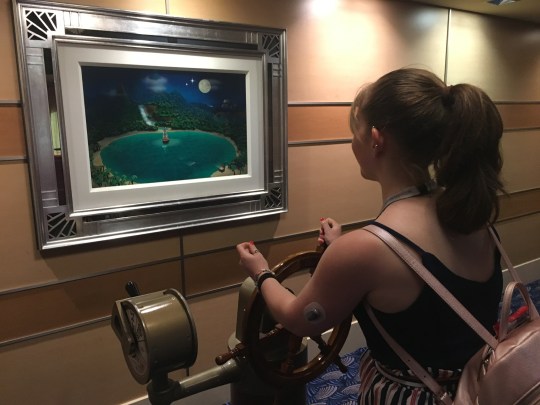
I gleefully sang this song multiple times throughout my short Disney cruise getaway earlier this month. I love cruises. I love Disney. I love tropical islands. So I got to combine my love for all three by embarking on a cruise to the Bahamas with my boyfriend that was planned sort of last minute, but desperately needed nonetheless.
When it comes to diabetes management on a cruise ship, I’m the captain (who does what she can to navigate safely through rough waters).
I’m so glad we went, even if it did involve a helluva ton of preparation time. Because as you’ve probably figured it out by now, traveling with diabetes requires extra work. But traveling with diabetes knowing that you’ll be stranded in the middle of the ocean for part of the time necessitates apocalypse-level planning.
There was a whole list of questions I needed to answer as I packed my bags for the trip. How many pods should I bring with me? How much insulin? How would I keep said insulin cool? What types of snacks should I have on hand? Should I bother bringing Glucagon? What about chargers for all of my devices?
The answer to most of those questions was…just bring more supplies than I think I’ll need. For instance, I brought triple the number of pods than I’d actually go through over the course of a four-night trip. I packed extra snacks – a few unopened boxes of granola bars and a whole bottle of glucose tablets. I don’t even know how many alcohol swabs or spare syringes I brought, that’s how many I crammed in my luggage. And I deemed that two bottles of Humalog, plus Glucagon, would be ample (after all, I’d rather have it all and not need it than need something random and not have it).
I ended up purchasing a cooling case on Amazon that would allegedly keep my insulin cool during the day trips we’d make to the islands. I say “allegedly” because it wound up not being that great (otherwise, I’d add a link here to purchase it). After a day on Disney’s private island, Castaway Cay, in which the cooling case never left the shade of our umbrella, I returned to our state room to discover the contents of the case were a bit warmer than I had expected. Disappointing, but the insulin still seemed safe to use.
In terms of meals and snacks on the boat, there was a plethora of foods to choose from. Oh, and virtual 24/7 access to a soft-serve ice cream machine. Aaaaand a lot of tempting tropical libations. I tried to stick to healthy options and incorporate vegetables or proteins at each meal, and of course I drank plenty of water, but it was vacation and I couldn’t resist a Mickey waffle at breakfast each morning or the occasional mojito-filled coconut. So it’s not totally surprising that on average, I ran a bit higher than I’d normally like for the whole cruise, but I don’t regret it because it’s really hard to judge how much insulin to take or food to consume when the days are jam-packed with physical activities and sun exposure. And I accomplished my goal of avoiding low blood sugars as much as I could, because I absolutely did not want to be stranded on the sand treating a low when I could’ve been swimming in the most gloriously warm turquoise waters with sea creatures.
Even though my diet wasn’t the healthiest, I was able to combat some of those choices with a lot of movement during the cruise. Between strolling the walking track that was on deck three of the ship, bicycling on Castaway Cay, snorkeling/swimming at the beach, and walking ALL OVER both land and ship to get wherever I wanted to go, I clocked some seriously miles on this vacation. Who would’ve thought that being on a boat would lead to so much exercise getting automatically incorporated into my day?
So sure, going on a cruise vacation does add an extra layer of stress to trip preparation. But trust me when I say it’s worth it. I was blissfully happy during the whole cruise and, even though I didn’t need more than half the supplies I brought with me, I enjoyed the peace of mind it resulted in because I’d taken the time to think things through. It just goes to show that diabetes can’t prevent the enjoyment of any type of travel.
So basically everyone in my life right now is engaged, or on the fast-track to getting engaged.
And that’s awesome! No, seriously, it’s an exciting time for a lot of my family and friends. And I’m happy to be part of it all because I like going to weddings. Who doesn’t love to celebrate love?
Well, I can tell you what doesn’t love to celebrate love…MY DIABETES.
My diabetes effing hates weddings.
My diabetes hates weddings SO much that I’ve yet to go to one where it doesn’t act up in some way.
I was naive enough to think that it would actually be a good diabetes day during the last wedding I attended. And it was, for the most part: I woke up, had a Dunkin Donuts sandwich for breakfast, got dressed and made-up. I showed up for the ceremony with a slightly low blood sugar that was swiftly corrected with a mini box of raisins (oh, if only I knew how many more I’d consume that night…).
I was fine, right through the cocktail hour and the start of dinner. But that’s where the troubles began. You see, there weren’t many passed hors d’oeuvres during the cocktail hour, and I could’ve really used some because I hadn’t eaten anything besides the sandwich and the raisins all day long. By the time dinner started, I was ravenous and basically shoved anything within arm’s reach into my mouth. This included a lot of cheese, meats, and pieces of flatbread.
If I’d actually been thinking about how my blood sugars usually respond to slow-acting carbs in things like flatbread, I might’ve actually wound up okay. But over the course of the next several hours, as wedding guests were whooping it up on the dance floor, my blood sugar was making a slow and steady climb up into the 300s! When I finally realized this, I started taking correction boluses that, apparently, were far too aggressive…because when I finally ended the night in my hotel room around 1:30 A.M., I was in the 70s. And dropping.
My lowest blood sugar was 43 that night. I ate multiple packs of raisins, 5 or 6 glucose tablets, a FiberOne bar, and half a pack of peanut butter crackers. All between the hours of 1:30 and 4 in the morning. It was exhausting. I was tearful and sweating so badly at one point that it looked like I had just come out of the shower. I even wound up sending my sleepy boyfriend down to the lobby at one point to buy me an orange juice, because I was running out of low blood sugar remedies. I drank half of it and was relieved to see my CGM showing, at long last, a diagonal up arrow. I couldn’t believe that I’d just spent the last few hours hovering below my “low” threshold on my CGM, but I didn’t waste any more time thinking about it – I was extraordinarily tired and happy to finally go to sleep.
But now that I’ve had time to think about it, I’ve realized that I need a new strategy for myself and my diabetes when it comes to weddings. I’m going to be my cousin’s maid of honor next month, for goodness’ sake, so I want to do everything I can to ensure “decent” (i.e, blood sugars under 200 but over 80) for the special day.
A key to success, I think, will be regularly scheduled meals and making sure that I avoid an empty stomach at all costs.
Do you have diabetes and will turn 26 in the near future? Will you be forced to switch from your parents’ health insurance to your own plan? If the answer to both of those questions is “yes”, then you’ll definitely want to take a minute to read my tips on how to make the transition as smoothly as possible. And even if you answered “no”, you still might find this to be a worthwhile read because chances are, either you or someone you know will have to go through this process, whether or not you/they have diabetes.
Here are the three most valuable tips I have for anyone who just turned, or is about to turn, 26 years old and is concerned about switching health care plans:
I figured out these tips the hard way. Save yourself a lot of frustration and time by following them A.S.A.P.
Tip #1: Ask your doctor for copies of all of your prescriptions. Do this well before your actual birthday. That’s what I did, anyways – I had a scheduled appointment with my endocrinologist at the end of April. That’s when I requested a copy of every single prescription she’s ever written for me, including for medications that I don’t really use anymore (e.g., Lantus, the long-acting insulin I used prior to my insulin pump). Then, I made multiple copies of these prescriptions, taking care to separate the originals from the copies. This tip really came from my mother, who told me that having the prescriptions now would save me trouble later. And she was right: When I did send in my Humalog prescription to Express Scripts, I did so with more confidence because I didn’t have to scramble to request it from my doctor.
Tip #2: Start the process of reordering supplies as soon as possible. Even if it means starting to reorder things on your actual birthday…do it. I’d say this is especially important if you’re running low on supplies. It took me nearly two months to start receiving stuff. Part of this was my fault because I procrastinated, and was also at an advantage because my mother took the time to order me plenty of extra supplies before I made the switch. But it was also the fault of the companies I was ordering from, who, for various reasons, didn’t send out my supplies on time or needed a longer period of time to review my orders before shipping them out. I’m lucky that I can say that I was never truly worried that I was going to run out of supplies, but the thought did cross my mind a few times, and it was unpleasant. So save yourself from aggravation and just get the ball rolling as soon as you can.
Tip #3: Keep records of everything. I keep a physical folder that contains receipts, prescriptions, photocopies, notes, and various other documents related to my health. I can’t say for sure what I’ll actually need to keep or throw away in the coming months, but I do know that it’s smart to hold onto this stuff in the beginning. That way, during my company’s next open enrollment period, I’ll be able to make informed decisions regarding things like how much money to put in my flexible spending account (FSA). Plus, any notes that I’ve taken during phone calls have already proved immensely helpful as I’ve needed to track down specific customer service representatives in order to take care of issues that have come up. It can be a little cumbersome to remember to keep all these papers, but I know it’s the right thing to do and that there’s no way that I’ll regret it.
BONUS Tip #4: Advocate for yourself until you get what you need. At first, I felt extremely awkward for calling Dexcom and Insulet every single day for a week. But then I realized that I shouldn’t. They weren’t going to make sure that I had my supplies: I had to depend on myself to do that. I also felt a bit stupid asking just about every customer service representative that I spoke to how everything works, but I eventually got over that, too, because it’s vital to understand this stuff, even when it seems extraordinarily complicated. So I’d tell anyone who’s going through this process, or who is about to go through it, to keep up the hustle. Don’t ever feel shame for asking too many questions or calling too many times; when it comes to all this, the limit doesn’t exist. Ask others for help when you need it (I spoke with all sorts of people in the DOC about my issues, and goodness knows that my mother provided me with all sorts of advice and support throughout this) and, with their assistance and a little determination on your part, you’ll get through this tiresome transition.
I’m not sure that I’ll ever fully be at peace with my diabetes.
I have days when I hate it a little less, sure. I even have days when it doesn’t bother me at all. But true acceptance of my diabetes? I used to think I had it…not anymore. In 22 years, there’s just been too many times that I’ve detested every aspect about life with diabetes: the painful shots/needles, the constant planning, the many doctors appointments, the countless hours of sleep lost, the amount of money that goes into caring for it…the list could go on and on.
I know, I know…this all sounds extremely negative. It’s a little unlike me. But let me tell you what, instead of forcing myself to unequivocally accept my diabetes, I’m learning how to be what I’ll call “chronically chill” with it. It’s a bit of a play on words, you see. Diabetes is considered a chronic illness (I prefer to think of it as a condition; to me, “illness” has an ickier connotation). By definition, the word chronic means long-standing or permanent, and I’ll always have diabetes. So it’s about time that I start to be chronically chill – persistently cool, relentlessly alright-fine-I-get-it-you’re-not-going-away-any-time-soon – with my diabetes.
Me, being my chronically chillest, on the beach.
To me, this is different than accepting it. Others might disagree, which is totally fine, but I think that accepting diabetes means hugging it warmly, with open arms. I don’t want to do that. Rather, I want to get to a place where I can be just…fine with my diabetes. Just let it coexist with me. I never want it to get to the best of me, but I also don’t want it to think that it can stay with me forever. I guess it’s the optimist in me that still thinks a cure is right around the corner.
How am I going about this process of being chronically chill? I’m taking it a day at a time. I’m trying to not get bogged down so much by the small things. I’m trying (and this is super mega hard for someone like me) to come to terms with the fact that I can’t have control over everything in my life. I’m trying to focus more on things like time in range versus my A1c. I’m trying all of this at once, and I believe that it will help me achieve the chronically chill status I’ve described.
And if the process goes more slowly than I want it to, I’ll just refer to the above photo of me on the beach from time to time…because it’s hard to find a place where I’m more chill – my most serene self – than when I’m near the sand and surf.
One of the most frustrating things about having diabetes is feeling like you’re finally understanding it, perhaps even mastering it, only for it to lash out at you and make you feel like you don’t know shit about it.
It’s when you do everything right – check and treat accordingly, eat properly, exercise sufficiently – and still get it wrong when your blood sugars don’t behave the way they should.
I really hate when this happens, but I loathe when it happens on vacation…which is exactly what happened to me last week when I was in Maine for a few days.
Things started going awry shortly after I woke up (if only I knew then that I was in for a DAY!!!). I ate breakfast and my blood sugar swiftly started to rise. But I didn’t panic, because that’s what I wanted to happen. We’d be walking all around town for part of the morning and most of the afternoon, so I wanted my blood sugar to be on the higher side so that my chances of dropping dramatically in the heat were lower. I made the right call – soon after we got downtown, I noticed a diagonal down arrow on my Dexcom app. Things were headed in the right direction…or so I thought.
Not long after I spotted the diagonal arrow, I started to feel a little low-ish. Not super shaky or anything, but just a bit disoriented. I decided to pop into my favorite candy store to fill a small bag with treats so I had something sugary to munch on that would prevent a bad low blood sugar.
Those were mistakes number one and two…not consulting with my CGM again before eating candy, and going to town on it because it was CANDY and it tasted delicious.
Within a half hour, I was rising up, up, and up. I took a small amount of insulin to correct it, not wanting to be too aggressive and risk a real low. But as I walked around the amusement park with my boyfriend and his family, I just wasn’t coming back down like I thought I would. I lingered in the mid-200s for much of the early afternoon, and by the time we stopped for lunch, I was rage-bolusing to bring my numbers down faster. I even chose a lower-carb lunch option in the hopes that it’d stave off another high blood sugar, but nope, the BG gods were not in my favor that afternoon. As we moved from the amusement park to a brewery (a drastically different change in locale, I know), I bolused once again, and then noticed that the batteries in my PDM were low.
And that actually wasn’t a problem, because I was prepared enough to have spare triple A batteries on me – thank goodness! I took the old ones out, popped the new ones in, and waited for my PDM to come back to life. And it did…but it asked me to input the month, day, and year.
Dammit. THAT’S never a good sign. I entered the information and the system accepted it, and then my pod failed immediately after, which meant that I had to ditch the brewery and the group of people that I was with to get back to the house we were staying at as quickly as possible to put a new one on.
It doesn’t get much more irritating than that.
(Later, I discovered that my PDM’s internal battery was going, and that this behavior would occur every time I replaced the triple A batteries. Needless to say, I’m awaiting a new PDM from Insulet, because it’s just not smart to continue using an aging PDM.)
By the end of this day of turbulent blood sugars and unpredictable medical device malfunctions, I was mentally beat. I felt like I’d been thrown into the roughest of ocean waters and forced to tread water for hours in order to keep my head above the surface. It’s exhausting to know that, when it’s all said and done, I was really trying to do the right things and take care of myself. I was SO DANG PREPARED with those extra triple A batteries, for goodness’ sake! But man, diabetes…just when I think I know it better than anything else, it throws me for a loop and I remember a saying from Professor Mad-Eye Moody of the Harry Potter series (of course I’m talking about Harry Potter again, don’t act surprised): CONSTANT VIGILANCE. I’ve got to be aware of my diabetes at all times. I’ve got to know how to react and when so that my diabetes will remain in my charge – not the other way around.
What do you do when a road trip that’s only supposed to last 7 hours turns into a 10 hour trek?
The answer isn’t cry, or whine, or freak the eff out. The answer is to roll with the punches…because you have no other choice.
At least that’s the way I saw it when my journey from Virginia to Massachusetts dragged out from 9 A.M. to 7 P.M. a couple of Fridays ago.
As someone who loathes driving, I was dreading this trip. But I knew it was important for me to conquer a fear of long-distance driving, as well as bring my car back to Massachusetts for a cutting-it-close car inspection. Plus, driving is much cheaper than flying, and you can’t beat the convenience of loading up your car with as much crap as you need to pack.
So I made myself do it, and besides teaching myself that I can handle a longer road trip, I also learned three interesting things about my diabetes from the many hours I spent in my car:
1. My diabetes doesn’t like for me to stay idle for so long.
This trip was an excellent reminder of how much my body and my diabetes rely on me to get up and move throughout the day. Throughout the workweek, I tend to get up from my desk chair at least once every hour, if only to stretch my legs. But that frequency of movement must make a difference, because I only visited a rest stop once during the full 10 hour trip. It felt awesome to move around for a few minutes, but I was eager to get back on the road and didn’t walk much while I was at the rest stop. Now, I’m wondering if I should factor that into my next long drive, but the idea of taking too many rest stops and prolonging my travel time is not exactly favorable to me…unless it means that my diabetes is guaranteed to be better behaved.
2. My diabetes is better behaved when I eat regular meals.
I eat a lot throughout the day. Breakfast, lunch, dinner, and at least two snacks are part of my daily meal plan. I typically eat all three meals and two snacks around the same times each day, to boot, so my diabetes depends on that consistency. It’s no wonder that I was dealing with rebelliously high blood sugars for most of my drive home, because I was fueling myself with absolute garbage: chicken nuggets (and only chicken nuggets for lunch), Fritos for a snack, and a granola bar for ANOTHER snack. In hindsight, it would’ve been much easier for me to pack a healthy lunch and maybe an additional, in-case-of-emergency snack, because I could’ve had a low-carb option available to me whenever I was ready for it. Plus, chicken nuggets and Fritos are things that I rarely consume, so of course my blood sugar wasn’t loving them.
3. My diabetes HATES stress.
And my goodness, was I stressed. I hate driving, period, so I doubly hate it when it’s a long distance. And my stress was exacerbated by the fact that I had to transport 60 cupcakes, on ice, back to Massachusetts with me for a bridal shower that I was planning for my cousin. That’s quite a bit to contend with, so it makes sense that my blood sugar shot up within minutes of me hitting the road. Even though I ran temp basals and bolused somewhat aggressively, it didn’t make much of a difference in my levels. And I suppose that I was hesitant to give myself too much insulin while I was behind the wheel, because going low seemed more dangerous and difficult to contend with than going high. Truthfully, though, there’s nothing fun about high or low blood sugar. It doesn’t matter if I’m driving, sleeping, exercising, whatever – anything other than “in-range” is just a pest to me.
So now that I’m aware of these three things, what am I going to do about it? For starters, I’m definitely going to get better about planning my meals for long car trips. I’m also going to try to take it easy a little bit…I put so much pressure on myself (I’m very good at working myself up into hysterics, really). So I might try some mindfulness exercises (e.g., meditating) before the next long drive…because anything I can do to take back control of my diabetes before going on my next one will be worth it.
I am one month into my new health insurance plan, and I’m more confused than ever.
I’ve sent several emails. I’ve engaged in a number of live chats. I’ve made countless calls to my insurance company, my insulin pump provider, a mail-in pharmacy service, and my CGM provider just to try and get some answers. And almost every time I hang up the phone or walk away from the chat service, I feel lost because nothing is clear to me.
Am I stupid?
I can’t be the only one who just doesn’t get how it all works…right?
Why can’t I just get definitive answers as to how much I’ll need to pay for insulin each month?
Why does my health insurance company advertise a partnership with a mail-order pharmacy that puts a cap on insulin costs…when in reality, it doesn’t (or at least, nobody has informed me that it does)?
Why am I learning, at this stage in the game, that my prescription plan isn’t integrated with my medical plan, which means that any prescriptions I fill using the mail-order service don’t qualify towards my deductible?
Why is it all so convoluted?
As mystified as I am by all of this, I’m coping with a strategy that my parents have helped me develop, which I’ll share with you: Anyone who is going through all of this right now, or anyone who is about to go through all of this, needs to remember to be their own advocate. (I’m reminding myself to do this on the daily.) Frequently, I tell myself that I have every right to make as many phone calls or contact efforts as needed until I understand the costs associated with reordering my supplies. Although it’s easy to get frustrated when a representative on the phone speeds through an explanation or provides contradictory information, it’s important to stay focused on the task at hand.
As I continue to figure all of this out, I’m going to take note of questions that crop up and have a notepad and pen in hand any time I make a call. I’m keeping track of all messages exchanged online and I’m using the next couple of weeks as my fact-gathering stage. It’s almost like I’m assembling pieces to a puzzle…a ginormous, complicated puzzle, but one that will result in a more complete picture of the cost of my prescriptions going forward.
I can always count on diabetes to make life’s most joyous occasions just a bit more challenging…so I shouldn’t have been surprised when my diabetes threw several curve balls at me on my cousin’s wedding weekend.
There was the moment at the rehearsal dinner when I stood up to get something and hit my leg against a chair, literally knocking my pod off my thigh. (But I didn’t even realize it for another 20 minutes.)
There was the moment later that night, after the rehearsal dinner, that I discovered my blood sugar was high and that my mealtime dinner bolus probably was never delivered.
There was the moment the next morning that I realized my breakfast options were limited to a giant, carb-y bagel or a massive, sugary blueberry muffin.
There was the moment when I was with the bridal party – applying makeup, styling hair, and trying to calm the bride down – that it hit me that I had no idea what to do with my backpack (a.k.a., my diabetes bag) during the ceremony, as I had to be standing up there with the other bridesmaids during the vows.
There was the moment I psyched myself out big time by wondering what the hell would happen if I passed out in the middle of the ceremony in front of all of the esteemed guests.
There was the moment I went a little too overboard on drinking Prosecco at the reception…and a few more cocktails at the after party.
There was the moment I woke up the next day with a high blood sugar and hangover from hell.
Needless to say, there were quite a few diabetes “moments” over the course of an otherwise beautiful weekend. As a result of them, I’ve decided to document some wedding dos and don’ts for myself, as this won’t be the first time this year that I’m a bridesmaid in someone’s wedding. Here’s my unofficial roundup.
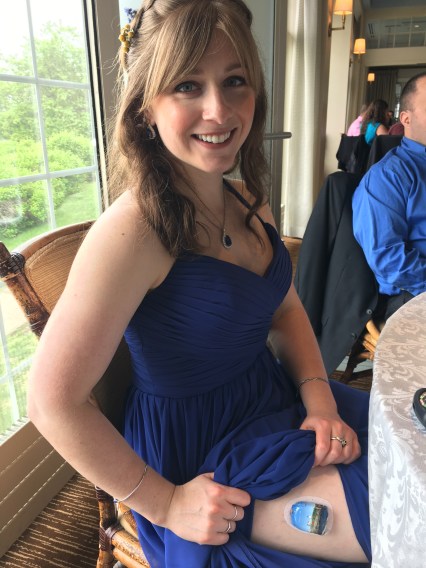
Showing off my decked-out pod at the wedding reception.
Do have plenty of back-up supplies. I got lucky this time around because my parents were a phone call and short car ride away from me when my pod fell off. I should’ve been carrying insulin and a spare pod on me, but at least it was within my mother’s reach at the hotel room.
Don’t sweat the small stuff. Things happen, and I’ve got to learn to accept them more quickly so I can better adapt to a situation. It took me awhile to forgive myself for the pod snafu at the rehearsal dinner, and if I hadn’t snapped out of it, then it could’ve ruined the night for me.
Do try to plan meals when possible. I knew that I should avoid a high-carb breakfast on such a busy morning, but I can’t resist a blueberry muffin, especially when it’s one of two breakfast options I had. I wish I’d thought to bring food that had accurate carb counts on it so I could’ve had more predictable blood sugars throughout the day, but I did come back down from the sugar-induced high relatively promptly.
Don’t forget that family and friends are willing to help. My “problem” with my backpack was solved by handing it off to my boyfriend about 30 minutes before the ceremony started. I didn’t miss any photo opps with the bride and bridesmaid during the hand off and I felt better knowing it was in good care.
Do remember that time flies. I had to keep myself in context; after all, I was standing up in front of the guests for less than 30 minutes. I knew there was relatively little insulin in my system and that I was starting to level out somewhere in the 100s by the time the ceremony started. The odds of me passing out were slim, and I needed to give myself that reality check.
Don’t forget to drink plenty of water. Duh, that’s drinking rule #1! I’m embarrassed to admit that I maybe had two glasses of water during the entire reception and after party. It’s not like there wasn’t water available, so I don’t know what I was thinking. But I do know that I was incredibly lucky to hold onto stable blood sugars well into the night, despite my lack of hydration.
Do have a plan for hangovers. Sometimes, they happen, and they’ve got to be dealt with swiftly. After some consultation with my mother, I set a temp basal to fight against my high blood sugar and downed glass after glass of water. By early afternoon, I was feeling much better. And even though I had a bellyache, I didn’t yak, so I suppose that’s a silver lining.
And one extra “do”…do have fun with diabetes devices! I decked out my pod in a Pump Peelz sticker that had an image of the lighthouse we were near on it. Sure, it wasn’t visible to anyone but me (and a few people I couldn’t resist showing), but it still made me feel extra special and coordinated with the wedding venue. Sometimes, its the little things in life.
So besides taking several valuable dos and don’ts away with me from this weekend, I’m also walking away with a wonderful first experience as a bridesmaid to a cousin who’s always felt more like a sister to me. When it comes down to it, my irritation with diabetes doesn’t matter – it’s the love and celebrations I felt all weekend long that do matter.
I can’t remember exactly when I heard of “DIY diabetes”, also known as “looping”. It may have been at a conference a few years ago, or maybe I saw something about it on social media. Either way, it seems to have totally blown up as more and more people with T1D are looping.
Are you a Looper?
Before I talk about it more…a brief definition of looping. Loop refers to a kind of automated insulin delivery system. According to what I read about it on diaTribe, Loop systems are open-source and DIY, meaning that T1D Loopers download an app for the iPhone that communicates with a device that also communicates with compatible pumps and CGMs.
If you’re confused, don’t worry – so am I. There’s a number of moving pieces involved with Looping that make it daunting and difficult for me to keep up with as the technology changes. But the ultimate goal of Looping is what has me interested in it. Looping is supposed to help improve time-in-range, particularly overnight, because it does a lot of the thinking for you and ultimately makes life with diabetes easier. And I’m all for that.
Looping’s been popping up on my social media a lot lately because at the end of April, the geniuses behind Loop announced that compatibly with the OmniPod for the first time. (Previously, Looping was only available to Medtronic folks.) On what feels like a daily basis, I notice more people on my social media platforms – particularly Instagram – who are Podders that have made the decision to start Looping. The common denominator with many of these individuals, besides being Looping Podders (sounds like a wacky band name) is that they’ve found great success in doing so. It seems like each person spends 90% or more of his/her time in range, encounters fewer low/high blood sugars, and wastes less time worrying about diabetes in general.
All of that sounds too good to be true. Of course my interest is piqued by such incredible results, and of course I’d love to dive right into Looping and see whether it’s a good fit for me. But the reason why I don’t is simple…I just hesitate to trust new technology.
Technology can fail. Plain and simple. All operations for Looping with the OmniPod take place on the iPhone. That means that the PDM is rendered useless. What happens if I lose my cell phone? What if the battery dies when I need to bolus? What do I do when I upgrade to a new phone? There are so many questions I can think of related to the phone issues alone, never mind any other potential problems. Put simply, the unknowns – the “what ifs” – terrify me so much that I can’t help but be skeptical of Looping.
But this doesn’t mean my interest goes away. My curiosity about Looping is stronger than ever. The DIY element is frightening, but the rewards could be greater than the risks.
The only thing I know for sure is that I won’t even attempt to Loop until I have a conversation with my endocrinologist about it. Together, we make decisions about my diabetes care and treatment that we both feel are safe and right for me. I’d love her opinion on Looping to see how much she knows about it and whether she has any patients who use it. Until I talk to her and gain more information from other Loopers, it’ll just be something that I cautiously admire from afar on social media.








 Hugging the Cactus