Three Things I Learned about Myself after Running a 5K

I recently ran in my first-ever 5K race. In the weeks leading up to the race, I experienced a variety of emotions – particularly self-doubt – that made me question whether I could really do it. Would my diabetes cooperate the morning of the race? Should I eat a big breakfast before running, or go into the race fasting? How would I handle correcting a low blood sugar while running? What about a high blood sugar? Was I even competent enough to run?

All of my diabetes anxieties aside, I’ve always hated running. HATED it. I played field hockey every fall when I was in high school, and we were required to run a timed mile before the start of each season. I dreaded this mile because I usually wound up finishing the mile last, or close to last – my asthmatic lungs and negative attitude helped ensure that I would give up running halfway through and resort to walking a sluggish, defeated pace.

So like I explained in a recent blog post, making the decision to go through with this 5K wasn’t easy. But I wanted to take on the challenge and prove something to myself.

AND I DID IT!!! I’m pleased to say that I completed the race on a gorgeously sunny Saturday morning along with hundreds of other runners. I was totally proud of myself for accomplishing this goal, especially since I had less than a month to train for it. Plus, I learned a few things about myself after participating in the race:

  1. I should have more faith in my ability to manage my diabetes. I spent so much time dwelling on the “what ifs” (a bad habit of mine) regarding what my diabetes might do during the race that my stomach was doing somersaults as I approached the start line. But as soon as I turned my music up and started running with everyone else, my doubts vanished. And better yet, I was absolutely fine throughout the race. I didn’t eat anything beforehand and went into it with a blood sugar of 142, and I stayed pretty steady for most of the 3.1 miles (I did start to spike soon after crossing the finish line, but I’m certain that was because of the adrenaline). I simply did what I’d been doing during my past month of training, and my experimentation with fasting vs. non-fasting paid off.
  1. I’m a lot more determined than I realized. I’ll admit that there were a few points throughout the race when I wanted to give up. I was breathing hard and my legs were starting to ache, but not once did I stop running and slow down to a walk. I pushed myself to keep going, even though I didn’t want to, and my determination helped me achieve my personal best running time.
  2. I’m ready to train for future races. This experience awakened something in me that wants more challenges. I’m still not in love with running, but I think I am a fan of trying things out of my comfort zone. I want to continue to get faster and stronger so I can try tougher races and physical tests. It’s almost like it’s an outlet for me to tell my T1D that it can’t stop me – that I’m stronger than it no matter how hard it tries to knock me down.

Training for my First 5K

At the start of the year, I told myself, this is your year. You’re going to be in the best shape of your life and finally run a 5K. I’ve never particularly enjoyed running, which is why the challenge of a 5K was more alluring than a different fitness goal. I felt that doing something I practically dreaded would make accomplishing it that much more gratifying.

But just a few short weeks into 2018, I broke a bone in my arm. I was crushed, because the kinds of physical activity I could do suddenly became severely limited. Instead of taking the injury in stride, I spent a long length of time moping over it. My exercise levels decreased and I stopped caring (for a short while, anyways) about my lean and mean pursuits. All I wanted was to heal, and heal swiftly.

Fortunately, I’ve fully recovered from the fracture, and so have my spirits. A renewed vigor took hold of me in April, and I spent many weekday mornings waking up early to complete a variety of workouts. I started to feel stronger and more confident in my athletic ability. So in the second week of May, just a few days after my 25th birthday, I decided the time was right to register for my first 5K.

And so I did, and I’ve devoted time training for it since then. It’s far from easy, but I must admit that each time I successfully complete a run, the feeling of accomplishment and pride that courses through my body makes it all worth it. It’s doubly wonderfully when I’m able to achieve in-range blood sugars before, during, and after each run.

I don’t have a convoluted strategy for stabilizing my blood sugar while running; rather, it seems to work best for me if I simply complete a fasting workout first thing in the morning. This eliminates a few variables affecting my blood sugar, including carbs consumed during a meal or insulin on board. I’ve found that I don’t even need to run a temporary basal or suspend any insulin – my body seems to do well if I’m running my normal basal rate. But with diabetes being a fickle fiend, I’m always prepared for a potential high or low blood sugar to occur on a run. In other words, portable glucose and my PDM are my constant running companions.

Race day is just a few short weeks away, and I can honestly say that I’m looking forward to it. Sure, I’m a little anxious, but I’m choosing to focus on the fact that I’m finally taking on something that tests me – and my diabetes – in all the right ways. I should be proud of that alone, but I must say, I’ll be over the moon when I get to cross that finish line.

Diabetes Connections: Gym Edition

“Are you a diabetic?” Despite the fact that I was wearing earbuds, I heard the question that was undoubtedly being directed toward me.

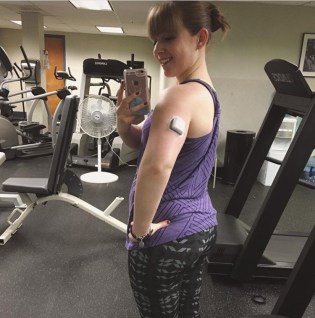
I glanced to my right and met the gaze of the teenage girl on the treadmill next to me. I smiled, tugging an earbud out, and said, “Yes, I am. My OmniPod gave it away, didn’t it?”

She nodded eagerly. “I have a Medtronic pump, but I know what an OmniPod looks like. When I saw it, I had to say something to you.”

This marked the beginning of what wound up being a thirty minute interaction with Shae, a high school senior with bucketloads of energy and questions for me about life with diabetes. We specifically chatted about college, and I couldn’t resist telling her all about the College Diabetes Network and what a useful tool it was for me during my three and a half years at UMass. The more we spoke, the more it felt like I was looking at a mirror image of myself from seven years ago. She had just finished taking her AP Psych exam and was relieved it was done. Her senior prom was in a few days, and she described how she’d wear her pump while donning her fancy gown. She was excited about college, but a little nervous about the dreaded “Freshman 15” and whether her diabetes would adjust well to college dining halls.

IMG_3979
It’s so funny to think how something as crappy as diabetes can introduce so many amazing people into your life.

I did my best to answer Shae’s rapid-fire questions frankly but reassuringly. As I told her about how much my CGM helped me in college (especially since I was still on multiple daily injection therapy at that time), she exclaimed that I was inspiring her to want to give her CGM another shot (pun unintended – I love spontaneous diabetes humor).

As we parted ways, we both grinned broadly and wished one another well. This is why moments like this – diabetes in the wild – are so great. Diabetes instantly bonds you to a stranger who you might not otherwise ever interact with, and the beauty in that immediate connection is priceless.

On the Road to Recovery

I shared the story of how I broke a bone in my arm last month. I was pretty down in the dumps about it, so I’m particularly pleased to say today that I am 90% healed from the injury!

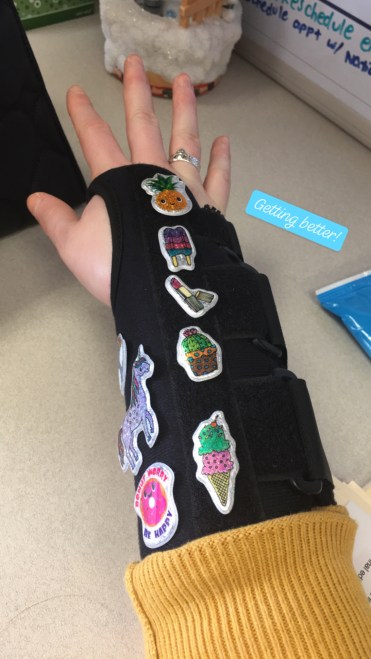
I know I’m lucky: My healing time was relatively quick. I spent just over four weeks in a cast. Others can spend six or more weeks trapped in layers of medical gauze and tape. I had my cast removed one month and four days after the accident happened, and my orthopedist advised me to wear a brace for another week to ten days as my arm got used to mobility again.

9C46EB0E-1D4B-4FBB-9B2A-F6CD0511D206
Naturally, I decked out the brace with stickers. Peep the cactus.

Yes, the broken bone was a total bummer. It slowed me down, messed up my exercise regimen (and my diet), and made me moody. But the experience may have been the kick I needed to get back on track with my overall health and take the best possible care of myself.

So the road to recovery looks promising. Now, I’m just looking forward to getting clearance to hit the boxing gym again and get reacquainted with my fitness.

Sun Salutations and Stable BG: Yoga Does the Trick for my Diabetes

1C08F38B-F61A-4747-BDA2-FD3A32F8315C

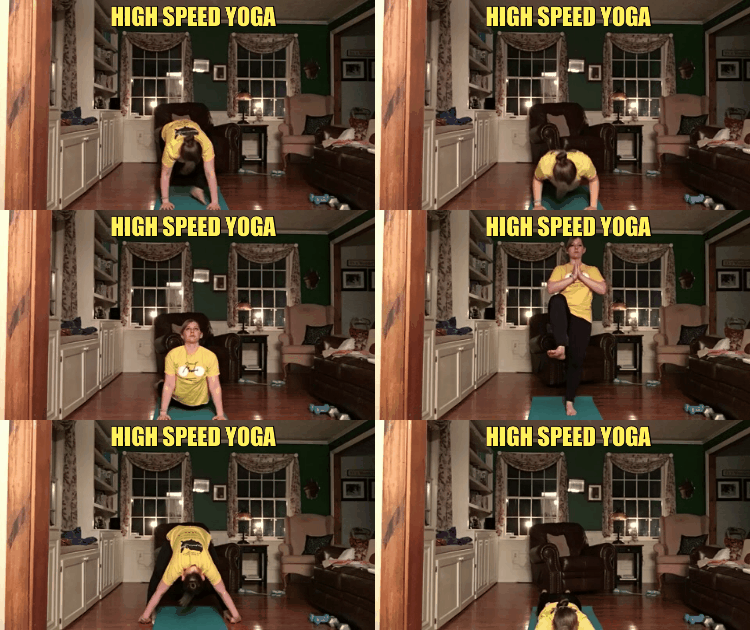
Whoa, who’s that dork doing a high-speed yoga routine up there?

Hi, it’s me!!

It’s kind of weird to watch a video of yourself doing yoga – especially when you see how awkward you look because the time-lapse feature on your iPhone sped it up so much.

So why did I film myself doing a yoga routine? Once I get past my self-consciousness, I look at the video to see what needs adjusting; for instance, I could sink a little deeper when I’m in my chair pose. I could also stand to slide my foot a bit higher up my leg, perhaps balance it on my thigh, when I’m in the tree pose.

Aside from looking for what needs to be improved, filming the routine also helps me understand why I do yoga. It shows me how my flexibility has increased, as well as my balance. I also realize that it shouldn’t be a surprise to me that I worked up a sweat during this practice – I’m constantly shifting from the ground to standing to various other poses. My muscles are stretching out and getting warm from the movements, so of course I’m giving my body a workout in the process.

And in turn, I’m also keeping my blood sugar stable. The yoga poses combined with controlled breathing and mind wandering does wonders for both my diabetes and my mental health. More often than not, I ride a straight line on my CGM throughout a yoga practice. It’s a great way to get in the right frame of mind at the start of a day, or unwind at the end of a long one.

Plus, there’s nothing like sinking into child’s pose (lying face down on the mat with your arms extended, your knees apart, and your rear in contact with your heels) or taking a nice long savasana (or corpse pose, in which you lie face up with your eyes closed, arms at your side, with fingers and toes spread open – without letting your muscles tense up) at the end of a practice to reset the mind.

Can’t beat the benefits of yoga.