Just Breathe

Just breathe…a mantra easier said than done when each breath flows in and out smoothly, instead of in ragged, wheezing gasps.

I’m no stranger to asthma. I dealt with it throughout most of my childhood. The details are blurry on when I experienced my first asthma attack, but all I know is that it left me rasping and feeling (on top of sounding) like the cute little penguin from the Toy Story series, Wheezy.

The only thing that would keep my asthma symptoms at bay was nebulizer treatments. The nebulizer is one of those loud machines that generates vapors – albuterol medicine – that must be breathed in through a mouthpiece. I hated these treatments because they left me feeling shaky for a long time afterward and often caused high blood sugar, but it was much easier and more comfortable to breathe after them…so they were worth it.

Throughout my teenage and most of my young adult years, though, asthma slowly became a distant memory. I experienced it less frequently until it stopped altogether, and suddenly diabetes was the only thing I had to worry about. And I was glad for it.

But then…let’s fast-forward to the week leading up to Christmas. I was busy. I mean, wicked busy. I was running all over the place, jetting from one party to another, interacting with all sorts of people who were bringing germs from all over to each of these merry gatherings. I was getting run down and sleeping less due to the holiday celebrations, so really, it shouldn’t have surprised me when I felt the first tinge of a sort throat in church on Christmas Eve. But when that sore throat was soon followed by a tight chest and a whistling sound whenever I exhaled, I was taken aback – not to mention straight-up annoyed.
IMG_5471
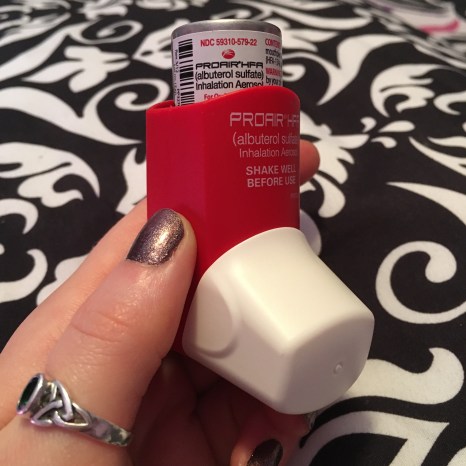
The rescue inhaler that’s been my best buddy the last couple of weeks.

I treated the initial waves of wheeziness with my rescue inhaler. But when that started to be less effective over shorter and shorter lengths of time, I knew I needed to get in touch with my primary care doctor. So I did, and I met with a nurse practitioner who diagnosed me with something new: reactive airway disease. I left the office feeling shell-shocked over a new diagnosis that would mean that I would have to use a different kind of inhaler twice daily for the next two weeks.

I was afraid to start it for many reasons, but the two biggest ones were 1) I was nervous it would make my blood sugar go up and 2) it can cause thrush (also known as an oral yeast infection, which sounds positively nightmarish) if I forget to rinse my mouth out with water after each dose.

Overall, though, it doesn’t sound like too big of a deal, right? If it helps my breathing, it shouldn’t be an issue to add this inhaler into my morning and evening routines.

Silly old me, however, did turn this into a big deal. I wasted far too much time fretting over this inhaler and saying “woe is me” for having to deal with yet another medication that was extremely expensive (I paid $56.83 for the darn thing…I have no idea what the total would have been if I was uninsured).

My logical self knows that this won’t do any good. So now, I’m getting my act together and just rolling with the punches.

I’m trying to gently remind myself…just breathe.

 

Why Meeting a New Endocrinologist is Scarier Than Going on a First Date

I have an appointment with my endocrinologist today. Or should I say, the person who I hope is my new endocrinologist. I really want this patient-doctor relationship to work out!

It’s my first new endocrinologist in about ten years and I am effing nervous. It’s comparable to going out on a first date with someone, only I’m not hoping to be wooed with flowers or treated to a fancy meal.

I’m hoping that this person is someone I can trust with my health…which I value a lot more than any of the associated costs of a first date.

Why Meeting a New Endocrinologist is Scarier Than Going on a First Date
There are higher stakes with a new endocrinologist than with a new dating-app match.

Why is this new doctor terrifying to me? For starters, I have so many questions. What if she doesn’t like me? What if I don’t like her? What if she judges me? What if she’s too lenient? What if…? The list goes on and on.

Plus, I’m seeing her after smack dab in the middle of holiday celebrations, also known as the most turbulent time of the year for me and my blood sugars. I’ve had so many highs in the last month that I’ve tried to stay on top of, but she’s bound to notice them and ask me if this is a regular thing for me. It’s also pretty likely that my weight has gone up as a result of the many indulgences I’ve enjoyed in the last few weeks, and I’m worried about whether comments will be made on that.

Not to mention that I haven’t seen an endocrinologist since…late August, I think? And that appointment was with my “old” doctor, who left to practice somewhere far, far away. It was a bittersweet parting, and it wasn’t on amicable terms because neither of us was ready for it to be over. So I’m heading into a new potential endocrinologist relationship with that in my mind, and my new doctor has a lot to live up to when compared with my old doctor.

I just want everything to go well. I know that if it’s not a perfect fit, it’ll be pretty evident straightaway, and I can seek another new endocrinologist. But to continue with the dating metaphor, it’s not as easy as just swiping along and seeing what other nearby options I have. There are other concerns beyond location: I need to make sure my doctor can accept my insurance, on top of them being likable, knowledgable, and eager to help me manage my diabetes. It might be surprising to learn that this particular combination is a tall order, but again, when it comes to my health I refuse to just settle.

Fingers crossed, it’s a match from the start and all of my concerns will be rendered invalid late this afternoon at the conclusion of my appointment…


Metformin Update #4: Here We Go Again…

Frequent readers of this blog are probably familiar with my journey with Metformin. If you aren’t, or want to brush up on my history with it, read here, herehere, oh, and here in order to get caught up.

Well, well, well…here I am again, taking yet another attempt at integrating Metformin into my daily diabetes routine.

I didn’t want to, certainly not after last time, when I thought it might be responsible for some unpleasant side effects I was experiencing.

But desperate times call for desperate measures…

METFORMIN UPDATE #2
Yep, I’m giving the giant white horse pills another go.

Long story short (because I’ve explained in previous posts that I had a rough September), my diabetes was totally rebelling against me about a month and a half ago. Each morning, I’d wake up, check my blood sugar (which nine times out of ten was very good, between 100 and 130), and prepare one of three of my standard breakfasts. I’d bolus for them just as I’ve always bolused for them, only to discover that my blood sugar was climbing much higher than it should have in the hour or two after the meal. It was so confusing. I thought it was only a breakfast problem, but when it carried over to lunch, and then dinner…I realized I was facing a bigger issue.

I’m sure you’re thinking that higher insulin dosages were the simple fix to what was happening. But I didn’t want to take approximately 30% more insulin each day to handle something that I couldn’t even begin to rationalize. I didn’t think that should be my only alternative. There had to be something else I could do.

Enter Metformin.

After consulting with my endocrinologist, we agreed that I’d take one Metformin each morning with my breakfast. I explained to her that I was reluctant to go back on it, but she gently reassured me that the side effects I’d mentioned were pretty rare and perhaps there was another explanation as to why I’d experienced them. She also made me feel a lot better about skipping doses here and there – I wasn’t sure if that would reduce the effectiveness of the Metformin – by telling me it would be fine if I forgot a dose or actively chose to miss one.

And so began my third go-round with Metformin.

As of this writing, I’ve been on it for several weeks. And I’ve noticed a difference. My total daily insulin intake is back at a number that I’m much more comfortable with, and I’m not having to take correction boluses multiple times throughout the mornings and afternoons just because I ate my regular meals.

It isn’t exactly the solution that I wanted, but it’s the one that I needed as well as the one that works for me, for now, anyways.

A Farewell to my Endocrinologist

Well…the day I’ve been subconsciously dreading has finally arrived.

It’s time for me to part ways with my endocrinologist…the diabetes doctor that I’ve seen for the last decade…more than one-third of my life.

She’s moving onto new things, and I’m sad to see her go. She’s helped me tremendously over the years.

She’s seen me at my “diabetes worst”, when I was a college student who cared more about having a normal college experience than managing my diabetes.

She was the one who finally convinced me to quit MDI in favor of an insulin pump.

She’s one of the few medical professionals I’ve ever interacted with who treated me like an equal – she never made me feel “less than” or inferior to her.

In other words, I was pretty dang lucky to be her patient.

1DEBAFF4-E2F8-460B-8FDF-7330F4EBA07D
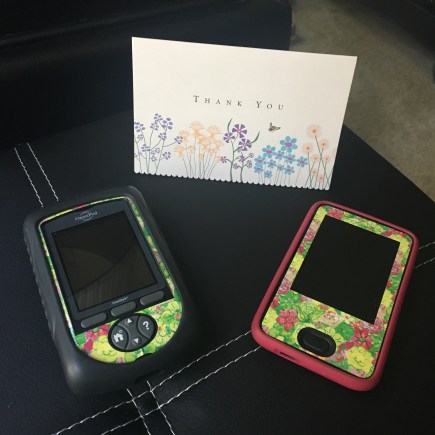
The “thank you” card that I plan on giving my endocrinologist, pictured with two devices I started using thanks to her.

I’m trying to take this forced change in stride. Maybe it will be good to meet with another endocrinologist. Maybe it will help me continue to improve. But I am allowing myself to feel a little upset and sorry over the situation; after all, it’s never fun to part ways with someone, especially when you had no say in the matter.

Guess what else I’m allowing myself to feel?

Gratitude.

I feel thankful for my endocrinologist, so I plan on giving her a card with the following message during our appointment tomorrow…because it’s important to me for her to know all the positive change she’s brought to my life:

Dear [Name Redacted],

I wanted to thank you for all that you have done to help me (and my mom and aunt) in the last several years. You have always motivated me to take better care of myself after every appointment I’ve had with you. I appreciate you for being patient with me, listening to my concerns, and inspiring me to try new technologies and treatments to improve my quality of life with diabetes. I don’t like having a chronic illness, but having a doctor like you around to help me deal with it means the world to a patient like me.

Wishing you all the best in your future endeavors!

Sincerely,

Molly

Why It’s Important to Remember That The Doctor Isn’t Always Right

We should always do what medical professionals tell us to do…right?

I mean, why wouldn’t we? They’ve gone through many years of extensive training. They’ve got the education and degree(s) to prove their medical expertise. So why would a patient question a doctor or a nurse when they’re telling them to do something that will improve the patient’s health?

Well, a patient might question a medical professional’s advice when it seems contrary to everything else that the patient’s been told by other, trusted members of their healthcare team.

This is exactly what happened to me when I went to see my primary care doctor a few months ago.

Actually, more specifically, I saw a nurse practitioner who works at my primary care doctor’s practice. I made an appointment with the office because I’d been experiencing some wheeziness that made me think I might have asthma that couldn’t reliably be treated with a rescue inhaler (which is all that I had) on its own. I figured it’d be smart to talk it over with my doctor, or at least someone at his practice, to see if I should start treating my symptoms with another kind of medication or therapy.

Lemon Squeeze
As patients, we should always do what the doctor says…right?

My appointment barely lasted 20 minutes. I met with a nurse practitioner who I’d never seen before. I explained how I’d been wheezing the last several days, and how it got worse when I went to lie down in bed at night. Before I could get another word out, she asked me if a rescue inhaler was all I had to use in these situations. I said yes. She proceeded to tell me that rescue inhalers aren’t designed for daily use because, as the name implies, they’re for emergency situations. Then she started telling me about a steroid that she thought I should begin to use twice daily.

I cringed at the word “steroid” because I know that they don’t interact well with my blood sugars. Steroids can make blood sugars go high rapidly, and it can take hours for blood sugar to come back down to normal levels. I told her this, and she shrugged off my concerns by telling me that the inhaled steroid would be going directly to my lungs, not my entire body like a typical steroid. I remember nodding uneasily and asking her how to use the steroid – I wasn’t going to leave the room until I had a satisfactory amount of information on this new, unfamiliar drug.

She told me I’d take it once in the morning and once at night, before brushing my teeth. Apparently, I would need to be careful and remember to rinse my mouth out with water immediately after administering the medication in order to prevent…thrush. (If you’re unfamiliar with that word, it has something to do with oral, yeast, and infection…A.K.A. something that sounds like a nightmare.) That’s when I really became alarmed. I told her that people with T1D are already more susceptible to that kind of infection, and wouldn’t it be a bad idea to even risk it by taking this steroid two times a day? And again, she essentially disregarded my protests and told me I’d be fine as long as I remembered to rinse. Then, she sent the prescription to the local pharmacy and left me in the exam room in a confused daze.

I went to pick up the prescription, but I never used it. I decided to trust my judgment and avoid a steroid that seemed like it would cause more harm than good. I also figured that since the weather had abruptly gotten cold, then perhaps my asthma symptoms would subside before long; in the meantime, I could use my rescue inhaler as necessary. And you know what?

I was right. My breathing was normal again in a matter of days, and I only had to take a few puffs from the inhaler when it was all said and done. My decision to take my health in my own hands was further validated when I went to go see my allergist soon after this ordeal. I told her all about it as we ran through the list of medications that I regularly take. She was incredulous that I was prescribed the steroid in the first place, seeing as my asthma is practically non-existent. To quote her, “You’re (meaning me) already sweet enough, you don’t need this steroid or a risk of thrush!”

That remark alone sealed it for me: I did what I thought was best because I knew I was capable of making a decision about my body; nobody knows myself better than me…even a medical professional.

Is it Weird That I Love Looking at Lab Results?

Is it just me, or does anyone else anxiously await checking lab results after getting blood work done? And am I the only one who excitedly reads through results, looking for anything abnormal so I can see which area of my health I need to work on? It’s kind of like whenever I handed in a paper or took an exam in college – I always logged onto the student portal multiple times in the days after to check for posted grades. I do the exact same thing with my patient portal.

I know, I know, I’m weird. I prefer to call it quirky.

Lab reslts
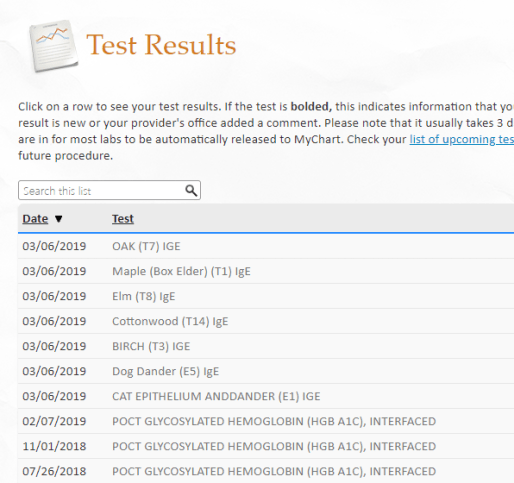
An *utterly fascinating* screenshot of some of the allergens I’ve been tested for in the past.

I started thinking about this little idiosyncrasy a few days ago, after I got lab results back from my allergist. She had me go into a lab to get 10 vials of blood drawn so it could be tested to see what types of allergies I had. Fun!!! In the days following, I checked my patient portal dozens of times to see whether the results were up. And when they finally were, I was obsessed with poring through them and seeing how much sense I could make of them.

And I’ll admit, I love looking at lab results because I have a historical view of just about anything and everything I’ve been tested for in my life, and that includes my A1c levels. On more than one occasion, I’ve fallen down the black hole of comparing and contrasting my results over the years. It’s interesting to see how I can trace back certain A1c levels to different events going on in my life at the time it was checked, and more than anything, I enjoy seeing how much I’ve improved in the last decade.

So if this habit of mine sounds plain strange to you, then I don’t want to be normal…I want to be informed. I always want to be informed when it comes to my own health, because ultimately, I’m the one responsible for it, as well as the one who will do everything in her power to improve it.

Molly, Meet Metformin

You may have read the title to this post and said to yourself, “Met-WHAT?”

Metformin is the new medication I’ve started taking (along with my typical insulin) to help regulate my blood sugars.

Maybe you didn’t make it all the way to that second sentence; instead, maybe you just Googled Metformin to learn more about it. And you probably immediately got confused, because the Google search results explained that Metformin is a medication normally prescribed to people with type 2 diabetes. You know that I have type 1, though, so what gives? Why am I taking this new pill?

You see, for about a year or so, my endocrinologist has been gently encouraging me to try Metformin. She expressed concerns over the fact that I’ve had diabetes for more than 20 years, and in that span of time, I’ve had to take a lot of insulin. Like, an incalculable amount. And while that insulin helps to keep me alive, there’s also risks associated with it. Namely, she explained to me that there’s research that indicates that people with type 1 who rely on large amounts of insulin have a higher risk of developing cancer later in life.

ClearanceYard Sale

Whoa. The “c” word. Something I never thought I’d hear during a doctor’s appointment. If you know me personally at all, then I’m sure it’s not hard to imagine that I pretty much shutdown at the mention of “cancer”. Almost immediately, I panicked and asked why she thought this research was worth mentioning. She said that it was part of her reasoning for wanting me to start Metformin. The idea is that it would make my insulin more effective, and ultimately decrease the amount of insulin I need each day. She went into a little more detail, mentioning that the only side effects tend to be nausea/upset stomach – and that’s when I stopped listening. I politely told her that I didn’t think Metformin was a wise option for me at that time, and later that day, when I took to Twitter to ask other T1Ds what they thought, I gained swift validation that I’d made the right decision: Other T1Ds with Metformin experience told me that the stomach issues they had when taking it were miserable and that they wouldn’t recommend giving it a try. Plus, I consulted with my T1D pharmacist aunt, and her opinions matched those of the other T1Ds on Twitter. So that was all I needed to hear to feel at peace with my choice to not take Metformin.

In fact, it was enough for me to turn my endocrinologist’s offer down during our next two or three appointments. I was relieved that she never pushed me to try it, but there was a small part of me that wondered whether I should give it more serious consideration. Maybe I should let her talk me into a little, rather than brushing it away and using fear as my excuse.

So we did talk about, during my most recent visit with her earlier this month. She gave me some more compelling reasons to consider taking it. Not only could I reduce my insulin intake, but it might also help me with some preexisting digestive issues I’ve had since childhood. When I asked her about the negative side effects on the stomach that I’d read about online, she told me that she would only prescribe me the “extended release” version of Metformin, which had a much lower (if any) chance of inducing nausea or any less…desirable gastrointestinal disorders.

This news definitely perked me up. We discussed a plan for introducing Metformin to my body: Start by taking one pill daily after dinner. Increase by one pill each week until I’m at four pills per day, the limit. At any point in time, I could message her with questions if I started to notice low blood sugars in the evening.

I felt reassured by this logical plan, as well as her explanations of the benefits of Metformin. So I bit the bullet and I’m in my first week of incorporating it into my post-dinner routine. I can’t say that I’ve noticed even the slightest difference, which isn’t a bad thing. I imagine that will change as my dosage increases.

I intend to blog about this new journey with Metformin; not just for the sake of keeping track of how it affects me, but to also help inform other T1Ds who may have been or may be in the same situation that I was. We’ll just have to see how it goes, but for now, rest assured that I’ll be honest in my writings about my Metformin experience. At this moment in time, I can’t help but feel hopeful that down the road, I’ll be glad I made this decision when I felt ready for it, as opposed to when I was fearful of it.

A T1Diary of my Recent Endo Appointment

I’m trying something new here today, folks. As you can see, this blog post features not just words, but video, too. How exciting! The aforementioned video shows the before, during, and after of my most recent endocrinologist appointment. I share a touch more than I normally would in this format, and I cover something that’ll be a big subject in one of my upcoming blog posts.

Originally, I shared this video (in short clips) directly to Instagram, where it would live in my stories for 24 hours before going away. But the thought occurred to me to save and splice the video segments together to create a full video, albeit a poorly manufactured one. I’ve decided to call it my first attempt at video blogging, otherwise known as vlogging.

Fear not, my fellow wordsmiths: I still plan on writing actual blog posts. I’m not sure how regularly I’ll be vlogging. But I can promise that if people kinda dig this, then I’ll make a point to vlog semi-regularly. I can also promise that the videos will be a bit shorter and shot in one take, because 1) I don’t think anyone wants to hear/watch me blabber for more than a couple minutes and 2) it’ll help ensure that I don’t jump around from topic to topic. And for the sake of full disclosure, I’m not lovin’ my once-a-month Favorite Things Friday post as much as I used to…so this may eventually replace it. We’ll see.

So, without further ado, enjoy this little video from me…and remember that it was initially created for Instagram, which encourages users to make very short video/photo clips, and helps explain why this whole package is a bit choppy. And please do let me know, in the comments or on various social media channels (accessible in the upper-right hand menu of the Hugging the Cactus homepage), what your thoughts are on vlogging.


Aim for an A1c of…What?!

All my life, I’ve been told that I should do what I can to keep my A1c levels between 6 and 6.5. This is the “ideal” range, the sort of long-term goal I should bear in mind on a daily basis.

So when my primary care doctor suggested that an A1c of 7 to 8 might be a more realistic, sustainable, and healthy zone, my jaw dropped to the floor.

He explained his reasoning for saying such a thing: Since people with diabetes obviously have different needs when compared to people without diabetes, it’s not entirely logical to expect a person with diabetes to maintain an A1c that they might have with a functioning pancreas. He said that as time goes on, it could affect cognitive abilities.

And then he said that this was the range that would be recommended to a person with type 2 diabetes – there’s no new research that indicates any difference in desirable A1c levels for a person with type 1 diabetes, so, as my doctor said, I should continue to aim for 6 to 6.5.

This was such a WTF moment for me, for a couple of reasons.

eb0ed848-712c-4a3f-9ed2-646696324953
Does anyone else feel super awkward taking selfies in exam rooms? Does anyone else even take selfies in exam rooms?!

One being that I had NO IDEA why he was saying this to me. He built up this whole explanation as to what the “new recommended A1c” is, only to inform me at the very end that it was only safely applicable to people with T2D at this time. Was he confused? Did he forget that I have type one for a minute there?

The other reason I was flabbergasted by this little discussion was that we hardly ever go into detail when it comes into my diabetes. In fact, he didn’t even ask me when my last A1c test was, or any questions regarding my insulin pump/CGM. He just asked the standard “how is your diabetes” question, to which I replied with a super-lengthy, not-at-all vague response: “good”. He did put orders in for the standard array of tests that I take for each annual physical, which would inform him of my blood sugar at that moment in time, as well as my current A1c. But it was nothing that I’d be talking to him about during that appointment because the results wouldn’t be available until late in the day. So yeah, I found the whole thing to be pretty bizarre and mildly misleading.

Coincidentally, I’ll be seeing my endocrinologist in a few weeks, and let’s be real here: She’s the one doctor who can best advise me when it comes to diabetes treatments and protocols. So I’ll be sticking with her recommended A1c range for me, which I have a feeling won’t be any different from what I’ve been told all these years with diabetes.

Memory Monday: The First Time I Met an Endocrinologist that I Didn’t Like

One Monday per month, I’ll take a trip down memory lane and reflect on how much my diabetes thoughts, feelings, and experiences have unfolded over the years. Today, I remember…

…the first time I met a diabetes doctor (endocrinologist, or endo for short) who I didn’t like. At all.

I knew right off the bat that we would be a bad fit, because he started the appointment by sharing his own blood sugar with me (as he was also a T1D). “Oh, I’m 136 right now…that’s a bit high, so I’m going to take insulin for it.” He reached for his insulin pump and I stared at him, nonplussed. Since when was 136 a “high” blood sugar? Why was he sharing this with me? If his own target blood sugar range is so narrow, then what the hell is he going to think of me when he reviews my own data?

C0E4AC20-C524-432B-8F8C-8161C2F776CD
The face I make when I think about that awful appointment and the negative thoughts it gave me about my A1c.

The appointment only went downhill from there. At this point in my life, I was a brand-new college freshman, and my diabetes was simply no concern of mine. So my blood sugars and A1c weren’t great.

And I got scolded for it.

Throughout the entire appointment, I felt judged. I held back tears at points because I felt that I had to explain myself to this guy, that I had to somehow get him to understand that the transition to college hadn’t been easy on me, and that’s why my A1c was high. But I couldn’t get the words out. Instead, I sat there, numb, as he lectured me on what I should and shouldn’t be doing to take care of my diabetes. He kept insisting that I go onto a pump, which at that time, was totally scary to me – a non-option. He was so adamant that I got frustrated and shut down towards the end of the appointment, nodding and smiling tightly at his words.

I’m certain that I cried on the way home from that appointment out of frustration over how it went. I didn’t feel motivated to take better care of myself; instead, I felt rotten. I realized that just because someone is a doctor, it doesn’t mean that they necessarily know how to convey messages about health to patients. In other words, not everyone has an appropriate bedside manner.

Fortunately, that was the first and last time I saw that doctor. He moved to a different practice weeks after I saw him. My next endo appointment was with my current doctor, and seven years later, it’s one of the healthiest doctor/patient relationships I’ve ever experienced. When I look at it that way, it was worth experiencing the worst in order to get the best.