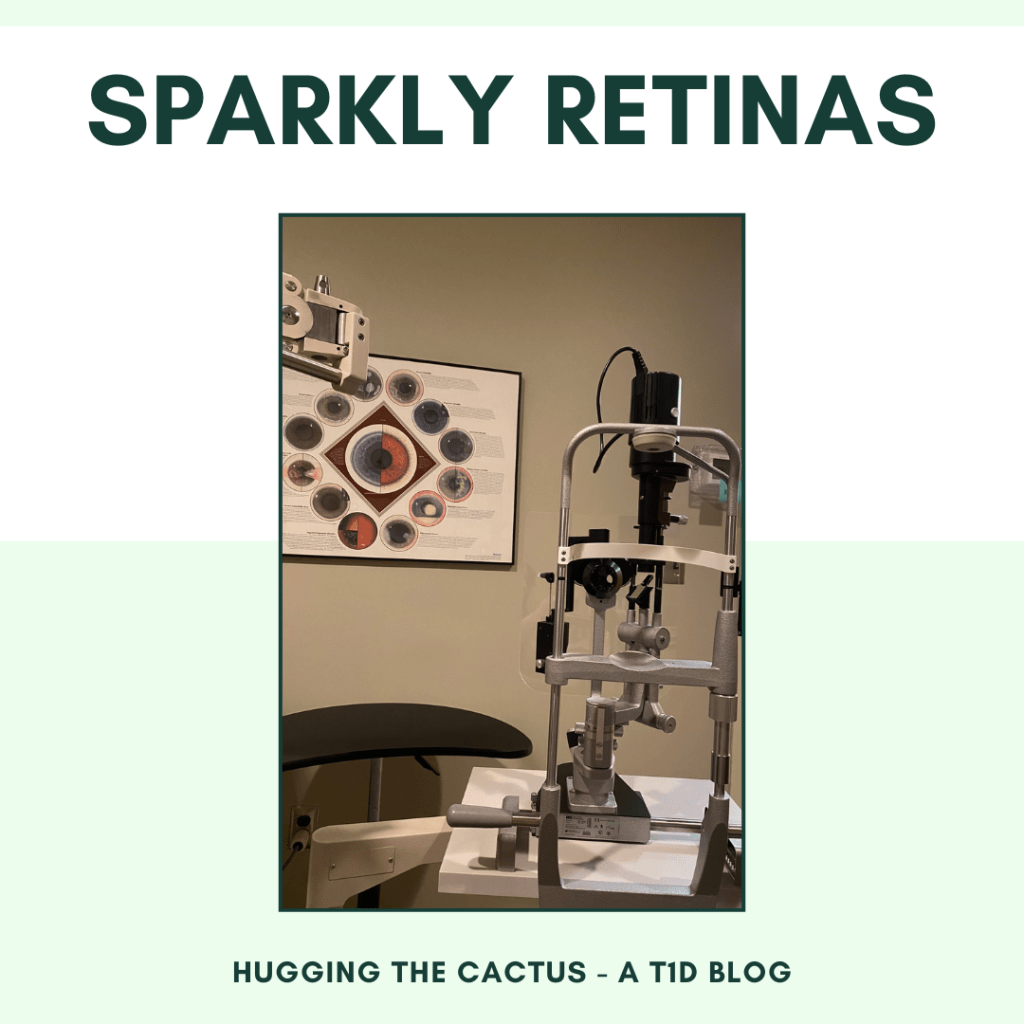
That’s how long my annual appointment with my ophthalmologist lasted this past week. I think we may have set a record in eye doctor appointment efficiency, as it was only such a short visit because there wasn’t a whole lot to talk about other than my “sparkly retinas”.
Yup, that was indeed the exact phrasing my doctor used to describe the state of my eye health upon dilation and examination. She went on to add several other gushing exclamations about my eyes, most of which I can’t recall because I was laughing at her comments.
It might sound like the appointment was rushed or that my doctor was less than thorough, given how short it was, but I was asked more than once if I had any eye concerns that I wanted to discuss with the doctor before I left. And I genuinely couldn’t think of anything worth mentioning, as my eye health has been stable in the last year and I haven’t had any noticeable vision changes. So we didn’t need to prolong my visit by any means. We probably spent a collective 7 or 8 minutes together before I was given a clean bill of eye health and asked to make my appointment for next year before leaving the building. It was that easy-peasy.
And I am extremely grateful for that.
Almost 26 years of living with diabetes and so far, it hasn’t impacted my eye sight. I don’t take that for granted. I know that may not always be the case. But for now, I’m more than happy to give up a measly hour of my day (I would’ve said 30 minutes, but I had to factor in the drive time to and from the doctor, naturally), once a year just to have that reassurance that I’m doing something right when it comes to my overall health. And maybe to hear that I have “sparkly retinas”, because that is quite a unique compliment.
You have a new message in MyChart! Please sign in to read your message.”
Whenever this notification pops up in my inbox, I’m filled with a sense of dread because it usually means one of 3 things: 1) I owe money to one of my doctors’ offices, 2) I have an upcoming medical appointment that I forgot about, or 3) There’s a problem with one of my prescriptions and my doctor’s office needs more information from me.
I never would’ve accounted for a fourth possible scenario, one that makes me feel good as a patient, being remotely likely…until it actually happened to me.
The message in question was from my diabetes nurse practitioner, and she wrote to me asking if I could recommend any diabetes support groups to another patient with T1D who was roughly my age. She explained that she thought to ask me because she knew that I have this blog/platform and remembered that I’ve spoken about how the diabetes community has greatly helped me over the years.
Upon reading the message, I immediately felt flattered that she thought to ask me. I typed up a thoughtful reply, including several different resources that might meet the patients’ needs, and sent it, feeling totally awestruck over how trust was definitely a two-way street in this particular HCP/patient relationship. It means a lot to me that my NP trusted my recommendations enough to not only want to pass them along to another patient, but to reach out and ask me for them in the first place. While my current overall healthcare team is lacking in some major ways – I won’t get into details on that, but let’s just say the search for a couple of new physicians is one that I’ll reluctantly embark on soon – this is reassurance that I do still have allies working for (and with) me. And that’s a really great feeling.
I’m still not used to having an endocrinology appointment every 6 months.
For my first two decades with diabetes, I saw an endocrinologist (or diabetes nurse practitioner [NP]) every 3 months. In hindsight, this sounds like a slightly aggressive amount of visits, but it’s what worked for me for a long time. Those appointments often served as motivation for me to do better, as well as learn about new diabetes care options available to me. And I’m fairly certain that they were a good opportunity for my parents and healthcare team to put their heads together, at least when I was younger, and come up with ways to make life with diabetes easier for me.
But as I’ve grown older and become more independent in my diabetes journey, I’ve relied a little less on these four-times-per-year check-ins. I don’t know exactly when, but in the last few years, my diabetes appointments became more of a nuisance than a boon…and I think my provider at the time recognized that. She suggested reducing my appointment frequency to twice a year, and since making that change I’ve greatly benefited from it.
And it’s why, when I attended my first appointment of the year recently, it felt like a nice little status check of where I’m at with my diabetes. In fact, that’s exactly how my NP kicked off the appointment: She asked me, “how are you doing? Is there anything new going on that you’d like to discuss?”
It felt great to be able to tell her: It’s all good.
Nothing new, no major complaints. We did chat a bit about my “diabetes cure” fluke from last month, in which we came up with no definitive answers but I was encouraged to monitor my blood sugars around my cycle a bit more carefully to see if I could come up with any patterns. We also went over my bloodwork and she was pleased to report to me that everything looked good, which is always reassuring to hear. The appointment ended with a check of my feet and thyroid, as they always do, and then I was free to go.
Even though we didn’t make any changes to my diabetes management, it was still worthwhile and comforting to know that my care team agrees with me that everything is all good and to keep up what I’m doing. That, in its own unique way, is enough motivation for me to do the best possible job taking care of my diabetes between now and the next appointment. It really is all good, and I’m grateful for (and proud of) that.
Diabetes, diabetes, diabetes! That’s all I hear and think about, all day long, day in and day out…
I risk sounding like Jan Brady from The Brady Bunch with that opening line, but since November 1st, diabetes is THE only thing on my mind – thanks to NDAM 2022 kicking off, among other factors.
That’s why the timing of my latest endocrinology appointment was particularly fortuitous – until I sat down in that doctor’s office, I hadn’t quite realized just how desperately I needed help from my healthcare team. And it wasn’t until we talked through my specific concerns that I realized that I’m actually doing a lot better on the diabetes front than I had assumed…and recognition of that, plus my obvious desire to aim for even more improvement, has gone a long way in changing my attitude.
In fact, you could say that this appointment totally revitalized how I feel about my diabetes lately, and I’m thankful that it happened before I got swallowed up in the throes of burnout.
I went into the appointment hoping that I would gain clarification around my use of the Omnipod 5 system. I started using it a couple of months ago, and from day one, I remained confident that it would revolutionize my diabetes care. That’s only been half true since I started using it, as the immediate and most obvious improvement happened to my nighttime blood sugars. But my daytime levels, particularly after breakfast and lunch, continued to mystify me.
This particular diabetes appointment came in the nick of time.
As I explained all this to my nurse practitioner, she listened without judgment – the first factor that went into boosting my diabetes spirits. What she said next was the second boon, and that was that I wasn’t alone in my struggle to adjust well to the automated insulin delivery. She validated that what I was feeling was normal, and that there were adjustments we could make as a team that would hopefully result in better utilization of the technology.
The third thing she did for me was put me in touch with someone at Insulet who would be able to answer my questions about the algorithm and fill in the blanks about the components of it that weren’t clicking with me. She made this connection for me before the end of our appointment, and witnessing her do so made me feel better about having one less hoop to jump through post-appointment…and goodness knows, when it comes to the admin side of diabetes, any assistance I can get on making phone calls or sending messages is a huge help.
This single, thirty-minute appointment took a huge weight off my shoulders that I’ve been carrying around all summer and fall this year. Of course, there’s still work to be done on my part, and little things like remembering to refills prescriptions are still my responsibility alone. But I’m feeling a lot more confident in my ability to make the progress that I’ve been so eager to achieve, and that alone is massive – and even more special, having happened during NDAM.
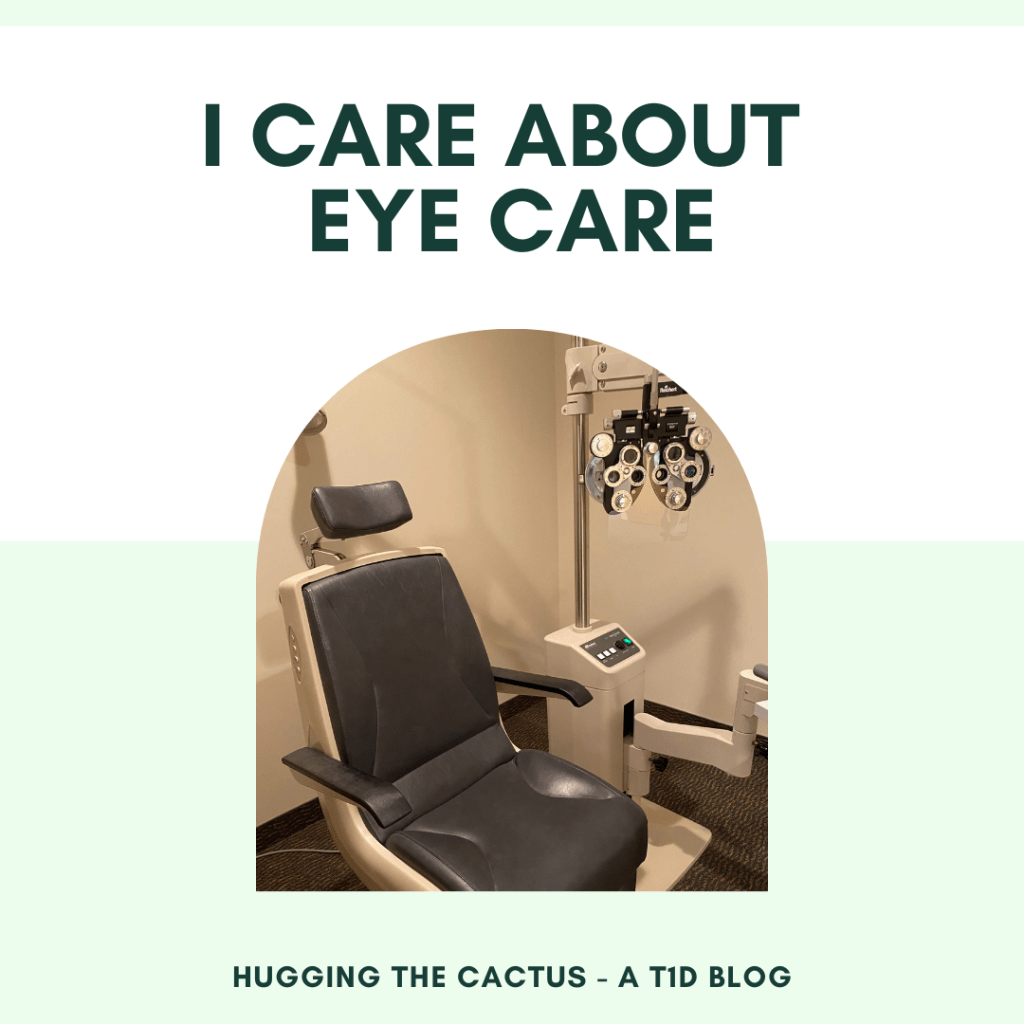
Like most people with diabetes, I see an ophthalmologist (essentially an eye health specialist) once a year. This is because diabetes can affect vision and overall eye wellness, so an ophthalmologist will look for things like cataracts, glaucoma, and macular degeneration within my eyes to make sure they’re healthy.
These appointments have all followed a similar pattern for me in the last couple dozen years that I’ve had diabetes. I’m brought into an exam room, my vision is tested with an eye chart, and then my eyes are dilated and examined with extremely bright lights. And I’ve been very fortunate to hear the same verdict from the ophthalmologist year after year: There’s no evidence of diabetes in my eyes, which translates to my eyes look healthy and normal.
This lack of diagnosis has always reassured me, and this year it was no exception. The only thing that actually changed for me was that it dawned on me that this appointment really means a lot to me. It was relatively quick, completely painless, and, dare I say, pleasant because of my doctor’s deep personal connection to diabetes (her son is around my age and also has T1D). She truly gets what it’s like, and didn’t make a big deal whatsoever when my Dexcom interrupted our appointment with a high alarm.
My annual appointment with my ophthalmologist is like performing a maintenance check on a car – it’s my chance to make sure everything is operating smoothly.
I’ve come to realize that even though it’s a blip on the radar compared to all the other doctors and healthcare specialists I see throughout the year, it’s still significant to me because I don’t take my vision for granted. Sure, I can’t see much without the aid of my contacts or glasses, but I can still see without pain, blurriness, or any other general eye discomfort. That makes me lucky and also motivates me to continue doing all the right things for my eyes, such as replacing my contact lenses on schedule and taking care to use high-quality cosmetic products. I can’t say that those two factors alone have contributed to my eye health (in fact, I can say with certainty that it’s my diabetes management more than anything else), but even so…I recognize that eye health is not to be taken lightly.
I care about eye care, and I definitely see the connection that doing my best for my ‘betes benefits it, my eyes, and well…all of me.
Break ups…they’re hard not to take personally. Especially when they aren’t done in person, face-to-face.
Phone calls are worse. But letters are the worst. Breaking up with anyone by sending them a letter in the mail removes all emotion from the equation. But I suppose there was no other way for my endocrinologist to end our doctor-patient relationship than via a vague, impersonal letter that wasn’t delivered just to me, but all of her patients.
That’s right…my endocrinologist broke up with all of us and informed us in a letter that she was leaving her (well, OUR) endocrinology office.
So long and farewell, endocrinologist…
She’s officially gone from the practice that I’ve been going to for nearly half of my life now, and I’m not going to lie, her abrupt departure shook me a bit. It’s not that I’m going to miss this doctor – I was never a huge fan of her bedside manner or approach to my concerns with my diabetes care. It’s more so that I’ll miss the convenience of traveling to this particular clinic, as well as the familiarity I have with all of their processes.
And it’s even more so that this situation is forcing me to face something I’ve been in serious denial about for quite some time: I need to prioritize finding a new endocrinologist that actually understands my wants and needs, and break out of the cycle of complacency that I’ve been stuck in all my adulthood.
It’s a daunting prospect and a reality that I’ve been trying to accept as I’ve gotten older and as my needs have changed, but real talk? Shopping around for a new doctor is exhausting. It’s just as bad, if not worse, than dating. You read about a person online, get your hopes up that they’ll be a perfect match, make plans to pencil them into your schedule, and then when you finally meet them…you’re disappointed. Wash, rinse, and repeat until you make a genuine connection with someone. Only the stakes feel higher in this situation because a doctor plays an integral role in your overall health and well-being.
So while it’s far from fun to find myself on the search for a new diabetes provider, I can still find a silver lining in the scenario. And that’s the belief and optimism that there is a doctor out there who will become a reliable and supportive player on my diabetes care team. I will find someone who is not located too far away, and who is kind, caring, compassionate, and knowledgeable when it comes to all things diabetes.
I’ve just got to have faith – and a little patience as I pour time and energy into the process.
This post was originally published on Hugging the Cactus on December 6, 2019. I’m sharing it again today as a follow-up to Monday’s post, which explained how I was introduced to Metformin. This one covers why I decided to call it quits on my Metformin journey. Read on for the full scoop…
Well, well, well…looks like I’ve got another Metformin update for you all.
You’ve probably lost track of where I am in this long, twisting journey with the pill. (If you need a refresher, all you need to do is click here and read through my original posts.)
All caught up? Great. Now you really understand how complex my relationship with Metformin is.
There were times that I loved it. There were times that I hated it. And there were times when I simply couldn’t be sure if it was working for me the way that I’d hoped and needed it to.
I thought Metformin was right for me, but it turns out it definitely is not.
This last go-round represented the latter thought: Metformin simply wasn’t cutting it for me.
I’d been taking one pill daily for about a month when I decided to quit. The reason why I stopped taking it is simple: I wasn’t noticing a dramatic reduction in how much insulin I take each day. It was maybe a one or two unit drop, and that just doesn’t justify me taking a pill like this on a daily basis.
Now, you might be wondering why I didn’t amp up my dose. After all, it says right on the bottle that I can take up to four pills daily. Well, I chose not to take more for a few reasons: 1) I’m in between endocrinologists right now, and don’t really have anyone to consult regarding dosage, 2) At one point in time, I thought I noticed side effects of taking Metformin, and I’ve convinced myself that any possible side effects would intensify with a higher dose, 3) I wasn’t sure whether the higher blood sugars I was dealing with in the fall were due to stress or permanent changes that my body was experiencing.
So yeah, as you can see, it’s not a cut-and-dry answer when it comes to me increasing my Metformin dose.
I feel like I’m in a better place now with my blood sugars and daily insulin intake. Certainly, things have improved compared to how they were in September and much of October. Rather than fret over taking “too much” insulin every day, I’m going to focus on things that I have greater ability to control, such as the foods I choose to eat (that may or may not impact how much insulin I need) and the levels of exercise I get each week. I feel like that’s a healthier, better way to take care of myself.
So…farewell, Metformin. I won’t miss you. I know you do great things for other people with diabetes, but I’m not sure that you and I are a good match.
This blog post was originally published on Hugging the Cactus on February 25, 2019. I’m sharing it again today because when I initially started taking Metformin, I felt really alone because I didn’t know any other person with T1D who was also taking it. It is my hope that talking about my experience helps someone who mightfeel similarly or would like to hear from a fellow T1D what it was like to start Metformin. Read on for more…
You may have read the title to this post and said to yourself, “Met-WHAT?”
Metformin is the new medication I’ve started taking (along with my typical insulin) to help regulate my blood sugars.
Maybe you didn’t make it all the way to that second sentence; instead, maybe you just Googled Metformin to learn more about it. And you probably immediately got confused, because the Google search results explained that Metformin is a medication normally prescribed to people with type 2 diabetes. You know that I have type 1, though, so what gives? Why am I taking this new pill?
You see, for about a year or so, my endocrinologist has been gently encouraging me to try Metformin. She expressed concerns over the fact that I’ve had diabetes for more than 20 years, and in that span of time, I’ve had to take a lot of insulin. Like, an incalculable amount. And while that insulin helps to keep me alive, there’s also risks associated with it. Namely, she explained to me that there’s research that indicates that people with type 1 who rely on large amounts of insulin have a higher risk of developing cancer later in life.
It took a long time for me to feel ready to try Metformin, but I’m glad I didn’t start it until I was comfortable doing so.
Whoa. The “c” word. Something I never thought I’d hear during a doctor’s appointment. If you know me personally at all, then I’m sure it’s not hard to imagine that I pretty much shutdown at the mention of “cancer”. Almost immediately, I panicked and asked why she thought this research was worth mentioning. She said that it was part of her reasoning for wanting me to start Metformin. The idea is that it would make my insulin more effective, and ultimately decrease the amount of insulin I need each day. She went into a little more detail, mentioning that the only side effects tend to be nausea/upset stomach – and that’s when I stopped listening. I politely told her that I didn’t think Metformin was a wise option for me at that time, and later that day, when I took to Twitter to ask other T1Ds what they thought, I gained swift validation that I’d made the right decision: Other T1Ds with Metformin experience told me that the stomach issues they had when taking it were miserable and that they wouldn’t recommend giving it a try. Plus, I consulted with my T1D pharmacist aunt, and her opinions matched those of the other T1Ds on Twitter. So that was all I needed to hear to feel at peace with my choice to not take Metformin.
In fact, it was enough for me to turn my endocrinologist’s offer down during our next two or three appointments. I was relieved that she never pushed me to try it, but there was a small part of me that wondered whether I should give it more serious consideration. Maybe I should let her talk me into a little, rather than brushing it away and using fear as my excuse.
So we did talk about, during my most recent visit with her earlier this month. She gave me some more compelling reasons to consider taking it. Not only could I reduce my insulin intake, but it might also help me with some preexisting digestive issues I’ve had since childhood. When I asked her about the negative side effects on the stomach that I’d read about online, she told me that she would only prescribe me the “extended release” version of Metformin, which had a much lower (if any) chance of inducing nausea or any less…desirable gastrointestinal disorders.
This news definitely perked me up. We discussed a plan for introducing Metformin to my body: Start by taking one pill daily after dinner. Increase by one pill each week until I’m at four pills per day, the limit. At any point in time, I could message her with questions if I started to notice low blood sugars in the evening.
I felt reassured by this logical plan, as well as her explanations of the benefits of Metformin. So I bit the bullet and I’m in my first week of incorporating it into my post-dinner routine. I can’t say that I’ve noticed even the slightest difference, which isn’t a bad thing. I imagine that will change as my dosage increases.
I intend to blog about this new journey with Metformin; not just for the sake of keeping track of how it affects me, but to also help inform other T1Ds who may have been or may be in the same situation that I was. We’ll just have to see how it goes, but for now, rest assured that I’ll be honest in my writings about my Metformin experience. At this moment in time, I can’t help but feel hopeful that down the road, I’ll be glad I made this decision when I felt ready for it, as opposed to when I was fearful of it.
Talking to one doctor or healthcare provider can be intimidating. It’s not exactly my idea of “fun” to sit in a stuffy room with a medical professional and discuss various health concerns. But what about talking to dozens of them, all at the same time? Forget about fun, it sounds like downright torture.
Fortunately, “torture” is not the word I would use to describe my experience speaking as a panelist at the ADCES Massachusetts All-State meeting earlier this month.
I really enjoyed the opportunity to speak on this panel.
Rather, words like “empowering”, “therapeutic”, and “reflective” sum up how I felt during the event, and I was pleasantly surprised by that outcome. After all, I had no idea what to expect – I was there sort of on behalf of my job, but also as a favor to a former colleague who was leading a session about navigating young adulthood and diabetes; in particular, what it’s been like to transition into the “new normal” of working from home, relying on telehealth visits, and dealing with record-high levels of mental health crises among the young adult population as a result of the pandemic in the last couple of years.
You know, just the type of light and fluffy stuff people love to spend Saturday afternoons discussing, right? (Yes, that was a sarcastic statement.)
Despite the heaviness of the subject, it was a really positive experience for me because I was able to be completely open about my experiences in a room of surprisingly engaged diabetes healthcare professionals. I say “surprisingly” only because I was speaking to a room of complete strangers who knew nothing about me, but that turned out to be the beauty of the entire discussion – I was a neutral third party whose experience they could learn from and take with them into future appointments with T1D patients my age. Similarly, I was able to draw from my own experiences with healthcare professionals in the last couple of years and elaborate on what’s worked (and what hasn’t), which was healing for me to talk about because as I’ve written about here in the past, I’ve had some less than satisfactory encounters with my doctors since the onset of the pandemic. It was also nice to feel like I was really being heard by these individuals, who reacted to my stories with empathy, kindness, and concern.
All in all, I’m pleased that this speaking opportunity went so well, and I’m grateful that I will have additional chances to be at events like this in the future, thanks to my job and diabetes community connections.
Your labs are stable. A1c is just slightly higher.”
This was the ultra-concise memo that my endocrinologist sent me post-appointment.
Nothing about this note was shocking, but somehow I’d deluded myself into thinking that my doctor’s analysis of my diabetes management in the last six months would be…I don’t know, a little more personal? Maybe contain congratulatory sentiments or words of encouragement?
Words of encouragement may have been more helpful in getting me to tip the scale and feel steadier about my diabetes management…
After all, I’d told her during our appointment that while I didn’t have any specific diabetes concerns to discuss, I did have a strong desire to improve my management. I know that I’m doing better than I was, say, at the age of 18 or 19, but as I grow older I become more acutely aware of the things that I could improve upon with my diabetes care. I acknowledge and accept that it’s up to me to be accountable for taking steps towards progress, yet I do rely on the input from my healthcare team in order to come up with realistic ways for me to make said progress. So naturally, I felt a slight tinge of disappointment when we discussed and agreed on a single, minor tweak to my basal and bolus settings before parting ways, with plans to see one another again in six months.
I couldn’t help but feel…that’s it? That’s all that I got out of this appointment? I suppose I’m feeling a bit jaded about it because it was my first time seeing my endocrinologist in about a year, since she had an extended leave of absence. In the time since I last saw her, I’d had a couple of appointments with the nurse practitioner who she allegedly works closely with, and I guess I had assumed that the NP would update my doctor on how I’m more determined than ever to take steps to achieve more time in range.
Now, I realize more than ever that I can only rely on myself to convey my thoughts and feelings about my diabetes to my healthcare team. Now, I realize that while my labs indicate my diabetes “stability”, my attitude towards my diabetes is the opposite.
I’m calling it…unsteadily stable. I’m doing fine with my diabetes, but I know that I am capable of doing better and feel like the path there will be a bumpy one.
Another way of putting it? I’m like one of those children’s roly-poly toys – I’m a little wobbly in terms of the goals I have for my diabetes management, but I certainly won’t let it cause me to fall down.




 Hugging the Cactus